Wednesday, 17 July 2019

Battles of Westeros

Way back in 2003, Fantasy Flight Games released the A Game of Thrones board game, which essentially fused elements of the classic board game Diplomacy into the A Song of Ice and Fire setting. A huge success, the game has remained continuously in print up until today, getting a second edition and multiple expansions, the latest of which was released only last year, along the way. 


Back in 2010 Fantasy Flight released their second ASoIaF-based board game, Battles of Westeros, a miniatures wargame which, as the box proclaims, spins off of the popular BattleLore rules system. The game received several expansions, but the line was abruptly cancelled in 2012. Despite that, the base game remains available at reasonable prices thanks to eBay, although the expansions are a lot more hit and miss.

Having recently gotten a copy of the game and several expansions (Lords of the River, Tribes of the Vale and the big House Baratheon expansion), I was surprised to see that the game had done poorly, as it is excellent. 


On a basic level, Battles of Westeros is a spin-off of the popular Command & Colors line of wargame/board game hybrids created by designer Richard Borg in 2000. This system has spawned a whole range of different iterations, the best-known and biggest-selling of which is the WWII version, Memoir ’44. The most recent is the excellent space opera version, Red Alert: Space Fleet Warfare, with other versions ranging from Command & Colors: Napoleonics to Tricorne (based on the American Revolutionary War) to The Great War, based on WWI. Most relevant here is BattleLore, a fantasy version featuring knights, griffins, trolls and elves. Battles of Westeros proudly proclaims itself “a BattleLore game,” which is being somewhat elastic with the truth as the game pretty much rewrites the rules of both BattleLore and Command & Colors so much that only the basic elements remain in common.

For gameplay purposes, you play scenarios which pit two armies against one another. The base game allows you to play Stark vs. Lannister, but the expansions add the Baratheon and Tully forces, as well as the irregular forces of the Brotherhood Without Banners and the tribes of the Vale of Arryn. The scenario details tell you how to set up the map, which is a plain green field covered in hexes. You place hexagonal tokens on the map to depict scenery, such as hills, villages, mountains, rivers and forests (the House Baratheon expansion also features a second map, depicting the Blackwater Rush and the walls of King’s Landing), and set up your armies as directed. Each army consists of archers, infantry, cavalry and – most critically – “leaders.” These leaders are special units depicting the commanders of the armies in question, such as Robb Stark, Jaime Lannister, Brienne of Tarth, Shagga, Stannis Baratheon, Brynden the Blackfish and so on. These units are usually quite powerful in combat, but they also play an important role in giving orders to your troops (and getting them captured or killed can be a devastating blow).


The game’s biggest deviation away from the Command & Colors system is that the board is not divided into sectors. Those games have a central sector and two flanks, and you draw cards telling you how many units in each sector you can use on that turn. Battles of Westeros replaces this with you playing cards as orders given by your leaders to troops within yelling distance. So, you play a card on a leader and he or she can direct units within 2 hexes of their figure. This is immediately more logical and also causes each player to carefully consider each turn how to manoeuvre their armies (and keep their leaders within order-giving range of their key troops without endangering them). Each turn you also get a number of general-purpose order tokens you can use to order any unit on the map, regardless of if they are in range of a leader or not, which is handy if you have a bunch of archers on a hill off to one side of the battlefield you want to take potshots at enemy forces without getting a general to ride over and keep telling them to do so.

Each leader also has special abilities, some they can use continuously and extremely powerful once-per-game abilities (such as allowing your troops to attack twice in one turn) that can prove decisive if used wisely.


There are additional rules for flanking enemy troops and veterancy: not all your troops are equal, with their experience denoted by the colour of their flag (green for fresh recruits, blue for experienced soldiers and red for veterans). That also determines how many dice they roll in attack and how far they move, with more experienced troops generally being slower but able to hit much harder. There is also a morale tracker, which swings back and forth determining on how the battle is going: lose too many units to the enemy without inflicting comparable damage and your army can rout altogether.

Despite this level of detail, Battles of Westeros is not a particularly complex game, especially if you have some previous experience of the Command & Colors system. Most turns have you playing a card on a leader, moving the figures of the troops they are commanding and rolling dice to determine if they are successful, and that’s pretty much it, unless you want to use a special ability. You then draw some new cards, roll some dice to determine how many other units you can move and away you go. Each scenario has specific victory conditions or complications to add variety to the game, and each leader has their own set of cards which you can add to your command deck, which adds quite a bit of longevity and replay value to the game, which is increased even further by the expansions.


The game’s presentation is solid (Fantasy Flight has built up a beautiful library of ASoIaF-related artwork over the last fifteen years), the rules are reasonably comprehensible and well-laid out, and the production value of the components is excellent. Most copies of the game you’ll find now are getting on for a decade, and every one I’ve seen has been in good nick. The cards are also good quality and the miniatures are impressive, although a little on the small side.

The rules are great, and if you’ve played a lot of Command & Colors the changes will likely be welcome. In particular, tying the order cards to the leader figures rather than random sectors simply makes a hell of a lot more sense, and it’d be cool to see this idea moved over to some of the other games in the same line. Complete newcomers may find a slightly steeper hill to climb, but in overall terms and compared to many contemporary board games (especially those on the wargame side of things), the game is not particularly hard to learn.


The negatives are relatively minor, but there are a few niggles. The figures don’t fit into their bases very well, so it’s recommended you glue them in, which can be fiddly and time-consuming. The only reason they’re not pre-fitted to the bases is to make painting them easier, but the figures are small enough that I don’t really see the value of painting them. As a Fantasy Flight game there are also an absolute ton of fiddly tokens, symbols and paraphernalia, a lot of which are really unnecessary to the game. Another negative with the rules is that the game is extremely limited in counterattacking options, to the point where it very rarely happens. It feels like the idea of using order tokens to allow counterattacking (recently employed in Red Alert) should be implemented here.

Another issue is the length of gameplay. Command & Colors is best-known for being relatively fast to play, especially versus traditional wargames, with it being possible to blast through say a few Memoir ’44 scenarios in 30-45 minutes apiece. Battles of Westeros has no truck with this, and you’ll be lucky to get a scenario done in much under two hours. However, the much greater detail of the combat means you’ll be making much more interesting decisions than in a standard C&C games, so the greater length can be seen as a reflection of the greater depth of gameplay. If you want a fast-playing wargame, break out Memoir ’44, if you want something a bit more detailed if slower then unleash BattleLore or Red Alert, but if you want something longer, meatier and more engrossing, Battles of Westeros works fine for that.
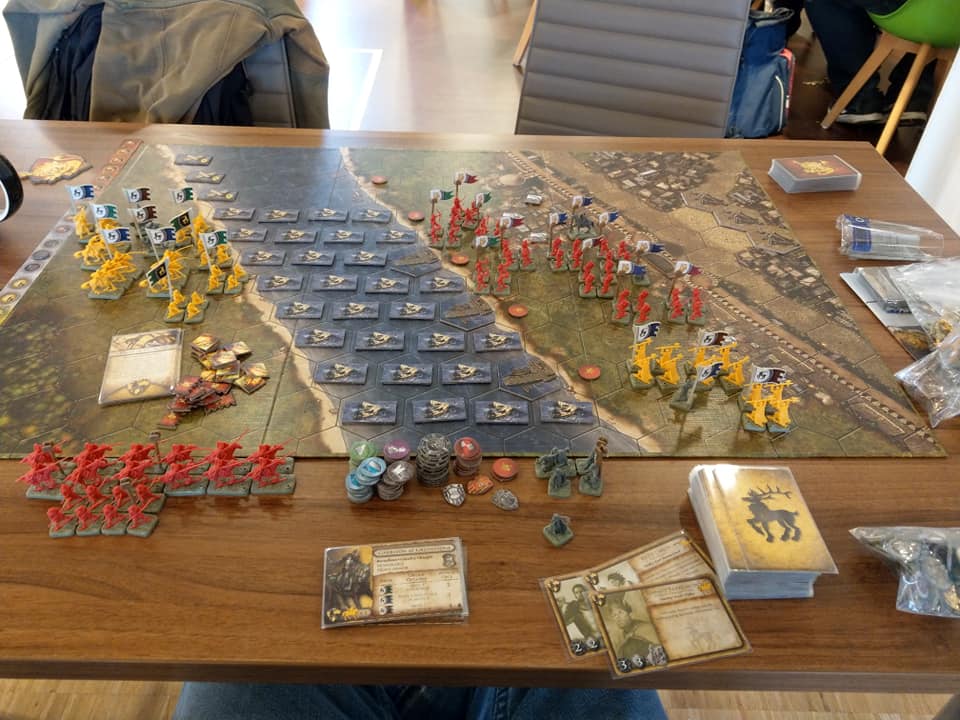

The biggest weakness is, of course, the lack of ongoing support. Despite the success of the TV show, Fantasy Flight have shown little interest in resurrecting the game and the recent release of CMON Games’ A Song of Ice and Fire: The Tabletop Miniatures Game (which has far more beautiful miniatures and considerably less-compelling rules) suggests they may no longer have the miniatures rights to do so. There are some online resources to extend the game and there are enough scenarios in the base game and expansions to ensure you will get a lot of value out of the game.

Battles of Westeros (****½) is a fine addition to any library of ASoIaF-based games, if you can track down a copy at a good price.

Tuesday, 16 July 2019

Taika Waititi to direct THOR 4, AKIRA put on hold

In a surprise move, Taika Waititi has confirmed that his next project will be a follow-up to his 2017 movie Thor: Ragnarok, rather than his live-action take on Akira that Warner Brothers had fast-tracked for a May 2021 release.


Waititi was in the middle of meeting Japanese actors for the key lead roles in Akira (presumably Tetsuo and Kaneda), so the decision to pivot to Thor 4 is surprising. However, according to the Hollywood Reporter's sources there were some concerns over the currently in-development script, and by putting Thor 4 first, Waititi is giving the script more development time. This seems to have been confirmed by the fact that Warner Brothers is still keen on having him direct, so have put the film on hold until Thor 4 is done rather than looking for another director. The power Waititi has over the project is notable in that he apparently convinced the sceptical studio to cast Asian actors, re-set the film back in Neo-Tokyo (several previous iterations of the script relocated the action to a futuristic New York) and mount the film as a multi-part project, all of which seems to remain in play.

Waititi's next projects for release are Jojo Rabbit, a smaller-scale movie starring Scarlett Johansson, which is due for release in October, and several episodes of The Mandalorian, the Star Wars live-action show debuting on Disney+ in November. Waititi may also helm an episode or two of the second season of What We Do in the Shadows, the hit comedy based on his 2014 movie of the same name (he helmed three episodes of the first season), depending on other commitments.

Disney and Marvel likely put significant monetary incentives in front of Waititi to helm Thor 4, especially given that the movie may also function as a stopgap Guardians of the Galaxy film (given the events of Avengers: Endgame) which Disney may find desirable given that James Gunn will not be able to start work on Guardians of the Galaxy Vol. 3 proper until 2021 (for a likely 2022 or 2023 release at the earliest), given his commitments to the new Suicide Squad movie.

A timeline for Thor 4's release date is likely to be announced this weekend at the San Diego Comic-Con, where Marvel will outline their movie projects for the next few years.

Akira fans don't have too much to complain about, however, as the original creator is working on a brand-new anime adaptation of the original manga for television. Unlike the 1988 movie (which is also getting a Blu-Ray and 4K remaster for release next April), this new adaptation will faithfully cover all six graphic novels and over 2,000 pages of the story. The original film, released before the manga was complete, had to heavily compress the story to fit into two hours.

It is also possible that the new anime - which we'll be lucky to see before 2022 or thereabouts - will further interest in the live-action movie, which Warner Brothers has taken into consideration in the decision to bench the film whilst Waititi is busy at Marvel.

Dying Light: The Following

Kyle Crane has helped defeat Rais and bring some measure of relief to the plague-infested city of Harran, but supplies of the drugs needed to control the plague are running low. Following rumours that some people living just outside the city have found a cure, Crane finds that the infection is also spreading into the countryside, and he has to ally with a religious cult and help out the local survivors before he can learn the truth about what's going on.


Dying Light was a splendid game, an open-world, zombie survival game with added parkour. The Following is an expansion to the game, rivalling the original in size, and changes things up by taking Kyle out into the countryside. Wide open fields replace the dense urban jungle, but to get around faster Kyle has the added ability to drive a souped-up buggy around. Harran's backwater includes a chemical plant, a granary, a lighthouse, a coastal town, a dam, mountains and forests among other attractions, which makes for a nice change of scenery from the original game.

Your progress from Dying Light carries over to The Following (and vice versa, as you can return to Harran at any time to address any left over business there), meaning that if you've completed the base game you will already be a relatively skilled and badass zombie-slaying, wall-running hero. The Following is a tougher game than Dying Light, so I would not recommend tackling it without having finished off the base game first.


The setup is pretty standard. Early in the game you befriend a bunch of survivors holed up in a farm, who give you missions. As you complete missions, your standing with the community grows. As it grows, the "Faceless" (acolytes of the mysterious "Mother," a religious figure) get in touch and give you more dangerous tasks, which eventually culminate in you learning more about their alleged cure to the plague. Unlike Dying Light, which had you frequently running into the main villain or his henchmen, the story in The Following is much less dominating to the narrative. Instead, the game encourages you more to go off-script and deal with side-missions, help out random survivors in the wilderness and take part in optional activities like time trials and races (amusingly, Crane is as bemused as the player that people are setting up races in the middle of a zombie apocalypse). A completionist approach makes The Following almost as long as Dying Light itself, so you get plenty of game here for your buck.

Despite being an expansion rather than a sequel, The Following has a different feel to the base game. The wild open spaces means that you'll be relying more on the buggy and less on your parkour skills. Indeed, it's only in the coastal town area and the granary and adjacent industrial plant that you'll be making a lot of use of your old parkour skills from the base game. Combat is also different, as guns are much more commonplace and you should have some meaty high-value melee weapons from the end of the original game as well. This takes away some of the incipient, claustrophobic terror of the original, particularly when your buggy is seriously upgraded and becomes capable of mowing down hordes of Volatiles with flamethrowers, an electrified cage and UV lights, but it does make the game's power fantasy much stronger, especially given that the rate of progression through the game remains modest, and it's still unlikely you'll max out the skill tree in any one playthrough.


The gameplay loop remains compelling, the graphics are effectively gory, combat is more satisfying and the buggy is fun to drive around. But The Following has several weaknesses, some of which it shares with the base game. The game regularly gets context-confused about what you're doing, resulting in you jumping off a wall to your death instead of pulling yourself over the top of the roof. A good 50% of my deaths in the game were from the game getting itself into a tiswas rather than my own errors, which is frustrating. The game also carries on the tiresome modern gaming phenomenon of making your character "respawn" rather than actually reloading an earlier saved game, sometimes resulting in you dying and reappearing halfway across the map for no discernible reason, or being able to cheese a challenging fight by constantly dying and charging back into the fight (as the zombies you killed previously are still dead). The rather odd ability to fast-travel around the map by dying and respawning in a tower closer to where you're trying to get to also remains intact. The buggy is also not entirely well-integrated with the base game. It's too easy to get the buggy stuck in an unrecoverable position which the "reset buggy" command won't fix, forcing you to walk on foot to the nearest garage to summon the vehicle back again. The buggy is also hungry on petrol, making the early game a bit boring as you constantly stop to loot gas from cars until you finally start unlocking the gas station safehouses, at which point you never need to worry about petrol again.

These niggles make The Following (****) occasionally frustrating, but when the game lines up and everything starts working as it should, it becomes a genuine joy to play. The combat is crunchy, the story is unobtrusive until the very end when it suddenly asks the player some very tough questions, the environment is fun to explore and at 20-25 hours in length, it's neither too short nor outstays its welcome. It is available now on Steam for PC and via the relevant online stores for X-Box One and PS4. Dying Light 2 will be released in the spring of 2020.

Friday, 12 July 2019

Amazon LORD OF THE RINGS presentation confirms Rings of Power focus

Amazon are deep in pre-production for their Lord of the Rings: The Second Age TV series, which is due to start shooting in New Zealand in the next two months. Up to this point the exact setting within the Second Age, which lasted for almost three and a half thousand years, has been unclear, but a private presentation by Amazon back in April suggests that it will focus on the forging of the Rings of Power.


The forging of the Rings of Power was always the most likely place for this story to start, as it's the strongest connective tissue between the Second Age and the events of Lord of the Rings (which takes place 4,859 years after the forging of the One Ring). In this story, the Dark Lord Sauron, disguised as the elven prince Annatar, goes among the elven-smiths of Eregion, who live in the shadow of Moria, and corrupts them with promises of riches and power. He tricks them into forging the Seven and Nine Rings of Power to corrupt dwarves and men, but is taken by surprise when the elven master-smith Celebrimbor forges the Three Rings for the elves. Sauron then uses the knowledge he has gained to forge the One Ring itself in the fires of Mount Doom, betraying the elves and leading to a devastating war with Sauron's forces. Established characters like Elrond, Galadriel, Celeborn and possibly Thranduil (the father of Legolas) play roles in this conflict.

The Amazon presentation doesn't feature any footage from the series - because it hasn't shot a single frame yet - but it does feature a shot of the iconic One Ring, glowing with its famous inscription.

With a five-season run planned for the series, it's likely we will see further seasons exploring later periods of the Second Age, including the Downfall of Númenor and the War of the Last Alliance.

Thursday, 11 July 2019

Happy 50th Anniversary to Space Oddity

Today marks the 50th anniversary of the release of "Space Oddity", the breakthrough single for David Bowie.


Inspired by the Apollo space programme and the film 2001: A Space Odyssey (released a year earlier), "Space Oddity" was the first single released from Bowie's second album, David Bowie (rather confusingly, the same name as his first album; the second was later renamed Space Oddity to reduce confusion). David Robert Jones had started making music at school, where he played recorder and saxophone. He formed his first band, the Konrads, in 1962 when he was 15. He went through a succession of other bands - the King Bees, the Manish Boys, the Lower Third, the Buzz and the Riot Squad - before going solo. Adopting the stage name David Bowie after being confused with Davy Jones of the Monkees, he released his self-titled debut album in 1967 but it didn't do very well.

Bowie regrouped after meeting choreographer Lindsay Kemp, who instilled in him a keen appreciation for image and artistry. He also began a relationship with dancer Hermione Farthingale. This burst of inspiration resulted in his second album and the title song, which was recorded in February 1969. Released on 11 July, just five days ahead of Apollo 11's landing on the Moon, the song was an immediate hit and a breakthrough for Bowie, who was largely unknown at the time.

The song didn't make Bowie an overnight superstar, but it did raise his profile and his next two albums - The Man Who Sold the World (1970) and Hunky Dory (1971) - did a lot better before Ziggy Stardust and the Spiders from Mars (1972) blew him through the stratosphere.


In 2016 the song took on a new resonance when Canadian astronaut Chris Hadfield recorded an acoustic version of the song on the International Space Station, making it the first music video to be actually, specifically filmed in space (as opposed to singles using footage from NASA missions, which had happened previously). In 2018 the song was played on the sound system of the Tesla Roadster fired into space as a publicity stunt by Elon Musk's SpaceX company.

Blogging Roundup: 3 June to 10 July 2019


The Wertzone

News
Brand new AKIRA anime in development
THE WALKING DEAD unexpectedly ends
Netflix release first official images from THE WITCHER TV series
Netflix and Warner Brothers developing a SANDMAN TV series
LORD OF THE RINGS TV series to film in Auckland, New Zealand
FINAL FANTASY TV series in development, based on FF14
WHEEL OF TIME Season 1 to shoot for nine months in Croatia, Slovenia and the Czech Republic
Rosamund Pike cast as Moiraine in WHEEL OF TIME TV series
Unknown Pleasures at 40
Tatiana Maslany teases new ORPHAN BLACK announcement for Thursday
PHOENIX POINT gets release date
LOVE, DEATH AND ROBOTS renewed for second season at Netflix
Terry Pratchett's AMAZING MAURICE AND HIS EDUCATED RODENTS optioned for film
DUNE TV series based on authorised fanfiction in development
FINAL FANTASY VII REMAKE (Part I) gets release date
Confirmed: BALDUR'S GATE III is happening
CYBERPUNK 2077 gets release date and bonus Keanu Reeves
AVENGERS: ENDGAME directors working on a MAGIC: THE GATHERING TV series for Netflix


Reviews
Ace Combat 7: Skies Unknown
Angel: Season 5
Stranger Things 3
Northgard
LORD OF THE RINGS: THE SECOND AGE gets director, new writers and confirmed filming location
Spider-Man: Far From Home
Warhammer 40,000: Dawn of War III
The Expanse: Season 3
Schitt's Creek: Seasons 1-5
Year of the Rabbit: Season 1
Spider-Man: Into the Spider-Verse
Angel: Season 4
Love, Death and Robots: Volume 1
Anarch by Dan Abnett
The Warmaster by Dan Abnett
Record of a Spaceborn Few by Becky Chambers
Salvation's Reach by Dan Abnett
A Closed and Common Orbit by Becky Chambers
Wertzone Classics: Chernobyl
Good Omens


Articles
RIP Rip Torn & Freddie Jones
The new LORD OF THE RINGS TV series, explained
The Marvel Cinematic Universe Timeline (updated)
Cities of Fantasy: Tar Valon
RIP Peter Allan Fields
RIP Paul Darrow


Atlas of Ice & Fire
A Map of China Mieville's Bas-Lag


Patreon
SF&F Questions: Which is the longest-running SF or Fantasy TV series?
Cities of Fantasy: Tar Valon


Thank you for reading The Wertzone. To help me provide better content, please consider contributing to my Patreon page and other funding methods, which will also get you exclusive content weeks before it goes live on my blogs. The Cities of Fantasy series is debuting on my Patreon feed and you can read it there one month before being published on the Wertzone.

Wednesday, 10 July 2019

RIP Rip Torn & Freddie Jones

Two very different but distinguished actors have sadly passed away this week.


Rip Torn (1931-2019) is best-known for his recurring role on The Larry Sanders Show (1992-98) and 30 Rock (2007-09) but his career began way back in Hollywood in 1956. His promising career was nearly derailed by conservative opponents in the 1960s when he discussed forming a national theatre company with Robert Kennedy and lost a lead rile in Easy Rider following a war of words (and allegedly knives) with Dennis Hopper, but he got back on track in the 1970s with roles in movies like The Man Who Fell to Earth.

His main genre credentials include the boss of the agency in the Men in Black trilogy and guest shots in TV shows such as The Man from UNCLE. He also occasionally provided vocal roles for video games, such as God of War III (2010). He is survived by six children, including actress daughter Angelica Page.


Freddie Jones (1927-2019) is probably best know to SFF fans for his memorable turn as the mentat Thufir Hawat in David Lynch's 1984 film version of Dune. He began acting in the 1960s, appearing in TV shows such as Z-Cars, The Avengers and The Caesars. After building up a solid filmography in the 1970s, he auditioned for David Lynch's The Elephant Man (1980). Lynch was impressed by Jones enough to cast him in both Dune and Wild at Heart (1990).

In his later career, Jones was cast on soap opera Emmerdale, where he played Sandy Thomas from 2005 to 2018. He left the role last year after deciding to retire from acting at the age of 90. He is survived by three children, including actor Toby Jones.

Tuesday, 9 July 2019

Ace Combat 7: Skies Unknown

The nation of Erusea has launched a surprise attack on its neighbours and its sworn enemy, the Osean Federation, by employing a huge number of unmanned drones. Seizing key locations across the continent of Usea, the Eruseans plan to win the war quickly by using their superior technology. Osean forces are pushed to the fringes of the continent, but quickly mount a counter-offensive, pitting the men and women of their air force against the Erusean AI in a desperate struggle for victory.


Back at the turn of the century, space combat games were all the rage. The X-wing, Freespace and Wing Commander series saw players take to the void to battle enemies in games which were perfectly-balanced mixes of arcade action, battle tactics and squadron management. This style of gameplay was extended to more realistic aerial combat as well, particularly in Crimson Skies. As the genre died on its feet, however, the Japanese company Namco took the concept further with their Ace Combat series on console.

The series hit the big time with its fourth through sixth entries and a spin-off prequel, which all took real jet aircraft and put them in the hands of fictional countries fighting one another on an alternate-reality version of Earth with completely different landmasses, in the so-called "Strangereal" universe. After the release of Ace Combat 6 in 2007, the series went in odd directions which annoyed long-term fans, with a much more arcadey experience based on Quick Time Events in Ace Combat: Assault Horizon (2011) and an online-only game in Ace Combat Infinity (2014). Clearly these didn't work out as Namco have gone back to basics with the release of Ace Combat 7.


Ace Combat 7 casts the player as "Trigger," an ace pilot flying for the Osean Air Force. Early in the war Trigger is flying standard combat missions, but after a case of friendly fire he is sent to an expendable penal squadron, flying the most dangerous missions possible. After clearing his name (although the game is a bit vague on this point) he returns to front-line duty as the war enters its most intense phase. The game's story is somewhat opaque and, it has to be said, overwrought, with lengthy cut scenes featuring inscrutable characters philosophising at length. The story itself isn't particularly complex - two countries fighting, one using AI-powered drone superweapons, the other a plucky band of heroes flying against the odds - but these often non sequitur cut scenes do seem to be trying to make more of the material than there really is. Still, given the typical patriotic, militaristic gung-ho nonsense you might expect from such a game, it's refreshing to find one that instead asks more interesting questions about the morality of warfare and when it is right to fight and when not to. The game also juggles extremely detailed versions of real aircraft like the F-22, F-35, Eurofighter Typhoon and A-10 Tank Buster with advanced drones and even some hard SF ideas, like a space elevator being much of the focus for the action and the plot.

Ace Combat 7's world and story are a bit odd, but the gameplay is superb. Anyone who's even played a LucasArts or Volition space combat game, or Crimson Skies, will be pretty much at home here. After a detailed briefing, you jump in a jet fighter, customise its weapons loadout and take to the skies. As you progress through the game's generous 20-mission campaign you gain additional points which can be used to unlock better technology and weapons, including longer-range missiles, de-icing technology, lasers and whole new planes. Most missions start with you in the air and headed towards a target and they then leave it to you on how you approach the mission.


The flight model is not, in any sense of the world, realistic, but it is instinctive and fun. You can throw your fighter through loops and turns which would kill a pilot in real life, survive one or two direct hits from missiles without suffering a scratch and, in some cases, fire over 150 missiles from a single aircraft (which makes the fact that you only carry 5 flares to be all the more bizarre). You can also fly at much, much lower speeds than you could get away with without stalling in real life, allowing for greater accuracy in ground-attack missions against static targets. It's all much more Freespace 2 than F-22 Air Dominance Fighter, but given that Freespace 2 is one of the greatest games of all time, that's not exactly a problem.

You can control the game with a console joypad or mouse-and-keyboard, and the game is arcade enough for that to be viable. However, the best way to approach the game is to switch on Advanced Flight Mode (also known as "perfectly normal mode" to anyone who has ever played a flight sim before) and use a joystick-with-HOTAS setup, such as the Thrustmaster series. This gives you much finer control over speed, which is the key between the aerial dogfights being joyfully engaging and a tough, circular slog of chase-the-other-plane's-tail. In fact, using this setup may give you an unfair advantage, as many of the game's reportedly extremely tough missions become fairly straightforward. However, you can't remap controls on the joystick and some standard options (like using the hat control to look around) are missing, which is a bit odd.


The game continues through some brutal difficulty spikes early on, although the game can be tough but usually fair: if you lose a mission, there's usually a reason for it and a way of re-attempting the attack which will bring you victory. Oddly, the worst difficulty spikes are early on, particularly around Missions 4-8. After that point the game becomes a lot easier and I sailed through most of the second half of the game without requiring a second attempt at a mission.

Progression is fairly solid and it is impossible to unlock the tech tree in a single playthrough, providing an impetus for tackling multiplayer and tackling the campaign+ mode, which also unlocks tougher difficulty levels for the more ambitious player.


There are a few negatives to the game. There are some basic controls missing from the game, which make it tougher than it needs to be. Targeting is particularly under-developed, with the inability to target the closest enemy or target an enemy who is currently targeting you. The absence of these options - which were standard even in sims twenty years ago - makes selecting targets a bit more laborious than it needs to be, since the "select next target button" is a bit hit and miss (often ignoring targets within firing range to lock onto something on the other side of the map). Given the ludicrous number of missiles you can carry, the game is also extremely stingy on flares, which given how much time you spend jinxing away from missiles can be frustrating. The biggest problem is that your wingmen are pretty much just there for show. They rarely engage with the enemy properly and often when they do hit a target they do no damage: I've seen a single enemy fighter hit six or seven times by AI players, but it won't get shot down until I've hit it twice. The same is true of ground targets. AI players will also not get shot down by chance, only if the story requires that they die on a particular mission. There's also no option for you to bail out, which feels very odd (especially when allied players will sometimes bail out if their aircraft are too damaged).

These niggles are pretty minor, but they take the shine off Ace Combat 7 (****½) a little bit, which is disappointing as this is otherwise a supremely competent, highly enjoyable and rewarding game. More complex than its "arcade sim" moniker suggests, with an original and interesting storyline and great gameplay, I'd say this is required playing for anyone pining for the good old days of space and aerial combat games. It is available now for PC on Steam.

Monday, 8 July 2019

Angel: Season 5

Angel and his team have made a deal with the devil, joining forces with their former enemies at Wolfram & Hart following their mutual battle against the evil Jasmine. Angel believes his team can rehabilitate the law firm and turn them into a force for good, but some (including their old allies from Sunnydale) believe they will be corrupted and swallowed by the beast. The return of an old friend turned enemy turned unreliable ally causes Angel to question his place in the world...and the loss of another friend threatens to destroy the team altogether.


Angel's fifth and final season is an interesting one. The fourth season (and to some extent the second and third as well) had gone into an incredibly dark, intense and serialised direction which the studio had not been entirely comfortable with. For the fifth season they wanted more stand-alone episodes and a lighter tone, which the show initially struggles a little bit with. It's hard to go as dark as Angel did in Season 4 and then reel it back in.

Moving the action to Wolfram & Hart shakes things up nicely, bringing in new and former recurring characters (like Mercedes McNab's Harmony and Christian Kane's Lindsey) and setting up a new paradigm. This allows the show to switch back to a monster/case-of-the-week storyline (albeit with serialised subplots continuing between episodes, such as Fred and Wesley's growing attraction) without it feeling too contrived. The addition of Spike to the cast takes a bit more work, since his sacrifice at the end of Buffy gave the character a powerful send-off and bringing him back to chase ratings on the sister show is a bit cheesy. That said, the addition of Spike - a second vampire with a soul - helps Angel's character, by causing him to question his own place and purpose in the world. James Marsters is good as usual and the writers find things for Spike to do to develop the story and characters without him dominating the show (as arguably he did on occasion in Seasons 4-7 of Buffy).

In the second half of the season the writers seemed to realise the writing was on the wall for the show, so started layering in more serialised storytelling, setting up both an absolutely shocking, heart-wrenching plot twist that comes out of nowhere (and is beautifully sold by all the actors, particularly Alexis Denisof and a never-better Amy Acker) and a final confrontation with the forces of evil, an all-star group of villains which, it turns out, the first half of the season was cleverly setting up and foreshadowing. This gives Angel - both the show and character - its mission statement back, to present a band of people fighting the good fight against the forces of darkness, no matter the cost. If Buffy was about growing up, Angel is about working out what to do with the rest of your life and if you can find something to believe in and fight for. It's a universal theme, but one arguably rarely presented as well and without cliche as in this show.

Angel's fifth season (****½) falters slightly early on but recovers to deliver a second half which sums up the character, the show and the entire Buffyverse in tone, and gives the show and the universe one of the best, messiest and most realistic endings an SFF show has ever had. It is available now as part of the complete series boxed set (UK, USA).

Sunday, 7 July 2019

Stranger Things 3

Hawkins, Indiana, 1985. School's out for the summer and the kids are enjoying themselves...apart from Will, who is annoyed at his friends constantly dropping him to hang out with their girlfriends. There's a new shopping mall in town and things seem to be on the up...until Dustin and Steve uncover evidence that the Russians are in town.


Stranger Things is the jewel in Netflix's crown, the show that made the streaming service must-watch television in 2016 and then exceeded that with its second season a year later. The streamer has had mixed success in replicating its appeal, with the ending of old mainstays Orange is the New Black and House of Cards making it even more dependent on the old favourite to deliver in its third season.

Fortunately, the third season delivers despite facing a number of obstacles. These include the young child actors growing up, something the show chooses to lean into and make the focus of a series of storylines, and the show of course simply not being as fresh as it once was. The 1980s nostalgia and the borrowing of tropes from Spielberg, Carpenter, Dante and Hughes movies was interesting in Season 1 and Season 2 kept things fresh by mixing things in with the increased spectacle of a James Cameron movie, but Season 3 faces the problem that the show is running out of 1980s tropes to exploit. Fortunately, the Duffer Brothers are canny enough to find new angles to tell their story (even if this means drawing inspiration from other decades), this time leaning on films like Red Dawn, The Terminator, The Thing, Mallrats and Dawn of the Dead, and exploiting themes of paranoia and the fragmenting of friend groups as they age.

Structurally, Season 3 splits the main cast up early on and has them taking on their own individual missions. Dustin, Steve, newcomer Robin and Erica (the ultra-sassy sister of Lucas, promoted from a scene-stealing role in Season 2) discover evidence of Russian agents working at the mall and investigating. Hopper and Joyce become embroiled in a battle of wills with a mercenary with a Terminator-like focus. Much of the rest of the gang discover evidence that the Upside Down is still impacting on events in this world, despite Eleven closing the gate in Season 2, and find themselves in a battle against a new monster, this time one that is exceptionally gross. Once again, for a show with so many young protagonists, it's a bit odd that you don't really want to be watching this with sub-teenage kids due to the amount of gore and swearing on display.

Splitting the cast up, Fellowship-style, allows their individual stories to rattle along nicely and the show is confident enough to hold fire on realising the full stakes and scope of the threat until the end of the fourth episode, devoting the first three episodes to set-up work and seeing our heroes having fun instead. This mostly works quite well, although Stranger Things is starting to feel like fanservice central. So we have Dustin and Steve's slightly incongruous friendship, simply because fans loved their bromance in Season 2, and we have the morally ambiguous Billy walking around without his shirt on. A lot. The show dodges a bullet this time around because those stories end up being good enough to maintain the viewer's interest (Billy even becomes somewhat sympathetic by the end of the season, a major feat given how under-developed he was in Season 2) and them leading to some genuinely good moments, such as the friendship between Steve and co-worker Robin which goes in a somewhat unexpected direction. The show even finds ways of subverting audience expectations, like not over-relying on Eleven's powers to get the kids out of every jam they find themselves in.

For a show with dimension-hopping kids fighting horrendous biological horrors, criticising the show for being unrealistic may be churlish. But, that said, there are some moments that do stretch credulity way past the breaking point, like a hostile foreign power somehow building a massive base of operations in the middle of rural America and running huge, energy-draining experiments without anyone noticing. There are also some storylines that are definitely under-developed, like dozens of people going missing and no-one really seeming to care, the kids vanishing from their homes for days on end and their parents shrugging it off with, "it's summer, what can you do?" (bearing in mind it's only two years since Will's disappearance traumatised the town). Cary Elwes gets some nice material as the town's corrupt mayor, but his story abruptly halts halfway through the season and is paid only lip service in the finale, whilst a subplot (begun in Season 2) with Karen Wheeler being tempted into an affair with a younger man also ends up fizzling out with no real resolution. Of course, with at least one more season to come, some of these elements may be explored further.

The third season of Stranger Things (****½) remains highly compelling viewing, with spectacular visual effects and production values, outstanding performances by the excellent cast and the writers finding surprising ways to take what might have been otherwise a stale story. However, the show also suffers from some issues with repetition, credibility and some undercooked subplots. With the Duffer Brothers still split on whether to end the show with its fourth or fifth season, I'm thinking that wrapping it up sooner, whilst it's still fresh (and before the kids enter college) might be a better idea. The show is streaming worldwide on Netflix now.