Showing posts with label battles of westeros. Show all posts

Wednesday, 17 July 2019

Battles of Westeros

Way back in 2003, Fantasy Flight Games released the A Game of Thrones board game, which essentially fused elements of the classic board game Diplomacy into the A Song of Ice and Fire setting. A huge success, the game has remained continuously in print up until today, getting a second edition and multiple expansions, the latest of which was released only last year, along the way. 


Back in 2010 Fantasy Flight released their second ASoIaF-based board game, Battles of Westeros, a miniatures wargame which, as the box proclaims, spins off of the popular BattleLore rules system. The game received several expansions, but the line was abruptly cancelled in 2012. Despite that, the base game remains available at reasonable prices thanks to eBay, although the expansions are a lot more hit and miss.

Having recently gotten a copy of the game and several expansions (Lords of the RiverTribes of the Vale and the big House Baratheon expansion), I was surprised to see that the game had done poorly, as it is excellent. 


On a basic level, Battles of Westeros is a spin-off of the popular Command & Colors line of wargame/board game hybrids created by designer Richard Borg in 2000. This system has spawned a whole range of different iterations, the best-known and biggest-selling of which is the WWII version, Memoir ’44. The most recent is the excellent space opera version, Red Alert: Space Fleet Warfare, with other versions ranging from Command & Colors: Napoleonics to Tricorne (based on the American Revolutionary War) to The Great War, based on WWI. Most relevant here is BattleLore, a fantasy version featuring knights, griffins, trolls and elves. Battles of Westeros proudly proclaims itself “a BattleLore game,” which is being somewhat elastic with the truth as the game pretty much rewrites the rules of both BattleLore and Command & Colors so much that only the basic elements remain in common.

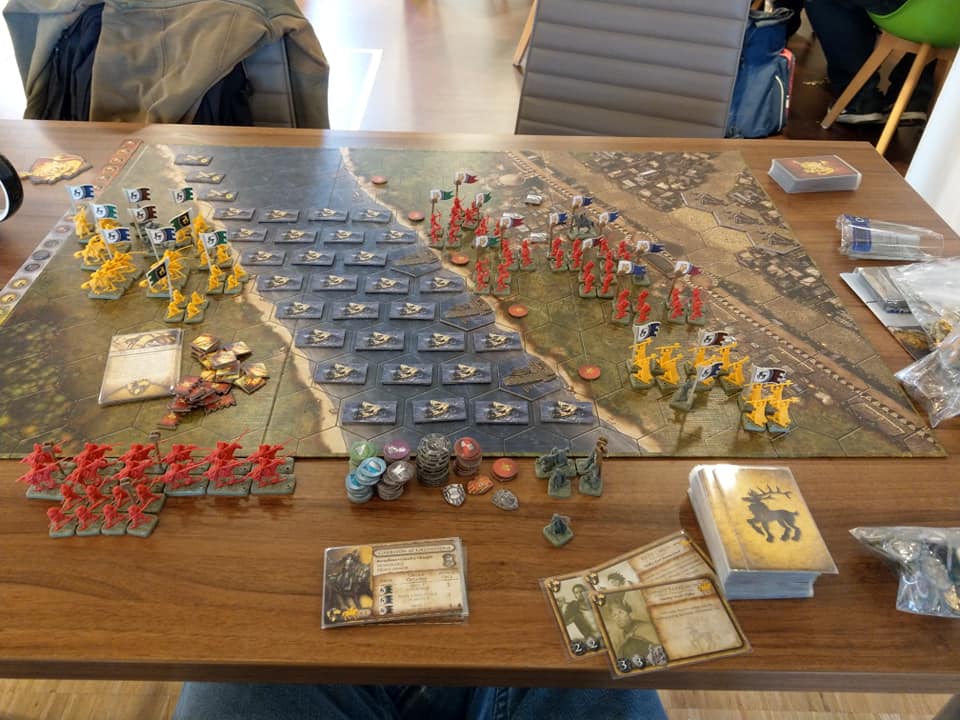
For gameplay purposes, you play scenarios which pit two armies against one another. The base game allows you to play Stark vs. Lannister, but the expansions add the Baratheon and Tully forces, as well as the irregular forces of the Brotherhood Without Banners and the tribes of the Vale of Arryn. The scenario details tell you how to set up the map, which is a plain green field covered in hexes. You place hexagonal tokens on the map to depict scenery, such as hills, villages, mountains, rivers and forests (the House Baratheon expansion also features a second map, depicting the Blackwater Rush and the walls of King’s Landing), and set up your armies as directed. Each army consists of archers, infantry, cavalry and – most critically – “leaders.” These leaders are special units depicting the commanders of the armies in question, such as Robb Stark, Jaime Lannister, Brienne of Tarth, Shagga, Stannis Baratheon, Brynden the Blackfish and so on. These units are usually quite powerful in combat, but they also play an important role in giving orders to your troops (and getting them captured or killed can be a devastating blow).


The game’s biggest deviation away from the Command & Colors system is that the board is not divided into sectors. Those games have a central sector and two flanks, and you draw cards telling you how many units in each sector you can use on that turn. Battles of Westeros replaces this with you playing cards as orders given by your leaders to troops within yelling distance. So, you play a card on a leader and he or she can direct units within 2 hexes of their figure. This is immediately more logical and also causes each player to carefully consider each turn how to manoeuvre their armies (and keep their leaders within order-giving range of their key troops without endangering them). Each turn you also get a number of general-purpose order tokens you can use to order any unit on the map, regardless of if they are in range of a leader or not, which is handy if you have a bunch of archers on a hill off to one side of the battlefield you want to take potshots at enemy forces without getting a general to ride over and keep telling them to do so.

Each leader also has special abilities, some they can use continuously and extremely powerful once-per-game abilities (such as allowing your troops to attack twice in one turn) that can prove decisive if used wisely.


There are additional rules for flanking enemy troops and veterancy: not all your troops are equal, with their experience denoted by the colour of their flag (green for fresh recruits, blue for experienced soldiers and red for veterans). That also determines how many dice they roll in attack and how far they move, with more experienced troops generally being slower but able to hit much harder. There is also a morale tracker, which swings back and forth determining on how the battle is going: lose too many units to the enemy without inflicting comparable damage and your army can rout altogether.

Despite this level of detail, Battles of Westeros is not a particularly complex game, especially if you have some previous experience of the Command & Colors system. Most turns have you playing a card on a leader, moving the figures of the troops they are commanding and rolling dice to determine if they are successful, and that’s pretty much it, unless you want to use a special ability. You then draw some new cards, roll some dice to determine how many other units you can move and away you go. Each scenario has specific victory conditions or complications to add variety to the game, and each leader has their own set of cards which you can add to your command deck, which adds quite a bit of longevity and replay value to the game, which is increased even further by the expansions.


The game’s presentation is solid (Fantasy Flight has built up a beautiful library of ASoIaF-related artwork over the last fifteen years), the rules are reasonably comprehensible and well-laid out, and the production value of the components is excellent. Most copies of the game you’ll find now are getting on for a decade, and every one I’ve seen has been in good nick. The cards are also good quality and the miniatures are impressive, although a little on the small side.

The rules are great, and if you’ve played a lot of Command & Colors the changes will likely be welcome. In particular, tying the order cards to the leader figures rather than random sectors simply makes a hell of a lot more sense, and it’d be cool to see this idea moved over to some of the other games in the same line. Complete newcomers may find a slightly steeper hill to climb, but in overall terms and compared to many contemporary board games (especially those on the wargame side of things), the game is not particularly hard to learn.


The negatives are relatively minor, but there are a few niggles. The figures don’t fit into their bases very well, so it’s recommended you glue them in, which can be fiddly and time-consuming. The only reason they’re not pre-fitted to the bases is to make painting them easier, but the figures are small enough that I don’t really see the value of painting them. As a Fantasy Flight game there are also an absolute ton of fiddly tokens, symbols and paraphernalia, a lot of which are really unnecessary to the game. Another negative with the rules is that the game is extremely limited in counterattacking options, to the point where it very rarely happens. It feels like the idea of using order tokens to allow counterattacking (recently employed in Red Alert) should be implemented here.

Another issue is the length of gameplay. Command & Colors is best-known for being relatively fast to play, especially versus traditional wargames, with it being possible to blast through say a few Memoir ’44 scenarios in 30-45 minutes apiece. Battles of Westeros has no truck with this, and you’ll be lucky to get a scenario done in much under two hours. However, the much greater detail of the combat means you’ll be making much more interesting decisions than in a standard C&C games, so the greater length can be seen as a reflection of the greater depth of gameplay. If you want a fast-playing wargame, break out Memoir ’44, if you want something a bit more detailed if slower then unleash BattleLore or Red Alert, but if you want something longer, meatier and more engrossing, Battles of Westeros works fine for that.

The biggest weakness is, of course, the lack of ongoing support. Despite the success of the TV show, Fantasy Flight have shown little interest in resurrecting the game and the recent release of CMON Games’ A Song of Ice and Fire: The Tabletop Miniatures Game (which has far more beautiful miniatures and considerably less-compelling rules) suggests they may no longer have the miniatures rights to do so. There are some online resources to extend the game and there are enough scenarios in the base game and expansions to ensure you will get a lot of value out of the game.

Battles of Westeros (****½) is a fine addition to any library of ASoIaF-based games, if you can track down a copy at a good price.

Sunday, 13 January 2019

Board Game Catch-Up #2

Following on from the previous board game catchup, here’s a few more games I’ve managed to try out in the last few months. 


X-Wing Miniatures
Fantasy Flight Games

This is a pretty straightforward game: one player has X-wings, the other has TIE fighters (approximately three million expansions are available to change this up, of course) and they fly around a board trying to shoot each other. Sometimes they succeed, sometimes they fail and sometimes they crash into an asteroid or one another in a somewhat anti-climactic fashion.

There is a phenomenon in board gaming called “spectacle gaming”, where the quality of the gameplay itself is rendered irrelevant by how beautiful the miniatures are and how cool they look sitting on the table. X-Wing Miniatures certainly fits into this bracket: the pre-painted spaceships are gorgeous and it’s fun moving them around the board. It’s less fun when your game has been going on for ten minutes and no-one’s managed to hit one another yet because of the dice rolls, or the game ends because someone’s flown their X-wing into an asteroid and can’t avoid it because space in the Star Wars universe isn’t three-dimensional, apparently.

I was a bit disappointed by this one, but the good thing about it is that it’s been enormously popular, meaning the model runs are large enough to make the models very well-priced, so if you want Star Wars ships on your shelves for decorative purposes instead (or perhaps to illustrate a roleplaying campaign), this is one of the best ways of doing that. I would be intrigued to give Armada (which is this game scaled up with capital ships) a go, as I suspect the rules work far better with slower ships, firing arcs and other fun elements from big ship combat. 


Zombiecide: Black Plague
CMON Games/Guillotine Games

Most zombie games employ clever mechanics to make for games of gut-wrenching terror and tension. Zombiecide: Black Plague has no truck with this and allows your team of heroes to run around annihilating zombies like there is no tomorrow. This is basically Hero Quest with zombies and that’s enormous amounts of fun up to a point, when the game starts feeling a little repetitive and a bit too easy. A fun and good-looking game, but not one I’d rush out to buy.


Horsemen of the Apocalypse
Ragnarok Publications

An amusing card game designed by fantasy author Mark Lawrence, with guest flavour text from authors including Robin Hobb and Wesley Chu. Basically the four horsemen of the apocalypse are rolling into town and the players have to organise things so that they are left standing rather than the other players. There’s some great tension and ideas here, but the game feels a little fiddly in the rules and the quality of the cards could be a lot better, especially given the price. Diverting but not essential.


Exploding Kittens
Ad Magic/ADC Blackfire

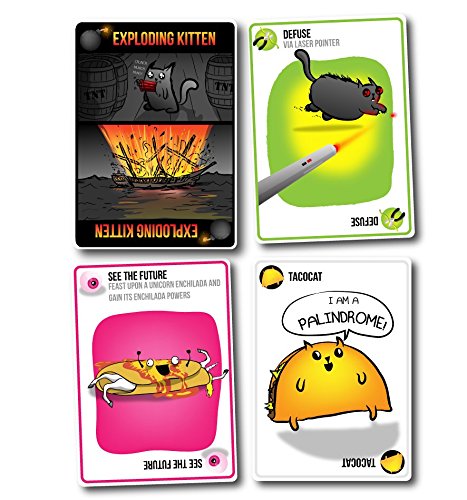
One of the biggest Kickstarter successes of recent years, this is fast-paced comical card game where there are kittens primed to explode and players have to avoid getting blown up by them using a battery of comical cards designed for this purpose. The game is funny (in a dark kind of way), with great artwork from the Oatmeal team and allows for some interesting strategy, although it’s still a relatively lightweight game. Good for kids, parties and after-meal entertainment.


BattleLore 
Fantasy Flight Games 

A fantasy take on Richard Borg’s Command & Colours system (also used in Memoir ’44, which we discussed last time and Battles of Westeros, see below), which adds magic, gryphons and undead to the classic C&C gameplay. This is a handsome-looking game with great production quality and some added tactical depth to the C&C rules which makes for a more interesting game, but also a somewhat-longer playing one. This is a very fine game but it does sacrifice one of the main appeals of Memoir ’44, the fast setup and playing time, in favour of somewhat more depth, which arguably it doesn’t quite achieve. As usual, there are also a lot of fairly expensive expansions which you really need to keep the variety and interest up. The game has recently gone out of print, effectively replaced by the somewhat more generic Runewars Miniatures Game, which is a shame.


Fallout: Wasteland Warfare
Modiphius Entertainment

Wasteland Warfare is the second tabletop game based on the Fallout video game, following on from Fantasy Flight’s decidedly underwhelming board game from 2017. Wasteland Warfare is unapologetically a tabletop miniatures wargame whose primary goal is to sell an absolute ton of add-on models, but it cleverly includes enough stuff in the base box to actually work very well as a standalone board game (especially if you access the fan community to download more scenarios and missions). There’s a lot of fun to be had here, especially the mission objectives which are quite varied, but beware getting sucked into the money pit of spending lots of cash on awesome models.

The rules are quite decent (and a major round of applause for including range tokens in the box instead of asking people to bust out rulers and measuring tape), although I think ultimately the game might be more useful as the miniatures component of a roleplaying campaign, with Modiphius rumoured to be working on an RPG behind the scenes. 


Axis & Allies: Zombies
Avalon Hill/Hasbro 

Axis & Allies: Zombies is a variant of the classic WW2 board game which adds zombies to the mix. This initially appears to be gimmicky as hell, but the game remarkably uses the idea to really mix the game up, causing massive land battles to take place where normally there is no combat at all in a regular game (such as the North and South American mainland, or in Africa). The result is a game that overcomes Axis & Allies’ perennial problem – the predictable opening moves of a standard game – and adds fresh life to an old favourite. The game is also excellent value for money, as you can play it as Axis & Allies 1941 (the base “introductory” version of the game) or Axis & Allies & Zombies, and it also includes a deck of cards for use with Axis & Allies 1942 (the current “standard” version of the game) to add zombies to that version as well. An unexpectedly strong game.


Pandemic: Reign of Cthulhu Z-Man Games

Do you like Pandemic? Do like Lovecraft’s books? Why not mix the two together? This also sounds a bit gimmicky, but the revamping of the Pandemic rules to account of hordes of cultists and shoggoth running around works really well, with you now having to move around several classic Lovecraft locations shutting down portals instead of curing the virus, with the “outbreak” cards instead replaced by a different Old One arising, their influence impacting on the game in different ways.

Rather than being a silly mash-up game, it’s one that cleverly rewrites the rules to accommodate the theme and is a different enough game to warrant some table time alongside standard Pandemic. Nicely recommended.


878: Vikings 
Academy Games

t’s 878 AD and the kingdoms of England are being overrun by invading Danes. It falls to King Alfred of Wessex to unite the people and rally large armies to throw back the Danes into the sea. The result is an excellent team game of strategy. Team games are surprisingly rare in modern board games, which tend to be either co-op (everyone versus the game mechanics) or competitive (everyone vs everyone), with teams often being alliances of convenience with backstabbing not uncommon (see A Game of Thrones: The Board Game or Twilight Imperium). 878 has two permanent alliances with the two players on each side cooperating (to the point of moving each other’s units around) and using their unique faction abilities to bolster themselves on the field of battle.

The result is a fast-moving strategy game with lots of interesting twists and is relatively straightforward and easy to understand.


The Expanse
WizKids

Based on the TV show and James S.A. Corey’s novel series, the Expanse board game reflects the space opera influences of its inspiration by…being a worker placement Eurogame?

The Expanse is one of the odder games based on a licenced property to emerge recently. Each player controls one of the four major factions from the TV show and books (Earth, Mars, the OPA and Protogen) and seeks to build up influence over individual planets, bases and their orbital spaces. Space battles aren’t a key part of the game, although it is possible to build new warships and blow up opponent ships, with instead the focus being on point-scoring. In this manner the game is reminiscent of CatanTicket to Ride or Lords of Waterdeep. However, the game’s rather poorly-explained rules make it harder to recommend than those games, which are all faster to setup and play and work the theme into the gameplay much more successfully. The Expanse's rather poor production values - a bland board and murky photography from the show - also feel a bit of a letdown given the game's not-inconsiderable cost.

Still, once the rules were better-understood the game becomes a lot more enjoyable to play, and there are some nice twists on the standard worker placement paradigm, such as scoring only when one of the scoring cards pops up. This makes timing incredibly important in the game, and knowing when to make certain events to happen for maximum impact. It’s still a somewhat fiddly game, it urgently needs a new and better-written rulebook and the theme feels almost incidental (the Rocinante crew “wild card” is rather underwhelming), but there’s enough going on here to make it worthwhile. 


Ticket to Ride: New York
Days of Wonder

Ticket to Ride is one of the very best light or intro boardgames around, a strong title with a fun competitive streak. There are numerous expansions and revisions of the core game, mostly bringing the game to different countries or continents and ramping up the complexity, but New York does the opposite: it streamlines the game right down and the scale with it, being set on a small board depicting New York City.

Ticket to Ride is a pretty light game anyway, so a streamlined version seems redundant. But New York still works, being a fun and small game which works perfectly as a travel game, something you can bust out on a train journey. You can get a game done in under 20 minutes and it's very enjoyable. For home gaming, it's rather unnecessary (and leaves you wanting to play the original Ticket to Ride) but as a travel game it's fun and also impressively cheap.


Battles of Westeros 
Fantasy Flight Games

Yet another game employing Richard Borg’s Command & Colours system, this time in the world of George R.R. Martin’s A Song of Ice and Fire. The box proclaims this to be “a BattleLore game,” which is quite thoroughly misleading, as the game has a very different ruleset and is not compatible with BattleLore at all.

This game is worthy of a deeper dive at some point, but briefly this game changes the traditional C&C rules by dumping the three sector approach (where the board is divided between a centre and two flanks) and instead making everything about the leaders. Each faction has at least 2 leader characters who are present on the battlefield and who exert control over a “zone of command” around them. Rather than ordering units in each sector, you instead order units within the zone of command. The game also randomly generates (via dice) command tokens which you can use to order remote units on the battlefield outside any commander’s zone of command.

This approach is then given further depth by each commander having special tactics cards which are mixed into the standard command deck, which adds tremendous variety to the game and to each battle.

This surprisingly elegant system immediately addresses the primary criticisms of the earlier C&C games (that they are too reliant on the right cards coming up) by giving each player much more control over the cards they can use and where they can use them on the battlefield. It also creates more interesting choices as your leaders are also combat units in their own right, but if they are defeated on the field, they can no longer issue orders, so you have to decide between throwing them into the fray or holding them back. The result is much greater and more interesting tactical decisions.

On the downside the game is rather fiddly: you have to manually glue the figures into their bases, there’s a lot of unnecessary tokens and the core mechanic of twisting the units’ flags around after they’ve moved will very quickly result in broken flag poles and flags. I just used fire tokens instead to show when each unit had been activated, which was far easier and quicker.

This game has gone out of print, unfortunately, effectively replaced by CMON Games’ A Song of Ice and Fire Miniatures Game, which has much more impressive miniatures but decidedly less engaging rules. Snap up Battles of Westeros (and its expansions) whilst you can.

Thank you for reading The Wertzone. To help me provide better content, please consider contributing to my Patreon page and other funding methods, which will also get you exclusive content weeks before it goes live on my blogs. SF&F Questions and The Cities of Fantasy series are debuting on my Patreon feed and you can read them there one month before being published on the Wertzone.