Angel and his team have made a deal with the devil, joining forces with their former enemies at Wolfram & Hart following their mutual battle against the evil Jasmine. Angel believes his team can rehabilitate the law firm and turn them into a force for good, but some (including their old allies from Sunnydale) believe they will be corrupted and swallowed by the beast. The return of an old friend turned enemy turned unreliable ally causes Angel to question his place in the world...and the loss of another friend threatens to destroy the team altogether.
Angel's fifth and final season is an interesting one. The fourth season (and to some extent the second and third as well) had gone into an incredibly dark, intense and serialised direction which the studio had not been entirely comfortable with. For the fifth season they wanted more stand-alone episodes and a lighter tone, which the show initially struggles a little bit with. It's hard to go as dark as Angel did in Season 4 and then reel it back in.
Moving the action to Wolfram & Hart shakes things up nicely, bringing in new and former recurring characters (like Mercedes McNab's Harmony and Christian Kane's Lindsey) and setting up a new paradigm. This allows the show to switch back to a monster/case-of-the-week storyline (albeit with serialised subplots continuing between episodes, such as Fred and Wesley's growing attraction) without it feeling too contrived. The addition of Spike to the cast takes a bit more work, since his sacrifice at the end of Buffy gave the character a powerful send-off and bringing him back to chase ratings on the sister show is a bit cheesy. That said, the addition of Spike - a second vampire with a soul - helps Angel's character, by causing him to question his own place and purpose in the world. James Marsters is good as usual and the writers find things for Spike to do to develop the story and characters without him dominating the show (as arguably he did on occasion in Seasons 4-7 of Buffy).
In the second half of the season the writers seemed to realise the writing was on the wall for the show, so started layering in more serialised storytelling, setting up both an absolutely shocking, heart-wrenching plot twist that comes out of nowhere (and is beautifully sold by all the actors, particularly Alexis Denisof and a never-better Amy Acker) and a final confrontation with the forces of evil, an all-star group of villains which, it turns out, the first half of the season was cleverly setting up and foreshadowing. This gives Angel - both the show and character - its mission statement back, to present a band of people fighting the good fight against the forces of darkness, no matter the cost. If Buffy was about growing up, Angel is about working out what to do with the rest of your life and if you can find something to believe in and fight for. It's a universal theme, but one arguably rarely presented as well and without cliche as in this show.
Angel's fifth season (****½) falters slightly early on but recovers to deliver a second half which sums up the character, the show and the entire Buffyverse in tone, and gives the show and the universe one of the best, messiest and most realistic endings an SFF show has ever had. It is available now as part of the complete series boxed set (UK, USA).
Showing posts with label angel tv. Show all posts
Monday, 8 July 2019
Monday, 24 June 2019
Angel: Season 4
Angel is trapped in a coffin at the bottom of the ocean. Wesley, feeling betrayed by his friends, has turned into a hard-bitten, demon-killing mercenary. Cordelia is missing and Lorne has relocated to to Vegas. Connor, Fred and Gunn are carrying on the good fight, but outnumbered and outgunned there are limits to what they can do. As the gang set out to gather their friends, a much greater threat is gathering force and is about to unleash an evil upon the world that nobody, not even the demonic law firm Wolfram & Hart, are prepared to deal with.
The fourth season of Angel is the most polarising. It's the show's darkest season, at times seemingly delighting in finding ways of sending characters already in dire straits to an even lower and more depressing state. However, it's also the most serialised season and the writers spend a lot of time delighting in one-upping one another with ever more elaborate and challenging cliffhangers and dramatic plot twists, most of which (just about) hang together.
It helps that the previous seasons established both this tight-knit group of characters and their enemies in Wolfram & Hart so well, so when the show rolls hand grenades into both camps in the form of "the Beast" (a seemingly unstoppable killing machine) there's a lot of good drama to be mined. Previously-established secondary characters are killed off at a rate of knots, and the show has to draft in some heavy guns from previous seasons (not to mention Buffy) to help tackle the threat, which makes the story feel genuinely high-stakes.
This year also benefits from better pacing than the third season, with a more heavily serialised arc split into chapters separated by stand-alones (which nevertheless further either characterisation or subplots related to the main arc). There's also a lot to do, from rescuing Angel to getting Wesley back on-team (or at least on speaking terms again) to identifying the Beast and formulating a plan to deal with it. More than most Buffy and Angel seasons, it earns its 22-episode running time.
Although the pacing is excellent and the general storyline very good - arguably the strongest season arc Angel ever tackled - some characters suffer, a lot. Behind-the-scenes shenanigans led to Cordelia's character being effectively thrown under a bus for most of the season and then shuffled off to Ambiguous Coma Land. Given Charisma Carpenter's excellent performance in the third season as she changed Cordelia into being the show's strong, moral centre, that's a bitter disappointment. Even worse is what happens to Angel's son, Connor. Connor is a moody teenager, which automatically makes him hard to like, but whilst the similarly-initially-unpopular character of Dawn on Buffy was allowed to change and grow and eventually earn her place on the team, Connor stays a mopey teenager all season. He also ends up being everyone's patsy, played like a fool by multiple enemies. His late-season redemption isn't enough to save the character and the producers have to shuffle him off the show in the most embarrassing way possible once they realise they can't redeem the character.
The fourth season of Angel (****) is divisive, being both a compelling rollercoaster of interesting storylines, and a sustained character assassination which renders at least two major characters unlikable for no real particular reason. It is available now as part of the complete series boxed set (UK, USA).
The fourth season of Angel is the most polarising. It's the show's darkest season, at times seemingly delighting in finding ways of sending characters already in dire straits to an even lower and more depressing state. However, it's also the most serialised season and the writers spend a lot of time delighting in one-upping one another with ever more elaborate and challenging cliffhangers and dramatic plot twists, most of which (just about) hang together.
It helps that the previous seasons established both this tight-knit group of characters and their enemies in Wolfram & Hart so well, so when the show rolls hand grenades into both camps in the form of "the Beast" (a seemingly unstoppable killing machine) there's a lot of good drama to be mined. Previously-established secondary characters are killed off at a rate of knots, and the show has to draft in some heavy guns from previous seasons (not to mention Buffy) to help tackle the threat, which makes the story feel genuinely high-stakes.
This year also benefits from better pacing than the third season, with a more heavily serialised arc split into chapters separated by stand-alones (which nevertheless further either characterisation or subplots related to the main arc). There's also a lot to do, from rescuing Angel to getting Wesley back on-team (or at least on speaking terms again) to identifying the Beast and formulating a plan to deal with it. More than most Buffy and Angel seasons, it earns its 22-episode running time.
Although the pacing is excellent and the general storyline very good - arguably the strongest season arc Angel ever tackled - some characters suffer, a lot. Behind-the-scenes shenanigans led to Cordelia's character being effectively thrown under a bus for most of the season and then shuffled off to Ambiguous Coma Land. Given Charisma Carpenter's excellent performance in the third season as she changed Cordelia into being the show's strong, moral centre, that's a bitter disappointment. Even worse is what happens to Angel's son, Connor. Connor is a moody teenager, which automatically makes him hard to like, but whilst the similarly-initially-unpopular character of Dawn on Buffy was allowed to change and grow and eventually earn her place on the team, Connor stays a mopey teenager all season. He also ends up being everyone's patsy, played like a fool by multiple enemies. His late-season redemption isn't enough to save the character and the producers have to shuffle him off the show in the most embarrassing way possible once they realise they can't redeem the character.
The fourth season of Angel (****) is divisive, being both a compelling rollercoaster of interesting storylines, and a sustained character assassination which renders at least two major characters unlikable for no real particular reason. It is available now as part of the complete series boxed set (UK, USA).
Wednesday, 8 May 2019
Angel: Season 3
The team at Angel Investigations are on top form, solving new mysteries and enhanced by the addition of Winifred Burkle - an astrophysicist with a gift for science and research - to the team. As Fred settles in (having spent five years imprisoned in another dimension), the team have to face the consequences of past actions, as Wolfram & Hart continue to undermine their operation and Darla returns...with a surprise for Angel.
The second season of Angel was a success, with a great main story arc and lots of excellent character development, especially for Angel, a character you'd assume by now had been fully explored. The third season is more or less a direct sequel to the second, but the writers pull back on some elements they feel had already been explored in sufficient depth, such as making Angel a darker character or having Wolfram & Hart constantly being behind whatever evil is going on in any given episode.
They also - thankfully - don't explore the camp fantasy world of Pylea again. Although a nice change of pace, Pylea outstayed its welcome at the end of Season 2 and we can do without going there again. Instead, the consequences of the Pylea trip play out several times over the course of the season, particularly for Fred (a winning performance by Amy Acker) and Cordelia (an ever-improving Charisma Carpenter).
If Season 3 has a major problem, it's in its structure and pacing. The writers clearly decided that some storylines in previous seasons had been allowed to dominate too many episodes, so this season each story arc unfolds much more intensely, usually over 3-4 episodes max, separated by stand-alone episodes. This means that stories have much greater verve and pacing, but it also means that the growing narrative momentum of the season keeps being reset with stand-alone episodes, which vary in quality immensely. The story arcs, revolving around the return of Darla, the campaign against Angel by his old enemy Daniel Holtz (a fine performance by Keith Szarabajaka) and the birth of a child with a surprising destiny, are all pretty solid, but the gaps between the stories feel contrived at best.
The season also makes a series of curious decisions regarding characterisation which are still highly controversial. Wesley has been getting more ruthless and capable since the first season, but the way he goes full-on dark and borderline amoral at the end of the season feels a bit undercooked. It makes him a far more interesting character in the final two seasons, sure, but the way he gets there feels implausible. There's also the implication that Wesley, a thirty-something guy who's been around the block a few times, makes the decisions he does because he gets turned down by a woman he likes, which feels like a very juvenile motivation point.
There's also the treatment of Cordelia as a character. Through most of Season 3 she undergoes tremendous growth and improvement as a member of the team and ends up being arguably the most well-adjusted and empathetic member of the crew, which given where she started so long ago (in Buffy Season 1) is remarkable. The end of the season throws this development into some doubt. This is less of a problem in Season 3 itself, but paves the way for Season 4, where Cordelia's character is thrown under the bus in a manner that is still highly contentious.
Still, Angel's third season (****) is highly watchable with some impressive storylines, cliffhangers and dramatic moments. Character development is a mixed bag, and some of the stand-alone episodes are painful, but overall it remains a solid addition to the series, and paves the way for the more impressive (if more controversial) fourth year. It is available now as part of the complete series boxed set (UK, USA).
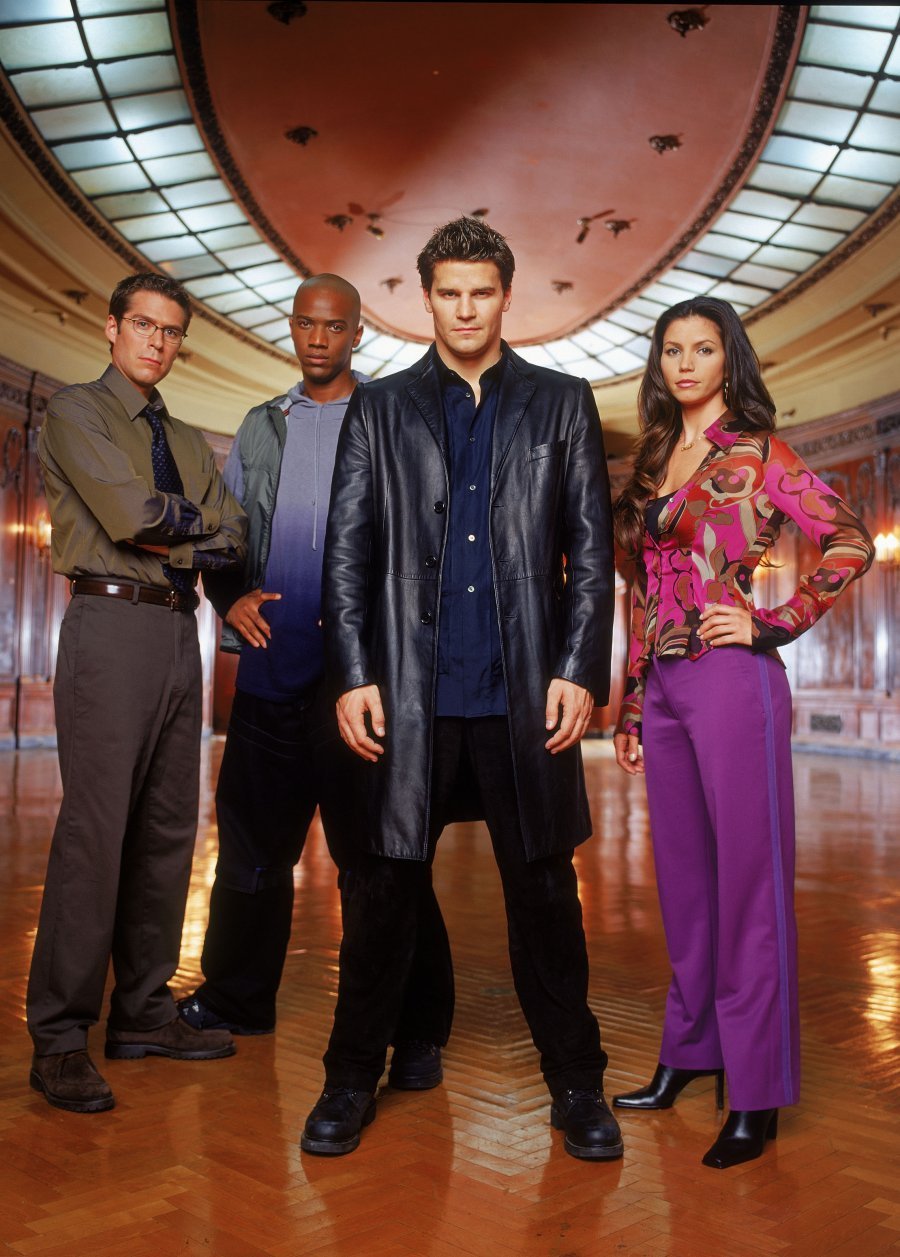
The second season of Angel was a success, with a great main story arc and lots of excellent character development, especially for Angel, a character you'd assume by now had been fully explored. The third season is more or less a direct sequel to the second, but the writers pull back on some elements they feel had already been explored in sufficient depth, such as making Angel a darker character or having Wolfram & Hart constantly being behind whatever evil is going on in any given episode.
They also - thankfully - don't explore the camp fantasy world of Pylea again. Although a nice change of pace, Pylea outstayed its welcome at the end of Season 2 and we can do without going there again. Instead, the consequences of the Pylea trip play out several times over the course of the season, particularly for Fred (a winning performance by Amy Acker) and Cordelia (an ever-improving Charisma Carpenter).
If Season 3 has a major problem, it's in its structure and pacing. The writers clearly decided that some storylines in previous seasons had been allowed to dominate too many episodes, so this season each story arc unfolds much more intensely, usually over 3-4 episodes max, separated by stand-alone episodes. This means that stories have much greater verve and pacing, but it also means that the growing narrative momentum of the season keeps being reset with stand-alone episodes, which vary in quality immensely. The story arcs, revolving around the return of Darla, the campaign against Angel by his old enemy Daniel Holtz (a fine performance by Keith Szarabajaka) and the birth of a child with a surprising destiny, are all pretty solid, but the gaps between the stories feel contrived at best.
The season also makes a series of curious decisions regarding characterisation which are still highly controversial. Wesley has been getting more ruthless and capable since the first season, but the way he goes full-on dark and borderline amoral at the end of the season feels a bit undercooked. It makes him a far more interesting character in the final two seasons, sure, but the way he gets there feels implausible. There's also the implication that Wesley, a thirty-something guy who's been around the block a few times, makes the decisions he does because he gets turned down by a woman he likes, which feels like a very juvenile motivation point.
There's also the treatment of Cordelia as a character. Through most of Season 3 she undergoes tremendous growth and improvement as a member of the team and ends up being arguably the most well-adjusted and empathetic member of the crew, which given where she started so long ago (in Buffy Season 1) is remarkable. The end of the season throws this development into some doubt. This is less of a problem in Season 3 itself, but paves the way for Season 4, where Cordelia's character is thrown under the bus in a manner that is still highly contentious.
Still, Angel's third season (****) is highly watchable with some impressive storylines, cliffhangers and dramatic moments. Character development is a mixed bag, and some of the stand-alone episodes are painful, but overall it remains a solid addition to the series, and paves the way for the more impressive (if more controversial) fourth year. It is available now as part of the complete series boxed set (UK, USA).
Tuesday, 16 April 2019
Angel: Season 2
Angel Investigations is expanding, fighting the good fight against evil from a new headquarters and recruiting expert vampire fighter Charles Gunn and finding a new informant in the form of Lorne, the Host. But when demonic law firm Wolfram & Hart resurrects Angel's sire and old lover Darla, it sets a chain of events in motion. To defeat their plan, Angel has to alienate his friends and risk his soul.
The first season of Angel, a spin-off from Buffy the Vampire Slayer focusing on the broody vampire-with-a-soul, was an entertaining but diffuse collection of episodes which varied widely in quality. However, in the second half of the season the show coalesced with the addition of Wesley as a regular character and became much more dynamic, climaxing with the explosive season finale in which Darla is resurrected.
Season 2 picks up on this thread with Darla playing mind games with Angel and throwing him off his game. Early episodes feel a bit Season 1-ish with a few stand-alone episodes, but these are mostly excellent. Are You Now or Have You Ever Been is a fantastic stand-alone drama which answers the question of what just Angel was doing for the century between regaining his soul and deciding to ally with Buffy and start redeeming himself, and Guise Will Be Guise is an entertaining Wesley solo adventure.
The meat of the season is the relationship between Darla and Angel and its impact on other characters such as Wolfram & Hart lawyers Lindsey ("evil hand!") and Lilah. This creates a complex, messy and compelling ten-episode story arc as Angel's commitment to doing the right thing are tested as he tries to help Darla find redemption, and then (once Darla joins forces with a returning Drusilla, from Buffy) vows to destroy her, alienating his team in the process.
Both Buffy and Angel work best when dealing with moral conundrums and difficult character relationships, and this story allows the writers to explore that to the hilt. Excellent performances - especially from Julie Benz (who was supposed to appear in one episode of Buffy and then die, so was doing pretty well here) - and genuinely surprising plot twists keep the story moving in a gripping fashion.
The season does fall down in a few areas. One of these is that it's never really explained why or how Angel and his team are able to rent out such a massive hotel in LA that is in a fully usable condition. Given their money troubles in Season 1 when they were renting a tiny office, it's unclear how they can afford this building. This is paid more attention to in Season 3, but is a niggling oddity in Season 2. Another is that there's so much going on this season that other storylines from Season 1 are minimised or ignored. Kate Lockley's storyline feels a bit undercooked in particular (Elisabeth Rohm's decision to quit the show to become a regular on Law & Order being very understandable as a result).
The season then ends in a curious manner. Perhaps feeling that the season had gotten a bit too dark and depressing, the writers decided to visit Pylea, the home dimension of Lorne, a karaoke bar-owning friendly demon who helps Angel out over the course of the season. Angel goes a bit Hercules/Xena in the final four episodes of the season, with lots of unconvincing castle sets and exteriors, and the crew helping the people rise up against their evil overlords. It's Angel's most bizarre and out-of-place story and hugely divisive amongst fans. I kind of like the whacky change of pace and the way it helps Angel come back from his dark place, but at four episodes the mini-arc is roughly twice as long as it really should be. The best thing the arc does is introduce Amy Acker as new regular character Fred, whose importance becomes much clearer in subsequent seasons.
Angel's second season (****½) is a significant improvement over the first, with a much more riveting story arc and more interesting character developments. It's a rollercoaster of darkness and grit, ending in an unexpected blaze of camp. It is available now as part of the complete series boxed set (UK, USA).
The first season of Angel, a spin-off from Buffy the Vampire Slayer focusing on the broody vampire-with-a-soul, was an entertaining but diffuse collection of episodes which varied widely in quality. However, in the second half of the season the show coalesced with the addition of Wesley as a regular character and became much more dynamic, climaxing with the explosive season finale in which Darla is resurrected.
Season 2 picks up on this thread with Darla playing mind games with Angel and throwing him off his game. Early episodes feel a bit Season 1-ish with a few stand-alone episodes, but these are mostly excellent. Are You Now or Have You Ever Been is a fantastic stand-alone drama which answers the question of what just Angel was doing for the century between regaining his soul and deciding to ally with Buffy and start redeeming himself, and Guise Will Be Guise is an entertaining Wesley solo adventure.
The meat of the season is the relationship between Darla and Angel and its impact on other characters such as Wolfram & Hart lawyers Lindsey ("evil hand!") and Lilah. This creates a complex, messy and compelling ten-episode story arc as Angel's commitment to doing the right thing are tested as he tries to help Darla find redemption, and then (once Darla joins forces with a returning Drusilla, from Buffy) vows to destroy her, alienating his team in the process.
Both Buffy and Angel work best when dealing with moral conundrums and difficult character relationships, and this story allows the writers to explore that to the hilt. Excellent performances - especially from Julie Benz (who was supposed to appear in one episode of Buffy and then die, so was doing pretty well here) - and genuinely surprising plot twists keep the story moving in a gripping fashion.
The season does fall down in a few areas. One of these is that it's never really explained why or how Angel and his team are able to rent out such a massive hotel in LA that is in a fully usable condition. Given their money troubles in Season 1 when they were renting a tiny office, it's unclear how they can afford this building. This is paid more attention to in Season 3, but is a niggling oddity in Season 2. Another is that there's so much going on this season that other storylines from Season 1 are minimised or ignored. Kate Lockley's storyline feels a bit undercooked in particular (Elisabeth Rohm's decision to quit the show to become a regular on Law & Order being very understandable as a result).
The season then ends in a curious manner. Perhaps feeling that the season had gotten a bit too dark and depressing, the writers decided to visit Pylea, the home dimension of Lorne, a karaoke bar-owning friendly demon who helps Angel out over the course of the season. Angel goes a bit Hercules/Xena in the final four episodes of the season, with lots of unconvincing castle sets and exteriors, and the crew helping the people rise up against their evil overlords. It's Angel's most bizarre and out-of-place story and hugely divisive amongst fans. I kind of like the whacky change of pace and the way it helps Angel come back from his dark place, but at four episodes the mini-arc is roughly twice as long as it really should be. The best thing the arc does is introduce Amy Acker as new regular character Fred, whose importance becomes much clearer in subsequent seasons.
Angel's second season (****½) is a significant improvement over the first, with a much more riveting story arc and more interesting character developments. It's a rollercoaster of darkness and grit, ending in an unexpected blaze of camp. It is available now as part of the complete series boxed set (UK, USA).
Saturday, 23 March 2019
Angel: Season 1
Having helped Buffy Summers, the Slayer, defeat the evil Mayor and save Sunnydale from destruction, the infamous vampire-with-a-soul Angel has relocated to Los Angeles to open a new front in the war against evil. He rapidly joins forces with former Sunnydale associate Cordelia Chase and newcomer Doyle (a half-demon with visions of people in trouble) to continue the good fight, guided by the mysterious "Powers That Be" and opposed by a supernatural law firm, Wolfram & Hart.
Way back in the day, when it was first announced that Buffy the Vampire Slayer was spinning off Angel into his own series I could only groan. Angel, particularly in his "good" mode, was not the most compelling character on Buffy and if often felt like him hanging around was inhibiting Buffy's character development. As it turned out, I was wrong and the Angel/Buffy relationship was also damaging Angel's own character. Freed from that relationship, Angel quickly becomes a more interesting character in his own show.
It helps, of course, that Buffy has already done the heavy lifting of introducing Angel and establishing his detailed backstory and motivations, so the show is able to jump much more into doing its own thing: establishing Angel as a private detective (!) working in LA, helping the helpless. This slightly goofy premise would be more wince-inducing if the show itself took it seriously. Instead, Angel's semi-Batman antics are roundly mocked (including his early-season use of a Bruce Wayne-style utility belt packed with unlikely gadgets) and drama is mined from both the standard supernatural shenanigans and more mundane concerns, like Angel and his associates needing money to keep going.
The first half of the season has its moments, but also has a lot of monster-of-the-week episodes where Doyle gets a vision, Cordelia does research and Angel kicks backside. This dynamic is fine, but a tad repetitive. We're not in Buffy Season 1 territory of low production values and some dire scripts here, but the show is a far cry from its later, much more compelling self. Things improve markedly in the second half of the season, as Wesley Wyndham-Pryce (from Buffy's third season) joins as a new regular character and J. August Richards' Gunn joins a recurring ally. The dynamics at Wolfram & Hart also become more interesting. Whilst Buffy had a "Big Bad" which changed every season, Angel more realistically has a "Big Bad" that constantly unfolds and develops across its entire five-season run, complete with its own internal machinations and betrayals which makes for some compelling drama.
Still, Angel still feels like it's running with its training wheels on until the two-part story where Faith arrives in LA (after events in Buffy Season 4) to cause even more mayhem. This results in one of the finest fight scenes that either Buffy or Angel ever did, followed by a remarkably powerful story of redemption that will unfold across the next three seasons. Combined with Wesley levelling up as a badass (after being tortured by Faith for hours knocks some of the Giles-ness out of him) and Wolfram & Hart becoming a much more threatening enemy in the genuinely surprising season finale, Angel's first season goes out on a high, paving the way for the superior second year.
Angel's first season (***½) takes a little whilst to get going, but once it does it kicks into high gear and never looks back, becoming a worthy companion to Buffy the Vampire Slayer and in some respects (such as general episode consistency) its superior. It is available now as part of the complete series boxed set (UK, USA).
Way back in the day, when it was first announced that Buffy the Vampire Slayer was spinning off Angel into his own series I could only groan. Angel, particularly in his "good" mode, was not the most compelling character on Buffy and if often felt like him hanging around was inhibiting Buffy's character development. As it turned out, I was wrong and the Angel/Buffy relationship was also damaging Angel's own character. Freed from that relationship, Angel quickly becomes a more interesting character in his own show.
It helps, of course, that Buffy has already done the heavy lifting of introducing Angel and establishing his detailed backstory and motivations, so the show is able to jump much more into doing its own thing: establishing Angel as a private detective (!) working in LA, helping the helpless. This slightly goofy premise would be more wince-inducing if the show itself took it seriously. Instead, Angel's semi-Batman antics are roundly mocked (including his early-season use of a Bruce Wayne-style utility belt packed with unlikely gadgets) and drama is mined from both the standard supernatural shenanigans and more mundane concerns, like Angel and his associates needing money to keep going.
The first half of the season has its moments, but also has a lot of monster-of-the-week episodes where Doyle gets a vision, Cordelia does research and Angel kicks backside. This dynamic is fine, but a tad repetitive. We're not in Buffy Season 1 territory of low production values and some dire scripts here, but the show is a far cry from its later, much more compelling self. Things improve markedly in the second half of the season, as Wesley Wyndham-Pryce (from Buffy's third season) joins as a new regular character and J. August Richards' Gunn joins a recurring ally. The dynamics at Wolfram & Hart also become more interesting. Whilst Buffy had a "Big Bad" which changed every season, Angel more realistically has a "Big Bad" that constantly unfolds and develops across its entire five-season run, complete with its own internal machinations and betrayals which makes for some compelling drama.
Still, Angel still feels like it's running with its training wheels on until the two-part story where Faith arrives in LA (after events in Buffy Season 4) to cause even more mayhem. This results in one of the finest fight scenes that either Buffy or Angel ever did, followed by a remarkably powerful story of redemption that will unfold across the next three seasons. Combined with Wesley levelling up as a badass (after being tortured by Faith for hours knocks some of the Giles-ness out of him) and Wolfram & Hart becoming a much more threatening enemy in the genuinely surprising season finale, Angel's first season goes out on a high, paving the way for the superior second year.
Angel's first season (***½) takes a little whilst to get going, but once it does it kicks into high gear and never looks back, becoming a worthy companion to Buffy the Vampire Slayer and in some respects (such as general episode consistency) its superior. It is available now as part of the complete series boxed set (UK, USA).
Subscribe to:
Posts (Atom)


