The fifth Harry Potter novel, The Order of the Phoenix, is also the longest, clocking in at over 800 pages in paperback and taking the author three times longer to write than any previous book in the series. When it came time to adapt the novel the screenwriters had to take a chainsaw to the manuscript.
Mercifully, this approach worked. Michael Goldenberg expertly focused the script on the core of the story from the novel whilst removing extraneous subplots. The loss of some of this material is a shame, particularly the removal of Ron's Quidditch storyline, but for the most part the cuts are well-judged and give us a fast-paced, action-packed film with some moments of more atmospheric reflection, courtesy of new director David Yates.
The addition of Yates adds an interesting visual texture to the film. Best-known previously for the excellent BBC mini-series State of Play, Yates darkens the visual tone of the series and introduces a much greater sense of continuity and creeping menace. The Harry Potter world makes a bit more sense as a setting in the Yates movies, and his grasp of film-making is assured and compelling. Keeping Yates around to direct the next three movies as well was a very good move. New castmembers such as Imelda Staunton as Delores Umbridge and Helena Bonham Carter as Bellatrix Lestrange are also outstanding, Staunton's brittle-to-the-point-of-deranged Umbridge being a particularly effective antagonist.
Where the film falters is when it includes elements from the book but can't pay them more than lip service: Nymphadora Tonks is well-played by Natalia Tena (later to appear in Game of Thrones) but she has such little to do in this or subsequent films that you wonder if the character should have just been cut altogether. The death of one major character, which was an important moment in the novels, is also kind of glossed over here.
Still, the film succeeds in being a well-paced, well-directed and compelling piece of fantasy cinema.
Harry Potter and the Order of the Phoenix (****½) is another fine addition to the film series. The movie is available now in the UK (DVD, Blu-Ray) and USA (DVD, Blu-Ray) as part of the Complete Harry Potter Movie Collection.
Showing posts with label daniel radcliffe. Show all posts
Sunday, 15 July 2018
Sunday, 1 July 2018
Harry Potter and the Goblet of Fire
The Prisoner of Azkaban was a major hit movie for Warner Brothers and the Harry Potter franchise, rewarding their faith in choosing an unusual director for the project and focusing more on the bigger picture of the overall story of the series and worrying less about making each movie stand alone. However, for the fourth film in the franchise an even bigger challenge lay ahead: Harry Potter and the Goblet of Fire was an enormous novel, more than twice the length of The Prisoner of Azkaban and almost three times the length of the first book in the series. Fitting the book into one move proved challenging.
For this film and the remaining ones in the series, producer David Heyman and writer Steve Kloves realised it would now be necessary to strip each book back to its key storyline and major moments and use simplified plot beats and storytelling to get from one moment to the next. In the process, numerous subplots and minor characters would have to be cut. This was a difficult decision, but ultimately one that allowed them to tell the story in as effective a manner as possible, and ultimately the decision was supported by writer J.K. Rowling.
With Cuaron reluctant to repeat himself, veteran and versatile director Mike Newell was brought on board. Having made films as different as Four Weddings and a Funeral, Donnie Brasco and Mona Lisa Smile, Newell was adept at fitting his vision to the tone of the material and creating reliably effective cinema. It helps that The Goblet of Fire is one of the best books in the series, Rowling opening up her world to show more of the magical society beyond Hogwarts and introducing a whole host of new characters and factions. The wizarding tournament with its sequential challenges also allows for both very effective pacing and tension-building, resulting in periodic key set-pieces throughout the movie.
The biggest success of the movie is in furthering the characterisation of our heroes. They are now more confident and competent, although the teenage angst of growing up is also present (exemplified by Ron and Harry's falling-out and Hermione's confused romantic feelings). Like The Prisoner of Azkaban before it, The Goblet of Fire succeeds in making sure that, no matter what else from the books is dropped or condensed, the core characterisation of the three leads is made paramount. This expands in this movie to include a few other significant secondary characters, like Neville Longbottom.
New actors joining the franchise in this movie include the mighty Brendan Gleeson, whose deranged performance as Mad-Eye Moody makes you want to stand up and applaud, and Ralph Fiennes who debuts as the ultimate villain, Voldemort. As expected by now, the secondary cast give excellent performances.
The script is also impressive, jettisoning as it does all repetitive and not-immediately-relevant elements and characters and focusing on the core of Harry's journey. In this manner the film's pacing and structure manages to be significantly better than The Prisoner of Azkaban.
The movie does have some significant weaknesses, however. There simply isn't enough time to fully develop the secondary cast. Whilst Cedric (a pre-Twilight Robert Pattinson) gets a few key moments and scenes to flesh him out, Viktor and Fleur (the other two tournament competitors) barely get any development at all. It's also a bit weird to cast an actor of the stature of David Tennant (even pre-Doctor Who, he was still a well-known up-and-comer) and only have him in a couple of scenes before vanishing from the film (and the franchise).
Still, Harry Potter and the Goblet of Fire (****½) is the strongest movie in the series to date, with a strong cast and some clever writing that condenses the huge narrative down to a manageable, exciting screenplay. The movie is available now in the UK (DVD, Blu-Ray) and USA (DVD, Blu-Ray) as part of the Complete Harry Potter Movie Collection.
Harry Potter and the Prisoner of Azkaban
After directing and releasing the first two Harry Potter movies in under three years, The Philosopher's Stone and The Chamber of Secrets, director Chris Columbus took a back seat and Warner Brothers made the bold choice of hiring Mexican director Alfonso Cuaron to helm the third movie in the series. Known for edgy, experimental and realist work, the move paid off with Harry Potter and the Prisoner of Azkaban being an enormous financial hit and the first major critical success in the series.
Straight away, it's clear we're in different territory. The Prisoner of Azkaban has more handheld and realistic camera shots than the previous two movies, which were much more safe and traditional. Cuaron shows a strong affinity for effects work (which would set him in good stead for his later movie Gravity, which would be filmed almost entirely in front of green and blue screens), for story and for character. He's an excellent director of actors and elicits terrific performances from both the young child stars and the increasingly impressive galaxy of well-known supporting actors, this time around including the impeccable David Thewlis, Gary Oldman, Emma Thompson and Michael Gambon (taking over from the late, great Richard Harris as Dumbledore).
Much of the film is also shot on location, whilst the first two movies only used a few location shots and filmed almost everything else in the studio. This immediately results in a much more realistic feel to the film and grounds the film more effectively. There is also greater attention to continuity, with Hogwarts now feeling like a real place with the location of each scene and piece of the action effectively communicated.
However, the film does suffer in pacing. The Prisoner of Azkaban, as a book, is almost half again the length of the previous two books in the series with many more subplots and characters. The film makes an attempt to fit the whole book into the movie, but a lot of extraneous material had to be cut out in rewrites (such Harry's tentative interest in fellow student Cho Chang, which was moved to the following film) and then edits. This problem is increased by the fact that Chamber of Secrets (the longest film in the series) was deemed too long for a children's movie, so Prisoner is a full twenty minutes shorter with even more story cut out as a result. The result is a great story but one that feels a bit too chopped around and bitty in pacing. This odd structuring of the story also means that a key subplot, which relies on the viewer picking up on odd clues from earlier in the film, may not be as apparent as it should be.
Still, Harry Potter and the Prisoner of Azkaban (****) is definitely an immense improvement on the first two movies in the series and is a by turns funny, dark and exciting family adventure film, with Alfonso Cuaron's direction bringing out the best from the source material and the resources at his command. The movie is available now in the UK (DVD, Blu-Ray) and USA (DVD, Blu-Ray) as part of the Complete Harry Potter Movie Collection.
Sunday, 12 February 2017
Harry Potter and the Chamber of Secrets
In 2002 Chris Columbus achieved one of the more notable achievements of modern Hollywood film-making. He started filming the second Harry Potter movie, The Chamber of Secrets, a fortnight after the first movie came out. He shot the entire movie, edited it and completed visual effects in time for it to come out a year later. By modern standards, where usually an entire year is given over to post-production and visual effects alone, that's an incredible achievement.
It was also clearly one that cost the film-makers dear, and it's unsurprising that the studio switched to an eighteen-month turn-around time for the later movies in the series. Harry Potter and the Chamber of Secrets is by no means a disaster, but it is the weakest film of the series.
The biggest problem with the film is the length. At 2 hours and 40 minutes it's the longest film in the series but it has the slightest plot. The book suffers from its relative slightness as well - being more important in establishing backstory than in telling its own story - but on screen the problem is more pronounced. The film runs out of steam a good half-hour before the undercooked epic finale is reached.
There are also some structural and plausibility issues, such people really thinking Harry might be a murderer and Dumbledore being removed from the school for no really convincing reason to try to inject fake drama into the series.
Moving away from that, there are many positives in the movie, but by far the most important is that Emma Watson, Daniel Radcliffe and Rupert Grint have all improved immensely as actors since the first film. They are more confident, more naturalistic and more relaxed. There's also been a major uptick in the quality of the effects. The Quidditch match is far better-realised than the first movie. Creatures also sit in the environment more convincingly. The film actually benefits now from being viewed as its own beast, whilst on release it was a bit more obvious that the film's effects were disappointing compared to The Lord of the Rings (most notably that Dobby, although effective, was simply nowhere near as good as Gollum as a CG creation interacting with human actors). The dialogue is also less grating, since the writers can get on with the story rather than having to unload huge amounts of exposition.
There's also some superb new additions to the cast, such as Kenneth Branagh as Gilderoy Lockhart, Jason Isaacs as Lucius Malfoy and Shirley Henderson as Moaning Myrtle, who expand the cast with charisma and skill.
The result is a bit of an odd film. In many ways a more relaxed and technically accomplished movie than its forebear, with more confident performances, but also one that is far too long for the story it is telling.
Harry Potter and the Chamber of Secrets (***) is a watchable movie, but it's neither as charming as its predecessor nor as well-paced and constructed as the later films in the series. It's fun but ultimately too long, and too reliant on unconvincing plot turns. The movie is available now in the UK (DVD, Blu-Ray) and USA (DVD, Blu-Ray) as part of the Complete Harry Potter Movie Collection.
It was also clearly one that cost the film-makers dear, and it's unsurprising that the studio switched to an eighteen-month turn-around time for the later movies in the series. Harry Potter and the Chamber of Secrets is by no means a disaster, but it is the weakest film of the series.
The biggest problem with the film is the length. At 2 hours and 40 minutes it's the longest film in the series but it has the slightest plot. The book suffers from its relative slightness as well - being more important in establishing backstory than in telling its own story - but on screen the problem is more pronounced. The film runs out of steam a good half-hour before the undercooked epic finale is reached.
There are also some structural and plausibility issues, such people really thinking Harry might be a murderer and Dumbledore being removed from the school for no really convincing reason to try to inject fake drama into the series.
Moving away from that, there are many positives in the movie, but by far the most important is that Emma Watson, Daniel Radcliffe and Rupert Grint have all improved immensely as actors since the first film. They are more confident, more naturalistic and more relaxed. There's also been a major uptick in the quality of the effects. The Quidditch match is far better-realised than the first movie. Creatures also sit in the environment more convincingly. The film actually benefits now from being viewed as its own beast, whilst on release it was a bit more obvious that the film's effects were disappointing compared to The Lord of the Rings (most notably that Dobby, although effective, was simply nowhere near as good as Gollum as a CG creation interacting with human actors). The dialogue is also less grating, since the writers can get on with the story rather than having to unload huge amounts of exposition.
There's also some superb new additions to the cast, such as Kenneth Branagh as Gilderoy Lockhart, Jason Isaacs as Lucius Malfoy and Shirley Henderson as Moaning Myrtle, who expand the cast with charisma and skill.
The result is a bit of an odd film. In many ways a more relaxed and technically accomplished movie than its forebear, with more confident performances, but also one that is far too long for the story it is telling.
Harry Potter and the Chamber of Secrets (***) is a watchable movie, but it's neither as charming as its predecessor nor as well-paced and constructed as the later films in the series. It's fun but ultimately too long, and too reliant on unconvincing plot turns. The movie is available now in the UK (DVD, Blu-Ray) and USA (DVD, Blu-Ray) as part of the Complete Harry Potter Movie Collection.
Tuesday, 7 February 2017
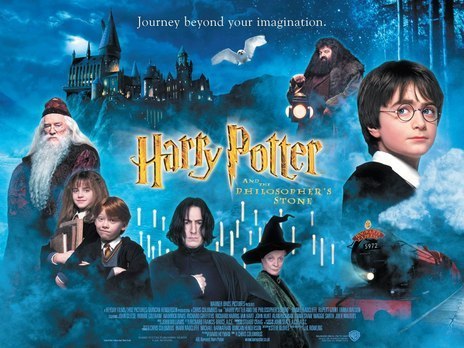
Harry Potter and the Philosopher's Stone
Twenty years ago, a children's book about a young boy fated to become a wizard was published. Along with its six sequels, it went on to sell half a billion copies and created one of the biggest film franchises in history. Reviewing it is only marginally less futile than reviewing oxygen, as you'll have likely watched this film years ago or already decided to never watch it at all. But the biggest fantasy franchise of the last generation is certainly something that should be up for review and criticism.
Harry Potter and the Philosopher's Stone (Sorcerer's, if you're of an American persuasion) was released in 2001, adapting the first book in the series. That first novel in the Harry Potter series is also the shortest, meaning that the film had to make very little alterations or changes to fit the entire story into one movie. This is something in its favour over the later films: as the novels got longer and longer, the films had to make more and more substantial cuts and alterations to maintain a coherent story on screen.
This first movie follows the book closely. We're introduced to Harry Potter, an 11-year-old potential wizard raised by his non-magical (or "Muggle") aunt and uncle after the murder of his parents at the hands of the evil wizard Voldemort during a magical war. Potter survived, somehow deflecting the spell that Voldemort tried to use to kill him back at its wielder, leaving a strange scar on his head. Voldemort hasn't been seen since and is presumed dead. Potter is rescued from the negligent care of his aunt and uncle to attend Hogwarts School of Witchcraft and Wizardry, where the reputation of his parents (and his own involvement in Voldemort's ultimate defeat) precedes him. At the school Harry makes friends with classmates Hermione and Ron and ultimately gets drawn into a disturbing series of events culminating in a showdown with a powerful magical foe.
The structure of the story is an extremely strong one. In the original novel Rowling set up Harry's world with skill and economy, establishing backstory, motivations and carrying out a fair bit of worldbuilding whilst also getting across a fairly intricate story, all in a very limited page count. The film does the same, with scriptwriter Steve Kloves and director Chris Columbus letting the story unfold with verve and economy. Columbus, a rather hit-and-miss director in his other work, knows when to let the story breathe and the camera linger on a magical moment and when he needs to get on with business and maybe cut some minor ancillary material from the book to accomplish that. Major set pieces from the book, like the Quidditch match, are fast-paced and exciting and the encounters with the shadowy figure in the forest and the final confrontation are effectively creepy. The highlight might be the life-sized wizard chess match, which is surprisingly brutal.
In terms of atmosphere and tone, Kloves and Columbus do mostly good work. In terms of acting and dialogue, the film is a bit less successful. Exposition is the order of the day and much of the dialogue, especially in the first half of the movie, tends to the clunky. The movie breaks the "show, don't tell" rule a few times, although it is able to deploy flashbacks to spice things up a bit. The adult actors also seem to start off struggling with their dry dialogue, with the notable exception of Alan Rickman who just commits 100% from his first appearance on screen, before getting to grips more with it later on.
Where the film lives and dies is on the performance of the three leads. Daniel Radcliffe, Emma Watson and Rupert Grint were all very young and inexperienced, and certainly give rough and unpolished performances. But they also have a huge amount of energy for their roles, making up in raw enthusiasm what they lack in experience at this stage.
The film is sixteen years old, so the CGI and effects have definitely dated, in some cases (particularly the troll, centaur and some of the actor replacement in the Quidditch match) quite badly. But for the most part it holds up well and the sets and overall production value remain impressive.
The biggest success of the film is that the film-makers recognise that the novels work because Rowling combined childhood whimsy with some very well-constructed worldbuilding and brief-but-effective moments of terror and action. This is a children's story, but one with some character and story depth to it.
Harry Potter and the Philosopher's Stone (***½) is at times a rough movie with clunky dialogue and stilted performances, not to mention some cliched British story tropes (like the elaborate private boarding school). But once it relaxes and gets underway, the story becomes more enjoyable and the performances more nuanced. A long way from being a perfect movie, it's certainly an entertaining one that opens the series very well. The movie is available now in the UK (DVD, Blu-Ray) and USA (DVD, Blu-Ray) as part of the Complete Harry Potter Movie Collection.
Friday, 4 September 2015
Daniel Radcliffe stars in BBC drama about GRAND THEFT AUTO
Yes, that headline exists and I am not making it up.
In The Gamechangers Daniel "Harry Potter" Radcliffe is playing Sam Houser of Rockstar Games, one of the guys who took the struggling Grand Theft Auto franchise (after one classic, hit game in 1997 and a so-so sequel in 1999) and, with 2001's GTA3, created the biggest franchise in gaming history (until Call of Duty, anyway).
The game focuses on the clash between Houser and Jack Thompson (played by Bill Paxton of Aliens and Agents of SHIELD fame), an American lawyer who tried to get the games banned for being violent and inspiring real-life crime. Thompson's unsubstantiated claims and general lack of professionalism later (SPOILERS!) led to him being disbarred.
I don't know if it's going to be any good or not - the trailer is bizarre - but the sheer randomness of this project may make it worth checking out. Radcliffe's disturbing facial fungus does make me long for an alternate universe in which he plays a young Trevor from GTA5.
Meanwhile, the project gives Rock Paper Shotgun the excuse to check out Harry Potter/Grand Theft Auto crossover fanfic, which also exists.
The Gamechangers will air on BBC2 on 15 September.
Subscribe to:
Posts (Atom)


