Showing posts with label gsc game world. Show all posts

Monday, 31 August 2026

S.T.A.L.K.E.R. 2: Cost of Hope

As Skif's journey through the Zone continues, he gets word that the checkpoint to the Iron Forest region is now open, and the people there are asking for help. Skif's answer leads him into an uneasy alliance with both the Duty and Freedom factions as they face down a mutual threat, which will eventually lead them to the Chornobyl Nuclear Power Plant itself, and a fateful decision.


STALKER 2: Heart of Chornobyl launched in late 2024 and was an instant commercial success, selling millions of copies. The game was also critically well-received, but some criticisms were made of the game not living up to its predecessors' impressive "living world" AI and featuring some janky bugs. The Cost of Hope expansion, launching alongside the v2.0 patch, is designed to not just add huge amounts of new content to the game, but also help boost the mother game's reputation and get more eyes on what is an impressive and atmospheric game. It's designed to be the Phantom Liberty to the original game's Cyberpunk 2077, in terms of revitalising the entire game, and it is certainly a partial success.

Launching the expansion can be a bit of a fiddle though. It takes place during the original game's story so you need to either launch a save file from before the point-of-no-return or have the game generate one for you from your end-of-game status. To be honest, it feels like it makes more sense to play this earlier in the game's timeline. Combined with all the 2.0 improvements to the game, it might even be worthwhile considering a total new playthrough. However, Cost of Hope adds at least 30 hours of new gameplay to the title, taking a 60-ish-hour game to closer to 90 hours, which is a fairly hefty time investment.


The expansion is broken into several sections. The first is set in the Iron Forest, so-called because it's a large region covered in electrical substations and pylons, with electricity anomalies running rampant. This area is interesting, not too big with several buildings to explore and a friendly camp to hang out at (as well as an eccentric single prepper), but it's no big shakes. I completed everything in this sector pretty quickly.

The storyline then takes you back into the main Zone and you end up revisiting several key locations, where things quickly take on a much more epic feel. The original STALKER trilogy (Shadow of Chornobyl, Clear Sky and Call of Pripyat) focused heavily on the opposing ideologies of Duty, who want to protect the rest of the world from the Zone and destroy it if at all possible, and Freedom, who want to exploit the unusual nature of the Zone to improve all mankind. These two factions took a back seat in STALKER 2 itself, where all the factions in the Zone are abiding (more or less) by a shaky treaty. Cost of Hope brings the two factions back to the fore in a strong way, with not just the tension between them explored but also the tensions inside each faction as different people have different idea on how to proceed. During the game you'll align more with one faction over the other, and have to deal with both a civil war within that faction (which can turn a previously peaceful and reliable base into a combat zone hellhole) as well as managing the tension between both factions when their ideologies eventually clash in a way that cannot be managed diplomatically.

This unfolds between the major NPCs representing each faction and, it has to be said, these are pretty good. One is a returning character from the original trilogy whilst the other is a major NPC from the Arena side-missions in STALKER 2, so you're already somewhat invested in their storylines from the start. Having to side with one over the other is sometimes quite painful, and, impressively, the game has the two NPCs as being allies with a lot of respect for one another who genuinely don't want to have to kill the other either, resulting in some anguished choices and moments (fortunately the game doesn't over-egg this too much).

Another sequence takes the STALKER franchise where it's never been before by converting it into a Resident Evil-style environmental puzzle game, playing out in a time-displaced town apparently designed by M.C. Escher having spent way too much time playing the Ravenholm level of Half-Life 2. Possibly the expansion's finest hour, the weird dreamscape feel and under-emphasising of combat in favour of exploration make this a very successful experiment in a different style of gameplay.

It takes about 20 hours for the expansion to even start herding you back to the Chornobyl Nuclear Power Plant itself and it pretty much lives up to its reputation of being dark and haunted. Delving deep into the bowels of the facility is foreboding, and it's a tribute to both the game designers and the team at HBO when you find yourself in locations that you recognise straight out of the TV series Chernobyl. Navigation can be a little bit of a pain - indestructible chainlink fences divide the NPP up into districts and sometimes going round them can take a major diversion - and the area is further complicated by the Flare, an absolutely massive anomaly that can give you terminal migraines very quickly and requires you to constantly break line-of-sight with it, which is hard when it's towering above the centre of the complex. Removing the Flare is, surprisingly, not a goal of the main storyline, with instead an entire side-chain of missions dedicated to getting rid of it, after which moseying around the ruined power station becomes a lot more fun.

As well as the very chunky main storyline, the expansion adds several significant side-quests. Removing the Flare is one, and another is a faction war storyline where your actions make it safer and easier to get to the facility, resulting in a free-for-all. Your aligned faction has to fend off an invading one in an absolutely massive battle sequence raging across most of the power plant and it has to be said this is satisfyingly epic. You lead a strike team in attacking enemy positions and driving them back until you can hold key points until reinforcements arrive. STALKER 2's combat versus human opponents has always been its strongest point, as the human enemy AI is reasonably clever. Enemies use squad tactics to try to flush you from cover, circling around to flank and use grenades. Enemies are also susceptible to grenades and headshots. If you're playing this expansion late in STALKER 2's run-through, you should also have the more formidable armour, damage-reducing anomalies and higher-calibre guns that should make the battle winnable, but it can be a hard grind to push the enemy lines back to their base and eliminate them (also refreshingly, once they've suffered catastrophic losses, the enemy does retreat rather than forcing you to kill every one of them).

The game also adds a multitude of new quests, some in the new locations (I enjoyed working with a high-powered sniper in one) but many in existing locations. Revisiting previously-visited bases will usually reveal new questlines in that region. As a result, Cost of Hope not only adds two new regions to the map but a substantial amount of content to existing ones. There is also new equipment, with binoculars (standard and night-vision, the latter capable of some stunning photo-realistic moments) being a particularly welcome addition to your toolset.

The v2.0 expansion itself increases the game's stability and drops system requirements, but this does come at the cost of slightly less-impressive visuals. In particular, lighting takes a bit of a hit and can be quite flat in some areas where it was previously dynamic. This seems to have been done to improve the game's performance on console, which is fine, but downgrading the game for PC players who previously had zero problems with how the game ran previously is weird. A big positive shift is foliage, with the new version of Unreal Engine the game is using being able to render much denser forests much more efficiently, which can make some of the more threadbare areas of the Zone suddenly much more realistic.

Whilst stability in the existing areas seems to have improved, the two new areas are less-blessed, and in the power plant itself I had multiple crashes to desktop and even one total-reset crash, which I did not appreciate. To be fair, GSC Game World has been pushing an aggressive patching schedule (the game has had multiple patches in just the week-and-a-half the expansion has been out) so a lot of these problems should vanish soon, but keep an eye on the discussion forums to see what areas remain problematic.

In terms of gameplay, the expansion does make a couple of dubious choices. STALKER 2 was already a bit irritating for having some major game moments play out in cutscenes rather than interactive gameplay, and Cost of Hope probably has one or two too many similar moments. Situations that you'd normally avoid by sneaking through the area stealthily and using a silenced pistol become heavy action sequences based on narrative fiat. A couple of boss fights feature tedious enemy mechanics. One boss fight involving two extremely tough creatures was so annoying it seems to have been nerfed in patches already (a door opens after a few minutes allowing you to simply leave the area). The expansion has several moments relying heavily on parkour, and given that Skif has less stamina than an arthritic 94-year-old nun midway through an asthma attack, these sections can be monumentally frustrating to get through. Fortunately they are brief.

STALKER 2: Cost of Hope (****) is a flawed but enjoyable experience. It adds new equipment, areas, enemies and weapons to an already-chunky game, and its main storyline is compelling. Side-quests are also very accomplished, and the faction war sequence (possibly a test-run for ideas for the upcoming multiplayer mode) is genuinely epic. Fiddly map design, an overreliance on clunky mechanics (especially jumping) and the ongoing issue with bullet-spongey mutant enemies are irritating, but ultimately ignorable.

Thank you for reading The Wertzone. To help me provide better content, please consider contributing to my Patreon page and other funding methods.

Tuesday, 28 July 2026

S.T.A.L.K.E.R. 2: COST OF HOPE launches on 20 August

They've left it a bit late, but GSC Game World has revealed the release date for their Stalker 2: Heart of Chornobyl expansion, Cost of Hope. The expansion launches on 20 August, or in just over three weeks' time.


STALKER 2 launched in late 2024 and was a very good time, despite janky launch bugs and some questionable AI, not to mention a somewhat-sluggish implementation of Unreal Engine 5. A stream of patches and updates fixed a number of these problems. Cost of Hope adds a lengthy new questline and a whole new area, including the Iron Forest and the Chornobyl Nuclear Power Plant itself, which was visible but not visitable in the initial release.

STALKER 2 has sold over six million copies since release, though sales seemed to tail off as fan frustration with some of the missing features and bugs became more notable. Cost of Hope launches alongside the 2.0 revision of the game, which completely updates the game's underlying technology, moves to more stable version of Unreal Engine 5 and features revamped textures and lighting. GSC also recently oversaw the release of technically-updated versions of original games STALKER: Shadow of Chornobyl (2007), STALKER: Clear Sky (2008) and STALKER: Call of Pripyat (2009).

Thursday, 15 May 2025

Updated version of original STALKER trilogy to be released next week

Fresh from the success of S.T.A.L.K.E.R. 2: Heart of Chornobyl, GSC Game World are re-releasing enhanced editions of the original three games in the series next week.

S.T.A.L.K.E.R.: Shadow of Chornobyl (2007), S.T.A.L.K.E.R.: Clear Sky (2008) and S.T.A.L.K.E.R.: Call of Pripyat (2009) were seminal first-person shooter games with RPG elements. Each game is set in a different time period and explores a different part of the Zone, a mysterious area of nuclear and paranormal contamination surrounding the Chornobyl Exclusion Zone in northern Ukraine, after a second accident at the site in an alternate 2006. The player has to follow a mysterious story whilst recovering artifacts, building up an arsenal of weapons and deciding which factions to support.

The new versions of the game have revamped lighting, new skyboxes and upgraded graphics, as well as improved support for modern resolutions and hardware, and a revamped UI. The games have also been optimised for Steam Deck. Impressively, GSC Game World are giving away the updated editions free for owners of the original versions of the game, so even if you have a Steam version of Shadow of Chornobyl from eighteen years ago, you'll still get the new "enhanced edition" for no further outlay. If you don't own any of the games and purchase the new "enhanced edition" of any of the games, you'll also get the original version of the game as well.

If you don't own any of the games, you can purchase the S.T.A.L.K.E.R.: Legends of the Zone - Enhanced Edition bundle to get all three new versions of the game, and the originals.

The new versions of the games will be available on 20 May on PC, PlayStation 5 and Xbox Series X/S.

Wednesday, 18 December 2024

S.T.A.L.K.E.R. 2: Heart of Chornobyl

An ex-soldier, Skif, is annoyed when his flat is destroyed by an "artifact," a strange, reality-warping device brought out of the Zone, the huge stretch of countryside surrounding the Chornobyl Nuclear Power Plant which has been sealed off from the world for almost twenty years whilst mercenaries and fortune-hunters, "stalkers," explore its ruins for artifacts and loot. Skif decides to head into the Zone to find out why this artifact was ejected into the outside world, and rapidly discovers events in the Zone are building to a bloody and dangerous climax.


There are few video game franchises both as beloved and janky as STALKER. The creation of Ukrainian developers GSC Game World, the original STALKER: Shadow of Chornobyl was acclaimed on release in 2007 for its graphics, its bleak atmosphere and its depiction of the real-life Chornobyl Exclusion Zone, filtered through a weird alt-history horror lens inspired by the 1979 movie Stalker by Andrei Tarkovsky and its own inspiration, the 1972 novel Roadside Picnic by the Strugatsky brothers (who also wrote the movie script). STALKER was also famous for its numerous bugs, lengthy patching process, and subsequent fan mods which restored cut content and made the game more stable.


The game was followed by two stand-alone expansions, the somehow-even-jankier Clear Sky (2008) and the much more polished Call of Pripyat (2009), which expanded the STALKER story with new characters, factions and stories. A planned "proper" sequel was announced, followed by the company promptly going bust (some devs spun off to make the splendid Metro series of games) and, just a few years later, suddenly coming back to life. Then, as STALKER 2 was entering the final stretch of development, the developers' homeland was invaded, forcing part of the dev team to relocate to Prague (some of the other devs stayed behind to join the army or help in the civilian support effort).


STALKER 2 is here and in some respects it's like the franchise has never been away: STALKER 2 is janky, but there's a lot of heart and interesting ideas bubbling under the surface. This is an old-school game with deteriorating weapons, the need to repair equipment and think about food and water, but also has a more modern design, with a massive open-world map and various side-stories to explore alongside the main narrative. Fortunately, the game rejects the idea of Ubiclone makework BS, with the bulk of the game's 60-hour playtime taken up by consequential missions and exploration rather than tracking down collectibles.

The main narrative is the focus of the game and is fairly entertaining. You play Skif, an ex-soldier who is rather irritated when his flat is blown up by a glowing rock from the Zone. Rather than file an insurance claim, Skif decides to perform a one-man vengeance mission into the Zone to find out where this rock came from and find someone who is going to pay for a new pad. As a newcomer to the Zone, Skif doesn't know what the hell is going on and other characters try to fill him in on the convoluted backstory from the original trilogy of games (which variously baffles Skif or leaves him apathetic; this guy is really focused on finding out why a rogue geode demolished his domicile). This is obviously a boon for newcomers to the franchise who haven't play the original games either, but getting up to speed is rather tough going as you are assaulted by a battery of proper nouns, nefarious-sounding organisations (Ward, Spark, Duty, Noontide, Monolith) and introduced to a ton of characters, most of whom are some variation on "cynical soldier-philosopher." I suspect Malazan fans will love this game. The story as it unfolds is reasonably intriguing, though sometimes goes off in a weird tangent that's not very-well explained (the STALKER Wikis might be your friend in understanding some of these events) which can be a bit odd.


Gameplay is your standard first-person shooter. You shoot a lot of people, things and mutated animals in this game, with an impressive array of weapons, each of which has its own ammo supply, which also comes in variants (armour-piercing, etc) which are meant for different types of enemies. I'll be honest and say this system is great if you really want to engage with it, but I went with "fire whatever is at hand at the enemy and hope for the best," and most of the time this was fine. Unfortunately, despite being a trained soldier, Skif is also apparently an asthmatic who runs out of breath after lightly jogging for about 12 seconds, so can't carry much in the way of weapons or supplies. As the game progresses you can get better armour, even power-assisted exoskeletons, and acquire weird artefacts from the Zone that ups your carrying capacity, but even so you're never going to be able to carry more than about four weapons max. Weapon variety is solid, but mostly boils down to you being recommended to carry a silenced pistol, some kind of semi-automatic rifle, a sniper rifle and a shotgun, the latter being essential for dealing with bloodsucker mutants that are usually invisible until they attack you without warning. Oh yes, the standard stealth system allowing you sneak up behind someone and stab them silently is present and correct.


Combat against human enemies is enjoyable, with some good sniper duels possible across the rooftops of Pripyat or between office buildings in abandoned industrial zones. Combat against mutants, on the other hand, is mostly tedious. A lot of the mutants are preposterously bullet-spongey, especially galling after the game plays fair with human enemies, where headshots will take down almost everyone in one headshot, unless they have armoured helmets. Patches have nerfed some mutants (bloodsuckers are now much easier to deal with) but others, like chimaeras and pseudogiants, remain absolute joyless slogs to fight and are simply best avoided or run away from.

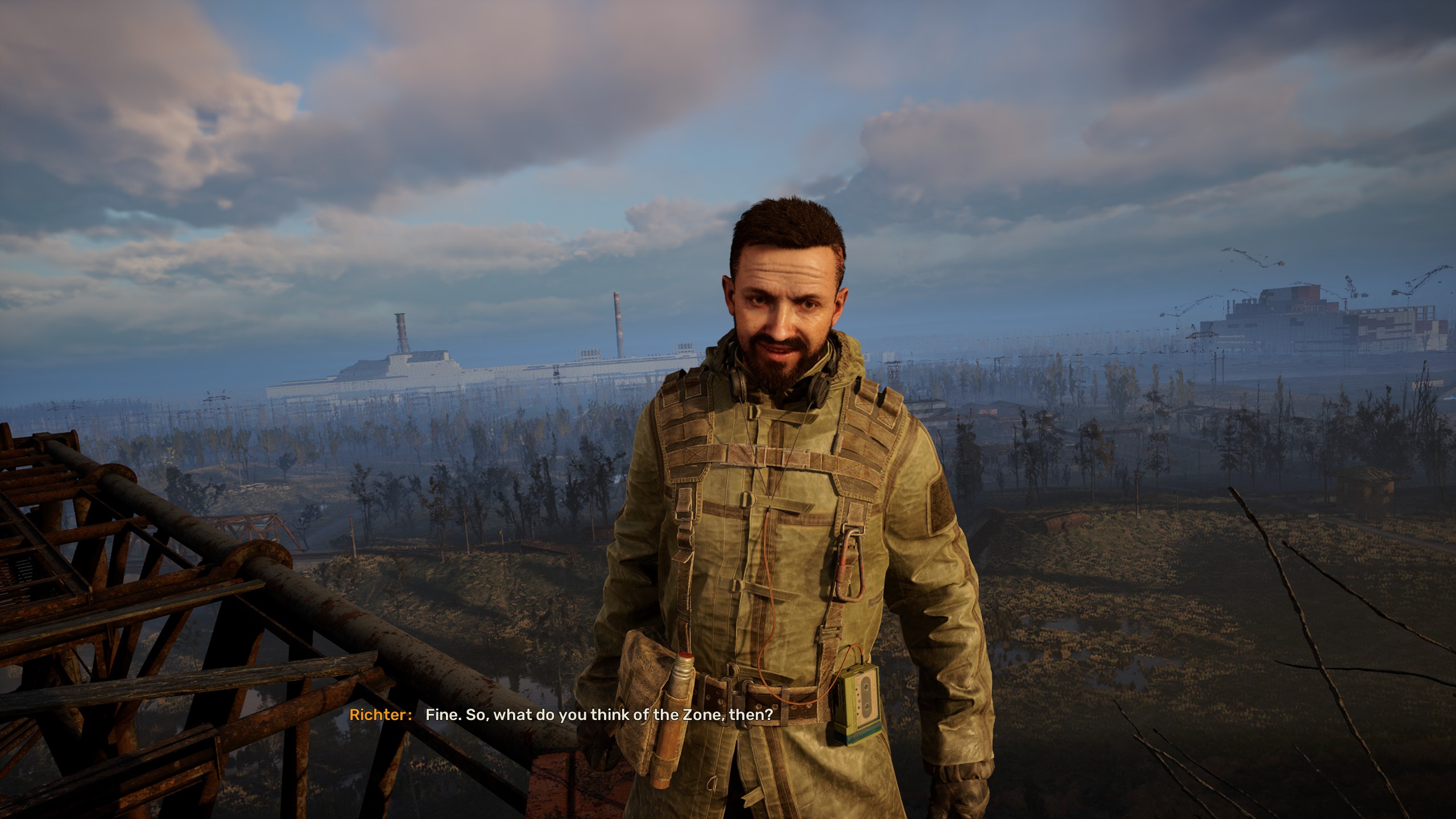
Graphically, STALKER 2 is frequently jaw-dropping. In some lighting conditions, the game looks photorealistic with amazing environments, textures and lighting. Fog or sunshine almost makes the game look like you've taken photos in the real Chornobyl Exclusion Zone. Human characters are a still not really there, with stiff animation and uncanny valley effects, and the mutants are almost universally ugly and not really convincing. It feels like the mutants were designed right at the start of the process when they might have been thinking about the game launching on last-gen hardware and were never updated to the latest version of the game engine. Still, for atmosphere there is no game out there (bar maybe Alan Wake 2) that can match STALKER 2. Trudging through a forest miles from the nearest town, trying not to stumble into an anomaly and low on health and ammo, only for a pack of wild dogs to attack and force you to take shelter in a nearby ramshackle barn, is an unmatched gaming experience. As with the better Bethesda RPGs, STALKER 2 is at its best when channelling an atmosphere of uncanny sparseness.


The map is massive, which I ended up having mixed feelings on. Having an accurate-ish size of map for the relatively small area of countryside the game is covering makes it feel realistic in terms of scale (Ghost of Tsushima, which had a massive map for a relatively constrained 40-mile-long island, achieved something similar), and early missions are very well-constructed for how they get you to explore new areas of the Zone. However, after a while missions start sending you from side of the Zone to the other, which is a fairly formidable undertaking requiring you to load up on weapons and supplies (recalling that Skif has the carrying capacity of an elderly nun with a back complaint), travel in a straight line for about 15 minutes and will probably result in you fighting off a mutant with two heads and two arses, a plague of rats and a ghost who inexplicably throws buckets at you, along the way. There is a fast-travel-ish system in the game via "guides" who can teleport you from one base to another base, but this doesn't always help much since bases are relatively few and far between. It's also astronomically expensive. Still, the atmosphere is so great that mostly you won't mind taking long hikes to your destination, aside from potentially wearing out your screenshot button.


The in-game economy is also pretty busted, with weapons and ammo being quite expensive, repairing your battered equipment is ludicrously expensive, and you usually spend your hard-earned cash on upgrading your armour to include more carrying capacity or deploying more artefacts about ten minutes before you find a much better suit of armour in a shack in the middle of nowhere, and have to start upgrading again from scratch. Sigh.

Voice acting, in Ukrainian, is also excellent (or so it seemed to me) and the minimalist musical score, backed up by dozens of original and licensed songs in certain areas, is also very good. The English voice acting is frequently terrible though, with a bizarre variety of accents that makes the Zone feel like it's Camden Market on a Saturday afternoon. Switch on Ukrainian voices and subtitles, it adds a ton to the game's atmosphere.


STALKER 2: Heart of Chornobyl (****½) is possibly the most stunningly atmospheric video game available at the moment, with excellent combat, characters and exploration, with a solid (if occasionally obtuse) story. Mutants are a pain in the backside and the massive map can be occasionally frustrating, whilst a plethora of small bugs can occasionally disrupt gameplay, though a steady patching schedule has already fixed a lot of problems. The game's rejection of modern open-world filler is refreshing, and it manages to be a more challenging experience than most modern games whilst not being totally off-putting to newcomers. There's certainly room for improvement, and with two big DLC expansions on the way it will be interesting to go back to the Zone and explore it further.

The game is available now on PC and Xbox Series X/S.

Thank you for reading The Wertzone. To help me provide better content, please consider contributing to my Patreon page and other funding methods.