Showing posts with label hideo kojima. Show all posts

Wednesday, 27 May 2026

Death Stranding 2: On the Beach

The Death Stranding has disrupted the connection between the living and the dead, creating a strange, post-apocalyptic world where people live in isolated shelters or clustered in cities under a total surveillance state. If someone dies alone, their body turns into a ticking antimatter bomb, even more dangerously if they are killed by the undead spirits - BTs - that have drifted into our world from beyond. Certain people can see the BTs before they strike, and destroy them.


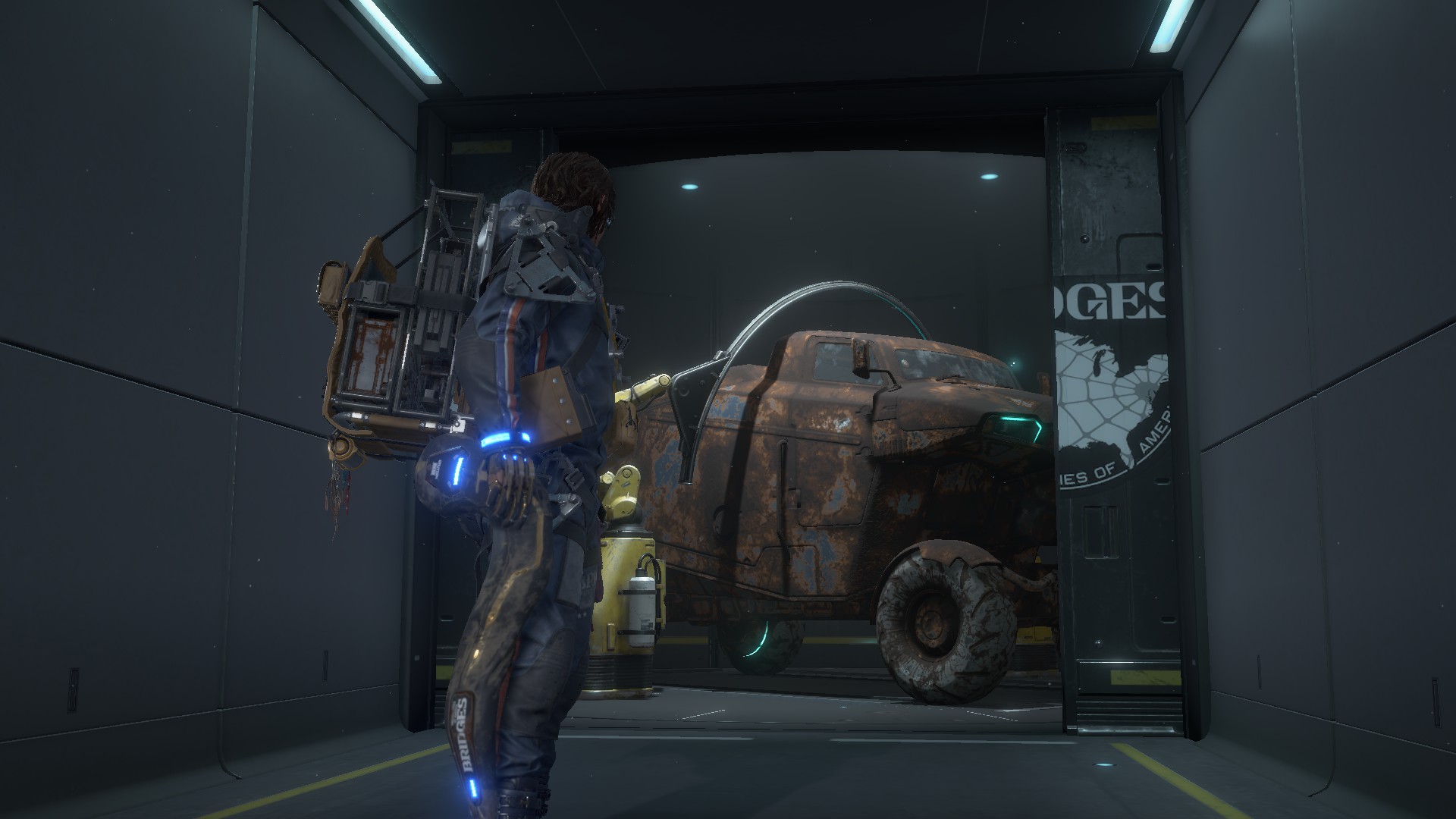
One such person is Sam Bridges, a porter who has already completed an epic journey across the former United States, linking remote cities and shelters together onto the chiral network, restoring connectivity and community to the human race. A year after he completed his mission, Sam is living in seclusion with his adopted daughter Lou when he is asked to bring Mexico onto the same network. His success in Mexico opens a portal, a "plate gate," leading to Australia. But his mission to bring the new continent back into contact with the rest of humanity is disrupted by devastating reversals and the arrival of new threats.

Death Stranding was released in 2019 as the first game by noted video game designer Hideo Kojima after his well-publicised split from Konami, after disagreements over the direction of the Metal Gear Solid franchise. A strange game about live, death, love, family and rock-climbing, the game was an acquired taste, with those who locked into its headspace loving it but others left baffled.


Death Stranding 2: On the Beach, is something that I don't think anyone was expecting from Kojima. It's a considerably simpler, more straightforward game than its forebear. Gone are the 20-minute cutscene TED Talks on the nature of reality, the metaphysical rules of how the game world works and characters with weird codenames talking about things you won't understand until a lot later in the game. Instead, Death Stranding 2 gets you into the action faster and cheerfully boils down the plot to, "linking cities together like last time, only now in Australia, and with monorails for some reason."

That's not to say that Death Stranding 2 drops all the weirdness and obtuseness from the game, but the denser plot elements are pushed far into the back end of the game in favour of focusing on what the first game did best: delivering parcels to people in desperate need of help.


The basic gameplay loop has Sam travelling around the open world, this time considerably larger than that of the first game, stopping at key settlements. These are divided between large cities on the edge of the map, big distribution centres at key points in the world and lots of individual small shelters, inhabited by individuals or small groups. Each settlement has goods that need to be delivered elsewhere, sometimes easy jobs with small amounts of cargo to a nearby location, sometimes a very large amount of extremely fragile cargo that needs to be taken across most of the map without breaking. Sam has a reputation with each settlement, and maximising his reputation allows him to claim more resources and build more equipment at each location. How fast he accomplishes each job and the status of the cargo in question can see him level up his reputation faster.

Traversing the world is possible on foot, using a variety of small vehicles, or using a larger truck. As with the first game, using the truck is by far the most efficient process (due to its large carrying capacity) but is stymied by a battery-limited range and mountainous terrain. You can build structures in the open world, including recharge points and even entire new shelters, and you can also build roads, which allow you to travel without using your battery. Roads are very resource-intensive to build, however. New to this sequel is that you can also build monorails, which can carry far vaster amounts of cargo and resources (not to mention you and your vehicle), but only between set locations. You can also now reactivate automated mines, which can be used to generate enormous quantities of resources.


Hardcore porters may prefer to travel on foot, using ziplines to traverse crevasses or go up and down mountains, but the game is relatively forging for the truckers, even more than the first game, with even the tallest mountain in the game being almost completely climbable on wheels.

The main story has Sam following directions on which location to visit next, usually involving taking a dangerous path through unexplored territory, dealing with bandits, the supernatural BTs or natural hazards along the way. The biggest change in Death Stranding 2 from the prior game is combat. In the first game, combat was to be avoided if at all possible, and nonlethal weaponry was encouraged since dead humans turn into ticking antimatter bombs which can blow up parts of the landscape (or cause total annihilation of the game world altogether). In the sequel, Sam now has access to stun-capable versions of machine guns and, somehow, explosive grenade launchers, able to knock enemies out or destroy BTs with the same weapons and never be in any danger of killing anyone. This feels a bit silly, removing a core gameplay element from the first game, but since the sequel throws a ton more combat at you than the first game, maybe it was unavoidable. The human and BT enemies, both of which now come in greater varieties, are now joined by strange, teleport-capable mechs, which might be more formidable foes if you didn't have access to missile launchers and grenades which render them trivial threats at best.


A story-focused playthrough of the game should take most players around 40 hours, maybe a bit longer if you decide to fix up a few roads and monorails, and unlock the hidden settlements on the map. Like the first game, the plot mostly revolves around Sam dealing with other characters (some new, some returning from the first game, and some who appear to be new but are actually characters from the first game in disguise), getting missions and updates from them and travelling to new locations. Sam seems far more taciturn in this game than the first one, to the point that you can go hours at a time without hearing Norman Reedus speak, which is a bit odd.

The biggest change to the gameplay loop is the addition of a mothership. The DHV Magellan is a huge mobile base which Sam has access to for most of the game, and can use for fast travel back to previously-visited cities, distro centres and even some shelters. If you're heading into new territory, you can only do that under your own power, but in areas linked by the network, the Magellan can remove a lot of repetitive makework from the game. You can even cleverly use it to carry an absolutely massive amount of resources (far more than any truck) to speed up construction efforts, which is a much-appreciated move. However, using the Magellan does prevent you from earning maximum reputation points on deliveries, so if you want to max out Sam's rep, you need to do it the hard way. The Magellan threads the needle of being a useful new tool without making the game too trivial. The way every single character always calls it "DHV Magellan" without fail instead of just Magellan is also curiously entertaining.


Death Stranding 2 benefits from a fair bit of humour throughout. Some of the missions are ridiculous, and undertaking missions for the enigmatic "Pizza Chef" results in a very funny cutscene. At one point, one of your companion characters gravely warns you that a very long cutscene is about to arrive. One returning character from the first game makes their arrival known via a full-on song-and-dance number (one ponders if Kojima was inspired by Alan Wake 2 here). The principle bad guy likes to use a sound-based weapon in combat that resembles a guitar, meaning he has to shred like a maniac to blow things up. One boss fight randomly turns into a Tekken-style 3D beat 'em up halfway through complete with health bars and special moves. Death Stranding 2 is notably less po-faced than the first game.

Whether Death Stranding 2 is as good as the first game is another question. It's bigger and, comparing like-for-like (solo or "connected" mode, where other players' structures may appear in your game world), a longer game than its forebear, with a much better-designed map, though maybe losing some of the tighter focus from the first game. It's definitely more straightforward, more combat-heavy and less weird, but that weirdness made the first game stand out from the crowd more. It feels like Death Stranding 2 is trying to be more conventional than the first game. That's only not a letdown because the first game was so oddball that the second game can only be more conventional in comparison. Compared to almost every other game out there, Death Stranding 2 still has a uniquely off-kilter atmosphere unlike anything else around (helped by its emotional soundtrack courtesy of Low Roar and Woodkid). Maybe more disappointing is that the second game uses a lot of copy-pasted assets from the first game, just punched up to 4K standards, with the shelters, distro centres and city entrances all being exactly the same as in the first game. Given it took three-and-a-half years to make the first game from scratch, one may ponder why it took six years to make the sequel given how much material is reused from its forebear.


Still, there's nothing else really around like this franchise, and the second game certainly benefits from being less obtuse than the first one (even if a total newcomer is still not going to have a clue what the hell is going on), with a much more satisfying, all-out epic action finale. Death Stranding 2 (****½) is an interesting game blending the survival horror, open world action adventure and crafting genres into something that can be quite compelling. The game is available now on PlayStation 5 and PC.

Thank you for reading The Wertzone. To help me provide better content, please consider contributing to my Patreon page and other funding methods.

Thursday, 2 February 2023

Death Stranding (Director's Cut)

A mysterious, apocalyptic event called the Death Stranding has ended the old world and ushered in the new. In this world the barrier between life and death has become vague and fluid. It is possible to breach the walls of death and visit the Beach, a purgatory-like stepping stone between this world and what comes after. But the Beach is feeding into our world, allowing dead souls, BTs or Beached Things, to manifest. Where BTs and living souls come into contact, there is annihilation, vast explosions called voidouts. These voidouts have obliterated much of America, leaving behind desperate islands of humanity, large numbers of survivors clustered in cities called Knots and singular preppers in remote shelters.


Sam Porter is recruited by Bridges, a company working closely with the nascent government called the United Cities of America. Their goal is to use the chiral energy of the Beach to reunite America, forming connections between cities and shelters until a single civilisation once again spans the continent. Sam is sent on a mission to complete the connections and find his missing adopted sister, reportedly held prisoner by extremists in a city on the remote west coast of the continent, cut off by a sea of tar. In this quest Sam is helped by a group of allies bearing oblique codenames and with varying motives. His closest ally is BB, a "Bridge Baby" (ghost-detecting quasi-foetus) wired into his suit's sensor systems, allowing him to sense and avoid BTs. But Sam and his BB are also being hunted by a mysterious figure, a soldier from the Beach who will stop at nothing to recover what he believes is his.


Death Stranding is a game that defies easy summary. It's a game which melds its decidedly familiar gameplay and format - an open world game you can traverse on foot or by vehicle, doing various missions for various people by means including stealth and combat - with the most obtusely deranged set of worldbuilding you've encountered this side of Steven Erikson's Malazan fantasy series, except even far more metaphysically weird. To play Death Stranding is to take an acid trip to a world where Darryl from The Walking Dead, Actual Guillermo Del Toro's Face and the baby from 2001 are FedEx couriers working to save America from Antimatter Ghosts you can shoot in the face with your own bodily excretions. To play Death Stranding is to play a game which asks, nay, demands that you pause it at least once per hour for the first five hours to ask, "what in the name of galloping fucknuts is going on?"

Of course, the obtuseness of the early game eventually gives way to understanding a bit more what's happening thanks to some of the longest infodumps in human history, in any medium. The game's characters are only too keen to tell you what is happening, using a battery of original Proper Nouns, holographic maps and charts. Essentially it's a narrative that has its weirdly obtuse cake and then also eats it from a plate of...frosty exposition? Death Stranding's worldbuilding and story eventually end up being nowhere near as inaccessible as some have made out, there's just a lot of it, and the story and worldbuilding are very front-loaded to the point that the game's opening few hours resemble wading through the treacle of lengthy cutscenes interspersed by tutorial-like bursts of gameplay before it gets out of its own way and lets you start playing the damn thing properly.


Once Death Stranding stops Lars von Triering out of your monitor, what emerges is a game almost disappointingly familiar: an open-world game where you walk around doing jobs for people. Jobs in this game consist almost exclusively of taking packages containing needed goods from one location to another. Early in the game you are limited to walking everywhere, and unlike almost literally every other video game in existence, the game has zero truck with you being able to carry three tons of inventory in an invisible container somewhere. Instead, every single item in the game has a physical presence and you have to account for it. This can end up with your character - Sam Porter Bridges, played by Norman Reedus from that zombie show and also that motorcycle show - comically staggering around with four feet of containers looming above his head, a mixture of cargo and survival gear. The more cargo you have, the easier it is to trip over and drop and damage it, which is no good for your client. You have tools to help you, such as ladders to ascend difficult spots or bridge streams and minor chasms, and ropes to ascend or descend sheer cliffs, but these are fairly limited at the start of the game.

Managing your cargo is a big problem initially, but Death Stranding immediately, and subtly, starts giving you ways of adjusting to the problem. The early settlements are relatively close to one another and it becomes easy to work out where to drop stuff off, double back to pick up other cargo, and then deliver stuff more efficiently. The game gives you a powered trike early on, but, amusingly, no way to charge it, so a bunch more deliveries lead you to gaining the ability to build field generators. Then the trike allows you to get around faster and carry more stuff, but soon you bump into new limitations.


The game also amps up the threat level quickly. You find your first batch of BTs early only, ghostly entities who don't just kill you, but first force you into a mid-tier-annoying boss fight. Detecting BTs with the help of your eerie demibaby companion becomes second nature, and avoiding them is relatively easy, though of course it's also easy to become overconfident and blunder down a hillside into a pack of them at the worst possible moment. Later on BTs become a more trivial threat once you learn how to weaponise your excretions into explosive weapons, but of course, not long after that the games starts feeding in more capable variants of BTs which are more difficult to defeat.

You also have human enemies to face, starting off with bandits called MULES (there's a ton of acronyms in this game and also absolutely zero explanation of what any of them stand for, which I kind of respect) and then advancing up to terrorists known as Homo Demens, whom everyone calls demons. MULES are annoying, beating you up with electro-poles and nicking your stuff, whilst the demons are lethal, happy to blow you away with automatic weapons and grenades. With both enemy types, the normal videogame instinct is to get some heavy hardware and liquidate them, but in the world of Death Stranding, this is a Very Bad Idea. Killing someone turns them into a BT; when a BT eats a passing live human, such as a MULE or terrorist when the camp respawns, it basically triggers a matter/antimatter explosion which effectively vaporises the game world. Or, more succinctly, every corpse you create in the world turns into a ticking time bomb which will eventually result in a game over screen. You can avert this by dragging the bodies either to an incinerator or into the Tar Sea, but these are at opposite ends of the game map and are very inconvenient to reach without a vehicle and still quite time-consuming with one. Just not killing people is the easier option. Since this game comes from the creator of the Metal Gear Solid series, there are fortunately myriad options for knocking people unconscious instead.


Death Stranding occupies an interesting space between the open-world action-adventure game and a narrative-heavy story game (not dissimilar to the previous game from the same team, Metal Gear Solid V). The narrative is very dense and complex, and taking a 20-hour break from the story to focus on side-missions won't exactly make it any more straightforward. On the other hand, taking long breaks from Yet Another Guillermo Del Toro Metaphysical TED Talk to just chill out hiking over some hills to some laidback Iceland rock might be very appealing.

The open-world elements are refreshingly stripped back: there is no skill tree, no pseudo-RPG ability unlocks (just occasional boosts to your carry capacity or stamina bar as you complete missions) and a bare handful of usable vehicles. Everything that is in the game is hyper-focused on making your life easier or the gameplay more interesting. Side-quests are almost uniformly a variation of "deliver something from Point A to Point B," with occasional missions directing you to raiding MULE camps or into BT-infested ruins to retrieve some vital piece of equipment. Occasionally missions direct you to unlock more information about your crew of supporting characters, and there's even escort missions, although these oddly involve strapping another human being to your back and lugging them around rather than them just, y'know, walking around themselves.


There is light crafting in the game, but the main building exercise in the game involves constructing, or reconstructing, a massive road network that spans the world map. Building this road network involves a ton of resource-collecting, with metals and ceramic either gained from completing quests, gatherable from allied outposts at regular intervals or lootable from MULE or terrorist camps. It's wholly unnecessary: vehicles with solid battery packs and building occasional generators in remote areas or shelters with garages for repairs will get you across the whole map without a problem. But even spanning a small corner of the map with roads to allow you fast transit between certain shelters can eliminate a lot the slower-paced travel from the game. How far you decide to go with that kind of activity is up to you; if you focus on the story and the story alone, you can finish Death Stranding in well under 30 hours. But if you set out to rebuild the road network solo and do every side-mission and get every achievement, you can expand this out to around 80 hours or even more with ease.

The game also features an interesting multiplayer mode. You never encounter other players in the game world, but your game data can synch with everybody else's on the server, so that other player's structures appear in your game and yours can appear in others'. Resources will flow into road repairs between your game world and others', dramatically speeding up the construction process. You can post signs warning other players about avalanches or raiders up ahead. You can dump unneeded equipment or weapons at a shelter for another player to pick up when it appears in their game. It's all rather interesting and ties into the game's central message about connectivity. Although you can also completely turn if off if you wish.


Death Stranding is built around this thematic idea of connectivity. As you traverse the game world, you bring isolated communities back into touch with one another through the medium of your role as a parcel delivery guy. The presumably unintended parallels to the COVID pandemic - the game was originally released just a few months before lockdowns became commonplace in early 2020 - are eerie. The theme is explored in interesting ways, although also fairly on-the-nose ones. Main character Sam is a loner with no interest in making friends at the start of the game, but through his connection with uncanny baby-thing BB and a host of bewilderingly damaged other characters, he becomes part of an extended family. It's both so cliched as to become saccharine, but also oddly effective.

It helps that the cast is both ridiculously stacked and extremely well-played. Reedus brings his familiar had-it-with-this-crap everyman exasperation from The Walking Dead and is a sympathetic lead (especially the way his stoic demeanour with others gives way to a goofier side when he's alone...well, apart from the player and BB). The Leftovers' Margaret Qualley is excellent as your main "man in the van," Mama, and Lea Seydoux gives an offbeat performance as Fragile, a fellow deliverer with an intriguing approach to next-day deliveries from anywhere on the continent. The Bionic Woman herself, Lindsay Wagner, makes for an excellent President of the United Cities, and Tommie Earl Jenkins and Troy Baker are having almost too much fun the ludicrously-named Die-Hardman (!) and Higgs, the antagonistic leader of the demons. Mads Mikkelsen lends the project fantastic gravitas as the enigmatic Cliff. Guillermo Del Toro and Nicolas Winding Refn only lend their likenesses rather than their voices to the roles of Deadman and Heartman, with Jesse Corti and Darren Jacobs picking up the vocal slack.


More amusing is the battery of more random cameos among the preppers and shelter-keepers you encounter, with manga artist Junji Ito, film directors Edgar Wright and Jordan Vogt-Roberts, game designer Sam Lake (best-known for his work on Remedy games like Alan Wake and playing the original Max Payne) and Video Game Awards founder Geoff Keighley all cropping up in small roles. Conan O'Brien has a particularly random limited appearance as an aggressive cosplayer. These cameos should feel massively incongruous, given the melancholy, more serious attitude the game cultivates elsewhere, but they end up feeling effective.

The gameplay loop of delivering parcels, unlocking new tools and vehicles and travelling to a new area is very effective early on, and there's no denying that the story and world, although dense and complex, are also original and interesting. The heavy de-emphasising of lethal combat is interesting, as is the decision to let you still indulge in it despite the risk of just blowing up the entire game world. Action is rare but satisfying when it takes place. The graphics are mostly excellent (although the relatively limited draw distance by modern standards does feel weird), the music is absolutely outstanding, and the game handles its tonal variation from moments of intense action to outright horror to melancholy loneliness very well.


There are problems though. The game frontloads exposition and introducing its bewildering world into the first few hours, meaning it does not put its best foot forwards and can give a very misleading view of what the game itself is like. Vehicle handling is okay on roads but pretty awful off it, and the twentieth time your truck bounces over a boulder half its own size with no problem only you get stuck on a pebble the size of a hedgehog will make you start to wonder if any of the developers have even seen an off-road truck, let alone used one. It's also hard to argue that the mountain biome can be deeply frustrating to navigate, at least until you unlock the use of ziplines and figure out the hidden paths trucks can use.

But these negatives are, for the most part, manageable. Death Stranding (****½) may be obtuse and strange for the sake of being strange, but it's also uniquely its own thing. Its atmosphere is haunting, its ideas original and its utter rejection of most modern gaming conventions (and, indeed, its not-always-subtle satirising of them) refreshing. This is not a game for everybody, but if you lock into its headspace, Death Stranding will be a memorable, fascinating gaming experience. The game is available now on PlayStation 4 and 5, and on PC. A sequel, DS2, is currently in development.

Thank you for reading The Wertzone. To help me provide better content, please consider contributing to my Patreon page and other funding methods.