Showing posts with label mass effect 2. Show all posts

Friday, 24 June 2022

Mass Effect: Legendary Edition

2183. Twenty-five years have passed since humanity discovered it was not alone in the universe. The Milky Way is dominated by the Citadel Council, a multi-species authority that seeks to limit conflict and war and promote peace and trade. One soldier now stands ready to become the first human Spectre, an elite agent with the authority to destroy threats to galactic peace. But their first mission uncovers evidence of a rogue element in the Spectre ranks, and evidence that a powerful, ancient threat is returning to the galaxy after fifty thousand years. With the Council not ready to face this truth, it falls to Commander Shepard to recruit a crew of like-minded allies and expose this new threat.
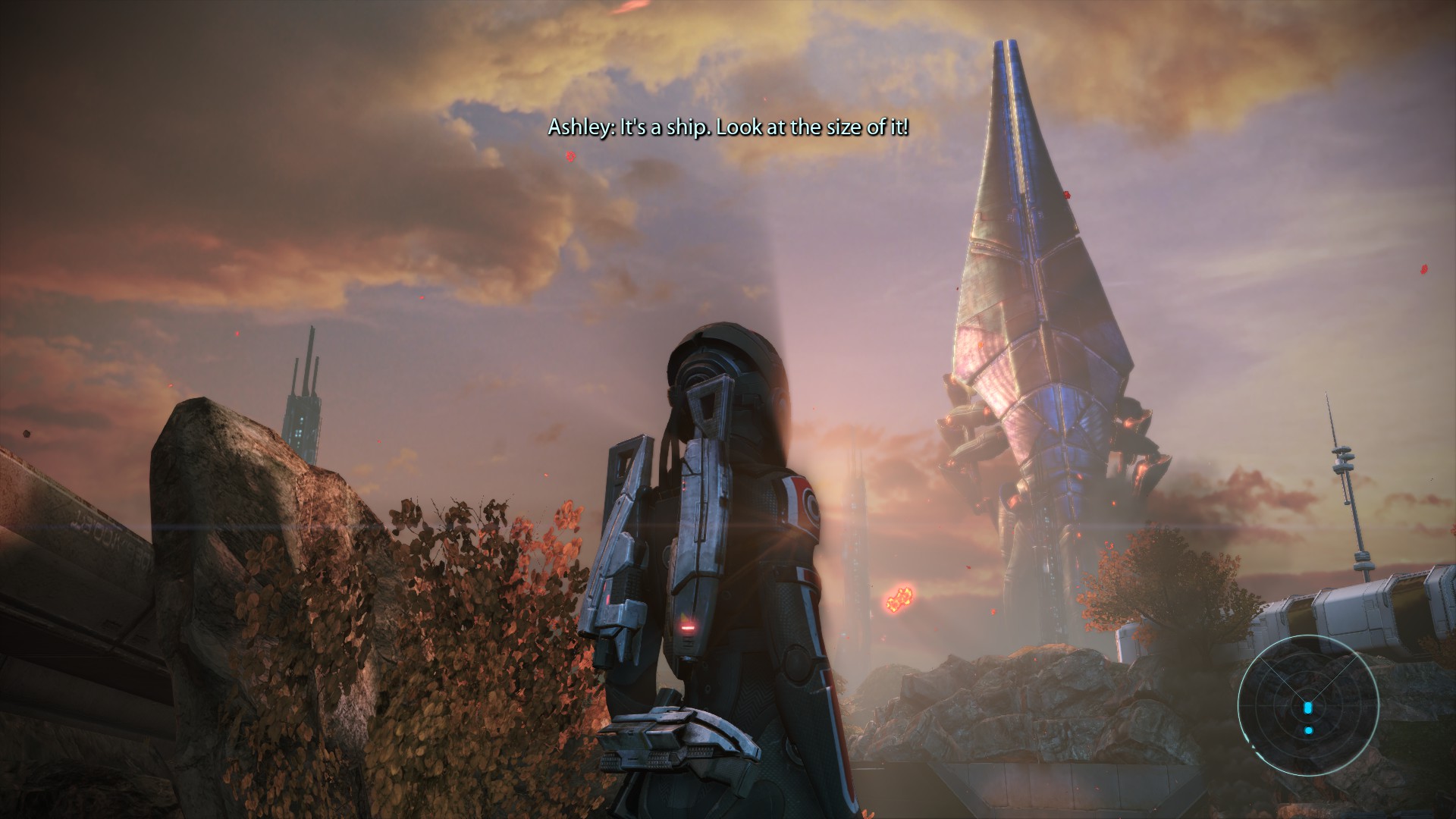
Yeah, get used to seeing these, Shepard.

If video games are about fulfilling fantasies, BioWare's Mass Effect trilogy offers one of the most compelling in the history of the medium: you are Commander Shepard, Space Adventurer. Your surname is set in stone but otherwise you can determine your Shepard's gender, appearance, abilities, sexuality and personality. You then guide your Shepard through a lengthy quest to save the galaxy, but it's up to you how you do it. You can be the ultimate hero, a paragon of honour and justice, or you can be a brutal, sarcastic antihero. Or maybe you just wing it as the fancy takes you. Depending on your deeds and words, entire civilisations will be destroyed, trusted friends may be betrayed or left for dead, and the fate of trillions of lives hang in the balance.

Most RPGs released since the trilogy have been open-world games, offering freedom in allowing you to travel across a vast landscape and mix and match quests and activities, but none have offered narrative freedom and control in this manner. You can see why, as well. It's very hard to pull off, and even BioWare themselves have shied away from trying to do it again. Their Dragon Age series has offered some of the same ideas of narrative control, but constantly changing protagonists and drastically changing locations between games has minimised the same kind of impact.

Where you command your ship from, and spend a lot of time searching for new worlds to visit in your bouncy tank.

The Mass Effect trilogy is really one immense game split into three for length and pacing reasons, and the Legendary Edition of the trilogy combines them for the first time into one cohesive package. Every bit of DLC is also included (one optional expansion for the first game excepted, which almost everyone ignored first time around anyway) and all three games have been given graphical spruce-ups and had their load times drastically improved. The first game has also had its combat revamped to better match the latter two games in the series. The result is now the best way to experience the trilogy, certainly for newcomers, and seasoned hands will find a more streamlined experience as well.

Martin Sheen plays the main human antagonist and has a blast in the process.

The trilogy's most vital feature is that you get to create your character and take them through all three games, carrying all their decisions with them to make for one epic story. The trilogy is ostensibly made up of roleplaying games, although it ends up being more of an RPG-shooter hybrid. All three games are separated into non-combat areas, where you can pick up missions, engage in dialogue and diplomacy and usually some shopping, and mission levels, which are linear maps where you usually make your way to an objective and shoot very large numbers of people along the way. The most important stuff usually happens in the non-combat zones, where you can guide Shepard through conversations using a radial dial and picking your responses. You can also gain "Paragon" and "Renegade" responses by picking kind or aggressive replies respectively. Increase your Paragon and/or Renegade scores and you can unlock special replies, which can sometimes allow you to avoid combat by defusing situations or intimidating an opponent into backing down. This is usually where you'll decide what kind of Shepard you can be, either a hero or an antihero (you can't really be a villain) or some kind of middle ground, although those trying to have their cake and eat it may find they're locked out of the special replies on both ends of the spectrum.

"Earth!?! Where are we?"

Combat sees you deploy Shepard and two companions and fight in third-person. Combat is inspired by the Gears of War series, with lots of conveniently-placed, chest-high walls to hide behind and fire off shots at the enemy. Combat in the first game is fairly forgettable, improves sharply in the second game and reaches its best in the final title. You can focus on your own fight and let AI handle your companions, or you can pause and give them orders mid-combat. The three games do handle difficulty differently, so I found that Mass Effect 2 could sometimes be challenging on Normal whilst Mass Effect 3 could occasionally feel a bit too easy even on Nightmare, so tweaking difficulty levels to find the right balance is key. However, given the important stuff happens in the dialogue scenes, combat can occasionally feel like a chore. Dropping the difficulty all the way to the easiest level makes combat trivial and allows you to get on with the story.

And it's the worldbuilding, story and characters where Mass Effect shines. Mass Effect is nothing too original - imagine 1990s SF TV classic Babylon 5 mashed up with the 2003 Battlestar Galactica and you're about 90% of the way there - but it almost gleefully mixes and matches its inspirations to create something very enjoyable, if occasionally familiar. The alien races are all memorable and have their interesting foibles and cultural tics, like the third-person-referring Hanar or grumpy space dwarf Voluses, or the Elcor, whose lack of facial expressions and monotonous voices means they have to patiently explain their current emotional state at the start of every sentence. The backstory, painting humanity as newcomers on the galactic stage who are still a bit paranoid about aliens but who are also rising fast in power and influence, angering older galactic civilisations, is also rich and interesting.

Tali, kickass space engineer and one of your best friends in the series.

The in-game story is also excellent, with you initially chasing down a rogue Spectre who has allied to a renegade race of mechanoids. The stakes get bigger and busier, and you eventually have to sacrifice a trusted friend and pull a gun on another when your relationship goes south. Eventually you discover the real threat, a Cthulhu-esque nightmare of techno-horrors from beyond the dawn of time, and have to fend off their first incursion into the galaxy with a massive space battle and a desperate battle up a burning skyscraper...and that's all in just the first game!

The story ranges far and wide across the galaxy, although players are often baffled by the turn it takes in Mass Effect 2. Trying to avoid spoilers, but suffice to say that there is a two-year gap between the events of the first two games and Shepard's warnings of the return of the Reapers have been disregarded by the Council, forcing them to join forces with a human separatist organisation with a dubious moral past but who have the massive resources needed to take the fight to a new enemy, the Collectors. The game feels like a huge side-quest from the main story arc, but it's also immaculately structured, with Shepard having to assemble a (more or less literal) Dirty Dozen of specialists in various fields, win their trust and then mount an all-out assault on the Collector home base. The brilliance of Mass Effect 2 is how closely it focuses on your relationship with the various characters: mess up your recruitment jobs and you may find some candidates will not help you, or may stab you in the back, or are so disillusioned with you that they will be killed in the final battle. Mass Effect 2 is distinctly odd when looked at in the grand context of the trilogy but it's a brilliant game in its own right.

One of the problems with facing cosmic techno-horrors from the beyond the dawn of time is that every other side-villain in the trilogy comes across as a time-wasting prat. This guy takes that to another level.

Mass Effect 3 then becomes an all-out war story, with you right in the middle of a desperate battle for survival with entire planets falling and burning, and a desperate resistance being organised against ridiculous odds. This may sound familiar, but really, Mass Effect 3 does an almost unmatched job of putting you in a ludicrously overwhelming situation and forcing you to make very tough decisions on which the fate of the galaxy will depend. It's enough to almost make you forgive the infamously divisive ending, which tries to bring the preceding ~95 hours of great storytelling to a satisfying close and can't quite manage it. It works and more or less fits the themes of the trilogy, but it also does feel like some of the unknowable mystery set up by the first game has been dissipated by lengthy exposition scenes in the third.

The Mass Effect's trilogy's ace card is its cast of characters. BioWare had superb casts of fun characters in earlier games, all the way back to Minsc and Boo in the venerable Baldur's Gate, but it was in Mass Effect where they really nailed it. Almost every character is excellently-written, superbly-acted (Mass Effect may have cumulatively the greatest voice cast and vocal performances of any video game series, ever) and given motivations and backstory that allow you to understand where they're coming from. A few characters are a bit on the bland side - Ashley, Kaidan, Vega, Jacob - and a couple don't feel like they really fit into a Paragon-based crew (Zaeed) or a Renegade-based one (about half the rest), but overall they're a great bunch. And of course Tali, Garrus, Wrex, Liara and Javik are among the best, most entertaining AI companions you could wish for in any game. There's also a few who might annoy at first or don't appear to do much, but gradually reveals themselves to be great picks (Jack, Samara, EDI, Grunt). Forging friendships or even romances with these characters, or encouraging hook-ups between their ranks, is amusing.

It's never revealed how much Shepard is paid for their troubles, but it's clearly not enough as this side-hustling advertising gig indicates.

So far, so good. But there are some issues. The first is that having all three games and their DLC in the same package creates some weird pacing problems, particularly in how you access the expansion missions. Arrival should really only be done after the final mission in Mass Effect 2 (it acts as a bridge to Mass Effect 3), but it's possible to trigger the mission a lot earlier and it fits very awkwardly into the timeline if you do that. Similarly, the Citadel expansion to Mass Effect 3 should be done as late in the game as possible to ensure you get to recruit the largest possible cast of characters from all three games for a reunion, but the lighthearted, comedic tone of the expansion fits awkwardly alongside the increasingly grimdark-AF atmosphere as the trilogy moves towards it conclusion.

There's also a lot of stuff that the games don't tell you that a newcomer should really know, like how regularly touring the ship between missions can unlock new conversations with your companion characters and open up opportunities to gain Renegade or Paragon points, or unlock new missions or "war assets" for use later on in Mass Effect 3 (Legendary Edition carries forwards more decisions from the first two games to help you in the third).

If you immediately got this Baldur's Gate reference, you are automatically a person of taste and refinement. Well done.

There's also the fact that although BioWare tinkered with how the OG Mass Effect works, they don't bring it fully in line with the other two games. Mass Effect is an RPG with a shooter combat mode, whilst Mass Effect 2 and 3 are much more shooters with RPG conversations. The difference is that Mass Effect has non-combat skills and more areas where combat and conversations mix, whilst the other two games only have very modest skill trees and much more clearly delineate their non-combat and combat areas. Mass Effect feels a bit out of keeping with the other two games and not fully integrated into how most of the series works, so the unified experience of playing all three games remains uneven (although less on this time around).

There's also the issue with minigames. Mass Effect 1 and 2 have laborious minigames for lockpicking and hacking, which are both tedious and should be dumped. Mass Effect 3 swaps them out for it simply taking a while and having to make sure nobody's shooting at you at the time. All three games also have an exploration mechanic which they handle differently. Mass Effect 1 has you driving around planets in the Mako, an inexplicably bouncy tank, looking for minerals and (very rarely) shooting bad guys. There's also identikit buildings - seriously, it's worse than Dragon Age II - you can sometimes clear out of enemies and loot. Exploring all these optional planets takes forever (literally 50% or more of Mass Effect 1's total playtime if you're going for an exhaustive run) and isn't much fun.

You will be doing this a lot.

Mass Effect 2 ups the ante with mineral scanning, which means you sit in orbit around planets and move the mouse around looking for minerals. It sounds and plays very dull, but is important to build up minerals for the final battle in the last game. Again, if you go for an exhaustive, 100% playthrough you will probably spend at least five hours accruing far more resources then you will ever need.

Mass Effect 3 has a much faster and more modest scanning game where you go looking for war assets to use against the Reapers. It's a bit more hit and miss, but it's fun to track down missing fighter squadrons or a damaged cruiser which can they rejoin the fleet for the final battle.

By the third game, even villains are stopping to tell Shepard how awesome they are before trying to kill them.

Another issue is that some storylines have not aged gracefully. Various cliches like genius autistic characters (who are then subjected to abuse and torture), wish-fulfilment hot alien space babes (some of the costume choices in the game were corny when the games came out, let alone now) and villains who are villains because villains rear their head from time to time and will make you roll your eyes as often. The games do improve immensely over this, sometimes fast enough for the third game to mock some of the decisions from the first.

Frozen Prothean soldier Javik is a very late addition to the crew (only appearing in the third game) but a superb one, with his bewildered disbelief at the state of the galaxy thanks to "primitive races" of his time being a constant source of comedy.

The biggest weakness of the trilogy is probably how it is divided into distinct "roleplaying" and "shooting" modes. The meat of the game is in the roleplaying sections and the shooting can sometimes feel rote and phoned in, a simple way of adding "more gameplay" to the series. The more hardcore RPG fan, especially those familiar with BioWare's earlier Knights of the Old Republic SF RPG, will bemoan the way tactical, squad-based combat has transformed into real-time twitch shooting. The games sometimes awkwardly move between the two modes and it can be odd seeing a Paragon Shepard extolling the value of all life and then five seconds later is gunning down forty enemies in rapid succession, gaining achievements for the number of people they massacre and set on fire. At its weakest, the trilogy can feel like a very-well written and characterised adventure game that is broken up by an shooting gallery minigame. Combat does improve across the three games, although the ability to split "run," "cover" and "use" into three different commands would make things even better.

It takes a while, but eventually Mass Effect delivers some outstanding CGI space battles.

If you've never played the Mass Effect trilogy before, then Mass Effect: Legendary Edition (****½) is an easy sell. One of the greatest video game stories ever told with one of the single finest casts of characters in video game history, with some genuine weight and consequence to your decisions. The workmanlike combat and tedious minigames can be borne for the sake of just spending time in this excellent world, and the negatives do generally clear up as the trilogy continues. If you're already a hardened Mass Effect fan, than Legendary Edition clears up some inconsistencies, puts all three games in a handy launcher, smooths out the process of carrying your character and decisions through all three titles and adds graphical and control improvements that make the experience just more enjoyable. Mass Effect: Legendary Edition is available now on PC, PlayStation and Xbox.

Thank you for reading The Wertzone. To help me provide better content, please consider contributing to my Patreon page and other funding methods.

Saturday, 7 November 2020

EA and BioWare confirm MASS EFFECT remaster for 2021 and a new game for later release

Electronic Arts have confirmed that the Mass Effect video game trilogy is getting a remaster for release in Spring 2021 and a further game in the series for later release.

Mass Effect: Legendary Edition includes all three games in the original trilogy (released in 2007, 2010 and 2012) plus all their accompanying expansions and DLC in one package. The primary change to the games will be graphically: textures, shaders, models and effects will be updated to modern standards but apparently there will not be a full "remake" of the three games. This seems to reduce the chance of the three games being brought fully into line with one another so they can be played as one seamless experience (the first Mass Effect, in particular, feels a bit clunky compared to the latter two games, which are much more streamlined).

BioWare have also confirmed that they are in early development on the "next chapter" of the Mass Effect series. It's unclear if this is a full Mass Effect 5, to follow up on the underwhelming Mass Effect: Andromeda (2017), or will be more of a spinoff. BioWare are currently working on updated content for Star Wars: The Old Republic and Anthem, as well as developing a fourth game in the Dragon Age franchise.

Mass Effect: Legendary Edition will be released in the Spring of 2021 for X-Box One and PlayStation 4, with an "enhanced" version available of PC, X-Box X and PlayStation 5. 

Tuesday, 21 November 2017

Happy 10th Anniversary to MASS EFFECT

On 20 November 2007 the video game company BioWare took one of the biggest risks in their history by releasing what was only their third original game, not one set in a pre-existing universe. The first, Jade Empire (2005), had been extremely good but had not set the world on fire. Given that BioWare had bet the farm on them moving into original, creator-owned IPs, they needed their new game to be a success. It was called Mass Effect and, rather fortunately, it was.


BioWare had been founded in Canada in 1995 by newly-graduated medical doctors Ray Muzyka, Greg Zeschuk and Augustine Yip. Using programming knowledge gained from other courses taken alongside their medical studies, they created a video game called Shattered Steel. It was published by Interplay and was a very modest success. Yip decided to return to practising medicine whilst Muzyka and Zeschuk moved into full-time development. Their second game came about during discussions with Interplay, who wanted to use the Dungeons and Dragons licence they'd just acquired (at a steal) from TSR, Inc. BioWare created a new video game engine, which they dubbed "Infinity", which blew away the team at Interplay and led to them getting the commission to make a massive fantasy roleplaying game. For a brand new studio it was a big achievement...and a huge responsibility.

Fortunately the two doctors and their rapidly expanding team were up to the job. They released Baldur's Gate in 1998 and it was an enormous success. They branched into console development with MDK2 (2000) but their hearts had been stolen by character and story-focused roleplaying games, games which emphasised character developments and even romances over magical explosions and loot. Baldur's Gate II: Shadows of Amn (2000) was an even bigger success than its forebear, whilst Interplay's in-house Black Isle Studios used the Infinity Engine to craft the excellent games Planescape: Torment (1999), Icewind Dale (2000) and Icewind Dale II (2002).

BioWare then created a new engine, the Aurora Engine, to power a new D&D roleplaying game. Neverwinter Nights (2002) was also a big success, although more for its incredibly powerful campaign-creation system allowing players to recreate the D&D experience online than the game's own, pedestrian story (the game's expansions were rather better-received). By this time BioWare had become arguably the most feted RPG design studio on the planet, so were the perfect collaborators for LucasArts, who wanted to make the first-ever Star Wars roleplaying game. The result, Knights of the Old Republic, was released in 2003 and was a huge success, one of the best RPGs of all time and possibly the finest single Star Wars video game ever made (a distinction it comfortably holds today, despite a serious challenge from Jedi Outcast and TIE Fighter).

At the very height of their success and critical acclaim, BioWare chose to give it up and begin working on their own, original titles. They encouraged their partner companies to dish the sequels out to the old Black Isle team, now rising out of the ashes of the collapsed Interplay as Obsidian Entertainment. Obsidian made the well-regarded (if buggy) Knights of the Old Republic II (2004) and Neverwinter Nights II (2007) whilst BioWare began their assault on the original IP space.

BioWare began developing three original games. The first was a martial arts roleplaying game called Jade Empire, using the Knights of the Old Republic engine. The game came out in 2005 and was an original X-Box title. It was a modest success, but not the mega-selling hit BioWare had been hoping for. They also began working on a new fantasy IP, a vast and expansive RPG using a whole new engine which would be a "spiritual successor" to Baldur's Gate. The game eventually went way over time and budget, but was ultimately released in 2009 under the name Dragon Age. Fortunately it was a big hit and went to spawn two sequels (and a third, under the working title Dragon Age IV, is currently in development).

Alongside these titles, BioWare began working on a science fiction RPG. They wanted to do something different for this game and that was to make an epic space opera in every sense of the word: a game with a deep, detailed backstory, lots of alien races and a growing menace which would eventually, over the course of three games, build into an apocalyptic threat. BioWare also really wanted to nail the things they'd always been applauded for - deep, interesting characters complete with friendships, interrelationships and even romances - but using modern 3D technology to make the characters more relateable and convincing than ever before.


Released in November 2007, Mass Effect fulfilled those goals. The player takes on the role of Commander Shepard, a resourceful military officer in the Systems Alliance (a future human government) and the first human "Spectre", a special forces agent tasked with dealing with massive threats to the Citadel, a multi-racial alliance based in a huge, ancient, alien space station. Saren Arterius, a rogue Turian Spectre, begins undertaking strange attacks against Citadel forces and Shepard is assigned to stop him, using a starship called the Normandy and a multi-ethnic crew of humans and aliens. The game ranges across a large chunk of the Milky War galaxy and, as the story developers, Shepard is forced to make a number of huge decisions with extremely far-reaching consequences. Literally, the fate of entire species is in Shepard's hands.

The game was widely praised for the customisability of the character. Shepard could be male (voiced by Marc Meer) or female (voiced by Jennifer Hale) and their physical appearance could be tweaked considerably. They could also be "good" (Paragon) or "evil" (Renegade) based on moral decisions they made throughout the game. Companion characters could be permanently killed off, along with allies and enemies (who would then go on to appear - or not - in the sequels). This led to a game with a set storyline but where the details of that story could completely change from player to player.

At the end of the game it is confirmed that Saren is working for a powerful alien race called the Reapers, a biomechanical nightmare that emerges every few millennia to wipe out advanced spacefaring races for unknown reasons. The overwhelming threat of the Reapers became the driving force behind the sequels.

Mass Effect sold well on release and was critically acclaimed, appeasing BioWare's new owners Electronic Arts (who were rather less happy with the long gestation period and enormous budget of Dragon Age, eventually mandating a low-budget, quickie sequel to help justify the cost of the first game). It was followed by Mass Effect 2 in 2010 and Mass Effect 3 in 2012. These games increased the emphasis on characterisation and story whilst refining combat (both games saw a reduction in traditional RPG gameplay elements, such as inventory management, to the ire of some fans). Mass Effect 3's release in March 2012 was highly controversial, with a badly-written ending that many fans felt was unsatisfying. BioWare released patches and DLC which reworked the ending and improved it, but it remained a dubious decision.

Despite the poorly-received ending of the third game, the Mass Effect series remains generally well-regarded. It's a big-budget, combat-focused space opera game which nevertheless emphasises relationships, dialogue and story over mass slaughter. There's a lot of good writing, moments of great humour and some canny characterisation in the trilogy, and the degree to which you can change things so entire races can be absent from later games in the series is remarkable. Mass Effect was also highly notable in that it was almost the only new space opera universe to appear on screen in the first decade of the 21st Century (The Expanse and SyFy label-mates Killjoys and Dark Matter eventually helped end that drought). The game trilogy eventually went on to sell about 20 million copies, which although not setting the world on fire (Fallout 4, for example, sold over half that in its first 24 hours on sale) is very impressive for a single-player-focused, narratively-driven game series.

Unfortunately, Mass Effect's legacy has not been enduring. The fourth Mass Effect game, Mass Effect: Andromeda was released in 2017 and faced a seriously mixed reception, with technical issues and a bland storyline. The game sold 2 million copies in its first six months on sale, which was far below EA and BioWare's expectations and led to the series being put on hiatus (despite two sequels to Andromeda being in the planning stages). BioWare are now focusing on Dragon Age IV and a whole-new IP, an action game called Anthem. Not only is the future of Mass Effect itself in doubt, EA seems to be down on the whole idea of single-player-focused games with strong stories altogether, preferring big "open world" games or multiplayer.

Although flawed, the original Mass Effect trilogy remains a compelling gaming experience and well worth a look if you haven't yet given it a try. The complete trilogy is available now for the PlayStation 3, X-Box 360, X-Box One and PC.

Thank you for reading The Wertzone. To help me provide better content, please consider contributing to my Patreon page and other funding methods, which will also get you exclusive content weeks before it goes live on my blogs. The Cities of Fantasy series is debuting on my Patreon feed and you can read it there one month before being published on the Wertzone.

Thursday, 7 February 2013

RIP Robin Sachs

Sadly, the news has broken that veteran actor Robin Sachs passed away last week at the age of 61.

 As Ethan Rayne on Buffy the Vampire Slayer.


Sachs is known for bringing his distinctive gravelley voice to numerous science fiction and fantasy roles on TV and film. He is best-known for his portrayal of Ethan Rayne, arch-enemy of Rupert Giles, in four episodes of Buffy the Vampire Slayer. He also had multiple appearances on Babylon 5, in which he played two roles, although, confusingly, each role had two names. He played the role of Hedronn, a member of the Minbari Grey Council, in two episodes and the TV movie In the Beginning. In the latter his character was inexplicably renamed Caplann. He also appeared as the Narn captain (and later general) Na'Kal in four episodes of the show, with the character now being called Na'Tok in his latter two appearances. Sachs is the latest in a surprisingly large number of actors who worked on Babylon 5 to pass away before his time.

Playing both a Minbari and a Narn on Babylon 5.


Also under heavy prosthetics, he played General Sarris in the 1999 SF spoof movie Galaxy Quest and General Valen in Star Trek: Voyager (in the episode The Void). In more recent years he has become known for voicing roles in computer games, playing multiple roles in Dragon Age 2 and voicing the popular character Zaeed Massani in Mass Effect 2 and 3. His last role was voicing the character of Ataman in the recent Resident Evil CG movie, Damnation.

Friday, 17 February 2012

Mass Effect 2

Every fifty thousand years a race of sentient alien starships, the Reapers, scour the Milky Way of organic life for unknown reasons. The time of their return is at hand and the races of the Galaxy are not ready. It took the combined firepower of several entire fleets to destroy the first Reaper scout, Sovereign. In the process the Citadel - seat of the Galactic Council - was so badly damaged that repairs will take five years to complete.


The Council believes the threat is over, and discounts reports that an entire fleet of hundreds of Reaper ships is lurking beyond the Galactic Rim. Their scepticism grows when Commander Shepard, the only human to know the true extent of the threat, is apparently KIA. But, two years later, Shepard resurfaces, now working for the Cerberus organisation outside the authority of Earth or the Council. Shepard now has the resources to carry the fight to the Reapers and starts by attacking one of their servant species, the Collectors, who have been raiding human colonies in the lawless Terminus Systems. But Shepard's allegiance with a borderline terrorist organisation threatens to alienate his former allies and undermines his attempts to expose the scale of the Reaper threat.

Mass Effect 2, released in 2010, is the middle volume of a computer roleplaying trilogy. Unlike a lot of such series, which are normally developed ad hoc based on the sales of the previous game, the Mass Effect series was always envisaged as a trilogy with events building from one game to the next and culminating in an epic finale (to be seen in Mass Effect 3, released next month) which pits the entire Galaxy against the invading Reapers on a massive scale. Mass Effect 2 is therefore something of a bridging game, with a surprisingly small scope compared to the events of the first or third games (these things are relative, however, as ME2 still features ferocious firefights in alien starships dozens of miles long).

The game's structure sees Shepard working for Cerberus and its shadowy founder, the Illusive Man (voiced with gravitas by Martin Sheen), an alliance of former foes (Cerberus is a side-enemy in the original Mass Effect) against the dual threat of the Collectors and the Reapers. The bulk of the game is set on the new starship Normandy SR-2, with Shepard choosing what assignment to undertake next. Early assignments revolve around building up a team of allies to help in the battle. The cast of the original Mass Effect has been scattered across the Galaxy and most are unavailable to help out in the new fight (though two of them do sign up and the rest show up in cameos), so Shepard is mostly reduced to forming a new team of dubious reliability and melding them into a cohesive unit. This is done by undertaking 'loyalty missions' for each character. Whilst optional, winning each character's loyalty pays dividends for the final mission - where unreliable or disloyal characters might die, or cause others' deaths - and hugely extends the playing time of the game (doing all of these missions results in Mass Effect 2 clocking in at about 25 hours, or twice the length of the original).

This structure relies on the characters being compelling. Fortunately, Mass Effect 2 is the work of BioWare, who have created some of the most memorable characters in RPG history (and one of their most famous, Minsc from Baldur's Gate, gets a couple of hilarious shout-outs in ME2). There is a sense of early disgruntlement that most of the characters you got to know over the dozen or so hours of the original Mass Effect have been jettisoned, but this is soon overtaken by an interest in the new cast. BioWare have gone to some lengths to give each character their own motivation, personality and goals, backed up by strong voice acting and some excellent writing. There's some geek-friendly casting, with the likes of Yvonne Strahovski (Chuck), Michael Hogan (Battlestar Galactica), Robin Sachs (Babylon 5/Buffy the Vampire Slayer), Keith Szarabjka (Angel) and Tricia Helfer (Battlestar Galactica) providing voices, but all do great work. Keythe Farley deserves a special mention for his exceptional voicing of Thane Krios, the spiritual assassin dying of a terminal wasting disease.


Gameplay-wise, Mass Effect 2 is an evolution - critics might call it a devolution - of the mechanics in the original game. Just as the original game downplayed some traditional RPG elements (such as inventory management) in favour of shooting, Mass Effect 2 takes this even further. Character advancement through levelling is streamlined considerably, with the removal of the original game's extensive skill tree in favour of a smaller, more combat-focused levelling mechanic, whilst the inventory has simply been removed completely. Inventory-less RPGs have been made before (such as the splendid Freedom Force superhero games) but it's still disconcerting to see in action. However, more careful examination of the game reveals that many of the same tangible effects of the inventory management of the first game (upgrades to weapons, grenades, armour and abilities) still exist, but have been transferred to the new research/upgrade system.

This system employs a research lab which has been installed on the Normandy. Once Shepard has recruited a scientist, he can start researching upgrades to existing weaponry, armour and abilities, or unlock new weapons altogether. He can also upgrade the Normandy's capabilities. Again, this seems optional but it plays a major role in the game's finale (extending to some characters dying if the ship hasn't reached its maximum potential). Researching doesn't come for free and resources must be gathered from planets to fund it. This leads to a side mini-game where the Normandy orbits planets and scans them for resources, launching mining probes to recover them. This system can be slightly annoying (spending significant amounts of time mining when there's Collectors to be killed can be frustrating) but it's a much more intelligent use of resources than the original game (where they existed solely as an optional mission objective to make you look good).

To the meat of the game, which is the in-mission view. There are two types of mission, 'hub' missions set on planets or space stations mostly inhabited by friendlies where Shepard has to resolve issues, typically through roleplaying. The game's intelligent dialogue system (slightly refined from the original game, with the addition of Paragon/Renegade actions you can undertake in addition to the simple speaking of dialogue) comes into its own here, with Shepard using diplomacy, threats or a mixture of the two to get a favourable outcome. However, far more commonplace are combat missions where Shepard and two allies have to fight their way through various enemies to achieve a mission objective.

Combat is similar to the first game, in that it emphasis cover and directly shooting enemies rather than any kind of turn-based or pause-based combat, though you can still pause the game and bring up a tactical command menu, giving orders to your troops or employing special abilities yourself. It's been refined, with a more intelligent cover system (less sticking to a wall you just happen to brush up against) and the addition of area-based damage, such as headshots. Those looking for a more RPG style of combat may be disappointed by the directness of the battles, but at the same time those used to pure shooters like the Gears of War series may find the addition of dialogue options and a great degree of player freedom and choice to be liberating. BioWare are conflating the two genres here and doing so well, but RPG fans may feel that the game is a little imbalanced towards the shooter genre. Those who like both genres (like myself) will feel more at home with the game.

Overall, Mass Effect 2 is a very strong game which emphasises player choice in the fields of characterisation and story development. What you, as Shepard, say or do in the game has enormous consequences, potentially leading to most of your crew being wiped out. Decisions also have important ramifications in Mass Effect 3, which may give players pause (for example, deciding the fate of a cure to the krogan plague or whether to pit the geth and Quarians into full-scale war has little impact in Mass Effect 2 itself, but will be major plot points in the final game). Complaints that the game is a dumbed-down RPG due to a streamlining of the gameplay systems are understandable, but the game also makes great strides forward in characterisation and the impact of player choice on personal interrelationships. This is a fascinating development in the way games handle characters and how relationships between them work, and shows how games can handle these factors in a way that films and novels cannot, an important evolution in the medium.

Of course, those less interested in the title's place in gaming history can ignore all of that and get on with saving the Galaxy by laying waste to everything in sight with overwhelming firepower.

Mass Effect 2 (****½) is a very good game, with some excellent writing, memorable characters and strong combat sequences. The reducing of RPG elements in favour of shooter ones may offend RPG purists, but overall BioWare handle the merging of the two genres successfully. The game is available now in the UK (PC, X-Box 360, PlayStation 3) and USA (PC, X-Box 360, PlayStation 3). Mass Effect 3 is released on 6 March 2012 in the USA and three days later in the rest of the world.