At the start
of March 1977 the newly-launched British SF comic 2000AD introduced its most famous, enduring and iconic character:
Judge Joseph Dredd. Dredd is a law-enforcement officer with on-the-spot powers
of judge, jury and, if necessary, executioner. Over the course of decades, Dredd has appeared
in thousands of comics, numerous novels and audio dramas and two feature films.
The world of Dredd, a hugely overpopulated American city of the early 22nd Century, is harsh and brutal, but also darkly humorous and bitingly satirical.
It was also grossly fantastical and completely implausible from the perspective
of 1977.
Almost half
a century later and a third of the way from the comic’s launch to the date of
its setting, Judge Dredd is starting
to look a lot less satirical and a lot more accurate. In fact, a reasonable
(and disturbing) claim could be made that Judge
Dredd may yet emerge as the most prescient work of British science fiction
of the late 20th Century.
A Century of Challenges
The story of
the 21st Century is likely to be the story of how humanity comes to
grips with three great, interconnected problems: climate change, overpopulation
and postcapitalism, the end of the centuries-long paradigm under which people
work and get paid for it so they can survive. Improved technology, AI and
automation will effectively end the relationship between work, survival and
rewards that has been the norm. At the same time a changing climate and rising
sea levels – even if kept to a modest degree – will present issues for food
supply and mass migrations from affected regions (most worryingly, low-lying
Bangladesh where at least 60 million people may be forced to move from coastal
regions). The problems associated with the mass, worldwide reduction in the
need for workers and a growing population crammed into the cities raises issues
related to civil rights, law enforcement and simply keeping people occupied.
Lurking
alongside these is the threat of nuclear war. Although the threat of a global
nuclear exchange such as that envisaged during the Cold War (when Judge Dredd was first conceived and
written) has receded significantly, the chances of a regional conflict using
weapons of mass destruction are getting ever higher. The Korean peninsula and
the Kashmir region are both potential flashpoints for a future nuclear
confrontation. More remote, but ever-present, are the threats from global
pandemics and antibiotic-resistant infections.
The World of Judge Dredd
The
“classic” Judge Dredd background is
that presented between the 1982 storyline The
Apocalypse War (which reduced the city from its even larger and more
implausible beginnings) and the 2011-12 epic Day of Chaos (which all but destroyed the city altogether). The
primary setting for Dredd stories in
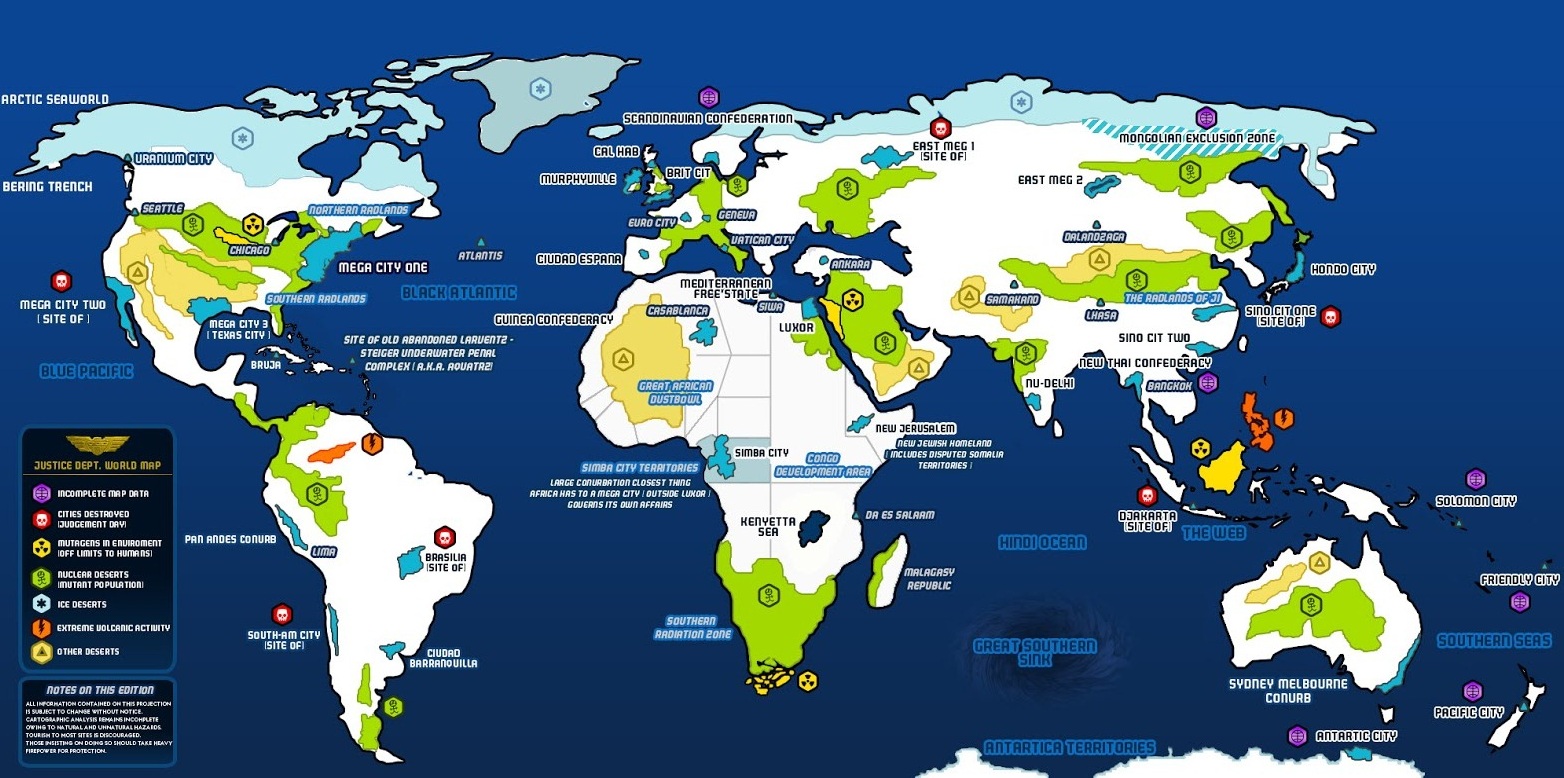
this time period is Mega-City One, a massive super-metropolis extending down
the Eastern Seaboard of the former United States, stretching from Boston,
Massachusetts to Charlotte, South Carolina and extending inland to the Great
Lakes and the Appalachians. Over 400 million people live in this vast area, many
of them crammed into huge tower blocks containing up to 50,000 people apiece.
By the early 22nd Century, AI, automation and robots have replaced all menial
jobs in the city and many others related to customer service and even medicine
and science. The unemployment rate swings from around 92% to 97%. The
overwhelming majority of the population survives on a basic, state-provided
income. Some people use their free time productively and energetically, creating
works of art or music or literature. Others do not, spending all day in front
of the television and eating unhealthily. Mega-City One is prone to fads or
crazes, where a new idea sweeps the city and people take it up in droves before
getting bored and moving on. Crazes can be relatively harmless to downright
unhealthy (competitive mass-eating, reducing people to immobile blobs trapped
in their apartments) to extremely dangerous (such as “Boinging”, or bouncing
around the city in indestructible plastic bubbles, causing immense property
damage along the way). Bored citizens sometimes get involved in crime or
tribalism. In the worst cases, this tribalism can boil over into Block Wars:
the people from one block blame the neighbouring one for having better food or
services, or stealing their water, or being too noisy, and they end up
fighting. Mega-City One is a seething cauldron of boredom, tensions and
grievances, constantly on the verge of boiling over.
The rest of
the Earth isn’t doing too much better. In 2070 a series of nuclear exchanges
reduced several large areas into radioactive wastelands. In the United States
only Mega-City One on the east coast, Mega-City Two in California and Texas
City in the south survived. The rest of the country was reduced to a burned-out
ruin known as the Cursed Earth, inhabited by criminals, exiles and mutants.
Other mega-cities exist in Asia, Australia and Europe, but most of Africa is
uninhabitable. Sea levels have risen modestly, flooding low-lying areas, but
the seas are also polluted (the Atlantic, for example, is now known as the
Black Atlantic for the garbage and pollution that infests it, with most forms
of marine life made extinct).
The world of
Judge Dredd is, of course, a massive
exaggeration of what could come to pass. But there are nuggets of truth in its
setting which are becoming eerily more prescient as time passes.
Postcapitalism, or How a Robot Stole
My Job
In the world
of Judge Dredd robots of varying
degrees of sophistication have replaced menial workers and factories are almost
completely automated (with only a few human overseers or supervisors).
Computers and AI systems handle everything from food deliveries and
transportation to intricate medical procedures. An early Dredd story, The Robot Wars (1977),
has one robot named Call-Me-Kenneth become self-aware and attempt to lead an AI
uprising to destroy humanity, but he is halted and new safeguards introduced to
stop this from happening again. As a result of this automation, well over 90% of
Mega-City One’s population is unemployed and surviving on a basic universal
income.
This
possible outcome has been mooted many times in science fiction but actual
economists and politicians have always scoffed at the idea. They point to
history: when the spinning jenny was invented in the north of England in the
1760s, the inventor’s house was broken into and his machines smashed by people
angry that his increased productivity would lower prices (which was correct) and
destroy jobs (which was incorrect), since one worker with a spinning jenny could produce cloth at
roughly eight times the rate of a worker by hand. However, market economics
always favour increased productivity over reduced costs, so companies with the
jennies would rather increase output (and thus profits) 800% rather than cut
labour costs. Indeed, the increased profits were used to buy bigger premises and employ more people, resulting in the invention of factories and mass industrialisation as we know it.
The same was true of almost every major technological invention and innovation
from the middle of the 18th Century to the late 20th.
However,
this movement has been reversed in recent decades. Large factories have been built (mostly in Asia but increasingly in Europe and
the Americas) which are very nearly completely automated. Cars are constructed
and built on assembly lines with minimal human oversight. One computer server
can now hold and retrieve records that used to require a battery of clerks to maintain.
A company like Amazon can hold, buy and sell goods across the entire planet
with a few thousand employees (mostly in warehouse stacking and retrieval jobs
which themselves are vulnerable to automation) whilst traditional retail
companies require thousands of stores, each with a dozen or more employees, to
do the same thing. All of these innovations are built on cost savings:
computers, AI and robots are cheaper to build and mass-produce than workers are
to train and hire, they never go sick, they never need holiday pay and they’re
unlikely to sneak off to the toilet to check on their Facebook feed. Adding
more people to these high-tech industries will increase costs and lower
productivity and profits rather than increase them. The recent suggestion that jobs outsourced to China could return to Europe and the United States has been surprisingly positively received because many of these jobs have since been largely automated and it doesn't matter at all if a robot is based in China or the USA.
More
recently we have seen traditional jobs in customer services requiring human
interaction being lost to self-service machines, not just in supermarkets but
increasingly in banks. The rise in personal banking over the Internet has also
seen thousands of bank branches (with their attendant jobs) all over the world
being shut down as people switch to more convenient ways of banking.
The sudden
advent of self-driving technology, being pioneered by companies including Uber,
Google and Tesla, is an even more alarming threat to traditional jobs. Driving,
either taxis or trucks for mass transport of goods, is a valuable source of
income for low-skilled workers. In less than a generation, we may see the
majority of these jobs disappear in favour of vehicles that can stay on the
road 24/7, never get lost, (hopefully) never have accidents and never
overcharge their passengers.
Some
countries are moving to tackle the issue: Finland is trialling a basic income, where people get enough money to survive from central
taxation and anything they earn through work is added onto that amount. A
similar trial in Aquitaine in France is also planned, and the Pirate Party in
Iceland is advocating for a trial of their own. Economic models in Europe,
where taxes are generally higher than the United States, indicate that a basic
income is both possible and sustainable, and has positive outcomes (one study
showed that only 1 in 10 people on the scheme voluntarily chose to stop
working, and most of those were older people close to retirement anyway or
parents choosing to spend more time with their children). Such a system would
be harder to implement in countries such as the United States, as it would
require a near-doubling of taxes to be sustainable. In the UK it would be more
achievable due to the UK’s over-complex morass of tax credits and rebates, not
to mention the enormously expensive welfare state bureaucracy. Eliminating all
of these would move the country some way to affording a basic income (which
would replace them).
The idea of
a basic income is controversial, since it suggests that during the likely
decades-long transitional period there would be people who worked hard to
effectively subsidise other people who chose not to work at all: Switzerland
rejected the notion by 76% in a referendum last year. Although studies show
that relatively few people would voluntarily choose not to work at all, there
would no doubt be some who did that make that choice, increasing social division
and resentment. There is also the risk that those on a basic income in
areas with no jobs would soon find themselves in the “just about managing”
bracket with the temptation of engaging in crime to supplement their income.
This outcome drives a lot of storylines in Judge
Dredd and is also a troublesome outcome in James S.A. Corey’s Expanse novels, where automation has
required most of the population of Earth to survive on a basic income (whilst
those in Mars and the asteroid belt have to work much harder just to survive,
to their annoyance). Still, it is another idea once consigned to SF that is now
being more actively discussed in the real world.

Democracy and the Law
One of the
more controversial aspects of Judge
Dredd is that the system Dredd works for is essentially fascism.
There are no elections and there are limitations on free speech. The argument
is that in a city of 400 million people, it is simply completely impossible and
unaffordable to go through lengthy trials, so the Judges are empowered to
punish people on-the-spot and decide if they are guilty or not, with no right
of appeal. Judges can fine citizens or sentence them to iso-cubes (small prison
cells), suspended animation or even execute them for capital crimes. The Judges
also act as officers in the city’s military (although it has both a small
regular army and a militia back-up, known as Civil Defence, who also provide
local security within the blocks) and fight on the front lines in times of war.
This blurring of the line between police, soldiers and the
judiciary is deeply concerning, and it should be. To paraphrase a famous line
from Battlestar Galactica, soldiers
are trained to obey orders without question and to see their opponents as the
enemy. Use soldiers for police work and they may see the civilian population,
the people they are supposed to be helping, as the enemy, and react (and
overreact) accordingly. The militarisation of the police has become a major
concern amongst civil liberties groups in the United States in the last few
years, and an issue in other countries where the threat of terror attacks has
given police and intelligence services unprecedented powers to investigate,
detain and even kill citizens whilst circumventing due process.
Another interesting aspect of Judge Dredd’s setting is that the United States Constitution and
its three-pronged system of checks and balances is suspended in 2070 by the
Judges (after an insane, populist American president elected to solve people’s
economic problems instead starts World War III through his own ineptitude) and
never reinstated. Dredd and many of the other Judges believe that democracy has
been proven to be a failure, constantly giving power to weak, corrupt and
selfish rulers and people are continuously shown to be voting against their
best interests. In the loosely-connected Democracy
story arc (running from Letter from a
Democrat in 1986 to America and Twilight’s Last Gleaming in 1991), Dredd
gradually shifts from this position after seeing the corruption possible in the
Judge system and eventually convinces the Chief Judge to call a referendum on
restoring democratic rule to elected officials. This referendum votes
overwhelmingly to maintain the status quo, reaffirming Dredd’s faith in the
system.
Writer John Wagner pointed out that this decision was
probably wrong from a moral perspective, but he felt having the democratic
system reinstated would shift the setting too far away from the satirical
points he wanted to make. In addition, it should be noted that shortly before
the referendum was held, Earth was attacked by an army of undead forces led by
Sabbat the Necromancer which obliterated Mega-City Two and killed hundreds of
millions of people before being stopped by Judge Dredd and the other Judges,
which may have had a minor (!) impact on swaying the vote. The ultimate message
is that, even with real outside threats at hand, the idea of suspending free
speech and voting in a strong leader may be attractive but ultimately
self-defeating. The comparisons with Nazi Germany in 1933 are of course clear.
From Time Out Hong Kong.
Mega-Cities in the
Making
The clearest area of prescience in Judge Dredd is in the Mega-Cities themselves. Indeed, they are
already here, and far earlier than anyone was expecting.
In 1985, eight years after the Judge Dredd strip started running, the Pearl River Delta region of
China was predominantly rural. The large cities of Hong Kong and Guangzhou were
located in the region along with numerous smaller towns, but this area was
still dominated by farming and agrarian pursuits.
In 2017, that situation is completely different. Nine cities
now exist in the region and are close to amalgamating into one massive
mega-city with a population of approximately 54 million, making it easily the
most populous conurbation on Earth. Behind it is the Greater Tokyo Metropolitan
Area in Japan, with a population of 38 million, which is also likely to
amalgamate with Nagoya and Osaka in the near future to form a city dominating
most of the country (a forerunner of the Hondo mega-city in Judge Dredd).
Indeed,
Mega-City One itself
is taking shape. The Greater New York Metropolitan Area has a population of
24 million and is already not far from linking with Philadelphia, Baltimore and
Washington, DC to form a single massive mega-city dominating the east coast,
the Northeast Megalopolis (informally, “BosWash”). This conurbation is also
likely to extend east to link up with Providence and Boston, and some (such as
William Gibson in his
Sprawl novels
starting with
Neuromancer) have
speculated it could extend as far south as Atlanta. The
Judge Dredd timeline speculates this could happen by 2050.
However, it does not appear likely that the real Mega-City
One will ever get close to 400 million people. Current population trends show
that the explosive population growth of the 20th Century is already
starting to lessen and the world’s population will (probably and hopefully)
never exceed 12 billion by the late 21st Century, with it expected
to fall modestly after that point. Hopefully that one particular vision of
Judge Dredd, with thousands of people
crammed into crime-ridden arcology towers surrounded by freeways in
near-permanent gridlock, will remain science fiction. But the comic,
inadvertently or not, has identified a number of other serious societal and
economic issues that will become very real concerns in the near future.
Thank you for reading The Wertzone. To help me provide better content, please consider contributing to my Patreon page and other funding methods, which will also get you exclusive content before it goes live on my blogs.