Due to the high popularity of the new
Doctor Who, it's not uncommon to see people asking online about what stories from the original series they should check out. Here are my recommendations.
Note: whilst I have watched a significant number of
Who stories in my time (thanks to the relatively low-priced VHS releases of the series in the 1980s and 1990s), I haven't seen all of them. And before people ask, no I haven't seen
The Talons of Weng-Chiang or
Pyramids of Mars.
Also note that this list is in chronological order, not any order of merit.
 An Unearthly Child
 (episode 1 only)
23 November 1963, Season 1
Doctor Who's first episode was broadcast on Saturday, 23 November 1963, and was almost completely ignored due to events that had transpired just a day earlier in Dallas, Texas. The episode was subsequently repeated a week later, where it got more attention. This episode revolves around two schoolteachers, Ian Chesterton and Barbara Wright, who become concerned over the behaviour of one of their students, Susan Foreman. They decide to talk to Susan's guardian, her grandfather, only to discover that the address she gave the school is for a junkyard, the only notable feature of which is a police telephone box...
This first episode of
Doctor Who is talky and tense, with the Doctor (played with a stern, authoritative air by William Hartnell) shown to be an ambiguous figure as he tries to work out what he's going to do about these two teachers who have stumbled upon the secret of the TARDIS. The rest of the four-part story is dull as dishwater (the Doctor and his companions become involved in a dispute between two opposing tribes of cavemen and inadvertently end up giving them the secret of fire), but this first episode is an effective opener to the series.
 The Dalek Invasion of Earth
21 November-26 December 1964, Season 2
Doctor Who's opening story may have not been a great success, but its second turned it into must-see TV.
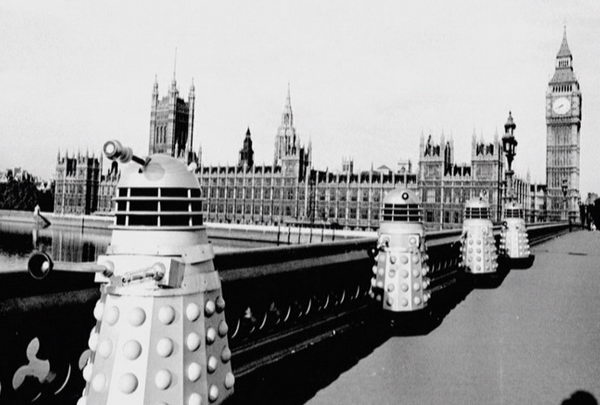
The Daleks introduced the Doctor's most enduring foes and triggered the phenomenon of 'Dalekmania', which swept across the UK for much of 1964-66. This second Dalek serial saw the BBC respond to the success of the series by giving it a ramped-up budget, allowing generous amounts of location shooting in London. The premise is extremely simple: the Doctor and his companions arrive on Earth in the mid-22nd Century to find it under Dalek occupation. The team are split up among several different groups of prisoners, quislings and rebels and undertake separate adventures until their paths cross again for the epic showdown. By the standards of the time, this is a big story, well-paced (unlike most of the contemporary six-episode or longer serials, which are glacial by modern standards) with a large cast and some great set-pieces. The story also introduces some enduring ideas, such as the notion of a black-cased 'Dalek Supreme' and the pain the Doctor experiences when one of his companions departs (here even moreso, as it's his granddaughter Susan who elects to remain behind on post-occupation Earth), ideas that even the new series has continued to mine.
 The War Games
19 April-21 June 1969, Season 6
Making a pick for the Second Doctor, Patrick Troughton, is difficult as his surviving stories tend towards the 'cheesy bollocks' (most notably the so-bad-it's-glorious
The Dominators, in which two aliens try to conquer a planet with the help of impractical shoulder pads and some very dumb robot servants). Basically it came down between
The War Games and
Tomb of the Cybermen, and
Tomb has to lose out due to the astonishingly bad acting of quite a few of the supporting cast (though the Cybermen waking from their tombs of ice is still a haunting image).
The War Games is a long, long story, weighing in at 10 episodes, but the four-hour length just about works due to a shift in focus every few episodes. The first few episodes see the Doctor, Jaime and Zoe arriving on Earth during WWI and get involved in various shenanigans on the Western Front. However, it is eventually revealed that they are really on a planet divided into historical timezones where unknowingly-kidnapped soldiers from different periods of Earth history fight it out whilst aliens study them. After exploring a couple of the zones, the story takes an unexpected turn when we discover that the aliens' time travel technology is the creation of the War Chief, an exile from the Doctor's home planet. As the Doctor and the War Chief face off, it becomes clear that the War Chief is a pawn for the leader of the aliens, the War Lord (a formidable performance by British character actor Philip Madoc, who brings 100% deadly earnestness to the role). Where the story succeeds is that it throws the Doctor for a loop every time he thinks he's solved the crisis, with the War Lord shown to be a remorseless foe who may be more than a match for the Doctor. Patrick Troughton, always a strong actor as the Doctor, is tested more than in any other story and rises to the occasion, showing the Second Doctor becoming increasingly frustrated and desperate as the crisis escalates. Eventually, the Doctor's resolve to defeat the War Lord cracks and he calls in his own people, the hitherto enigmatic (and unnamed) Time Lords, to sort it out for him!
This then leads us into the extremely different and hugely revelatory final episode, in which the Time Lords, having dealt with the threat of the War Lord, now bring the Doctor to trial for his crimes of interfering in the affairs of other planets. The Doctor puts on an impassioned defence of his desire to fight evil and injustice wherever it may be found, which doesn't seem to move the emotionless Time Lords...until they read out the verdict, in which it appears that the Doctor's arguments have indeed swayed them, and he is exiled to Earth in the 20th Century. A rather grim final episode with an ending that is rather mixed in its outcome: the Doctor survives, but he loses his companions and (temporarily) the use of the TARDIS, and sets up a very loose story arc that unfolds over the next three seasons. Fans remain divided to this day on the morality of the Time Lords 'killing' the Second Doctor by forcing him to regenerate as well.
 Day of the Daleks
1-22 January 1972, Season 9
Day of the Daleks is a clever story as it's one of the vanishingly few times the original series dealt with temporal paradoxes (Steven Moffat has used the temporal paradox story idea more times in his two seasons in charge than in the entirety of the original series, for example). The Doctor (now played as more of an action hero by Jon Pertwee) is highly confused to find that Earth in the 22nd Century is again under the rule of the Daleks (since he defeated them in
The Dalek Invasion of Earth) and learns that time-travel has resulted in the creation of an alternate future. Ironically, it's not the Daleks' fault, but rather that of the well-meaning rebels who are trying to stop them. The story is a tense affair as the Doctor tries to repair the timeline in the future, but in the present UNIT are put on alert by the apparently-imminent outbreak of World War III. Aubrey Woods gives the main human villain, the Controller, a sense of depth as he is shown to be ravaged by guilt for his actions as a collaborator of the Daleks, whilst
Doctor Who gains a new race of villains with the entertainingly dumb Ogrons (footsoldiers of the Daleks). Crucially, the Daleks are not overused and are kept in the background throughout, Machiavellian masterminds rather than easily-defeated soldiers.
 The Sea Devils
26 February-1 April 1972, Season 9
One of the best things about the Pertwee Era was the relationship between the Doctor and his arch-nemesis, the Master, played in this incarnation by Roger Delgado. The Doctor and the Master here are portrayed as the alien equivalent of Sherlock and Moriarty, well-matched opponents who both hate and respect one another.
The Sea Devils opens with the Master in prison and the Doctor paying a visit to the apparently reformed villain, but unsurprisingly the Master is soon revealed to be up to his old tricks. This time, he's in cahoots with the Sea Devils, an off-shoot of the Silurians (the original inhabitants of Earth who are in stasis far below the planet's surface, awaiting the chance to return; they most recently appeared with Matt Smith last year), who are planning to conquer the Earth etc. A lot of the story is rather forgettable, to be honest, but it's the game of cat and mouse between the Doctor and the Master which is most fascinating, especially when it escalates to a literal fencing match between the two (here enhanced with lightsabre effects because...erm...why not?).
 The Ark in Space
25 January-15 February 1975, Season 12
In 1974 Tom Baker took over the role of the Doctor, bringing an element of demented insanity to the role that, in later seasons, took over the show to its detriment. Early on, however, Baker delivered a series of iconic performances where his humour, intelligence and dramatic skills were kept in balance.
The Ark in Space is a perfect example of this, as the Doctor's comic early exasperation with new companion Harry Sullivan gives way to probably his finest speech about why he likes hanging around human beings so much (a speech so iconic even the new series has referenced it) upon viewing the thousands of humans in cryostasis on an immense space station:
"Homo sapiens, what an inventive, invincible species. It's only a few million years since they crawled up out of the mud and learned to walk. Puny, defenseless bipeds! They've survived flood, famine and plague. They've survived cosmic wars and holocausts. Now here they are out among the stars waiting to begin a new life, ready to outsit eternity. They're indomitable."
Later on, things go a bit
Alien as parasitical lifeforms attach themselves to the sleeping humans and turn them into ferocious monsters. Ignoring the fact that the alien grubs are clearly covered in green-painted bubble-warp, this was probably the scariest and most horrifying episode of
Doctor Who to this time, marking the beginning of a period when
Who was frequently criticised for being too disturbing for children to watch. But overall this is a well-written, dramatic and slightly disturbing story.
 Genesis of the Daleks
 8 March-12 April 1975, Season 12
After another period in which the Daleks had been heavily over-used, the production team decided to rest them for a while. But before they bowed out, Dalek creator Terry Nation decided to write a story exploring the creation and origin of the Daleks. He introduced their creator, the crippled, insane scientist Davros, and had the Doctor face an ethical dilemma as he is ordered by the Time Lords to destroy the Daleks at the moment of their creation (this move was later retconned as the opening salvo in the Time War). The Doctor thus spends the serial agonising over the morality of genocide even as the humanoid Kaleds and Thals slaughter one another with shocking abandon. Nation uses Nazi imagery to further make it clear that Davros and the Kaleds are Not Nice People, though the violent Thals hardly come out of it any better. This is
Doctor Who at its most morally murky, but also at its most dramatic and watchable. A terrific story in which, again, the Daleks are purposefully kept off-camera as much as possible to make their appearances more memorable and powerful.
 City of Death
 29 September-20 October 1979, Season 17
City of Death may be the single most totally-bonkers story in the history of the series. Written by Douglas '
Hitch-Hiker's Guide to the Galaxy' Adams and filmed partially on location in Paris with a totally random cameo by John Cleese and Tom Baker's comedic skills being fully unleashed,
City of Death is an unabashed joy from start to finish. Baker has some golden lines ("What a delightful butler, he's so violent!") and the plot is bananas (an exploding alien spaceship half a billion years ago splits its pilot into several incarnations scattered through Earth's history), but a key element here is Julian Glover (most recently seen as Pycelle in
Game of Thrones) giving a steely, well-judged performance as the main villain. Boundlessly inventive and propelled by palpable cast enthusiasm, this is
Doctor Who at its funniest and most entertaining.
 The Caves of Androzani
8-16 March 1984, Season 21
Peter Davison's sojourn as the Fifth Doctor comes to an end in a remarkably grim and 'different'
Doctor Who story. Directed by Graeme Harper (the only director of the original series invited back for the new one) and written by the ever-reliable Robert Holmes (he also wrote
The Ark in Space), this story pits the Doctor and Peri against the disfigured and violent Sharaz Jek (a blistering, intense performance by Christopher Gable). However, the situation is complicated by political machinations between Jek's allies and enemies, and frankly none of the characters come out of the situation very well. With its cast of fully-realised characters (each of whom has a fully-fleshed out motivation for what he's doing), this is
Doctor Who at its best-written (and, frankly, not a single story since, not even the splendid
Blink or
The Doctor's Wife, matches it). It also features the best regeneration to date, with Peter Davison's Doctor having to will himself through a difficult rebirth, egged on by visions of his past companions and threatened by images of his greatest enemy, the Master. The final scene, of the new Doctor Colin Baker rather threateningly saying that change has come, "Not a moment too soon," promises more than subsequent stories deliver, however.
 Remembrance of the Daleks
5-25 October 1988, Season 25
A tricky choice, since
Remembrance does feature some of the weakest guest stars of Sylvester McCoy's admittedly difficult era, but Ben Aaronovitch's script is very strong and it's certainly one of the most ambitious
Doctor Who stories. It brings us full circle back to the events of
An Unearthly Child, being set just a few days after the Doctor, his granddaughter and two teachers vanished from Earth in late 1963, and we discover exactly why the Doctor was on Earth in the first place: to recover the Hand of Omega, an immensely powerful artifact capable of manipulating stars. No less than two factions of Daleks are also on the trail, and as they get closer to the device this results in some epic battles on the streets of London (the fact that the other three serials of Season 25 look like they had a combined budget of 25p is probably explained by this), most notably when the ludicrously over-powered Special Weapons Dalek is deployed which can take out streets full of enemy Daleks with a single shot.
But beyond the fireworks, it's McCoy's performance as the Doctor as a grand chess-master, orchestrating events from behind the scenes and manipulating others - even his companion Ace - into doing what he wants which really stands out. This is one of the few times in the show's history that the Doctor himself sets in motion the events of the story rather than being reactive to it, and that simple change elevates the story to a new level, as does its raising of normally-ignored issues like racism in 1960s London.
So there we go. Ten stories from the original run of
Doctor Who that I think are pretty good stuff (bearing in mind that some dating and aging of things like special effects and filming techniques have taken place).