Saturday, 13 August 2016

Playing the Wild Card: A Reading Order to George R.R. Martin & Melinda Snodgrass's Superhero Universe

The news last week that Universal had taken out an option on the Wild Cards shared world superhero series seems to have awoken some renewed interest in the franchise. Wild Cards has been an ongoing project since 1987, now encompassing twenty-three books and contributed to by thirty-one authors, so it may be helpful to arrange this into some kind of structure suitable for newcomers.

 
The Premise

In 1946 Earth was nearly destroyed by an alien race known as the Takisians. Genetically identical to humans, a rogue Takisian house decided to field-test a new virus on the planet to assess the effects on a large population before deploying it against its enemies. Prince Tisianne, one of the creators of the virus, had second thoughts on moral grounds and pursued the test ship to Earth to destroy it. He successfully halted the release of the virus into Earth's atmosphere, but was detained by American military personnel. During his detention, a human criminal named Dr. Tod recovered the virus and used to it to blackmail the American government, threatening to release it over New York City unless he was paid $20 million.

Dr. Tod's bluff was called and he attacked New York in a massive dirigible on 15 September 1946: Wild Card Day. World War II flying ace Robert Tomlin - popularly known as "Jetboy" - helped destroy the airship at the cost of his own life, but the virus was still released. Fortunately, thanks to Jetboy's efforts, the virus landed in pockets across the city, reducing the death toll from the millions to ten thousand.

The virus had the following effects:
  • 90% of those infected died instantly.
  • 9% of those infected survived, but were mutated and deformed, becoming known as Jokers.
  • 1% of those infected survived and were granted amazing powers, becoming known as Aces.
Unfortunately, the impact of the virus was not confined to New York City. Wind currents carried the virus across much of the eastern seaboard, whilst some of the virus spores actually survived intact and were carried unwittingly in cargo planes and ships across the globe. Major outbreaks followed in Rio de Janeiro, Mombasa, Port Said, Hong Kong and Auckland, with smaller outbreaks in many parts of the world.

The virus was also genetically transmittable, most commonly from parents to children. As a result of propagation, the number of people affected by the wild card virus, although still a minuscule minority of the human race, was still rising in the early 21st Century, seventy years after its arrival.

Prince Tisianne elected to remain on Earth and help make amends for the impact of the virus. Dubbed Dr. Tachyon by the press (for his spacecraft's FTL drive) and possessing immense telepathic powers, Tisianne is counted as an Ace although his powers are innate to his species rather than drawn from exposure to the virus. In the 1980s Tisianne returned to Takis and learned that the Takisian faction that had tried to test the virus on Earth had fallen from power, and there was no further threat to Earth from his people.

The first Wild Card book (and several stories in later volumes) spans the period 1946-86, showing how the existence of the Jokers and Aces alters the course of history. These reveal that a chunk of Manhattan has been turned into "Jokertown" where Jokers (and some Aces) are forced to live in a ghetto by a population fearful of their horrible appearances, and that a civil rights movement for Jokers later gets underway. Meanwhile, some Aces are employed by the American government, some go solo as vigilantes and some become villains. These stories also expand on the impact of the virus: we get to meet Deuces, Aces whose powers are useless or seem so, and Joker-Aces, Aces who have amazing powers but also the deformed and unpleasant appearance of Jokers.

From the second volume onwards, the stories proceed roughly in real-time, taking place approximately analogous with the year the book was released.

In 2008 the series was "rebooted" with the eighteenth volume in the series, Inside Straight, which picks up five years after the previous volume with a "Next Generation" approach, focusing mainly on new characters (although older ones are referenced or show up in smaller roles). This was done to create a second, easy entry point to the series for new readers.


Characters

There is no central character in the Wild Cards universe, with instead the stories moving between a rotating cast of characters at different periods of time and in different locations. That said, several of the most notable characters are as follows:


Thomas Tudby, aka "The Great and Powerful Turtle"

Tudby is a powerful telekinetic who can move vast amounts of matter with his mind: he once lifted a 45,000 ton American warship. However, his powers falter if he becomes scared or nervous. To render himself immune to attack, he used his powers to create a shell out of old motor car bodies, which he can then levitate and fly around. This led to the nickname of "the Turtle". The Turtle played a major role in several incidents of the late 1980s and early 1990s before revealing his identity to the world and effectively retiring. Formerly respected by Aces and Jokers alike for his bravery, his later writing of his memoirs and authorising of a film based on his life led to accusations of him "selling out".

The Turtle is regarded as George R.R. Martin's signature character, as well as the one most closely based on the author himself, also being from New Jersey and a massive comic book fan. Whether George R.R. Martin also has monstrous powers of telekinesis has not yet been confirmed, although it is known that he can get tens of thousands of people to freak out by simply mentioning words like "Winter" on his blog.


Croyd Crenson, aka "The Sleeper"

Croyd has arguably the weirdest ace power of them all. Every few months he goes into a deep sleep, lasting anywhere from weeks to months. When he wakes up, he is not only still alive but he will have attained a completely new appearance and set of powers. Two-thirds of the time he wakes up as an Ace or Joker-Ace, but one-third of the time he will take the form of a Joker with no powers and a disturbing appearance. He retains his memories over transformations but loses all other identifying marks, including fingerprints. His next appearance can be of any age, so it is unclear if he is immortal or if his body is still ageing normally (in which case he would be almost ninety years old).

Created by the late Roger Zelazny, but used by other writers with his blessing, the Sleeper is arguably the most popular Wild Cards character and the most versatile.


Jack Braun, aka "Golden Boy"

Braun became one of the most recognisable and famous Aces after the virus was released. His powers grant him immortality (he looks the same now that he did in 1946), super-strength and virtual invulnerability. He is not completely indestructible (a large enough explosion could kill him and he is vulnerable to poison) but he is pretty close. Braun fought as part of a superhero team known as the Four Aces after the virus, but in 1950 betrayed his comrades during the McCarthy witch hunts. After a stint as a Hollywood actor, he felt guilty about his actions and went into seclusion, emerging rarely thereafter. In 2008 he uncharacteristically agreed to take part in a reality TV show, serving as a "boss" the contestants had to defeat. Despite his shunning of the limelight, he liked the fact that no-one cared who he was any more.


Prince Tisianne, aka "Dr. Tachyon"

Dr. Tachyon is one of the Takisian scientists who helped create the wild card virus. Later repenting his actions, he tried to stop the deployment of the virus on Earth. He failed. Riven by guilt, he decided to stay and make amends by helping with Earth's technological development, the treatment of those infected by the virus and cataloguing the powers of the Aces. As Takisians are genetically identical to humans, he can pass as human with no problem. He is quite short and enjoys dressing in eccentric clothing. He has tremendous telepathic powers.

Dr. Tachyon was a character of primary importance in the first ten books in the series. However, he was then written out when he returned to his homeworld and stayed there. It is unknown if he will appear again.


Novels or Short Stories?

Wild Cards has been described as a series of novels and as a series of short story anthologies, although neither description is entirely accurate. It is fairer to say that Wild Cards is, taken as a whole, an alternate history of the world (but predominantly the United States) from 1946 to the present day. Single-author novels, multiple-author novels (known as mosaic novels), stand-alone short stories and short stories linked by chronology, location or thematic elements all combine to fill in this history. The Wild Cards series is also not defined by a single over-arcing narrative. This is no single story with a beginning, middle and end, but a whole series of stories set in a shared world. It is perfectly possible to read and enjoy books from the middle and even more recent period of the series without having read the rest first.


In-Print or Out of Print?

The problem of catching up with the series is also exacerbated by many of the middle books in the series being long out of print. Both Tor Books (in the USA) and Gollancz (in the UK) have embarked on ambitious plans to reprint the entire series, but both are proceeding incredibly slowly: Tor, slightly ludicrously, is only releasing the books at a rate of one a year and has only reached the fifth book (the sixth is out in February). This means they should complete the reprinting of the series in 2028. Meanwhile, Gollancz seem to have stalled after the publication of the seventh volume last October, with no more releases scheduled at present.


Why Not Omnibi*?

More than once it has been suggested that reprinting the series one-by-one has been inefficient, with a better way forwards being to reprint the books as omnibuses with three or four books per omnibus. This strategy was pursued by the Black Library with great success when it reprinted most of its Warhammer 40,000 output as massive, economically-priced omnibus and saw them sell over a million books in a short period of time. This method would be even more appropriate for Wild Cards, with narrative arcs often unfolding over three or four volumes. For their ebook editions, Gollancz has experimented with this process by collecting Books 1-3 as an omnibus called The Epic Beginning and Books 4-7 as The Puppetmaster Quartet. It would be interesting to see this expanded to the print editions as well (and yes, this would mean some very big books, but it worked brilliantly for the Black Library and for other publishers putting out big omnibuses), but no doubt this will depend on sales.


The Publishers

The Wild Cards series has been published by four distinct publishers to date: Bantam Spectra released Books 1-12, whilst Baen Books released Books 13-15. iBooks picked up Books 16 and 17 before spectacularly going bust. Tor Books have published Books 18-22 and will be publishing Book 23 later this year, and will remain the primary publisher of the series going forwards (three more books are under contract). The series has had several UK publishers but Gollancz are currently handling the series in Britain.


The Books

As previously mentioned, there are twenty-three books in the series. They are generally organised into "triads", arcs spanning three volumes but this name is something of a misnomer: Books 6 and 7 were supposed to be one book split into two for length, whilst Book 10 is something of a side-story  to the events of 8-9 and 11 (which form the triad proper and can be read in that order). There aren't really official titles for each triad, so they are more descriptive than formal:


The Beginning Triad
1. Wild Cards (1987)
2. Aces High (1987)
3. Jokers Wild (1987)

These first three volumes in the series introduce the wild card virus and chronicle the way it reshapes the history of the 20th Century. By the end of the second volume the series has already caught up with the then-present day (1987) and events in the series then unfold in real time (more or less). Book 1 introduces the premise and the original cast of characters, whilst Books 2 and 3 see the Aces learning of a potential alien invasion.


The Puppermaster Triad
4. Aces Abroad (1988)
5. Down and Dirty (1988)
6. Ace in the Hole (1990)
7. Dead Man's Hand (1990)

These four novels chronicle the machinations of the mysterious "Puppetmaster" and his eventual downfall, whilst numerous other events take place. Most notably, Book 4 explores the impact the wild card virus has had in other parts of the world beyond the United States.


The Jumper Triad
8. One-Eyed Jacks (1991)
9. Jokertown Shuffle (1991)
10. Double Solitaire (1992)
11. Dealer's Choice  (1992)

These four novels deal with the activities of a gang of body-swapping villains known as jumpers. Double Solitaire is notable for being a single novel written by Melinda Snodgrass rather than the usual rotating team of writers and stands apart in the continuity, being set on Dr. Tachyon's homeworld of Takis simultaneously with the events of Dealer's Choice.

As a note of trivia, George R.R. Martin started writing A Game of Thrones either whilst writing and editing work was proceeding on Jokertown Shuffle or just after it had been completed.


12. Turn of the Cards (1993)

This is a single stand-alone novel written by Victor Milan. The previous volume had finished off the jumper storyline and there was one book left on the contract with Bantam. Rather than start a new storyline, the editors decided to write a stand-alone book to fulfil the contract and retain the freedom to move to a new publisher if necessary.


The Card Sharks Triad

13. Card Sharks (1993)
14. Marked Cards (1994)
15. Black Trump (1995)

The series moved to Baen Books for this trilogy, which revolves around a protagonist who is neither an Ace nor a Joker. Although Baen offered a larger advance, they lacked the marketing muscle of Bantam. With no new books coming out, Bantam also let the older books go out of print, which effected both backlist sales and also meant that newcomers did not have an easy jumping-on point for the series.


16. Deuces Down (2002)
17. Death Draws Five (2006)

With sales for Baen being disappointing, the series moved again to iBooks for these two volumes. Deuces Down is unusual in being a true anthology, consisting of short stories from all over the Wild Cards history, unified only by the theme of focusing on Deuces, Aces with powers which are of only apparently marginal utility. Death Draws Five is a single novel written by John J. Miller with a stand-alone storyline, although it does feature the final appearance of original Wild Cards character Fortunato. Death Draws Five is the rarest Wild Cards book, as only a few hundred copies were published before iBooks went bust. These two books were recently reissued as ebooks from Brick Tower Press, who bought out the iBooks stock.
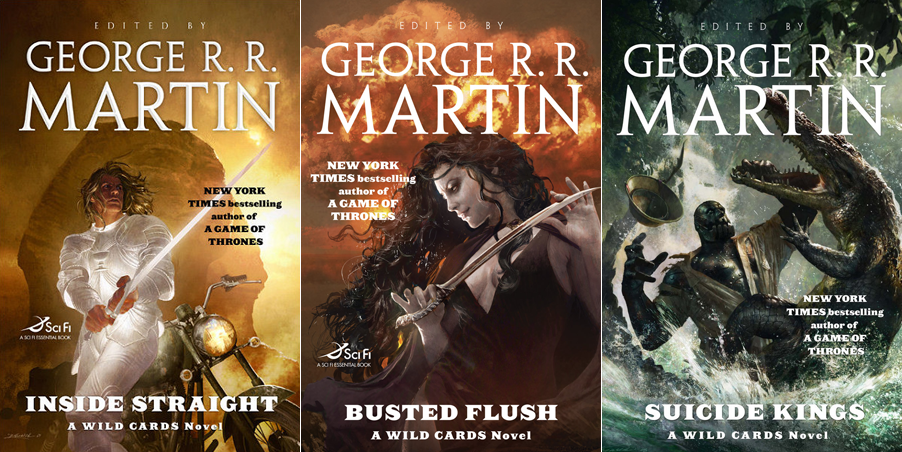


The American Heroes Triad (aka The Committee Triad)
18. Inside Straight (2008)
19. Busted Flush (2008)
20. Suicide Kings (2009)

The series moved to Tor Books for this triad, which works as a "Next Generation"-style entry point for new readers to the series and mostly focuses on new characters. The series initially focuses on a reality TV show revolving around Aces but then moves onto the formation of a new superhero organisation called the Committee.


The Jokertown Triad
21. Fort Freak (2011)
22. Lowball (2014)
23. High Stakes (2016)

This triad adopts a back-to-basics approach, focusing on the "Fort Freak" police department which has to handle cases in and around Jokertown in New York City.

The USA Triad
24. Texas Hold 'Em (tbc)
25. Mississippi Roll (tbc)
26. Low Chicago (tbc)

This forthcoming triad is under contract to Tor Books. According to George R.R. Martin, although it's unofficially called the USA Triad it's actually going to be three self-contained books linked more by location (presumably Texas, Mississippi and Chicago) than anything else. There are also potentially two more triads, which will have more traditional linking stories, under discussion.


Writers

Wild Cards evolved out of a roleplaying campaign run by George R.R. Martin using the Superworld rules from Chaosium. As the original games master, Martin is counted as the creator of the Wild Cards universe and the primary editor-in-chief, although all of the writers have a say in the future direction of stories and the series. Martin is a bit busy with his own fantasy side-project, so he no longer writes for the series (his last story was in Inside Straight almost a decade ago, and before that in Black Trump a decade earlier) but is still the main editor. Melinda Snodgrass, a respected science fiction and fantasy author and scriptwriter in her own right, has acted as co-editor on many volumes in the series and regularly contributes stories.

The other Wild Cards authors have been, or still are: Daniel Abraham, Edward Bryant, Pat Cadigan, Michael Cassutt, Chris Claremont, Paul Cornell, Arthur Byron Cover, David Anthony Durham, Ty Franck, Gail Gerstner-Miller, Leanne C. Harper, Stephen Leigh, David D. Levine, Victor Milan, John J. Miller, Laura J. Mixon, Mary Anne Mohanraj, Kevin Andrew Murphy, Cherie Priest, Lewis Shiner, Walter Simons, Caroline Spector, Ian Tregillis, Carrie Vaughn, Howard Waldrop, Sage Walker, Walter Jon Williams, William F. Wu and Roger Zelazny. The next triad will feature stories from new writers Saladin Ahmed, Max Gladstone, Marko Kloos and Diana Rowland.


Where to Start?

This is pretty straightforward. The most obvious answer is simply Wild Cards, the original 1987 book that started the whole thing rolling. It is easily available now, having been reprinted many times. However, you can also start with Book 18, Inside Straight (2008), the first novel from Tor Books which was deliberately written as a fresh entry point to the series for new readers, taking a "Next Generation" approach.
____
* Technically this is incorrect usage, but what the hell. It rhymes.

Ruin and Rising by Leigh Bardugo

The Darkling has won a stunning victory, seizing control of Ravka and the Grisha. His agents now hunt the land for Alina Starkov and her band of rebels. But Alina has one chance to win back victory: she alone knows the location of the third amplifier, which will grant her the power to destroy the Shadow Fold and the Darkling both. But her growing power also threatens to overwhelm her morality and judgement. Saving Ravka may mean losing herself...


Ruin and Rising brings the Grisha Trilogy by Leigh Bardugo to a close. This fantasy young adult series, riffing off YA and epic fantasy tropes and filtered through a Russian-inspired naming convention, has been engaging and energetic and this concluding volume continues along that path.

It continues the theme from the previous novel of Alina being torn between using her power to save her country and her friends, but worried that doing so will corrupt her absolutely. It's a powerful theme (if arguably overplayed in fantasy) but it's a little bit weakened here by the fact that it's clear Alina never would do anything so outright evil and the fact that defeating the Darkling is so important. Otherwise the book continues in a similar vein from the previous one, save that Alina and her friends are now on the run rather than working from the heart of Ravka's power.

The novel looses up a little and we have some stronger characterisation in the form of Alina's former arch-nemesis turned close associate Zoya, who has somehow convincingly become a friend and ally despite not really changing her character from a spoiled, overconfident aristocrat. This is a clever piece of character work that the author pulls off quite well. There's also more offbeat character tics, like the slightly demented Harsha (a fire Grisha who's a little too fond of fire) and his feline companion, Oncat. These add a bit more character and spark to proceedings.

There's also a nice twist where the spine of the novel, the search for the third amplifier, takes an abrupt turn that feels predictable in retrospect (it's well foreshadowed from earlier novels) but took me by surprise anyway. There's also the grand finale, which feels like it is riffing off the ending to a major late 1990s TV fantasy show, which I always thought was an excellent an unconventional way of ending a fantasy series about a Chosen One but hadn't seen replicated in literature until now. It certainly gives rise to a neat and suitable ending.

Some of the complaints about the series from the earlier novels remain in force. Sometimes things happen far too fast without proper appreciation for the consequences, travel time and distances are all over the place (Alina seems to allow her team maybe three days maximum to explore a whole, massive mountain range for a creature with no knowledge of its location) and the Russian influence seems to be limited solely to the names with little evocation of actual Russian history or culture: on that basis Peter Higgins's Wolfhound Century trilogy is altogether more successful in creating a faux-Russian atmosphere. Mal, although a bit more likable in this novel, also remains an unengaging and sometimes wooden protagonist.

But overall, Ruin and Rising (***½) is a fine and readable conclusion to what has been an entertaining and diverting trilogy, but it does feel like there is some unfulfilled potential here. It is available now in the UK and USA.

Friday, 12 August 2016

HarmonQuest: Season 1

Fantasy roleplaying! A bunch of friends create characters - wizards, elves, thieves, dwarves, sorcerers and what have you - and make their way through a vivid world created and controlled by the Dungeon Master Gamemaster. Various attempts have been made to capture the fun of roleplaying and put it on the screen, but they've largely ended up being a bit poor.


HarmonQuest takes a different tack by combining fantasy roleplaying with improvisational comedy in the vein of Whose Line Is It Anyway? Just typing that makes me realise how blinding obvious an idea it is and why no-one thought of it years ago and cashed in. HarmonQuest features three regular players: Dan Harmon, the famous comedy writer (Community, Rick & Morty) and podcaster (Harmontown); comedian Erin McGathy; and actor Jeff Davis. Respectively, they play half-orc ranger Fondue Zoobag, elven barbarian Biaro Shift and goblin rogue Bone Weevil.

There is also a special guest slot which is filled in by a rotating cast of comedians and actors: Paul F. Tompkins, Ron Funches, John Hodgman, Rhea Butcher, Kumail Nanjiani (as a pathological gold and handjob-obsessed kobold), Matt Gourley, Steve Agee, Chelsea Peretti (Brooklyn Nine-Nine) and Thomas Middleditch (Silicon Valley), along with an excellent appearance by the immortal Nathan Fillion (Firefly, Castle). The greatest turn, arguably, comes from the mighty Aubrey Plaza (Parks & Recreation) as the randomly insane gnome Hawaiian Coffee. The in-joke is that the guest characters can't continue into the next episode, so they have to be introduced to the adventure, fulfil a vital story role and then be written out (usually killed off in a ludicrous manner, but a couple survive) in an organic fashion, all in an hour (the episodes are the edited half-hour highlights of each game session).

That's a tall order for any Dungeon Master Gamemaster, but fortunately HarmonQuest employs the impressive skills of Spencer Crittenden, a GM for the ages. His ability to let the crazy comedy play out when it should, reign in the insanity when it threatens to completely sidetrack the adventure and pushing the story forwards whilst adapting for his players' impressive improvisational skills is completely amazing. I feel a better Gamemaster for just having watched him in action.

The adventure itself is splendid, old-skool fun: Fondue and Bone Weevil's favourite village haunt is destroyed by an evil cult seeking to unleash a powerful manticore upon the world. Teaming up with barbarian warrioress Biaro, they try to stop the cult getting its hands on the three gems it needs to complete the summoning ritual. This doesn't entirely go to plan. Along the way they have to deal with Fondue's unresolved childhood issues and confused sexuality (Harmon basically making a one-man argument in favour of characterisation in roleplaying), Bone Weevil's need for respect and Biaro's tendency to hulk out in a barbarian rage. There's some excellent running jokes but it's the guest actors that really make the show, each one bringing a different sensibility and style to the story which mixes things up nicely.

The big trick in the bag is that each episode of HarmonQuest is partly animated, with the live-action shots showing the actors and players discussing what they want to do and animated segments showing the result of their plans. The animation is colourful, well-characterised and quite funny. This is HarmonQuest's ace in the hole which lifts it from being simply entertaining to occasionally bordering on genius.


It's all very, very funny, although some episodes are funnier than others: the first, fifth and last ones are the stand-outs but even the weakest installment still unleashes regular laughs. Interestingly, the actors who have serious Dungeons and Dragons fantasy roleplaying experience seem to be the least amusing, as they take it all a bit too seriously, whilst those who have never played seem to do the best as they don't worry about the rules, just having a fun time.

I'd be interested to see that audiences with no fantasy roleplaying background at all make of it, but the show pulls back on anything to do with the rules in favour of the story and laughs so it should be pretty accessible for everyone.

Season 1 of HarmonQuest (****½) is excellent, being clever, funny and featuring a surprisingly well-executed story. I recommend it very much.

You can see Episode 1 on YouTube (embedded above) but the remaining nine episodes are only available (right now) on the Seeso streaming service in the United States. I imagine there will be some kind of international release (Netflix? Amazon?) for those wanting to watch the show in other parts of the world.

Note: the fantasy roleplaying game that is being used is the excellent Pathfinder from Paizo Publishing and, as Harmon rather worriedly points out several times, absolutely not Dungeons and Dragons in any way, shape or form, and certainly not any that suggests anything even vaguely copyright-infringing.

Siege and Storm by Leigh Bardugo

Alina Starkov is the Sun Summoner, able to wield tremendous powers of light. She wants to use this power to burn away the Shadow Fold and reunited the sundered land of Ravka, but is opposed by the Darkling, leader of the Grisha, a former ally turned mortal foe. Fleeing across the ocean to the continent of Novyi Zem, Alina hopes to find sanctuary. But the reach of the Darkling is a long one...


Siege and Storm is the middle volume of the Grisha Trilogy by Leigh Bardugo and follows up on the ending of Shadow and Bone. The novel is divided into several distinct sections, the first set in Novyi Zem. I was looking forward to seeing Alina and Mal in a new environment where Grisha are rare and the rules of the land are different, but this lasts a bare handful of pages before we're scooting back across the sea to Ravka. One of the main appeals of this trilogy is that the author doesn't hang around and blitzes from plot beat to plot bear with impressive skill and speed, but this felt a little too abrupt.

After this point is a series of sea battles and some impressive use of Grisha powers to create new weapons and technology (such as Grisha wind summoners fuelling sky-skimming warships), as well as Alina gaining the power of a second amplifier to increase her magical powers. This also increases the risk of her being corrupted by her power the way the Darkling was by his, and the book manages to extract more tension than you'd expect from the notion that Alina might give in to her power and either turn evil or lost control of it. This is helped by the fact that the Darkling becomes more than a villain in this second volume, he also becomes a symbol of Alina's thirst for more knowledge and the power to do good.

It's a strong idea, but is undermined by the fact that Alina never really does anything too heinous with her enlarged powers and you never really buy that she's going to be slaughtering lots of innocent people.

The latter half of the book, in which Alina has to mobilise a Grisha army against the Darkling, is good fun as Alina recruits and retains Grisha warriors, has relationship angst with Mal and is drawn against her will into the political maneuvering for control of Ravka between two feuding brothers. It's all fun but played a little too safe. It's not until near the end of the book that we get some major moments of dramatic power and some action scenes. These scenes are certainly impressive, but they are set up in a rather contrived manner where one character doesn't tell the rest what's going on, because if he did the bad guy's plan would simply never work.

Siege and Storm (***½) is an entertaining and enjoyable read. Unfortunately the atmosphere of the book feels like it's taken a knock from the predecessor. The first novel, if only intermittently, channeled its Russian inspiration into the environmental descriptions and cultural details of the book. In this second volume it feels like it's been reduced to simple linguistic variations. In addition, the book feels like it's too fast-paced when it should slow down a bit (at the start) and then too slow-paced when it should pick up (in the latter part). The result is a book that's breezy and fun, but maybe a little bit more lightweight than it should be. The novel is available now in the UK and USA.

RED DWARF XI to launch on 22 September

British TV station Dave has confirmed that the eleventh season of Red Dwarf will start airing in the UK on Thursday 22 September at 9pm.


Red Dwarf, created by British writers Rob Grant and Doug Naylor, is the longest-running British sitcom overall and the longest-running science fiction sitcom in history. It tells the story of Dave Lister, the last human being alive in the universe after he is put into suspended animation for three million years. His only company is a humanoid creature which evolved from his pet cat, a neurotic mechanoid and the holographic recreation of his officious and pedantic former boss.

Its first episode aired on 15 February 1988 and it aired six seasons between then and 1993. Following a hiatus caused by the break-up of the Grant-Naylor writing partnership, Naylor regrouped to write two additional seasons, which aired in 1997 and 1999. Naylor would spend most of the next decade trying to get a Red Dwarf feature film off the ground before returning with a short mini-series in 2009. Although critically derided, it proved extremely popular on the Dave cable channel. A tenth season aired in 2012 and was surprisingly accomplished, being the best season since at least the sixth.

Hopefully Season 11 continues this return to form. Season 12, surprisingly, has actually already been filmed with production concluding recently. Season 12 will air in 2017, also on Dave.

New trailer for STAR WARS: ROGUE ONE

Lucasfilm has dropped a major trailer for Rogue One, the next Star Wars movie.


The movie features the first proper appearance of Alan Tudyk's droid character, who seems to be channelling a bit of HK-47 from the Knights of the Old Republic games.

Rogue One, which takes place shortly before the events of the original Star Wars (or Episode IV: A New Hope if you really insist), will be released on 14 December 2016.

Thursday, 11 August 2016

STAR TREK: DISCOVERY will be yet another STAR TREK prequel for no apparent reason

Star Trek is very much a franchise based on the idea on going out into the universe and exploring strange new worlds and civilisations and boldly going where no one has gone before. So that makes the news that CBS's Star Trek: Discovery is going to be yet another redundant prequel a bit perplexing.


Executive producer and showrunner Bryan Fuller has confirmed that Star Trek: Discovery will be set about ten years before the time of Kirk, Spock and company. It will be a time when the Federation is still exploring new parts of the galaxy, when the Klingons are still hostile and when no-one's heard from the Romulans for ninety years. Other Trek staple species like the Cardassians, Ferengi and Borg are still decades away from being contacted.

Great, I guess? Discovery will be the third Star Trek project in a row - after the 2001-04 TV show Star Trek: Enterprise and the new alternate-continuity movies launched in 2009 - to go back in time and be a prequel or alternate take on stories we've already seen. And it's getting a bit stale, to be honest.

Star Trek is fundamentally about pushing things forward and doing new things. No-one is going to argue that the triple punch of Star Trek: The Next Generation, Deep Space Nine and Voyager (aka the 24th Century series) did exhaust an enormous amount of story possibilities as well as building up some complex continuity over the course of fourteen years, but a new Star Trek series set twenty or fifty years after them - effectively a Next Next Generation - would dispense with such issues as well as tipping its hat at what came before and allowing bold writers to chart out completely different concepts. Bryan Fuller's Star Trek: Federation concept, which depicted a faltering and weak Federation about to collapse and being reinspired by the adventures of a new USS Enterprise commanded by a distant descendant of James T. Kirk, was cheesy as hell but at least it allowed for the possibility of exploring new worlds and doing new things.

This isn't to say that Discovery will be a bad show. I'd be surprised if it was, with the likes of Fuller and Nicholas Meyer writing episodes, and the 13 episode run should allow for tighter storytelling with less filler and space-anomaly-of-the-week episodes. But it's also going to be constrained in its storytelling by concerns over continuity and we know that nothing is really going to get shaken up. It'll be Star Trek boldly going exactly where it's been before and that's really not cutting it anymore. But hopefully, if Discovery is a big success, we'll see another show that takes the much-needed leap forwards into the 25th Century and delivers to us something that really is fresh, interesting and new.

More interesting is the idea that the "main character" will be a lieutenant commander on the Discovery and the main cast focus and dynamic won't be the traditional bridge crew setup. Fuller also confirmed there would be more aliens, the show would feature robots and would also be inspired by a key event referenced in the original series but not shown. The only incident which might apply is the destruction of the USS Farragut, when a young Lt. Kirk escaped from a space monster that killed his captain and most of his crew. However, that seems to contradict Fuller's stance that there won't be any original series characters in Discovery, at least to start with.

Star Trek: Discovery debuts in January 2017 on CBS All Access in the United States, on SPACE in Canada and on Netflix in most of the rest of the world.

QUANTUM BREAK breaking free of shackles of Windows 10

Remedy's time-bending action game/TV show hybrid Quantum Break was released back in April as an exclusive for X-Box One and Windows 10 PCs. Five months later, perhaps aware that this was reducing their audience for no really good reason, Microsoft are re-releasing the game so it works on PCs with operating systems that people actually want to use.


A new edition of the game will launch on 10 September, with the game being available through Steam for Windows 7 and 8 PCs and a boxed copy shipping with lots of funky extras. This is excellent news, as I've been a massive fan of Remedy since the release of their second game, the mighty Max Payne, in 2001. Max Payne, Max Payne 2 and Alan Wake have all been excellent, original and slightly offbeat action games and Quantum Break looks very much like it's in a similar vein. The accompany TV episodes, starring genre favourites Shawn Ashmore (X-Men), Dominic Monaghan (Lord of the Rings, Lost), Lance Reddick (Fringe, Lost, The Wire) and Aidan Gillen (Game of Thrones), also look entertainingly cheesy.

There's now an EISENHORN video game starring Mark Strong

Kind of. Pixelhero Games have teamed up with Games Workshop to release Eisenhorn: Xenos, an action-adventure game based on the first novel in Dan Abnett's superlative Eisenhorn trilogy.


The game, as Rock Paper Shotgun describes, isn't a freeform title but is instead a sort of narrated graphic novel, with you intervening at key moments to direct the action. Those expecting something like Mass Effect or even Relic's Space Marine game will be disappointed. This is something a bit more like a Telltale Adventure, although possibly with even less real interaction.

Still, for seeing Dan Abnett's gritty blending of Warhammer 40,000 insanity with noir fiction by way of outright SF weirdness on screen, it has some curiosity value.

Wednesday, 10 August 2016

TRANSFORMERS: THE MOVIE is 30 years old

Back in the autumn of 1986, when I was seven years old, I was addicted to Transformers. These were the original toy releases, Optimus Prime, Megatron, Starscream, Prowl, the Dinobots and so forth. As well as putting up with me playing with the toys all day and the watching the cartoon series, my long-suffering parents also bought me the UK Transformers comic every week. It was the comic that taught me how to spot the differences between writing styles: Bob Budiansky's American-written stories were (mostly) terrible and Simon Furman's British-written stories were totally awesome.

"One shall stand, one shall fall."

In the summer the comic started previewing an upcoming "big event" series. This was surprising, as the comic had just done a big series of event stories unveiling the combiner teams: the Aerialbots, Stunticons, Protectobots and Combaticons, four teams of five Transformers who could combine to form much bigger robots. But what was coming up was bigger still, a single story spanning eleven issues, roughly equal to six-and-a-half monthly American comic book issues. Target: 2006 was a huge time travel epic tying in with the upcoming Transformers: The Movie, and it was awesome.

Wait, there was a Transformers movie coming out? Back in the the mid-1980s kids toy franchises didn't get movies. You got a bunch of toys, a comic and maybe a badly-written, even more badly-animated TV show that lasted one or two seasons at best. But Transformers had become a worldwide phenomenon, successful in the United States, South America, right across Europe and in Japan as well. Saying it was the "Pokemon of 1984" (as one superfan claimed on a DVD special feature) was perhaps a slight exaggeration, but not by a huge amount. Hasbro felt it was more than worthwhile to take the story to the big screen in an animated feature film.

They organised a big, multimedia event to sell the film. New toys were released - of course! - including Hot Rod, Kup, Blurr, Ultra Magnus, Galvatron, Cyclonus, Scourge and Wreck-Gar (although not, to much irritation, of Arcee, the first-ever female Transformer, or the film's villain Unicron) and Simon Furman wrote what is sometimes still regarded as the greatest Transformers story ever. Slightly embarrassingly, Target: 2006 was, if we're being honest, a much better story than Transformers: The Movie itself (#UKreprezent), partially because it didn't brutally murder all of the audience's favourite toys (only Skywarp, and he kind of got better later on), but mainly because it didn't talk down to its audience and resolved the story by discussing temporal paradoxes in a surprisingly mature and well-thought-out way.

There's an extremely self-aware comic strip in which the Autobots, responding to feminist criticism, build Arcee. Unfortunately, they forgot to get any design input from actual women and ended up receiving further criticism for building a pink robot with a "differing upper chassis design". In fact, the whole thing was ripping on the very daft design of the character in the first place.

But the effort Hasbro's partner studio, Sunbow, put into the movie was impressive. The movie got a surprisingly raucous rock and roll soundtrack courtesy of artists like Lion (whose heavy metal-leaning version of the theme tune may be definitive), Weird Al Yankovic and the mighty Stan Bush, whose "The Touch" is sadly ubiquitous ("Dare" is actually a much better track). The voice cast is pretty bonkers: Judd Nelson, hot off The Breakfast Club, along with Eric Idle and Leonard Nimoy? But what was really crazy was the studio getting Orson Welles to play Unicron. It turned out to be his last role, with the venerable actor passing away a few days after finishing audio work on the film.

Transformers: The Movie was released on 8 August 1986 in the United States, but we had to wait until December before it came out in the UK. I made my long-suffering parents take me to the cinema to see it and I loved it: it was much stronger than the cartoon series (which I liked, but considered vastly inferior to the comics) and was stuffed full of quotable lines, as well as confirming that, for all the new characters, the greatest Transformer remained Grimlock.

Grimlock reviews Transformers: The Movie in an issue of the UK Transformers comic. Metafictional awareness in 1986!


The Transformers cartoon series has really not aged very well (as this NSFW sweary video attests, the storylines are very dumb), although the UK comics have fared quite a lot better. But the movie has aged quite well, being perfectly watchable (on the level of an entertaining kid's action movie) today. Although a healthy dose of nostalgia helps this, it is also reinforced by contrasting it to the utterly horrific Michael Bay movies we've seen over the last decade which lacked any sense of strong characterisation, clearly-defined storyline or emotional investment. Transformers: The Movie knocks the likes of Revenge of the Fallen or Age of Extinction into a cocked hat in these departments.

There's also the craziness of the movie, in which Optimus Prime dies for no real reason fifteen minutes into the picture and stays dead (the cartoon series would later bring him back in a half-arsed kind of way) and most of the original cast of toys is brutally wiped out so Hasbro can sell some new ones. But this ruthlessness heightens the stakes very well and Galvatron's entrance as a tremendously powerful, amoral and utterly ruthless being (he kills fan-favourite villain Starscream within a minute of meeting him) is tremendously effective.

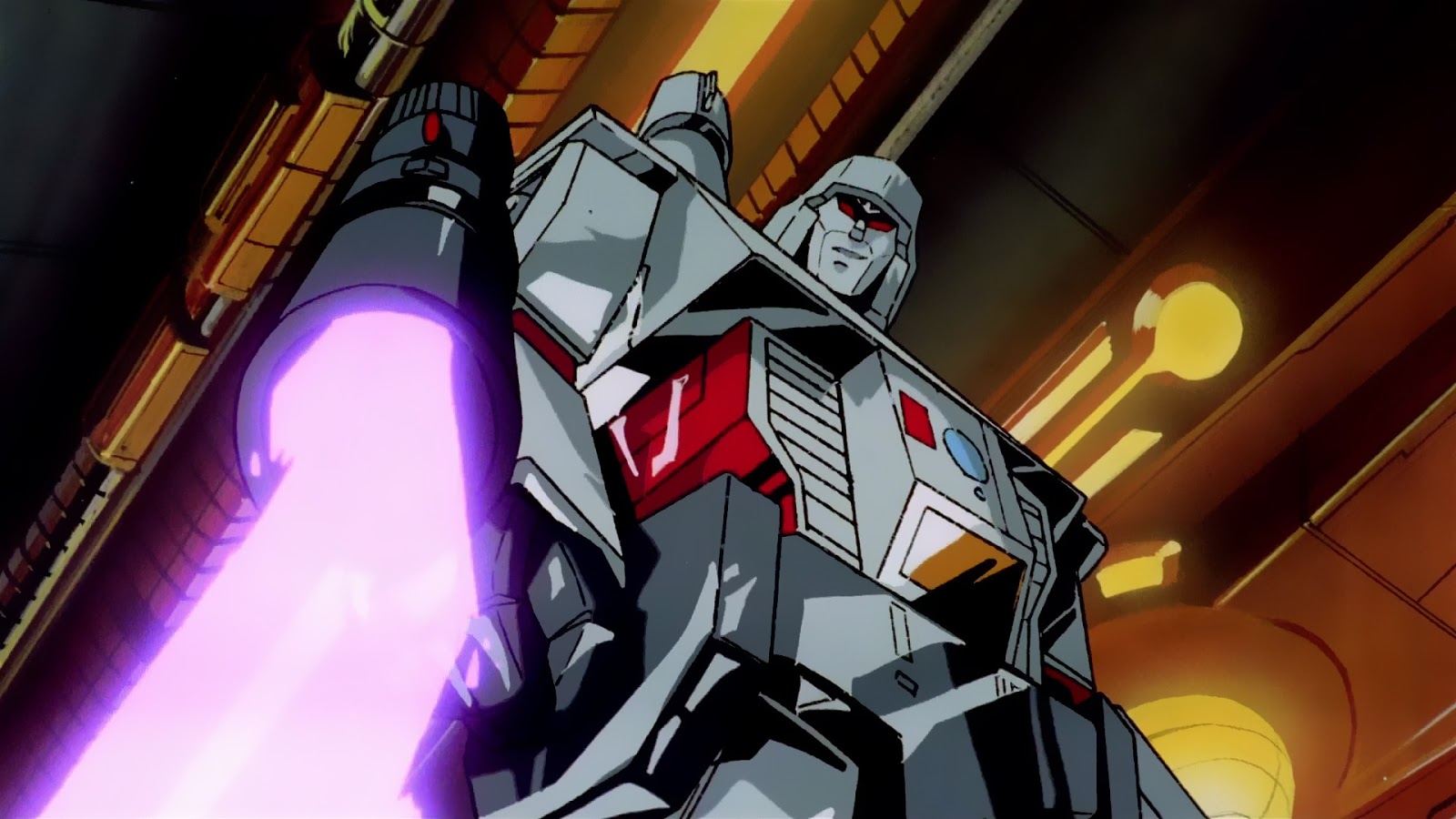
"Such heroic nonsense." Megatron brutally executing fan-favourite Autobot Ironhide with a fusion cannon blast to the face. This movie is basically what would happen if you got George R.R. Martin to write Transformers.

The film also has little truck with cliche, with Galvatron's attempts to join forces with the Autobots to defeat Unicron (the traditional ending to such a story) being undone almost immediately. There's a very nice line in gallows humour throughout the film, such as Springer's world weary exclamation of, "I've got better things to do tonight than die," and pretty much absolutely everything Kup says ("I'm trying to remember what happened, there were an awful lot of casualties that day"). Clearly the writers relished the fact that they didn't have to abide by the quite strict codes of conduct that governed what they could put on screen at 8am on a Saturday morning and instead dialled up the violence quite a bit. For the first time on screen, the much-vaunted war of four million years actually felt like, well, a war. People died, getting shot by a massive laser blast actually hurt (in the cartoon series they tended to just shrug it off) and these guys really hated one another, rather than just indulging in wrestling-style trash talking. It's all very mild stuff for an adult, but for a kid it was a transformative (pun intended) experience.

Is it an objectively good movie? I have no idea, I'm way too close to tell but I suspect not. The animation veers between brilliant and awful (sometimes in the same scene), the soundtrack is ridiculously 1980s and it relies on pre-existing knowledge of the franchise (otherwise at least half the deaths mean nothing). But it's one of the stories (alongside the comics) that had the biggest effect on me as a kid, and to see it getting an expensive, elaborate 4K/HD remaster for its 30th anniversary raises a smile.