Saturday, 12 December 2015

Wertzone Classics - Star Wars: Episode V - The Empire Strikes Back

What do you do when you've made the most successful movie in the history of movies, made a huge amount of money and are then asked to follow up on it? If you're smart, you hire the best writers in the business and get an off-beat, idiosyncratic director to make the film and bring a different sensibility to it. In 1978, when starting pre-production on his sequel to the original Star Wars, George Lucas chose to be smart. He got renowned pulp SF author (and experienced screenwriter) Leigh Brackett to write the script and, when she sadly passed away, hired a skilled up-and-comer named Lawrence Kasdan to polish her draft. He also asked Irvin Kershner to direct the movie when he realised that just financing and retaining creative control of the movie was going to be a full-time job.


With Lucas mostly hands-off in production (returning to help with the Dagobah scenes but leaving Kershner and Gary Kurtz to oversee production elsewhere), the result was the least-typically-made of the Star Wars movies. It was by far the most collaborative, with the actors invited to help brainstorm ideas and alterations to the script. This was particularly important for Carrie Fisher and Harrison Ford to sell the romance between the Leia and Han Solo that had to rely on the implication of a lot of things having happened off-camera in the gap between the two movies. The fact they manage to sell the romance and make it convincing with very limited screentime is a tribute to the collaborators involved, and a far cry from the dismal failure in Attack of the Clones to have Amidala and Anakin do the same thing.

Elsewhere the film benefits from a counter-intuitive plot and structure. The film opens with what should have been a massive climactic battle and then downscales from there, with much of the film concerned with the attempts of the Millennium Falcon crew to escape from the Imperial Fleet and Luke training in the swamps of Dagobah with Yoda. The film ends with pretty much the good guys losing and things are left on a cliffhanger. It's far cry from the medal-awarding triumphalism of the first movie and one that subverts expectations without coming totally out of left field. The tone and feel of the film has been described as being grimmer than the others, but there's actually quite a lot of humour in the movie. What Empire does the best out of all the films is make the Empire feel like a real, credible threat whilst humanising the characters and making the stakes feel real and the scope larger. It also leaves plot points for the viewer to identify and interpret rather than over-explaining things. The significance of the Dark Side cave on Dagobah and what it says about Luke is reasonably obvious, but the film still does a good job of leaving it up to the audience to draw their own conclusions.

As always, the design work is incredible, the special effects are excellent and still stand up well (even puppet Yoda looks and feels realer than the CG creature in the prequels) and John Williams delivers what may be the best score out of the six films (although it's a close tie with The Phantom Menace). But what makes The Empire Strikes Back the best of the six films (controversial opinion, I know) is the combination of good writing, great acting from performers heavily invested in their characters and the decision to give the Empire a real sense of menace and competence, even when they don't have a ridiculous superweapon backing them up.

There are some very minor flaws, mostly relegated to the pointless changes made in the Special Edition (particularly Vader's extremely bizarre "returning to the Executor" sequence) and the under-selling of the time that passes in the film. Apparently it took weeks for the Falcon, limping on a backup hyperdrive, to reach Bespin and Luke also spent weeks (if not months) on Dagobah, but neither span of time comes across well in the film. But these are pretty minimal complaints.

The Empire Strikes Back (*****) is available now as part of the complete (but soon not to be) Star Wars Saga box set (UK, USA).

Wertzone Classics - Star Wars: Episode IV - A New Hope

If there is a moment that the history of film changed forever, it was on 25 May 1977 when George Lucas released Star Wars (later renamed A New Hope in 1981). It set new standards in visual effects and was notable for embracing the traditional "Hero's Journey" myth-arc as theorised by Joseph Campbell, rejecting the more morally murky and conflicted protagonists that had dominated 1970s cinema. Arguably every effects-heavy action film of the last forty years owes its existence to Star Wars, and it remains one of the better films of its genre.


It's a difficult film for me to analyse fairly given I've grown up watching and rewatching it to the point where I could probably quote the entire film. However, it's been a few years since I last saw it and the question arises of if it can really stand up.

The answer is yes, with some reservations. It's a very entertaining film which embraces a simple, straightforward narrative and structure. Unlike George Lucas's inept prequels, Episode IV establishes character, sets out the stakes and introduces its primary locations with a brisk, breezy and narratively economical opening that is a far cry from the interminable CGI and baffling waffle of the later movies. This sparseness was driven by budget concerns - Star Wars was a fairly low-budget movie even for the time given its scope and what it was trying to do - but really helps give the film momentum.

The movie also benefits from a much more collaborative spirit. Whilst Lucas is the screenwriter, director and producer, he also had more supervision and help on this project. Gary Kurtz, noted as one of the few people who could tell Lucas "No" when he came up with a poor idea, serves as producer and the screenplay received an uncredited-but-essential polish from American Graffiti writers Gloria Katz and Willard Huyck. Katz and Huyck added most of the film's wit and banter and helped mould the lines into something more naturalistic that fitted in the setting better. Fellow director Brian De Palma also helped Lucas by rewriting the opening crawl into something comprehensible. This results in a much more relaxed screenplay which includes enough exposition to make sure the audience knows what is going on but never descends into technobabble or over-explaining anything.

The performances are excellent. Alec Guinness and Peter Cushing bring formidable experience and charisma to the film. Cushing, in particular, gives Grand Moff Tarkin presence and menace despite having no real motivation or backstory. This actually works well, with Tarkin presented as a bureaucratic, murderously official military officer who is formidably loyal to the Emperor and seemingly even has Vader's respect. There's a star-making turn from Harrison Ford, a spirited performance from Carrie Fisher that overcomes some diabolical lines (and a coming-and-going English accent) and a satisfyingly grumpy performance by Mark Hamill, who convinces as the young man torn between several destinies but who hasn't totally outgrown teenage selfishness just yet, until he finds inspiration in figures like Obi-Wan.

Yes, the film does have flaws. It's aged pretty well considering work on it now started forty years ago, but the budgetary constraints are a lot more obvious with time. It's easily the least-epic film of the seven so far, but this pared-down approach actually serves it pretty well. Most of the effects have held up, with only the lightsabres really feeling out of place with the later movies. The biggest issue is that the Special Edition additions, which add vast crowds and snazzy CGI to places like Mos Eisley, stick out like a horrible sore thumb compared to a sparser feeling elsewhere in the movie. And yes, there are a couple of clunky lines and a few logic issues, such as Luke getting enormously attached to Obi-Wan Kenobi given he knows him for about a day and Chewbacca and Wedge not being honoured at the end of the film with everyone else.

But these issues can be borne for the verve and economy of the storytelling, the relaxed and intriguing worldbuilding (assuming you're coming at this as the first film in the saga, which is really the best approach to the series), the banter and chemistry between the three leads, the humour beats which still work really well and the utterly stunning design work, musical score and space battles.

Star Wars (or A New Hope if you really insist, ****½) is available now as part of the complete (but soon not to be) Star Wars Saga box set (UK, USA).
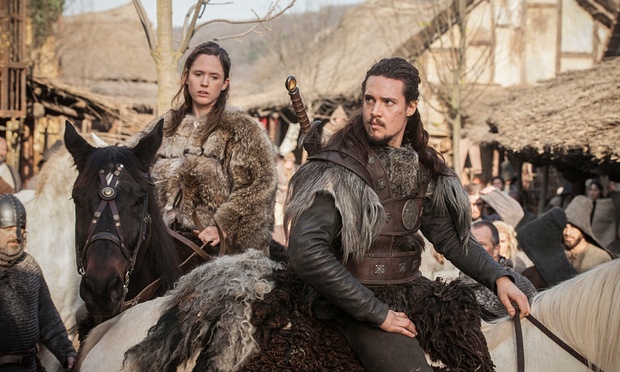
THE LAST KINGDOM renewed for a second season

The BBC has ordered a second season of The Last Kingdom, their TV drama based on Bernard Cornwell's Saxon Saga of novels.


The Last Kingdom has proven to be a successful series, winning critical acclaim and reasonably strong ratings on both sides of the Atlantic. The first season was based on the first two novels in the series (of nine so far), The Last Kingdom and The Pale Horsemen. If the second season is based on the next two novels, The Lords of the North and Sword Song, it will focus on Uhtred's quest to reclaim his homeland as well as widening the scope to new locations, including London.

Thursday, 10 December 2015

THE WITCHER movie announced

Platige Films and the Sean Daniel Company have confirmed that they are collaborating on an big-screen adaptation of The Witcher short stories and novels by Andrzej Sapkowski.

The city of Beauclair, the capital of the French-flavoured nation of Toussaint, in the upcoming Witcher III expansion.

Platige is a Polish company founded in 1997 which has worked in advertising and short film. The Sean Daniel Company is an American production company best-know for its work in The Mummy franchise and the upcoming Ben-Hur remake, as well as working on The Expanse TV series.

The planned Witcher movie will be an adaptation of the short stories 'The Witcher' and 'Lesser Evil' from The Last Wish, the first book featuring the character of Geralt of Rivia. These are fairly low-key stories by epic fantasy standards which will require only a modest use of effects and locations, explaining why the two companies are not (so far) working with a big Hollywood company on the project. The director is Tomasz Bagiński, who was nominated for an Oscar in 2002 for his short animated film The Cathedral.

There was a previous, low-budget Polish Witcher movie in the early 2000s, along with a short-lived spin-off TV show. Neither were successful and both were critically condemned. This new movie will apparently have a larger budget and be aimed at an international audience. If successful, it will be followed by more films and potentially a TV series adapting the remaining Witcher short stories and novels.

The Witcher is the story of Geralt of Rivia, a monster-slaying mutant who attempts to stand aside from the struggle between the human kingdoms of the north and the elder races (elves and dwarves) they are pursuing a genocidal war against. When a powerful empire to the south invades the northern kingdoms, Geralt is reluctantly drawn into the battle. The Witcher books are, in order of internal chronology: The Last Wish (1993), Season of Storms (2013), Sword of Destiny (1992), Blood of Elves (1994), Time of Contempt (1995), Baptism of Fire (1996), The Swallow's Tower (1997) and Lady of the Lake (1999).

Although successful in Poland, Spain, Russia and much of Eastern Europe, the Witcher franchise didn't reach a truly international audience until the release of three video games by CDProjekt: The Witcher (2007), The Witcher II: Assassin of Kings (2011) and The Witcher III: Wild Hunt (2015). The three games were hugely successful, selling many millions of copies in English and introducing the franchise to a much bigger international audience.

FINAL FANTASY VII REMAKE becomes a trilogy because of money

Square Enix have announced that Final Fantasy VII Remake has been split into multiple episodes (probably three) because it needs to make more money.


Players of the original game will remember that it came on three CD-ROMs on its original release on the first PlayStation in 1997, making for a then-astonishingly huge game given its graphical prowess. However, Final Fantasy VII was also a rather modestly-sized game in overall terms by modern standards. I beat the game in 32 hours on my first playthrough (not doing all the sidequests or grinding for chocobos) and 37 on my second (doing all of the sidequests and a bit of grinding). Most of my friends finished it in around 40 hours or so, which also seems to be the generally-accepted length of the game. For comparison's sake, a complete playthrough of the two-and-a-half BioWare Baldur's Gate games could take 200 hours when all sidequests and faction-specific missions were taken into account. The likes of Skyrim and Fallout 4 have well north of 100 hours of content apiece. Even the very linear and relatively modest Dragon Age II has a length of around 25 hours.

Trying to justify the split, Square have pointed out the fact that the original game had a lot of unique art. Transforming that into original 3D graphics for each location, with limitations on how much assets can be re-used as the game moves from urban to desert to tropical to jungle to arctic environments. This, to be fair, is a reasonable point. 3D games get away with their sizes by cleverly recycling content. Older 2D games (Final Fantasy VII had 3D characters moving over pre-painted 2D backdrops) could have unique art and assets in every location as the backdrops were simple paintings.

To give more bang for players' buck, Square have confirmed that each chunk of the game will be expanded, with new story material, side-quests, perspectives and other elements added. They pointed out that Midgar will now be a large, open-world hub rather than a series of distinct, linear sections, giving you more freedom to move around. Presumably other parts of the game will get the same treatment.

No release schedule for Final Fantasy VII Remake has been set, but one piece of good news about the split is that it means we might get the start of the game sooner. Square would be silly not to be aiming for the game's 20th anniversary in 2017 for the release of the first part.

Wednesday, 9 December 2015

Guy Gavriel Kay honoured with Canadian national award

Fantasy author Guy Gavriel Kay has been inducted into the Order of Canada, Canada's second-highest national award. He was inducted for his services to Canadian literature.


Guy Gavriel Kay is one of the world's foremost authors of fantasy fiction. His career began in 1974-75 when he assisted Christopher Tolkien in the editing of The Silmarillion, J.R.R. Tolkien's magnum opus which was left in a disordered state upon his death. Christopher brought the book to a publishable state by drawing on a large number of manuscrips, and Kay provided editorial assistance.

Kay's own writing career began with a fantasy trilogy called The Fionavar Tapestry, published in 1984-86. His subsequent novels were the highly-acclaimed Tigana (1990), A Song for Arbonne (1993), The Lions of Al-Rassan (1995), The Sarantine Mosaic duology (1998-2001), The Last Light of the Sun (2004), Ysabel (2007), Under Heaven (2010) and River of Stars (2013). His next novel is Children of Earth and Sky, due for publication in spring 2016.

Congratulations to Guy on this honour!

Big interview with George R.R. Martin

The South Bank Show, Britain's biggest art and culture TV show, had an episode devoted to George R.R. Martin and Game of Thrones earlier this year. You can now catch it (while you can!) on YouTube:


The interview takes in Martin's entire career, but focuses on A Song of Ice and Fire and its TV adaptation. As well as Martin, contributions are taken from historians, Game of Thrones showrunners David Benioff and Dan Weiss, and writers such as Lisa Tuttle and Neil Gaiman.

Tuesday, 8 December 2015

22-year-old WHEEL OF TIME mystery solved

A pair of mysteries established in the fifth and sixth Wheel of Time novels, published in 1993 and 1994 respectively, have been solved thanks to the actions of an eagle-eyed superfan.

WARNING: SPOILERS FOR THE WHEEL OF TIME NOVELS


In the fifth novel in the series, The Fires of Heaven, the character Asmodean is killed by a mysterious assailant. Robert Jordan did not reveal the identity of his killer before his death, but did include it in the notes for the novels. Brandon Sanderson revealed the identity of the killer as Graendal, a fellow member of the Forsaken, in the penultimate volume of the series, Towers of Midnight.

In the sixth volume, Lord of Chaos, Rand joins forces with Mazrim Taim, a false Dragon defeated in battle by the Saldaean army and taken prisoner by Aes Sedai. He escapes and allies himself with Rand, eventually becoming commander of the Asha'man. In the concluding volumes of the series it is revealed that Taim is a Darkfriend, sworn to the service of the Dark One. He corrupts a number of the Asha'man into fighting against Rand, but is killed by Egwene during in the Last Battle. However, fans doubted his true identity, citing a number of times when he seems bewildered by concepts in the world that someone should know and that Lews Therin Telamon (or, rather, his insane voice in Rand's head) seemed to recognise him. Fans concluded early on that he was probably the Forsaken Demandred in disguise. However, later novels showed Demandred and Taim in the same room and working together. The final volume of the series seems to confirm that Taim is exactly who he said he was all along.

Thanks to the efforts of superfan Terez, it has now been revealed the Robert Jordan played a bit fast and loose with fans. According to the voluminous notes he left behind, he did indeed intend Mazrim Taim to be Demandred in disguise, and that the disguised Taim/Demandred (dubbed "Taimandred" by fans) was also responsible for killing Asmodean. The former theory was already well advanced by fans at the time, but the latter theory was not. Robert Jordan had always said that the person who killed Asmodean had actually already appeared in the series, and neither Taim nor Demandred appeared until Lord of Chaos (although they were both referenced earlier).

Of course, the notes Robert Jordan created for the series were a work in progress and most of them were written during or after the writing of The Path of Daggers. By the time Robert Jordan started going online and interacting with fans regularly (after the release of Crossroads of Twilight in 2002), at which time he ruled out "Taimandred", he had changed his mind and decided that Graendal was behind the crime. This was helped by a popular fan theory published in the late 1990s that pinned Graendal as the murderer.

Although irrelevant now, it does show that writers, even major writers penning a series already many thousands of pages advanced, can change their ideas on the fly and adjust all the foreshadowing elements beforehand to fit a new idea if matches up to their designs more satisfyingly. And some old-school fans can take some satisfaction in knowing they were right, at least for a time.

RED MARS adaptation greenlit with BABYLON 5 showrunner in charge

Spike TV has given a full season order for Red Mars, a TV series based on Kim Stanley Robinson's classic Mars Trilogy of novels. J. Michael Straczynski, the creator/producer/writer of Babylon 5 and recently the co-creator and writer of Sense8 for Netflix, will be the primary writer and showrunner on the series.


Robinson's trilogy consists of the novels Red Mars (1992), Green Mars (1993) and Blue Mars (1996), along with a companion volume of short stories and essays, The Martians (1999). The trilogy opens in the year 2026 when fifty men and fifty women - the First Hundred - travel to Mars on the colonisation ship Ares. The opening part of the first novel covers the months-long journey out to Mars, with the scientists and engineers getting to know one another and dealing with crises like solar storms which threaten to kill them before they even get to the planet. During the voyage an ideological and philosophical debate begins which eventually comes to dominate the colonisation saga: whether Mars should be left in the state it is found or terraformed to support human life.

The rest of the first novel concerns the building of Underhill, the first town on Mars, and the establishment of an outpost on its moon Phobos. As the years pass more colonists are sent and technology rapidly develops, with canyons and craters being roofed and pressurised to create the first towns and, later, cities. A life-extension drug is developed which allows characters at the start of the story to still be alive and in excellent health forty years later. However, as the population of Mars swells, so does the control of the meta-national megacorporations which have displaced the nation-state as the primary power on Earth. This sparks a desire for independence, and the scene is set for a bloody revolution. The later novels, Green Mars and Blue Mars, cover an additional 200 years of future history.

J. Michael Straczynski's Babylon 5 featured a long-running, series-spanning storyline about the Mars colony's desire for independence and freedom.

It is likely that Straczynski will be changing some things about the books. First off, the timeline will likely be changed (since we are more like thirty years from the establishment of the first colony on Mars rather than eleven). We are also likely to see a lot more action and drama, particularly during the events of the latter two books which are more free of plot incident than the first novel. However, as Babylon 5 and Sense8 both show, Straczynski is a thoughtful writer who can write entertaining television even about controversial issues like religion, immigration and the morality of science, so don't expect these elements to be dumbed down too much. Indeed, Straczynski appears to have been a fan of the novels, with the Mars storyline in Babylon 5 feeling at least very partially inspired by Robinson's books (that were released simultaneously with the show's opening seasons).

Vince Gerardis, who helped shepherd Game of Thrones to the screen, will co-produce alongside Straczynski, who will write and be the primary showrunner. Kim Stanley Robinson will serve as a creative consultant on the project, but it's not yet been confirmed if he will write any episodes.

Spike TV, known for its more young adult male demographic than its thoughtful, hard SF one, appears to be appealing to a new audience with this project. They have also made a significant investment in the new show, ordering a full 10-episode first season instead of a pilot. It is possible that the success of the Ridley Scott film The Martian inspired them to move forward with the project.

According to Straczynski, his work on Red Mars will not interfere with his writing for the second season of Sense8, which was recently commissioned by Netflix.

Sunday, 6 December 2015

Les Revenants (The Returned) - Season 2

Six months have passed since a large number of deceased people enigmatically returned to life in a remote French mountain town, followed by part of the town flooding. Most of the population has fled and the army has arrived to investigate what's going on, but the local population is reluctant to help them. Meanwhile, the Returned (and a few living allies) are living in a suburb cut off from the rest of the town by floodwaters...but a second batch of Returned have arrived, including some of a more hostile and murderous bent.


The first season of Les Revenants aired on Canal+ in France in 2012. After a belated three-year delay, during which the series won over cult audiences in Britain and America via broadcasts on Channel 4 and Sundance, its second season has arrived. Surprisingly, as the showrunner indicated that they had a three-year plan during production of the first season, the final episode of the season does wrap up the story and most of the characters pretty well. That certainly doesn't mean everything is answered, but it does give a sense of closure in case the show does not return.

The second season comprises sequences sent in the present day, six months after the flood, and flashbacks to several points in the past. Most of these surround the collapse of the local dam in 1977 and the subsequent inundation that killed more than a hundred people. Unexpectedly for such a low-key show, at one point we actually see the accident take place in full force, with some astonishing CGI shots of the destruction. It's a moment that wrongfoots the audience in all the right ways, and more follow.

The second season is bleaker and more paranoid than the first. The army and a newly-arrived engineer are asking questions that none of the locals want to answer for fear of sounding like lunatics, or endangering their loved ones (living or dead). No-one is sure who to trust, especially as the floodwaters have broken up several families. However, the Returned themselves are becoming divided. The return of Milan, Serge and Toni's murderous and deluded father, causes significant problems, as does the birth of Nathan, the son of revenant Simon and the still-living Adele. Julie has dedicated herself to looking after the enigmatic child Victor, but when his mother and brother both return as well she finds herself shut out of his life.

There are many stories in the second season, but at its core it is the story of Victory, the unusual child with the terrifying thousand-yard stare, and Julie, the bruised, battered and defiant survivor of one of Serge's serial killer sprees. Julie is further devastated by the (apparent) loss of her lover Laure during the events of the Season 1 finale, but she tries to find redemption in Victor. When that is taken away, she is plunged into despair, but recovers thanks to a friendly nurse and an old man in the hospital who holds the key to Victor's past.

It's at this point that the series does what you'd never expect it to do: it unlocks the past and gives us lengthy explanations and flashbacks showing Victor's life before, during and after the flood. This rewriting of the backstory we learned in the first season could risk feeling forced or a retcon, but works beautifully. It both explains why the dead are coming back (if not quite how) and how the situation can be remedied, and what the consequences might be if it isn't fixed. The young Swann Nambotin has to do a lot of dramatic and emotional heavy-lifting to make these pivotal scenes and he delivers in spades. Céline Sallette's performance as Julie is heartbreaking, and remarkable as she has to portray despair and emotional numbness but still be compelling to watch.

Elsewhere the show falters a little bit, apparently having issues with returning castmembers: I get the impression in early episodes that they thought they could get Alix Poisson back later on as Laure and then realised they couldn't, so killed her offscreen, which doesn't really track with Julie's comments in early episodes. Other major characters from the first season also have limited screentime in the second (such as brothers Toni and Serge). But otherwise the show handles its cast extremely well, particularly the story of the twin sisters Camille and Lena which provided us with the emotional core of the first season and pays off well here. The only characters who do feel really short-changed are Adele and Simon, particularly the completely baffling ending to their story which feels like it goes against what is established elsewhere in the series.

It wouldn't be Les Revenants if characters sat down and gave us a long explanation about what is going on, and they don't here. But by the end of the second season enough information is given to put together a reasonable conclusion about what has happened and how it has been resolved...and how it might happen again, as a couple of minor plot threads are left dangling for a future third season. If that does happen it will be a very different show, and at the moment feels completely optional.

The second season of Les Revenants (****½) is wonderfully well-written, fantastically acted and beautifully shot, complete with stunning cinematography and an even better musical score than the first year, again by Scottish band Mogwai. The series will be released in the UK on 11 January 2016 (DVD, Blu-Ray) and is available in the USA now on Amazon On-Demand.