Monday, 25 May 2026
Star Wars: The Mandalorian & Grogu
Wednesday, 15 January 2025
Star Wars: Skeleton Crew
The people of the planet At Attin are carrying out a Great Work for the Galactic Republic, which requires their planet to be sealed off from the rest of the galaxy by an unbreachable barrier. The children of At Attin are encouraged to study hard to get great jobs to carry out the Work, with only ancient stories of Jedi percolating through to reach those with imagination. When four children stumble across a buried starship which inadvertently carries them far from At Attin, they have to use all their resourcefulness to get home, through a galaxy decidedly less civilised than they were led to believe.
Skeleton Crew is yet another Star Wars TV show from the Lucasfilm/Disney+ production line. Since The Mandalorian debuted five years ago, the production line has pushed out a whole raft of Star Wars projects, which have all looked fantastic but, to varying degrees, struggled to hit the high notes of the franchise. The first season of Andor and the first two seasons of The Mandalorian were very good, but its third season, Obi-Wan Kenobi and Ahsoka were all patchy, The Acolyte flawed and The Book of Boba Fett bafflingly structured.
Combined with the well-documented struggles in getting a new movie in the franchise off the ground, this has led to the conclusion that Star Wars, at least as a live-action concern, was in trouble under Disney's stewardship.
Fortunately, and most unexpectedly, Skeleton Crew didn't get that memo. Jon Watts, who masterminded Marvel's take on Spider-Man, rocked up with a mission: to make the Star Wars / 1980s kids' movie crossover event that we never knew we wanted, but it turns out was a great idea all along. Taking inspiration from the likes of The Goonies and Flight of the Navigator, the film jettisons almost all the baggage of the extended Star Wars canon that has been weighing down the rest of the franchise for a near-stand-alone adventure in which some kids find a spaceship and get into hijinks.
You might think that sounds fair enough but maybe not enough to sustain eight episodes, but Watts and his team expand the storyline to incorporate subplots revolving around the kids' families trying to work out how to find them from back home, as well as expanding on Jod, the mentor character they encounter along the way who agrees to be their guide through the dangerous galaxy beyond At Attin. Jude Law plays Jod with absolutely maximum relish, turning in a great performance that mixes humour and roguery in classic Star Wars fashion. The kids are all fine (due to their age, the occasional scene where they mistake enthusiasm for skill can be overlooked), and many of the other adult actors are great, though Kerry Condon (Rome, Better Call Saul) feels under-utilised.
The episode count allows our characters to visit several planets (all new) and learn more about the galaxy and its recent past, meaning that total Star Wars novices should be at home here. The impressive action set-pieces come thick and fast, and the lighter tone is mostly successful after too many Star Wars projects that feel weighed down by the need to be serious. But, like the best 1980s kids' movies, the show also knows it won't work without some darker moments and real jeopardy, and a late-series shakeup to its format is highly effective at darkening the show without making it unsuitable for its audience.
Star Wars: Skeleton Crew (****) is not high art but it achieves its objective of being breezy fun for kids and adults alike. Easily the best Star Wars TV project after Andor and the early part of The Mandalorian, it's almost a relief to find an adventure in the Galaxy Far Far Away that can simply be enjoyed and not merely tolerated. The show is airing now on Disney+ worldwide.
Tuesday, 6 December 2022
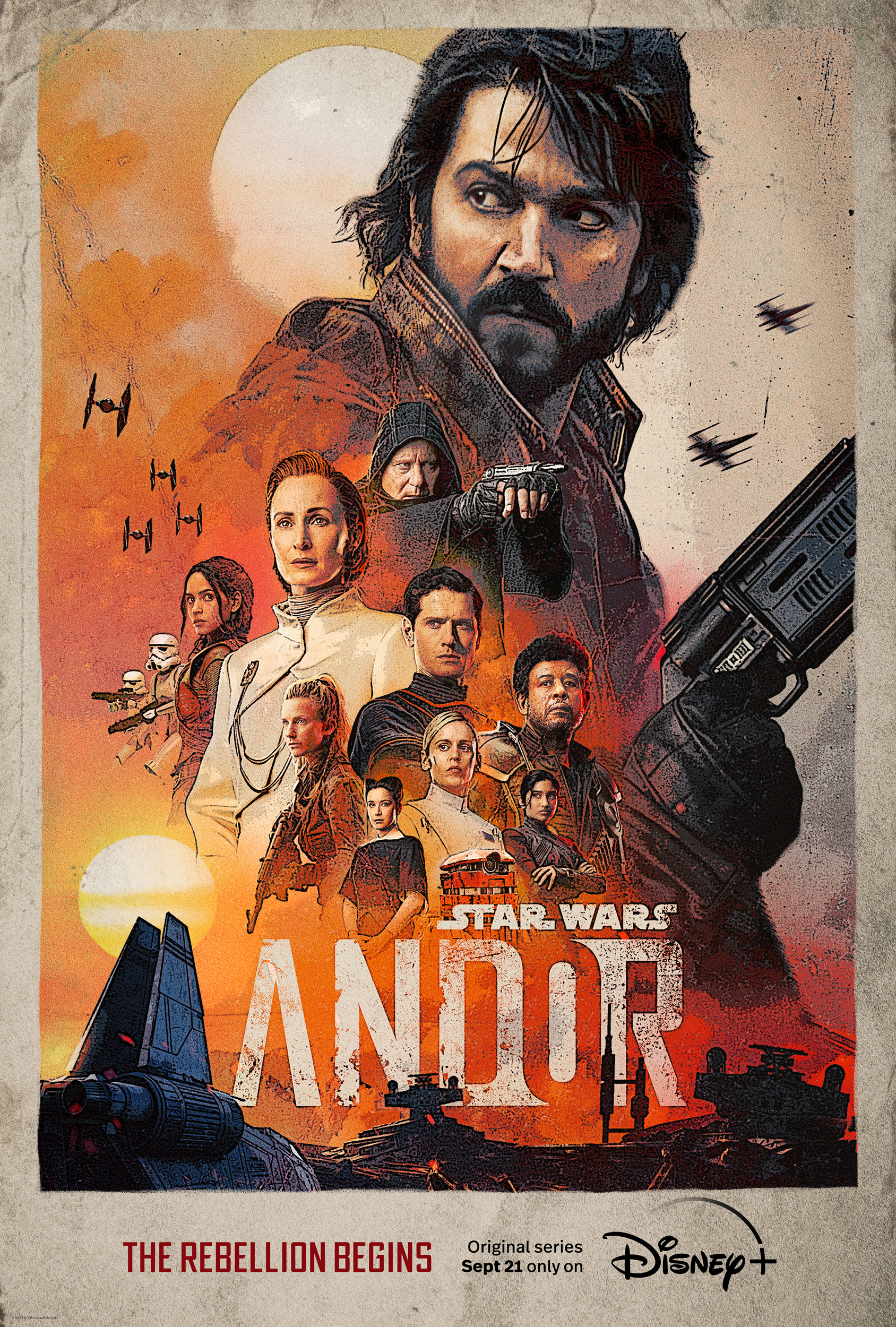
Andor: Season 1
Fourteen years after the end of the Clone Wars, the Galactic Empire seems to be invulnarable. From Coruscant, a colossal bureaucracy rules over millions of worlds through thousands of warships and a vast number of troops. Resistance appears futile. But there are those who believe otherwise, and from the lowliest depths of the poorest planets to the halls of the Galactic Senate itself, a rebellion is taking shape. Fighting this rebellion will not be easy, or pretty, or easy, and to start it requires a single victory, small in scope but enough to start the avalanche.
When Lucasfilm was putting together its initial package of live-action Star Wars TV shows, the one about Cassian Andor, a relatively low-key character from Rogue One, always seemed like the most random and least interesting. An Obi-Wan show? Sure, that makes sense. A show about Mandalorians? Cool. A Boba Fett series? Why not? But this guy? Diego Luna gave a great performance and there were some interesting edges around this more amoral, ruthless rebel operative, but he didn't exactly seem to be screaming out for more backstory.
Andor's first season proves that guess completely wrong, and unexpectedly emerges as the best of the live-action Star Wars shows to date, knocking the underwhelming Obi-Wan and disappointing Book of Boba Fett into a cocked hat, and even shading the fun Mandalorian. Coming across as the answer to the question, "What if Star Wars was on HBO?", Andor is a serious, adult SF drama about totalitarianism, the price of freedom, the perils of resistance and ultimately how the smallest acts can have huge ramifications.
The show nominally focuses on Cassian Andor, with Diego Luna returning to play a younger, cockier version of the character from Rogue One. Flashbacks reveal his backstory as a young child on a planet left ravaged by an unexplained disaster, whilst his present-day story sees him recruited by Luthen Rael (a fantastic Stellan Skarsgård) from his adopted homeworld of Ferrix to take part in a rebel raid on the planet Aldhani. The raid triggers a massive series of reprisals by the Empire, with the Imperial Security Bureau sending its best agents to track down those responsible. Andor absconds from the cause the first chance he gets, only to wind up, ironically, getting arrested and sentenced to an Imperial prison facility under a false identity. There he has to learn to become a leader and a facilitator for his fellow inmates, and sets about recruiting the reluctant floor manager Kino Loy (an outstanding Andy Serkis) to his cause.
However, one of the show's smartest moves is using Andor as the connective tissue between the ground-level story of how the Empire is crushing the common people, exemplified by Andor himself, and a much higher-level story in the Imperial Senate, where Mon Mothma (Genevieve O'Reilly reprising her role from Rogue One and Revenge of the Sith, the only high-profile actor apart from Luna and Forest Whitaker as Saw Gerrera to return from the films) is trying to simultaneously present herself as a harmless, bleeding-heart irritant against the Emperor's tyranny whilst secretly funding the establishment of the Rebel Alliance. When the financial web she's spun to carry this out is abruptly broken, she urgently needs to find a way of covering her back before the Empire discovers and destroys the Alliance before it can even get going.
In some senses Andor is an atypical Star Wars show: there's only a single, brief space battle and only a few ground-based action scenes. Much of the show seems to revolve around taut conversations between desperate individuals. The Empire is frequently presented as a mildly boring bureaucracy packed with functionaries just trying to get through the day so they can go home, rather than psychopathic maniacs. One major storyline revolves around financial dealings and shadow accounts and distasteful criminal deals like an episode of The Wire. It's also a decidedly more adult show: sex is alluded to more than in most Star Wars material, we get our first blink-and-you'll-miss-it bit of swearing in the franchise and character motivations are much more the focus, rather than cool spaceships or droids (though we do get at least one great new spaceship and a somewhat sympathetic robot with B2EMO).
It's a bold step but also a necessary one. Star Wars is now a transmedia franchise that is clearly never going to entirely stop this side of the end of human civilisation, but it can't do that if it doesn't broaden its tonal horizons and become a much broader church than what it has been up until now. Lucasfilm has been reluctant to do that - after hiring Phil Lord and Christopher Miller to make a more comedic Star Wars movie with Solo, they panicked when the directors did exactly that and fired them - but seems to have now gotten the message. How far this will go remains unclear: will we eventually get Star Wars the romantic comedy (no, Attack of the Clones does not count) and Star Wars the horror franchise? Maybe. But starting that broadening with Star Wars: The Prestige Streaming Showcase isn't such a bad idea.
Andor works because it shows us in a very real way how day-to-day life in the Empire works. It doesn't actually appear to be that bad, as long as you keep your head down and work hard and don't speak out, and you might even get a promotion and fancy you can work inside the system to your family's benefit, or try to make things better. But the insidiousness of the Empire is clear, as it beats and crushes the spirit out of people slowly, day by day. Star Wars has always nodded a little at Nineteen Eighty-Four with its depiction of the Empire, but that influence is much stronger here, with a bit of Brazil-esque surrealism thrown in as well (particularly with Syril Karn's story). The effort it takes for people to "wake up" and realise they have to fight is startling, but once that ball starts rolling it becomes difficult to stop.
Andor does have some flaws. The pacing is deliberate and measured, and for the most part that works well. However, there's at least one episode's worth of material that could have been shaved off to make an even tighter, sharper show. There's also some creaky continuity gaps between Andor and the rest of the franchise: The Bad Batch established that resistance movements against the Empire began almost immediately after its founding (with Andor character Saw Gerrera playing a leading role!), and Rebels, set almost simultaneously with this show, seems to suggest the Rebel Alliance should be much further along the road to being the spaceborne insurgency we all know. Having the Rebellion in a much more nascent form here doesn't seem to be quite right. Others will bemoan a Star Wars show without more action, or one they can't perhaps as easily sit down to watch with their kids.
That said, it's hard to argue with quality. Andor's first season (****½) is an impressive, adult science fiction drama that interrogates many of the ideas and premises of the Star Wars franchise that we haven't seen in live-action before (some of the novels and video games have trodden this kind of ground, though), and restores hope to a franchise that was in danger of becoming moribund.
The season is available to watch now worldwide on Disney+. A second season is in production for airing in 2024.
Monday, 1 November 2021
First trailer for STAR WARS: THE BOOK OF BOBA FETT released
Thursday, 15 April 2021
Disney and Alan Dean Foster approaching settlement on royalties
"The irritating imbroglio with Disney, which you may have read about, is moving towards a mutually agreeable conclusion. A formal statement will be forthcoming."
Thursday, 19 December 2019
Gratuitous Lists: The Star Wars Movies Ranked (updated again)
For the record, Lucasfilm have seemingly ruled both Caravan of Courage (1984) and The Battle for Endor (1985) - which were both released in cinemas in Europe - as non-canon, so I'm going with the eleven Star Wars movies theatrically released since 1977.
Previous versions of this list appeared in 2018 and 2016.
12. The Clone Wars
Released 15 August 2008 • Directed by Dave Filoni • Written by Henry Gilroy, Steven Melching and Scott Murphy
Over the course of five-and-a-half seasons, The Clone Wars evolved into a fantastic, gripping and fun pulp SF adventure show. However, it took a while to get there. The first few episodes were made on a limited budget with very few CG assets, whilst producer Dave Filoni and his team were still finding their feet with pacing and characterisation. George Lucas was a little bit too impressed by what the guys at Lucasfilm Animation had achieved when he decided it was good enough quality to go on the big screen. Coming in the same year as Wall-E and with a juvenile tone that turned off adult Star Wars fans, The Clone Wars just couldn't cut it.
If some of the later, much better arcs and episodes had been made into an animated film, the results may have been different.
Released 16 May 2002 • Directed by George Lucas • Written by George Lucas & Jonathan Hales
Well, where to start? The worst live-action Star Wars movie has the most risible performances, dialogue (including the epic "hatred of sand" speech), execrable plotting and confused structural tics out of all of them. It's embarrassing to see actors of the calibre of Natalie Portman and Christopher Lee working with scripts this awful and the hyper-polished CGI sheen over the effects is sterile and uninvolving. Hayden Christensen isn't quite as bad as is often said (given that even Samuel L. Jackson and Ewan McGregor are struggling with this material, Christensen doesn't really disgrace himself) but is still an uninteresting protagonist. Even John Williams is feeling uninspired, only rising to the occasion in his score when he revisits themes from previous movies.
10. Revenge of the Sith
Revenge of the Sith and The Phantom Menace are at a very similar level of quality and you could swap their positions quite easily. Sith, for me, falls short for several reasons. The first is that the utterly pointless CG overload of Attack of the Clones is pursued and doubled down on in Revenge of the Sith, making the film feel even more artificial and sterile. The next is that the dialogue has somehow even gotten worse, along with the performances. Natalie Portman's cringe-inducing "You're breaking my heart!" and Ewan McGregor's completely flummoxed reaction to Anakin murdering children are both awful pieces of acting.
There are some good moments in Sith - the dialogue-less moment where Anakin decides to betray the Republic and the execution of Order 66 - and John Williams remembers to show up with a couple of excellent scoring moments, but the long-awaited Obi-Wan/Anakin lightsabre showdown is awful and the conclusion of the Clone Wars is bitty and unsatisfying. Revenge of the Sith had the potential for greatness and wastes it thanks to George Lucas's ego. On that level Revenge of the Sith isn't the worst Star Wars movie but it is, easily, the most disappointing.
9. The Phantom Menace
Released 19 May 1999 • Directed by George Lucas • Written by George Lucas
Enjoying The Phantom Menace is possible, especially if you cheat and watch The Phantom Edit (which cuts out the majority of Jar-Jar scenes and dramatically reduces the "endearing" antics of little Anakin). But even the original edit is fine if you can simply ignore Jar-Jar. The Phantom Menace emerges as (marginally) the best film of the prequel trilogy thanks to its absolutely stellar soundtrack (a never-better John Williams), the grounded, inspiring presence of Liam Neeson as Qui-Gon Jinn and the use of real sets and models for many of the effects. It also helps that our main villain Darth Maul almost never speaks, so retains some menace rather than losing it by uttering inanely awful dialogue. Some CG overload is still present, but it's nothing as bad as the latter two prequel movies. There's also a pacier feel to events, with the shifts in location and plot meaning that weaker scenes don't drag on as long as they do in the two other prequels, and the movie may feature the prequel trilogy's best set-piece with the pod racing sequence, as well as its best (if occasionally showiest) lightsabre duel.
It's still an enormously flawed film with plot holes you can drive a Star Destroyer through, of course, but not quite as awful as its reputation suggests.
8. The Rise of Skywalker
Released 19 December 2019 • Directed by J.J. Abrams • Written by J.J. Abrams
J.J. Abrams course-correcting from the divisive Last Jedi meant doing two things with The Rise of Skywalker. The very good thing is focusing even more on the Kylo Ren/Rey relationship, which gives the film (and the whole sequel trilogy) its dramatic spine and several genuinely epic moments.
The bad thing is fanservice. Fanservice! Everywhere. If a classic Star Wars sound effect, spaceship or character doesn't show up in the extraordinarily loud and bombastic closing half-hour of the movie, it's not for want of trying.
At its best, the film is an epic and dramatic struggle between two characters struggling with their destinies. At its worst, it's an exercise in weaponised nostalgia, J.J. Abrams walking into the amphitheatre on Geonosis and playing the full four seconds of the film in which Wedge Antilles appears and screaming "ARE YOU NOT ENTERTAINED?" at baffled nine-year-olds.
But when the film works, it does tickle the old Star Wars magic out of hiding. It just feels like it struggles to do it as well the films higher up this list.
7. The Last Jedi
Released 15 December 2017 • Directed by Rian Johnson • Written by Rian Johnson
There's a huge amount of unrealised potential in the movie, which a few more rewrites and judicious editing could have fixed. But the biggest problem is that The Last Jedi does not follow through on its promise: Rey should have joined Kylo Ren at the end and either become the big villain for Episode IX, or perhaps tried to work to redeem him from within. By instead snapping back to the status quo at the end of the movie, it betrays its own promise to be an edgier and different kind of Star Wars movie. Instead, it returns things to normal and J.J. Abrams doesn't do anything too unpredictable in the next movie to keep things fresh.
6. Solo
Released 25 May 2018 • Directed by Ron Howard (with Phil Lord & Christopher Miller) • Written by Lawrence Kasdan & Jonathan Kasdan
Released 18 December 2015 • Directed by J.J. Abrams • Written by Michael Arndt, Lawrence Kasdan and J.J. Abrams
The Force Awakens is two movies sitting on top of one another. The first is the struggle of the Resistance to avoid the destruction of their hidden base by the First Order's planet-destroying superweapon, which is ludicrously powerful but has a rather-easily-exposed weakness. This plot is less than satisfying, since it's a retread of Star Wars (A New Hope). However, the second is the family drama of Han Solo and Princess Leia having a son strong in the Force who brutally betrays them, murders his way into a position of power in the First Order and embraces the Dark Side, but is constantly tempted by the lure of good. New character Rey has the chance to take his place as the new champion of the Force, but only if she can overcome her own limitations in the process.
This latter story is far more interesting and provides The Force Awakens with its real dramatic meat. Excellent performances by newcomers and old hands alike, excellent effects and John Williams dropping an awesome musical score combine to make a movie that couldn't feel any more Star Wars if it tried. Far from a perfect movie, the main problem with The Force Awakens is that it sometimes tries a little too hard to be Star Wars rather than going with the flow. But as franchise-resurrecting reboots go, this is impressive. The Pacific Rim of the Star Wars franchise: oh, oh so dumb, but so much fun you just don't care.
Released 16 December 2016 • Directed by Gareth Edwards • Written by John Knoll, Gary Whitta, Chris Weitz & Tony Gilroy
Rogue One is a fine movie with some fantastic performances, action sequences and individually powerful scenes. CG overload is mostly avoided and the film feels punchy, nailing The Dirty Dozen in Space vibe it is shooting for. The movie also, and rather surprisingly, justifies its existence by mostly avoiding continuity problems and fixing a couple of niggling problems in the original Star Wars.
On the negative side of things, characterisation can be a little variable (Jyn's motivations seem to have gotten lost in the edit) and the way the film ends is structurally messy, whilst the score is forgettable. But congratulations to Lucasfilm for having the resolve to end the film in the only manner that makes sense.
Rogue One is the big winner over previous lists, where I ranked it below The Force Awakens and Solo. In retrospect, Solo's big grin enjoyability doesn't endure through rewatches, whilst The Force Awakens' rewatchability is better but the film's sillier side does grate a bit more. Rogue One is the only one of the new-era Star Wars film which really creates a sense of weight and jeopardy, particularly in the utterly outstanding space battle (the only one outside the original trilogy that's worth a damn) and the decidedly grimmer tone of events.
3. Return of the Jedi
Released 25 May 1983 • Directed by Richard Marquand • Written by George Lucas and Lawrence Kasdan
Return of the Jedi always comes last from the original trilogy when these lists are written, which feels a little unfair. It's got the best space battle of the entire saga, it has a fantastic three-way showdown between Luke, Vader and the Emperor, it has awesome music and also some very fine dramatic moments (Luke and Vader's conversation at the docking platform may be the most underrated scene of the saga). Mark Hamill also gives arguably his best performance in this movie (although it's close between this one and Empire).
It's also a bit of a structurally weak film. Spending so much time at Jabba's palace doesn't quite work, since Jabba is a secondary villain not really worth the screentime he eats up. Also, and this is far more prevalent on marathons when you don't have three years between films, Han Solo's entire kidnap storyline feels like a waste of time given how easily it is resolved. Han and Lando's morally dubious sides have also been eroded away with both now straight-up good guys and white hats, which makes them a bit less interesting. And of course, Ewoks (although I've never had that big a problem with them).
But it's still a fine capstone to the first six films in the saga which earns its (mostly) happy ending.
Released 25 May 1977 • Directed by George Lucas • Written by George Lucas, Gloria Katz (uncredited) and Willard Huyck (uncredited)
This is where the fun begins. Released in 1977 and made on a modest budget, Star Wars (reluctantly aka A New Hope) utterly transformed cinema in a way not seen before or since. Watching it today, it's clearly the cheapest Star Wars movie but this also means it has to focus more on story, character and dialogue. It's also pacy and energetic, steered by a never-better George Lucas clearly realising he has the chance to reinvent the wheel here. A brilliant space battle, a tremendous musical score and some very effective Tunisian location filming all give the film a sense of scale and scope that goes beyond its meagre resources. Thrown in tremendous performances from Peter Cushing and Alec Guinness and a star-making turn by Harrison Ford, and the original Star Wars is still a brilliantly-conceived piece of entertainment.
1. The Empire Strikes Back
Released 21 May 1980 • Directed by Irvin Kershner • Written by George Lucas, Leigh Brackett and Lawrence Kasdan
The Empire Strikes Back being the best Star Wars movie has been clear for years, but it's still remarkable just how good it is. It goes dark compared to the original movie, but its power comes more from how invested the audience is in the relationships from the first movie and how effectively this sequel messes around with those relationships (Han and Leia hooking up wrong-foots the audience expecting her to get together with Luke). The film also feels more naturalistic, with director Irvin Kershner letting his actors breathe, discussing character motivation and improvise dialogue in manner that George Lucas was incapable of doing. Most importantly, new characters such as Yoda and Lando grab hold of the imagination and are just as strong as the returning characters, which is quite a feat for a sequel.
The film also has arguably the Star Wars saga's greatest effects set piece as the Millennium Falcon swoops balletically through an asteroid field with John Williams' soundtrack framing events perfectly, with the Battle of Hoth not far behind it in quality.
But of course the real reason the film emerges as the best in the saga is down to that climactic confrontation between Luke and Vader which turns what was supposed to be a disposable popcorn series into an epic, generation-spanning family tragedy. This remains the Star Wars bar of quality that needs to be beaten.
Star Wars: Episode IX - The Rise of Skywalker
The Rise of Skywalker concludes the Star Wars sequel trilogy, an exercise in film-making where one writer-director gets to write the opening movie a trilogy, another one gets to trash it and do something completely different, and then the original writer-director comes back and trashes what the second one did but can't do his original plan (because it's been trashed) so says screw it and just turns in a greatest hits compilation. The Rise of Skywalker is fanservice turned into nothing less than avant-garde performance art, an unrelenting assault on the senses where it feels like the director spends two and a half hours playing you sound effects and video clips of the previous ten Star Wars movies and yelling "Remember that this was cool when you were twelve?"
We'll skip over the main storyline, which is a mostly forgettable travelogue of unoriginal new planets, including the 476th desert planet to appear in the franchise, in search of increasingly forgettable maguffins (a magic dagger, a droid memory decoder and a magic pyramid thing) and meeting almost completely pointless new characters. Richard E. Grant, Naomi Ackie and Keri Windsor are all great but have maybe 15 minutes of screen time combined. Palpatine - a screen-chewing Ian McDiarmid on fine form - has maybe less.
Instead the focus is firmly on our new friends: John Boyega, Oscar Isaac, Daisy Ridley and Adam Driver, with an even tighter focus on Ridley and Driver. The Rey-Kylo Ren relationship drives this entire trilogy and is the best thing about it, and it's especially the best thing about The Rise of Skywalker. The ambiguity of their relationship, Rey's pull towards the Dark Side and Kylo Ren's pull towards the Light Side makes this all quite tense and interesting in a way that Lucas never quite managed with either previous trilogy (since we already knew how Anakin was going to go and we never really thought that Luke was going to go bad). This thread gives the movie a spine to hang onto even when the overload of plot coupons, laser fights, fake-out deaths and lucky escapes get out of hand elsewhere. Expect a "Reylo Cut" of their relationship to emerge after the final film comes out on physical media which strips away a lot of the distracting frippery.
That distracting frippery gets very distracting as the movie builds towards its bombastic but - as with so much of this trilogy - strangely weightless climax. There's no real worldbuilding depth to this trilogy, with ships continue to be able to jump in and out of hyperspace directly from planetary atmospheres, and almost from planetary surfaces (ignoring the first six films which established you couldn't do that). The movie does bizarrely retcon the hyperspace ram from The Last Jedi, revealing it's not actually possible and they're not sure how it was done. This is probably the most overt of several decidedly juvenile, snide digs Abrams gets in at his predecessor film which feels both infantile and also hubristic; The Last Jedi had a lot of issues of its own, but it is also a more coherent, original film than The Rise of Skywalker.
The final thirty minutes of the film play like The Return of the King's five endings but on crack, with so much fanservice hurled at the audience that it is physically exhausting. Almost every single spaceship that's ever been in a Star Wars film or TV show turns up. Tons of characters from all three trilogies get cameos (some so short that you wonder why they bothered), and they even live-action canonise (albeit only through audio clips) several characters from the Clone Wars and Rebels TV shows. Fan-favourite musical cues from across the series are weaponised with merciless efficiency by John Williams on autopilot, who in lieu of new material seems to have merely hit "shuffle" on his Star Wars Greatest Hits playlist and handed it over to Abrams. The very end of the film goes full overload in burying the audience with cheese. It's not totally ineffective - it turns out that a sunset shot and John Williams' stirring theme still can't get old after forty-two years - but it feels a bit obvious and a bit safe.
The Rise of Skywalker (***) puts all of its dramatic heavy lifting on the shoulders of Adam Driver and Daisey Ridley's shoulders and they pull it off with aplomb, giving the film and the trilogy a dramatic spine which is really fascinating and well-played, when the movie remembers to focus on it. The rest of the time the move is an unrelenting popcorn rollercoaster ride which never stops moving and never stops hurling references to the previous movies at the viewer. On a base level that's fun, but those hoping for some new twists on the classic formula will leave disappointed.
The Rise of Skywalker is on general release worldwide.
Saturday, 27 July 2019
1981 version of STAR WARS gets a very limited re-release
Much to their surprise, they instead got what appears to be a completely new print of the 1981 "second version" of the movie, which was re-released in cinemas in the aftermath of the release of The Empire Strikes Back. This is identical to the original 1977 movie with the sole exception that the opening crawl has been adjusted to have the subtitle A New Hope added.
Details are scarce, so it's unclear if the film has been further cleaned up from the original (such as having visible matte lines around models eliminated) or if it's simply a 1981 print of the movie that's undergone extensive restoration work, which is more likely.
This marks the first time that the "original" version of the movie has been released to the public (albeit in a limited way) since the 2006 "extremely limited edition" release of the original trilogy on DVD, which sold out almost instantly and now goes for considerable sums on the collector's market.
Some fans have pondered if this means a wider re-release of the original, unaltered trilogy is on the cards, perhaps to help launch Disney+ later this year. That's entirely possible, although it is also possible that this was for a special, one-off performance. Apparently, George Lucas was asked to give his approval to the showing. Although he no longer has any ownership of the Star Wars franchise, Lucas has been adamant that the 2004 "final" versions of the original trilogy are his preferred edition of the film and he considers them to be canonical. Kathleen Kennedy has indicated that Disney will respect his wishes in this, so those hoping for a wider release may be disappointed, at least at this point.
Still, the fact that Lucas relented on this occasion may give (a new) hope to those hoping to see the original, untouched trilogy back on release at some point in the future.
Wednesday, 1 May 2019
WILLOW sequel TV series in development
The original movie saw the diminutive title character, played by Warwick Davis, take custody of a young human baby upon whom the fate of the world depended. Willow teamed up with a group of heroes to safeguard the child and ensure the defeat of the evil villain, Queen Bavmorda (Jean Marsh). Val Kilmer, Joanne Whalley also starred, whilst George Lucas produced and came up with the story. Ron Howard directed.
The film was only a modest financial success but gained a greater following on home video, and has become regarded as a cult classic over the years, along with fellow 1980s fantasy movies Labyrinth, The Dark Crystal, Dragonslayer and Conan the Barbarian. Lucas planned a larger and more epic sequel at one time (essentially a Lord of the Rings to Willow's The Hobbit) but never fulfilled these plans. Instead, he developed a sequel novel series with X-Men writer Chris Claremont, under the title Chronicles of the Shadow War. Three books were published in this series between 1996 and 2000: Shadow Moon, Shadow Dawn and Shadow Star.
The new project came about after Ron Howard and Warwick Davis were reunited during the filming of Solo: A Star Wars Story. Davis discussed ideas for a sequel with Howard and Lucasfilm president Kathleen Kennedy. Solo co-writer Jon Kasdan was also intrigued by the idea of developing a sequel to the original movie. Kennedy didn't think there was mileage in a film continuation, but felt it might be a better fit as a TV series or mini-series at Disney+.
Although not formally greenlit, development of a script is continuing with Davis having already agreed to return in the title role. Val Kilmer has also expressed interest in returning.
Sunday, 17 June 2018
SF&F Questions: Has Disney turned a profit on its Lucasfilm purchase yet?
In 2012 Disney bought Lucasfilm from founder George Lucas, paying $4.05 billion for the company, all of its assets and sub-divisions (including special effects company Industrial Light and Magic), and all of its franchises, most notably Star Wars and Indiana Jones.
A common question that's often been asked recently is if Disney has made back the money on this deal in the last four years, which has seen multiple Star Wars TV shows and video games made, along with dozens of novels and comics and, of course, four feature films (with many more coming).
The answer is that this is difficult to answer definitively - Disney are not exactly releasing detailed financials to the public - but we do have significant evidence to go on.
Profit from the Films: $1.5 billion
Disney, of course, have not just spent $4 billion on buying Lucasfilm, but have also spent significant money on producing the new movies and materials. For that reason we are not interested in the total gross of the movies, but the profit alone (as each film - with the possible exception of the underperforming Solo - has made a profit on an individual basis).
Fortunately, we have figures confirming the profit made from the new movies. This confirms that The Force Awakens made $780 million in pure profit for Disney and The Last Jedi made $415.5 million. That's around 1/3 of the total gross in each case (The Force Awakens' box office total was $2.06 billion and The Last Jedi was $1.3 billion). Extrapolating, Rogue One likely made around $300 million profit from its box office of $1.06 billion. Solo, at this rate, will struggle to break even at the box office and will likely rely on future home media and streaming releases to carry it across the line, so that can be disregarded for now.
Profit from Media Releases: $1 billion
These figures are harder to come by, but it has been confirmed that The Force Awakens has made $151 million in Blu-Ray sales in the USA alone, followed by Rogue One at $66 million and The Last Jedi at $56 million. Worldwide figures can comfortably double this and DVD sales (as DVD remains, bizarrely, a strong-selling format) can double that again. This is also not including media releases from The Clone Wars and Rebels, and Disney's legacy re-release of the original six movies in multiple formats.
Streaming rights to different channels worldwide is also a significant income. I would bet that the home media releases in varying formats match the $1.5 billion made by the films (matching the profitability of the original franchise at the moment Disney bought it in 2012, where home media and box office were at parity), but certainly well in excess of $1 billion.
Profit from the Toys: $300 million
Star Wars has been a phenomenon in toy sales, with combined action figure, vehicle, playset, Lego and costume sales exceeding an astonishing $14 billion by 2012. Sales since then have been more modest (a reflection of kids spending more time and money on video games and mobile devices than physical toys), but Star Wars was still the biggest-selling toy franchise in 2015 and 2016 before falling to second place in 2017. Star Wars toy sales exceeded $700 million in fiscal year 2015-16, did slightly less in 2016-17 and a lot less in 2017-18 (so far), the latter surprising as it's the first fiscal year to see two Star Wars movies released.
Thanks to Netflix documentary series The Toys That Made Us, we know that Lucasfilm's deal with Hasbro (inherited by Disney) gives them 16% of the income from the toys. Assuming $1.75 billion from toy income since 2015, this takes us up to around $280 million conservative.
These figures doesn't appear to include the adult collectable market (which is small in overall numbers but huge in margin), books, comic books, collected graphic novels and the adult-oriented board games and miniature games from Fantasy Flight. Crucially, this figure also doesn't include early sales from 2012-15 as well. On this basis, Disney's merchandising sales likely far exceed $300 million in terms of pure profit.
Video Games: $500 million
There have been two major video game releases since Disney took over the franchise: Star Wars Battlefront (2015) and Star Wars Battlefront II (2017), along with several spin-off Lego video games and legacy sales of earlier titles. Many classic Star Wars games have recently been released on the GoG store and have cumulatively sold hundreds of thousands of new copies. The MMORPG Star Wars: The Old Republic has also generated significant income ($140 million in 2013 alone, for example).
We are predominantly interested in the performance of the two Battlefront games. Together, the two titles have sold 22 million copies, Battlefront accounting for 14 million copies sold and Battlefront II about 8 million. This would generate almost $1.5 billion in revenue. Disney's cut is rumoured to be around 30% (which would certainly explain Electronic Arts' bizarre claims about the games "disappointing" in their performance, since their cut is significantly reduced), which gives us an approximate figure of $500 million in profit to Disney. This figure does not include Disney's cut of microtransactions or income from mobile games and services, which are also significant.
Industrial Light and Magic: $1 billion
When Disney bought Lucasfilm in 2012, they also acquired Industrial Light and Magic, a division of Lucasfilm that provides visual effects to the film industry. Since the 1980s, ILM has consistently been the largest and most successful provider of visual effects to the global film industry, despite challenges from the likes of Weta Digital and Framestore.
We know that ILM made over $180 million per year in the late 1990s, at a time when the global effects market was small fraction of its present day size. As a wholly-owned subsidiary of Lucasfilm and in turn Disney, ILM's profits are a mystery, but they appear to be significant, and certainly far higher than in 1997. The company is the largest employer of digital effects specialists in Hollywood, it has the largest render farm in the industry and it is capable of tackling half a dozen large movies simultaneously. As well as the Star Wars movies, it works on the Marvel Cinematic Universe and Disney's new live-action division, as well as providing visual effects for the Transformers franchise.
A reasonable and massively conservative estimate of ILM's profits would be $200 million per year, every year, in 2013-17. This is likely a gross underestimate, not accounting for the sheer magnitude of ILM's global operations and work on dozens of films in multiple countries and franchises. As ILM charges a flat market fee (which is not dependent on the film's final performance, so they still get paid regardless of the film's performance), this gives them a commanding presence in the industry.
Final Tally: $4.3 billion
The final and highly conservative tally falls somewhere around $4.3 billion in pure profit garnered by Disney since 2012. There are significant shortfalls in these figures, however. We don't know what revenues the TV series Star Wars: Rebels have brought in, or the novels or comics (it should be noted that the novels and comics were highly profitable in the pre-2012 era, cumulatively bringing in over $2 billion in profit), nor the amusement park rides and attractions.
The final figure will be somewhat higher than this.
Answer: Since the takeover by Disney, Lucasfilm's franchises and divisions have brought in well over $4 billion in profit alone. George Lucas may have even significantly underestimated the value of the company when he sold. Disney are now comfortably in profit on the overall deal.
Friday, 25 May 2018
Gratuitous Lists: The Star Wars Movies Ranked (updated)
For the record, Lucasfilm have seemingly ruled both Caravan of Courage (1984) and The Battle for Endor (1985) - which were both released in cinemas in Europe - as non-canon, so I'm going with the eleven Star Wars movies theatrically released since 1977.
11. The Clone Wars
Released 15 August 2008 • Directed by Dave Filoni • Written by Henry Gilroy, Steven Melching and Scott Murphy
Over the course of five-and-a-half seasons, The Clone Wars evolved into a fantastic, gripping and fun pulp SF adventure show. However, it took a while to get there. The first few episodes were made on a limited budget with very few CG assets, whilst producer Dave Filoni and his team were still finding their feet with pacing and characterisation. George Lucas was a little bit too impressed by what the guys at Lucasfilm Animation had achieved when he decided it was good enough quality to go on the big screen. Coming in the same year as Wall-E and with a juvenile tone that turned off adult Star Wars fans, The Clone Wars just couldn't cut it.
If some of the later, much better arcs and episodes had been made into an animated film, the results may have been different.
Released 16 May 2002 • Directed by George Lucas • Written by George Lucas & Jonathan Hales
Well, where to start? The worst live-action Star Wars movie has the most risible performances, dialogue (including the epic "hatred of sand" speech), execrable plotting and confused structural tics out of all of them. It's embarrassing to see actors of the calibre of Natalie Portman and Christopher Lee working with scripts this awful and the hyper-polished CGI sheen over the effects is sterile and uninvolving. Hayden Christensen isn't quite as bad as is often said (given that even Samuel L. Jackson and Ewan McGregor are struggling with this material, Christensen doesn't really disgrace himself) but is still an uninteresting protagonist. Even John Williams is feeling uninspired, only rising to the occasion in his score when he revisits themes from previous movies.
9. Revenge of the Sith
Released 19 May 2005 • Directed by George Lucas • Written by George Lucas
Revenge of the Sith and The Phantom Menace are at a very similar level of quality and you could swap their positions quite easily. Sith, for me, falls short for several reasons. The first is that the utterly pointless CG overload of Attack of the Clones is pursued and doubled down on in Revenge of the Sith, making the film feel even more artificial and sterile. The next is that the dialogue has somehow even gotten worse, along with the performances. Natalie Portman's cringe-inducing "You're breaking my heart!" and Ewan McGregor's completely flummoxed reaction to Anakin murdering children are both awful pieces of acting.
There are some good moments in Sith - the dialogue-less moment where Anakin decides to betray the Republic and the execution of Order 66 - and John Williams remembers to show up with a couple of excellent scoring moments, but the long-awaited Obi-Wan/Anakin lightsabre showdown is awful and the conclusion of the Clone Wars is bitty and unsatisfying. Revenge of the Sith had the potential for greatness and wastes it thanks to George Lucas's ego. On that level Revenge of the Sith isn't the worst Star Wars movie but it is, easily, the most disappointing.
8. The Phantom Menace
Released 19 May 1999 • Directed by George Lucas • Written by George Lucas
Enjoying The Phantom Menace is possible, especially if you cheat and watch The Phantom Edit (which cuts out the majority of Jar-Jar scenes and dramatically reduces the "endearing" antics of little Anakin). But even the original edit is fine if you can simply ignore Jar-Jar. The Phantom Menace emerges as (marginally) the best film of the prequel trilogy thanks to its absolutely stellar soundtrack (a never-better John Williams), the grounded, inspiring presence of Liam Neeson as Qui-Gon Jinn and the use of real sets and models for many of the effects. It also helps that our main villain Darth Maul almost never speaks, so retains some menace rather than losing it by uttering inanely awful dialogue. Some CG overload is still present, but it's nothing as bad as the latter two prequel movies. There's also a pacier feel to events, with the shifts in location and plot meaning that weaker scenes don't drag on as long as they do in the two other prequels, and the movie may feature the prequel trilogy's best set-piece with the pod racing sequence, as well as its best (if occasionally showiest) lightsabre duel.
It's still an enormously flawed film with plot holes you can drive a Star Destroyer through, of course, but not quite as awful as its reputation suggests.
7. The Last Jedi
Released 15 December 2017 • Directed by Rian Johnson • Written by Rian Johnson
There's a huge amount of unrealised potential in the movie, which a few more rewrites and judicious editing could have fixed. But the biggest problem is that The Last Jedi does not follow through on its promise: Rey should have joined Kylo Ren at the end and either become the big villain for Episode IX, or perhaps tried to work to redeem him from within. By instead snapping back to the status quo at the end of the movie, it betrays its own promise to be an edgier and different kind of Star Wars movie. Instead, it returns things to normal and I can't see J.J. Abrams doing anything too unpredictable in the next movie to keep things fresh.
Released 16 December 2016 • Directed by Gareth Edwards • Written by John Knoll, Gary Whitta, Chris Weitz & Tony Gilroy
Rogue One is a fine movie with some fantastic performances, action sequences and individually powerful scenes. CG overload is mostly avoided and the film feels punchy, almost nailing The Dirty Dozen in Space vibe it is shooting for. The movie also, and rather surprisingly, justifies its existence by mostly avoiding continuity problems and fixing a couple of niggling problems in the original Star Wars.
On the negative side of things, characterisation can be a little variable (Jyn's motivations seem to have gotten lost in the edit) and the way the film ends is structurally messy, whilst the score is forgettable. But congratulations to Lucasfilm for having the resolve to end the film in the only manner that makes sense. It's all good from hereon up.
5. Solo
Released 25 December 2018 • Directed by Ron Howard (with Phil Lord & Christopher Miller) • Written by Lawrence Kasdan & Jonathan Kasdan
Released 18 December 2015 • Directed by J.J. Abrams • Written by Michael Arndt, Lawrence Kasdan and J.J. Abrams
The Force Awakens is two movies sitting on top of one another. The first is the struggle of the Resistance to avoid the destruction of their hidden base by the First Order's planet-destroying superweapon, which is ludicrously powerful but has a rather-easily-exposed weakness. This plot is less than satisfying, since it's a retread of Star Wars (A New Hope). However, the second is the family drama of Han Solo and Princess Leia having a son strong in the Force who brutally betrays them, murders his way into a position of power in the First Order and embraces the Dark Side, but is constantly tempted by the lure of good. New character Rey has the chance to take his place as the new champion of the Force, but only if she can overcome her own limitations in the process.
This latter story is far more interesting and provides The Force Awakens with its real dramatic meat. Excellent performances by newcomers and old hands alike (Carrie Fisher may have considered a couple of remedial catch-up acting lessons, but she doesn't have too much to do so that's not too much of a problem), excellent effects and John Williams dropping an awesome musical score combine to make a movie that couldn't feel any more Star Wars if it tried. Far from a perfect movie, the main problem with The Force Awakens is that it sometimes tries a little too hard to be Star Wars rather than going with the flow. But as franchise-resurrecting reboots go, this is impressive. Some may even say...most impressive.
3. Return of the Jedi
Released 25 May 1983 • Directed by Richard Marquand • Written by George Lucas and Lawrence Kasdan
Return of the Jedi always comes last from the original trilogy when these lists are written, which feels a little unfair. It's got the best space battle of the entire saga, it has a fantastic three-way showdown between Luke, Vader and the Emperor, it has awesome music and also some very fine dramatic moments (Luke and Vader's conversation at the docking platform may be the most underrated scene of the saga). Mark Hamill also gives arguably his best performance in this movie (although it's close between this one and Empire).
It's also a bit of a structurally weak film. Spending so much time at Jabba's palace doesn't quite work, since Jabba is a secondary villain not really worth the screentime he eats up. Also, and this is far more prevalent on marathons when you don't have three years between films, Han Solo's entire kidnap storyline feels like a waste of time given how easily it is resolved. Han and Lando's morally dubious sides have also been eroded away with both now straight-up good guys and white hats, which makes them a bit less interesting. And of course, Ewoks (although I've never had that big a problem with them).
But it's still a fine capstone to the first six films in the saga which earns its (mostly) happy ending.
Released 25 May 1977 • Directed by George Lucas • Written by George Lucas, Gloria Katz (uncredited) and Willard Huyck (uncredited)
This is where the fun begins. Released in 1977 and made on a modest budget, Star Wars (reluctantly aka A New Hope) utterly transformed cinema in a way not seen before or since. Watching it today, it's clearly the cheapest Star Wars movie but this also means it has to focus more on story, character and dialogue. It's also pacy and energetic, steered by a never-better George Lucas clearly realising he has the chance to reinvent the wheel here. A brilliant space battle, a tremendous musical score and some very effective Tunisian location filming all give the film a sense of scale and scope that goes beyond its meagre resources. Thrown in tremendous performances from Peter Cushing and Alec Guinness and a star-making turn by Harrison Ford, and the original Star Wars is still a brilliantly-conceived piece of entertainment.
1. The Empire Strikes Back
Released 21 May 1980 • Directed by Irvin Kershner • Written by George Lucas, Leigh Brackett and Lawrence Kasdan
The Empire Strikes Back being the best Star Wars movie has been clear for years, but it's still remarkable just how good it is. It goes dark compared to the original movie, but its power comes more from how invested the audience is in the relationships from the first movie and how effectively this sequel messes around with those relationships (Han and Leia hooking up wrong-foots the audience expecting her to get together with Luke). The film also feels more naturalistic, with director Irvin Kershner letting his actors breathe, discussing character motivation and improvise dialogue in manner that George Lucas was incapable of doing. Most importantly, new characters such as Yoda and Lando grab hold of the imagination and are just as strong as the returning characters, which is quite a feat for a sequel.
The film also has arguably the Star Wars saga's greatest effects set piece as the Millennium Falcon swoops balletically through an asteroid field with John Williams' soundtrack framing events perfectly, with the Battle of Hoth not far behind it in quality.
But of course the real reason the film emerges as the best in the saga is down to that climactic confrontation between Luke and Vader which turns what was supposed to be a disposable popcorn series into an epic, generation-spanning family tragedy. This remains the Star Wars bar of quality that needs to be beaten.