The NX-01 Enterprise, Earth's first deep-space exploration vessel, continues to visit new worlds and make first contact with new species. However, Captain Archer's mission is complicated by rising tensions between the Vulcans and Andorians, the ongoing threat of the Suliban and internal dissent within the Klingon Empire which results in a price being placed on his head.
The first season of Star Trek: Enterprise was promising and intermittently fun, but it was also highly variable in quality, pulled its punches a lot and didn't have the courage of its convictions. A Star Trek prequel series featuring life at the rough end of space, humans establishing relations with races like the Tellarites, Vulcans and Andorians and featuring lots of low-tech solutions that Geordi or O'Brien would have fixed in five seconds in later series could be quite exciting. Enterprise doesn't do that, however. It's really just another Star Trek show, slightly bland and playing it safe whilst leaning a lot on Star Trek tropes that were exhausted long before The Next Generation ended, let alone by the time Enterprise was on air a full decade later.
The season actually starts off in an entertaining enough fashion, with T'Pol relating the story of a Vulcan science team stuck on Earth in the 1950s which does some typical but amusing culture clash stuff quite well. A Magnificent Seven-riffing episode has the crew help a team of miners defend themselves from Klingons and a war episode focusing on Andorians and Vulcans fighting over a contested moon is clever for how it shows that human flexibility can be an asset in resolving a situation that the Vulcans can't deal with through logic alone. There's also a solid Klingon trial episode starring J.G. Hertzler as a Klingon attorney and a very good first contact culture clash episode starring the late, great Andreas Katsulas as an alien captain who forms a bromance with Captain Archer over their mutual love of exploration. A late-season episode featuring a flashback to Archer's days as a warp test pilot (riffing on things like The Right Stuff) is also decent. There's a solid sense of character progression throughout the season as well, with T'Pol developing into a more interesting character and Phlox getting some interesting episodes as well.
The weaknesses from Season 1 remain intact, however. Trip gets far too many episodes dedicated to him when he is simply far too bland and uninteresting a character to merit it, Travis gets exactly one episode to do anything of interest in (and doesn't do too great a job) and Hoshi doesn't even get that. To be fair they do drop some of the more frustrating elements from Season 1 - the Temporal Cold War is pretty much forgotten about, apart from two episodes - and they also work on making the Klingons more formidable bad guys at the end of the season, but Enterprise remains firing on half-thrusters for most of the season. For every good episode there is a dull-as-dishwater one, and a couple that are flat-out terrible.
That said, the season finale is surprisingly good. The Suliban reluctantly form an alliance with Enterprise to combat a greater threat in a region of space known as the Delphic Expanse, setting the scene for the much more heavily-serialised third season.
The second season of Star Trek: Enterprise (***½)
remains watchable and at times it lives up to the promise of the premise. But all too often it waters down gripping ideas into dull, Star-Trek-by-the-numbers morality plays and sells short its own potential. The season is available now on Blu-Ray (UK, USA) and on Netflix in the UK and Ireland.
Saturday, 17 December 2016
Thursday, 15 December 2016
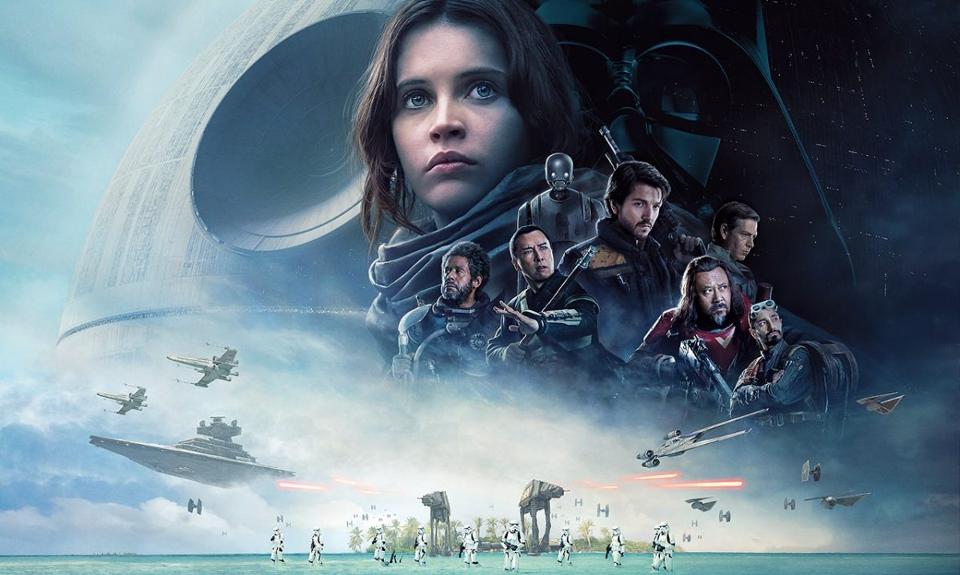
Star Wars: Rogue One
The Galactic Empire is constructing a weapon of mass destruction with the help of a weapons expert named Galen Erso. The nascent Rebel Alliance has heard rumours of its existence but little more...until a defecting Imperial pilot goes to ground on Jedha with an extremist named Saw Gerrera. The Rebels dispatch intelligence agent Cassian Andor to Jedha along with Jyn Erso, Galen's daughter, with orders to discover the nature of the Imperial threat and uncover its weaknesses.
When is a Star Wars movie not a Star Wars movie? That's a difficult question to answer. For hardcore fans, the franchise has always been about the depiction of a vast galaxy with lots of stories to tell about characters and worlds unrelated to the Force, the Empire or the Skywalker family, across comics and video games and animated TV series, but for casual movie-goers it's a more complex question. Rogue One is the first live-action Star Wars film not to be about the Jedi or the machinations of the Skywalker family tree, but it still has X-wings, TIE fighters, droids and villains with perfectly-clipped English accents. Disney seem to be kidding themselves that they are taking a risk with this movie, although it's still a fine slice of action blockbuster entertainment that will have adult fans and kids queueing up to see the movie in droves (although no-one is expecting it to repeat the business of last year's The Force Awakens, it should still be one of the biggest films of the year).
Those same kids may be leaving the cinema in floods of tears though. I've seen some people saying that Rogue One is the "darkest Star Wars film except for Sith and maybe Empire". That's lowballing it. Rogue One is easily the most ruthless and bleakest Star Wars movie to date, dispatching characters with such murderous and sometimes offhand efficiency that even George R.R. Martin might rise an eyebrow at it. An insurgent bombing of an Imperial convoy in a desert town feels rather uncomfortable to watch given contemporary events in Syria and the concluding tropical battle, which starts off feeling like a cheerful CGI shoot 'em up before (in one of director Gareth Edwards' more subtle and brilliant moments) shifting gradually into Apocalypse Now, becomes increasingly uncomfortable to watch. For a franchise whose numbered entries have sanitised their violence (the dismemberment of Anakin in Sith being the only real previous moment of visceral horror in the series), Rogue One has no problem with pushing the boundaries of what kids will tolerate. If possible, I would advise a parent preview of the film before deciding if you want young kids (say under 10) from seeing it.
The movie tells the story of a group of original characters who, it is established, are the ones who hear about the Death Star and eventually steal the plans that allow Luke, Han, Chewie, Wedge, Biggs and company to blow up the station at the end of the original 1977 film, A New Hope. It's a film that therefore exists in a somewhat schizophrenic state: on the one hand, as an original piece with new characters it has the chance to do things that are brave, original or even experimental, but it has to also closely coexist with the established continuity, particularly A New Hope, which may be the most scrutinised and iconic SF movie of all time.
Against the odds, the film does - more or less - succeed at doing what it sets out to do. Our core team of saboteurs and mercenaries consist of Jyn Erso (Felicity Jones), Cassian Andor (Diego Luna), Chirrut Imwe (Donnie Yen), Baze Malbus (Jiang Wen), K-2SO (Alan Tudyk) and Bodhi Rook (Riz Ahmed). They are uniformly excellent, as you'd expect from seasoned hands (the newest performer here is Jones, who still made her screen debut twenty years ago as a child actress), and they all get their moments in the sun. The interplay and connection between the characters is pretty compelling and it's a shame that we're not going to see more adventures with them: Disney has ruled out a direct sequel to Rogue One and it sounds like the next few Star Wars movie are going to take place in the post-Force Awakens era or be more prequels set before Rogue One and focusing on the backstories of Han Solo, Lando Calrissian and (possibly) Boba Fett and Obi-Wan Kenobi.
The story slots into place rather neatly before the events of A New Hope (days, if not hours, separate the two) and helps clear up a few niggling continuity issues from that film, namely what happened to the Rebel fleet in that film, how did Princess Leia get the battle plans and just how stupid were the Death Star designers? It turns out they weren't, the designer was a Rebel sympathiser who deliberately built a weakness into his plans which, thanks to security-mandated compartmentalisation, no-one else was senior enough to spot. No wonder George Lucas is reportedly a fan of the movie, as it helps retcon a few of the (admittedly minor) issues from the original movie out of existence.
More problematic is that the film needs to deal with the fact that some major characters are shared between it and A New Hope, and many of those actors are now dead or forty years older than they were when they made that film. A mixture of solutions are deployed. Darth Vader, for example, is simply a new actor (Game of Thrones's Spencer Wilding) wearing the suit with James Earl Jones back to do the voice work. Mon Mothma and General Dodonna are lookalikes, with actors Genevieve O'Reilly and Ian McElhinney (also late of Game of Thrones) replacing Caroline Blakiston and Alex McCrindle. In a clever move, director Gareth Edwards used alternate takes of the X-wing and Y-wing pilots from the Battle of Yavin from A New Hope to directly drop some of the established pilots from that battle into this engagement (which makes perfect sense). More controversial is the decision to use CGI to recreate Grand Moff Tarkin, played by the late Peter Cushing. His first appearance comes reflected in a starship window and if they'd stuck to that approach and kept his appearance to a cameo that would have been fine. Instead, having the very-clearly CG Tarkin wandering around and interacting with other characters drops us very firmly into the uncanny valley. Fortunately it's only really a couple of scenes that this impacts, but it's still weird and feels a bit inappropriate.
One of the film's biggest issues is the odd structure and pacing in the final act. The film doesn't climax so much as end abruptly on a rather bleak and horrible note, with the writers and director Edwards content to let A New Hope take over in providing catharsis or a resolution to the many storylines in motion. In this sense the film feels like it maybe gives too short a shrift to its compelling own cast of heroes and reduces them to, from the POV of the entire saga, also-rans. It's a movie that short-changes its own cast of characters in order to set up another one you've already seen, which is certainly a valid direction to take, just a rather odd one. This more notable with the villains, with Director Krennic (Ben Mendelsohn struggling manfully with variable material) being very a clearly a C-lister compared to Tarkin and Vader, despite having vastly more screen time. Whenever he wasn't on screen, I tended to forget he even existed.
Ultimately, Rogue One (****) is a successful movie, even if it's more of a modest diversion from the main focus of the series rather than an original piece of film-making. There's some excellent space battles (and it's undeniably thrilling to see the original X-wings, Y-wings, TIE Fighters, Corellian Corvettes and Star Destroyers mixing it up), some impressive stunts and some superb acting from a bunch of contemporary actors all at the top of their game. There's some musings on the morality of warfare and how far the desperate Rebels are willing to go to achieve their ends which add a little more depth to proceedings. The CG resurrection of long-dead actors I could do without and the film crashes rather unsubtly through the barrier between "subtle homage" and "fan-service" a few too many times, but overall this is an entertaining and worthwhile film that experiments moderately with the Star Wars formula whilst not straying far from the series tropes. But on final reflection I have to say I found The Force Awakens a more emotionally satisfying film with a proper beginning, middle and end, despite its derivative re-use of plot elements from other films in the saga, whilst Rogue One ultimately can't quite deliver on its initially more interesting story and more satisfying action beats.
Star Wars: Rogue One is on general release across most of the world now. The next Star Wars movie, Episode VIII (the direct sequel to The Force Awakens), will be released in December 2017.
Wednesday, 14 December 2016
STAR TREK: DISCOVERY casts main character
CBS have confirmed that Star Trek: Discovery has found its lead castmember.
Walking Dead actress Sonequa Martin-Green, who has played Sasha on the zombie show for five years, will play the role of a Lt. Commander on the USS Discovery. It appears that she will, initially at the start of the series, be in a more junior role despite being the star of the series. All of the previous Star Trek series have focused on the ship or station commander as the main character (all of them captains apart from Deep Space Nine's Commander Sisko, who was promoted to Captain at the end of Season 3). This has led to speculation that the protagonist may play a junior role but will be promoted later on.
Martin-Green will apparently continue to appear on The Walking Dead as well, since Discovery is shooting in The Walking Dead's off-season and her character does not appear in every episode of the AMC show. She will be the first woman of colour to head a Star Trek series, following in the pioneering footsteps of Nichelle Nichols as Lt. Uhura, who was one of the first actresses of colour to appear as a regular on a TV show, on the original Star Trek; Avery Brooks, the first African-American actor to lead a Star Trek show as Captain Sisko on Deep Space Nine; and Kate Mulgrew as the first leading actress on a Star Trek show as Captain Janeway on Voyager.
CBS also recently confirmed that there will be a Klingon presence on the show, with Chris Obi (Roots), Shazad Latif (Penny Dreadful) and newcomer Mary Chieffo playing the roles of T'Kuvma, Kol and L'Rell respectively.
Star Trek: Discovery will air in May 2017.
Wild Cards: Jokers Wild, edited by George R.R. Martin
The alien Swarm has been driven back into deep space. The band of villainous aces and jokers who tried to summon the Swarm, led by the Astronomer, have been defeated in battle and the victorious aces are taking some time out to enjoy Wild Cards Day 1986, the fortieth anniversary of the arrival of the alien virus on Earth. Unfortunately, the Astronomer hungers for revenge and sets out to murder all of the aces responsible for his defeat.
Jokers Wild is the third novel in the Wild Cards series and follows on directly from the events of Aces High. Having lost the battle in that book, the Astronomer is now out for revenge and begins cutting his way through the ranks of aces in New York City. Jokers Wild is interesting in that the entire book takes place across one day, so it's pretty unrelenting in pace, and also that it's the first "mosaic novel" in the series. Earlier books were collections of short stories which shared some events and characters, but mosaic novels actually intertwine around one another. The book reads as a regular novel, but each chapter is written by a different author and sometimes even sections and paragraphs within each chapter are written by different authors, who handle different characters and subplots.
This is a pretty noticeable phenomenon and for the first half or so of the book I found it seriously distracting, with sometimes jarring shifts in tone, atmosphere and prose style taking place. The somewhat relaxed and even jovial Hiram Worcester storyline (written by George R.R. Martin) and the adventurous Wraith plot (written by John J. Miller) didn't feel like it was really taking place in the same world as the sleazy, sexually explicit Fortunato stuff (written by Lewis Shiner) and the traumatising Roulette/Tachyon material (written by Melinda Snodgrass), despite the storylines all interacting with one another. This, combined with the disparate and wildly disconnected nature of the plots, made the first half of the book very tough going.
Fortunately, things gelled into place in the second half. The storylines start coming together and the way the heroes are working at cross-purposes without realising it becomes is quite cleverly structured. Eventually all of the scattered storylines come together in a massive, explosive and reasonably satisfying finale, even if the willingness of major characters to walk away and leave villains (who've just killed several of their friends) alive rather than either finishing them off or putting them in jail seems a bit implausible.
Still, if Jokers Wild (***½) is an experimental novel in structure and writing style, it is ultimately a successful one but takes quite a long time to get there. Accordingly, this is the weakest of the first three Wild Card books, but still a worthwhile read. The book is available now in the UK and USA.
TORMENT: TIDES OF NUMENERA gets a release date
inXile Studios have confirmed that, after many delays, their crowdfunded computer roleplaying game Torment: Tides of Numenera will be released on 28 February 2017.
Described as a "spiritual successor" to the classic 1999 Black Isle RPG Planescape: Torment, Tides of Numenera is set a billion years in the future on (or near) a post-human Earth inhabited by the ruins of eight great civilisations. Heavily inspired by Jack Vance's The Dying Earth and Gene Wolfe's The Book of the New Sun, this is a deep, reactive CRPG which will encourage dialogue and puzzle-solving as well as violence as a way of solving problems.
The game is primarily written by Colin McComb, who wrote a lot of Planescape: Torment as well numerous Planescape sourcebooks back when it was a Dungeons and Dragons campaign setting. George Ziets (Neverwinter Nights II, Fallout: New Vegas) is another lead writer. Chris Avellone, the project lead on Planescape: Torment, has also contributed a couple of quests and characters, as has Patrick Rothfuss, the writer of The Name of the Wind.
This is one of the more promising CRPGs in development at the moment, and it'll be interested to see if the lengthy gestation period (the game will launch four years after its Kickstarter campaign started, which is a long time for an isometrically-viewed CRPG) will result in an appropriately impressive game.
Tuesday, 13 December 2016
Visit Westeros, the Malazan world and the Forgotten Realms as globes
A website called Map to Globe allows budding fantasists to transfer their flat maps onto a sphere so you can see what your fantasy world looks like as an actual planet.
I've been playing around with it using some famous fantasy worlds.
A Song of Ice and Fire
This doesn't work entirely well because the maps of the North and the lands beyond the Wall need to be adjusted so they work on a globe. So this is a very rough and ready look at Westeros and Essos. It works really well for Essos and the Jade Sea, though (the coastlines of Sothoryos, eastern Essos and Ulthos are non-canon and speculative though).
LINK
(note: may not be working: either the maps time out after a while or I linked this in too many places and it's getting hammered).
The Malazan Book of the Fallen
This works really well, because Steven Erikson and Ian Cameron Esslemont were clever enough to stay away from the poles, which introduces a lot of distortion.
WITH NAMES
WITHOUT NAMES
Forgotten Realms
This was easy because mapmakers ProFantasy created a globe of the Forgotten Realms for their Forgotten Realms Interactive Atlas CD-ROM released in 2001. The base maps from that CD-ROM still splendily wrap around a sphere like they were supposed to.
SATELLITE VIEW
POLITICAL MAP
The Wheel of Time
The world of Robert Jordan's The Wheel of Time. The base map is not tremendously detailed and the artist did not draw Seanchan to the correct scale (the south of the continent extends much further east, explaining better why they chose to invade the Westlands from the west rather than the east).
LINK
Dragonriders of Pern
It works pretty well with Pern, the planet from Anne McCaffrey's Dragonriders of Pern series.
LINK
Great North Road
The planet St. Libra, from Peter F. Hamilton's massive novel Great North Road.
LINK
Avatar: The Last Airbender
The planet from Avatar: The Last Airbender and its sequel series, The Legend of Korra.
LINK
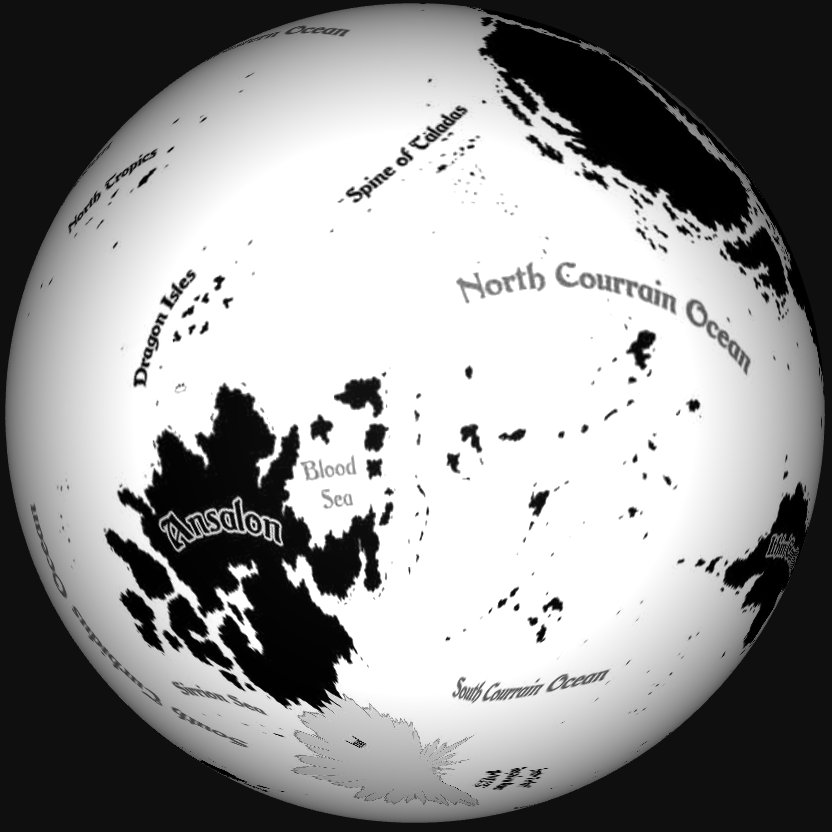
Dragonlance
Krynn, the planet of the Dragonlance Saga.
LINK
The Elder Scrolls
Nirn, the planet of the Elder Scrolls video games.
LINK
Conan the Barbarian
This is the world of Conan the Barbarian, which is based on Earth many thousands of years ago. This map is rough, since I didn't line up the features of the Thurian continent with the real Eurasia.
LINK
The Belgariad
This is the world of The Belgariad and The Malloreon by David and Leigh Eddings.
LINK
All in all, a fun little timewaster for a few hours.
Monday, 12 December 2016
Atlas of Ice and Fire: Historical Map series concluded
Over on Atlas of Ice and Fire, I recently concluded the "Historical Maps" series. This is a series of 25 posts covering the history of the Song of Ice and Fire world from the arrival of the First Men through to Mance Rayder uniting the wildling tribes just before the events of A Game of Thrones.
Next up with be posts on the physical geography of the world and then maps related to the novels themselves.
Friday, 9 December 2016
Brandon Sanderson completes first draft of new STORMLIGHT ARCHIVE novel
Brandon Sanderson has completed the first draft of Oathbringer, the third novel in The Stormlight Archive sequence, following on from The Way of Kings (2010) and Words of Radiance (2014).
The novel will require extensive rewrites and editing before publication, which is currently scheduled for November 2017. The novel currently clocks in at 461,223 words, which is actually too large to be published in one volume. Sanderson anticipates the word count to come down in the edits, so the novel is reduced to something more easily publishable.
If the current word count stood, it would make Oathbringer one of the longest fantasy novels ever written, behind To Green Angel Tower by Tad Williams (520,000 words), Ash: A Secret History by Mary Gentle (493,000) and The Lord of the Rings by J.R.R. Tolkien (473,000) but ahead of A Storm of Swords by George R.R. Martin (424,000) and Sanderson's own Words of Radiance (just over 400,000).
Oathbringer is the third of ten planned novels in The Stormlight Archive sequence. Sanderson's original plan was to release the books at 18-month intervals, but the actual release dates are working out at between three and four years per book. If Sanderson is able to release each future book at precisely three-year intervals, that means that the series will not completed until 2038, or twenty-two years from now. However, it would be considerably longer than this since Sanderson plans to take a long break between Books 5 and 6 to write the Mistborn II trilogy, pushing the completion of the Stormlight series comfortably back into the 2040s.
It'll be interesting to see if Sanderson (who turns 41 next week) starts making the books shorter or reduces his other projects to get Stormlight done faster, or if he accepts that this is just how long the books are going to take.
The writing time of the Stormlight books may also become problematic if DMG Entertainment's planned film adaptation of Sanderson's Cosmere mega-series (which Stormlight is just one part of) is a big success and they want to start cranking the films out faster. But we'll see how that goes.
Tuesday, 6 December 2016
RIP Peter Vaughan
Veteran British actor Peter Vaughan has passed away at the age of 93.
Peter Vaughan was born in 1923 in Shropshire. He fought in the Second World War, and after the conflict ended took up stage acting. He made his screen debut in 1959.
Vaughan was best-known to British audiences for his numerous character actor roles in comedy and drama, including memorable turns on Porridge and Citizen Smith and a 1990s resurgence in roles in Chancer, Our Friends in the North and the film The Remains of the Day.
However, he won a new legion of fans appreciators with his role as Maester Aemon in HBO's Game of Thrones. He appeared in the first five seasons before his character passed away at the end of Season 5.
Vaughan was a stalwart actor of British stage and screen for almost sixty years, with an impressive emotional range and ability. He will be sorely missed.
Monday, 5 December 2016
MECHWARRIOR 5 announced
Piranah Games have announced MechWarrior 5: Mercenaries, a new addition to the venerable battlemech combat game series.
The new game begins in 3015 AD and is set during the Third Succession War. Players will control massive battlemechs in a branching single-player campaign, along with robust multiplayer options. Previous MechWarrior games - the first was released in 1989 - have been critically acclaimed, particularly the second and fourth games, for their mixture of action and tactical planning. Piranha previously planned a reboot of the series in 2008 before it transformed into MechWarrior Online, a free-to-play game that has had a mixed critical response.
Jordan Weisman, the original co-creator of the BattleTech and MechWarrior games, is working on his own turn-based strategy game, BattleTech, for release in 2017.
Subscribe to:
Posts (Atom)