Saturday, 7 December 2024
Fear the Walking Dead: Season 1
Wednesday, 20 November 2024
The Walking Dead: Season 8
Sunday, 10 November 2024
The Walking Dead: Season 7
Rick Grimes and his long-standing band of companions have initiated hostilities with a group of extorters called the Saviors, thinking them just the latest in a long line of gangs of thugs and bandits they've been dealing with in the two years since civilisation fell. But the Saviors are a far larger, far more dangerous and far more unpredictable group than any they've come across since, under the leadership of the charismatic and capricious Negan. The Saviors take control of Alexandria, forcing Rick's group to work for them and executing two of their number to make sure they are taken seriously. The group is divided on how, or even to, resist, whilst others of their number find more of the network of settlements that Hilltop was just one of, and gradually realise that the Saviors have made a lot of enemies, something they might be able to turn to their advantage.
It's been a minute since we last touched base with The Walking Dead, Robert Kirkman's comic turned Frank Darabont's lawsuit target turned epic zombie apocalypse turned slightly frustrating nation-building exercise. I got so frustrated with the show's pacing being all over the place that I decided to tune out until it was over, which took slightly longer than expected, not helped by the seasons immediately following my hiatus being soundly criticised even by hardcore fans.
As a recap, Season 6 saw the gang take over the town of Alexandria, whose citizenry can be best described as nice-but-dim. Rick and his gang of hardened survivors had to take over the town for their own good, almost turning into villains in the process, a highly interesting idea that the show immediately squandered (the town is immediately attacked by feral lunatics known as Wolves and a massive zombie horde, and only Rick and The Gang have the cojones to sort them out whilst the Alexandrians just gawp), as is often the case with The Walking Dead. The latter part of the season flirted with an even more interesting storyline in which Rick and The Gang are manipulated into fighting the Saviors by the duplicitous Gregory, leader of Hilltop. The show could have had the Saviors as a more reasonable group, so Rick's pre-emptive attack was an illegitimate act and the resulting counter-strike by Negan was more justified, but again that would have made the show too interesting, so we are reassured at every second moment that the Saviors are evil, almost killing two of our heroes on a whim and subjecting multiple towns to tyranny, murder and extortion.
Still, the season was the most action-packed The Walking Dead has ever been and, whilst logic had not so much left the building but screamed out of town in a jet fighter at Mach 5, never to be seen again, there's no arguing it was fun to watch in a very dumb kind of way. This is what I call the "Game of Thrones Season 7 Effect," where character and plot logic have been sacrificed on the altar of visceral action and some sick special effects, but the latter are executed so well you kinda don't mind (and The Walking Dead was never the most subtle study in character interplay in the first place).
Season 7 continues in much the same vein. The season opens with the infamous episode where Negan gets to pontificate at Rick and, via an unnecessarily drawn-out, tension-building exercise, kills two of the regular characters in a very gory fashion. Despite the undeniable gut-punch of seeing two solid characters (one of whom has been around since the very beginning, or almost) go out, it also feels like someone at AMC decided this was going to be their Wal-Mart own-brand version of the Red Wedding and milked it for every nanosecond. The result is possibly the worst episode of the show to date, devolving into that most curious of beasts, extremely boring torture-porn.
Once the show gets over that hump, it sets about exploring its new paradigm with entertaining relish. The Saviors live at the Sanctuary, a massive factory-turned-fortress, and are extorting the people of three settlements, Alexandria, Hilltop and the Kingdom. There are also two other settlements nearby which know about the Saviors but have remained undetected: the Junkyard, home to a bunch of inexplicable weirdos known as the Scavengers; and Oceanside, home to a bunch of women whose menfolk were all killed by the Saviors, buying them time to escape and establish a secret stronghold on Chesapeake Bay. Handily, Carol and Morgan have already established contact with the Kingdom, a town built in and around an old zoo and ruled by a flamboyant ruler known as King Ezekiel (who feels like he has been airdropped into the show from the Renfair Hallmark version of Game of Thrones, but is easily one of the most entertaining characters on the show so we'll allow it), whilst Tara, who went missing at the end of Season 6 and literally nobody at all noticed, has established less-cordial relations with Oceanside.
Season 7 is, as usual, divided into two eight-episode sub-arcs. In the first Rick and The Gang are trying to make their new position of working for the Saviors fly, with some characters angrily planning revenge on Negan and the Saviors but others arguing for patience and time to regroup. Daryl has been taken prisoner by the Saviors so we get to explore the Sanctuary via him (and returning Season 6 bit-players Dwight and Sherry), whilst Maggie is trying to consolidate the Hilltop in their alliance, whilst fighting a rather one-sided rivalry with Gregory. Tara's visit to Oceanside is rather tedious, in the lowest-rated episode of the entire series, which I thought was a bit harsh; there's more than a few episodes before this in which absolutely nothing happens, whilst this at least had some solid walker-killing. A storyline in which Morgan struggles with his vow not to kill whilst Carol needs a time-out in a cottage is...okay, I guess, but only works because of the two actors.
Inevitably, after a few more Alexandrians are killed and Negan turns out to be even more loony-tunes than we first thought, Team Rick decides to fight and starts banding the communities into a big army. The weak link here are the Scavengers who are blatantly, obviously untrustworthy from the off and Rick's efforts to bring them into the alliance are ludicrous (and the fact we get the exact same story in Season 8 beggars belief). Negan also ends up moving from genuinely threatening figure at the end of Season 6 to pantomime dame, flouncing around and straining to find reasons not to kill the more popular characters blessed with plot armour. Jeffrey Dean Morgan always gives a great performance but there are a few moments where even he seems to be asking, "why am I not killing every person in this room?"
Things do get better as the season wraps up, with the web of alliances coming to fruition in a surprisingly messy finale with double-crosses and plot twists and some solid action beats. The season does quite well on this front with a few good set-pieces such as Michonne and Rick taking down 300 walkers with a weaponised steel cable, and later clearing out a funfair by themselves. The storyline in the Kingdom is unexpectedly a highlight, its daftness (Ezekiel has a CGI pet tiger) giving way to a much edgier story as they try to work reasonably alongside the Saviors but ultimately realise they can't.
Season 7 of The Walking Dead is trying to do something that most long-running post-apocalyptic media tries to do and often falters in the process: transitioning from the post-apocalypse to the post-post-apocalypse, from simple survival to nation-building. Running from zombies in the immediate aftermath of disaster with plentiful supplies to scavenge, not many survivors and tons of guns lying around (in a US-set story, anyway) is easily turned into compelling drama. Working out how to get reliable supplies of food and water, especially with a brutal local government around? Not so much, or at least it's trickier. The Fallout franchise had a similar problem with the early games set just after the nuclear war giving way to the later games set 200 years later with tons of factions and even nation-states arising, and the game developers too often falling back on post-apocalyptic tropes even where they no longer made sense, because it was easier.
The Walking Dead is to be commended for trying this tricky transition in its seventh season (***½) and it doesn't fare as badly as I was expecting, with some nice character arcs and action setpieces. But the show struggles with selling some of its plot points and ideas, and the whiff of contrivance as Rick's group need a bunch of allies to fight the Saviors and immediately meet a bunch of allies to fight the Saviors is high. The result is an entertaining-enough season of television, which recovers from a cynical and crappy start to deliver some satisfying resolution, even if you can't quite buy all the steps along the way. The show can be seen on multiple streaming platforms worldwide right now.
Thursday, 28 April 2022
Changes for the WALKING DEAD and DUNE TV series
The Walking Dead is gearing up to end its run, but there are changes afoot for its spin-off shows.
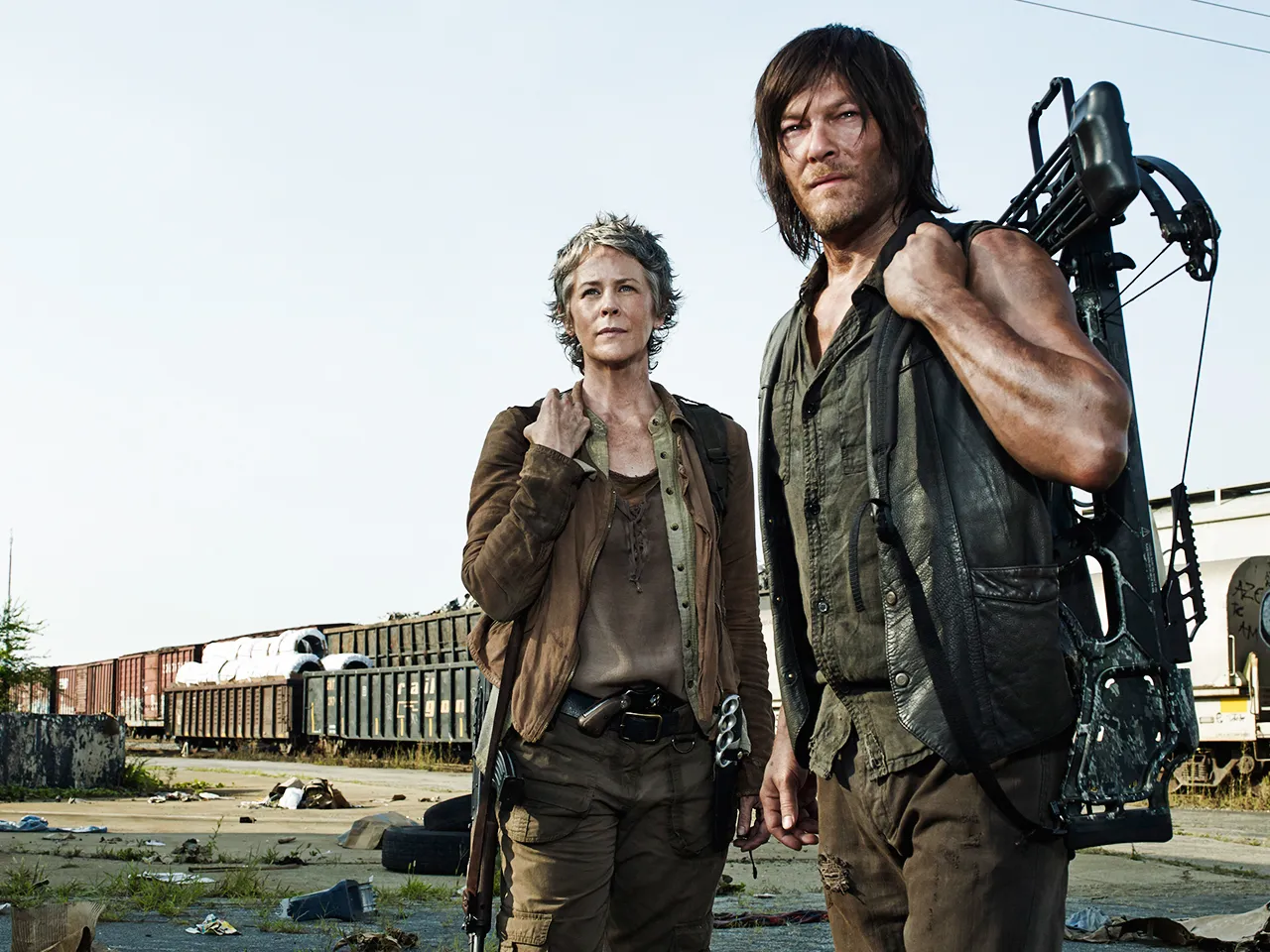
As noted previously, AMC is planning a number of new spin-off shows from The Walking Dead, beyond the existing Fear the Walking Dead and The Walking Dead: World Beyond. The first of the new spin-offs was planned to focus on the characters of Carol (Melissa McBride) and Daryl (Norman Reedus) after the events of the series. This is significant as McBride and Reedus are the only Season 1 regulars still on the show in its final season, and arguably are the two most popular characters and actors on the series.
However, Melissa McBride has now withdrawn from the project due to scheduling issues. Unlike the existing shows, which film principally in Georgia in the United States, the new show will shoot in Europe for cost-saving reasons. McBride is unable to relocate to Europe for the required filming dates. As a result, the new show is being rejigged to focus on Daryl only.
Anthology series Tales of the Walking Dead is currently shooting and a further spin-off, Isles of the Dead, which will see Maggie (Lauren Cohan) and Negan (Jeffrey Dean Morgan) relocating to a ruined New York City, is in pre-production.
Meanwhile, HBO Max is continuing to develop Dune: The Sisterhood, a Bene Gesserit-focused spin-off from the movies directed by Denis Villeneuve. The series was due to have Villeneuve direct its first two episodes, but the proposed filming dates clash, ironically, with those for the film Dune: Part Two. Chernobyl and Breaking Bad director Johan Renck has been picked to replace him.
Wednesday, 9 September 2020
AMC confirms the end of THE WALKING DEAD
AMC have announced that The Walking Dead will end in 2022 after airing its 11th season, which will be super-sized as a result, with 24 episodes as opposed to the usual run of 16 episodes.
The Walking Dead began airing in 2010 under the stewardship of Frank Darabont (The Shawshank Redemption, The Green Mile). Based on Robert Kirkman's successful comic book series - which ran for 193 issues between 2003 and 2019 - the series follows a band of survivors in the aftermath of a zombie apocalypse, which mostly takes place off-screen. The focal character is Rick Grimes (Andrew Lincoln), a sheriff who is caught up in the apocalypse along with his family, best friend and some random other survivors. Over the course of the show, the initial band of survivors changes composition many times (until only two actors from Season 1 are still in the regular cast in Season 11) and it evolves from a desperate, isolated band to a group of community-leaders and nation-builders. The zombies, although everpresent, decline as the main threat in favour of other human communities of varying degrees of morality and corruption.
The show quickly became the biggest thing on television for several years, until being displaced by HBO's Game of Thrones. Recent seasons have seen sharp declines in viewing figures and critical appreciation, but with an ending in sight and a climax to build towards (which for various reasons will have to be very different to the ending in the comic book), it'll be interesting to see if the show can win back some sceptical, long-departed fans.
The show's first spin-off series, Fear the Walking Dead, is continuing to air on AMC and a second spin-off, The Walking Dead: World Beyond, set ten years after the apocalypse, is due to launch in the next couple of months. World Beyond is a limited series planned to run for just two seasons. AMC have also confirmed they will be launching a third spin-off, which will follow the adventures of Daryl (Norman Reedus) and Carol (Melissa McBride), the most popular characters from The Walking Dead and the last two Season 1 characters standing. A series of TV movies focusing on Rick Grimes is also in the planning stages.
AMC is also developing Tales of the Walking Dead, an anthology series set in the same universe involving both new and old characters from different points in the series timeline.
Wednesday, 3 July 2019
THE WALKING DEAD unexpectedly ends
The Walking Dead began in October 2003 as the "zombie movie that never ends," with Kirkman painting a picture of a world in disarray after an unexpected zombie apocalypse. Main POV character Rick Grimes, a police officer who was shot and fell into a coma in one world and awoke in another, led readers through sixteen years and 193 issues of hell, with Rick amassing a collection of friends and allies, all trying to survive in this new world. Along the way they battled a succession of powerful villains, including the Governor, cannibals and Rick's baseball bat-wielding nemesis, Negan.
Kirkman claims that the decision to end the comic in this fashion came because he didn't want fans counting down to the end, or perhaps over-hyping it. Announcing it was the final issue just a couple of days before release had been his plan for several years.
In 2010 AMC began airing a TV series based on the comic, starring Andrew Lincoln as Rick. The show became an international phenomenon for several years, before it's star was eclipsed first by Game of Thrones and then by Stranger Things. More recent seasons of the show have had a cooler critical reception and suffered from plummeting viewing figures. The show has also deviated from Kirkman's source material, including killing off major characters who are still alive many years later in the comic timeline. However, the show remained popular enough to spawn a spin-off, Fear the Walking Dead, and a forthcoming series of TV movies. The show's tenth season will begin airing later this year.
In 2012 Telltale Games released The Walking Dead, an episodic adventure game which set new standards in writing and characterisation in video games. Several sequels followed, although these were again more coolly received after the original creative team behind the first game quit the company.
The end of the comic series will likely have little impact on the TV show, since the the TV series has deviated quite far from the original. In particular, it will be impossible for the TV show to end the same way the comic book does, as the comic book relies on several characters who have been killed on the TV series.
Monday, 20 May 2019
Gratuitous Lists: Top Ten SFF Pilots
Here is a list of ten of the best show-openers (in no particular order). Note that I have used "pilot" to mean "the first episode of the series" rather than the technical definition (a premiere episode filmed separately to the rest of the series, not always for public consumption).
Ronald D. Moore worked on the Star Trek franchise over a decade, starting on The Next Generation in 1989 and rounding off the final season of Deep Space Nine in 1999, co-writing two movies along the way. In 2000 he joined the writing team of Star Trek: Voyager in its sixth season, but quickly found his goals for the series being thwarted. He wanted to see Voyager, trapped far from home on the other side of the galaxy, taking damage and staying damaged from episode to episode. He wanted to see more consistent characterisation, the morals of Starfleet being tested in extreme circumstances. Instead the other writers and producers wanted to hit the reset button at the end of every week.
Three years later, Moore was approached by the Sci-Fi Network (now SyFy) with an intriguing offer. They'd picked up the rights to 1978 space opera Battlestar Galactica and were developing a remake project. A previous reboot attempt, with X-Men producers Bryan Singer and Tom DeSanto, had foundered in the wake of 9/11 and SyFy were now looking for a fresh take. Moore agreed to take on the project on the understanding that he wanted to make it a more gritty and adult show. Although he'd enjoyed the original show, he felt the premise had been under-valued. The destruction of twelve planets and the deaths of billions of people would have left a staggering mental scar on the survivors, not to mention raising extreme ethical concerns of how the military and civilian authorities worked together in such circumstances, not to mention the collective PTSD of having tens of thousands of people trapped in spacecraft with dwindling supplies for months or years on end.
The result was a mini-series, aired on SyFy and then NBC in 2003, which served as a backdoor pilot for a series proper. And it'd be fair to say that Moore and his team knocked it out of the park. The second the mini-series opens it feels different. Director Michael Rymer created a shaky, immediate style of shooting that put the viewer in the heart of the action. Composer Richard Gibbs used a drums-heavy sound to create a very different, military-feeling soundtrack. The actors, a mix of newcomers like Jamie Bamber and Katee Sackhoff and industry veterans like Edward James Olmos and Mary McDonnell, are uniformly excellent. The visual effects by CG studio Zoic are (still) amazing. Over the course of a generous three hours, the mini-series builds the world of the Twelve Colonies and then tears it down, leaving the bewildered survivors to try to escape and build a new life for themselves.
It's not the series at its best - the first episode of Season 1 and thus the next episode after this, 33, may hold that honour - but it does set up the show well and leave you wanting to watch more.
In the late 1970s, veteran TV writer Terry Nation was called in to a meeting at the BBC to discuss creating a new show. A respected writer with a huge amount of experience in the industry, he was still best-known for creating the Daleks for Doctor Who fifteen years earlier, and the BBC were hoping to tap that magic again. Nation had several ideas for crime dramas and other ideas, but the executives he was talking to seemed underwhelmed. Improvising on the spot, Nation suggested a dystopian space opera, with a band of malcontents and criminals reluctantly joining forces to escape a tyrannical government. He left with a commission to write a pilot.
Blake's 7 was developed as a conscious riposte to the relentless optimism of Star Trek; the symbol of the despotic Terran Federation is that of Star Trek's Federation but turned to the extreme right. Nation decided he didn't want to write a children's show, and instead wrote an adult, tough and at times brutal pilot script in which engineer Roj Blake is taken to a clandestine meeting of rebels against the government and learns that he was once a respected military leader, captured by the Federation and mind-wiped to be turned into a model citizen. Blake is horrified and suffers a mild mental breakdown as his real memories come flooding back. His new associates are killed in a massacre and Blake finds himself on trial on trumped-up charges of child molestation. His lawyers discover the truth and embark on a quest to clear Blake's name...with invariably fatal results. Only at the end of the episode does Blake meet some of his other soon-to-be fellow shipmates (Jenna and Vila; Avon doesn't appear until the second episode), as he is carried away from Earth on a transport, vowing to return to destroy the government.
The Way Back is uncompromising and quite astonishingly cynical, landing in tone somewhere between Nineteen Eighty-Four, The Prisoner and a waking nightmare, and light-years from the cowboy theatrics of the then recently-released movie Star Wars. It has money problems - Blake's 7 was commissioned as a replacement for contemporary crime drama Softly Softly: Task Force and given the exact same budget! - but these are mostly overcome by cunning use of industrial wastelands and locations as sets and some quite excellent model work. What remains overwhelmingly impressive is the bleak atmosphere and superb acting, particularly from Gareth Thomas as Blake. Not just a great pilot episode, this is one of the best episodes of the entire series.
The result is a vivid and immediately-impactful vision of the future, and a show that starts already in fifth gear and only accelerates from there. Stunning visuals (the effects team on the show deserve all the plaudits for their clear, detailed style, and to be frank the guys creating the murky, often barely-discernible CG on Star Trek: Discovery could learn a lot from them), some excellent music and some terrific directing (the opening imagery of Julie Mao on her terror-stricken ship is now iconic) help propel the story onwards.
The Expanse is the best space opera show since - and possibly including - Battlestar Galactica and this first episode is an important part of the reason why. Remember the Cant!
This was a huge shame (understatement) as Serenity - not to be confused with the movie of the same name - is a splendid pilot, the best Joss Whedon has ever written. It sets up both the world and the worldview of its characters, introduces a relatively large cast and establishes a significant mystery that will run across the season. It also has to tell rollicking good story in its own right, which it does with enviable skill.
Whilst it's hard to pinpoint one reason why Firefly failed, taking it's excellent opening two hours and burying them at the end of the first season probably had a key role to play.
Costing almost $15 million, the pilot episode to Lost is still the most expensive TV pilot ever filmed. To sell the crash-landing of Oceanic Flight 815 on a remote island in the South Pacific, ABC shipped a broken-up Lockheed L-1011 to Hawaii, scattered bits of it along a beach and then, after several weeks of shooting, had to carefully remove it again. It was absurdly indulgent, but every second of the expense ends up on screen, resulting in a scene of chaos, explosions and people trying to save one another that grabbed the audience and didn't let up.
J.J. Abrams and Damon Lindelof's script is intriguing, setting up no less than fourteen regular characters (and several more recurring) and establishing almost all of them with some interesting character work before later episodes would do the heavy lifting of fleshing them all out via flashbacks. Excellent acting and fantastic location shooting in Hawaii added up to that rarest of things, a network TV show that looked as expensive as premium cable.
Lost's pilot shows the value of starting your show with a bang, grabbing the audience's attention, and then not letting it go.
Mr. Robot began life as a movie script by Sam Ismail which he developed for some time before realising that the story was too big and the characters bursting past the page count, demanding more material. Ismail reframed the two-hour movie as a ten-hour season of television, with the pilot expanding from the first thirty pages of the script.
Mr. Robot's pilot is remarkable, an intense drama blending psychology, hacking, cyberthriller and drama. Rami Malek is perfectly cast as Eliot Alderson, a man suffering from depression and loneliness who relates to people by hacking them online, even his therapist. In doing so he finds out secrets about them that they don't even know, and is able to influence their lives without them ever knowing.
Mr. Robot's pilot also has unusual rewatch value. You can watch it on the surface as the technothriller it comes across as, but after watching Season 1 you can go back with fresh information and see all the events again in a different light. A remarkable opening episode to a very unique-feeling series.
"Everybody's dead, Dave." The very first episode of Red Dwarf sets up a very strong premise, with Dave Lister, the lowest-ranking crewmember on the five-mile-long mining ship Red Dwarf (because the service robots have a better union than the human maintenance crew), being sentenced to spend the rest of the mission in temporal stasis after smuggling an unquarantined cat on board. This proves unexpectedly helpful when the crew is wiped out by a lethal radiation leak. Holly, the ship's AI (IQ 6,000, "the same as 12,000 traffic wardens"), steers the ship into deep space and waits for the radiation to die down to a safe background level...which takes 3 million years.
Deep Space Nine is almost certainly the finest Star Trek television series for myriad reasons, from its greater levels of serialisation to its intricate character arcs to its refusal to push the reset button at the end of each episode, but one that is oft-overlooked is the fact that it has the best opening episode in the entire franchise.
The Cage was so esoteric and weird that it put the broadcasters off and nearly killed the original Star Trek, before it came back with the (somewhat) stronger and mostly-recast second pilot Where No Man Has Gone Before; the broadcasters were still unconvinced and ended up dropping in a random early Season 1 episode to kick things off instead. Star Trek: The Next Generation's Encounter at Farpoint was intriguing but clumsily-written, with the characters pale shadows of their later, more fleshed-out incarnations. Voyager's Caretaker was only okay, and Enterprise's Broken Bow started off well by promising a more low-tech approach to Star Trek that it had pretty much broken by the end of the pilot. Discovery took arguably three whole episodes to even finish off setting up its basic premise.
Emissary, though, is a much more successful episode. It opens with a literal bang, with producer Michael Piller finally apologising to fans for having to wimp out on showing the Battle of Wolf 359 from The Next Generation's Borg epic The Best of Both Worlds three years earlier (due to cost). An epic flashback depicts the desperate struggle as the Borg cut through a Starfleet armada of forty starships with contemptuous ease, Commander Ben Sisko losing his wife in the process.
The rest of the episode is fascinating. The Cardassians have withdraw their occupation force from the planet Bajor after forty years of brutal conquest, leaving massive religious and social upheavals in their wake. The Federation has stepped in to help the transition and run an orbiting Cardassian space station, but to the surprise of the Starfleet personnel, they find a hostile reception among those Bajorans who fear they've swapped one oppressor for another. It's all rather messy and a big departure from The Next Generation, where everyone is so civilised and reasonable and solves problems over cups of (Earl Grey, hot) tea and sessions with the ship's counsellor. The fact that the main cast includes a significant number of both Starfleet and non-Starfleet personnel (a first and, to date, last for the franchise) allows for more character and cultural conflict than we'd previously seen on Trek, and fuelled seven full (and mostly excellent) seasons of stories.
The visuals are striking throughout, particularly the closing images of Rick riding a horse into an eerily deserted Atlanta, only to be attacked by a vast horde of walkers and forced to take refuge in a tank. It's rare to see a pilot given this level of production value, scripting and direction, and a genuine pleasure to watch.
Of course, Darabont would be forced off The Walking Dead in -contentious circumstances a year later (with litigation still continuing today), and The Walking Dead would go through so many showrunners, writing staffs and contortions of premise that the show today barely resembles how it started, but this opener remains excellent and compelling viewing.
Thank you for reading The Wertzone. To help me provide better content, please consider contributing to my Patreon page and other funding methods, which will also get you exclusive content weeks before it goes live on my blogs. SF&F Questions are debuting on my Patreon feed and you can read them there before being published on the Wertzone.
Tuesday, 29 May 2018
THE WALKING DEAD to lose its star this year
The Walking Dead is of course known for its frequent shifts in cast, but Lincoln has played a major role on the show since the very first episode of the series aired in 2010. Cohen has also been a relatively major player since she joined in Season 2. The move leaves Norman Reedus as Daryl Dixon and Melissa McBride as Carol Peletier as the sole two surviving regular characters from the first two seasons on the show. Reportedly AMC has offered Reedus a substantial salary hike to take over as the surviving character. Chandler Riggs, who played Rick's son Carl, was abruptly killed off in Season 8 for no immediately discernible reason, leading to a negative backlash by the fans and the actor (and his family).
Of course, it's not a given that the character of Rick Grimes will be killed off, although given the circumstances of the zombie apocalypse it's hard to see him just walking off into the sunset.
The casting changes have been a bit bemusing, as it was generally assumed that Rick would either make it through the whole show or would die at some point, handing off to either his son Carl or Maggie, who has gained impressive leadership skills over the course of the series whilst becoming a mother and losing her entire family to the zombie apocalypse.
The long-term future of The Walking Dead remains open to question, with some rumours suggesting it will end after Season 10 in 2019-20. AMC have been bullish, claiming that the show could last effectively forever with regular shake-ups in cast, but this has never been taken entirely seriously by critics. In particular, the show remains the target of multiple lawsuits from original producer Frank Darabont and comic creator Robert Kirkman. If these lawsuits are successful, AMC could potentially lose every single dollar of profit they've made on the show in eight years, which might sour their enthusiasm for it. Another possibility is that spin-off show Fear the Walking Dead, which has seen improvements its critical reception recently, might step up to take over the parent show's timeslot, possibly with a further spin-off put into development.
Monday, 12 June 2017
The Walking Dead: Season 6
The Walking Dead is probably the most frustrating show on television (although it's also traded that title a few times with Game of Thrones in its most recent two seasons). It's beautifully shot, fantastically scored and has an outstanding cast of excellent actors. The writing and characterisation, however, is highly variable and the show's tone can go all over the place, from slightly cartoonish ultraviolence to gritty realism to funny character interactions and back again, often in a very clunky fashion. By far the show's biggest problem, however, has been pacing and structure. The series has had sixteen episodes per season since its third year, which is very generous by modern American cable standards, but it has struggled, sometimes excruciatingly, with filling that time with consistently gripping drama. From its third through fifth seasons, The Walking Dead has made wheel-spinning into an almost admirable art form.
For its sixth year, the show takes a different tack and one that is quite successful in solving this problem. The first half of the season revolves around two entwined events: Rick and his friends driving off a walker horde at the same time some opportunistic scavengers called the Wolves attack Alexandria. This results in a complex, two-front battle which becomes even more challenging when part of the horde splits off and crashes the party in town. This results in The Walking Dead's most action-packed storyline to date, with eight episodes of building tension, drama and all-out warfare. The series has often been criticised for sometimes forgetting there's even zombies around (although that was kind of Robert Kirkman's point, the zombies are merely the mechanism by which civilisation falls whilst he is far more interested in the social dynamics of reconstruction) but that complaint is certainly dismissed this season. The first few episodes of the show have our characters going to war, engaging the walkers in a full-scale, all-out offensive to save their new home.
It's all splendid stuff. The characters get their moments in the sun, Carol and Tara get new romantic partners, someone gives Daryl a rocket launcher and we're reunited with (slightly inexplicably) fan-favourite bit-player Morgan, who finally joins the cast full-time and gives us the possibly the show's most bizarre stand-alone episode in which he learns aikido from a random dude in the woods and his goat. This episode is gloriously insane, makes very little sense and seems to think it's very profound, which makes it awesomely enjoyable (if not quite for the reasons the writers intended). The first half of the season is The Walking Dead at its very strongest and most gripping, even if the decision to "kill" Glen and hide his fate for three episodes remains utterly moronic.
The second half starts going a bit wonky almost immediately. The end of the battle for Alexandria sees several characters introduced at the end of Season 5 brutally murdered apparently just to keep the cast costs down, which is less tragic than just annoying. Things pick up with a fantastic Daryl/Rick road trip episode in which they meet a charismatic new character called Jesus and then learn about the existence of a network of other settlements. At this point the show's allusions to the Fallout video game series (which have always been present, if not in the actual setting, then in the general post-apocalyptic tone) pick up as Rick moves from being on the defensive to gaining a view of a new civilisation arising from the survivors, that maybe they do all have a future. Having snatched away the possibility of a cure for the Turn in Season 5, The Walking Dead makes up for it by giving us a sliver of hope that maybe things will turn out okay.
There is, of course, a problem: the newly-contacted settlements are being extorted for food and ammo by a group called the Saviors. The show very nearly does something great here by having Rick and co immediately agree to attack them without actually talking to them first, which is a startlingly ruthless (and strategically unsound) move, and thus instigate hostilities. Unfortunately the series provides a get-out clause by revealing that they're the same group that attacked them earlier in the season (and had to be sorted out by Daryl and his rocket launcher), immediately giving Team Rick the moral high ground. This only increases when we get to meet the Saviours and discover just what a bunch of bad 'uns they are. Even so, the show makes some very interesting dramatic choices, such as having our first major interaction with the group come through a group of ruthless women who have sworn in with them, resulting in an unexpectedly feminist episode where they take Carol and Maggie prisoner and we're waiting for Rick to burst in and save them, but this turns out to be unnecessary because Carol and Maggie know how to take care of business by themselves.
So if the second half of the season falters compared to the first half, at least it's making interesting and original storytelling decisions, deploying its large cast of characters in dramatically compelling ways and keeping things ticking over nicely. And then it really all goes horribly wrong in the finale.
The Season 6 finale of The Walking Dead has been justly reviled by very large numbers of both critics and fans. One of the most interesting things about the Saviors before this point is that they're nasty and ruthless, but arguably not outright evil (their insistence on murdering one person as an example has to be countered with Rick's willingness to murder all of them without even knowing anything about them), and in fact seem to be what Team Rick were on their way to becoming given a few more months. The Saviors have some wins and losses, and seem to be a match for our heroes without totally overwhelming them (as, say, the Governor did initially). In the Season 6 finale the Saviors become psychic super-savants, capable of working out exactly what roads (ut of the utter maze of highways, back roads and side-trails sprawling outside Washington, DC our heroes are going to take and blocking them off expertly, building petrol-strewn barricades in minutes and knowing precisely where our characters will stop to get out of their truck to risk a cross-country run so they can set an elaborate trap. It's the most unconvincing, contrived bit of writing I've seen in years and is embarrassingly stupid. The silliness of this ending takes away from the introduction of Negan, the Saviors' much-foreshadowed leader, played with relish by the always-good Jeffrey Dean Morgan, and really reduces the impact of his ruthless execution of one of our heroes (not that you find out who that is until Season 7).
So the sixth season of The Walking Dead (****) is very nearly the best (and is certainly the best-structured and paced), but then makes a series of writing decisions throughout the season which are needlessly annoying, particularly its reliance on fake-out deaths. But as frustrating as it can be, The Walking Dead can also be, particularly in its quieter moments of just dwelling on the world after the fall, surprisingly atmospheric and thoughtful. The show's never-ending quest for consistency continues. The season is available now on DVD (UK, USA) and Blu-Ray (UK, USA).
Wednesday, 14 December 2016
STAR TREK: DISCOVERY casts main character
Walking Dead actress Sonequa Martin-Green, who has played Sasha on the zombie show for five years, will play the role of a Lt. Commander on the USS Discovery. It appears that she will, initially at the start of the series, be in a more junior role despite being the star of the series. All of the previous Star Trek series have focused on the ship or station commander as the main character (all of them captains apart from Deep Space Nine's Commander Sisko, who was promoted to Captain at the end of Season 3). This has led to speculation that the protagonist may play a junior role but will be promoted later on.
Martin-Green will apparently continue to appear on The Walking Dead as well, since Discovery is shooting in The Walking Dead's off-season and her character does not appear in every episode of the AMC show. She will be the first woman of colour to head a Star Trek series, following in the pioneering footsteps of Nichelle Nichols as Lt. Uhura, who was one of the first actresses of colour to appear as a regular on a TV show, on the original Star Trek; Avery Brooks, the first African-American actor to lead a Star Trek show as Captain Sisko on Deep Space Nine; and Kate Mulgrew as the first leading actress on a Star Trek show as Captain Janeway on Voyager.
CBS also recently confirmed that there will be a Klingon presence on the show, with Chris Obi (Roots), Shazad Latif (Penny Dreadful) and newcomer Mary Chieffo playing the roles of T'Kuvma, Kol and L'Rell respectively.
Star Trek: Discovery will air in May 2017.
Tuesday, 8 November 2016
The Walking Dead: Season 5
The Walking Dead reaches its fifth season, in which everything is awesome and our heroes are happy and smiling. Or maybe not. The season opens with our heroes prisoners in a cannibal stronghold before joining forces with a priest losing his faith and ending with them deliberately traumatising a peaceful community into accepting them as their new protectors. Along the way several major characters die for no immediately-discernible reason and the writers tease the audience with the possibility of some kind of actual over-arching storyline with a firm resolution in mind before snatching it away, leaving both characters and viewers with no hope and to wallow in misery.
Or to put it another way, welcome to another season of The Walking Dead, y'all.
George Romero - someone who knows a thing or two about zombies - once called The Walking Dead a "zombie soap". He's not wrong. That's not a criticism, because Robert Kirkman also called the story that of a "zombie movie that never ends". Week in, week out, month in, month out, on screen, in the comics and in the video games, people tune into the next instalment of this story which tries to make a strength out of the fact it has no end, no master plan and no planned resolution.
This sense of an ongoing narrative works in soap operas, however, because of the shifts in tone. Yes, characters get divorced, get into fights, occasionally die, but they also get married, fall in love and have moments of real happiness. The Walking Dead's biggest problem has always been its nihilistic streak, that the world is full of misery and pain after the Turn and that both the walkers and other people are dangerous and out to kill you at any given moment and every day is a remorseless, never-ending struggle to feed yourself and your family, to avoid injury and disease, and to find shelter and ammo. Other TV shows embrace the darker side of life, but lighten things with moments of genuine humanity (like The Wire, whose cast The Walking Dead continues to pilfer for new roles), occasional comedy (Breaking Bad) or hope (Game of Thrones). The Walking Dead does this only very, very occasionally, which makes it a harder show to watch. It's the ultimate example of "grimdark" on television, with the strengths and weaknesses of that movement.
Season 5, like the past two seasons, attempts to overcome one of its biggest problems - the inability to sustain a narrative over 16 episodes - by dividing the season into two halves. The first half sees our heroes at their lowest ebb in Terminus, but they also have the hope of a cure and an endgame in mind. This ultimately proves a blind alley which is deeply frustrating, but perhaps true to the show's basic premise. Finding a cure for the walkers would, ultimately, feel like a cheap way of ending the series, even if it did provide some kind of upbeat resolution.
The first half of the season is a mixed bag. Our heroes spend way too much time hanging around in a church and the enemies they face from Terminus are characterless ciphers. There's a very half-hearted attempt to inject pathos by suggesting these people were once as good as Team Rick, but turned evil after meeting some bad people. But they never really follow up on it in enough depth to justify the sheer depravities they resort to. This part of the season also makes an ill-considered choice to use fractured, non-linear storytelling, moving from place to place, reversing back in time to fill in back story and accelerating forward again. Non-linear storytelling is a great device when handled well, but The Walking Dead uses it instead in this instance as a way of annoyingly retconning storylines and engaging in cheap emotional manipulation (when Person A was about to die and you thought Persons B and C were miles away, but it turns out in a flashback that Persons B and C were miles away hours earlier, and are now ready to save Person A). It also allows them to pad out the story with filler episodes in which not much happens. The Walking Dead TV show has always been far superior at characterisation than the comic books, and sometimes its use of quieter episodes to expand on character is effective. In the first half of Season 5 it never really works, however.
Once the show returns from its mid-season break, it regains a sense of momentum. Our heroes arrive on the outskirts of Washington, DC (those expecting some great shots of an abandoned Mall won't get them: the show's relatively low budget is never quite as painfully obvious as this season) and find a new safe haven, Alexandria. This results in a much more engaging storyline in which our heroes are presented as the unsafe invaders in a peaceful and stable community, Rick's ruthless pragmatism presented as cynical selfishness and maybe even outright villainy by the existing community leaders. This idea of turning Team Rick into the bad guys has always been an ace in the show's hole and their employment of it is well-assured, accompanied by some excellent performances. However, the show presents even this storyline with the training wheels still on. The revelation of a new group of bad guys who employ tactics far worse than anything Team Rick have done; some of the people in Alexandria turning out to be cowards and murderers; and the Alexandrians genuinely not having a clue about the world outside mean that our sympathies remain firmly lodged with Team Rick throughout. When offered a chance to make a genuinely interesting point on morality, The Walking Dead shrugs and keeps walkin' instead.
Still, The Walking Dead's primary strengths remain intact: some excellent actors, fantastic prosthetics work and some outstanding moments of cinematography and framing of shots. On a moment to moment basis, the show is mostly watchable and there are some outstanding action scenes. Carol (Melissa McBride) remains the best performer on the show, with some brilliant scenes and the opportunity to channel her inner soccer mom in the concluding episodes. She also gets most of the best lines. Many of the other actors also do quality work. But the sense remains that the show needs more of a sense of an endgame and more of a direction to the story. A zombie soap is great fun, there's only so long that it can keep doing that and remain fresh.
Season 5 of The Walking Dead (***½) is available now on DVD (UK, USA) and Blu-Ray (UK, USA).
Friday, 26 December 2014
The Walking Dead: Season 4
The Walking Dead continues to be one of the oddest shows on television. On the one hand, its a big-budget, crowd-pleasing depiction of the mass killing of zombies. On the other, it's a bleakly nihilistic portrait of people who seem to only ever be a few more catastrophes away from committing group suicide. More than once whilst watching a particular season, the idea comes to mind that the show is completely pointless, lacking as it is in any kind of long-term direction or plan for survival beyond holing up for a bit and seeing what happens.
If the show's lack of a long-term focus is a problem, it's one the writers manage to (mostly successfully) push to the back-burner by emphasising individual moments and the crisis of the day. A debilitating disease sweeps the prison in the opening episodes and no sooner is that burning itself out then a full-scale war is underway, after which the survivors are scattered across the countryside and have to fight their own battles to survive. This structure seems to have emerged after dissatisfaction with the previous season's main storyline, which in order to get to sixteen episodes had to resort to lots of cheap filler.
The show's overlong seasons are still a big problem, but the fourth season certainly handles it better by treating each of the two halves as its own eight-episode serial. The first half is tighter, with the characters more closely bound together and even confident enough to spend two full episodes on exploring the backstory of a secondary character in detail. The second half is more sprawling and more of an anthology series, with the characters divvied up into random teams and having to survive without the benefits of the larger group. This allows hitherto chronically-underdeveloped characters like Beth to emerge much more strongly as fully-rounded figures. The arrival of survivors from Texas on a mission which might actually tie into the origins of the walker plague, and the discovery of a new refuge accepting people in from a large area, also gives the show that much-needed sense of direction in its final episodes of the season as well.
There are still weaknesses. The show is prone to repetition, and the zombie-killing is now so routine that the characters seem as bored by it as the viewers are. The structure of the season is a big improvement on the previous one, but events are still too slow-paced and the producers could have done with cutting to the chase a bit more quickly.
Still, the fourth season of The Walking Dead (****½) emerges as the best to date. Entertaining, if at times bleakly so, and always well-acted, the show could still do with a bit more focus and certainly less episodes per season, but it seems to be on the right track. The season is available now on DVD (UK, USA) and Blu-Ray (UK, USA).