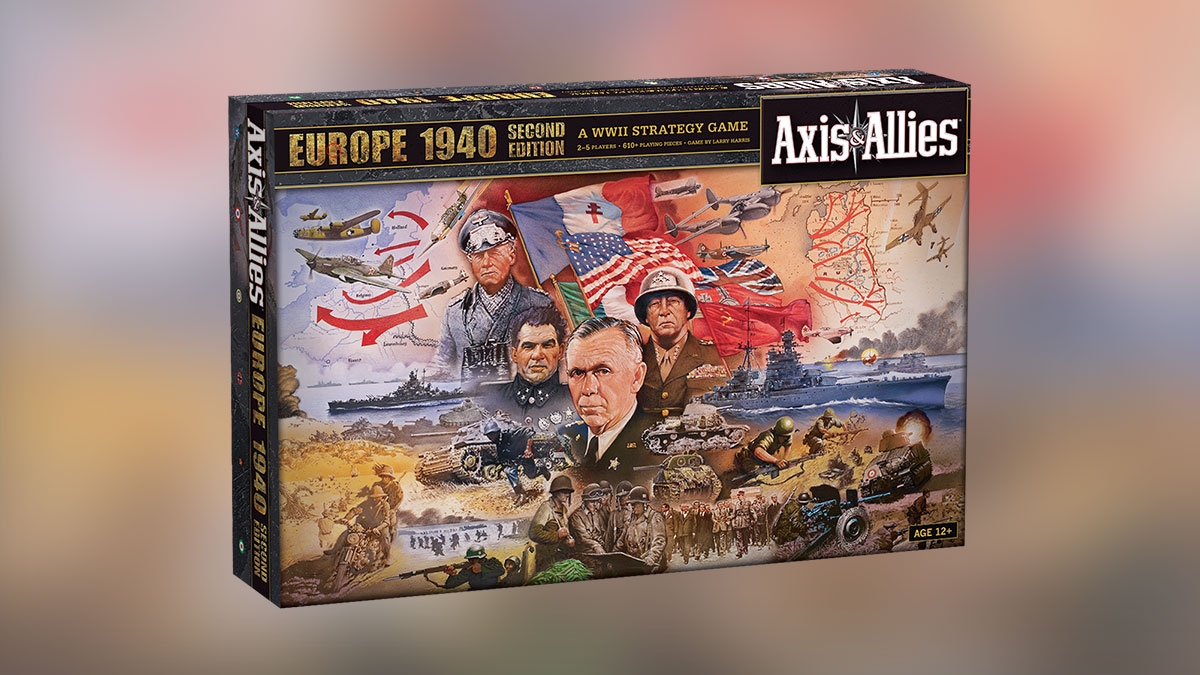
One of the most notable and popular board games around is
Axis & Allies. Originally released in 1981, the game was designed to depict the full scale and scope of World War II in a concise board game form but with greater complexity and depth than
Risk, the then-dominant popular wargame. Since its release almost forty years ago, the game has sold many millions of copies to become one of the most popular board games of all time.
However, several changes of ownership, several edition changes and the release of a series of related-in-name-only spin-off games have left the casual gamer potentially confused over which edition to pick up or check out. If you fall into this bracket, this Franchise Familiariser may be of some use.
A game of Axis & Allies Anniversary Edition in progress. German units are shown in black, British units in tan, Russian in red and Italian in brown. American and Japanese forces not shown.
The Basics
Axis & Allies is a series of board games which attempts to depict major military conflicts (predominantly World War II) from a military and economic perspective, but in a relatively straightforward and streamlined manner. The
Axis & Allies franchise is at heart a deliberately asymmetric game which intends to replicate (in broad strokes) the key difference between the two main sides in the Second World War: the Axis powers start the conflict with enormous and formidable military forces, but if the Allies can withstand their initial onslaught, their superior economic might will, in the long run, turn the tide of the conflict. Whilst modern board games attempt to reduce the role of randomness by substituting card choices for dice rolling, the
Axis & Allies games revel in rolling enormous numbers of dice. The dice mechanic is very simple: the game uses a standard six-sided dice and you want to roll as low as possible to inflict enemy casualties.
Games of
Axis & Allies usually revolve around the combined use of ground troops (infantry, artillery and tanks), air forces (fighters and bombers) and naval units (submarines, destroyers, cruisers, battlecruisers and transports) to win battles and seize territory. Territory zones have an economic income, which allows the victor to increase their supply of money and buy more units for the next turn. Victory goes to the side which achieves either an unassailable position (agreed by mutual consent) or seizes its military objectives, usually key cities and enemy capitals.
The core factions of each game are the Axis and Allies. Most editions of the game feature the
Soviet Union,
United Kingdom and
United States as the Allied side with
Germany and
Japan forming the Axis. Some editions of the game adjust this, introducing Italy as a third Axis side and China, the ANZAC forces (Australia and New Zealand) and the Free French as additional Allied factions. Depending on the edition, the game can be played by anything from two to nine players, although nine would be considered excessive (and the ANZAC, French and Chinese players would have relatively little to do). The most common variant is a four-player game with one player controlling each of Russia, Germany and Japan, and a fourth player controlling the USA and UK.
Recently the franchise has expanded to cover the war from three levels of play (beginner, intermediate and advanced), as well as developing spin-off games of varying quality, from the very well-received
World War I 1914 to the poorly-received
Guadalcanal. There are also video games inspired by the series and a more hardcore miniature wargame which shares the name.
The traditional Axis & Allies logo.
The Series
The
Axis & Allies series consists of the following games:
The Core Game
- Axis & Allies (Nova Games Edition, 1981)
- Axis & Allies Classic (1984)
- Axis & Allies Revised (2004)
- Axis & Allies Anniversary Edition (2008)
- Axis & Allies 1941 (Beginner's Game, 2012)
- Axis & Allies 1942 (Intermediate Game, 2012)
- Axis & Allies Anniversary Edition, Second Printing (2017)
Individual Theatres
- Axis & Allies: Europe (1999)
- Axis & Allies: Pacific (2001)
- Axis & Allies: Pacific 1940 (2009)
- Axis & Allies: Europe 1940 (2010)
- Axis & Allies: Pacific 1940, Second Edition (2012)
- Axis & Allies: Europe 1940, Second Edition (2012)
Spin-Offs
- Axis & Allies: D-Day (2004)
- Axis & Allies Miniatures (2005)
- Axis & Allies: Battle of the Bulge (2006)
- Axis & Allies: Guadalcanal (2007)
- Axis & Allies Naval Miniatures: War at Sea (2007)
- Axis & Allies: WWI 1914 (2013)
- Axis & Allies & Zombies (2018)
Video Games
- Axis & Allies (turn-based strategy game, 1998)
- TripleA (2001)
- Axis & Allies (real-time strategy game, 2004)
Franchise History
Larry Harris (1948- ) is the son of Lawrence Holiday Harris, Snr. (1920-2010), a former US infantryman who fought in the Pacific Theatre of WWII, taking part in battles at the Solomon Islands, New Guinea and the Philippines. Harris himself saw military action in Vietnam, serving with the 82nd Airborne Division.
Harris developed the original
Axis & Allies for Nova Games in 1981, inspired by long talks with his father over his military service. Harris was inspired to create a WWII game which was more complex and true to history than, say,
Risk, but was still approachable and easier to play that a detailed, full wargame. In 1984 he re-released the game through Milton Bradley as part of their "Gamemaster Series". This edition of
Axis & Allies, known known as the "Classic Edition", became iconic for its colourful map and strong theme. This edition sold over a million copies by itself.
Harris moved on to develop other games (including
Thin Ice in 1989) and for some years resisted revisiting his best-known game. In 1999 he relented and released a much more focused version of the game, concentrating solely on the European Theatre. In 2001 he did the same for the Pacific. After experimenting with a series of spin-off games using all-new rules and focused on single battles, not to mention a miniatures of game of dubious connection to the main series, Harris and his team (now working for Avalon Hill, an off-shoot of Hasbro) returned to the original game in 2008, releasing a series of new editions for all levels of play, as well as re-releasing the European and Pacific variants in new editions which could be combined into one massive new game of unparallelled size and scope (featuring over 1,000 miniatures).
More recently, the team has been working on spin-offs which actually use the core
Axis & Allies rules but in new settings, resulting in
Axis & Allies: WWI and
Axis & Allies & Zombies (2018). Future games which take the
Axis & Allies gameplay into new settings are also in the planning stages.
Axis & Allies: Nova Games Edition (1981)
Factions: UK, USA, USSR, Germany, Japan.
Units: Infantry, Tanks, Fighters, Bombers, Aircraft Carriers, Submarines, Transports, Battleships, Nuclear Bombs.
The original Axis & Allies was released in 1981 by Nova Games. This version of the game is noted for its paper map and its use of counters rather than miniatures. Despite its primitive presentation, the gameplay is surprisingly close to that of the "classic edition". The biggest and most startling change is the presence of a nuclear bomb: each side can research nukes either as an alternative win condition or to actually use (the nuke obliterates every unit, friendly or hostile, in a single game space). Later editions of the game removed the nuclear bomb, although some house rules sometimes incorporate the race to acquire a nuke as an optional win condition.
Axis & Allies: Classic (1984)
Factions: UK, USA, USSR, Germany, Japan.
Units: Infantry, Tanks, Fighters, Bombers, Aircraft Carriers, Submarines, Transports, Battleships.
The classic edition of the game was released by Milton Bradley in 1984 and remained in print for almost twenty years. This version of the game remains iconic for many people due to its colourful, well-delineated world map and its relatively straightforward gameplay. Aside from getting rid of the nuclear bombs, this edition didn't change too much apart from introducing a tech tree where each side could develop new and better weapons as the game progressed, such as heavy tanks, V2 rockets and jet aircraft. Later editions of the game either removed or reduced this aspect of the gameplay.
Axis & Allies: Europe (1999)
Factions: UK, USA, USSR, Germany.
Units: Infantry, Artillery, Tanks, Fighters, Bombers, Aircraft Carriers, Submarines, Transports, Destroyers, Battleships.
The first theatre-specific edition of the game focused on Europe and North Africa. This version of the game is arguably the bloodiest - the German and Russian players can expect to lose dozens upon dozens of units apiece in the fighting on the Eastern Front - but also arguably the most strategically interesting, with various variant strategies available (including the Axis diverting more troops to the Middle East or the UK mounting an assault on Norway). This edition of the game also introduced artillery, which dramatically improves the effectiveness of infantry in attacking, and destroyers as an urgently-needed counterbalance to German submarines. These improvements would be incorporated in most future editions of the game.
This game also features some cities which are entire spaces on the board by themselves (Leningrad, Moscow and Stalingrad) and convoy routes which the Axis player can raid with U-boats to interrupt the flow of resources to the beleaguered UK and USSR.
Axis & Allies: Pacific (2001)
Factions: UK, USA, Japan.
Units: Infantry, Marines, Artillery, Tanks, Fighters, Bombers, Aircraft Carriers, Submarines, Transports, Destroyers, Battleships.
This version of the game focuses overwhelmingly on the Pacific Theatre, naval combat and the clash between the Allied powers and Japan. This version of the game introduces Marines (as special troops with a bonus for storming islands) and Naval Bases (which give naval forces a boost to movement). Although very popular, this edition of the game has some problems, most notably the simplistic combination of India, Australia and New Zealand under the British banner and the US player taking control of Chinese forces.
Axis & Allies: Revised (2004)
Factions: UK, USA, USSR, Germany, Japan.
Units: Infantry, Artillery, Tanks, Fighters, Bombers, Aircraft Carriers, Submarines, Transports, Destroyers, Battleships.
The third edition of the core game is also the least popular. The introduction of the new rules from the theatre games into the base game - such as destroyers and artillery - are welcome, but this version of the game features a particularly hideous world map which is not enjoyable to play on.
Axis & Allies: Anniversary Edition (2008, 2017)
Factions: UK, USA/China, USSR, Germany, Japan, Italy.
Units: Infantry, Artillery, Tanks, Fighters, Bombers, Aircraft Carriers, Submarines, Transports, Destroyers, Cruisers, Battleships.
Released to celebrate the 50th anniversary of Avalon Hill Games,
Axis & Allies: Anniversary Edition was the first attempt to create a "big" version of the standard game. The game takes place on a map which is over 33% larger than the original with many more territories. It also adds Italy as a sixth faction and introduces new rules for China (which is still controlled by the US player, but is now handled as a separate military power). The game also expands the "victory city" idea, identifying 18 cities which are of strategic value. The first faction to capture a certain number of cities wins. This edition also retains the tech tree from the Classic edition that was omitted from later versions of the game. The only new unit introduced is the Cruiser, which sits between a Destroyer and Battleship in capability.
This version of the game has been cited by many
Axis & Allies fans as the definitive version of the game. Out of print for many years, it was recently re-released in 2017 and, at this time of writing, remains on general release.
Axis & Allies: 1942 (2009, 2012)
Factions: UK, USA, USSR, Germany, Japan.
Units: Infantry, Artillery, Tanks, Fighters, Bombers, Aircraft Carriers, Submarines, Transports, Destroyers, Cruisers, Battleships.
The new "standard" edition of the game, replacing the unloved
Axis & Allies: Revised and
Axis & Allies: Anniversary Edition (when the first printing sold out). This game features a new, more realistic map and incorporates Cruisers from the anniversary edition, as well as new, faction-specific sculpts for units (rather than everyone using the same tank and same bomber models, etc). A welcome return to form for the core game, praised for its presentation. However, this edition of the game has been criticised for unclear territory boundaries on the map, cardboard tokens for factories (rather than the plastic units of previous editions) and the removal of bank notes from the game to allow players to track their money, not to mention a highly inadequate number of provided dice.
Axis & Allies: Pacific 1940 (2009, 2012)
Factions: UK, USA/China, ANZAC, Japan.
Units: Infantry, Mechanised Infantry, Artillery, Tanks, Fighters, Bombers, Tactical Bombers, Aircraft Carriers, Submarines, Transports, Destroyers, Cruisers, Battleships.
A revision of the 2001 Axis & Allies: Pacific game, this edition features a greatly expanded role for China (in line with the Anniversary Edition) and introduces the ANZAC (Australia and New Zealand) forces as a distinct faction.
Axis & Allies: Europe 1940 (2010, 2012)
Factions: UK, USA, USSR, France, Germany, Italy.
Units: Infantry, Mechanised Infantry, Artillery, Tanks, Fighters, Bombers, Tactical Bombers, Aircraft Carriers, Submarines, Transports, Destroyers, Cruisers, Battleships.
A major revision of the original 1999 Axis & Allies: Europe game, this edition is similar but also incorporates most of Africa (rather than just the northern coast) and adds some improvements in the form of mechanised infantry, tactical bombers, airbases and naval bases. This game also features an earlier starting position, with Germany considerably weaker than in the original game and with more work to do, as France is still extant and needs to be defeated before the Axis turns its attention towards the Soviet Union.
Axis & Allies: Global 1940 (2010, 2012)
Factions: UK, USA/China, USSR, France, ANZAC, Germany, Italy, Japan.
Units: Infantry, Mechanised Infantry, Artillery, Tanks, Fighters, Bombers, Tactical Bombers, Aircraft Carriers, Submarines, Transports, Destroyers, Cruisers, Battleships
Axis & Allies: Global is not a separate game but is instead created by combining the
Pacific 1940 and
Europe 1940 boards and units into one massive map almost six feet in length. This version of the game can be best described as the "ultimate"
Axis & Allies experience, with over 1,000 plastic miniatures and eight factions (with potentially nine players, as the USA and China can be played separately). With a play time of 10 hours, this is a game for players with lots of time on their hands and an urge to go truly epic with their game.
Although undeniably impressive, this version of the game is possibly a bit "too much" due to the overwhelming number of units and the huge number of territories on the map which can result in dead spans of time in which not much happens. In addition, whilst you can go for nine players, the people playing China and France may find themselves with not much to do. This version of the game should be approached with the same caution reserved for tackling, say,
Twilight Imperium with half a dozen players.
Axis & Allies: 1941 (2012)
Factions: UK, USA, USSR, Germany, Japan.
Units: Infantry, Tanks, Fighters, Bombers, Aircraft Carriers, Submarines, Transports, Destroyers, Battleships.
With each edition of
Axis & Allies getting bigger and more insane than the previous one, someone at Hasbro had the brainwave of developing a "back-to-basics" version of the game. This version of the game is stripped back and streamlined: Cruisers and Artillery have been dumped, most of the optional rules have been junked, the map is much smaller and there are far fewer territories, which are now also larger. The focus is on the five original factions and the idea is to get games done and dusted in two hours or less.
This version of
Axis & Allies is fast-moving and short-lived, perfect for game nights where people want to get several different games down or for beginners just starting out in learning the game. With far less features, options and units, the game is also exceptionally cheap, going for a quarter of the price of
Anniversary Edition or a third of
1942.
Axis & Allies: WWI 1914 (2013)
Factions: British Empire, USA, Russian Empire, France, Imperial Germany, Italy, Ottoman Empire, Imperial Russia.
Units: Infantry, Artillery, Tanks, Fighters, Aircraft Carriers, Submarines, Transports, Battleships.
The first attempt to depict a different time period with the core
Axis & Allies rules,
WWI 1914 is a major success. The game depicts trench warfare through a very simple mechanic: instead of units constantly attacking one another until the battle is won or lost (as in the standard game, to depict fast-moving battles taking place over weeks or days), only one exchange of fire takes place, allowing players to pour more troops into an ongoing battle in a static line. This allows players to fight battles lasting many months for relatively small amounts of territory, which is historically accurate (whether it's fun or not will depend on the players and their ingenuity in how they overcome the stalemate). Optional rules can bring about the collapse of the Soviet Union through the Russian Revolution of 1917 or the early entry of the USA into the war in force.
Axis & Allies & Zombies (2018)
Factions: UK, USA, USSR, Germany, Japan.
Units: Infantry, Tanks, Fighters, Bombers, Aircraft Carriers, Submarines, Transports, Destroyers, Battleships, Zombies, Zombie Control Ray, Chainsaw Tanks, various new units (unconfirmed).
Axis & Allies & Zombies is the forthcoming, and possibly inevitable, first edition of the game to add zombies. Adding zombies to WWII has always been a (somewhat inexplicably) popular idea in film and other games, so seeing them show up in an Axis & Allies title is predictable, but possibly interesting. The game will apparently be based on the 1941 edition, with a focus on fast play, and will see the standard WWII game interrupted by the arrival of zombies, who are a force of nature (not under anyone's control). A new card mechanic will allow players to destroy zombies or possibly funnel them towards the enemy, whilst new units like chainsaw tanks and zombie control rays will make for new and interesting strategies. A gimmick? Sure, but potentially a fun one. The game will be released in time for Halloween this year.

Larry Harris's next game, War Room, is a ground-up reinvention of the WWII war/board game with a focus on diplomacy, morale, resources, propaganda and terror weapons, all of which are missing from the more streamlined Axis & Allies.
The Future
Axis & Allies is an older game, but it's popularity remains undimmed. The key to the game's long-term appeal has been how it recreates WWII in broad strokes that are surprisingly accurate whilst not going in the direction of being a hardcore wargame. The game has been credited with inspiring a greater interest in the conflict and encouraging people to read up the actual history of what happened, which was (and remains) one of Larry Harris's original goals. Since Hasbro took over the franchise, there has been some concern of over-exploiting it, with the number of different editions currently available being potentially too confusing (my advice: buy
1941 if you're a total newcomer with limited time,
Anniversary Edition if you want a good all-round experience,
1942 when
Anniversary Editions goes out-of-print, and the
Pacific/Europe 1940 combo if you're a hardcore, experienced
Axis & Allies player with lots of gaming time available).
Axis & Allies & Zombies could be fun, but it may be a sign of the bottom of the barrel being scraped, although I must admit I'd be totally down for a well-designed
Axis & Allies: Middle-earth or a
Game of Thrones variant.
Larry Harris's next game is potentially more interesting. Many of the criticisms of
Axis & Allies stem from its limited economic model (which ignores resources such as oil and metals), the absence of diplomacy (although that does make sense, as the game opens with the war in full swing) and factors such as propaganda, resources and weapons of mass destruction. Introducing these elements to the existing game would create a confusing and unbalanced mess, so Harris has sensibly designed a new game from the ground up incorporating these elements.
War Room is the result of that design process. The game is superficially similar to
Axis & Allies, but features more factions (the UK, USA, USSR, China, Germany, Japan and Italy are the base factions), resource types (such as oil and iron), trade (between allies and with neutral nations) and morale (defeats overseas may trigger unrest at home).
Featuring a large circular map and lots of new features,
War Room was successfully funded on Kickstarter last year to the tune of half a million dollars and we should see the game on the shelves in the next year or two. Whether it's any good or not remains to be seen, but it's good to see the spirit of
Axis & Allies is still alive and being furthered by its creator.
See Also
A handy tool for
Axis & Allies fans is
TripleA, an open-source video game based on the board game which features a large amount of variant rules and ideas. This is useful for both practice (although make sure you're using the game version which matches the correct edition of the board game), and playing with friends who live far away.
Thank you for reading The Wertzone. To help me provide better content, please consider contributing to my Patreon page and other funding methods, which will also get you exclusive content weeks before it goes live on my blogs. SF&F Questions and The Cities of Fantasy series are debuting on my Patreon feed and you can read them there one month before being published on the Wertzone.