Showing posts with label buffy the vampire slayer tv. Show all posts

Wednesday, 6 March 2019

Buffy the Vampire Slayer: Season 7

For Buffy Summers, it's a strange sense of deja vu to see her sister Dawn starting high school at the newly-rebuilt Sunnydale High. Soon, however, an old enemy returns to Sunnydale and sets in motion a chain of events which threatens everything and everyone. Buffy has to become a leader as she never has before to stand against the threat, and the cost will be very high.


The cast of Buffy hit absolute rock bottom in the show's sixth season, a long and bleak journey from post-traumatic stress through self-realisation to catharsis via a lot of really bad relationship choices, several deaths and the world very nearly being destroyed. Season 7 opens with the fall-out from that season still being felt - Willow in recovery from her magic addiction, Spike trying to deal with his newly-acquired soul - but also with a bit of a back-to-basics feel.

There's a new Sunnydale High (unwisely built - in record time - on top of the old one and the Hellmouth) which Dawn is attending and where Buffy gets a job as a school counsellor, which is one of those genius ideas that the show proceeds not to do very much with. Early episodes of the season have a bit of a Season 1 feel, although this also includes, with the bemusing episode Him, an instalment that feels like Season 1 quality as well. The season is a bit rough in the early going with potentially solid story and character developments being undercut by filler episodes and some odd character choices, like reducing Spike to a raving loon for half the season and killing off fan-favourite side-characters for questionable story reasons.

The story does pick up with Conversations with Dead People, the season's best episode, in which characters are haunted by figures from their past (and yes, this episode bears more than a passing resemblance to Babylon 5's Neil Gaiman-written episode Day of the Dead) which leads to both character growth and also to pushing the main storyline on. By mid-season it's become clear that the true threat is an old enemy returning to destroy the world and the tension ratchets up a gear as Buffy assembles an army of new allies and older characters to face the threat. Spike also stops acting crazy, to everyone's relief.

Events then build to the epic season finale, taking in a few twists and turns along the way, including a memorable turn by Firefly's Nathan Fillion as a crazed evil preacher with superhuman (or subhuman) powers. This is all good stuff and it's a refreshing change of pace after the introspection of Season 6, although those who felt that in-depth psychological exploration of the characters in that season was a strength may be disappointed by the more obvious good-vs-evil struggles this season which dials back the intense character drama.

Buffy does at least stick the landing: the ending is thematically appropriate, rewarding for the characters and leaves the world on a good note, although some may bemoan a few perfunctory character deaths and a rather pointless apparent heroic sacrifice that had been undermined by news the character was moving to Buffy's sister show Angel. Beyond that, the ending and the final line are very nicely done.

Buffy the Vampire Slayer's seventh and final season (****) is a fine ending to the show. It's not the strongest season, but it does provide an appropriately epic finale to seven years of Slaying and it does give the show a nice coda. The season is available now as part of the complete Buffy the Vampire Slayer DVD box set (UKUSA).

Monday, 25 February 2019

Buffy the Vampire Slayer: Season 6

The world has been saved, but the cost was high. Willow Rosenberg, now a powerful witch, decides to fix the problem and succeeds, but sets in motion a chain of events that will, once again, threaten the world.


What happens when everything goes wrong at once?

This is a question that many people - perhaps almost all people - will face at some point in their lives, when not just one thing goes horrendously wrong but suddenly multiple problems crop up together. Work, relationships and family problems become insurmountable, leading to unhealthy coping mechanisms, addictions, exceptionally poor relationship choices and a failure to communicate effectively with friends.

Buffy the Vampire Slayer always worked most effectively as a metaphor, using demons to stand in for school bullies or a magical threat to the world as a stand in for academic stresses. In Season 6 the show still does that, but it also takes a surprisingly deep dive into real stresses and anxieties. Sure, the root causes of the stresses our characters encounter are supernatural - such as Buffy's PTSD after suffering horrendously in the Season 5 finale - but the ways they cope are remarkably ordinary. If Seasons 1-3 of Buffy were about the traumas of high school and Seasons 4-5 were about college life and starting to realise your own place in the world, Season 6 is about becoming an adult and suddenly having real responsibilities land on your lap, and the realisation that you are in control of your own life and should really try not to mess it up.

It's bold move for a show that previously mixed real life issues with metaphors, comedy and romance, and like most such bold moves it was (and remains, seventeen years on) very divisive among fans. People who tuned in to Buffy to see the Slayer kick ass, Xander make a funny quip and Giles get exasperated felt uncomfortable instead to see their characters having a miserable time of it and making one horrendous mistake after another.

This is exemplified by the annual external threat, the traditional "Big Bad," which in fact is pretty risible for most of the season: two very minor antagonists from previous seasons team up with a dude no-one remembers to take over Sunnydale. Their plans are mostly stupid and go wrong, and their actual threat value is somewhere around zero...right up until it isn't and then things go south very fast.

For most of the season, the show is more concerned with the long trip through the soul of Buffy Summers. Suffering severely after the events at the end of Season 5 and having to take care of her little sister and keep their house running, Buffy is also forced to quit college and get a horrible, soul-destroying job to keep the money coming in*. Buffy's problems are startlingly mundane and her reaction to them - internalising her stress, trying to keep a brave face on as everything comes crumbling down inside - is both natural and leads to horribly predictable coping mechanisms.

What's even worse is that our other characters are unable to help because they are also suffering their own problems: Xander and Anya have relationship issues, Willow's growing addiction to magic is causing problems, Spike doesn't know what his purpose is any more and even Dawn is making poor choices, whilst Giles is trying to work up the courage to leave Sunnydale for good. The Scooby Gang has become completely dysfunctional apart from the perennially unflappable Tara, who finds herself - not entirely comfortably - becoming the confidante of the group as they struggle to deal with their issues.

The path our heroes take to finally saving the day is a difficult one and eventually risks destroying the group altogether, but ultimately they succeed (and I feel confident saying that now, because you need some hope to get through these 22 episodes) in a manner that is appropriate, realistic and somewhat positive. It helps that the sixth season isn't completely a walk through nightmare city. There are some funny side-episodes and some brilliant individual scenes. The episode where Buffy goes full Groundhog Day (complete with Freaky Mummy Hand) is fantastic, as is another where Buffy gets turned invisible. The concluding three-episode arc of the season is very well-handled, finally giving our heroes a traditional battle to fight (kind of). The most infamous episode of the season, of course, is Once More With Feeling, the musical. I've always enjoyed the episode but also felt it was a tad overrated: some of the songs fail to land and the concluding Buffy/Spike song really doesn't work that well, which is problematic given how it's the moment the whole season revolves around. It's a hard episode to criticise too much, though, and it gave Whedon the experience he needed to make the much stronger musical special Dr. Horrible's Sing-Along Blog six years later.

The season does handle its more challenging and realistic material well (especially since you can now blitz through it in a few hours, rather than over nine months), but there are a couple of problems. One is that Willow's "addiction = drugs" storyline is a bit too silly and on the nose, literally sending her into a 1960s-style trippy den of inequity at one point. It's at that point the subtext becomes not just text but an entire novel filled with the words "DO YOU GET IT YET?" Mercifully the show quickly gets a grip and moves on from that idea.

Buffy the Vampire Slayer's sixth and penultimate season (****½) is generally regarded as the darkest season of the show, which is definitely true. It's also the season that has aged the best since the show originally aired. It's the psychologically richest season of the show, the one which really gets under the characters' skin and explores them in a manner the show never managed before. I also suspect the twenty-somethings who were irked with the season's darkness because they were having a great time may be much more sympathetic to it as forty-somethings with baggage (cough). The season is available now as part of the complete Buffy the Vampire Slayer DVD box set (UKUSA).

* Exactly why the Watchers' Council aren't picking up the tab, given Buffy and Giles's reinstatement in Season 5, is curiously unexplained.

Wednesday, 13 February 2019

Buffy the Vampire Slayer: Season 5

Things seem to be going well: Buffy and Willow are thriving at university, Buffy is enjoying a healthy relationship with an ordinary, living guy and Giles has found an exciting new job. A combination of family illness and the arrival of mysterious new threat in town soon leaves Buffy on the back foot and relying on her friends and family more than ever....even her little sister, Dawn.


The fifth season of Buffy the Vampire Slayer is an interesting set of episodes. After the slightly mundane Season 4, the fifth season sets up a much more formidable villain in the shape of Glory, a hell-demon who was once a goddess, ruling an entire dimension of pain and suffering. Trapped in our world, she is plotting her return home, which would be fine if it the process wasn't going to destroy Earth along the way. Buffy and her friends conspire to stop the apocalypse. So far, so standard.

However, the season wrong-foots the audience and upends expectations almost straight away. The first episode sets up none other than Dracula himself as a nemesis for Buffy, to the point where the audience might be expecting him to be the season's big bad, but instead he turns out to be a bit of comic relief, one and done. Then we get our first real shock: Buffy has a 14-year-old sister, played with considerable charm by Michelle Trachtenberg. Of course, we know that Buffy doesn't have a sister but every character in the show reacts as if she's always been there. Unravelling this puzzle takes a few episodes, but so well does Trachtenberg fit in that you sometimes forget she hasn't been around all along.

The battle against Glory is fun, although perhaps a little too low-key: the threat recedes for several episodes in the back half of the season and the show struggles to explain why Glory - show to be effortlessly superior to Buffy in combat  - doesn't simply kill Buffy when it would be logical to do so.

The show balances the supernatural threat against a much more mundane one, a non-magical illness that strikes one of our regular characters. This is dealt with realistically and with grace, culminating in The Body, which is not only the best episode of Buffy the Vampire Slayer but one of the greatest episodes of television ever written, a searing and beautifully-acted deep dive into grief, shock and loss that is genuinely upsetting to watch. Unlike one of the other all-time great episodes of the series, like say Hush or Once More With Feeling, this one isn't going to be getting lots of repeat airings because it is quite raw to watch, but it may be the show and director Joss Whedon's finest hour.

Season 5 (****½, except The Body which is clearly *****) has some weaker moments and episodes that don't gel quite as well as they should, but overall it contains a strong arc, the best individual episode of the series and a striking, shocking ending. The season is available now as part of the complete Buffy the Vampire Slayer DVD box set (UKUSA).

Buffy the Vampire Slayer: Season 4

Sunnydale High has been destroyed, the world saved (again) and now Buffy and her friends have to face a brand new challenge: college. As Buffy tries to juggle slaying and studying, a mysterious team of crack demon-hunting soldiers arrives in Sunnydale, and an old enemy returns.


American high school dramas seem to inevitably reach that point where it's no longer possible to keep the kids in school any more and send them off to college, which can also be a shark-jumping moment as the old, successful paradigm is dropped and the show struggles to adapt to a new one. In the case of Buffy's fourth season, the show adapts to the new order with surprising grace. It helps that there's also a turnover of cast to keep things fresh. Angel and Cordelia left for their own spin-off show at the end of Season 3 and it's not long before Oz is also out of the picture. Cue new regular characters Riley Finn and Tara, with returning villains Spike and Anya promoted to regulars as well.

This freshness also extends to a more realistic take on the "moving on from high school" trope. Only Buffy and Willow make it to college, with Xander entering the world of full-time employment and Giles taking the year off, effectively.

This change and growth is a good thing, which the show mostly handles well in terms of characterisation. Unfortunately, it leads to a somewhat underwhelming main story arc. After the battles against the Master, Angelus and the Mayor, Season 4's main villain takes an inordinate amount of time to emerge. We're well past the halfway point of the season when the main threat becomes clear and even then it feels kind of underwhelming. The stand-alone episodes also struggle to pick up the slack, with several of the show's worst episodes since Season 1 (such as the remarkably poorly-conceived Beer Bad) falling in Season 4.

Still, this is Buffy and the show refuses to let itself get dragged down by a couple of weak spots. The dialogue sparkles even in weaker episodes, the actors are all comfortable in their roles and the increased production value results in better effects (although less said about Adam's prosthetics the better). The new additions to the cast are mostly solid (although Riley is a very bland character) and the season gives the cast chances to show off their other talents, such as Giles's guitar playing and singing. But the season's triumph is in giving us two bold, unusual and experimental episodes which rank among the show's finest.

Hush may be the show's finest hour, or at least the finest hour you can show people without a lot of other context (unlike The Body, Once More With Feeling and Conversations with Dead People). A bunch of demons show up in Sunnydale and steal everyone's voices, leaving the cast having to fight an enemy without the ability to speak. Given how much TV writing is conveyed by dialogue, making a speech-less episode work is a monumental challenge but one the cast pulls off brilliantly.

The other such episode is Restless, the season finale which takes place in a shared dream experience. "Dream episodes" are ten-a-penny in SF and fantasy franchises, but few capture the lucid surrealness of a dreaming experience as well as this one. It's a busy episode with some very clever writing which addresses everything which has happened in the season and also starts setting up Season 5 (which opens with one of the biggest whiplash moments of surprise of any TV show).

Season 4 (****, but ***** for Hush and Restless) is not the best season of Buffy and may in fact have the weakest overall story arc. But that is saved by the strong dialogue, characterisation and performances, and two of the best episodes the series ever produced. The season is available now as part of the complete Buffy the Vampire Slayer DVD box set (UKUSA).

Thursday, 31 January 2019

Wertzone Classics: Buffy the Vampire Slayer: Season 3

Buffy and her allies have saved the world, but at a terrible cost. Angel is apparently lost forever, several key friends of the group are dead and the survivors are traumatised. Worse, Buffy herself has skipped town to try to recover from the chaos of the previous year, leaving her friends to hold down the fort in Sunnydale. Buffy's path leads her from the darkness of Los Angeles back home, where a new threat is rising.


The third season of Buffy the Vampire Slayer is, arguably, the show's most consistent. There's a very strong, large number of excellent episodes and the season arc is rich with dramatic possibility, pitting Buffy as it does against her own reflection and shows what she could have become if she'd chosen a darker path.

The result is Buffy's most dramatically accomplished season (even if the individual best-ever episodes of the series are still to come in later seasons), with very few weak episodes and several outstanding ones. This is the show firing on all creative cylinders, with the writers, directors and actors all at the top of their game. New castmembers like Eliza Dushku as Faith, Harry Groener as the Mayor, Emma Caulfield as Anya and Alexis Denisof as Wesley all fit into the show with ease like they've always been there, and there's a great mix of stand-alone episodes, arc-heavy stories and even a couple of conceptually bold pieces, like The Wish, an interesting look at an alternative universe where Buffy never came to Sunnydale, instead being diverted to fight the ultimate evils of the world in Cleveland.

The season isn't completely flawless, however. Angel's inevitable return leads to some dramatic angst, but this going on for the whole season eventually becomes a little old, with the writers clearly running out of ideas of what to do with Angel long before the end of the season. Their solution, to spin him off into his own TV show, is ultimately a brilliant one (Angel arguably being a more consistently high-quality show than Buffy itself) but it takes a while to get there. There's also a similar issue where it feels like the writers are keeping Oz (Seth Green) around because they liked the character and actor, but don't really give him very much to do. His somewhat abrupt decision to quite the show early in Season 4 when it became clear the same thing was happening again is understandable, although regrettable.

The third season of Buffy the Vampire Slayer (*****) is, simply put, the finest run of episodes in the show's history and an excellent showcase of the series at its best. The season is available now as part of the complete Buffy the Vampire Slayer DVD box set (UK, USA).

Thursday, 24 January 2019

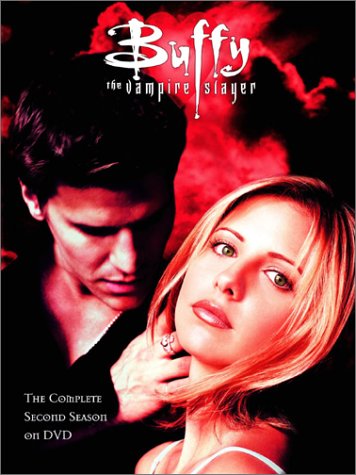
Buffy the Vampire Slayer: Season 2

Buffy and her friends have defeated the Master, closed the Hellmouth and prevented the end of the world. No sooner has the dust settled then two new vampires arrive in Sunnydale looking to pick up where he left off: Spike and Drusilla. As Buffy prepares to fight this new threat, she has no idea that an even greater danger is lurking much closer to home.


The first season of Buffy the Vampire Slayer was promising but, it has to be said, rocky around the edges. It took quite a few episodes to really hit its stride, but by the end of the season it was firing on all cylinders. Season 2 continues in this vein, with a greater confidence in the premise and characters, leading to stronger dialogue and more interesting characterisation.

There's also a nice line in irreverence towards the show's own mythology. Having set up the Anointed One in Season 1 as the heir to the Master's mantle, Spike and Dru showing up instead wrong-foots the audience. This is in the best possible way, because James Marsters (and his masterful English accent) and Juliet Landau (and her...less accomplished accent) fairly explode off the screen with glee and wild abandon, upping the energy level of the series considerably.

The first half of Season 2 is pretty zippy, in fact, with fast-paced episodes mixing action, mystery, backstory and romance. We get more information on Giles's background with the introduction of his nemesis, Ethan Rayne (Robin Sachs), which makes Giles a far more interesting character, and the introduction of a new character named Oz (Seth Green) who quickly becomes a key new ally of our heroes (and a love interest for Willow). This first half of the season does have few disposable episodes (Inca Mummy Girl is a marginally-less-terrible cover version of Teacher's Pet, Reptile Boy is forgettable, Bad Eggs is legitimately awful) but it does more than make amends with episodes like School Hard, which is Buffy's take on Die Hard (kind of) and Halloween and The Dark Age, which expand on Giles's backstory, along with the two-parter What's My Line, where Buffy goes up against Spike and Drusilla, helped by an unexpected ally.

And then everything changes.

Even in the late 1990s, when almost all American TV dramas aired 22 episodes a year, Joss Whedon seems to have recognised the problem in sustaining a single story arc over that length of time (Season 1 didn't have the issue because it was only 12 episodes long). His solution was to simply chop the season in half and have two distinct storylines, the one in the first half of the season leading naturally into the second, usually with an escalation of villain. This trick of upping the ante halfway through the season would eventually get a bit predictable in later seasons, but here it feels quite fresh, mainly because it comes almost out of nowhere. Before you know what's going on, Buffy and her friends are fighting an enemy who knows them better than they do themselves and has no problem killing off major recurring characters on a whim.

This gives the second half of the season a bleak and desperate feel to it, punctuated by real moments of horror and tragedy that you wouldn't have believed the show was capable of in Season 1 (the episode Passion, in particular, is a masterpiece of tension and darkness). The stakes constantly get higher and things culminate in a season finale which even Shakespeare may have drawn the line at for being "too tragic," helped by Christophe Beck's mighty score.

If there is a major problem with Season 2, it's that Whedon may have peaked too soon, and he has since admitted that this storyline should have played later in the series for a much more powerful impact (although in that case we may have never gotten Buffy's spin-off series, which would definitely have been a shame). As it stands, this story gives Season 2 real teeth and leaves the viewer wondering how they can possibly top it for the third year.

The second season of Buffy the Vampire Slayer (****½) is a huge improvement over the first, adding a strong sense of tragedy to the show's action, comedy and romantic stylings. A string of iffy episodes prevent the second season from being the best, but arguably the season has the most compelling arc of the seven (or twelve, counting spin-off show Angel), it being the storyline that most effectively hits Buffy where she lives. The season is available now as part of the complete Buffy the Vampire Slayer DVD box set (UK, USA).

Sunday, 20 January 2019

Buffy the Vampire Slayer: Season 1

Into every generation is born a girl with the power to stand against the forces of darkness: the Slayer. In the late 1990s, the Slayer is Buffy Summers, a 16-year-old California girl who tries to balance schoolwork, dating and friends with vampire slaying. Having recently moved to the town of Sunnydale to escape her destiny, Buffy instead finds it enhanced: Sunnydale sits on the Hellmouth, a mystical convergence with draws vampires, demons and trouble to it. Buffy is going to have her work cut out for air.


Originally airing in 1997, Buffy the Vampire Slayer's first season can charitably be called "a little rough." Joss Whedon had originally come up with the concept for a 1992 movie starring Kristy Swanson and Donald Sutherland, but the movie had gone in a campier direction than he'd planned. Offered the chance to revisit the concept, he accepted with alacrity and reworked the premise into a darker and more interesting story.

In this updated version of the premise, Buffy (played with immediate charisma by Sarah Michelle Gellar) moves from Los Angeles to Sunnydale in the hope of getting away from her destiny. Unfortunately, this backfires when she discovers that Sunnydale sits on top of a gateway into hell. This gives the series its best conceit: that demons, ghosts, vampires, werewolves and all sorts of supernatural creatures are attracted to the Hellmouth, explaining why Buffy is fighting a new threat every week.

Buffy is advised and mentored by a Watcher, a stuffy British expert on the paranormal called Rupert Giles (played with veritable aplomb by Anthony Stewart Head). She also makes two friends who quickly discover her secret: Xander (Nicholas Brendon, who shows more enthusiasm than skill in early episodes before becomes a stronger player in later episodes) and Willow (the infectiously joyous Alyson Hannigan). There's also a handsome stranger named Angel (the magnificently broody David Boreanaz) who keeps showing up at the oddest moments and Cordelia (Charisma Carpenter), Buffy's would-be high school nemesis who eventually discovers Buffy's secret and becomes another ally.

To be frank, at least in the early going, Joss Whedon and his team should be forever grateful that their casting team hit the ball out of the park for virtually every regular and recurring castmember. The core cast are all well-played and keep the show going even when the individual episode concept falters (particularly during the astronomically terrible Teacher's Pet). The script quality is seriously uneven for the first few episodes, but somewhere around the seventh episode, Angel, when we get the tortured backstory of the mysterious character, things start clicking into a higher gear. This culminates in the season finale, Prophecy Girl, where Whedon both writes and directs for the first time and completely lifts the show onto another level of scripting, directing and dialogue. If you ever wonder why Joss Whedon was A Thing for so long, this is the episode that shows why.

There's still a lot of slow going in these early episodes, which are further hamstrung by budget restrictions (Buffy was picked up as a mid-season replacement, with no time or money to build more than a couple of sets or have more than a few CG vampire dustings in the whole season), but the heart of the show asserts itself early on, as does the show's tendency to get really, really dark and brutal unexpectedly. This was key to Buffy's success: the goofy name and premise put as many people off from watching it as hooked them in, but its ruthless attitude to its characters, its surprisingly high mortality rate and its increasingly complex worldbuilding (moreso in later seasons) added grit and depth to the concept that made it more compelling.

Watching Buffy in 2019, almost 22 years after I originally saw the first season, is also an interesting experience. In some key areas the show has dated badly, but in others (such as Giles's concerns over the Internet as an eroding force on civil human relationships and the metaphors employed for male characters desiring female ones even after being turned down) it feels quite fresh. More of an issue is the show's visual quality: Buffy's first two seasons were shot on 16mm film and definitely feel a bit blurry, especially on larger TVs. Whilst Fox did organise a HD remaster of Buffy, they messed it up by using very odd cropping choices, using widescreen masters featuring boom mikes, light stands and crewmembers standing visibly in shot, over-use of DNR (leading to uncanny valley-looking smooth human faces) and a myriad other problems which, several years on, remain resolutely unfixed. For now, I'd advise skipping the remaster and going back to the DVDs (which at least can be upscaled a bit by running them through a Blu-Ray player).

The first season of Buffy the Vampire Slayer (***, apart from the final episode which is a strong *****) is rough around the edges but it takes a while for the show to bed in, but when it does it becomes a compelling and enjoyable watch which sets the scene for the almost infinitely superior second year. The season is available now as part of the complete Buffy the Vampire Slayer DVD box set (UK, USA).