Showing posts with label matthew woodring stover. Show all posts

Friday, 2 April 2021

Del Rey resurrecting classic STAR WARS novels with new art and audio editions

Del Rey is celebrating the 50th anniversary of Lucasfilm by launching Star Wars: The Essential Legends Collection, a reprint of classic novels from the old Star Wars Expanded Universe line with new artwork and new audio editions.

The first three books in the range are Heir to the Empire (1991) by Timothy Zahn, Shatterpoint (2003) by Matthew Stover and Path of Destruction (2006) by Drew Karpyshyn.

Heir to the Empire was hugely important as the first Star Wars novel to launch the Expanded Universe fiction line (although a number of 1970s and 1980s-published novels were later retconned and in some cases rewritten into the line). The novel, set five years after the events of Return of the Jedi, introduced the iconic characters of Grand Admiral Thrawn and Mara Jade, the Emperor's Hand, and introduced factions and ideas such as the New Republic and the city-planet of Coruscant. It was the first novel in The Thrawn Trilogy. The new cover art is by Tracie Ching.

Shatterpoint, sometimes cited as the best-ever stand-alone Star Wars novel, focuses on the character of Mace Windu and sees him tracking down his missing former padawan shortly after the outbreak of the Clone Wars. The novel was highly praised for giving more texture and depth to Windu than his fleeting appearances in the prequel trilogy films. The new cover art is by Jeff Manning, with a brand-new, unabridged audio adaptation by Sullivan Jones.

Path of Destruction, the first book in the Darth Bane series, tells the story of Darth Bane, the Sith Lord who restructured and reorganised the Sith following millennia of defeats into their later "Rule of Two" incarnation. The cover art is by Simon Goinard.

The three books will be published on June 15th. It is unclear if more books will be added to the range.

Wednesday, 6 September 2017

Scott Lynch on THE THORN OF EMBERLAIN

The Helsinki Times caught up with fantasy author Scott Lynch whilst he was at WorldCon in Finland last month. They chatted about his fantasy series, The Gentleman Bastard, and Scott's inspirations and future plans.


Scott confirmed that the fourth book in the series, The Thorn of Emberlain, should be finished before the end of the year and then published next year. He is very happy with how the book has turned out, and notes that it marks a major shift in the series. Originally Thorn of Emberlain was supposed to be where the series starts, but he couldn't make the characters work without more backstory, so The Lies of Locke Lamora, Red Seas Under Red Skies and The Republic of Thieves were essentially written as prequels.

The Thorn of Emberlain introduces two new factors to the series: Emberlain itself as a sort-of permanent new base for our characters, instead of each subsequent book featuring a new city, and Anton Strata as a new major character, a teenage claimant to the throne of the Kingdom of the Seven Marrows whose ascent is tested by Locke and Jean's latest scam.

Lynch also expands further on his love of Japanese RPGs and his appreciation for the mighty Matt Stover.

Sunday, 29 November 2015

A History of Epic Fantasy - Part 29

One of the most common criticisms of epic fantasy is how lightweight and silly it can be, saying nothing about the human condition or developing relevant themes and instead being consumed by spectacle and forgettable action. This criticism is intermittently justified, with many lightweight or lowbrow works existing in the genre as indeed there are in all genres, but in the 1990s and 2000s fantasy was moving ever more decisively in favour of works which did feature more thought, rumination and artistic intent.

At the forefront of these were works like A Song of Ice and Fire and The Malazan Book of the Fallen, but numerous authors were engaged in writing fantasies that engaged in relevant topics for a contemporary reader, such as religion, power and politics. But three series in particular emerged at the turn of the millennium which provided much food for thought, were all controversial and all highly divisive amongst fans of the genre.


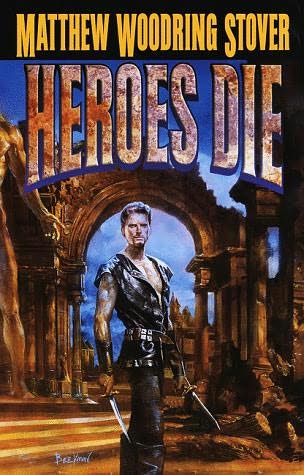
Heroes Die

Published in 1998, Heroes Die is the first novel in the Acts of Caine sequence by Matt Woodring Stover. This series is a rationalised fantasy, with an SF explanation for events in the series. In the 23rd Century humanity has created portal technology linking Earth with a traditional fantasy world called Overworld. Special agents known as "Actors" are sent to Overworld to pose as heroes or villains, fighting battles for the amusement of television audiences back home. The most famous of these is Hari Michaelson, known on Overworld as Caine. In Heroes Die Michaelson is sent to rescue his wife, another Actor, who has been taken prisoner by a newly-risen dark lord. However, this dark lord proves to be highly intelligent, capable and formidable, pushing Michaelson and his Caine alter-ego to the limits of their intelligence and endurance to defeat him...if defeat is even an applicable concept.

Heroes Die is a rollicking adventure novel but also a thoughtful book musing on themes such as volition, willpower, violence, entertainment, responsibility and the struggle of the individual against the masses. Its sequel, Blade of Tyshalle (2001), is considerably larger, more complex and delves into these issues in a much darker, bleaker and more complex manner. Caine Black Knife (2008) is a more back-to-basics adventure which features both a new adventure for Caine on Overworld and flashes back to his oft-referenced greatest triumph, retelling that story as a tragedy and trauma. Caine's Law (2012), probably one of the most mind-bending genre novels ever written, forces the reader to reappraise the entire series from its core concepts outwards.

The Acts of Caine sequence remains somewhat obscure, but is highly influential. Scott Lynch and John Scalzi are among the biggest fans of the series, the former citing it as key reference work whilst writing The Lies of Locke Lamora.


The Darkness That Comes Before

There are few works of fantasy that inspire both such admiration and praise and hatred and bile as R. Scott Bakker's Second Apocalypse sequence. This sequence consists of three sub-series: the Prince of Nothing trilogy (2004-06), the Aspect-Emperor quartet (2009-17) and a forthcoming duology which will wrap the story up.

On its surface, the series is about the arising of the Chosen One. The nations of the Three Seas are gripped by conflict as the Inrithi church calls a grand crusade - the Holy War - to travel a thousand miles across harsh wilderness to destroy the heathen Fanim and take back the holy city of Shimeh. Of course, they are unaware that the legendary Consult (who once almost destroyed the world by summoning a nihilistic force of destruction known as the No-God),  have emerged from millennia in hiding and are now plotting to destroy the world as they know it. It falls to four unlikely figures to save the day: Drusas Achamian, a Mandate wizard and scholar aware of the return of the Consult; Cnaiur urs Skiotha, a formidably cunning "barbarian" warrior and self-proclaimed "Most violent of all men"; Esmenet, a prostitute whose low birth, caste and station has prevented her formidable intelligence and will from being used to its full benefit; and Anasurimbor Kellhus, a mysterious monk from the Ancient North who sees the Holy War as a tool he can use to his own ends.

As the initial trilogy unfolds and Kellhus becomes aware of the threat of the Consult and the No-God, he begins taking command of the Holy War and moulding it into a weapon against the true enemy of humanity, but in the process alienates his would-be friend and ally Achamian. It is only at the end of the trilogy that Achamian realises that Kellhus may indeed be the only person capable of saving the world, but is also a ruthless, amoral being whose thought processes are not quite human. The sequel trilogy, The Aspect-Emperor, picks up twenty years later and sees Kellhus (whose powers are now godlike) leading another crusade - the Great Ordeal - against the Consult, an apparently laudable pre-emptive strike against the enemy before they can resurrect the No-God, but one that goes horribly wrong.

The combined series is unusual for its intelligence and its dwelling on philosophical concepts, as well as its inversion of fantasy tropes, well-written action sequences, spectacular magic and the prevalence of religious metaphysics on the world and characters. It's also been criticised for its graphic sexual imagery and violence (most of it against men, it has to be said) and its perceived sexism (the world of Earwa is based on Biblical notions of original sin and women are not well-treated before Kellhus's rise to power). Heavily influenced by Dune, The Lord of the Rings and the history of both the Crusades and Alexander the Great's empire, it's not quite like anything else in the genre, both for good and bad.


The Sundering

Jacqueline Carey is best-known for her trilogy of trilogies set in a fantasised alternate-history version of France called Terre d'Ange, starting with Kushiel's Dart (2001). But in 2004 and 2005 she published a very long novel split into two volumes called The Sundering (comprising Banewreaker and Godslayer).

The Sundering is, pretty much, The Lord of the Rings as retold from the POV of the Witch-King of Angmar. In this case our protagonist is Tanaros Blacksword, reviled for murdering his king and joining the armies of the dark demigod Satoris the Banewreaker. However, less well-known is that Tanaros's king had seduced and impregnated Tanaros's wife and was a ruthless and unjust ruler. As the series unfolds it is suggested that the "good guys" aren't really that good and that the wizard Malthus (Carey's Gandalf analogue) is manipulative and amoral. The duology is heavily concerned with the idea of morality as a sliding scale rather than a binary choice between good and evil, and the notion that history is written and justified by the winners.

Some of the ideas in The Sundering have been explored independently in more recent works, most notably Joe Abercrombie's First Law universe which likewise features a Gandalf-like wise mentor who in reality is a brutally ruthless political mastermind and highly uncertain ally. But Carey's series is a much more direct riff on Tolkien and the perceived notions of moral relativism in the fantasy genre.


These were all interesting but relatively obscure and financially less-successful works. Indeed, by the mid-2000s it had been some considerable time since an epic fantasy author had launched and been an immediate big success. Perhaps, some mused, the genre had had its day and was now going into decline? But over the next few years a number of writers debuted whose books were not only critically successful but also sold a very large number of copies, restoring the genre to the top of the bestseller lists.

Saturday, 21 September 2013

Caine's Law by Matthew Woodring Stover

Normally I start reviews with a mini-plot summary but I won't do that here, because trying to condense Caine's Law down to a paragraph without indulging in major spoilers or causing my brain to leak out of my nose is simply impossible.


What Caine's Law is, however, is the fourth and to date final book in the Acts of Caine series.  Future sequels are possible but this book provides enough closure that the series can end here if necessary. It's also the second half of the previous novel, Caine Black Knife, which ended on a series of cliffhangers which Caine's Law does - eventually - resolve. It does take its sweet time doing so, however because Stover's primary focus in the rest of the book is tapping on his readers brains until they turn into confused mush.

Caine's Law takes place before, during and after Caine Black Knife. It riffs on elements from Blade of Tyshalle, and events that took place between that book and the first novel, Heroes Die. It explains exactly how some rather implausible events in earlier books really unfolded. It has time travel and alternate timelines, and uses the term 'unhappen' a lot. Events in the deep back-history of Overworld are explained. Major characters reappear, despite some of them being very dead indeed.

This is the sort of book where a very clear, action-adventure chapter (and few authors do action-adventure as well as Stover) can be followed by an interrogation sequence where both captors and captive spend most of their time debating the literary merit of To Kill a Mockingbird. Chapters featuring heavy magic use and explosive set pieces sit alongside explorations of a key thematic element involving horses and how they see the world. Caine being a smart-arse and swearing a lot is mixed up with discussions on the nature of reality, friendship and acceptance. Caine confronts the demons of his past and deals with them, sometimes maturely, sometimes by kicking them in the balls, and sometimes by making sure they never happened at all. If the Acts of Caine series wrong-foots the audience with each book being a shift in gear and almost genre, Caine's Law delights in wrong-footing them chapter by chapter.


This is a novel that is severely confusing and ultimately you have to stop trying to understand it and instead read each section (the book is broken up into episodes) on its own merits. Eventually the book's mind-shredding narrative structure coalesces into something that does make sense. In the wrong hands this would be disastrous, but Stover ensures that even when you can't see how a particular episode fits into the overall structure of the novel and the series, it's still enjoyable on its own terms. As usual his actions scenes as visceral and vivid, his characterisation is nuanced and complex and his worldbuilding is sublime. The novel is also as 'grimdark' as anything in the genre but also has a very powerful commentary on issues such as gender relations and power imbalances without every getting preachy.

Caine's Law (*****) feels like a collaboration between Richard Morgan and Christopher Priest, but with an attitude and energy that is 100% Stover. Intelligent, thought-provoking, action-packed and featuring a recursive narrative structure that borders on genius, Caine's Law is a totally different kind of fantasy novel, and confirms this series as the most criminally underread series in the genre. The novel is available now in the USA and as an ebook-only release in the UK.

Friday, 2 August 2013

Caine Black Knife by Matthew Woodring Stover

Three years have passed since Hari Michaelson - better known to two worlds as Caine - defeated his enemies, left the rancid and overpopulated Earth behind and escaped to Overworld to live in peace. When his adopted ogrillo brother Orbek goes missing in the Boedecken, Caine is reluctantly pulled back to the site of his first and greatest adventure, the one that won him his name, and he finds that he must finally face the ramifications of the huge events that happened twenty-five years earlier.


Caine Black Knife is the third novel in the Acts of Caine series. With every book in this series, author Matt Stover seems to enjoy changing gears, shifting genres, mixing up casts and generally wrong-footing the audience. After Blade of Tyshalle, a massive, epic and weighty (in terms of both size and theme) tome, Stover resists the urge to go bigger and more apocalyptic. Instead he strips things down, delivering the shortest and most focused novel in the series.

Caine Black Knife at heart is a detective story. Caine is trying to find out where his friend Orbek has gone and, once that's done, what the hell is going on in the Boedecken Waste. Caine is not happy to be back, as his former visit transformed him into a superstar but at the cost of enormous numbers of lives and only by Caine performing some truly heinous acts. The novel is divided into chapters that alternate between Caine's investigation in the past and flashbacks to his first adventure in the Boedecken. Some familiar faces return (or are discussed at length) from the first two books but for the most part this is a new and stand-alone adventure.

Caine is a complex protagonist at the best of times, and in this novel Stover has to show him twice over at different points in his life. The contrast between the more ruthless and selfish 25-year-old Caine and his 50-year-old, half-crippled, more cynical but also more reflective and (dare we say it) guiltier older self is fascinating. Caine is driven by his demons and ghosts in this novel, but Stover cleverly avoids undercutting the character development from the previous two books: Caine has made his peace with a lot of the problems he had previously and even made something of a new life for himself before he is drawn into Orbek's problems.


The shorter page count and tighter focus means more action and plot development, but never at the expense of characterisation. The cast is much smaller than Blade of Tyshalle, but we still get to meet several Knights of Khryl (a bunch of fanatical warriors who somehow manage to be unlike any other bunch of fanatical religious warriors you've ever met in a fantasy novel) and a bunch of Caine's past associates. Stover has a gift for fleshing out even briefly-appearing characters, with even the staff and patrons of the inn Caine is staying it getting developed and involved in the storyline. Also, whilst black, cynical humour has always been part of the series, it feels a bit more prominent in this volume which helps alleviate the grimness.

This is a pretty dark book - if not quite as harrowingly bleak as Blade of Tyshalle - but Stover manages to sidestep a lot of the problems associated with modern 'grimdark' fantasy. The violence is prominent but never feels gratuitous. Apart from Caine, most of the major and important characters in the book are female (as in the previous two, for that matter) and whilst sexual assault is implied, it is kept firmly off-page and treated with seriousness. There's a strong undercurrent of tragedy and inevitability running through the book and Stover even subverts his own 'happy ending' for a couple of the characters by pointing out how they died during another adventure years later.

If there is a problem with the book, it's that it feels like a stand-alone but ends abruptly with numerous plot strands left unresolved. Though irritating on release (with a four-year gap for the next volume), this is not a problem now since the fourth book, Caine's Law, is already available.

Caine Black Knife (*****) is Stover once again changing the way he writes and even the genre (to an extent) and still coming up with a gripping, intelligent and original fantasy novel. Outstanding. The book is available now in the USA and as an ebook-only release in the UK.

Thursday, 4 July 2013

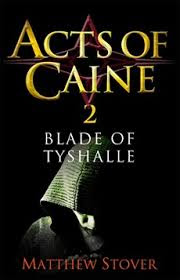
Blade of Tyshalle by Matthew Woodring Stover

Seven years ago, the warrior-assassin Caine - played by Actor Hari Michaelson - saved his lover Pallas Rill and became a hero on Earth and infamous on Overworld. In that final battle Michaelson was severely wounded and can now only walk intermittently, with technological help. When Michaelson discovers that a devastating virus has been unleashed on Overworld from Earth, he immediately intervenes to stop it...and unleashes a terror upon both worlds in the process.

  
Blade of Tyshalle is the second volume of The Acts of Caine series (four books so far) and is a quite startling deviation from its predecessor, Heroes Die. Whilst Heroes Die was an intelligent, smart SF/fantasy hybrid novel with lots of action, Blade of Tyshalle is an outright philosophical assault on the senses. This is a murkier, more violent and darker book than its predecessor, but also one that is more demanding, smarter and less interested in spelling things out. It is, on almost every front, a step-up from the first book in the series.

In terms of characterisation, the book is highly impressive. Michaelson/Caine himself is a deceptively straightforward figure. When he has an objective, he does whatever is necessary to achieve it. When he has everything he wants - a family, a great job, fame and fortune - he is utterly miserable. When the world sets itself against him (or, in this case, two worlds and almost everyone on them), he shines. When he has the freedom to forge his own destiny, he flounders. It's the classic mid-life crisis narrative, made even harsher by the fact that Michaelson is partially crippled. There's something inherently tragic in the fact that Michaelson's closest friend is also his deadliest enemy, the exiled Emperor Ma'elKoth. Caine is against the odds but also certain to win through because that is the task he sets himself. Some reviews have taken this to mean the book is pro-fascist (The Triumph of the Will could be the title of Caine's biography) but Stover undercuts this by showing that Caine cannot achieve his goals without him relying on his friends and allies (and some of his old enemies).

The book is unusual in that the first-person narration parts of the book are split between Caine and his old friend Kris. The book opens with a tantalising glimpse at Michaelson's youth as he first enters training as an Actor and Kris is assigned to stop him flunking out. The experience changes Kris forever, leading to a fateful decision and a reunion many years later in the main narrative of the book. The rest of the cast is a mixture of returning characters from Heroes Die (such as Shanna, Ma'elKoth, Kierandal and Majesty) and newcomers such as Raithe, a Monastic citizen who harbours an old grudge against Caine. Stover juggles them all with skill.


In terms of the antagonist, Stover does something very interesting by making it more of a force of nature and philosophy than an actual villain (though it is personified when it possesses the body of an old enemy of Caine's). This leads to the book's most stomach-churning sections as this force for evil kills and slaughters on a scale that is quite shocking. The book also muses on the theme of rape, not of the body (though this is implied in several moments), but of the mind. The destruction of consciousness, the stripping of identity and the nature of self are all dwelt on as concepts.

Stover pulls back from these philosophical moments - though the book remains intelligent and sharp-witted throughout - to deliver a finale which may redefine the term 'apocalyptic'. The final 200 pages of the book feels like experiencing the Vietnam War on fast-forwards. It's relentless, grim and action-packed. It probably goes on a little too long - at 725 pages of small print in tradeback the novel is substantially longer than Heroes Die - and there's a few too many endings as Stover tries to wrap things up fairly conclusively, but ultimately it's an ending to be remembered.

Blade of Tyshalle (*****) is a vastly more ambitious book than its predecessor which pulls off what it's trying to do. Action, philosophy and characterisation are blended to create what may be one of the outstanding examples of the fantasy genre in the last decade. Blade of Tyshalle is available now in the USA and as an e-book only edition in the UK.

Wednesday, 19 June 2013

Matt Stover interviews Scott Lynch

Matt Stover, author of the splendiferous Acts of Caine SF/fantasy series, talks to Scott Lynch, author of the also-splendiferous Gentleman Bastard series, over on the Orbit blog.


No, I haven't got one. No, you can't have it afterwards if I do get one.

Scott has also revealed that ARCs of The Republic of Thieves are being assembled at Gollancz Supreme Headquarters in preparation for distribution to the masses. Since revealing this news, Gollancz Towers have become encased in an impenetrable forcefield and ED-209s have been seen patrolling the grounds, so don't even think about it.

Thursday, 6 June 2013

Heroes Die by Matthew Woodring Stover

Caine: the most infamous man in the Ankhanan Empire. A hero who has saved the Empire from invasion and destruction, and a villain who killed the Prince-Regent on the orders of a monastic order. Wherever there is danger, intrigue or violence, there is Caine.


In reality, Caine is a fictional character, played by Hari Michaelson. 23rd Century Earth is linked to Overworld - a post-medieval alternate reality where magic and gods are real - by advanced technology. The rigidly caste-bound population of the overcrowded planet is entertained by the exploits of the Actors, and Caine is one of the most famous Actors on the planet. When Caine's wife, Actor Shanna (who plays Caine's lover, Pallas Rill), disappears on an Adventure, Caine is summoned back into battle. This time the mission is to find his wife before her link to Earth expires, killing her, and to overthrow the monstrous new Emperor. But Michaelson faces hidden enemies on Earth even as Caine faces overwhelming odds on Overworld.

Matt Stover has carved out a reputation as the best writer ever to put pen to paper in the Star Wars franchise, writing a string of intelligent, thought-provoking books that overcome and challenge the limitations of the setting. The Acts of Caine is his most famous own creation, a four-book sequence (more are planned) that mixes SF and fantasy. It is an action-packed series, but also one that is heavily character-driven, and those characters (heroes, villains and the ambiguous alike) are three-dimensional, well-motivated individuals, even the most loathsome of whom is at some level understandable.

Heroes Die is the first book in the sequence, originally published in 1997, but is a stand-alone novel with no cliffhangers or incomplete story arcs. Its publication date precedes the bulk of the modern 'gritty' wave of fantasy novels, but it can be seen as an early example of the subgenre. The book has a black sense of humour that will appeal to fans of Joe Abercrombie, a rich urban atmosphere and cast of thieves that serves as a precursor to Scott Lynch (Lynch has said that Stover's books are one of the primary influences and inspirations behind The Lies of Locke Lamora) and features a dystopian future world that emphasises death and murder as a form of entertainment in a similar manner (but a much more sophisticated one) to The Hunger Games. It's a rich, genre-bending brew that satisfies on all fronts.


The characters are where the book shines. Scenes on Overworld are told from Caine's POV in first-person, but scenes on Earth are related in third-person. Other scenes on Overworld involving other characters are also told in the third-person.This device is quite successful, and is intriguing as Caine's POV scenes also feature his running commentary on what's happening back to the millions of people watching on Earth. Some tension is caused by Caine occasionally thinking things impolitic about life on Earth, causing friction with both the Studio and the future Earth's caste-bound government. Michaelson/Caine is a fascinating character, a man of intelligence who is ready to resort to violence at a moment's notice, but has a reason for doing so. His lover, Senna/Rill is likewise well-depicted, with her idealism contrasted against her lover's pragmatism. Stover even has well-developed villains, making even the monstrous Emperor and the psychopathic swordsman Berne (very briefly) sympathetic with reasons (if only convincing to them) for doing the monstrous things they do.

Heroes Die is unusual for the opening volume of a fantasy series by arriving complete, fully-formed and brimming with confidence and presence. It's an explosive and action-packed novel which explores its premise and characters intelligently, develops the plot and themes with skill and then finishes on a high. Complaints are few: one character gains access to a reservoir of incredible power near the end of the book, which has the whiff of deus ex machina until Stover subverts it.


Heroes Die (*****) is available now in the USA, and in the UK has just been released for the first time as an e-book only edition.

Sunday, 28 April 2013

Matt Stover's ACTS OF CAINE series comes to the UK

The first four volumes in Matt Woodring Stover's critically-acclaimed Acts of Caine series are being published for the first time in the UK on 27 May.


The books are only being published as ebooks, though hopefully a UK publisher will follow up with paper copies at some point.

The series is set on a futuristic Earthwhich has discovered the existence of Overworld, a parallel world with a culture and tech level more like traditional epic fantasy worlds. The central character is Hari Michaelson, an actor on Earth who travels to Overworld to play the role of the deadly assassin Caine. His adventures are recorded to be shown as entertainment on Earth. Needless to say, complications and mayhem ensue.

To date, four books have been published: Heroes Die (1997), Blade of Tyshalle (2001), Caine Black Knife (2008) and Caine's Law (2012). Stover has projected up to three more volumes to follow. I will be reviewing the series in the coming months.

 Update: From Scott Lynch, via the comments:
"Oh, you fortunate people. HEROES DIE and BLADE OF TYSHALLE directly informed the writing of THE LIES OF LOCKE LAMORA... I'd dare say they were what taught me how to craft a novel. Matt is criminally underrated, and these books are bog standard for him, which is to say 'brilliant.' They're bold, startling, multi-layered, humane, and laugh-out-loud wonderful at frequent intervals. I'm not really anything resembling objective on Matt any more, and he's a friend, but I appreciated his work before I ever got to really know him."
Update 2: The UK ebooks have their own cover art, which is, erm, disappointingly generic: