Peter F. Hamilton is a British writer of science fiction, born in 1960 in Rutland, where he continues to reside. His work falls into two broad categories: near-future thrillers and mysteries exploring high-tech but plausible ideas; and far-future grand space operas, featuring richly detailed fictional universes awash with different alien races and technology based on modern theoretical physics. He began his writing career in 1987 and sold his first short story to Fear magazine in 1988. After several years writing short stories, his first novel, Mindstar Rising, appeared in 1993 and was the first book featuring near-future psychic detective Greg Mandel. Two sequels followed. However, it was Hamilton's Night's Dawn Trilogy, which began with The Reality Dysfunction in 1996, which made him a well-known name on the SF stage.
The Greg Mandel Trilogy was an interesting start to Hamilton's career. Set in the 2040s in a Britain devastated by global warming (London has apparently been destroyed by a fusion explosion and the new capital is Peterborough) and then ruined by an oppressive, socialist government, some critics complained it was little more than a right-wing writer's attack on the Labour Party (although the 'New Conservatives' who are trying to restore Britain are hardly painted more sympathetically). More to the point, it established Hamilton's credentials as a writer who enjoyed telling a good, rip-roaring, page-turning story. Although keen to use 'hard science', Hamilton's books have never been about the nitty-gritty details of string theory calculations, instead preferring to show the effects of such science and technology on ordinary people. The Mandel trilogy is a successful work, prefiguring the rise of the SF thriller subgenre of the early 2000s (led by Alastair Reynolds' Chasm City and Richard Morgan's Altered Carbon) and establishing Hamilton as a writer to watch.
That promise was delivered, with interest, in The Night's Dawn Trilogy. Whilst David Brin and Iain Banks had had some success in keeping the original space opera novel alive in the preceding years, it was Night's Dawn that brought it back into vogue. Set in the 27th Century, Hamilton painted a picture of a universe where humanity has spread across 860 worlds, splitting into two divergent strains (the traditional Adamists and the telepathic Edenists) and building vast, sentient space habitats and living starships whilst vast corporations fund the expansion of the human race. On a remote colony world a chance encounter between a low-tech colony and an utterly alien entity unleashes a nightmarish force upon the Confederation which is soon overrunning entire worlds. Night's Dawn is an impressive example of 'genre-bending' and horror and SF collide. The trilogy also established Hamilton as a writer of huge, brick-thick volumes. Whilst the Mandel trilogy had consisted of sensibly-sized 400-page books, each of the Night's Dawn novels extended across 1,200+ pages in paperback and were split in two apiece for American publication.
Hamilton's next two books were related to his grand trilogy. A Second Chance at Eden, published between the second and third volumes, collects several short stories from the Night's Dawn universe and shows a greater range than perhaps Hamilton had evidenced previously, most notably his ability to use different prose styles. His main novels employ a fairly straightforward, somewhat prosaic or 'clean' style to tell the story (with stories this complex, a fancy prose style is the last thing both the author and the reader want to worry about), but his short stories display a greater talent. After the release of The Naked God, Hamilton followed it up with a guide to the series, The Confederation Handbook, which published a lot of the background materials and notes he'd used to create his future history.
With Hamilton now established as a major force in British SF, he chose to move away from his Night's Dawn setting rather than exploit it through further novels. His next book, Fallen Dragon, was a stand-alone novel which postulated that mankind's expansion into space had faltered and run out of steam, leaving dozens of dead-end worlds essentially left to their own devices. Although a clever novel with a great twist ending, Fallen Dragon showed a more melancholy aspect of Hamilton's writing, and was not regarded as much of a success as Night's Dawn.
Hamilton's next work was not very well received. Misspent Youth returns to a near-future setting, but a different continuity to the Greg Mandel novels. In this new future, Britain is part of a greater European Union and its national identity seems in question. At the same time, a rich entrepreneur becomes the first human to undergo rejeuvenation technology and goes from being in his late 70s to having the body and health of a 20-year-old, which leads to conflict with his teenage son. Misspent Youth features some fantastic ideas, such as Hamilton's 'nightmare future' of what will happen if the Internet does kill off creativity since copyrights cannot be protected: a world where writers, directors and musicians cannot make a living and the only forms of entertainment left are soap operas and pornography. Misspent Youth is a relentlessly downbeat book, and did not receive much critical acclaim.
Interestingly, despite its weaknesses, Hamilton had cleverly used Misspent Youth to seed ideas for his next novel series. Choosing to return to the world of space opera, he planned two books set some 300 years after the events of Misspent Youth in a world where everyone undergoes rejeuvenation at regular intervals, with some people now being over 300 years old. Hamilton also cleverly reverse-engineered technology from Night's Dawn, so that freestanding wormhole gates directly and permanantly link various planets together, and travelling across the Galaxy is as easy as catching a train. Starships do not exist (they are not needed) and the apparently benign SI (Sentient Intelligence, essentially a friendly version of Skynet) watches over humanity from afar to ensure its survival. However, the disappearance of two stars some one thousand light-years from Earth proves the impetus for mankind to build its first starship, and unleashes a chain of events that leads to the wealthy and indolant Intersolar Commonwealth facing a full-scale war, whilst treachery lurks within. His Commonwealth Saga restored Hamilton's reputation as a writer of large-scale SF blockbusters, capable of addressing myriad storylines simultaneously and bringing them to a reasonable conclusion. Perhaps aware that Night's Dawn had been criticised for its 'neat ending', Commonwealth left more unexplained questions to be resolved in his newest series, The Void Trilogy, which picks up the storyline some eleven centuries further on.
Hamilton is now established as Britain's biggest-selling science fiction author, and is increasingly a well-known figure in the USA as well. Whilst Hamilton is not a flawless writer (some may feel his books may feature somewhat more sex than is necessary for the story and he sometimes shies away from big SF issues, such as the Singularity), he is reliably entertaining and extremely inventive. As Colin Greenland once said, his books often feel like "fifty SF novels in one," leaping from subject to subject, idea to idea, in dizzying fashion. He remains one of the more notable authors in the field today.
The Greg Mandel Trilogy
Mindstar Rising (1993) ****
A Quantum Murder (1994) ****
The Nanoflower (1995) ****
The Night's Dawn Trilogy
The Reality Dysfunction (1996) *****
The Neutronium Alchemist (1997) ****½
The Naked God (1999) ****
A Second Chance at Eden (1998) ****
The Confederation Handbook (2000) ***
Fallen Dragon (2001) ****
Misspent Youth (2002) ***
The Commonwealth Saga
Pandora's Star (2004) ****
Judas Unchained (2005) ***½
The Void Trilogy
The Dreaming Void (2007) ****
The Temporal Void (planned for release in October 2008)
The Evolutionary Void (planned for release in 2010)
Sunday, 28 January 2007

Friday, 26 January 2007
The Blade Itself by Joe Abercrombie
In 2006 Gollancz asserted themselves as Britain's premier SF publishing imprint. This year, mainly thanks to the efforts of Simon Spanton, it delivered three very high-profile debut novels: the much-applauded The Lies of Locke Lamora by Scott Lynch, The Stormcaller by Tom Lloyd, and the superb The Blade Itself by Joe Abercombie.

At first glance The Blade Itself is pretty old-school: it's book one of a trilogy (entitled The First Law; the second volume, Before They Are Hanged, is out in March), it features an old wizard mentor character and a barbarian hero as well as an untried youth, a feisty young woman and an army of nasty barbarians on the march in the north, whilst a resurgent desert empire threatens our heroes' homeland - the Midderland Union - from the south. There's also the threat of a non-human species gathering its forces beyond the northern-most reach of humankind's lands (isn't there always?).
Yet Abercrombie invests these storylines with vigour and energy. None of our heroes are quite what they first appear to be and the author expertly deconstructs them throughout the book, revealing their true motivations when you last expect it. Abercrombie is also a dab hand are writing excellent battle scenes and swordfights. There is also a hint of otherwordly alieness in this book, such as the scenes set in the House of the Maker which are quite memorable. The only major complaint I had about the book is the lack of a map. Most fantasy novels with a map don't really need them, but with military campaigns getting underway it would be nice to tell exactly where Adua is in relation to the Northlands, and where both are in relation to Dagoska, for example. But this is a minor complaint at best.
By the end of the book the pace has been ramped up to a compelling level, as our heroes depart in different directions to face their various destinies and full-scale war seems about to erupt on all sides. The Blade Itself is a tremendously enjoyable novel and I count myself fortunate to have read it late enough in the day to only have a brief wait for the second book.
The Blade Itself (****) is published by Gollancz in the United Kingdom in trade paperback and hardcover. The mass-market paperback will be available on 8 March. Pyr Books will publish an American edition in September 2007 (no Amazon listing as yet).
The sequel, Before They Are Hanged, will be published by Gollancz in the UK in trade paperback and hardcover on 15 March 2007.

At first glance The Blade Itself is pretty old-school: it's book one of a trilogy (entitled The First Law; the second volume, Before They Are Hanged, is out in March), it features an old wizard mentor character and a barbarian hero as well as an untried youth, a feisty young woman and an army of nasty barbarians on the march in the north, whilst a resurgent desert empire threatens our heroes' homeland - the Midderland Union - from the south. There's also the threat of a non-human species gathering its forces beyond the northern-most reach of humankind's lands (isn't there always?).
Yet Abercrombie invests these storylines with vigour and energy. None of our heroes are quite what they first appear to be and the author expertly deconstructs them throughout the book, revealing their true motivations when you last expect it. Abercrombie is also a dab hand are writing excellent battle scenes and swordfights. There is also a hint of otherwordly alieness in this book, such as the scenes set in the House of the Maker which are quite memorable. The only major complaint I had about the book is the lack of a map. Most fantasy novels with a map don't really need them, but with military campaigns getting underway it would be nice to tell exactly where Adua is in relation to the Northlands, and where both are in relation to Dagoska, for example. But this is a minor complaint at best.
By the end of the book the pace has been ramped up to a compelling level, as our heroes depart in different directions to face their various destinies and full-scale war seems about to erupt on all sides. The Blade Itself is a tremendously enjoyable novel and I count myself fortunate to have read it late enough in the day to only have a brief wait for the second book.
The Blade Itself (****) is published by Gollancz in the United Kingdom in trade paperback and hardcover. The mass-market paperback will be available on 8 March. Pyr Books will publish an American edition in September 2007 (no Amazon listing as yet).
The sequel, Before They Are Hanged, will be published by Gollancz in the UK in trade paperback and hardcover on 15 March 2007.
Wednesday, 17 January 2007
A Game of Thrones: The TV Series
For years, many George RR Martin fansites have been speculating on what would happen if the Song of Ice and Fire novel series were turned into a series of films or a TV series. What would stay in, what would get cut out, who would play who, etc. It was always laughed off as a game. After all, no-one would ever, ever be insane enough to even attempt this, would they?
From Variety.
From Chud.com.
From DarkHorizons.com
Apparently they would. HBO, which has turned out edgy, innovative, big-budget drama serials for years now, have decided to go for it. Their plan is to adapt each of the seven novels in the series into a TV season. Whether this would be a standard American TV season (22-25 episodes) or the 10-episode season format that HBO favours for some of its projects (like Rome, which returned for a second season last week) is unclear. They've already hired two screenwriters and George RR Martin has agreed to both serve as executive producer and also pen one episode of the first season. Martin himself is an experienced screenwriter, working on The New Twilight Zone and Beauty and the Beast in the 1980s, and the news he is taking an active role on the project has been well-received by fans, although not without concern. Book Five of the series, A Dance with Dragons, is expected to be published before the end of the year, but there are two more books (The Winds of Winter and A Dream of Spring) to come and a minimum of four-to-five years to get there. However, between fully greenlighting the project, pre-production, production and publicity, it looks like the TV version of A Game of Thrones will not be aired until 2009 or 2010 at the earliest, giving GRRM plenty of time to complete most of the remaining work on the novels before the TV series gets underway.
From Variety.
From Chud.com.
From DarkHorizons.com
Apparently they would. HBO, which has turned out edgy, innovative, big-budget drama serials for years now, have decided to go for it. Their plan is to adapt each of the seven novels in the series into a TV season. Whether this would be a standard American TV season (22-25 episodes) or the 10-episode season format that HBO favours for some of its projects (like Rome, which returned for a second season last week) is unclear. They've already hired two screenwriters and George RR Martin has agreed to both serve as executive producer and also pen one episode of the first season. Martin himself is an experienced screenwriter, working on The New Twilight Zone and Beauty and the Beast in the 1980s, and the news he is taking an active role on the project has been well-received by fans, although not without concern. Book Five of the series, A Dance with Dragons, is expected to be published before the end of the year, but there are two more books (The Winds of Winter and A Dream of Spring) to come and a minimum of four-to-five years to get there. However, between fully greenlighting the project, pre-production, production and publicity, it looks like the TV version of A Game of Thrones will not be aired until 2009 or 2010 at the earliest, giving GRRM plenty of time to complete most of the remaining work on the novels before the TV series gets underway.
"They tried for 50 years to make 'Lord of the Rings' as one movie before Peter Jackson found success making three," Martin said. "My books are bigger and more complicated, and would require 18 movies. Otherwise, you'd have to choose one or two characters."Already, the fansites have been erupting with ideas for the proposed series. However, as GRRM has already said, HBO have merely bought the rights to the series. Although they have detailed plans on how to proceed and have already assigned writers (and pretty prestigious writers at that, including the author of hit novel and Spike Lee movie veryThe 25th Hour, David Benioff), the series has yet to be fully greenlit. In my view, this could be a very successful project. There are issues, such as the needed buget being colossal, rivalling or exceeding that even of Rome, if not Band of Brothers, but overall the approach that HBO is taking is very reassuring. Expect this to be one topic to run and run over the next few years.
Wednesday, 10 January 2007
Fat by Rob Grant
Rob Grant's fourth solo novel postulates a world in which the chronically overweight are persecuted and patronised, forced by guilt and shame to try scientifically dubious methods of weight-loss and dangerous dieting techniques. It is, pretty much, the world we live in already.

Fat has been marketed to the SF crowd, despite its SF credentials being more or less non-existent. Rob Grant is, of course, best known as an SF writer. He co-created the SF sitcom Red Dwarf (the only decent live-action SF sitcom ever made) twenty years ago and co-wrote the first thirty-six episodes and two novels (Infinity Welcomes Careful Drivers and Better Than Life, both excellent) before splitting with writing partner Doug Naylor. His first (and only) solo Red Dwarf novel, Backwards, was a major success, as were his subsequent two original novels, Colony and Incompetence. Now he's back with a timely look at the modern obsession with weight. It isn't really SF: if it is, it's set the day after tomorrow, when concerns over weight are slightly more extreme than they are now.
The novel follows three characters in turn. Grenville Roberts is a man genetically predisposed to be fat. No matter how much he diets, no matter how much he exercises, he still takes ten minutes to get out of bed every morning, which tires him out for the rest of the day. Clearly something needs to be done, but his latest exercise regime is cruelly interrupted when, in a fit of rage at the persecution of fat people by the thin, he goes on the rampage and destroys a car park.
Jeremy Slank is a PR man working for a City firm, called in to help publicise the government's new Well Farm, a firm-but-fair institution designed to help people lose weight. After all, people are getting fat and dying chronically early from heart disease due to laziness and greed, costing the health service millions. Or is that the simplistic view, and the health farms are a government's sound-bite answer to a complex problem?
Hayleigh can't stand to look at her own reflection in the mirror and feels she is too fat to carry on living. All she can see is her own horrible obesity. But what Hayleigh sees is not the truth...
Fat is a novel of conflicting viewpoints. Simultaneously, it is a very funny, satirical comedy; it is a heartbreaking, powerful depiction of chronic anorexia; and it is a revisionist sideswipe at the accepted view of the science of dieting. Oddly, it manages to handle these competing aspects pretty well. There is a strong educational streak in the book. I didn't know, for example, that a large number of people start dieting by immediately drastically cutting their salt intake, which is quite dangerous, or that cholesterol's link to heart disease is actually not entirely accepted by the medical community (although a quick trawl of scientific websites reveals this is on the same level as those who reject global warming: a small but vocal minority). Grant's rejection of the accepted science in some cases is a bit baffling (being controversial for the sake of it) and leaves the reader wondering what point he is trying to make. It's okay to go out of your way to eat unhealthily because there is a 90% chance you'll put any weight you lose back on again in less than twelve months? A mixed message if I ever heard one.
Whilst Grant's science is somewhat shaky in places, his grasp of character is as assured as ever. He has a deft hand in painting characters well and depicting strong emotions. Grenville's rage at the unfairness of life is quite amusing and well-handled, whilst Hayleigh's quieter despair at her situation verges on the heart-breaking. It is with this latter storyline that Grant finally comes of age as a novelist, portraying this teenage girl's despair with a surprisingly deft hand. And it is to his credit that the word 'anorexia' never appears in the book at all. The resolution to this storyline is perhaps a tad simplistic, but psychologically it works well.
Fat is a well-written and, in places, extremely funny look at the phenomenon on dieting, whilst elsewhere it is a well-realised look at depression. At barely 300 pages, the book doesn't outstay its welcome either. It isn't really SF, no matter its writer's history, but no matter. It is an interesting, amusing and well-written look at a controversial slice of modern life, let down only by a non-partisan approach to the science.
Fat (***) is published by Gollancz in the United Kingdom. It has no US publisher, although some copies are available via Amazon.
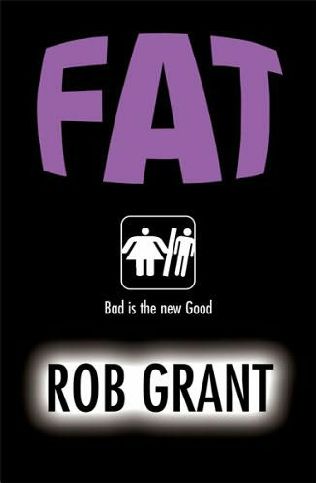
Fat has been marketed to the SF crowd, despite its SF credentials being more or less non-existent. Rob Grant is, of course, best known as an SF writer. He co-created the SF sitcom Red Dwarf (the only decent live-action SF sitcom ever made) twenty years ago and co-wrote the first thirty-six episodes and two novels (Infinity Welcomes Careful Drivers and Better Than Life, both excellent) before splitting with writing partner Doug Naylor. His first (and only) solo Red Dwarf novel, Backwards, was a major success, as were his subsequent two original novels, Colony and Incompetence. Now he's back with a timely look at the modern obsession with weight. It isn't really SF: if it is, it's set the day after tomorrow, when concerns over weight are slightly more extreme than they are now.
The novel follows three characters in turn. Grenville Roberts is a man genetically predisposed to be fat. No matter how much he diets, no matter how much he exercises, he still takes ten minutes to get out of bed every morning, which tires him out for the rest of the day. Clearly something needs to be done, but his latest exercise regime is cruelly interrupted when, in a fit of rage at the persecution of fat people by the thin, he goes on the rampage and destroys a car park.
Jeremy Slank is a PR man working for a City firm, called in to help publicise the government's new Well Farm, a firm-but-fair institution designed to help people lose weight. After all, people are getting fat and dying chronically early from heart disease due to laziness and greed, costing the health service millions. Or is that the simplistic view, and the health farms are a government's sound-bite answer to a complex problem?
Hayleigh can't stand to look at her own reflection in the mirror and feels she is too fat to carry on living. All she can see is her own horrible obesity. But what Hayleigh sees is not the truth...
Fat is a novel of conflicting viewpoints. Simultaneously, it is a very funny, satirical comedy; it is a heartbreaking, powerful depiction of chronic anorexia; and it is a revisionist sideswipe at the accepted view of the science of dieting. Oddly, it manages to handle these competing aspects pretty well. There is a strong educational streak in the book. I didn't know, for example, that a large number of people start dieting by immediately drastically cutting their salt intake, which is quite dangerous, or that cholesterol's link to heart disease is actually not entirely accepted by the medical community (although a quick trawl of scientific websites reveals this is on the same level as those who reject global warming: a small but vocal minority). Grant's rejection of the accepted science in some cases is a bit baffling (being controversial for the sake of it) and leaves the reader wondering what point he is trying to make. It's okay to go out of your way to eat unhealthily because there is a 90% chance you'll put any weight you lose back on again in less than twelve months? A mixed message if I ever heard one.
Whilst Grant's science is somewhat shaky in places, his grasp of character is as assured as ever. He has a deft hand in painting characters well and depicting strong emotions. Grenville's rage at the unfairness of life is quite amusing and well-handled, whilst Hayleigh's quieter despair at her situation verges on the heart-breaking. It is with this latter storyline that Grant finally comes of age as a novelist, portraying this teenage girl's despair with a surprisingly deft hand. And it is to his credit that the word 'anorexia' never appears in the book at all. The resolution to this storyline is perhaps a tad simplistic, but psychologically it works well.
Fat is a well-written and, in places, extremely funny look at the phenomenon on dieting, whilst elsewhere it is a well-realised look at depression. At barely 300 pages, the book doesn't outstay its welcome either. It isn't really SF, no matter its writer's history, but no matter. It is an interesting, amusing and well-written look at a controversial slice of modern life, let down only by a non-partisan approach to the science.
Fat (***) is published by Gollancz in the United Kingdom. It has no US publisher, although some copies are available via Amazon.
Wednesday, 27 December 2006
Perdido Street Station by China Mieville
I decided to put up a review I did a little whilst ago of the best book I read in 2006, although it was actually published back in 2000.
Welcome to New Crobuzon. A vast city of skyrails and towers, of elevated railway lines and glasshouses inhabited by sentient cactii-people, a city of squalor and beauty where insects make art and the government dines the ambassadors of hell.

China Mieville’s debut novel takes the reader on dizzying tour of his immense construction, a teeming steampunk metropolis of six million people, the industrial and commercial hub of his painstakingly-constructed fantasy world of Bas-Lag. Rarely has a fictional city been brought to life so vividly, its tastes and smells all but leaping off the page. New Crobuzon immediately joins Viriconium, Ankh-Morpork, Minas Tirith, Amber, Lankhamar and the city-castle Gormenghast as one of the great civic constructions of fantasy literature.
Enough of the backdrop, what about the story? The novel follows the misadventures of a mixed band of heroes and antiheroes, of the ‘rebel’ inventor and scientist Isaac trying to build wings for a flightless bird-man of the desert; of the half-human, half-insectoid artist Lin being called upon to create the most complex piece of art of her life; of a journalist working for a secret newspaper dedicated to bringing down the corrupt government. Combined with the backdrop of civil discord and even robotic rebellion, the stage would be set for a truly great story.
What we get instead is a bug-hunt. Naturally, it’s a very good bug-hunt, tremendously well-written and incredibly tense in places, but it does feel that Mieville, having built one of the most amazing constructions in fantasy history, didn’t know what to do with it, but happily caught a re-run of Aliens on TV and was inspired. The slight mundanity of this plot compared to the amazing backdrop makes for a curious dichotomy. A bit like Tolkien creating Middle-earth and choosing to concentrate on the adventures of Thranduil fighting spiders in Mirkwood rather than on Frodo and Aragorn’s adventures. This lack is offset on a first read by the expectation of the story taking a more radical turn, and the introduction of the sentient, demigod-like Weaver does fulfil this criteria. However, although the Weaver is a fascinating creation and character, it does veer towards deus ex machina, being employed to rescure our heroes from certain death twice in a short space of time. Despite the slight dampening effect of this, Mieville turns things round for a satisfyingly twisted and melancholy ending. There are some plot elements that are not explained and are presumably being held back for later Bas-Lag novels (the enigmatic character of Jack Half-a-Prayer being one, hopefully), but overall Perdido Street Station emerges as an awesome piece of worldbuilding, with a reasonable and entertaining story tacked on. But you get the feeling Mieville could have done more with his story. And perhaps he will.
Perdido Street Station (****) is published by Pan in the United Kingdom and by Del Rey in the United States.
China Mieville is also the author of King Rat (1998), The Scar (2002) and Iron Council (2004), the latter two of which are also set on the world of Bas-Lag. He published a short story collection, Looking for Jake and Other Stories, in 2005 which includes a Bas-Lag novella featuring Jack Half-a-Prayer. His next novel, Un Lun Dun, is a young adult fantasy due out in early 2007. He has plans to return to Bas-Lag at a later date. Mieville is also a political writer: his PhD thesis was published in book form in 2005 as Between Equal Rights: A Marxist Theory of International Law.
Welcome to New Crobuzon. A vast city of skyrails and towers, of elevated railway lines and glasshouses inhabited by sentient cactii-people, a city of squalor and beauty where insects make art and the government dines the ambassadors of hell.

China Mieville’s debut novel takes the reader on dizzying tour of his immense construction, a teeming steampunk metropolis of six million people, the industrial and commercial hub of his painstakingly-constructed fantasy world of Bas-Lag. Rarely has a fictional city been brought to life so vividly, its tastes and smells all but leaping off the page. New Crobuzon immediately joins Viriconium, Ankh-Morpork, Minas Tirith, Amber, Lankhamar and the city-castle Gormenghast as one of the great civic constructions of fantasy literature.
Enough of the backdrop, what about the story? The novel follows the misadventures of a mixed band of heroes and antiheroes, of the ‘rebel’ inventor and scientist Isaac trying to build wings for a flightless bird-man of the desert; of the half-human, half-insectoid artist Lin being called upon to create the most complex piece of art of her life; of a journalist working for a secret newspaper dedicated to bringing down the corrupt government. Combined with the backdrop of civil discord and even robotic rebellion, the stage would be set for a truly great story.
What we get instead is a bug-hunt. Naturally, it’s a very good bug-hunt, tremendously well-written and incredibly tense in places, but it does feel that Mieville, having built one of the most amazing constructions in fantasy history, didn’t know what to do with it, but happily caught a re-run of Aliens on TV and was inspired. The slight mundanity of this plot compared to the amazing backdrop makes for a curious dichotomy. A bit like Tolkien creating Middle-earth and choosing to concentrate on the adventures of Thranduil fighting spiders in Mirkwood rather than on Frodo and Aragorn’s adventures. This lack is offset on a first read by the expectation of the story taking a more radical turn, and the introduction of the sentient, demigod-like Weaver does fulfil this criteria. However, although the Weaver is a fascinating creation and character, it does veer towards deus ex machina, being employed to rescure our heroes from certain death twice in a short space of time. Despite the slight dampening effect of this, Mieville turns things round for a satisfyingly twisted and melancholy ending. There are some plot elements that are not explained and are presumably being held back for later Bas-Lag novels (the enigmatic character of Jack Half-a-Prayer being one, hopefully), but overall Perdido Street Station emerges as an awesome piece of worldbuilding, with a reasonable and entertaining story tacked on. But you get the feeling Mieville could have done more with his story. And perhaps he will.
Perdido Street Station (****) is published by Pan in the United Kingdom and by Del Rey in the United States.
China Mieville is also the author of King Rat (1998), The Scar (2002) and Iron Council (2004), the latter two of which are also set on the world of Bas-Lag. He published a short story collection, Looking for Jake and Other Stories, in 2005 which includes a Bas-Lag novella featuring Jack Half-a-Prayer. His next novel, Un Lun Dun, is a young adult fantasy due out in early 2007. He has plans to return to Bas-Lag at a later date. Mieville is also a political writer: his PhD thesis was published in book form in 2005 as Between Equal Rights: A Marxist Theory of International Law.
Sunday, 24 December 2006
Altered Carbon by Richard Morgan
It's a world where human beings have become digital information, swapped between bodies, backed up on computer hard drives and sometimes illegally copied. It's a world where centuries-old rich folk have formed an elite watching over the rest of the human race. It's a world utterly unprepared to deal with a man named Takeshi Kovacs. Welcome to Earth in the 25th Century.

Altered Carbon, first published in 2002, is the debut novel by British SF author Richard Morgan and also the first to feature his antihero Takeshi Kovacs. Since the book was published, two sequels have followed: Broken Angels (2003) and Woken Furies (2005). Morgan has also written two non-Kovacs novels, Market Forces (2004) and the forthcoming Black Man (2007). He has also announced that his next project will be a fantasy trilogy, the first book of which has the interesting title of A Land Fit for Heroes. But it's his debut novel I am concerned with here.
Altered Carbon comes very highly recommended and, for the most part, this can be agreed with. This is a book with serious attitude, with a take-no-prisoners approach as body-hopping ex-Envoy Takeshi Kovacs (think of an entire SAS platoon rolled into one person) is freed from prison (digital storage) in return for investigating the murder of a wealthy 'Meth', one of the long-lived elite who effectively control Earth. Kovacs may be a hardened killer and a one-man army, but he's from the provincial colonies with no clue how life works on the old homeworld and it's this juxtaposition - an experienced warrior in an unfamiliar environment - that gives Morgan a way of feeding us information on this futuristic society. Sometimes he misses the target completely: a very implausible conversation in a diner lets us handily know that an advanced alien civilisation used to exist on Mars and they left behind the locations of many other inhabitable worlds, giving mankind a roadmap to follow in its colonisation of the Galaxy. It's a fascinating idea, but very clunkily handled.
It's a tribute to Morgan's writing that this is just about the only flaw I could find in the book. Otherwise it's a clever, often exceptionally violent trawl through the underworld of a far-future San Francisco, taking in heavy torture and a heavy bodycount along the way. A strong stomach is certainly recommended for some parts of the book. There's a great line in dark humour (Kovacs' sidekick through part of the book is the sentient AI system that runs his hotel) and some very well-realised characters as well.
The SF thriller has undergone something of a renaissance in the last decade. Isaac Asimov arguably first mastered the genre back in the 1950s with his Elijah Bailey novels (The Caves of Steel and The Naked Sun, plus their much-delayed sequel, The Robots of Dawn) before cyberpunk dipped its toes in the pond, but Peter F. Hamilton's enjoyable Greg Mandel Trilogy brought it back into focus in the early 1990s before Alastar Reynolds' excellent Chasm City was released in 2001. Morgan sits amongst their ranks with ease. Hamilton is a big fan and I'm pretty convinced that some of the body-hopping and rejeuvenating antics in his recent Commonwealth Saga (combined with a futuristic detective subplot) may have been influenced by this book.
I'm now looking forward to picking up and reading the sequel.
Altered Carbon (****) is available from Gollancz in the United Kingdom and Del Rey in the United States.

Altered Carbon, first published in 2002, is the debut novel by British SF author Richard Morgan and also the first to feature his antihero Takeshi Kovacs. Since the book was published, two sequels have followed: Broken Angels (2003) and Woken Furies (2005). Morgan has also written two non-Kovacs novels, Market Forces (2004) and the forthcoming Black Man (2007). He has also announced that his next project will be a fantasy trilogy, the first book of which has the interesting title of A Land Fit for Heroes. But it's his debut novel I am concerned with here.
Altered Carbon comes very highly recommended and, for the most part, this can be agreed with. This is a book with serious attitude, with a take-no-prisoners approach as body-hopping ex-Envoy Takeshi Kovacs (think of an entire SAS platoon rolled into one person) is freed from prison (digital storage) in return for investigating the murder of a wealthy 'Meth', one of the long-lived elite who effectively control Earth. Kovacs may be a hardened killer and a one-man army, but he's from the provincial colonies with no clue how life works on the old homeworld and it's this juxtaposition - an experienced warrior in an unfamiliar environment - that gives Morgan a way of feeding us information on this futuristic society. Sometimes he misses the target completely: a very implausible conversation in a diner lets us handily know that an advanced alien civilisation used to exist on Mars and they left behind the locations of many other inhabitable worlds, giving mankind a roadmap to follow in its colonisation of the Galaxy. It's a fascinating idea, but very clunkily handled.
It's a tribute to Morgan's writing that this is just about the only flaw I could find in the book. Otherwise it's a clever, often exceptionally violent trawl through the underworld of a far-future San Francisco, taking in heavy torture and a heavy bodycount along the way. A strong stomach is certainly recommended for some parts of the book. There's a great line in dark humour (Kovacs' sidekick through part of the book is the sentient AI system that runs his hotel) and some very well-realised characters as well.
The SF thriller has undergone something of a renaissance in the last decade. Isaac Asimov arguably first mastered the genre back in the 1950s with his Elijah Bailey novels (The Caves of Steel and The Naked Sun, plus their much-delayed sequel, The Robots of Dawn) before cyberpunk dipped its toes in the pond, but Peter F. Hamilton's enjoyable Greg Mandel Trilogy brought it back into focus in the early 1990s before Alastar Reynolds' excellent Chasm City was released in 2001. Morgan sits amongst their ranks with ease. Hamilton is a big fan and I'm pretty convinced that some of the body-hopping and rejeuvenating antics in his recent Commonwealth Saga (combined with a futuristic detective subplot) may have been influenced by this book.
I'm now looking forward to picking up and reading the sequel.
Altered Carbon (****) is available from Gollancz in the United Kingdom and Del Rey in the United States.
Monday, 18 December 2006
The New Tolkien Book
In 2007 the biggest and most important author in the history of 20th Century Fantasy releases his new book. This is an impressive feat, coming as it does thirty-four years after he died.

The Children of Hurin by JRR Tolkien is published by HarperCollins in the United Kingdom on 17 April 2007, with a cover by Alan Lee, the noted Tolkien artist who is responsible for both a lavish illustrated version of The Lord of the Rings and also worked on the movie adaption by Peter Jackson. A second edition of the book, which includes several full-colour illustrated plates by Lee, is released on the same day. The legend of Hurin and his children is a long-standing part of the Tolkien legendarium, first seeing print in The Silmarillion in 1977, although it was referenced in The Lord of the Rings (published in 1954). Tolkien actually wrote the very first version of the story in the late 1910s when he began work on the creation of Middle-earth.
The new version of the story has been coallated from several sources: a prose version of the story that Tolkien wrote called The Tale of the Children of Hurin, apparently in the 1950s and 1960s and included in the 1981 collection Unfinished Tales; a much earlier version, written not long after The Fall of Gondolin, the very first tale of Middle-earth that Tolkien wrote in 1917, and included in the two-volume 1983/1984 collection The Book of Lost Tales; and a poem in alliterative verse from slightly later. Most interesting is the fact that a lengthy 'new' section has been added focusing on the journeys of Hurin himself. This story was written by Tolkien but witheld from previous collections, and presumably forms the meat of the new narrative.
The new narrative has painstakingly created by Christopher Tolkien, who has edited and presented virtually all of his father's unpublished materials from The Silmarillion onwards, including Unfinished Tales and the twelve-volume History of Middle-earth series. His role in the construction of the new tale has been mildly controversial, since this is the first time since The Silmarillion that Christopher has assembled an actual story out of his father's writing (rather than presenting the extant story fragments with editorial commentaries) and, whilst JRR certainly intended that Christopher present The Silmarillion for publication following his death, no such intention is known with regards to The Children of Hurin. Nevertheless, Christopher Tolkien's well-known fidelity to his father's work and his frequent turning down of opportunities to 'cash in' on his father's success (by writing totally original Middle-earth fiction, for example) means that this is certainly not a quick-fire 'cash in' work in the vein of Brian Herbert and Kevin J. Anderson's ill-considered additions to the Dune universe.
The Children of Hurin will likely be one of the most intriguing and controversial SF&F releases in 2007, and it's not too far off either.

The Children of Hurin by JRR Tolkien is published by HarperCollins in the United Kingdom on 17 April 2007, with a cover by Alan Lee, the noted Tolkien artist who is responsible for both a lavish illustrated version of The Lord of the Rings and also worked on the movie adaption by Peter Jackson. A second edition of the book, which includes several full-colour illustrated plates by Lee, is released on the same day. The legend of Hurin and his children is a long-standing part of the Tolkien legendarium, first seeing print in The Silmarillion in 1977, although it was referenced in The Lord of the Rings (published in 1954). Tolkien actually wrote the very first version of the story in the late 1910s when he began work on the creation of Middle-earth.
The new version of the story has been coallated from several sources: a prose version of the story that Tolkien wrote called The Tale of the Children of Hurin, apparently in the 1950s and 1960s and included in the 1981 collection Unfinished Tales; a much earlier version, written not long after The Fall of Gondolin, the very first tale of Middle-earth that Tolkien wrote in 1917, and included in the two-volume 1983/1984 collection The Book of Lost Tales; and a poem in alliterative verse from slightly later. Most interesting is the fact that a lengthy 'new' section has been added focusing on the journeys of Hurin himself. This story was written by Tolkien but witheld from previous collections, and presumably forms the meat of the new narrative.
The new narrative has painstakingly created by Christopher Tolkien, who has edited and presented virtually all of his father's unpublished materials from The Silmarillion onwards, including Unfinished Tales and the twelve-volume History of Middle-earth series. His role in the construction of the new tale has been mildly controversial, since this is the first time since The Silmarillion that Christopher has assembled an actual story out of his father's writing (rather than presenting the extant story fragments with editorial commentaries) and, whilst JRR certainly intended that Christopher present The Silmarillion for publication following his death, no such intention is known with regards to The Children of Hurin. Nevertheless, Christopher Tolkien's well-known fidelity to his father's work and his frequent turning down of opportunities to 'cash in' on his father's success (by writing totally original Middle-earth fiction, for example) means that this is certainly not a quick-fire 'cash in' work in the vein of Brian Herbert and Kevin J. Anderson's ill-considered additions to the Dune universe.
The Children of Hurin will likely be one of the most intriguing and controversial SF&F releases in 2007, and it's not too far off either.
Empire Sample
I mentioned earlier how Orson Scott Card's Empire has had a somewhat 'mixed' reception. This sample I believe explains why. It is simply one of the most turgid pieces of writing I have experienced since seeing excerpts from the latest Goodkind novel. The difference here is that Orson Scott Card is a writer who has written some good books in the past. The total lack of any kind of effort that has gone into this sample is startling, coming as it does from a major author.
Saturday, 16 December 2006
Galacticawatch 2
As expected, Battlestar Galactica's 'Season 3.0' has come to an end, leaving our heroes dangling on a perilous cliffhanger for five weeks until the season resumes on Sunday 21 January 2007. The latter batch of episodes has restored some faith in the series, which after the barnstorming four-episode opening arc had been looking decidedly ropey.
Unfinished Business had a somewhat bizarre framing device - an onship boxing match - but the flashbacks to the year on New Caprica were interesting, showing Tyrol and Cally settling down, Adama and Laura relaxing together and, most notably, revealing the destructive events that tore Apollo and Starbuck's relationship apart. The episode has some good music and a tremendous sense of melancholy since the audience knows that the society they are building will soon be shattered by the Cylons. There is also a very funny scene where Adama and Roslin take time out to smoke a joint. There are some flaws, most notably the exercising of the subplot in which we find out how Starbuck and Tigh became buddies all of a sudden, but overall this is a satisfying episode that answers a lot of dangling questions.
The Passage is a 'prelude' to the two-parter that bridges the mid-season divide. The Galactica and her fleet have to force their way through the blinding layers of radiation surrounding a dense star cluster to reach a lifebearing planet so they can replenish their food supplies. The Viper and Raptor pilots have to guide the civilian ships through the radiation storm, but the heavy workload and stress of the mission start to take their toll, particularly on Kat, who is also being blackmailed by a mysterious newcomer. This episode gets points for the 'passage' storyline, which is nicely filled with tension and some breathtaking CGI, but the soap opera-ish elements revolving around Kat's secret past are a bit tedious.
The Eye of Jupiter is the first part the mid-season cliffhanger and is an appropriately superb episode, the best of the season since Exodus, Part 2. The Galactica and her fleet are resupplying food stocks from the brilliantly-named 'Algae Planet' when Chief Tyrol stumbles across what appears to be a temple left behind by the Thirteenth Colony. The Cylons soon show up looking for the temple and a stand-off ensures, with the Cylons threatening to destroy Galactica if she tries to recover the mysterious 'eye of Jupiter' from the temple, whilst Adama threatens to nuke the temple if the Cylons try to land on the planet. This stand-off is a catalyst for a number of impressive confrontations as various storylines that have been building over the past few weeks come to a sudden fruition: Three and Baltar find themselves working together; the deception over the fate of Helo and Athena's baby is brutally exposed; Athena and Boomer come face to face; and Lee and Anders clash over Starbuck. The episode is nicely written, not too obviously cut to pieces by the editors (a problem that has been plaguing the show all season), with a number of interesting 'firsts' (such as the first time the Cylons actually talk to the crew directly rather than just try to kill them), the multiple cliffhanger works quite well and a number of very interesting issues are left open to be resolved. A welcome return to Galactica's better form.
309: Unfinished Business ***
310: The Passage ***
311: The Eye of Jupiter ****
Forthcoming: Rapture (21/01/07), Taking a Break From All of Your Worries (28/01/07), The Woman King (04/02/07), A Day in the Life (11/02/07), Dirty Hands (18/02/07), Maelstrom (25/02/07), The Son Also Rises (04/03/07), Crossroads, Part 1 (11/03/07), Crossroads Part 2 (18/03/07)
Unfinished Business had a somewhat bizarre framing device - an onship boxing match - but the flashbacks to the year on New Caprica were interesting, showing Tyrol and Cally settling down, Adama and Laura relaxing together and, most notably, revealing the destructive events that tore Apollo and Starbuck's relationship apart. The episode has some good music and a tremendous sense of melancholy since the audience knows that the society they are building will soon be shattered by the Cylons. There is also a very funny scene where Adama and Roslin take time out to smoke a joint. There are some flaws, most notably the exercising of the subplot in which we find out how Starbuck and Tigh became buddies all of a sudden, but overall this is a satisfying episode that answers a lot of dangling questions.
The Passage is a 'prelude' to the two-parter that bridges the mid-season divide. The Galactica and her fleet have to force their way through the blinding layers of radiation surrounding a dense star cluster to reach a lifebearing planet so they can replenish their food supplies. The Viper and Raptor pilots have to guide the civilian ships through the radiation storm, but the heavy workload and stress of the mission start to take their toll, particularly on Kat, who is also being blackmailed by a mysterious newcomer. This episode gets points for the 'passage' storyline, which is nicely filled with tension and some breathtaking CGI, but the soap opera-ish elements revolving around Kat's secret past are a bit tedious.
The Eye of Jupiter is the first part the mid-season cliffhanger and is an appropriately superb episode, the best of the season since Exodus, Part 2. The Galactica and her fleet are resupplying food stocks from the brilliantly-named 'Algae Planet' when Chief Tyrol stumbles across what appears to be a temple left behind by the Thirteenth Colony. The Cylons soon show up looking for the temple and a stand-off ensures, with the Cylons threatening to destroy Galactica if she tries to recover the mysterious 'eye of Jupiter' from the temple, whilst Adama threatens to nuke the temple if the Cylons try to land on the planet. This stand-off is a catalyst for a number of impressive confrontations as various storylines that have been building over the past few weeks come to a sudden fruition: Three and Baltar find themselves working together; the deception over the fate of Helo and Athena's baby is brutally exposed; Athena and Boomer come face to face; and Lee and Anders clash over Starbuck. The episode is nicely written, not too obviously cut to pieces by the editors (a problem that has been plaguing the show all season), with a number of interesting 'firsts' (such as the first time the Cylons actually talk to the crew directly rather than just try to kill them), the multiple cliffhanger works quite well and a number of very interesting issues are left open to be resolved. A welcome return to Galactica's better form.
309: Unfinished Business ***
310: The Passage ***
311: The Eye of Jupiter ****
Forthcoming: Rapture (21/01/07), Taking a Break From All of Your Worries (28/01/07), The Woman King (04/02/07), A Day in the Life (11/02/07), Dirty Hands (18/02/07), Maelstrom (25/02/07), The Son Also Rises (04/03/07), Crossroads, Part 1 (11/03/07), Crossroads Part 2 (18/03/07)
Friday, 15 December 2006
Just a Round-Up...
Orson Scott Card - who has milked his status as the writer of one of the most iconic SF novels of the 1980s (Ender's Game) for all it's worth - has released his newest book, Empire, in the USA and it's kicked up a bit of a storm. Essentially it's a near-future novel chronicling the USA falling into a civil war between the right and the left, and apparently Card paints liberals as evil weaklings who will lead the USA to destruction. Okay. The book has not had a good reception so far.
Robert Jordan's publisher, Tom Doherty of Tor Books, has indicated that they currently plan to publish the twelfth and final installment of The Wheel of Time, A Memory of Light, in early 2009. The longer-than-normal wait is due to the book's much greater length than the prior volumes (themselves of not inconsiderable size) and because of Jordan's serious illness. He is battling a very serious blood disorder called amyloidosis and has vowed to beat it, although it is not a curable condition at present. His fans have given large sums of money to the charities dedicating to beating this illness, and was the basis for a recent article on the Forbes website.
George R.R. Martin has confirmed that, as expected, he will not be able to finish A Dance with Dragons, the fifth volume of A Song of Ice and Fire, before the end of this month. However, he does plan to finish it early in 2007. Publication will likely now slip until the autumn of 2007 at the earliest. However, comments by the artist Ted Nasmith (best known for his work on Tolkien) have suggested that the long-awaited The World of Ice and Fire companion book, co-written by Martin with the admins of the Westeros fan site and forum Elio 'Ran' Garcia and Linda Antonsson, may follow quite quickly in the spring of 2008. It should be noted that this date is not final, however.
PS Publishing have confirmed that Steven Erikson is writing a new novella set in the Malazan world, entitled The Lees of Laughter's End, to be published in early 2007, likely around the same time that Reaper's Gale, the seventh novel in the main series, is published by Bantam.
Robert Jordan's publisher, Tom Doherty of Tor Books, has indicated that they currently plan to publish the twelfth and final installment of The Wheel of Time, A Memory of Light, in early 2009. The longer-than-normal wait is due to the book's much greater length than the prior volumes (themselves of not inconsiderable size) and because of Jordan's serious illness. He is battling a very serious blood disorder called amyloidosis and has vowed to beat it, although it is not a curable condition at present. His fans have given large sums of money to the charities dedicating to beating this illness, and was the basis for a recent article on the Forbes website.
George R.R. Martin has confirmed that, as expected, he will not be able to finish A Dance with Dragons, the fifth volume of A Song of Ice and Fire, before the end of this month. However, he does plan to finish it early in 2007. Publication will likely now slip until the autumn of 2007 at the earliest. However, comments by the artist Ted Nasmith (best known for his work on Tolkien) have suggested that the long-awaited The World of Ice and Fire companion book, co-written by Martin with the admins of the Westeros fan site and forum Elio 'Ran' Garcia and Linda Antonsson, may follow quite quickly in the spring of 2008. It should be noted that this date is not final, however.
PS Publishing have confirmed that Steven Erikson is writing a new novella set in the Malazan world, entitled The Lees of Laughter's End, to be published in early 2007, likely around the same time that Reaper's Gale, the seventh novel in the main series, is published by Bantam.
Subscribe to:
Posts (Atom)