Showing posts with label liveship traders. Show all posts

Sunday, 8 January 2017

Ship of Destiny by Robin Hobb

The liveship Vivacia is in the hands of the pirate king Kennit, who has won the living ship's heart with his kindness and rejection of slavery. But Althea Vestrit is not prepared to let her family ship be taken into piracy. Having refloated the liveship Paragon and assembled a crew, she now plans to retake her vessel. Meanwhile, the forces of Jamaillia and Chalced have sacked Bingtown. The surviving Traders have to rebuild and reassert themselves in times of great adversity. But, far to the north, the first dragon seen in the world for centuries has taken wing...


Ship of Destiny concludes the Livship Traders trilogy, the second major movement (of five, so far) in Robin Hobb's Realm of the Elderlings mega-series. The conclusion to her first series in this world, The Farseer Trilogy, was sabotaged by the book being incredibly overlong, with poor pacing and structural issues that made ploughing through it a chore. Ship of Destiny is certainly a far superior ending, juggling a much larger number of stories and interesting characters far more effectively, although some similar issues remain. It does feel like events continue to unfold more slowly and laboriously than they really should, and the book has more endings than the film version of The Return of the King.

Still, Hobb's gifts of characterisation continue to shine with her treatment of her major cast. After being fairly restrained in the previous novel, it's good to see Althea reassert herself as a major protagonist and after all of his self-delusions and justifications, it's good to see Kennit's flaws and plans blow up in his face. However, I can't help but feel that the mechanism Hobb uses to make it clear that Kennit is a villain and not a cool, amoral antihero - the rape of another character - is a little too obvious. Unlike some characters who introduce this idea into their work for shock value, Hobb owns this story decision and follows through on its consequences effectively, which is a refreshing change even as it makes for some grim reading.

The storylines and characters are developed satisfyingly, although as we reach the climax the focus shifts to events on the Vivacia and Paragon and the storylines in Bingtown and Trehaug are completely abandoned. This is a bit surprising as major characters vanish abruptly from the story for hundreds of pages at the end of the novel, but Hobb actually makes it work quite well when we eventually catch up with those characters at the end of the story.

Ship of Destiny (****) is a surprisingly relaxed conclusion to a highly enjoyable and some different kind of fantasy trilogy, with Hobb's fine gifts for characterisation on full display. The novel is available now in the UK and USA.

Sunday, 13 November 2016

The Mad Ship by Robin Hobb

The fortunes of the Vestrit family have become more desperate. Their liveship, the Vivacia, has been captured by the notorious "pirate king" Kennit and is now helping liberate slaver ships on the seas between Jamaillia and Chalced. The Vestrits have no choice but to help refloat the mad liveship Paragon in the hope they can convince the deranged vessel to help them regain the ship and rescue their kin.


The Mad Ship is the middle volume of The Liveship Traders trilogy and very much reads like one. The story doesn't really start or finish, instead transitioning from the beginning to the end without necessarily having a defining storyline itself. The storylines begun in Ship of Magic are pretty strong so having them continue is fine, and the new additions to the world - a subplot involving the Satrap of Jamaillia and one of his Consorts, and a new story set in an Elderling city in the Rain River Wilds - are well-judged and engrossing.

However, the novel definitely loses some of the pace and momentum of Ship of Magic, which remains my favourite Hobb novel (again, only having read the first six). Hobb's net is cast wider here and the story, world and characters remain fascinating, but there's also much greater periods of time in which nothing much seems to be happening, or we touch base (again) with the Vestrit family having another grim conference about the status of the lower field and getting embarrassed with a family friend whose clothes are a bit old.


Still, if the momentum isn't quite as swift as in the previous novel, Hobb's other strengths remain on full display. The depth of characterisation is remarkable, especially of previously-annoying characters like Malta who develops impressively in this novel beyond the more stereotypical, troublesome teenager of the first book. The biggest success is in the curious relationship between Kennit, Etta, Wintrow and Vivacia, which defies cliche at every turn and becomes a gripping study in character dynamics, power structures and obligation (Hobb does torpedo this, rather frustratingly, in the final volume of the trilogy but at this point it's fascinating).

There's also some uncharacteristic (for Hobb) large-scale action scenes which she handles well, some more deft political maneuverings and some effective mystical dream sequences which hint at a major plot revelation about the nature of the liveships and their place in the world.

The Mad Ship (****) doesn't impress as much as Ship of Magic and definitely feels like it's a slower, more relaxed book, but it evolves the story and characters nicely and sets things up well for the final (and rather more problematic) volume in the trilogy, Ship of Destiny. The book is available now in the UK and USA.

Saturday, 15 October 2016

Wertzone Classics: Ship of Magic by Robin Hobb

The Bingtown Traders have grown rich from the use of the liveships, great, sentient sailing ships made of the fabled wizardwood. After three generations of captains die on their decks, they quicken into life. Epheron Vestrit's death brings the liveship Vivacia to life, but the jubilations of the Vestrit family are cut short when it is revealed that the ship will pass into the ownership of Kyle Haven, the husband of Epheron's eldest daughter, rather than to his younger daughter Althea. Furious at this betrayal, Althea vows not to rest until the Vivacia belongs to her again. This resolve only hardens when Kyle decides to use the Vivacia to carry slaves, to the horror of his family.


Meanwhile, an unusually eloquent and cultured pirate captain named Kennit schemes to become King of the Pirate Isles. His plotting involves liberating slaver ships, winning the hearts and minds of the people...and finding and capturing a liveship.

Ship of Magic is the first novel in the Liveship Traders trilogy, which takes place in the same world as The Farseer Trilogy but in the lands to the south. There's an almost completely new cast and setting (one major Farseer character does show up in disguise), with most of the action taking place on ships or in dingy port towns. This shift to a nautical setting is refreshing and makes for a very different-feeling novel to the previous books.

The structure of the book also changes. Farseer was told in a first person point-of-view from FitzChivalry Farseer, but The Liveship Traders is told from a rotating POV structure. The major characters are Kennit, Althea, her mother Ronica, sister Keffria, niece Malta and nephew Wintrow, but other POV characters include the Vivacia herself, the beached, mad liveship Paragon and Brashen, another crewman on the Vivacia. This immediately makes for a grander, more epic story as the author moves between different characters.
Whilst this loses the immediacy of the Farseer books and the deep connection with Fitz, it does allow Hobb to cover the story from more angles and explain things more clearly rather than filtering all of the exposition and information through Fitz alone. It's a good move, justifying the novel's impressive page count (over 870 pages in paperback) rather more convincingly than the Farseer books, which felt rather padded out to reach such lengths.

 
Indeed, although I've only to date read Hobb's first six novels, Ship of Magic is easily the best. The story is epic, but it feels tight with naturalistic character development of a large cast and events proceed at a steady clip. Hobb's main skill has always been in the development of a convincing emotional connection to the characters and that skill is in impressive form here. We share Althea's frustration and betrayal, Wintrow's shock and hurt at his relationship with his father Kyle and the casual betrayal of his calling, Ronica's uneasy dealings with the Rain Wild Traders as she tries to protect her family's holdings and Kennit's ambitions as he strives to make his people more than what they are.

Kennit is easily Hobb's most fascinating character to date. He is greedy, selfish and arrogant, but he also has a fast-moving intelligence and wit and altruistic outcomes see to flow from his self-centred acts. Kennit's ability to adapt to rapidly changing circumstances on the fly and ensure that he always comes out on top is impressive. Kennit clearly has negative characteristics, but it's not entirely clear in Ship of Magic if he is supposed to be a villain. Indeed, it is Kyle Haven who more readily fulfils that role in this book.

Ship of Magic (*****) is an outstanding fantasy novel, and an impressive return to form after the disappointing slog that was Assassin's Quest. The book moves with pace and vigour despite its length, the cast of characters is fascinating, the worldbuilding subtle but convincing, the background politics intriguing and the book moves with tremendous purpose. The ending will leave you eager to read the next book, The Mad Ship, immediately. The novel is available now in the UK and USA.

Sunday, 15 November 2015

A History of Epic Fantasy - Part 27

Summing up what epic fantasy is and is not is difficult. The barest tropes of the genre - big armies, travelogues, magic - can be used to define it, but it always feels like it's describing the symptoms and not the causes of why people write the genre, and why people read it. One potential definition is that epic fantasy is the story of big events channelled through the eyes of a small number of well-defined characters whom the audience invests in.


Or to put it another way, we may be interested in Middle-earth as a place and a collection of societies, but we only get interested in it through the actions of characters we empathise with: Bilbo, Frodo, Gandalf, Gollum etc. The same with Westeros. The war for the Iron Throne is irrelevant if the reader does not care about Ned Stark or Tyrion Lannister or Daenerys Targaryen. Arguably epic fantasy can go off the rails when the scope balloons and so many characters are brought in that the tension and pace can become diffuse, a problem struggled with by many of even the best and most critically lauded authors in the genre. This tension between the macro and micro-scale, between the personal stories of characters we love and the epic struggle of clashing armies and gods and philosophies, arguably lies at the core of the appeal of epic fantasy and how different authors approach it can determine their success. It often feels like fantasy authors, when in doubt, move in favour of the massive, epic scale and throw so many new ideas, new characters and new magic systems into their narratives that they can risk overload or crashing the momentum of their series.

In 1995 a novel was published which firmly tilted in the opposite direction, where big things happened but the perspective was tightly limited (at least for most of the books). This gave rise to one of the biggest-selling, most critically lauded and respected fantasy series of the last fifteen years: The Realm of the Elderlings mega-sequence by Robin Hob.


Assassin's Apprentice & Ship of Magic

Of course, it didn't start out that way. Margaret Astrid Lindholm Ogden had published her very first novel, Harpy's Flight in 1983. By the early 1990s she'd been writing novels for ten years and had released ten books in the adventure fantasy field (and also a single SF novel, Alien Earth). These had been released under pen-name, Megan Lindholm. In July 1993 she concluded a deal with Bantam for three further books, this time an epic fantasy trilogy. The first volume at this point had the working title Chivalry's Bastard.

By the time the book was completed and delivered, the author and her publisher agreed it was a very different kind of novel for her. It was longer, more complex and much more adult. It was decided to remarket the novel as coming from a new author. She picked the name "Robin Hobb" after discovering that the "H" row was often on a perfect eyeline for an adult browsing the shelves in a bookstore.

Retitled Assassin's Apprentice, the novel was released in April 1995 and was immediately successful. Two heavyweight fantasy artists - Michael Whelan in the United States and John Howe in the United Kingdom - provided excellent covers. Reviews were very strong. The book was fairly traditional, focusing on the character of Fitz, the bastard son of the king's heir who is reluctantly allowed to live in the royal household but finds himself at something of a loose end. He is trained by the royal assassin, Chade, and uncovers political intrigue with his half-uncle Regal seeking to usurp the throne, the Six Duchies facing attacks by the mysterious Outislanders and relations with the Mountain Kingdom being strained. Royal Assassin (1996) and Assassin's Quest (1997) continue and resolve these issues, the three books together forming The Farseer Trilogy.

However, although the books feature political intrigue, two magic systems (the Skill and the Wit) and occasional bouts of violence, their popularity rested on a series of relationships: between Fitz and his wolf, Nighteyes; between Fitz and his mentor Chade, and his uncle Verity; and, most tantalisingly, between Fitz and the highly enigmatic Fool. The trilogy ended on a positive note, but Fitz did not seem to have truly found happiness at its conclusion.


Robin Hobb went on to write The Liveship Traders (1998-2000), a further trilogy set in the same world but along the coast of the continent to the south. This trilogy focuses on the families of Bingtown, who have developed the ability to carve ships controlled by sentient figureheads. Initially the books revolve around the battle within a family for ownership of the liveship Vivacia, but as the narrative unfolds the scope expands. Unlike the Farseer series, which was written in first-person, Liveship is written from a more traditional third-person viewpoint and encompasses a wide range of characters living in different locales. This trilogy features more compelling and original worldbuilding than Farseer, which is very traditional, but also is notable for giving the primary villain a journey and arc of his own that is understandable and sympathetic. Indeed, Hobb arguably is too successful in making Kennit a relatable figure and the decision to have him revert to pure villainy by becoming a rapist feels heavy-handed. But overall The Liveship Traders is as strong and readable a series as its forebear, benefiting from the shift in location and theme.

Hobb returned to Fitz's story in The Tawny Man (2001-03), which followed up on his adventures fifteen years after the events of Farseer. More intriguingly, it touched on events in The Liveship Traders and started pulling together story threads revolving around the Liveships, sea serpents, dragons and the extinct race of mysterious Elderlings, providing a larger-scaled and more mythic backdrop for the series. However, the focus remained resolutely on the key characters.

Hobb took a break from Fitz's world to write the Shaman's Crossing trilogy (2005-08), set on a completely different world with gunpowder. Although well-regarded, it wasn't as successful critically as her Elderling mega-series. She subsequently returned to the setting of the Rain Wilds, touched on in both the Farseer and Liveship story strands, for a four-volume series expanding on that region, The Rain Wild Chronicles (2009-13). This led Hobb to write Fitz and the Fool (2014-17, est), a new trilogy continuing (and perhaps wrapping up) the story of Fitz and his enigmatic friend, now emerging as arguably the central figure of the entire saga.


The Robin Hobb books feature all the hallmarks of epic fantasy, but her prose and dialogue style are a marked improvement over much of the genre and her focus on character over the furniture of the setting is highly laudable. Her approach is also hugely appealing on a wide level. Her books were Harper Voyager's biggest-selling series until A Song of Ice and Fire overtook them in the early 2000s, and she has enormous respect from her peers. Authors as different as George R.R. Martin and Steven Erikson are big fans, and The Telegraph even called the first book of the Fitz and the Fool sequence "High art." If the books have a weakness it may be a traditional one: excessive verbiage with the streamlined opening volumes of both Farseer and The Liveship Traders being dwarfed by the concluding volumes of each trilogy (each almost double the size of the first), and the Rain Wild Chronicles expanding almost uncontrollably from a duology to a four-volume series.

But at her best Robin Hobb is one of the most human and humane writers in the field, writing intelligently and with clarity about people and what makes them tick, whilst also remembering to throw in the requisite fantasy cool stuff like dragons and sentient sailing ships.


By the end of the 1990s the genre's success appeared secured through the arrival and establishing of a new breed of epic fantasy authors writing with greater skill and interest in characters and people, whilst also being more willing to delve into the darker side of the genre. But a parallel subset of fantasy was also developing which wanted to turn over all the rules and do something really different. Really...weird.

Saturday, 6 February 2010

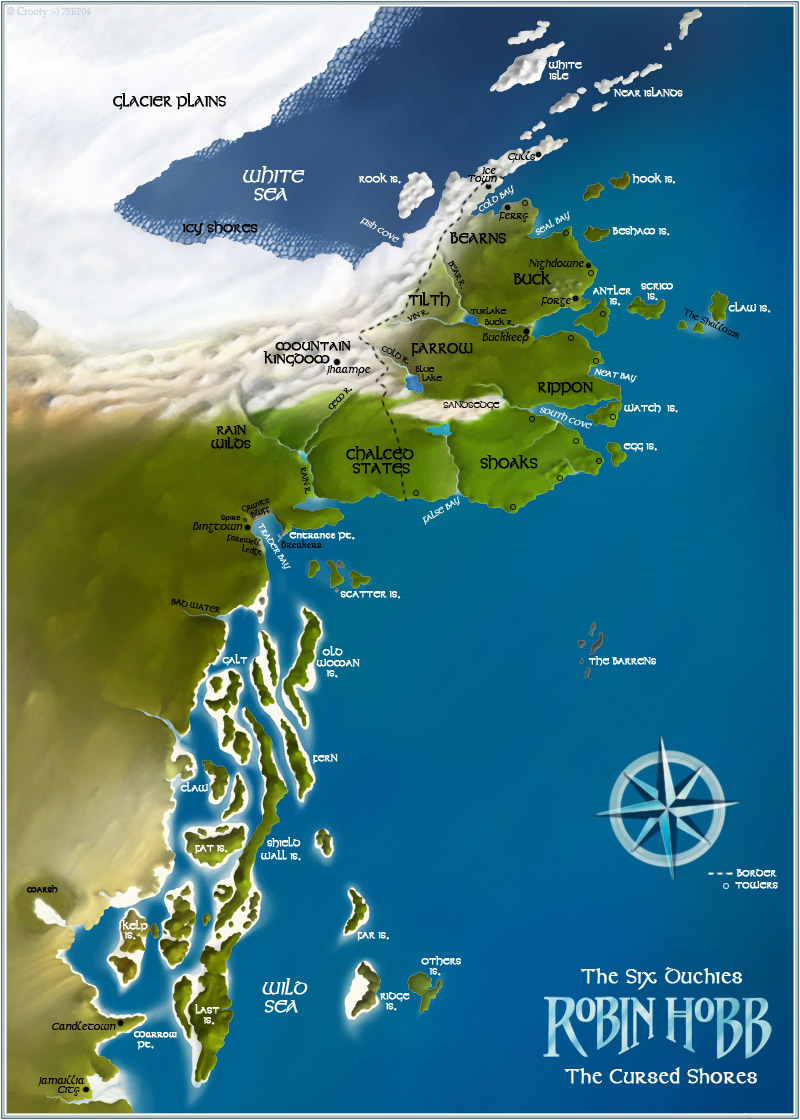
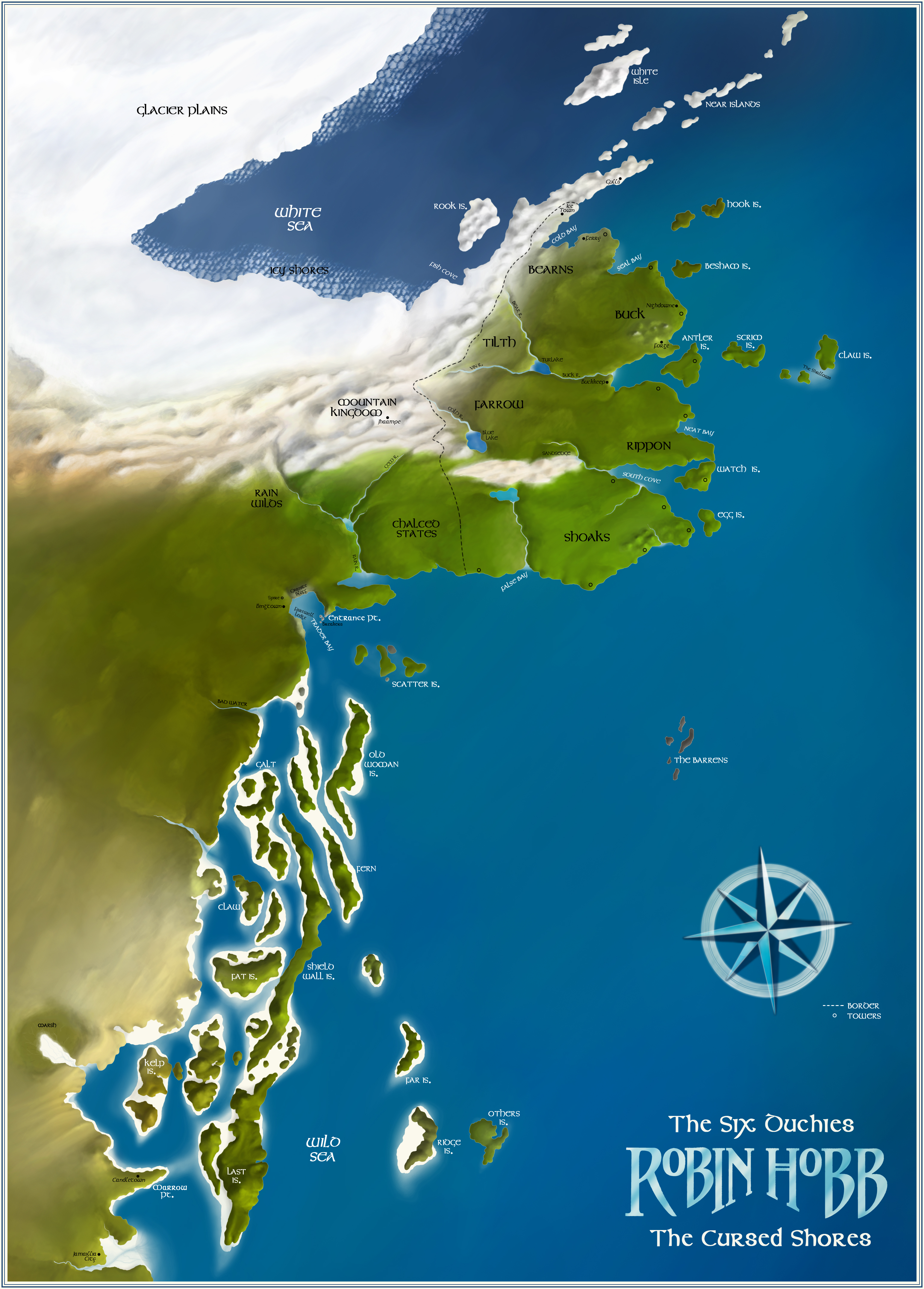
Interesting map for Robin Hobb fans

A very nice combined map of the Six Duchies and Cursed Shores regions from Robin Hobb's Farseer Trilogy, Liveship Traders, Tawny Man and Rain Wild Chronicles series can be seen here. A mega-resolution version for download and printing can also be found here. The same artist has some other Hobb-inspired artwork here.


Interesting stuff for the fantasy cartography fans out there.