Showing posts with label electronic arts. Show all posts

Friday, 7 November 2025

MASS EFFECT TV series to be an original story set after the original video game trilogy

BioWare have confirmed that Amazon's upcoming Mass Effect TV series will be an original story, set after the original video game trilogy.


Amazon have been developing a TV project based on the video game franchise for some years now. The original announcement sounded like the show would be based directly on the events of the original games, Mass Effect (2007), Mass Effect 2 (2010) and Mass Effect 3 (2012). The original story depicts humanity trying to establish itself on the galactic scene, where several, much older races dominate a multi-civilisation society based at an ancient, gargantuan space station known as the Citadel. The protagonist, Commander Shepard, becomes the first human accepted into the elite Spectre organisation, given wide latitude to track down a renegade agent named Saren. From a small start, the trilogy expanded into a massive war story with the galaxy under attack from an ancient alien force known as the Reapers and Shepard having to assemble a vast fleet and army to stand against them.

The fourth game in the series, Mass Effect: Andromeda (2017) avoided having to commit to any outcome from the story by being set centuries later and over two million light years away, with a fleet of exploration ships reaching the Andromeda galaxy after centuries in stasis. The game was not as well-received as others in the series. BioWare did enjoy success with the release of Mass Effect: Legendary Edition in 2022, a moderate remaster of the series.

Reportedly the Mass Effect TV series is still a year away from shooting, let alone airing. Doug Jung is producing and showrunning. Meanwhile, BioWare are developing a new Mass Effect video game, but there hasn't been much news about the game for a while.

Saturday, 27 September 2025

Titanfall 2 (campaign)

The Frontier, a remote region of space far from Earth and the Core Systems, is ravaged by war between the Interstellar Manufacturing Corporation (IMC) and the Frontier Militia. Both sides use Titans, large, AI-assisted combat exoskeletons, and Pilots, highly-trained, hyperaware soldiers with improved mobility and weapons knowledge. The planet Typhon becomes the latest battleground between the two sides. Rifleman Jack Cooper is given a field-promotion to Pilot when his commanding officer is killed. Taking command of his Titan, BT-7274, Jack stumbles on a secret IMC conspiracy to destroy the Frontier Militia once and for all, and has to foil their plans deep behind enemy lines.

Emerging from the flaming wreckage of Call of Duty developers Infinity Ward, Respawn Entertainment's first game back in 2014 was Titanfall, a heavily multiplayer-focused game where two sides of soldiers engaged in battle, with the twist that they could call upon powerful mechs for support. Bigger than power armour but not as large as full-on BattleMechs from other franchises, Titans were more nimble and maneuverable, but able to carry a much heavier weapons loadout. The game was successful, but players complained about the lack of a single-player campaign. For the sequel (released just two years later), Respawn added a story campaign to give better context to the battles. Unexpectedly, the story campaign would go on to be hugely well-received.

On one level, Titanfall 2 feels like any vast number of manshooters from the last thirty years. You control a guy with a gun and must shoot a truly colossal number of other guys with guns. You can swap weapons, with some weapons better at short range and others better at long. Some guns reduce enemies to gibs of flesh, some set them on fire, some blast them with electricity. The usual. The game throws two curveballs into the situation. The first is the freedom of movement for your character. You can run along walls and bounce off one wall to run along another, as well as double-jump and pull yourself over ledges etc. Once you get used to the movement controls, you can ping-pong all over the map like an angry ball with guns. The second is that you also have a partner, a semi-independent walking battlesuit who provides covering fire and whom you can board to command directly in battle. Fighting as a Titan is significantly different to on foot, trading speed and maneuverability for much greater durability and heavier weapons.

The game is linear, with areas that are divided into Titan-compatible zones and other areas (usually inside buildings) where the Titan can't fit, so you have to go in on foot. As with most first-person shooters, weapon choice is key as you can only (sigh) carry two weapons at once and if you run out of ammo, have to ditch one for another one. Weapon have their own advantages and disadvantages, but I generally found ditching a gun the second it ran out and just picking up whatever was nearest and making do worked fine. The game does have a very nice line in shotguns and some good sniper rifles, though given the game's focus on frenetic movement and always taking the fight directly to the enemy, switching to a sniper strategy feels a bit odd. Ground combat is chunky and most satisfying, with okay enemy AI and aggressive strategies being rewarded.

Titan combat is a mixed bag. You actually don't spend that much time doing it, which is odd given how much emphasis is placed on training you in different loadouts (this is more useful for multiplayer, of course). Different loadouts have different damage outputs and defensive options, as well as different special attack moves. There's a lot of fun here, using missiles, lasers and forcefields that catch enemy bullets and missiles and sends them straight back Return to Sender. There's also the nice stompy power fantasy of being in your Titan and being attacked by guys on foot, leading to very one-sided fights (unless they have tons of missiles and suicide drones). Some of the later battles with half a dozen Titans on each side are also pretty cool. This isn't MechWarrior and those after a more simulationist approach are directed to that franchise, whilst those who want a more anime-ish approach can check out the Armored Core series. Titan combat can be fun, but limited, as least in the single-player game.

The game has fantastic level design, which makes figuring out where to go and how to get there a constant delight. The game takes place in jungles, underground installations, scientific bases, and even inside a flatpacked house-assembly warehouse. Wall-running and bouncing between areas can be a lot of fun (though occasionally the game gets confused over what you're trying to do). There's also way more imagination than I was expecting: one level set at the scene of a scientific experiment with time that went wrong allows you to bounce between two timelines, switching time periods to get past obstacles. This bit was reminiscent of Dishonored 2's legendary "A Crack in the Slab" mission, and more impressive as it predated that game by a few months. Another level has you trying to reach a satellite uplink facility and you have to use cranes to set up the wall-running route you need to get to the destination. There's some more traditional levels - fighting in caves or on the hull of an inevitably exploding spaceship - but they're carried out with aplomb.

The game is keen on getting you in the action with a much lower-than-normal amount of tediously expository cutscenes, and animations are mercifully restrained. Although the game is linear (though some of the areas you have to fight through are quite large, allowing different routes across factory floors or through office blocks), the game is also determined to get out of its own way and to let you have fun. The game also has little truck with stealth: there's a nascent cloaking device and a stealth-kill takedown option, but they feel like they're there because they're expected, not that the game encourages you to use them. If you're not wall-running into an area, dropping on five guys' heads and stomping them with your mech feet, you're possibly playing the game wrong.

The story structure, which requires you taking down a bunch of mercenary commanders in order before tracking down the inevitable superweapon, is unoriginal but satisfying, leading to a series of amusing boss fights against special enemies with their own moves. The story is fine, with some nice moments and humour, though the worldbuilding and characters are mostly Generic Manshooter 101. They get the job done but no more, possibly with the exception of the AI piloting your Titan, whose laconic observations on the mission are often amusing.

The campaign definitely does not outstay its welcome, wrapping up in less than six hours. Given the intensity of the combat and gameplay, this felt fine, though obviously you don't want to be buying this at a premium. The game's usual price is still a bit steep for singleplayer-only fans, you probably want this to be in the £10 ballpark before looking seriously at it. But for a high production value, fun, tighly-designed, well-designed shooter, Titanfall 2 (****) is extremely entertaining.

Thank you for reading The Wertzone. To help me provide better content, please consider contributing to my Patreon page and other funding methods.

Tuesday, 11 June 2024

Electronic Arts announce release window for new DRAGON AGE game

Electronic Arts and subsidiary BioWare have announced the release date for the latest Dragon Age fantasy RPG. The video game, recently retitled Dragon Age: The Veilguard, is due for release in autumn this year. They have also released a gameplay trailer.


The Veilguard is the fourth full game in the series, following on from Dragon Age: Origins (2009), Dragon Age II (2011) and Dragon Age: Inquisition (2014) (though some count Dragon Age: Origins' massive 2010 expansion, Awakening, as an additional full game in the series as well since it is about as large as Dragon Age II). The series is set on the continent of Thedas and chronicles the battling of the player character and various allies against a series of large-scale threats to the continent and the world. Each game in the series has its own antagonists and cast of characters, with relatively light continuity connections between games, although a few characters do appear in multiple titles.

The series so far has acted as something of a travelogue of the continent, with Origins and Awakening set in the kingdom of Ferelden in the south-east; Dragon Age II in the Free March of Kirkwall in the central-eastern region; and Dragon Age: Inquisition in the Empire of Orlais in the centre of the continent. The Veilguard takes place in the Tevinter Imperium, a huge, mage-controlled empire in the central-north region. The game specifically opens in the capital city of Minrathous. The plot follows a new adventurer - yourself - joining forces with a band of seven fellow heroes to save the world from the Dread Wolf, a fallen elven god who banished his fellows and plans to now restore them, despite the fact this will tear open the Veil and release thousands of powerful demons into the world.

The game feels like a bit of a make or break moment for BioWare. The once-lauded RPG powerhouse was famed for its long run of hit games: Baldur's Gate (1998), Baldur's Gate II: Shadows of Amn (2000), Neverwinter Nights (2002), Star Wars: Knights of the Old Republic (2003), Jade Empire (2005), Mass Effect (2007), Dragon Age: Origins (2009), Mass Effect 2 (2010) and, despite an iffy ending, Mass Effect 3 (2012).

However, the wheels seemed to fall off after BioWare was purchased by Electronic Arts (during the development of Dragon Age: Origins). They mandated a quickie Dragon Age sequel, resulting in the controversial Dragon Age II (2011), and both a move to cash in on the open world craze and using the Frostbite Engine, which was not well-suited for open world environments. Dragon Age: Inquisition (2014) had a mixed reception, with praise for its story and DLC, but criticisms of its vast amount of filler content; Mass Effect: Andromeda (2017) had a similarly mixed reception and disappointing sales. Anthem (2019) was a move to a multiplayer-focused, online style of game which was a bizarre choice for a developer known for deep, single-player roleplaying games. The game was heavily criticised and died almost immediately.

Although Dragon Age II and Inquisition both sold well, Andromeda and Anthem were both flops. This means that BioWare is betting the farm on The Veilguard and a forthcoming new Mass Effect game; if these both do badly, then BioWare's future may be in doubt. More ironic is that the Dragon Age franchise has moved away from the deep, party-based tactical combat of the original game to more of an action game, but Larian's Baldur's Gate III - a sequel to BioWare's own series - sold over 20 million copies by leaning very hard on party-based, tactical combat and even being turn-based.

Whether The Veilguard can stop the rot and rescue BioWare remains to be seen. The game will launch later this year.

Wednesday, 8 November 2023

BioWare unveil teaser for fifth MASS EFFECT game

BioWare have unveiled a brief teaser for the upcoming fifth game in the Mass Effect franchise.

As part of N7 Day - an annual celebration of the franchise derived from the N7 special forces group in the video games - BioWare released a series of text and video bursts teasing a new clip. Once fans had done some detective work, the full clip was posted as above.

The accompanying text (in the original files) suggests that the next game in the series takes place in or after the year 2819, the year that Mass Effect: Andromeda took place in, and a distress call from the Andromeda Galaxy has been detected. The text also suggests that the Systems Alliance, the Earth-led human faction in the Mass Effect universe, is still extant. The original Mass Effect trilogy concluded in the year 2186, for reference.

BioWare and parent company Electronic Arts confirmed some years ago that a new Mass Effect game was in development. However, it is still likely some years off; the company is currently working hard to get Dragon Age: Dreadwolf finished for its likely 2024 launch and will only turn its full firepower towards Mass Effect 5 (or, more likely, Mass Effect Colon Dramatic Subtitle) after that game comes out.

The Mass Effect franchise was launched in 2007 with the titular original game; it was followed by Mass Effect 2 (2010) and Mass Effect 3 (2012). The three games are notable for combining into one very large mega-game where players can guide their characters through almost 100 hours of an epic space opera war story, in which humanity and the other races of the Milky Way are plunged into war against an ancient alien threat, the Reapers. In 2017 BioWare released Mass Effect: Andromeda, a spin-off story set more than six centuries later in the Andromeda Galaxy. However, the game garnered a lukewarm reaction from fans and middling sales. BioWare decided not to proceed with a direct sequel, despite the game setting one up. In 2021 they released Mass Effect: Legendary Edition, a packaging of all three original games into one title with some upgrades to the graphics and controls.

It sounds like the new game will take place in the Milky Way again and will have to decide which one of Mass Effect 3's endings is canon. However, by taking place after Andromeda, it may also be able to resolve some of the unresolved story threads from that game.

Although teasing a new Mass Effect game is welcome, fans have also taken advantage of N7 Day to criticise the lay-offs of numerous developers from the company in the last few weeks, including some of the last original team-members from the Baldur's Gate franchise (an interesting look after Baldur's Gate III launched back in August from Larian Studios and was a massive critical and commercial success of the kind that BioWare has not enjoyed in over fifteen years), as well as QA staff after they voted to unionise (although BioWare have pointed out that was a decision by their contracted company rather than BioWare themselves).

It's fair to say that an enormous amount is riding on the success of both Dragon Age: Dreadwolf and Mass Effect Next: BioWare have not had a really big hit since the release of Dragon Age: Inquisition nine years ago, and the company has since been haemorrhaging fans, critical acclaim and its creative firepower.

Friday, 26 August 2022

Amazon possibly lining up to buy Electronic Arts

News broke this morning (via GLHF and USA Today) that Amazon had reached a deal to buy video game publisher Electronic Arts. GLHF then offered a clarification that the deal might not be announced today or, indeed, will happen at all, leaving the video game press in a state of confusion.

Electronic Arts are one of the biggest video game publishers in the world, known for a battery of major franchises including FIFA, Need for Speed, The Sims, Medal of Honor, Command & Conquer, Dead Space and Battlefield, and, via their subsidiary BioWare, Dragon Age and Mass Effect. Through recent acquisition Codemasters, they also picked up the lucrative Formula One tie-in licence. Until recently they also held exclusive rights to Star Wars, releasing hit games The Old RepublicBattlefront 2, Star Wars: Squadrons and Jedi: Fallen Order. They will continue making Star Wars games moving forwards, but on a non-exclusive basis.

EA have been searching for a buyer as part of a wider consolidation movement in the video games industry, which has seen Bethesda and EA's arch-rivals Activision snapped up by Microsoft. Microsoft reportedly were unwilling to consider acquiring EA whilst their Activision acquisition is incomplete. EA reportedly entered communications with Disney, Apple, Amazon and Comcast/NBC Universal, with Comcast/NBC apparently strongly interested.

Amazon have been making various attempts to enter the video game space, mostly through acquiring video game streaming service Twitch in 2014. Various attempts to launch their own video games label have floundered, apparently due to the company wanting faster results with a quicker turnaround than the industry is really capable of generating. An Amazon-EA merger would make a lot of sense, although it would also likely generate legal concerns over monopolies, and gamers would be concerned over what this would mean for EA's recent tactical alliances with Microsoft and Steam, that saw EA games become available via Xbox Game Pass and the Steam storefront.

Whether this announcement was premature - Amazon and EA have made a deal and are waiting for the paperwork to go through, and GLHF jumped the gun - or if was totally erroneous, is unclear.

Thursday, 7 July 2022

Mass Effect: Andromeda

The year 2819. 634 years ago, the Andromeda Initiative launched five space arks and a huge mobile space station towards the Andromeda Galaxy. 100,000 settlers from a dozen races were placed in cryo-suspension and a cutting-edge FTL telescope identified half a dozen "Golden Worlds" in the Heleus Cluster for colonisation. However, something has gone wrong. The golden worlds are now desolate and ravaged by radiation or ice or heat. Strange ruins guarded by robots can be found on many planets, and a hostile alien race, the Kett, have invaded and seem to be determined to subjugate the cluster and its native race, the Angara. Low on fuel, food and supplies, the Andromeda Initiative has to work hard just to survive. The human Pathfinder, Ryder, is given their own ship and a tough crew to help the expedition survive. There is no going back.

Andromeda is the fourth game in the Mass Effect series and, as the lack of numeration hints, also a soft reboot of the franchise. The original Mass Effect trilogy told one story that over hundreds of choices made over three games until different players could have wildly different outcomes to their versions of Commander Shepard's battle against the Reapers. As a result, to avoid "canonising" any of these choices, Andromeda moves the action 2.5 million light-years away to our nearest big galactic neighbour. Plenty of familiar races, technology and terms show up, but no familiar characters. It was definitely a bold solution to the problem.

Andromeda also shifts gears in terms of format and genre. The first three games were linear action-RPGs, dramatically increasing the action quotient and dialling back the RPG systems as the trilogy went along. Andromeda reverses that move, having more RPG, customisation and advancement systems than any game in the series to date. It also takes a leaf out of the original Mass Effect (2007) by focusing on exploration as a key mechanic, although a much simplified version of the search for resources mechanic from the second and third games is also present. There is also much more of an open-world feel to the game this time around, complete with large, expansive maps with lots of side-quests to undertake and collectibles to find.


The changes were controversial with fans, who felt that the success of the Mass Effect series is rooted in linear storytelling, focused characterisation and a relatively constrained playing time (each game in the Mass Effect trilogy clocks in at around 30 hours). Making Andromeda into an open-world game taking comfortably more than twice that long to complete was always going to be divisive, not helped by Andromeda certainly not having the sharp writing of the series at its best. The game also suffers from having to dial down the huge events and epic storytelling from Mass Effect 3 (2012) and start building a new narrative from scratch. After the huge events of Mass Effect 3, Andromeda feels small again which some took as a good thing (you can't really beat Mass Effect 3 for scale, and it'd be foolish to try) but others took as a sign of a lack of ambition.

Structurally, the game starts out as normal for BioWare: an early, linear section acts as a tutorial and also an introduction to the story and characters. You play either Scott or Sara Ryder, the twin children of Alec Ryder. Alec is a Pathfinder, a special exploration/reconnaissance specialist whose skills are boosted by the presence of an AI in his brain, named SAM. After choosing which twin to play, the other one is unceremoniously boosted into a cryo-tray malfunction coma, which feels like a bit of a wasted potential (the option to play both twins in co-op would have been welcome). Anyway, Ryder Jnr. quickly inherits their father's super-AI and becomes the new Pathfinder.

Once the initial linear section is over, the game opens up and you have the option of taking on new quests on the Nexus - the mobile space station that serves as this game's answer to the Citadel - and then shooting off into space on the Tempest, the game's equivalent of the Normandy. The Tempest is a much smaller but, it has to be said, far more swish spaceship and it's genuinely more fun to explore, hang out and shoot the breeze with your companion characters (who have far, far more to say than their original trilogy counterparts) before carrying out missions. You can explore the map of the Heleus Cluster, scanning planets from orbit for resources and supplies, and also land at will on five planets. In the biggest shift in format for the series, each one of these five planets is an absolutely enormous map across which you can explore in the Nomad, this game's equivalent of the Mako.

Each planet is suffering from some kind of problem: Eos's magnetosphere appears to have been damaged, allowing harmful radiation to reach the surface. Havarl is a toxic jungle which is becoming less able to support life. Voeld is a frigid, frozen wasteland. Kadara's water supply is poisoned. Elaaden is a baking desert. These problems inhibit your ability to move around freely, restricting you to the Nomad and occasional jaunts outside. However, and most fortuitously, you quickly discover that an ancient alien race was in the process of terraforming the cluster and they have left behind huge engines hidden below the surface of each planet. Thanks to your SAM interface, you can activate these engines and bring each planet back to habitability. When you do so, the environmental problems clear up and you can found colonies on each planet.

Of course, you are not alone. Early on you meet the Kett, a hostile alien race which sees other species purely as resources that can be consumed, barely at the level of animals. This allows you to murderate the Kett on sight without guilt (always handy in a game built around lots and lots of combat), although to be fair the Kett do get some more development later on in the game that makes them both more hateful as enemies but also opens the possibility of negotiation, at least with some factions. The Kett are definitely not on the threat level of the Reapers, and are actually less advanced than the Milky Way interlopers, not having biotics or mass effect technology. Their guns hit hard, though, and they certainly have numbers on their side. They also come in a lot of varieties, with each type requiring different tactics to deal with.

More friendly are the Angara, the native inhabitants of the cluster. The Kett are the only aliens they've ever met, so unsurprisingly it takes quite a while for you to win them over as potential allies (after gaining an Angaran representative as an ally on your team). This is where Andromeda gets interesting. A game about 100,000 people showing up without warning and setting up home is effectively a story about colonisation and colonialism, a tricky subject to get right. Andromeda constantly brings up the subject, with Ryder at one point admitting to their new Angaran friend that whenever two civilisations meet in an unprepared manner, one usually ends up subsumed by the other. The legitimate Angaran concerns over whether the Milky Way newcomers are allies to help out against the Kett or potential rivals for limited resources in the cluster are given a fair bit of weight, and at different points in the story you gain and  lose Angaran allies because of how the Initiative is comporting itself as it settles the planets. The game doesn't go too far down this road, as ultimately this is a game about shooting bad aliens and being friends with the good aliens, but it's good to see the subject being tackled at all.

The game's main storyline unfolds as the Initiative settles the cluster, fights off Kett attacks and manages some tricky diplomacy with the Angara. The storyline and structure encourages you to mix in main story missions with a ton of side-missions, such as helping the colonies get off the ground, tracking down supplies and trying to reconcile various "outcasts" from the Initiative who have gone rogue. You also have to find the missing other arks and track down resources like food and fuel for the organisation. There are also tough administrative choices on the Nexus, with issues like needing to bring more people out of stasis to work at solving these problems, but also in a way that doesn't exhaust current resources. You also have a personal mission to follow, as it turns out that your father had various secrets about why the Andromeda Initiative was founded and launched, and his own hidden objectives he kept from everyone else.

If that wasn't enough, the six squad-mates you pick up through the game also each have their own backstory and attendant loyalty quests to attend you. Completing these quests unlocks another tier of skills they can access in battle. You also have to manage the Initiative's APEX security squads, recruiting troops and send them off to perform missions you are too busy to deal with, as well as researching new technology to help you in Heleus. At certain points in the game you can also wake up new Initiative crew from cryo-sleep and assign them to science, military or commercial projects.

There is a lot going on in this game, far more than in any prior Mass Effect game (although you can see the descendants of Mass Effect 2's loyalty missions and Mass Effect 3's War Assets systems here). Sometimes it is exhausting and overwhelming, but a lot of it is pretty good and makes you genuinely feel like a plugged-in, senior member of a space exploration team. Trudging in from a lengthy ground combat mission on the desert moon of Elaaden to check in on how your APEX teams are doing and then invest your research points in some better armour and then assign a new science team which has just woken up from stasis can feel pretty good.

There is a thin line between "keeping you busy" and "burying you in filler makework," though and Andromeda strays across that line a few times (to be fair, not anywhere near as often as its structural predecessor, Dragon Age: Inquisition). Missions like tracking down 15 plants to scan or 15 new minerals to analyse are too tedious, and the game's immensely involved system for researching and building armour and weapon upgrades is both impressive and almost useless, since you will usually acquire comparable equipment from enemies in the field or from shops. Once you've used the terraforming vaults to save the planet Eos, you instantly know how to unlock the three Remnant ruin sites and attendant vault on each of the other planets, and it's a fairly repetitive task to undertake (with the exact same boss fight to follow). There also a few too many missions, particularly at the end of the game, which require you to visit three or four of the planets in rapid succession, which can feel like you're battling through a series of never-ending loading screens.

Andromeda also lacks the sharp writing of the best of the trilogy. Infamously, one of your crewmates is religious and when she asks you about your beliefs, your only options are to profess total ignorance of what religion is (!), immediately profess belief in a deity yourself or castigate her for believing in fairy stories. This lacks the more nuanced approach in some of the earlier games, and is fairly typical of the dialogue through the game. There is also a fair amount of implausibility about the size, scope and cost of the Initiative project (which was never mentioned once in the OG trilogy, even though it turns out several of the original characters knew about it), although to be fair the game does try to explain this later on.

Your cast of companion characters are also solid, but a little undercooked. South London geezer Liam is more fun than the bland human companions of the OG trilogy, but still doesn't really give you any reason to take him on missions. Cora is a fine human biotic soldier whose major defining character trait is that she served with an elite squad of Asari commandos, something she will shoehorn into every other conversation. She's also (very briefly) narked off because she was in training to become Pathfinder, but you usurped her position thanks to your convenient Head AI. Any potentially interesting character conflict is dealt with in about five minutes. You also have an Asari archaeologist, Peebee, whom the writers try very hard to differentiate from Liara by making her an attention-deficit, reckless, manic pixie girl (she does improve immensely over the game's length, but that first impression is yikes). There's a grizzled Krogan warrior, Drack, who starts off as a clone of OG grizzled Krogan warrior Wrex. Fortunately, Drack differentiates himself due to his sheer age and his family connections (his granddaughter Kesh is an important side-character) and ends up becoming a solid crewmate. Turian smuggler Vetra is also good fun, but the game's MVP in terms of characters is Jaal, the Angaran representative who joins your team and whose sense of humour and bewildered research into the Milky Way races is a constant source of comedy and sometimes pathos. Overall, they're a good cast but lack the punch and finer writing of the OG crew from the trilogy.

However, the game wins back a lot of goodwill through combat. Combat was very stiff in the first Mas Effect game, improved in the second and became fairly solid in the third, but never spectacular. Andromeda takes advantage of the more advanced engine and the larger areas where you will be fighting. One of the game's big selling-points is that you have a jet pack which you can use for combat and exploration, and it has to be said that it is fantastic. You can rocket up to vantage points, jump out of melee range of non-ranged enemies and execute a sharp dodge to get out of a sniper's firing line. You can level up dozens of abilities rather than just four or five and switch between them in the field. The game's frankly ludicrously huge selection of weapons and armour means you can tailor your character's combat abilities and specialities in fine detail. Simply put, Andromeda has easily the best combat in the series to date and the best mechanics and systems for tailoring your character in the way you see fit.

Andromeda is a game that sometimes feels like an embarrassment of riches and sometimes a rich source of embarrassment. The sheer volume of content should in theory mean you'll never get bored, but in practice you can find yourself tracking down just one more plant to scan at 2am and wonder what the hell you're doing. The companion characters are potentially fascinating, but their dialogue sometimes feels undercooked. The game has an immense array of systems to engage with, but they're not all worth the time. The game has fantastic combat, but the enemy can feel under-developed and not enough of a challenge. The theme of colonisation is potentially brilliant, but the story only periodically engages with it. The planets are huge and beautiful, but also full of repetitive content.

If you can work through or avoid the more disposable content of the game, its story eventually becomes quite interesting (especially as the events of the original trilogy do turn out to have more bearing on Andromeda than you first think), its combat is always great and compelling, and the game sells the wish-fulfilment fantasy of you being a space captain (more Janeway than Kirk) quite well.

Mass Effect: Andromeda (***½) can't hold a candle to the original trilogy's stronger story and characters, but by pivoting to focus on exploration and more freedom, it carves out its own identity. Somewhat underrated and well worth a look, the game is available now on PC, PlayStation 4 and Xbox One.

Thank you for reading The Wertzone. To help me provide better content, please consider contributing to my Patreon page and other funding methods.

Friday, 24 June 2022

Mass Effect: Legendary Edition

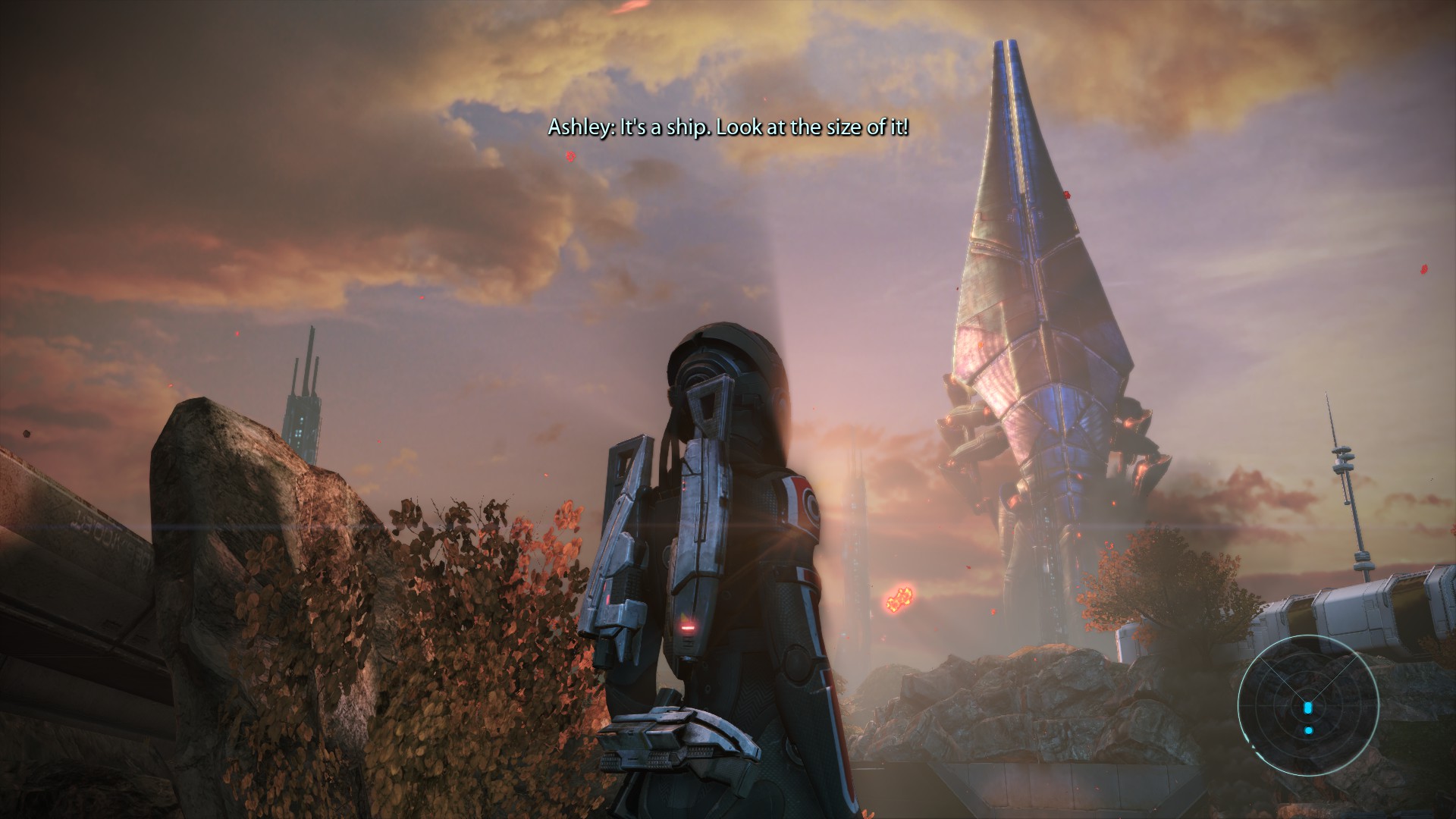
2183. Twenty-five years have passed since humanity discovered it was not alone in the universe. The Milky Way is dominated by the Citadel Council, a multi-species authority that seeks to limit conflict and war and promote peace and trade. One soldier now stands ready to become the first human Spectre, an elite agent with the authority to destroy threats to galactic peace. But their first mission uncovers evidence of a rogue element in the Spectre ranks, and evidence that a powerful, ancient threat is returning to the galaxy after fifty thousand years. With the Council not ready to face this truth, it falls to Commander Shepard to recruit a crew of like-minded allies and expose this new threat.

Yeah, get used to seeing these, Shepard.

If video games are about fulfilling fantasies, BioWare's Mass Effect trilogy offers one of the most compelling in the history of the medium: you are Commander Shepard, Space Adventurer. Your surname is set in stone but otherwise you can determine your Shepard's gender, appearance, abilities, sexuality and personality. You then guide your Shepard through a lengthy quest to save the galaxy, but it's up to you how you do it. You can be the ultimate hero, a paragon of honour and justice, or you can be a brutal, sarcastic antihero. Or maybe you just wing it as the fancy takes you. Depending on your deeds and words, entire civilisations will be destroyed, trusted friends may be betrayed or left for dead, and the fate of trillions of lives hang in the balance.

Most RPGs released since the trilogy have been open-world games, offering freedom in allowing you to travel across a vast landscape and mix and match quests and activities, but none have offered narrative freedom and control in this manner. You can see why, as well. It's very hard to pull off, and even BioWare themselves have shied away from trying to do it again. Their Dragon Age series has offered some of the same ideas of narrative control, but constantly changing protagonists and drastically changing locations between games has minimised the same kind of impact.

Where you command your ship from, and spend a lot of time searching for new worlds to visit in your bouncy tank.

The Mass Effect trilogy is really one immense game split into three for length and pacing reasons, and the Legendary Edition of the trilogy combines them for the first time into one cohesive package. Every bit of DLC is also included (one optional expansion for the first game excepted, which almost everyone ignored first time around anyway) and all three games have been given graphical spruce-ups and had their load times drastically improved. The first game has also had its combat revamped to better match the latter two games in the series. The result is now the best way to experience the trilogy, certainly for newcomers, and seasoned hands will find a more streamlined experience as well.

Martin Sheen plays the main human antagonist and has a blast in the process.

The trilogy's most vital feature is that you get to create your character and take them through all three games, carrying all their decisions with them to make for one epic story. The trilogy is ostensibly made up of roleplaying games, although it ends up being more of an RPG-shooter hybrid. All three games are separated into non-combat areas, where you can pick up missions, engage in dialogue and diplomacy and usually some shopping, and mission levels, which are linear maps where you usually make your way to an objective and shoot very large numbers of people along the way. The most important stuff usually happens in the non-combat zones, where you can guide Shepard through conversations using a radial dial and picking your responses. You can also gain "Paragon" and "Renegade" responses by picking kind or aggressive replies respectively. Increase your Paragon and/or Renegade scores and you can unlock special replies, which can sometimes allow you to avoid combat by defusing situations or intimidating an opponent into backing down. This is usually where you'll decide what kind of Shepard you can be, either a hero or an antihero (you can't really be a villain) or some kind of middle ground, although those trying to have their cake and eat it may find they're locked out of the special replies on both ends of the spectrum.
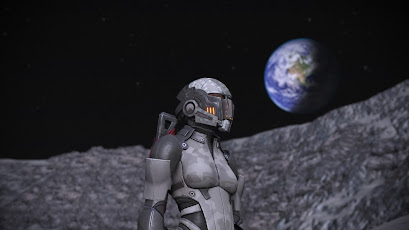
"Earth!?! Where are we?"

Combat sees you deploy Shepard and two companions and fight in third-person. Combat is inspired by the Gears of War series, with lots of conveniently-placed, chest-high walls to hide behind and fire off shots at the enemy. Combat in the first game is fairly forgettable, improves sharply in the second game and reaches its best in the final title. You can focus on your own fight and let AI handle your companions, or you can pause and give them orders mid-combat. The three games do handle difficulty differently, so I found that Mass Effect 2 could sometimes be challenging on Normal whilst Mass Effect 3 could occasionally feel a bit too easy even on Nightmare, so tweaking difficulty levels to find the right balance is key. However, given the important stuff happens in the dialogue scenes, combat can occasionally feel like a chore. Dropping the difficulty all the way to the easiest level makes combat trivial and allows you to get on with the story.

And it's the worldbuilding, story and characters where Mass Effect shines. Mass Effect is nothing too original - imagine 1990s SF TV classic Babylon 5 mashed up with the 2003 Battlestar Galactica and you're about 90% of the way there - but it almost gleefully mixes and matches its inspirations to create something very enjoyable, if occasionally familiar. The alien races are all memorable and have their interesting foibles and cultural tics, like the third-person-referring Hanar or grumpy space dwarf Voluses, or the Elcor, whose lack of facial expressions and monotonous voices means they have to patiently explain their current emotional state at the start of every sentence. The backstory, painting humanity as newcomers on the galactic stage who are still a bit paranoid about aliens but who are also rising fast in power and influence, angering older galactic civilisations, is also rich and interesting.

Tali, kickass space engineer and one of your best friends in the series.

The in-game story is also excellent, with you initially chasing down a rogue Spectre who has allied to a renegade race of mechanoids. The stakes get bigger and busier, and you eventually have to sacrifice a trusted friend and pull a gun on another when your relationship goes south. Eventually you discover the real threat, a Cthulhu-esque nightmare of techno-horrors from beyond the dawn of time, and have to fend off their first incursion into the galaxy with a massive space battle and a desperate battle up a burning skyscraper...and that's all in just the first game!

The story ranges far and wide across the galaxy, although players are often baffled by the turn it takes in Mass Effect 2. Trying to avoid spoilers, but suffice to say that there is a two-year gap between the events of the first two games and Shepard's warnings of the return of the Reapers have been disregarded by the Council, forcing them to join forces with a human separatist organisation with a dubious moral past but who have the massive resources needed to take the fight to a new enemy, the Collectors. The game feels like a huge side-quest from the main story arc, but it's also immaculately structured, with Shepard having to assemble a (more or less literal) Dirty Dozen of specialists in various fields, win their trust and then mount an all-out assault on the Collector home base. The brilliance of Mass Effect 2 is how closely it focuses on your relationship with the various characters: mess up your recruitment jobs and you may find some candidates will not help you, or may stab you in the back, or are so disillusioned with you that they will be killed in the final battle. Mass Effect 2 is distinctly odd when looked at in the grand context of the trilogy but it's a brilliant game in its own right.

One of the problems with facing cosmic techno-horrors from the beyond the dawn of time is that every other side-villain in the trilogy comes across as a time-wasting prat. This guy takes that to another level.

Mass Effect 3 then becomes an all-out war story, with you right in the middle of a desperate battle for survival with entire planets falling and burning, and a desperate resistance being organised against ridiculous odds. This may sound familiar, but really, Mass Effect 3 does an almost unmatched job of putting you in a ludicrously overwhelming situation and forcing you to make very tough decisions on which the fate of the galaxy will depend. It's enough to almost make you forgive the infamously divisive ending, which tries to bring the preceding ~95 hours of great storytelling to a satisfying close and can't quite manage it. It works and more or less fits the themes of the trilogy, but it also does feel like some of the unknowable mystery set up by the first game has been dissipated by lengthy exposition scenes in the third.

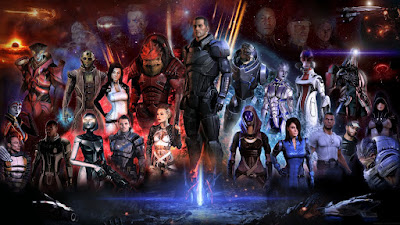
The Mass Effect's trilogy's ace card is its cast of characters. BioWare had superb casts of fun characters in earlier games, all the way back to Minsc and Boo in the venerable Baldur's Gate, but it was in Mass Effect where they really nailed it. Almost every character is excellently-written, superbly-acted (Mass Effect may have cumulatively the greatest voice cast and vocal performances of any video game series, ever) and given motivations and backstory that allow you to understand where they're coming from. A few characters are a bit on the bland side - Ashley, Kaidan, Vega, Jacob - and a couple don't feel like they really fit into a Paragon-based crew (Zaeed) or a Renegade-based one (about half the rest), but overall they're a great bunch. And of course Tali, Garrus, Wrex, Liara and Javik are among the best, most entertaining AI companions you could wish for in any game. There's also a few who might annoy at first or don't appear to do much, but gradually reveals themselves to be great picks (Jack, Samara, EDI, Grunt). Forging friendships or even romances with these characters, or encouraging hook-ups between their ranks, is amusing.
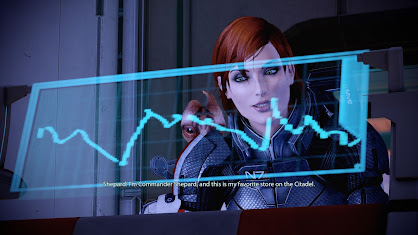
It's never revealed how much Shepard is paid for their troubles, but it's clearly not enough as this side-hustling advertising gig indicates.

So far, so good. But there are some issues. The first is that having all three games and their DLC in the same package creates some weird pacing problems, particularly in how you access the expansion missions. Arrival should really only be done after the final mission in Mass Effect 2 (it acts as a bridge to Mass Effect 3), but it's possible to trigger the mission a lot earlier and it fits very awkwardly into the timeline if you do that. Similarly, the Citadel expansion to Mass Effect 3 should be done as late in the game as possible to ensure you get to recruit the largest possible cast of characters from all three games for a reunion, but the lighthearted, comedic tone of the expansion fits awkwardly alongside the increasingly grimdark-AF atmosphere as the trilogy moves towards it conclusion.

There's also a lot of stuff that the games don't tell you that a newcomer should really know, like how regularly touring the ship between missions can unlock new conversations with your companion characters and open up opportunities to gain Renegade or Paragon points, or unlock new missions or "war assets" for use later on in Mass Effect 3 (Legendary Edition carries forwards more decisions from the first two games to help you in the third).

If you immediately got this Baldur's Gate reference, you are automatically a person of taste and refinement. Well done.

There's also the fact that although BioWare tinkered with how the OG Mass Effect works, they don't bring it fully in line with the other two games. Mass Effect is an RPG with a shooter combat mode, whilst Mass Effect 2 and 3 are much more shooters with RPG conversations. The difference is that Mass Effect has non-combat skills and more areas where combat and conversations mix, whilst the other two games only have very modest skill trees and much more clearly delineate their non-combat and combat areas. Mass Effect feels a bit out of keeping with the other two games and not fully integrated into how most of the series works, so the unified experience of playing all three games remains uneven (although less on this time around).

There's also the issue with minigames. Mass Effect 1 and 2 have laborious minigames for lockpicking and hacking, which are both tedious and should be dumped. Mass Effect 3 swaps them out for it simply taking a while and having to make sure nobody's shooting at you at the time. All three games also have an exploration mechanic which they handle differently. Mass Effect 1 has you driving around planets in the Mako, an inexplicably bouncy tank, looking for minerals and (very rarely) shooting bad guys. There's also identikit buildings - seriously, it's worse than Dragon Age II - you can sometimes clear out of enemies and loot. Exploring all these optional planets takes forever (literally 50% or more of Mass Effect 1's total playtime if you're going for an exhaustive run) and isn't much fun.

You will be doing this a lot.

Mass Effect 2 ups the ante with mineral scanning, which means you sit in orbit around planets and move the mouse around looking for minerals. It sounds and plays very dull, but is important to build up minerals for the final battle in the last game. Again, if you go for an exhaustive, 100% playthrough you will probably spend at least five hours accruing far more resources then you will ever need.

Mass Effect 3 has a much faster and more modest scanning game where you go looking for war assets to use against the Reapers. It's a bit more hit and miss, but it's fun to track down missing fighter squadrons or a damaged cruiser which can they rejoin the fleet for the final battle.

By the third game, even villains are stopping to tell Shepard how awesome they are before trying to kill them.

Another issue is that some storylines have not aged gracefully. Various cliches like genius autistic characters (who are then subjected to abuse and torture), wish-fulfilment hot alien space babes (some of the costume choices in the game were corny when the games came out, let alone now) and villains who are villains because villains rear their head from time to time and will make you roll your eyes as often. The games do improve immensely over this, sometimes fast enough for the third game to mock some of the decisions from the first.

Frozen Prothean soldier Javik is a very late addition to the crew (only appearing in the third game) but a superb one, with his bewildered disbelief at the state of the galaxy thanks to "primitive races" of his time being a constant source of comedy.

The biggest weakness of the trilogy is probably how it is divided into distinct "roleplaying" and "shooting" modes. The meat of the game is in the roleplaying sections and the shooting can sometimes feel rote and phoned in, a simple way of adding "more gameplay" to the series. The more hardcore RPG fan, especially those familiar with BioWare's earlier Knights of the Old Republic SF RPG, will bemoan the way tactical, squad-based combat has transformed into real-time twitch shooting. The games sometimes awkwardly move between the two modes and it can be odd seeing a Paragon Shepard extolling the value of all life and then five seconds later is gunning down forty enemies in rapid succession, gaining achievements for the number of people they massacre and set on fire. At its weakest, the trilogy can feel like a very-well written and characterised adventure game that is broken up by an shooting gallery minigame. Combat does improve across the three games, although the ability to split "run," "cover" and "use" into three different commands would make things even better.
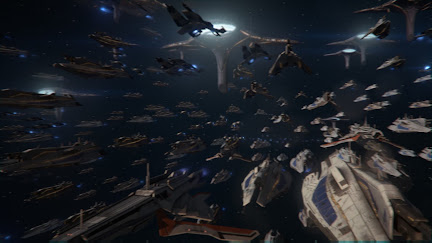
It takes a while, but eventually Mass Effect delivers some outstanding CGI space battles.

If you've never played the Mass Effect trilogy before, then Mass Effect: Legendary Edition (****½) is an easy sell. One of the greatest video game stories ever told with one of the single finest casts of characters in video game history, with some genuine weight and consequence to your decisions. The workmanlike combat and tedious minigames can be borne for the sake of just spending time in this excellent world, and the negatives do generally clear up as the trilogy continues. If you're already a hardened Mass Effect fan, than Legendary Edition clears up some inconsistencies, puts all three games in a handy launcher, smooths out the process of carrying your character and decisions through all three titles and adds graphical and control improvements that make the experience just more enjoyable. Mass Effect: Legendary Edition is available now on PC, PlayStation and Xbox.

Thank you for reading The Wertzone. To help me provide better content, please consider contributing to my Patreon page and other funding methods.

Thursday, 2 June 2022

DRAGON AGE: DREADWOLF announced by BioWare

BioWare have confirmed that the next game in their Dragon Age series of fantasy CRPGs will be called Dreadwolf, but the game has no release date as yet.


Dreadwolf will be the fourth game in the series. It began with Dragon Age: Origins in 2009 and then continued with Dragon Age II (2011) and Dragon Age: Inquisition (2014). Set on the continent of Thedas, the games initially chronicled the invasion of the civilised lands by a monstrous race called the Darkspawn. Subsequent games have focused on political intrigue and the conflict between wizards and the world's religious orders. The games have spun off a number of novels and comics.

According to BioWare, Dreadwolf will focus on the character of Solas, a character from Inquisition, who will serve as the titular Dreadwolf and the game's main antagonist.

BioWare have been working on the game since Inquisition's release, but development was complicated by several ideas and builds for the game being scrapped and then started over. Staff were also seconded to help on Mass Effect: Andromeda (2017) and Anthem (2019). The direction and format of Dreadwolf has changed several times during development, with a strong multiplayer focus being scrapped in favour of being a single-player-only game.

BioWare have not set a release date for the game, but it is not expected before 2023 at the earliest. BioWare are also working on a new Mass Effect game.

Wednesday, 2 March 2022

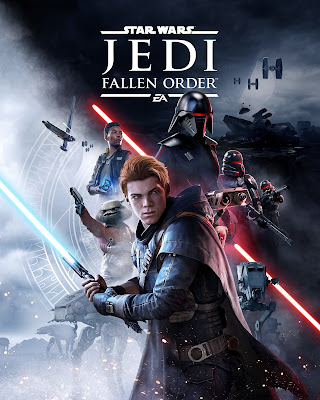
Star Wars Jedi: Fallen Order

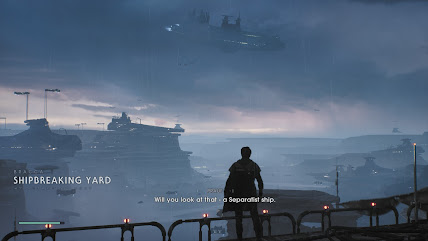
Five years after the end of the Clone Wars and the collapse of the Galactic Republic, with the Empire rising to replace it, fugitive Padawan Cal Kestis is flushed out of hiding on the planet Bracca. Rescued by former Jedi Knight Cere Junda and starship captain Greez Dritus, Kestis discovers that the Empire and its Inquisitors are hunting for a Jedi holocron filled with the location of Force-potential children scattered across the galaxy. Kestis revolves to find the information first before the Empire can wipe out a potential new generation of Jedi.


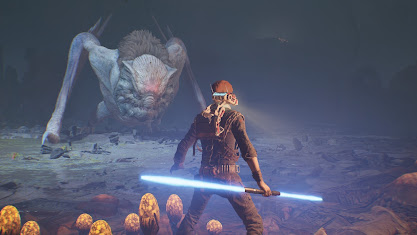
There's a saying that if you're going to steal, steal from the best. Respawn Entertainment took that to heart when they were given the keys to make a new Star Wars action game. As well as the movies and expanded setting, they tapped games like Dark Souls, Metroid, Arkham Asylum and Castlevania for inspiration. The shadow of the Dark Forces (aka Jedi Knight) series, with its definitive first and third-person Star Wars action and unbeaten lightsabre combat, also looms large over Fallen Order.

Against such comparisons Fallen Order buckles but does not fail, and sometimes impresses. The game sees the player take control of Cal Kestis, former Jedi Padawan who has gone into hiding from the Empire. Flushed out by the Inquisitors, he is rescued by former Jedi loyalists and learns that he has to follow a trail of breadcrumbs across the galaxy in search of a Jedi holocron containing vital data. The Empire is also, of course, after that data and a race against time develops. The trail takes Kestis to several different planets, some new to the franchise, some well-known (thankfully, Tatooine is notable by its absence after its recent, massive overexposure). On these plants Kestis finds roadblocks to progress, but also learns new skills and gains new equipment which unlocks new routes on other planets. Hence he - slightly comically - is stymied by a slightly too high cave opening and has to travel five thousand light-years to get some special climbing gloves and then come back to climb to the opening.


It's daft but it works. As you to and fro across the galaxy, the story evolves and each world's levels evolve, giving you more new areas to explore, new enemies to fight and new skills to learn. It's fun, but drawbacks soon start appearing.

The first is how the game treats enemies. Fighting stormtroopers is fun and Fallen Order cleverly repurposes some of the types we've seen before: Return of the Jedi scout bike troopers are now reclassed as advance recon troops with special melee combat training; whilst flame and rocket troopers are much more lethal with those weapons than previously. Stormtroopers are less disposable goons here and have to be treated with some respect in how you fight them. Inquisitors, who are trained to fight Jedi one-on-one, are even more formidable, and their officers (and the main villains) are devastatingly effective bosses whom you have to learn Dark Souls-style attack patterns and blocking formations to defeat effectively. This is all excellent. Less excellent is the fact that you spend maybe around 25% of the time fighting any of this type of enemy. The rest of the time you are fighting deadly birds, angry plants, giant slugs, gianter insects and a quite bewilderingly huge variety of spiders. Why on Earth they spent so much time making the lightsabre combat so solid only to have you spend more than half the game fighting off wildlife with your laser sword is mystifying.


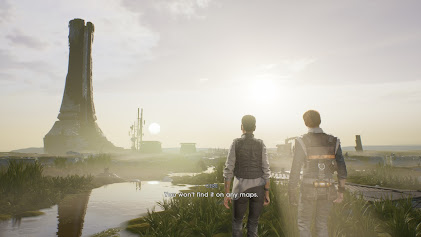
The game's trump card is its amazing level design, with levels that fold back on themselves quite ingeniously, fantastic use of vertical space and are also at least vaguely believable as actual spaces someone would live in or use. Less amazing is the game's tendency to overuse certain tricks like slippery slides. You will spend a quite astonishing amount of time in this game judging how to fall down a slide and making sure you hit turns correctly so you don't shoot off the side to an insta-death. These slides are absolutely everywhere, regardless of it it makes any sense or not. There's also a truly staggering amount of wall-running and double-jump puzzles (some inherited from the same developers' Titanfall series), some intricate and fun, others tiresomely frustrating.

For a game so rooted in precision jumping and controls, it also does have a fair bit of jankiness and iffy collision detection. There's a lot of clipping, allowing you to sometimes kill enemies through solid walls, and during boss fights it's not uncommon to see an enemy weapon go right through you without causing damage one second, and in the next hit thin air three feet away and cripple you. The jank never gets too bad, but it does feel like this is one area that needs to be worked on for the in-development sequel.


Still, negating the levels, fending off enemies and successfully deducing and executing the solution to an environmental puzzle never gets too old. The story is basic, but told with aplomb and some great voice acting, and the characters are great, especially Dathomir witch frenemy Merrin, who really should be the star (or co-star) of the next game, along with her ridiculously dry sense of humour. Kestis himself is a bit of a blank slate, though the utterly predictable mid-game struggles with the Dark Side do at least liven him up a bit.

Graphically, the game looks phenomenal, although as a PlayStation 4/Xbox One game it does have that slight problem of needing to slow down progress to load the next environment in the background, leading to rather a lot of crawlingly agonisingly slowly through narrow passageways. The built-in 3D map is excellent (if occasionally confusing, especially regarding vertical travel) and the controls are mostly responsive and fluid (if occasionally requiring a bit too much ambidexterity on the keyboard).

Star Wars Jedi: Fallen Order (****) overcomes a fair bit of jank to emerge as the most satisfying Star Wars action game since Republic Commando in 2005. In terms of its mix of combat and action, it can't match the venerable Jedi Knight series - and Cal Kestis is no Kyle Katarn - and its occasional arbitrary limitations feel random. But the lightsabre duels are great fun, the level design is very solid and at 20 hours or so, it doesn't outstay its welcome. Fallen Order is available now on the PlayStation 4, PlayStation 5, Xbox One, Xbox Series X/S, Google Stadia and PC.

Wednesday, 24 November 2021

Amazon developing a MASS EFFECT television series

Amazon Prime Television are developing a television series based on the popular science fiction video game series, Mass Effect.


The news came as Amazon celebrated the launch of their new Wheel of Time television series. The first three episodes, which dropped last Friday, have exceeded Amazon's launch expectations and become Amazon's highest-rated debut series of 2021, and one of their biggest of all time, in the same bracket as anti-superhero drama The Boys and the highly acclaimed comedy series The Marvellous Mrs. Maisel. A second season is already more than halfway through shooting and reports indicate that a third season has been at least "amberlit," with contingency planning underway before Amazon decides to pull the trigger on that order.

Mass Effect is a popular video game series consisting of a trilogy and a stand-alone sequel game, all developed by BioWare (also known for their Baldur's Gate and Dragon Age franchises). The trilogy - Mass Effect (2007), Mass Effect 2 (2010) and Mass Effect 3 (2012) - was released on PC, Xbox 360 and PlayStation 3. A "Legendary Edition" of the three games was released this year on PlayStation 4, Xbox One and PC, to some success and acclaim. Microsoft published the original game whilst the two sequels and subsequent re-releases were handled by Electronic Arts. Mass Effect: Andromeda (2017), which was supposed to start a new storyline set in a completely different galaxy, was not successful and EA and BioWare have since pivoted to make Mass Effect 5, which reportedly will lean harder on the original trilogy's characters and factions.

Set in the late 22nd Century, Mass Effect is set several decades after first contact between Earth and a community of alien civilisations who control most of the Milky Way. This community is represented by the Citadel Council, a sort-of United Nations in space who are based on the Citadel, a colossal city-space station which acts as a trade and diplomatic hub between the various species. Despite their newcomer status on the galactic scene, humans are petitioning hard for greater prestige and power on the Council, to the annoyance of alien races who've been waiting centuries for promotion to the higher ranks. Key to Earth's hopes is Shepard, a skilled human agent who has become the first of their species to join the Spectres, an elite special forces division which reports directly to the Council. Shepard's investigation of an attack by the cybernetic Geth leads them to uncover evidence of a massive threat to all life in the galaxy, and their attempts to convince other races of the threat before it arrives.

The trilogy was highly praised on release for its writing, characterisation and action, as well as the slowly-growing sense of dread that built until the third game turned fully apocalyptic. The trilogy was also acclaimed for the accumulating weight of meaty decisions the player could make, which could leave individual characters dead or alive, and even entire civilisations destroyed, hostile or allied. However, the ending of the third game was considered underwhelming on original release, resulting in enough of a fuss that the ending was revised in later patches. Despite this, the trilogy retained enough goodwill to make last year's "Legendary Edition" a reasonable success. To date, the franchise has sold almost 20 million copies across all formats.

Rumours of a movie or TV version have circulated for years, with different options on the table. It sounds like Amazon's current plan is the most serious yet. It is unclear if Amazon would directly adapt the trilogy to the screen or develop a new story in the same universe, but the trilogy's storytelling and character focus would make a direct transition more viable than it is for many other games. Amazon would have to make some interesting casting choices, including which gender of actor for Commander Shepard to pick (players could choose their gender in the trilogy, with different vocal performances from Mark Meer and Jennifer Hale).

It's worth noting that Witcher, Enola Holmes and Superman actor Henry Cavill was recently pictured with potential script pages for a Mass Effect project. A noted fan of the video game trilogy, it was assumed he had gotten a voiceover part for Mass Effect 5, but it might be he's also been put in mind for a role on the Amazon project, his other commitments allowing.

Amazon are also developing a Fallout TV series with the Westworld creative team. Meanwhile, Electronic Arts and BioWare are continuing to develop Mass Effect 5 for an estimated 2023-25 release window.

More news on this project if and when it develops,