Wednesday, 21 October 2026
Electronic Arts shuts down BioWare and cancels the next MASS EFFECT game
Friday, 12 December 2025
STAR WARS: FATE OF THE OLD REPUBLIC announced
A new Star Wars video game has been announced at the 2025 Game Awards.
Star Wars: Fate of the Old Republic is an action-RPG successor to Knights of the Old Republic I and II, and is directed by Casey Hudson, who was the project director on the original Knights of the Old Republic (as well as the Mass Effect trilogy). His new studio Arcanaut is developing the game alongside Lucasfilm Games.
In an interview, Hudson confirms the game is very early in development and is not a direct sequel to the existing games, but is a successor in a similar time period.
No release date has been set so far.
Wednesday, 27 July 2022
KNIGHTS OF THE OLD REPUBLIC remake on hold at Aspyr and in "serious trouble"
In surprising news, Aspyr Media has put its eagerly-awaited remake of classic Star Wars CRPG Knights of the Old Republic on hold.
Knights of the Old Republic was released by BioWare in 2003 and has been regularly acclaimed as one of the very best Star Wars video games of all time, and one of the very best CRPGs. A sequel, Knights of the Old Republic II: The Sith Lords was released in 2004 and launched the career of Obsidian Entertainment. The game was released during BioWare's "imperial period" when everything they made was either great or at least ambitiously interesting. Baldur's Gate II (2000), Neverwinter Nights (2002), Jade Empire (2005) and Mass Effect (2007) all hail from this period as well. BioWare has since fallen on tougher times, with Dragon Age II (2011), Mass Effect 3 (2012), Dragon Age: Inquisition (2014), Mass Effect: Andromeda (2017) and Anthem (2020) all suffering controversies of one kind or another, and the latter two also experiencing poor sales. Critics and fans have frequently said that BioWare needs to get back to making games of the type and scale as Knights of the Old Republic to return to success.
Aspyr Media, based in Texas, has focused on porting existing games to new formats, including porting Knights of the Old Republic itself to MacOS in 2004. Knights of the Old Republic Remake was announced in 2021 as Aspyr's first large-scale, big-budget video game project. The game is a total, ground-up remake of the original title using modern graphics technology and new voice acting (including the return of fan-favourite actor Jennifer Hale).
Unfortunately, it appears that Aspyr were unprepared for the scale of the project. Internally and informally, Aspyr were targeting a late 2022 release date, but insiders have noted this is unachievable and unrealistic, and that a release date of 2025 is more likely. It also sounds like the game may have started off with more modest goals but transformed into a full-on remake when it became clear how difficult using the original code and assets was going to be. If it's the case that Aspyr envisaged a more modest remaster and scaled up to something of the scope of the Final Fantasy VII Remake, it's unsurprising that they've realised they've bitten off more than they can chew.
Whether the project is remounted in the future remains to be seen, but unfortunately, it looks like the project is not happening in the near future.
Thursday, 9 September 2021
STAR WARS: KNIGHTS OF THE OLD REPUBLIC REMAKE officially announced
Aspyr Media are working on a full remake of Star Wars: Knights of the Old Republic, arguably the greatest and best-regarded Star Wars video game of all time*.
Knights of the Old Republic, developed by BioWare in association with LucasArts, was released in 2003. Set roughly 4,000 years before the events of The Phantom Menace, the game tells the story of a war being fought between the Galactic Republic and its Jedi defenders against a Sith army and fleet led by Darth Malak. The player takes on the role of a character of their own creation who is roped into helping rescue a Jedi Knight named Bastila Shan from the city-planet Taris. As the game continues, the player acquires a large array of allies, such as the murderous and meme-generating assassin droid HK-47, and learns a shocking secret about themselves. Events culminate in a final battle between the Republic and the Sith Empire.
The game was immensely successful on release, generating both critical acclaim and high sales. It was followed by two sequels: the more ambitious but more divisive sequel, Knights of the Old Republic II: The Sith Lords (2004) from Obsidian Entertainment; and MMORPG The Old Republic (2011) by BioWare themselves. Although set in an original universe, the later Mass Effect trilogy (2007-12) draws on some structural ideas from Knights of the Old Republic.
It is unclear how thorough a remake this will be, since no gameplay footage has been shown. The "remake" title and the age of the game and engine suggest that it'd have to be a much more thorough reworking of the game from scratch, possibly in a new engine, rather than the "retexture-and-polish" style of remakes like the Mass Effect Legendary Edition.
Knights of the Old Republic Remake is "early" in development and no release date has yet been set. So far, it has only been announced for PlayStation 5.
* Arguments for TIE Fighter, Republic Commando and Jedi Outcast can be heard at a later date.
Friday, 5 February 2021
RUMOUR: KNIGHTS OF THE OLD REPUBLIC project underway at Aspyr Media
Saturday, 9 January 2021
New STAR WARS official timeline seems to formally confirm that the OLD REPUBLIC era is no longer canon
- The High Republic (c. 400-200 Before the Battle of Yavin): a period extending from roughly 400 to 200 years before the events of The Phantom Menace, during which time the Galactic Republic and the Jedi Order are at the height of their power. The era includes the High Republic line of comics and novels, and the forthcoming TV series The Acolyte.
- Fall of the Jedi (32-19 BBY): This period depicts the fall of the Old Republic and the Jedi Order over a period of more than a decade. This period includes the Prequel Trilogy (The Phantom Menace, Attack of the Clones and Revenge of the Sith) as well as the Clone Wars animated series.
- Reign of the Empire (19-5 BBY): This period depicts the Galactic Empire at the height of its power, with Emperor Palpatine and Darth Vader in unquestioned command of the galaxy. This period includes the forthcoming animated series The Bad Batch, the film Solo: A Star Wars Story and the Disney+ series Obi-Wan Kenobi.
- Age of Rebellion (5 BBY-4 After Battle of Yavin): This period depicts the Galactic Civil War between the Empire and the Rebel Alliance, culminating in the Battle of Endor. The Original Trilogy (Star Wars, aka A New Hope; The Empire Strikes Back and Return of the Jedi) takes place in this era, along with the spin-off film Rogue One, the live-action show Andor and the animated series Rebels.
- The New Republic (4 ABY-29 ABY): This period depicts the reorganisation of the Rebel Alliance into the New Republic and its attempts to bring peace and order to the galaxy. The Mandalorian and forthcoming spin-off shows The Book of Boba Fett, Rangers of the New Republic and presumably Ahsoka take place in this time period.
- Rise of the First Order (29-35 ABY): This period depicts the conflict between the First Order, a successor-state to the Empire, and the New Republic and, after the Republic's at least partial collapse following the Starkiller Incident, the Resistance. This period concludes with the Battle of Exegol. The Sequel Trilogy (The Force Awakens, The Last Jedi and The Rise of Skywalker) take place in this era, along with the animated series Resistance.
Friday, 24 January 2020
Rumour: new STAR WARS: KNIGHTS OF THE OLD REPUBLIC game in development
Sunday, 5 January 2020
New STAR WARS movies rumoured to focus on period 400 years in the past
The Star Wars franchise has so far spanned three main eras: the Old Republic/prequel trilogy era, which includes the Clone Wars; the Galactic Civil War/original trilogy era, which includes the war between the Empire and the Rebel Alliance; and the First Order/sequel trilogy era, which includes the struggle between the Resistance and the First Order. These three eras are all pretty close in time, spanning only sixty-six years between the events of The Phantom Menace and The Rise of Skywalker.
The now-retired Expanded Universe featured other eras of Star Wars history, most notably the "Reformation Era" set about 1,000 years before the films and focusing on the reorganisation of the Republic into its later form and the threat posed by Darth Bane.
Far better-known and more popular is the "Old Republic Era," which is set about 4,000 years before the films and focuses on a series of ancient struggles between the Jedi and the Sith which devastated vast areas of the galaxy. This era was the setting for a very popular comics series and also the best-selling Knights of the Old Republic series of video games. The current Star Wars online RPG, The Old Republic, is still set in this era and its future story direction is being directed by the Lucasfilm Story Group, semi-canonising it under the new Disney regime.
Last year it was reported that Altered Carbon showrunner Laeta Kalogridis was developing a film script based on the original Knights of the Old Republic and that Disney were planning to set all of their currently in-development films post-Rise of Skywalker in this era, including a trilogy spearheaded by Last Jedi director Rian Johnson and a multi-film project led by former Game of Thrones showrunners David Benioff and D.B. Weiss. Benioff and Weiss subsequently walked from the project and the under-performance of recent Star Wars media has left the future of the franchise in the cinema in some doubt.
According to the report, Disney are now most likely to press on with their "Project Luminous" idea, except it won't be set 4,000 years earlier but four hundred years before the existing movies. Reportedly, this project will incorporate the next few feature films, video games, novels and comic books, and will focus on a group of Jedi exploring the Unknown Regions of the galaxy. Exploration and confronting new threats will apparently be a focus, along with a possible confrontation with a group of Sith hiding in remote corners of the galaxy.
The wisdom of abandoning all of the familiar parts of the Star Wars setting, as well as the popular Knights of the Old Republic sub-setting, for a completely fresh time period is questionable. The quality of the project will depend on the creative talent involved, which has yet to be confirmed.
Although it sounds like most or all Star Wars projects in the medium term will focus on this new setting, Lucasfilm will continue to explore more familiar settings through further seasons of The Mandalorian, as well as their up-coming mini-series focusing on Obi-Wan and a prequel spin-off from Rogue One.
Tuesday, 29 October 2019
David Benioff & D.B. Weiss part ways with STAR WARS
Benioff and Weiss signed with Lucasfilm and Disney eighteen months ago to develop a fresh Star Wars film series that would be set in a time and location far-removed from both the nine-part main "Skywalker Saga" and the stand-alone spin-offs. Director Rian Johnson is also developing a trilogy with an eye to setting up a new setting and cast of characters for the films. According to other reports, either setting may be a revamped version of the popular Knights of the Old Republic setting, with writer Laeta Kalogridis developing early concepts for the idea, including possible direct adaptations of the popular video games.
Benioff and Weiss's departure appears to be due to their massive $200 million development deal with Netflix for new TV series and projects. It is unclear what these new projects will be, or if the money was well-spent; Benioff and Weiss experienced a critical drubbing this week after an interview in which they seemed to suggest they didn't know what they were doing with Game of Thrones, ignored the primary themes of the novels and admitted they were more interested in adapting set-pieces and stand-out scenes than the story as a whole. Benioff and Weiss's former partners at HBO also seem to have distanced themselves from the producers, refusing to even bid with Netflix to retain their services, quietly dropping their Confederate TV pitch into a dumpster after the negative publicity it received and pivoting hard to supporting and working with George R.R. Martin on other projects.
The critical opprobrium and disdain may be overstated - Benioff and Weiss did bring the books to television and made it the most popular contemporary fantasy series in the world, as well as giving HBO it's biggest-ever TV hit - but it seems that the industry has certainly cooled towards the writing team who, just a couple of years ago, could do no wrong.
The news won't help the headaches over at Lucasfilm either, who have been experiencing a lengthy run of directors dropping out or even getting fired on Star Wars projects. They will now have to either accelerate plans for Rian Johnson's next Star Wars movie or they will have to find a new team to step into Benioff and Weiss's shoes to bring the next film to the screen.
Thursday, 26 September 2019
Head of Marvel Studios to develop a STAR WARS movie
The news is surprising because Feige has a pretty busy slate on his hands, with numerous films and TV shows in development in the MCU. However, Feige is also a huge Star Wars fan and with an opening in his schedule (presumably related to the Sony/Marvel Spider-Man break-up), it appears he wants to help out the Lucasfilm team with their slate of upcoming TV shows and films.
There's no word yet on the nature of the project, although at the moment it sounds like a single film and that it will be part of the "new era" of Star Wars films set to follow the release of The Rise of Skywalker in December, which will conclude the story of Rey, Kylo Ren, Poe Dameron and Finn that began with The Force Awakens in 2015. The film will also reportedly end the nine-part, "trilogy of trilogies" extending back to the release of the original Star Wars in 1977.
Disney's handling of the Star Wars franchise has had mixed results, with a well-received TV show (Rebels) and movie (The Force Awakens) followed by The Last Jedi, which had very mixed results, and the animated show Resistance, which has been cancelled after just two seasons and poor reviews. Of the spin-off films, Rogue One did very well but Solo became the first-ever Star Wars film to lose money at the box office, despite a positive critical reception.
These results have led to Lucasfilm delaying the release of the next Star Wars film (after Rise) to 2022. Former Game of Thrones showrunners David Benioff and D.B. Weiss are developing a multi-film series, whilst The Last Jedi director Rian Johnson is committed to a trilogy of films. Both series are apparently set in a new period of time and a part of the galaxy distinct from previous worlds. Rumours persist that the new wave of Star Wars films - presumably including Feige's - will be set in the Knights of the Old Republic time period, but this remains unconfirmed.
The next Star Wars project to hit the screens will the franchise's first-ever live-action TV show, The Mandalorian, which will help launch the Disney+ streaming service on 12 November this year. Star Wars: The Rise of Skywalker hits cinemas on 20 December.
Thursday, 23 May 2019
STAR WARS: KNIGHTS OF THE OLD REPUBLIC movie in development at Lucasfilm
Screenwriter Laeta Kalogridis (Shutter Island, Altered Carbon, er, Terminator: Genisys) is reportedly developing a film trilogy based on the game and has almost completed the script for the first film in the series.
Set over 4,000 years before the events of the Star Wars prequel trilogy, the game tells the story of an amnesiac Jedi who awakens on a starship above the planet Taris that is under attack by Darth Malak's forces. The galaxy at this time is engaged in a civil war between open Jedi forces, led by the Jedi Council, and Sith forces under Darth Malak, former apprentice to the slain Darth Revan. The Republic is weak and divided between the two factions and a strong neutral faction.
The game sees the protagonist (named by the player) gaining a large number of powerful friends and allies, including Republic pilot Carth Onasi, Wookie warrior Zaalbar, Jedi Knight Bastila Shan, Mandalorian warrior Cancerous Ordo, psychopathic droid HK-47 and warrior Juhani (the first-ever canonically gay character to appear in Star Wars) following a trail of clues that leads to Darth Malak's true objective, a powerful weapon known as the Star Forge.
It is unclear if the new project plans to adapt the game - a single playthrough of which can last for well over 20 hours - as three movies, or if it will be to adapt the game as one movie with possible sequels based on Knights of the Old Republic II: The Sith Lords (2004) and The Old Republic (2011).
It is also unclear if Kalogridis is developing the film as the one to be produced and directed by David Benioff and D.B. Weiss for release in 2022, or for Rian Johnson's trilogy project, or as a speculative script unrelated to the above (possibly for Disney+?). It should be noted that Lucasfilm have been adamant that the post-Rise of Skywalker movies will take place in a completely different part of the Star Wars canon in both time and place, which this would certainly qualify for.
If the rumour is true, Laeta Kalogridis will become the first woman to write for a Star Wars film since Leigh Brackett wrote the first draft of the script for The Empire Strikes Back in the late 1970s.
Knights of the Old Republic is comfortably one of the most popular Star Wars stories and projects of all time, often ranking high on lists of the most popular instalments of the Star Wars franchise. BioWare have frequently discussed making a Knights of the Old Republic III, the last time as recently as completing work on Mass Effect 4 and moving that team over to Anthem, but reportedly their publisher Electronic Arts are sceptical of the appeal of a single-player focused RPG with no microtransactions or multiplayer element.
Lucasfilm have neither confirmed nor denied the story as yet.
Friday, 8 February 2013
Mass Effect 4 - Knights of the Old Republic 3
Meanwhile, BioWare have made a lot of confusing comments about Mass Effect 4. The only thing they have seemingly confirmed is that it will not be called Mass Effect 4. In a bizarre twist one of the developers has said that "the game does not have to come after. Or before. Or off to the side. Or with characters you know." Actually, logically it kind of does, unless it's set in a completely different universe (and hence wouldn't be a Mass Effect title). Good to see that BioWare still can't make a single announcement about the Mass Effect franchise without turning into a confusing mess. However, it does confirm that Mass Effect 4: Whatever is now in active development.
Meanwhile, Ubisoft have confirmed that Far Cry 3 has sold 4 million copies since its release, far outstripping their projections. As a result, they have confirmed that a Far Cry 4 will be released within the next three to four years. Surprising no-one, they have also confirmed that a new Assassin's Creed game is in the offering for 2014. Assassin's Creed III has sold a staggering 12 million copies since its release just three months ago.
Thursday, 27 August 2009
Wertzone Classics: Star Wars: Knights of the Old Republic II - The Sith Lords

The death of Malak did not end the chaos in the Galaxy. New Sith lords have arisen and Sith assassins have continued to strike, targeting the few Jedi who had survived the Mandalorian conflict and the Jedi Civil War that came after. The Jedi Order disbanded, its few surviving members disappearing, leaving the war-ravaged Republic vulnerable.
Unexpectedly, one of the Jedi warriors who followed Revan into battle at Malachor has resurfaced, stripped of her connection to the Force. Rescued from certain death by a ship called the Ebon Hawk and taken to a hospital facility on Peragus, this warrior now has to find out what has happened, who tried to kill her and why she can no longer use the Force. To this end she accumulates a band of allies, learns the fate of the other Jedi and is brought to a new understanding of the Force by a very enigmatic mentor...
Knights of the Old Republic II is to its predecessor what The Empire Strikes Back is to A New Hope: the grittier, more brooding and more philosophical sequel with a dark, ambiguous conclusion. However, it doesn't match Empire's primary achievement - of being a sequel superior to the original - for various reasons.
Knights of the Old Republic II's biggest problem is the incredible vagueness of the story at the start of the game. KotOR I put you in a big city with lots of options and quests to do right off the bat and plenty of characters and politics to interact with. KotOR II instead has you exploring a space station pressing buttons for what feels like ages (it's actually about an hour and a half of fairly tedious running around) and you're not really given a reason for doing so. Your character is also curiously unwilling to ask questions of the strange old woman, Kreia, who has appeared out of nowhere to mentor you. It's about halfway through the game before you can even ask if she's a Jedi, which is the question I wanted to ask about two minutes after meeting her.
Once the oddball opening sequence is dispensed with, you find yourself on Citadel Station orbiting Telos, and the more familiar playing style of the first game kicks in. From here you have lots of quests and sub-quests to pursue, different factions to ally with or play off against one another and several characters you can recruit to your party. The relationship between your character and Kreia also develops impressively, as Kreia has adopted a philosophical relationship with the Force which is fairly unusual and complex, going beyond the simplistic Light Side = Good, Dark Side = Bad notions of George Lucas and some of the less thoughtful other Star Wars writers. This gives rise to some fascinating conversations and some excellent dialogue. The game's main designer, Chris Avellone, was also the creator of possibly the greatest computer roleplaying game ever made, Planescape: Torment, and KotOR II covers some of the same ground as that earlier game. Avellone has a good claim to being the best writer of dialogue for computer RPGs around at the moment, and examples of that can be found throughout KotOR II.
It's an interesting approach and KotOR II does have a unique atmosphere and feel to it. Lightsabres and the Force aside, its dark story about challenging moral simplicity and questioning identity feels like it's come from some other universe altogether. This is also possibly the game's key weakness: Empire Strikes Back may have been an altogether more sophisticated take on Star Wars than the first movie but it still retained the core humour and warmth of the character relationships and still 'felt' like Star Wars. Matt Stover's novel Traitor, often heralded as another successful 'dark' take on Star Wars, also succeeds in retaining that core identity despite going to places George Lucas would be very uncomfortable with. KotOR II often fails to uphold that identity, and its coldness and lack of humour sometimes makes it hard going, especially compared to the manner in which KotOR I nailed those elements so successfully.
A major success of KotOR II is how it handles your party. In the first game it was possible to simply keep picking the first two NPCs you meet at the start of the game and take them through the whole game, missing out on the storylines of the other members of party. Whilst it is broadly possible to do this in the sequel, there are several quests which take place simultaneously, so you have to pick a second party from your character pool and have them doing stuff at the same time as your 'star party' is on a mission, which is an interesting and refreshing approach that gets as much of the plot as possible on screen and really gets into the characters across in a more interesting manner.
Unfortunately, this is slightly problematic as the NPCs in the second game are not quite as interesting as those in the first. They are fairly low-key in personality and the fact that they are a depressed and brooding bunch who have often committed horrible crimes makes empathising with them hard. The writing is excellent and eventually these characters' motivations are made clear, but they lack the vital personalities of characters such as Zaalbar, Mission and Bastila from the first game (although there is a brilliant inversion of the 'cute' Zaalbar/Mission, tough Wookie/smartass sidekick dynamic from the first game).
"If you seek to aid everyone that suffers in the galaxy, you will only weaken yourself… and weaken them. It is the internal struggles, when fought and won on their own, that yield the strongest rewards. You stole that struggle from them, cheapened it. If you care for others, then dispense with pity and sacrifice and recognize the value in letting them fight their own battles. And when they triumph, they will be even stronger for the victory."
- The Dark Lords of the Sith, apprently followers of Ayn Rand
Nevertheless, the game's story unfolds in a consistently intriguing manner, with enough mystery and plot development to drag you through its bumps. The game skirts against true masterpiece status a few times towards the end of the game through an impressively-executed plot twist (although not on the level of the central twist in the first game), but then things start falling apart again towards the end of the game. This time the problems have a far more straightforward explanation: LucasArts wanted the game released for Christmas 2004 no matter what, and denied Obsidian Entertainment the extra time needed to finish the game off properly. The result is that the game is incomplete. The designers managed to do enough to tie off the primary storyline at least, so that tracks coherently, but several quests are simply not solvable and most of your NPC allies' individual character arcs are left hanging in mid-air, with a cheesy dialogue exchange at the end of the game explaining the fates of the other characters. Two characters are left in a life-or-death situation that is simply never resolved, and another character's solo quest is not implemented in the game at all. This means the end of the game is extremely abrupt with many loose ends left dangling. Obsidian made a heroic effort to solve some of these problems through post-release patches, but LucasArts denied them the funding to actually finish the game through a content expansion.
As a result, what could have been (despite its slow opening) a five-star game and another classic is left wounded and broken. It's actually a tribute to the team at Obsidian that the game remains playable and compelling despite this significant problem. A mod team have been working for some time on restoring and completing the abandoned content (made possible thanks to Obsidian cheekily putting all the half-finished stuff on the game CD-ROMs for this specific purpose) which could immensely improve the game, but no release date has been set for this so far, and since it is now five years after release it is arguable if there is much point to it any more.
Knights of the Old Republic II: The Sith Lords (****) is a fascinating, compelling and altogether different take on Star Wars. It is intelligent, philosophical and refreshingly well-written for a computer game, although it doesn't skimp on the action and combat sequences either. However, a dull opening sequence and the incomplete content does leave the game feeling distinctly unfulfilling, especially compared to its near-flawlessly-executed forebear. The game is available now on the PC** (UK, USA) and X-Box (UK, USA) and a sequel, The Old Republic, is currently in development by BioWare.
* Although you can determine your character's gender, race and abilities, Lucasfilm has decreed that for canon purposes the main character in Knights of the Old Republic was male and your character in Knights of the Old Republic II was female.
** I would very, very strongly advise that those planning to purchase the game on PC download the two post-release patches, which are necessary to stabilise the game and eliminate its numerous bugs (once this is done the game is actually much smoother and easier to play on modern PCs than KotOR I) and also download the movie and music patches, which replace the horrible low-res movies and music from the original release. There's also an additional patch to run the game under Windows Vista as well.
Monday, 17 August 2009
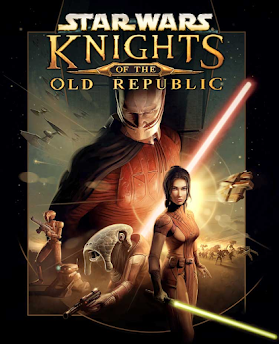
Wertzone Classics: Star Wars: Knights of the Old Republic
Back in 1999, excitement for the new Star Wars movies was palpable. Fans were waiting excitedly to see the epic Clone Wars, the clash of entire armies of Jedi against the forces of evil, and the gripping tragedy of Anakin Skywalker's fall to the dark side. Instead, they got an extended toy commercial where genuine human conflict and drama was substituted for insane amounts of confusing and badly-choreographed CGI. By the time 2003 arrived, the ludicrous revelation that the Clone Wars was actually fought by an entire army of Boba Fetts against some very camp robots had destroyed whatever vestigal interest a lot of Star Wars fans had in the franchise.
It was thus surprising that it was a Star Wars game which became one of the most talked-about titles of the year. RPG stalwarts BioWare, creators of the legendary Baldur's Gate series, teamed up with Lucasfilm to produce the first-ever Star Wars computer roleplaying game. Declining the suggestion of setting the story during the Clone Wars (perhaps aware that the next movie would likely de-canonise anything major they chose to do), they went back four millennia into the distant past, to the time of the Sith and the Jedi, to the time covered in the popular Tales of the Jedi comic mini-series, and created a new story there.
Darth Malak, bringer of universal armageddon and giant space station headquarters/mechanical voicebox trend-setter.Knights of the Old Republic's roaring success comes from it identifying with pinpoint accuracy all the things that make Star Wars great: memorable, strong characters, cool spaceships, a gripping plot, satisfying action and some great humour. They also did things that would likely give George Lucas a heart attack if he tried them: they added genuine moral ambiguity to the characters, they gave the player the choice of taking his or her character (and several others) down the dark side, and included intriguing moral debates over the Force itself (pointing out the very true fact that all we know of the 'dark side' in the movies comes from the hardly-unbiased 'light'-sworn Jedi). They also included the second-biggest twist in the entirety of Star Wars canon to date (outstripped only by the "I am your father," moment). They also borrowed some great ideas from the then-current New Jedi Order series of novels, such as ideas about a more dispassionate 'neutral' side of the Force and even a cameo mention of the Yuuzhan Vong. The result is what is easily the finest slice of Star Wars in any medium since The Empire Strikes Back (Matt Stover's Traitor possibly excepted).
Knights of the Old Republic sees you taking up the role of a Republic soldier marooned on the city-planet of Taris when your flagship is blown up. How you proceed is up to you, with you taking on jobs for profit as you attempt to track down the Jedi Bastila so you can get off-world. You can follow the light side by acting altruistically and honourably, or the dark side by threatening, murdering and blackmailing your way through the game. As the game continues you amass a number of sidekicks, some good, some bad, some somewhere inbetween, and build up complex relationships with them (including, interestingly, the potential for romance). It's this core cast of characters that, for starters, makes Knights so cool. Your sidekicks include the unfeasibly muderous assassin droid HK-47, the smart-alec street girl Mission, the disgraced wookie Zaalbar, the brutal Mandalorian warrior Canderous and several more, all superbly characterised and voice-acted. You also get your own ship, the Ebon Hawk, a badass smuggler's craft that gives the Millennium Falcon a serious run for its money as coolest ship in the Star Wars universe.
As the game continues the plot opens up. After the initial sequence on Taris, you spend most of the game travelling between several different worlds, including Tatooine (here presented at the very start of human settlement, with only a single small starport and the genesis of the some of the cultures that become dominant by the time of the films), the wookie homeworld of Kashyyyk, the water world of Manaan and the Sith tombworld of Korriban, not to mention the Jedi training enclave on Dantooine. As you roar back and forth between these worlds, carrying out missions, engaging in a bit of trade, fighting off Sith and criminals and pursuing the locations of the mysterious 'Star Maps' that may hold the key to the resolution of the war, your characters gain experience and their own backstories and mysteries come to the fore. The game is also highly replayable, as some missions only take place if you have a certain character or combination of characters in your party at any one time, and there are notably different endings depending on if you follow the dark or light side of the Force.
The game has aged well. The graphics, particularly on PC where they can now be rammed to the maximum on any decent modern-ish machine, are very good and the controls, although a little clunky due to the behind-the-shoulder 3D camera and limited field of view, generally work well. A lot of fun is had customising your character's armour and weapons for the best possible result. As the game is based on the pen-and-paper Star Wars RPG, which in turn is based on the D&D d20 system, the rules tend towards a curious favouring of melee combat which may be appropriate for lightsabre-wielding Jedi but would feel out of place elsewhere. Cleverly, BioWare use the fact that the game is set in a different era to set up a different culture of combat, with lightsabre-resistent cortosis blades and personal shields (reminiscent of those in Dune, although lacking their tendency to detonate in nuclear blasts) commonplace and thus duelling is still popular with warriors right across the galaxy. Voicework is also extremely impressive, particularly computer game veteren and BioWare regular Jennifer Hale as Bastila, who comes over as Princess Leia with a lightsabre, which is amusing.
Perhaps inevitably, your character does show Force potential and later gains access to Force powers and the use of lightsabres in combat. If you decide to go down a combat-oriented gameplay path I strongly recommend creating a dual-wielding character right from the off, as they tend to be the most effective, and later equip your character with two lightsabres or one of those Darth Maul-style doubled-ended jobs for maximum impact.
Aside from the possible technical difficulties that come with any game more than a few years old (see below), there aren't many weaknesses. Sometimes you have to backtrack across quite large areas, which can get slightly tedious. The absence of a fast-travel system to cover already-explored territory is sometimes keenly felt. Other issues are really not Knights of the Old Republic's fault: at the time of its release its structure was quite fresh, but BioWare has reused many ideas from the game in later releases such as Jade Empire. Mass Effect in particular is something of a rehash of Knights in their own setting, but only about half the size, and suffers in comparison (although still a fine game compared to most titles out there). A more glaring problem is that one event in the game can leave a whole stack of quests uncompletable and you have no warning of it, meaning that if you don't have a handy save when it happens a good hour or so of game content can be rendered unreachable (although you can still complete the game without a problem). Also, and I'm really reaching here, the light side/dark side metre is open to ridiculous abuse, as you can behave like a total paragon for 90% of the game and then kill a couple of innocent people to open some interesting side-quests and you don't really get penalised for it. The only other thing that comes to mind is that although the game sticks a level cap on you (you can only get to Level 20 in the game), the last few locations in the game seem to assume you'll be four or five levels lower when you get there, making them quite easy to get through at Level 20.
None of these issues are really problematic, however, and are more down to technical constraints and the fact the game had to be scaled for both PCs and the X-Box at the same time, as well as the fact it was aimed at a more casual console-buying public as well as the hardcore PC RPG-player.
Knights of the Old Republic (*****) is a superbly-written, surprisingly morally complex and well-characterised RPG. It is one of the best slices of Star Wars of any stripe in existence, and would also rank as one of the best computer RPGs ever made. Star Wars fan or not, if you enjoy a good computer roleplaying game, you have to check this out. It is available now on PC (UK, USA), Mac (UK, USA) and X-Box (UK, USA).
Technical note: unfortunately, BioWare chose to use OpenGL as the game's graphics driver, which may not have been wise (D3D had won that battle several years earlier, making it a curious choice on their part) as modern graphics cards have a problem with that outmoded driver system. NVidia graphics card-owners can get around this quite easily, but those with ATI Radeon cards may find the game crashes frequently. Also, whilst the game works fine with Windows XP (which was current when it first came out), Vista owners may also experience headaches getting it to work, although it is doable and well worth the effort.