Showing posts with label leonard nimoy. Show all posts

Wednesday, 12 July 2023

Wertzone Classics: Star Trek: The Original Series

Space, the final frontier. And so forth. In the mid-23rd Century, the Federation starship Enterprise explores strange new worlds under the command of Captain James T. Kirk, making discoveries both wondrous and terrifying.


Reviewing the original Star Trek is a bit like reviewing oxygen (you're not going to convince too many people about not using it), or Lord of the Rings. People are probably already going to watch it or have decided not to. I can't imagine there's too many people sitting on the fence over it. Still, having just watched the whole thing, reviewing it is only polite.

Perhaps the most succinct review of The Original Series, as it is now doomed to be called, came from Futurama back in 2002: "79 episodes, about 30 good ones." This is maybe a little harsh but also not entirely untrue. Airing from 1966 to 1969 (with an unaired pilot produced in 1964), Star Trek was a product of 1960s American assembly line television, producing a mind-boggling 29 episodes in its first season alone. Episodes were not so much carefully written as thrown together in a mad rush, with location filming being a rare luxury and decent visual effects an even rarer one. If anything, it's remarkable that the OG Star Trek holds together as well as it does, and when it works it's still excellent television.

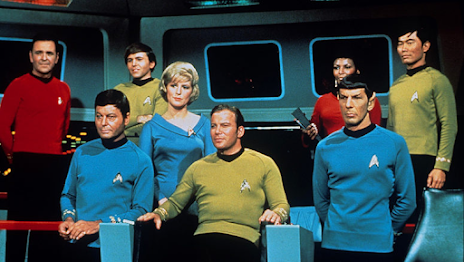
The core of the show is the regular cast, particularly the triumvirate of William Shatner as Captain Kirk, Leonard Nimoy as Spock and DeForest Kelley as Dr. McCoy: the action hero, the logical analyst and the emotional heart. This trio works extremely well, with consistently outstanding performances from Nimoy and Kelley across the entire show (Kelley is easily the most underrated performer on the show and in the following movies, and is always a delight to watch; Nimoy's brilliance has been extolled so much over the years it's almost redundant to repeat it now). This focus on the core trio detracts somewhat from the wider cast: George Takei as Lt. Sulu, Walter Koenig as Ensign Chekov, Nichelle Nichols as Lt. Uhura and James Doohan as Chief Engineer Scott (with frequent guest appearances by Majel Barrett as Nurse Chapel, and a rotating cast of recurring actors as crewmen, some of whom play multiple characters). The wider group gets relatively little time in the sun compared to the core three, which feels a bit weird from a modern lens but was relatively normal practice at the time.

From a performance perspective, William Shatner is a fascinating study. He is, for the first half of the show, consistently very good. Kirk is authoritative, moral and decisive, balancing the logic of Spock with the humanity of McCoy to good effect. In the latter half of the series, starting late in Season 2, it feels like he's checked out a little. The much-lampooned cliches of over-enunciation, attempts at dramatic pauses (which just feel like he's forgotten his lines midway through a speech) and occasionally wild over-acting become much more pronounced. When he has a good day, or is in a good episode with good material, he is still great, but that does become less common as the third season goes on (his worst performance is easily in Turnabout Intruder, which mercifully is also the last episode of the series).

From a writing perspective, the show is often inventive, intriguing and relatively smart, at least in the early going. Later episodes tend to emphasise action and develop tropes that are so rapidly reused they become tedious: the godlike entity who can crush the Enterprise and its crew any time they want, but first they have to use Kirk and the crew as pawns in some game, and are eventually defeated either by semantic trickery or (less commonly) some kind of technological breakthrough. The Enterprise mysteriously loses the use of its weapons, shields and transporter so often that your eyes may roll into the back of your head. Kirk talks sentient computers into self-destruction frequently enough that you wonder why an anti-Kirk firmware update isn't in circulation in the sentient evil computer club.

But the show is also remarkably adept at employing metaphor: Let That Be Your Last Battlefield's commentary on racism is so subtle it flew over the heads of some people, who wrote into the studio to complain that the near-identical aliens hating one another on the basis of skin colour alone was stupid (right in the middle of America's Civil Rights period). It also sings when it moves away from the all-powerful aliens trope to more even engagements: Balance of Terror's WWII submarine-inspired tension is superb, and Space Seed's battle of intellect and wills between Kirk and genetically-engineered warlord Khan is excellently portrayed. The battle between two Federation starships and a powerful (but not unbeatable) planet-killer in The Doomsday Machine is outstanding. The Devil in the Dark is possibly the show's best statement on how to respect and treat sentient life even if it looks and acts nothing like you are used to.

Like most shows of the period, the idea of "worldbuilding" is absent as a conscious idea, but when it strays into it, it is excellent, such as with our first visit to Vulcan in Amok Time and the Federation conference in Journey to Babel. The Klingons and Romulans are both intriguing enemies, although the portrayal of the Klingons lacks depth (maybe aside from Michael Ansara in Day of the Dove); the Romulans appear less frequently but more memorably, with both Balance of Terror and The Enterprise Incident being series highlights.

The show also gives good comedy, with both The Trouble with Tribbles and A Piece of the Action emerging as comic powerhouses (and The Naked Time having its moments). Gene Roddenberry was definitely less keen on comedy episodes, feeling they encouraged people to mock the show, but it's something Trek has been consistently pretty good at over many different shows and episodes. The show is also adept at existential horror, particularly in the early going through episodes like Where No Man Has Gone Before and Miri which make you wonder how the hell Trek got its reputation as a family show with a lot of charm: these episodes are cold, bordering on the bleak at times. That concept doesn't really emerge until the latter part of Season 1 and really sings in Season 2. It's been said so many times as to be redundant now, but Season 3 sees a marked slump in quality, with some of the worst episodes of the show and the franchise like Spock's Brain. Excellent episodes still crop up amongst the dross, like The Enterprise Incident and All Our Yesterdays, but it can be hard going.

Production value-wise, the show is obviously almost sixty years old so doesn't look fantastic. Location shooting is a bonus, hugely enhancing episodes like Shore Leave and Arena, but most episodes are forced to rely on sets (of wildly varying effectiveness) to portray exterior locations. Makeup and prosthetics are mostly underwhelming, but imaginative design can help overcome that: the Gorn looks weak, but the drama of the script helps overcome these deficiencies. Modelwork and space shots are often decent, and the 2006 remastered version of the show is excellent for updating the space shots whilst staying true to the original design intentions. In a similar vein, the show has some wince-inducing dialogue and ideas about the treatment of women and minorities compared to modern shows, but in other respects, and especially by the standards of the day, the show is remarkably progressive (and later Trek shows aren't always fantastic in this regard either).

Star Trek: The Original Series (****) is, in some respects, dated. But in many others it is remarkably watchable, with frequently great performances. It mixes horror, comedy and SF action-adventure to good effect. It set the scene and groundwork for the most successful TV SF franchise of all time. Sure, there's a fair number of episodes which are poor and don't work very well, but when the show does work - such as in City on the Edge of Forever, Balance of Terror, Amok Time, The Doomsday Machine, The Trouble with Tribbles and more - it remains excellent entertainment. The show is available right now in most territories via Paramount+ and on DVD and Blu-Ray.

Thank you for reading The Wertzone. To help me provide better content, please consider contributing to my Patreon page and other funding methods.

Friday, 28 May 2021

Star Trek VI: The Undiscovered Country

The Klingon moon Praxis has exploded, disrupting the Empire's energy production and polluting the atmosphere of the Klingon homeworld. The United Federation of Planets sees the catastrophe as an opportunity, offering assistance in repairing the damage in return for a lasting peace. The Klingon Chancellor travels to Earth to negotiate the treaty but is killed, his assassination pinned on Captain Kirk, a well-known enemy of the Klingon Empire. With Kirk and McCoy imprisoned, it falls to Captain Spock and the Enterprise crew to exonerate their comrades, rescue them and stop those who are determined to end the chances of peace forever.


With the release of Star Trek V in 1989, it was felt that the time of the original Star Trek crew had come to an end, and the next film would star the Next Generation crew. However, Paramount were not keen on waiting until The Next Generation finished before making a new movie in the franchise. Plans for a prequel film set at Starfleet Academy also failed to excite anyone. At the same time, the collapse of the Berlin Wall and the end of the Cold War was firing up the excitement of Leonard Nimoy and Wrath of Khan writer-director (and Voyage Home co-writer) Nicholas Meyer, who saw the opportunity for a great analogy with real-life events. The frugal Meyer's involvement worked for Paramount, who wanted to make the film for less money than the disastrous Final Frontier, and also for Nimoy, who had pondered directing but knew it would annoy co-star Shatner; Meyer was a neutral figure everyone respected and whose work on two previous movies had been lauded. The meme that "every odd-numbered Star Trek film is rubbish" had started gathering pace by this time as well, so the fact the next movie was an even-numbered one and Meyer had worked on the two previous even-numbered films was encouraging.

Star Trek VI is not a subtle film. The comparisons to contemporary politics are fairly obvious, with the destruction of Praxis being basically Chernobyl in space, and the Klingon-Federation peace talks are the end of the Cold War by any other name. However, the film does start building a genuine sense of mystery. When the Enterprise fires on the Klingon ship, despite its records showing a full set of torpedoes on board, it creates a paradox that Spock, Scotty, Chekov and Uhura have to work to unravel. This is great fun - Star Trek usually handles mysteries well, at least those that do not bog down in technobabble - and is preceded by some very powerful scenes employing actors of the calibre of David Warner and Christopher Plummer (an old friend of Shatner's, who's clearly having an absolute whale of a time) as they debate realpolitik and quote Shakespeare. There some startling scenes as Kirk has to confront his racism towards the Klingons, inspired by his constant struggles with them and their murder of his son (in The Search for Spock). Characterisation is strong and the actors do well with the material, Meyer again getting a great performance out of Shatner (though he seems more willing to let some hammier takes go through, possibly due to a lack of time and money) and Nimoy showing up with his A-game, having understandably lost the will to live during The Final Frontier.

The film also features George Takei's best performance as Sulu, as well as giving him much more to do as the Captain of the Excelsior. More disappointing is the absence of Saavik, who was originally supposed to be the traitor on the Enterprise. Kim Cattrall auditioned for the part and impressed Nimoy and Meyer, but was unimpressed to learn she would be the third actress to play the role and turned it down. The producers agreed to rewrites making her a new character, Valeris (Cattrall even named her). However, the script was not adjusted to fit a more Vulcan-like character, leaving Saavik's more emotional tendencies (a result of her supposed half-Romulan heritage, although that revelation had been cut out of The Wrath of Khan) in place with a supposedly purely-Vulcan character. Cattrall does as good a job as she can as Valeris, but the character is somewhat under-written as a result of the changes.

The sequences on Rura Penthe are also disappointing; the lack of budget results in unconvincing sets and iffy alien makeup, though Iman gives a good performance as Martia, and the sequence relies a lot on Shatner and DeForest Kelley's effortless banter to get through it.

The film has a rousing climax with a solid space battle, and it's good to see the constantly-hamstrung USS Excelsior finally cutting loose and showing what it is capable of. The fact that this time everyone knew they were making their last full picture together makes for a more final and emotional ending, enhanced by the fact that the film launched in Star Trek's 25th anniversary year and that Gene Roddenberry sadly passed away shortly before the premiere. 

Star Trek VI: The Undiscovered Country (****) is not as accomplished as either The Wrath of Khan or The Voyage Home, but comfortably emerges as the third-best Star Trek film, with some excellent characters and storylines and some great dialogue. Only a few clunky scenes and budget constraints hold it back from matching the earlier two Meyer films.

Tuesday, 25 May 2021

Wertzone Classics: Star Trek IV: The Voyage Home

Having saved their comrade Captain Spock, the crew of the late starship Enterprise decide to return home to face court martial for their actions. However, an alien probe of tremendous power arrives in Earth orbit and drains the planet of energy, whilst sending out incomprehensible transmissions. Analysing the transmissions, Admiral Kirk and his crew determine that the probe is attempting to communicate with humpback whales, a species rendered extinct due to the actions of humans three hundred years earlier. With little choice, the crew decide to time travel to the late 20th Century to try to recover two whales to help them save humanity.


As a seven-year-old back in 1986, I remember reading reports about the new Star Trek movie in production. The story - that the crew would go back in time to save the humpback whale from extinction with a right-on environmental message, the Enterprise would not appear and the film would have a comedic tone - sounded second only to Spock's Brain in cringe-inducing awfulness, and I braced myself for a terrible movie.

Which just goes to show. Star Trek IV: The Voyage Home is, easily, the most breezily enjoyable popcorn flick in the entire Star Trek canon. In terms of raw dramatic power and thematic richness it can't hold a candle to The Wrath of Khan, but it doesn't even try. Instead it leans heavily on the warmth and comedic interplay of the crew, celebrating twenty years of working together in this film. Everyone is on top form, Leonard Nimoy delivers arguably his best work as both director and actor, William Shatner gets to deploy his formidably-weaponised wit and charm (somewhat missing from the three previous, more sombre films) and the other actors all get their time in the sun.

The film does feel a bit over-familiar in some aspects: the opening with an alien object of tremendous power approaching Earth is pretty much a replica of Star Trek: The Motion Picture (fortunately this probe only knocks ships out rather than scanning them to death), and the ships in the film are all suspiciously the same as the four extant Starfleet ship models (the Constitution, Miranda, Excelsior and Oberth classes, by this point). But this is all (well-handled) setup to the central gag of getting our characters to 20th Century Earth and seeing them try to cope in a "paranoid, primitive culture." The culture clash gags are amusing - even moreso now that we are so far removed from 1986 San Francisco that it appears to be a historical time period itself - with the crew struggling with concepts like money and public transport. Once the crew find their feet, the film becomes even more entertaining, with Dr. McCoy giving a dialysis patient a tablet that instantly regrows her kidney, Scotty and McCoy creating a self-repeating temporal paradox by giving the inventor of transparent aluminum the formula, Chekov getting into hot water for asking about "nuclear wessels" and Spock mind-melding with a whale. Rarely does a scene pass without a genuinely great, comedic line ("You are not seeing us at our best," "That much is certain").

There are some spotty plotting moments, including why they went back to 1986 to recover whales when their numbers were already depleted rather than, say, the middle of the 6th Century BC and just beaming them up, though I like the idea of Spock deciding to communicate with them and bring them on-board with the plan; they are sentient beings, after all (that said, one line suggests that Spock recreated the timejump parameters by memory from their last jump in the original TV series, in which they travelled back exactly 300 years, so that may have been the limitation here). The Klingon Bird-of-Prey also continues its somewhat elastic connection with any kind of scaled reality, dramatically shifting in size depending on the needs of the scene. But this isn't a film about nitpicking or pedantry. It's a feel-good adventure, especially after the heavy drama of the previous two flicks, and it works extremely well on that basis.

Particularly strong is the script, which is packed with delights. The original script wasn't working so producer Harve Bennett convinced Wrath of Khan co-writer and director Nicholas Meyer to return for a script polish-up, adding a lot of character and warmth to proceedings. The script also intelligently addresses the outstanding plot issues from the previous two films, with Kirk and his crew having to face the consequences of their actions. The claim that Star Trek II, III and IV form a trilogy is overstated - the three films merely acknowledge the previous films happened and there is some plot business from them that needs to be dealt with - but it's good to see continuity being handled well and logically.

The film also works well without a villain: The Motion Picture tried that but it didn't entirely work. Here it's handled much better. The superbly-realised and somewhat eerie probe is the closest thing we have to an antagonist and it's more of a force of nature than a character, though some may feel disappointed we don't learn more about its origins (the entertaining novel Probe does provide some interesting ideas about its origins, non-canon though it is). John Schuck - who later appears as Draal in Babylon 5 - makes a good but brief impression as the belligerent Klingon Ambassador to the Federation who is out for Kirk's blood, and he reprises that role in Star Trek VI: The Undiscovered Country (which can be seen as something of a stand-alone "sequel" to the "Genesis Trilogy," as limited as those connections are).

The film is also notable for its distillation of the Star Trek ethos: the probe is a potential threat, but not mindlessly belligerent. Violent solutions to the situation are rejected in favour of peaceful ones. The hunting of intelligent beings to death just for their meat is deemed by Spock to not be "logical." The short-sightedness of humanity against its long-term interests is repeatedly mentioned. Arguably the film's most interesting moment is also its most subtle: in his mind-meld, Spock asks the whale Gracie to help save humanity from the probe and she agrees, despite learning her species is destroyed just a few decades later by the actions of humanity, a subtle suggestion that the morality of whales is superior to that of humans.

Star Trek IV: The Voyage Home (****½) is unalloyed fun from start to finish, hampered maybe by a few clunky lines of dialogue and one or two gags that don't land as well as most. Maybe not quite the best Star Trek film, but certainly the most watchable and the most fun, augmented by Leonard Rosenman's distinctive and unusual-for-Star Trek score and some great visual effects (the film's animatronic whale models are particularly impressive). One of the main legacies from the film was Leonard Nimoy and William Shatner's high salary demands, which made the viability of future films doubtful and spurred Paramount to commission a brand new television show with a new, cheaper cast. Star Trek: The Next Generation was announced just before the film launched, but the "classic" cast would still have two more appearances to come.

Monday, 24 May 2021

Star Trek III: The Search for Spock

The USS Enterprise has returned home following the battle with Khan. Captain Spock is dead and the Enterprise is to be decommissioned, with some of the crew transferred to the new, cutting-edge USS Excelsior. A Federation science team is dispatched to investigate the newly-formed Genesis Planet, whilst the Klingon Empire becomes keen to get its hands on the Federation's latest "weapon." On Earth, a series of revelations inspire Admiral Kirk to take drastic action to save his two greatest friends, but he must pay a heavy cost to do so.


After the over-indulgence of Star Trek: The Motion Picture almost sank the Star Trek franchise, it was the superbly (and cheaply!)-executed directness of Star Trek II: The Wrath of Khan that saved it. The hands-down best Star Trek movie gave the property a new lease of life and re-energised actors who were conflicted on continuing to appear in it in the future, most notably Leonard Nimoy, who had agreed to do The Wrath of Khan partially because it gave him the chance for a great death scene. Ironically, the experience of making the film was so good that Nimoy leapt at the chance to return, especially when he was also given the chance to direct.

Producer-writer Harve Bennett had a feeling during the making of The Wrath of Khan that the franchise would continue, so added a series of lines and shots setting up a sequel over director Nicholas Meyer's objections. The final cut included these against Meyer's wishes, leading to him refusing to have anything to do with the sequel; he and Bennett later reconciled, Meyer acknowledging it had been a good choice in the long run, but he was not around for this film. The script for the third film pretty much wrote itself from that point on: Spock is dead, but had transferred his katra or spirit into Dr. McCoy's mind just before the end. His dead body was then shot onto the surface of the newly-formed Genesis Planet, but since the Genesis Wave can bring life from lifelessness, the result was that Spock's body was regenerated as well. All that was required was a way to reunite the two, which was provided by Sarek (Spock's father) telling Kirk what had happened. Jeopardy was added from two directions: the Federation's refusal to allow anyone except a science team to go to Genesis, forcing Kirk to disobey direct orders from Starfleet Command and even steal the Enterprise to accomplish his mission. The second threat is from the Klingons, who aren't about to let the Federation develop a weapon that can make, remake or destroy entire planets, which could potentially threaten the Empire.

It's a great storyline which builds intelligently on things established in both the previous film and the original TV series (the finale, on Vulcan, even references the classic episode Amok Time in its set design and appearance). It has the weakness of being predictable - even in 1984 the idea of bringing a dead character back to life for popularity reasons was cliche - which bugged Harve Bennet (a writer of integrity, of the old school) so much that he decided that Kirk had to pay three unexpected prices for the restoration of Spock: the loss of his ship, his career and his son. It's surprisingly brutal: the off-hand murder of David might only be bested by the death of Tasha Yar in Star Trek: The Next Generation for sheer callousness. But it also fulfils a basic tenet of storytelling: your characters can't win something big without a correspondingly massive loss, and one of the reasons why The Wrath of Khan is a classic and The Search for Spock a very good film, and why the much later Into Darkness is such an emotionally hollow and narratively inept remake of the same storyline.

The Search for Spock is also a hugely iconographic film. It introduces a whole range of ships, designs and concepts that dramatically expanded the scope of the Star Trek universe. The Earth Spacedock is a still jaw-dropping design, a massive orbital station that utterly dwarfs the Enterprise. The USS Excelsior, the B-52 to the Enterprise's B-24 bomber, is one of the very finest starship designs ever made for the franchise, so much so that the later Enterprise-B would be of that class and the design would become the Federation default standard by The Next Generation and Deep Space Nine. There's also the fabulous Klingon Bird-of-Prey warship, easily the most famous non-Federation design in the franchise. Even the design of the accessibility-challenged USS Grissom would go on to become a mainstay of future TV shows.

The vfx are more numerous and more sophisticated than The Wrath of Khan's and two sequences stand tall as among the very best in the franchise: the Enterprise spacejacking, probably the most tense "reversing the car out of the garage" scene in cinematic history (with James Horner's God-tier soundtrack lifting the sequence onto another level), and the later destruction of the same ship, which brought a lump to the throat of every Star Trek fan on the planet at the time, before they decided to do it every fourth film for "shock value."

There are, however, several weaknesses the movie has to overcome. Aside from the predictability of the plot, despite attempts to off-set it with greater losses elsewhere, there's the under-servicing of the villain. Christopher Lloyd gives a superb performance as the Klingon Captain Kruge, but he's not well-served by the script. He has several great moments, such as where he orders the death of his lover when he realises she's seen sensitive information and his stoic embrace of death in his final battle with Kirk, but he spends the rest of the time barking out rote threats. You get the impression that if he'd been given the kind of material given to Montalbán in the previous movie and later (in Star Trek VI) Christopher Plummer, he'd have delivered as equally killer a performance, but the lack of good material holds him back. Another weakness is Shatner returning to a more lacklustre performance. He's good in a few scenes (his unblinking and unwavering commitment to stealing the Enterprise, his joy at Spock recognising him in the film's closing moments), but otherwise Nimoy fails to get the same kind of nuanced and vulnerable performance as Meyer did in the prior movie.

The script overall feels a little lacking. There's some good lines and humour, particularly for McCoy (DeForest Kelley relishing a greater turn in the spotlight in Nimoy's absence), but the script lacks the epic scope of The Wrath of Khan. Although Bennett wrote both movies, Nicholas Meyer gave a huge spit and polish to the second film's script which added all of its character and thematic depth. Without his influence, Bennett's more bare-bones script (punched up a bit by Nimoy to add more humour) has less going on. It's not for want of trying though, and it's nice to see the supporting actors finally given more to do: George Takei's Sulu gets a solo action sequence, Nichelle Nichols's Uhura gets arguably her best scene in the franchise despite being absent from most of the film and James Doohan's Scotty gets a gleeful scene after sabotaging an opposing vessel.

Similarly, the film's themes feel a little undersold. Kirk takes preposterous risks to get Spock back, paying a heavy price in the process. Both Sarek and Spock are aghast at what Kirk has done to save Spock, but the film never really adequately gives Kirk time to process his losses and to ask the tough question of if it was worth it. Kirk tries to answer this in the movie's finale but it feels like it could have been explored in greater detail.

The film also suffers from budget issues. This is a more ambitious film than Wrath of Khan on not a much greater budget, and very obvious corners are cut. The Excelsior bridge feels more like it came off a contemporary episode of Doctor Who than a multi-million dollar movie. All of the outdoor scenes on the Genesis Planet are filmed on a set, which is effective in some scenes and all-too-obvious in others. The finale, where Kirk and Kruge's not-very-obviously-disguised stunt doubles awkwardly punch one another whilst the polystyrene set crumbles around them, recalls some of the less-accomplished moments of the original Star Trek series. Again, James Horner's score comes to rescue even in these weaker moments of the film.

Star Trek III: The Search for Spock (****) holds the distinction of being probably the most underrated film in the franchise. A whole raft of iconic moments, some fantastic ship designs, an outstanding musical score and a script that understands that if you're going to pull off something huge, you need to pay a massive price (something that only Avengers: Endgame seems to have understood out of contemporary epic SF movies) are undercut by budget issues, an under-utilised villain and a less-sophisticated script that its forebear, but this is still a fine slice of enjoyable Star Trek action.

Monday, 23 May 2016

Star Trek at 50: Crossing the Generations

Star Trek IV: The Voyage Home had been a major box office success upon its release in 1986, but the original crew's thunder had been stolen a little by the launch of Star Trek: The Next Generation a year later. With that series established as a success, Paramount were keen to continue developing the movie series.


In order to retain William Shatner as Captain Kirk, Paramount had made an informal agreement for him to direct the fifth movie in the series. This followed Leonard Nimoy's directing of the third and fourth movies, both of which had been judged highly successful. Shatner's screen directing career was more limited than Nimoy's, limited to ten episodes of his TV series TJ Hooker, but he was certainly familiar with the process as well as knowing his fellow actors well and having the support of the filming crew, which would be a mixture of experienced personnel from the previous movies and staff from Star Trek: The Next Generation. Harve Bennett, who had produced every movie since The Wrath of Khan, also stayed on as producer for this film and helped break the story.

The premise was that the Enterprise crew were going to meet God, something Gene Roddenberry had been pushing for for a long time. However, the twist envisaged by both Shatner and Bennett was that it would be an alien posing as a deity who would manipulate people into following him through faith. Although the premise was judged strong, further rewrites were believed to be necessary to make the story stronger. This turned out to be impossible as the 1988 Writer's Strike took hold, forcing the movie to shoot with a script that had been less revised than was ideal.

Unexpectedly, the shoot turned out to be quite enjoyable. Even those actors who had experienced personal acrimony or issues with Shatner - most famously George Takei - found that Shatner as a director worked quite well. In particular, Shatner enjoyed getting his fellow actors involved in physical activities despite their age (they were then all well into their fifties and James Doohan was approaching his seventies), which they respected. They also appreciated the fact that Shatner kept backstage drama - such as budget cuts and constant interference from the studio - away from the rest of the cast.

As it turned out, Star Trek V: The Final Frontier nearly killed the franchise. The movie opened in the summer of 1989, in a crowded sequel season, playing against Ghostbusters II and Indiana Jones and the Last Crusade as well as Tim Burton's Batman. The film took home $63 million, a franchise low, against a franchise high budget of $33 million. The reviews were also terrible. Shatner accepted the blame, although also pointing out issues such as the script development being cut short by the strike and constant budget cuts meaning they had to use a less experienced special effects company.

Over the next year or so Paramount began to question the future fate of Star Trek on the big screen. The massive burst of popularity that Star Trek: The Next Generation underwent through its third season caused them to change their mind, as this resulted in renewed goodwill to the franchise on the eve of its 25th anniversary. Harve Bennett was asked to develop a new script which would act as a prequel to the series, featuring new, younger actors playing Kirk, Spock and McCoy at Starfleet Academy. This script went through several versions, but as momentum gathered pace the original series actors began to see the benefits of returning in a new film. There was a feeling that they did not want Star Trek V to be their goodbye to the franchise. Bennett was asked to jettison his previous work for a new story involving the old crew but he was not interested in this idea and decided to leave the series after spending ten years working on it.


Paramount began considering new writers and reached out to Leonard Nimoy for ideas. Nimoy went to see Nicholas Meyer, the director of Star Trek II and co-writer of Star Trek IV, and they started throwing concepts around. Meyer was thinking about contemporary issues and suddenly had the thought of the "the wall coming down in space", a reference to the then-recent fall of the Berlin Wall and the resulting end of Communism in Europe. He came up with the story that the Klingon Empire experienced a massive ecological disaster (comparable to Chernobyl) and this sparked the idea of glasnost with the Federation, but forces on both sides working to undermine it, including - unintentionally - Kirk. Nimoy took the idea to Paramount, who immediately saw potential in it, and Nimoy asked Meyer to direct. Nimoy himself was a preferred choice, but Nimoy foresaw possible difficulties with Shatner if Nimoy directed his third Trek movie to Shatner's one. Meyer agreed. Gene Roddenberry was brought on board as a consultant, but fervently disliked the movie's militaristic and naval tone. Meyer described one argument as being extremely passionate and angry, and he later felt ashamed of himself. Meyer particularly took issue with Roddenberry arguing that Saavik (a returning character from Star Trek II and III) would never betray Kirk, as Meyer himself had created the character. Ultimately, actor scheduling issues meant that Saavik had to be removed from the script and replaced with a similar Vulcan character, Valeris.

As with Star Trek V, there were significant struggles over the budget. Eventually, the sixth movie would come in at $27 million, $6 million less than the previous movie. Money was saved by redressing Star Trek: The Next Generation sets wherever possible, as well as reusing the already-built Enterprise, Excelsior and Klingon Bird-of-Prey models, as well as overhauling the Klingon battlecruiser model built for Star Trek: The Motion Picture.

Star Trek VI: The Undiscovered Country was released on 6 December 1991 and was an unexpected hit, grossing just under $100 million. The critical reception was much stronger for the film and some of the marketing for the movie - most notably a guest appearance by Leonard Nimoy as Spock on a Star Trek: The Next Generation two-part episode called Unification - was highly praised. Amusingly, the only real scorn was reserved for the movie's opening special effect in which a massive explosion in space only propagates in two dimensions rather than three. Enough of a fuss was made about this by fans that a similar stellar explosion in the following movie was explicitly shown to be a sphere.


Gene Roddenberry passed away barely six weeks before the film opened. The movie was dedicated to him. In addition, the castmembers' signatures appeared at the end of the film as they expressly said goodbye to the characters they had been portraying for a quarter of a century. The movie marked the final appearances by Nichelle Nichols (to date) and DeForest Kelley in a Star Trek production.

Behind the scenes, Paramount were very happy with the movie's rate of return versus its budget and began planning a seventh film. Star Trek: The Next Generation was planned to end with its sixth season and it was decided to bring the new cast and crew to the big screen. When it was decided to expand this to seven seasons, Paramount declined to change the release date for the movie, forcing the crew to begin development of the film whilst work on the final season of the TV show was underway (everyone involved later admitted that this was a mistake). The seventh movie would feature Walter Koenig and James Doohan in brief cameos, with William Shatner taking a larger role in a story which would teamed him up with Patrick Stewart's Jean-Luc Picard to defeat a mutual enemy.

Friday, 13 May 2016

Star Trek at 50: The Genesis Trilogy

In December 1979, Paramount Pictures released Star Trek: The Motion Picture, a lavish, big-budget adaptation of the Star Trek TV series to the big screen. In public, they were confident and enthusiastic. Behind the scenes they were in a state of panic. The film's budget had tripled during production and post-production, and early reviews had not been the kindest. In the event, the movie did quite well and brought home a solid profit.

Leonard Nimoy was still not entirely comfortable with playing Spock when asked back for Star Trek II. He returned after he was told he would get a memorable death scene. His enjoyment of making the film and his involvement in creative decisions led to him committing wholeheartedly to the character for the rest of his career.


The Paramount executives quietly shuffled Gene Roddenberry into a consulting role, blaming his constant rewrites and creative meddling for causing the budget inflation on the first movie. This wasn't entirely fair, as Paramount's own prevaricating over the script, whether there were making a movie or a TV series, hiring a perfectionist director and delaying hiring an effects team until after the last possible minute all played their roles in pushing the costs upwards. But Roddenberry had certainly been the leading advocate of making a slow-paced, 2001-style cerebral film instead of an action film, which Paramount now considered a mistake.

To make the sequel, Paramount brought on board veteran TV writer and producer Harve Bennett. Bennett knew how to make projects quickly but with integrity, delivering excellent value for money and finding the cleverest ways to extract maximum bang for their buck. He was also a good judge of character and an excellent negotiator. When he called Leonard Nimoy to judge his interest in the project, Nimoy expressed concerns that the character of Spock was played out. Bennett offered him the chance for an amazing, emotional and intense death scene. Nimoy thought briefly about it and then accepted.

Bennett was an excellent producer and writer, but had a slight problem in that he'd never watched the original Star Trek series. He holed up in an office at Paramount with a screening room and all 79 episodes of the series. He made notes on each episode, searching for inspiration. Towards the end of the first season, he was intrigued by the episode Space Seed. In this episode a genetically-engineered dictator and tyrant, Khan Noonien Singh, is found on a sleeper ship in deep space. He and his followers are at first grateful to Kirk and the Enterprise crew for rescuing him, but then he tries to take over the ship with the help of a crew woman who has fallen in love with him. Khan is defeated and he and his crew are exiled on the planet Ceti Alpha V, a verdant but untamed paradise planet. Kirk promises to check up on Khan, but this never happened in later episodes. Bennett was pleased that there hadn't been a sequel as it meant he could re-use Khan as the villain for the movie. The first draft revolved around Khan manipulating Kirk's hitherto unknown son into fighting against his father. Additional drafts, plotted with the help of Jack B. Sowards, introduced a devastating Starfleet superweapon known as the Omega System that Khan is trying to steal.

Paramount and the team were pleased with the rapid progress that was being made, but they hit on a snag that it was unlikely that the Federation would create a planet-destroying weapon of mass destruction (fears of similarities with the Death Star of Star Wars may have played a part). Bennett and Soward struggled with this until the art director, Michael Minor, suggested that it could be a terraforming device instead: an object of profoundly peaceful intent that is perverted into a weapon. Bennett literally hugged Minor, declaring that he had "saved Star Trek." The Omega System was retitled the Genesis Device.

A new draft was produced which featured Spock dying very early in the script, a shocking move inspired by Psycho. Negative fan reaction after the script leak led to the studio backing away on the idea of Spock dying. Bennett hit upon a sneaky idea, however, by showing Spock dying in the opening minutes of the film only for it to turn out to be a training simulation. This would trick viewers into thinking that the story had been changed so Spock wouldn't die at all. Instead, his death was moved to the back end of the film and turned into a heroic, "blaze of glory" ending that Leonard Nimoy felt was quite moving. Although the script was becoming more familiar, it was still a bit flabby and Bennett felt a fresh pair of eyes would be useful. Nicholas Meyer, the director of Time After Time, was recommended to him. Meyer had no experience of Trek so viewed the script as a stand-alone move. He made a list of everything he liked from the previous drafts and delivered a streamlined, focused version in just two weeks. This new script had more action, space battles and explosions but also developed a strong thematic link of ageing, the next generation coming up and taking over and the old generation passing away. Meyer linked this in with the Genesis Device to create a theme of death, life and rebirth that underlines the space battles and impassioned speeches between Kirk and Khan. This impressed Paramount and Bennett so much that they offered him the job of directing the movie.

Ricardo Montalban was 61 years old and suffering from back problems when the film was shot, but still practised a formidable daily exercise regime and was in better shape than some of his younger co-stars.

Everything was in place...except for the villain. Bennett had assumed that someone in casting had checked with Ricardo Montalban's availability and his willingness to reprise the role. Casting had assumed he'd done it. In a bit of a panic, Bennett contacted Montalban. The veteran actor was uncertain if he could reprise the role, and was concerned if playing a cold-blooded villain would upset fans of his character Mr. Roarke on Fantasy Island. However, he was impressed by the script and quickly got back into character. The producers were especially impressed with Montalban's formidable physical condition: despite being in his sixties and having a back condition, Montalban still vigorously worked out every day. After the movie came out some viewers complained about Khan's "prosthetic chest", which both the producers and Montalban found deeply amusing. Initial script drafts had depicted a lengthy confrontation between Kirk and Khan, including one suggestion that fight using swords, but Meyer had disregarded these. Unable to come up with a plausible way Kirk would survive a direct confrontation (given Khan's genetically-engineered superior strength, speed and stamina), he simply didn't have them meet at all, instead exchanging threats and glowers through viewscreens.

The rest of the Star Trek cast reunited for the film with Meyer keen to give each character their moment in the sun: McCoy and Spock have a series of witty exchanges in the spirit of the TV series, whilst Scotty's nephew joins the crew. Scotty is incredibly proud, but then distraught when he dies in the opening engagement with the Reliant. Sulu is promoted to Captain of the USS Excelsior, but agrees to do "one last training mission" for Kirk. This scene was cut and in the event George Takei had to wait ten years until Star Trek VI showed him commanding the Excelsior. Bennett and Meyer liked the ship name and held onto it for the next movie. Uhura also had more dialogue and scenes, acting as a conduit of information to the bridge in a more naval command-and-control role than in the series. Finally, Chekov was promoted to first officer of the USS Reliant and forced to betray his shipmates with the use of mind-controlling eels. Meyer was worried about this plot element, feeling it was corny, but felt that casting the respected actor Paul Winfield as Captain Terrell helped sell the scene. He also cast an up-and-coming young actress, Kirstie Alley, as Spock's Vulcan protege, Lt. Saavik.

Leonard Nimoy was excited to film Spock's death scene, but when the day of filming arrived he surprised Meyer and Bennett by telling them that he had thoroughly enjoyed making the film and the more collaborative atmosphere of production. He asked them if there was a way he could return in the future if necessary, especially since Paramount had already begun talking about a third film. The death scene was rewritten to include a sequence where Spock mind melds with Dr. McCoy, and a new shot showing his funeral casket lying on the surface of the newly-created Genesis Planet was added in post production.

Star Trek II's visual effects, although fewer in number and simpler than The Motion Picture's, received praise for their clarity and quality.

Shooting began on 9 November 1981 and concluded on 29 January 1982. To reduce costs, a very large chunk of the film took place on just one set: the bridge of the Enterprise, which then doubled as the simulator room at Starfleet Academy and then as the bridge of the USS Reliant, the ship Khan steals and turns against the Federation. Initially the producers were going to depict the Reliant as a ship of the same class as the Enterprise so they could use the same model, but the special effects crew threw a fit. They hated the big, bulky and elaborate Enterprise model and said it'd be cheaper to design and build a whole new model. Bennett and Meyer agreed and the Reliant became a Miranda-class starship, smaller but more manoeuvrable than the Enterprise. The Reliant in fact became the first non-Constitution-class Federation starship to appear in the Star Trek franchise. Compared to the laborious post-production process for The Motion Picture, Star Trek II's visual effects process was more streamlined and even had time to allow for experimental shots, such as using cloud and water tanks to generate the concluding battle in the Mutara Nebula. Production of the effects also proceeded alongside shooting rather than afterwards, allowing closer integration of the effects into live-action scenes.

One area were there were problems was depicting the rapid terraforming of a planet in the Genesis Project demonstration video. Effects supervisor Jim Veilleux was frustrated and turned to Lucasfilm, who had an embryonic studio dabbling in the earliest computer-generated visual effects. They agreed to provide a wholly computer-generated 60-second animation showing the Genesis Device terraforming a planet from a ball of rock into an Earthlike world. This was the first scene in a live-action movie to be generated completely through CGI. The Lucasfilm Computer Graphics Group used the scene as a demonstration of what they could do: a few years later they spun off as a new company called Pixar.

Star Trek II: The Wrath of Khan was released on 4 June 1982, barely four months after shooting finished. It was a lean, tight and focused movie. It had been made for $11.2 million (which was considered pretty cheap even then), came in at an audience-friendly 112 minutes and was immediately showered with praise by both fans and critics alike. The film opened to a $14.3 million weekend, at that time an all-time record, and took home $80 million in the United States and $97 million in total. Although this was down on The Motion Picture, it was vastly more profitable compared to the film's production costs. There was tremendous approval of the film's action scenes and visual effects sequences, but a lot of praise was lavished on Montalban and Shatner's palpable mutual hatred, the themes of death and rebirth, on the extraordinary musical score by newcomer James Horner and on the film's focus. Even Gene Roddenberry, who had had little to do with the movie, grudgingly accepted it was "exciting".

Star Trek III introduced several of the franchise's most iconic spacecraft designs, including (pictured here) the USS Excelsior and the Spacedock station orbiting above Earth. The movie also introduced the Oberth-class science vessel and the Klingon Bird of Prey.

Paramount quickly moved forwards with a third Star Trek movie. Harve Bennett agreed to return as producer and it was decided to make the movie a direct sequel to The Wrath of Khan. They decided that the plot would focus on the return of Spock, but Bennett was keen that the resurrection could only come at a profound personal cost to Kirk. Working backwards through the script, he decided that Kirk was lose his son, David (introduced in the previous movie), he would be forced out of Starfleet and that the Enterprise would be destroyed. Nicholas Meyer was asked to return, but Meyer was unhappy with the way the final edit of the film was handled by Paramount (including much more blatant foreshadowing of Spock's survival than Meyer had intended) and decided to sit the movie out. Bennett hit on the idea of Nimoy himself directing: the actor had been directing TV episodes, plays and smaller TV films for over a decade and had familiarity with the franchise, the cast and the crew (many of them returning from The Wrath of Khan). Nimoy relished the challenge, especially since he didn't have to appear in front of the camera apart from right at the very end of the movie.

As with The Wrath of Khan it was decided to have a memorable villain, and the first draft focused on the Romulans, including a return for their Bird-of-Prey class warship from the episode Balance of Terror, now updated to a new design. However, it was later decided to change the villains to the Klingons, who a more general audience would be more familiar with. Nimoy decided to cast Christopher Lloyd as the Klingon Captain Kruge, citing his dramatic work rather than his comedy role on Taxi which viewers were more familiar with. Nimoy was particularly praised for his direction of his friend and co-star Shatner, reigning in his tendency to chew the scenery. George Takei was also impressed by how Nimoy and Bennett handled him complaining about a massive security guard calling him "Tiny," which Takei found unnecessary. However, watching the complete sequence back (including the "Don't call me Tiny," rejoinder after Sulu kicks the guard's butt) impressed Takei, who immediately apologised.


Spock's return was well-received by fans, especially given it was achieved with difficulty and only at cost.

The visual effects team had more work to do on this film, including designing no less than four iconic new designs: the Federation Spacedock, the Oberth-class USS Grissom, the Klingon Bird-of-Prey and of course the colossal USS Excelsior. All of these designs would go on to feature heavily in future Trek films and TV series. In particular, Nimoy and Bennett were able to increase the visual effects budget by reusing numerous sets, props and costumes from The Wrath of Khan, and by using an interior set for the Genesis Planet rather than most costly exterior shooting. As a result, the film's budget of $16 million (almost 50% higher than The Wrath of Khan's) went a lot further, allowing for the elaborate planet set to break apart as the Genesis Planet disintegrates and for a lengthy sequence showing the destruction of the Enterprise. Bennett was annoyed when Gene Roddenberry, who loathed the idea of destroying the ship, leaked word of the ship's destruction to fans, resulting in derogatory letters being sent in. The visual effects crew, who hated the badly-wired and unwieldy Enterprise model with a passion, were keen to take a hammer to the model to destroy it completely, but were stopped by Bennett and Nimoy, in case it was needed in the future.

Star Trek III: The Search for Spock was released on 1 June 1984. The film took $87 million worldwide and was considered a success, but the critical reception was more muted. Some reviews were critical of the obvious sets used to depict the Genesis Planet (although some said they enjoyed this was a throwback to the original series) but for the most part Nimoy's direction was praised, along with the visual effects. The film was the first in the series to be criticised for relying on continuity from the previous movie and not doing enough to work as a stand-alone film.

Paramount were keen to continue the franchise, but wanted a change of direction: this coincided with both Nimoy and Bennett's feelings as well, that the fourth movie should be a break away from the past. Nimoy in particular was to change gears and make a film that was lighter, more comedic and less reliant on staples such as warp drive, phasers and menacing villains. However, Bennett was also keen that lingering continuity issues from the previous films - such as the knowledge of the Genesis Device being made public, the Klingon outrage after the death of Kruge and Kirk and his crew being fired from Starfleet and facing criminal charges - should be addressed. However, the whole plan was nearly derailed when Shatner refused to sign up for the movie unless he got a bit pay rise. Paramount, possibly as a negotiating ploy, asked Bennet and Nimoy to consider a new film set in Starfleet Academy with the characters played by younger actors. It seems that this threat, combined with a more modest pay increase and production approval, convinced Shatner to sign on. New ideas came on board, such as time travel and the idea of something on contemporary Earth that doesn't exist in the future being key to saving the day. The idea of using humpback whales appealed to Nimoy, who wanted to include a message about conservation but not to the detriment of the drama. Wrath of Khan writer-director Nicholas Meyer returned to polish the script and help integrate the best ideas from the development process.

Star Trek IV's contemporary setting led to a well-received change of pace, but also introduced production headaches for director Leonard Nimoy.

The new film invoked time travel so that he bulk of the film was set in contemporary San Francisco. Real locations were used wherever possible to help keep costs down, along with props and models being reused from the previous movies. The Reliant model, for example, was re-employed to depict the USS Saratoga and the Klingon Bird-of-Prey, Earth Spacedock and the Excelsior models were broken out of storage. The only major new model constructed for the film was the alien probe which menaces Earth in the opening and closing sections.

Nimoy found that directing the film was a more daunting task than The Search for Spock, since he had to appear on-screen as well as direct. There were also logistical difficulties with filming scenes involving traffic (which required set-ups taking 30 minutes each) and extras recruited off the street. There were also some positive nods to long-term fans of the series, such as using the US Navy's Enterprise aircraft carrier (although the ship was actually at sea, so the USS Ranger was substituted). The film also nearly cast long-term Star Trek fan Eddie Murphy in a role as a professor, but Murphy wanted to play an alien or Starfleet officer instead. The issue was resolved when he went to film The Golden Child instead, a decision he later regretted.

Star Trek IV: The Voyage Home was released on 26 November 1986. The film was marketed differently from its predecessors, with emphasis placed on the contemporary setting, the more comedic tone and the fact there was no need to be familiar with the franchise to enjoy the film. Traditional fans were dismayed by some of these elements, such as the whales, but found that the movie handled them far better than was expected and were happy with the ending, in which Kirk is demoted from Admiral to Captain and placed in command of a new USS Enterprise. The movie attracted both critical and commercial praise and took home over $133 million, just $6 million shy of The Motion Picture's take but on less than half the cost (The Voyage Home came in on a $21 million budget).

Star Trek IV ended with the crew given a new Enterprise...but Paramount had a slightly different direction in mind for the future of the franchise.

Paramount was extremely happy with the film's profitability and critical acclaim. It was also astonished by the franchise's longevity, and the fact that the original series was still generating significant revenue in syndication twenty years after it debuted. However, the wage increases for the original actors had become significant and Paramount wanted to approach the franchise from a different angle.

On 10 October 1986, one month before The Voyage Home debuted, Paramount announced that Star Trek was coming home to television with a new, weekly TV series featuring a new ship and a new crew: Star Trek: The Next Generation.
Tuesday, 10 May 2016

Star Trek at 50: Phase II and The Motion Picture

Star Trek: The Original Series ran for three seasons on NBC from 1966 to 1969 and was a modest success. However, the show really found its footing in syndication and became a huge smash hit, with millions of viewers tuning in. In 1973-74 an animated series aired which was moderately successful, but fans were clamouring to see more live-action adventures.


 Concept artwork for Star Trek: Phase II.


So were Gene Roddenberry and Paramount Pictures, who had inherited the Star Trek franchise when they bought up Desilu. However, there were early disagreements over how to proceed. The fans wanted a new TV series which could explore many more characters and stories. Paramount were keener on a mid-budget film series. The cast were divided, but certainly Leonard Nimoy was highly ambivalent over returning to play Spock on a regular basis out of fear of typecasting (perhaps groundlessly, as he had among the busier post-Trek careers of his colleagues).

In May 1975 Paramount decided to proceed with a feature film and Roddenberry began considering ideas. He initially toyed with a prequel showing the Enterprise crew forming and coming together, but ultimately settled on the idea of a malfunctioning AI declaring itself a deity and travelling towards Earth. With the working title The God-Thing, the script underwent several revisions with writers such as Theodore Sturgeon and Robert Silverberg taking passes. However, Paramount were unnerved by the script's anti-religious overtones (especially the insinuation that by the 23rd Century religion had effectively become extinct on Earth) and pulled Roddenberry from the project. The new creative team developed a fresh idea called Planet of the Titans and considered a more action-oriented story featuring Spock fighting a Klingon nemesis played by Japanese actor Toshiro Mifune.

Two years into development, Star Wars was released and Paramount got cold feet about launching a mid-budget production that would not be able to compete with George Lucas's movie in terms of visual effects. Reasoning that audiences would not be interested in two movie SF franchises at the same time, they brought Roddenberry back in and began developing a new Star Trek series, with the working title Phase II.

With Paramount looking to put the series into a reasonably fast turn-around to debut on their new TV network, Roddenberry quickly reworked The God-Thing into a much-less controversial script called In Thy Image, now envisaged as a two-part pilot episode. The new series would see the bulk of the old crew (including Kirk, McCoy, Scotty, Sulu, Chekov and Uhura) return on a drastically upgraded and rebuilt version of the Enterprise, Roddenberry using the real-life naval tradition of "refits" to justify the change in design. New characters would also feature, most notably Commander Decker as first officer, Lt. Ilia as a psychiatrist and counsellor and Lt. Xon as the new science officer. Spock would be reduced to a recurring role, playing a large role in the occasional episode but sitting out of most episodes. This was to satisfy Leonard Nimoy's conflicting desire to still do the series as a professional courtesy to Roddenberry and the fans, but not commit to it to the exclusion of other projects.

Sets were designed, costume and make-up tests were undertaken and original designer Matt Jefferies began updating the Enterprise model. Everything was going well and it looked like Star Trek: Phase II would enter production in November 1977.

The cast of Star Trek: The Motion Picture.

What happened next took everyone by surprise: Paramount announced the cancellation of Phase II less than a fortnight before filming was due to begin. Apparently the studio had gotten wind of the pre-release excitement and hype for Close Encounters of the Third Kind, whilst Fox had announced that a Star Wars sequel movie was in development. Paramount had concluded that the marketplace could sustain multiple big SF movies simultaneously, and this was confirmed when Close Encounters came out at the end of November and was a massive hit. Paramount mandated that not only would Star Trek now become a feature film, but it would be a big-budget affair. But they wanted it in production yesterday.

Roddenberry and his team of writers began reworking the script for In Thy Image into a movie script. With a much bigger budget available, they mandated sweeping shots of much more elaborate starship models than they had first envisaged and ordered the construction of much larger and more elaborate sets. Satisfied with early work, Paramount announced in March 1978 that Robert Wise would be directing Star Trek: The Motion Picture, based on a script by Harold Livingstone and a story by Gene Roddenberry. The budget was set at $15 million.

Richard Taylor and Andrew Probert updated the Enterprise design and model from the Phase II version into what would - arguably - become the most iconic and definitive version of the ship for the films. Syd Mead was brought into design the V'Ger spacecraft, a titanic model that ended up being over 68 feet (21m) long.

Filming began on 7 August 1978; delays had been caused by script dissatisfaction, especially with the ending, but these had been overcome. The intervening period had also been useful in allowing Gene Roddenberry to convince Leonard Nimoy to play a larger role in the story (Nimoy had originally planned to sit out the film altogether). However, as filming started the script was still being tweaked, with Roddenberry, Robert Wise and even Nimoy and Shatner suggesting a near-constant stream of updates and changes. There were also significant production problems, including faulty lights, dubious electrical issues and illness among the cast.

The refit version of the original USS Enterprise is often cited as the best version of the ship to date. It was so popular that the second Enterprise simply reused the same design.

Shooting finally wrapped on 26 January 1979, 125 days after it began, and a massive wrap party was held. Post-production then got underway, but even this spiralled out of control as the effects shots became more and more elaborate. Multiple companies and effects teams were brought in until Douglas Trumbull stepped in. Despite having only nine months to complete twice as many effects shots as Star Wars (which was developed over a three-year period) and a famously exacting nature, Trumbull managed to pull off the feat. However, the effects budget had ballooned out of control in the meantime.

Star Trek: The Motion Picture was released on 7 December 1979. To the horror of Paramount, the budget had ballooned to $46 million (over four times the budget of Star Wars and almost twice the budget of its then-in-production sequel, The Empire Strikes Back) and they began to fear a disasterous flop. Fortunately, this didn't happen. The film made $11 million on its opening weekend, which was considered very good, and ultimately the film grossed $139 million worldwide. This was not considered to be a massive, phenomenal success, but it was considered to be a good return given the critical reception.

The film was dubbed Star Trek: The Slow Motion Picture almost immediately, with critics agreeing that the effects were dazzling but went on for far too long at the expense of characterisation. Robert Wise later regretted not test-screening the movie first, as he could have cut out some of the effects and reinstated some of the character material that had been cut for time. However, the film's cerebral core and interest in diplomacy and science over action and violence did go down quite well with some viewers and fans, who had feared a violent action-fest inspired by Star Wars.

With the film a success, Gene Roddenberry presented Paramount with an idea for a sequel, involving time travel and the assassination of JFK. Paramount thanked him for his and "kicked him upstairs" to a consulting role. They brought in a new writer and producer, Harve Bennett, who had been doing good work on television working on low and mid-budget productions. They asked him for his honest thoughts about The Motion Picture and he replied that he found it a bit boring. They then asked him if he could make a sequel for "less than forty-five f***ing million dollars". Bennett said he could make five movies for that amount of money. Bennett was hired on the spot. He did raise one objection: he'd never actually seen any Star Trek. He was given a screening room and the reels of all 79 episodes to familiarise himself with the characters and premise, as well as look at ideas for a story. Bennett was actually looking for something more specific: an antagonist, juding it a major weakness of The Motion Picture that it had no enemy or bad guy. It actually wasn't that long before Bennett found what he was looking for.

"Hi. I'm here to save your franchise."

Monday, 9 May 2016

Star Trek at 50: The Original Series

In early 1966 NBC and Desilu Productions signed an agreement formally committing to producing a full season of television based on Gene Roddenberry's Star Trek. To get to that point Roddenberry had had to create two pilots, hire a cast and build elaborate sets over a period of eighteen months, and still nothing had actually made it to the screen. The formal greenlight allowed him, his writers and his actors to breathe a sigh of relief.

"Space, the final frontier. These are the voyages of the starship Enterprise. Her five-year mission: to explore strange new worlds, to seek out new life and new civilisations, to boldly go where no man has gone before."


Just a few weeks later, Desilu almost killed the series. Although the production company was influential and capable, it was not the largest in Hollywood and it could not afford to mount a number of large projects simultaneously. Bruce Geller had proposed a new, expensive spy drama series to Desilu that had gotten a number of networks very excited, more excited than they were over Star Trek. Desilu agreed to proceed with this series, but it put the future of the Star Trek deal in doubt, as it financially overextended the company. Herb Solow, the Desilu director of programming who was Star Trek's champion, had to meet the head of Desilu, the formidable actress and producer Lucille Ball, and convince her to back both shows simultaneously. Ball agreed and work resumed on both Trek and the spy show, which became known as Mission: Impossible, making this one of the more notably successful such gambles in the history of Hollywood.

For the series itself a number of additional castmembers were added. The second pilot, Where No Man Has Gone Before, saw William Shatner cast as Captain Kirk, Leonard Nimoy retained as Mr. Spock and them both joined by James Dooham as Chief Engineer Montgomery Scott and George Takei as Mr. Sulu. Sulu was initially characterised as a scientist but for the show itself became the helmsman of the Enterprise. Paul Fix played Dr. Piper in the second pilot but for the series he was replaced by DeForest Kelley at Dr. Leonard McCoy. Gene Roddenberry was interested in diversifying the cast with female roles, so retained Majel Barrett from the original pilot, The Cage, in the new role of Nurse Christine Chapel and cast Grace Lee Whitney as Janice Rand, the captain's yeoman. However, Roddenberry wanted a female character front and centre on the bridge, so cast the young African-American actress Nichelle Nichols as communications officer Lt. Uhura. This was an unusual move in the racially sensitive period of the 1960s, but Roddenberry felt it was essential to show an aspirational future free of the petty prejudices of the day.

Filming commenced in the summer of 1966 and the first episode, The Man Trap, was aired on 8 September 1966. The show initially had favourable ratings, but a mixed critical reception. The show's ratings also dipped as the season continued. However, NBC had started studying the demographics of viewership rather than just the raw numbers and concluded that Star Trek's audience, although small, was committed and also young. Using these figures, it was able to still sell advertising space at a favourable rate which kept the show on the air for the rest of the first season.

The Hugo Award-winning City on the Edge of Forever is widely (but not unanimously) regarded as the best episode of The Original Series. It was written by Harlan Ellison, with rewrites by a team including D.C. Fontana, Gene Roddenberry and Gene Coon.

The first season of the original Star Trek is often regarded as the best, featuring episodes such as The Galileo Seven, Balance of Terror and, most memorably, Space Seed and The City on the Edge of Forever. Space Seed saw Ricardo Montalban cast as Khan, a genetically-engineered super-criminal who nearly seizes control of the ship with the help of a Starfleet traitor. Kirk exiles Khan to the planet Ceti Alpha V at the end of the episode and them promptly forgets about him. City on the Edge of Forever, written by popular SF novelist and short story writer Harlan Ellison, was unusual for Star Trek in that it mixed in time travel with a love story, featuring William Shatner's Kirk falling in love with a political activist played by Joan Collins. The script would be partially rewritten by D.C. Fontana and Roddenberry himself, amongst others, to bring it in on time and budget. The episode won the 1968 Hugo Award for Best Dramatic Presentation and became something of a pop culture phenomenon even outside Star Trek's own fanbase: the 1990s British sitcom Men Behaving Badly set an entire episode around the characters watching this episode on a rerun.

Star Trek's first season also saw NBC receive a large amount of praise for the show. It received 30,000 pieces of mail about the series, including letters from scientists, doctors and engineers praising the show. The Smithsonian Institution requested a copy of the series to be stored in its archives as it was of scientific and cultural interest. NBC was taken aback and this support helped it make the decision to renew the series, even though the ratings had already been good enough to ensure that anyway.

The second season saw only a few cosmetic changes to the formula from the first. The most notable was the addition of Walter Koenig to the cast as Ensign Pavel Chekov. Roddenberry had decided that adding a Russian character was a good idea to show that in the future the United States and Russia would have put aside their differences and reconciled, which he thought was a healthier message than other shows which were using the Cold War as a source for action and conflict.

More subtle, although irritating to some of the cast, was the fact that William Shatner and Leonard Nimoy had emerged as the stars of the show and were now given the lion's share of the action. DeForest Kelley's Dr. McCoy became an excellent foil to the two so the show became centred on the three leads (although McCoy had relatively few episodes about him specifically, compared to Kirk and Spock), with the other characters becoming supporting roles. Nichelle Nichols considered leaving the show at this point and to use her newfound fame to get work on Broadway. However, at a charity fundraiser she met Dr. Martin Luther King, Jr., whose civil rights movement was at its height. He told Nichols that she was an inspirational role model for both women and people of colour across the United States and asked her to stay. She agreed.

The second season saw additional memorable and classic episodes, including Amok Time, The Changeling, The Doomsday Machine, Journey to Babel (which introduced Spock's parents) and The Trouble with Tribbles. The show continued to gain fans but the ratings remained less than what NBC would have preferred. However, Star Trek was outperforming the opposition and the demographics continued to show that affluent and professional people were watching the series. A change in transmission date meant that some of the younger viewers from the first season were no longer watching, which have led to some brief discussions at NBC and the rumour that they were considering cancelling the series. This does not appear to have been seriously on the cards, but Gene Roddenberry fanned the flames of the rumour at a series of SF conventions. 116,000 pieces of fan mail flooded the NBC letter room begging them to keep the show on the air. NBC made the unusual step of announcing the renewal live on air, just to let the fans know the show would definitely be coming back.

Things looked rosy for Star Trek but then a problem emerged: internal network politics. The plan had been to move Star Trek to a Monday night, which was considered prime airing real estate. However, the producer of the comedy show it would have replaced angrily objected and, due to contractual agreements, that show could not be moved. Trek had to be dropped back to Friday nights. This was considered the kiss of death as Trek's target audience frequently went out on a Friday evening, but there was no other slot available. The advertising revenue for this slot was also lower than Trek's old slot, so this resulted in a 10% budget cut compared even to Season 1.

Shatner and Nimoy were "unimpressed" with the quality of scripts for the show's third and final season, but particularly despised Spock's Brain, possibly the nadir of the entire Star Trek franchise.

Roddenberry was utterly furious and spent months locking horns with NBC to get them to change their minds, to no avail. He was so annoyed that he withdrew from day-to-day production duties on the show. Roddenberry's previous co-producer had been Gene L. Coon (aka "The Forgotten Gene"), who had joined halfway through Season 1 and won the respect of the cast and the writers as a skilled, even-handed showrunner with a fine eye for quality scripts. Unfortunately, Coon had been offered an excellent deal at Universal and left towards the end of Season 2 (to the later woe of the cast and crew alike), although he continued to contribute scripts under a pseudonym. NBC appointed Fred Freiberger to take charge of the production instead. Freiberger was less interested in serious SF stories and instead mandated more action and monster stories, to the consternation of the cast, writers and fans. The third season was critically mauled compared to the first two, especially the mind-bogglingly awful episode Spock's Brain which opened the season. Nimoy and Shatner were both embarrassed and annoyed by the script, and Nimoy considered the episode the most appalling thing he'd ever worked on. Freiberger's influence on the show was regarded as highly detrimental, replacing the more serious SF of the first two seasons with shlock and cheap sensationalism. A decade later, he would do the same thing when he took over the running of Space: 1999 for its second season and likewise sent the quality of the show right off the edge of a cliff.

Later episodes were better, however, with The Enterprise Incident, The Tholian Web and Day of the Dove considered to be quite strong pieces. The season also managed to score two notable points for political commentary: Plato's Stepchildren featured a kiss between a mind-controlled Kirk and Uhura. Although not quite the first interracial kiss on American television (Sammy Davis, Jr. and Nancy Sinatra had kissed on a TV show a year earlier), it was still considered provocative and daring, and attracted complaints from NBC affiliates in the South. Let That Be Your Last Battlefield was an allegorical episode, featuring the Enterprise crew stumbling on a planet with an overclass who consider themselves racially superior to the underclass, yet both are identical: black on one side of the face and white on the other. The crew are baffled when they realise that the sides of the colours are inverted between the two sides, a completely arbitrary distinction. The racial allegory was unsubtle but somewhat effective.

Ratings for the third season, as expected, tanked and this time no amount of letter-writing could save the show. Turnabout Intruder, the final episode of Star Trek, aired on 3 June 1969. The sets were struck and the actors moved onto other projects. Leonard Nimoy, in fact, only moved across the lot to join the cast of Mission: Impossible. Star Trek, it appeared, was done.

Or maybe not. One month after the final episode aired in the States, the show aired in the United Kingdom for the first time, on the BBC. Glossy and in full colour, Star Trek showed up the BBC's own Doctor Who as looking a bit tired and antiquated, helping inspire a full, dramatic revamp of that show (less episodes, higher budgets and a move to full colour). The show also started airing in many other countries, where it quickly became popular. Star Trek also finished airing just a few weeks short of Apollo 11 landing on the Moon. Suddenly science fiction was a hot property, and everywhere. NBC's cancellation of Star Trek after just 79 episodes fell short of the normal number required for syndication (roughly 104, allowing stations to show two episodes a week year-round), but they found a lot of interest anyway and sold the entire series to local networks to air as and when they pleased.

The result was an explosion of popularity. Suddenly Star Trek was in constant reruns all over the United States and many other countries. Books started appearing, and in December 1972 a Star Trek-specific convention was organised in New York City, attended by Gene Roddenberry. Soon Trek conventions became an annual event, attracting thousands of attendees with castmembers regularly showing up.

Star Trek: The Animated Series ran for two seasons in 1973 and 1974. It reunited most of the original cast for a new series of adventures, mostly scripted by writers from the original series. Gene Roddenberry was not a fan of animation and later "decanonised" the series. However, it was restored to official status in the 1990s.

This belated success caused Roddenberry and NBC to consider a revival of the show. The actors and writers had other commitments which made this difficult, but in 1973 the cast did regroup to make Star Trek: The Animated Series. This ran for two seasons on NBC and was a moderate success, particularly for the way it allowed much more alien creatures and worlds to be used, but the fans were keen for new live-action adventures.

What followed was story of conflicting interests, with Paramount keen to use the name appeal of the show to launch a feature film series and Roddenberry and the fans generally more inclined to want another TV series which would allow them to see more of the characters. Other factors came into this, such as Leonard Nimoy's reluctance to reprise the role of Spock for long periods (his first 1975 autobiography, I Am Not Spock, saw him engaging in this debate publicly) out of fear of typecasting. This series of battles and corporate conflicts was finally settled in May 1977: the release and massive success of Star Wars led - somewhat bafflingly - to Paramount concluding that no-one would go and see two science fiction movies so close together, so they formally greenlit Star Trek: Phase II, a new TV series reuniting the original cast but adding new characters and featuring Spock only as an occasionally recurring role.

Star Trek was on its way back to the screen.