Showing posts with label respawn entertainment. Show all posts

Saturday, 27 September 2025

Titanfall 2 (campaign)

The Frontier, a remote region of space far from Earth and the Core Systems, is ravaged by war between the Interstellar Manufacturing Corporation (IMC) and the Frontier Militia. Both sides use Titans, large, AI-assisted combat exoskeletons, and Pilots, highly-trained, hyperaware soldiers with improved mobility and weapons knowledge. The planet Typhon becomes the latest battleground between the two sides. Rifleman Jack Cooper is given a field-promotion to Pilot when his commanding officer is killed. Taking command of his Titan, BT-7274, Jack stumbles on a secret IMC conspiracy to destroy the Frontier Militia once and for all, and has to foil their plans deep behind enemy lines.

Emerging from the flaming wreckage of Call of Duty developers Infinity Ward, Respawn Entertainment's first game back in 2014 was Titanfall, a heavily multiplayer-focused game where two sides of soldiers engaged in battle, with the twist that they could call upon powerful mechs for support. Bigger than power armour but not as large as full-on BattleMechs from other franchises, Titans were more nimble and maneuverable, but able to carry a much heavier weapons loadout. The game was successful, but players complained about the lack of a single-player campaign. For the sequel (released just two years later), Respawn added a story campaign to give better context to the battles. Unexpectedly, the story campaign would go on to be hugely well-received.

On one level, Titanfall 2 feels like any vast number of manshooters from the last thirty years. You control a guy with a gun and must shoot a truly colossal number of other guys with guns. You can swap weapons, with some weapons better at short range and others better at long. Some guns reduce enemies to gibs of flesh, some set them on fire, some blast them with electricity. The usual. The game throws two curveballs into the situation. The first is the freedom of movement for your character. You can run along walls and bounce off one wall to run along another, as well as double-jump and pull yourself over ledges etc. Once you get used to the movement controls, you can ping-pong all over the map like an angry ball with guns. The second is that you also have a partner, a semi-independent walking battlesuit who provides covering fire and whom you can board to command directly in battle. Fighting as a Titan is significantly different to on foot, trading speed and maneuverability for much greater durability and heavier weapons.

The game is linear, with areas that are divided into Titan-compatible zones and other areas (usually inside buildings) where the Titan can't fit, so you have to go in on foot. As with most first-person shooters, weapon choice is key as you can only (sigh) carry two weapons at once and if you run out of ammo, have to ditch one for another one. Weapon have their own advantages and disadvantages, but I generally found ditching a gun the second it ran out and just picking up whatever was nearest and making do worked fine. The game does have a very nice line in shotguns and some good sniper rifles, though given the game's focus on frenetic movement and always taking the fight directly to the enemy, switching to a sniper strategy feels a bit odd. Ground combat is chunky and most satisfying, with okay enemy AI and aggressive strategies being rewarded.

Titan combat is a mixed bag. You actually don't spend that much time doing it, which is odd given how much emphasis is placed on training you in different loadouts (this is more useful for multiplayer, of course). Different loadouts have different damage outputs and defensive options, as well as different special attack moves. There's a lot of fun here, using missiles, lasers and forcefields that catch enemy bullets and missiles and sends them straight back Return to Sender. There's also the nice stompy power fantasy of being in your Titan and being attacked by guys on foot, leading to very one-sided fights (unless they have tons of missiles and suicide drones). Some of the later battles with half a dozen Titans on each side are also pretty cool. This isn't MechWarrior and those after a more simulationist approach are directed to that franchise, whilst those who want a more anime-ish approach can check out the Armored Core series. Titan combat can be fun, but limited, as least in the single-player game.

The game has fantastic level design, which makes figuring out where to go and how to get there a constant delight. The game takes place in jungles, underground installations, scientific bases, and even inside a flatpacked house-assembly warehouse. Wall-running and bouncing between areas can be a lot of fun (though occasionally the game gets confused over what you're trying to do). There's also way more imagination than I was expecting: one level set at the scene of a scientific experiment with time that went wrong allows you to bounce between two timelines, switching time periods to get past obstacles. This bit was reminiscent of Dishonored 2's legendary "A Crack in the Slab" mission, and more impressive as it predated that game by a few months. Another level has you trying to reach a satellite uplink facility and you have to use cranes to set up the wall-running route you need to get to the destination. There's some more traditional levels - fighting in caves or on the hull of an inevitably exploding spaceship - but they're carried out with aplomb.

The game is keen on getting you in the action with a much lower-than-normal amount of tediously expository cutscenes, and animations are mercifully restrained. Although the game is linear (though some of the areas you have to fight through are quite large, allowing different routes across factory floors or through office blocks), the game is also determined to get out of its own way and to let you have fun. The game also has little truck with stealth: there's a nascent cloaking device and a stealth-kill takedown option, but they feel like they're there because they're expected, not that the game encourages you to use them. If you're not wall-running into an area, dropping on five guys' heads and stomping them with your mech feet, you're possibly playing the game wrong.

The story structure, which requires you taking down a bunch of mercenary commanders in order before tracking down the inevitable superweapon, is unoriginal but satisfying, leading to a series of amusing boss fights against special enemies with their own moves. The story is fine, with some nice moments and humour, though the worldbuilding and characters are mostly Generic Manshooter 101. They get the job done but no more, possibly with the exception of the AI piloting your Titan, whose laconic observations on the mission are often amusing.

The campaign definitely does not outstay its welcome, wrapping up in less than six hours. Given the intensity of the combat and gameplay, this felt fine, though obviously you don't want to be buying this at a premium. The game's usual price is still a bit steep for singleplayer-only fans, you probably want this to be in the £10 ballpark before looking seriously at it. But for a high production value, fun, tighly-designed, well-designed shooter, Titanfall 2 (****) is extremely entertaining.

Thank you for reading The Wertzone. To help me provide better content, please consider contributing to my Patreon page and other funding methods.

Saturday, 19 April 2025

STAR WARS: ZERO COMPANY announced

Lucasfilm, Respawn and BitReactor have confirmed development of Star Wars: Zero Company, a turn-based tactics game set during the Clone Wars. The game is currently targeting a 2026 release window.

The game is basically "XCOM, but in Star Wars." The game sees players taking control of a Republic special forces group fighting the Separatists. Your initial squad of named characters (who will drive story decisions and appear in cutscenes) can be augmented by fresh recruits, who can level up as they do missions. The game will feature an ironman mode and also permadeath, which on the highest difficulty can be applied even to your named characters. On the named characters is a Jedi, one is a droid and there are at least two Clone Troopers. You lead character, Hawks, can be customised in appearance and ability.

The game is being developed by new studio BitReactor (who have veterans of the XCOM, Civilization, Gears of War and Elder Scrolls series on board) but are receiving support from Respawn, who made the recent Jedi Fallen Order and Jedi Survivor games. The game will be published by Electronic Arts.

Wednesday, 2 March 2022

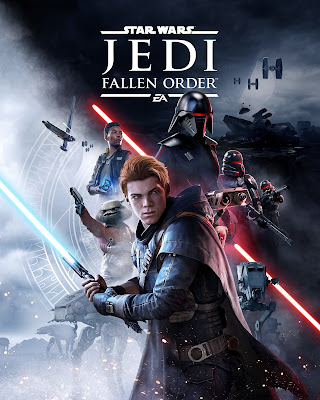
Star Wars Jedi: Fallen Order

Five years after the end of the Clone Wars and the collapse of the Galactic Republic, with the Empire rising to replace it, fugitive Padawan Cal Kestis is flushed out of hiding on the planet Bracca. Rescued by former Jedi Knight Cere Junda and starship captain Greez Dritus, Kestis discovers that the Empire and its Inquisitors are hunting for a Jedi holocron filled with the location of Force-potential children scattered across the galaxy. Kestis revolves to find the information first before the Empire can wipe out a potential new generation of Jedi.


There's a saying that if you're going to steal, steal from the best. Respawn Entertainment took that to heart when they were given the keys to make a new Star Wars action game. As well as the movies and expanded setting, they tapped games like Dark Souls, Metroid, Arkham Asylum and Castlevania for inspiration. The shadow of the Dark Forces (aka Jedi Knight) series, with its definitive first and third-person Star Wars action and unbeaten lightsabre combat, also looms large over Fallen Order.

Against such comparisons Fallen Order buckles but does not fail, and sometimes impresses. The game sees the player take control of Cal Kestis, former Jedi Padawan who has gone into hiding from the Empire. Flushed out by the Inquisitors, he is rescued by former Jedi loyalists and learns that he has to follow a trail of breadcrumbs across the galaxy in search of a Jedi holocron containing vital data. The Empire is also, of course, after that data and a race against time develops. The trail takes Kestis to several different planets, some new to the franchise, some well-known (thankfully, Tatooine is notable by its absence after its recent, massive overexposure). On these plants Kestis finds roadblocks to progress, but also learns new skills and gains new equipment which unlocks new routes on other planets. Hence he - slightly comically - is stymied by a slightly too high cave opening and has to travel five thousand light-years to get some special climbing gloves and then come back to climb to the opening.


It's daft but it works. As you to and fro across the galaxy, the story evolves and each world's levels evolve, giving you more new areas to explore, new enemies to fight and new skills to learn. It's fun, but drawbacks soon start appearing.

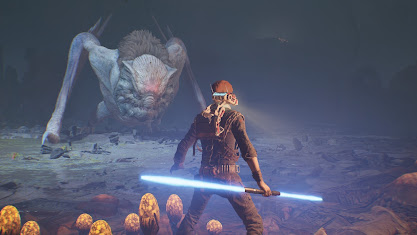
The first is how the game treats enemies. Fighting stormtroopers is fun and Fallen Order cleverly repurposes some of the types we've seen before: Return of the Jedi scout bike troopers are now reclassed as advance recon troops with special melee combat training; whilst flame and rocket troopers are much more lethal with those weapons than previously. Stormtroopers are less disposable goons here and have to be treated with some respect in how you fight them. Inquisitors, who are trained to fight Jedi one-on-one, are even more formidable, and their officers (and the main villains) are devastatingly effective bosses whom you have to learn Dark Souls-style attack patterns and blocking formations to defeat effectively. This is all excellent. Less excellent is the fact that you spend maybe around 25% of the time fighting any of this type of enemy. The rest of the time you are fighting deadly birds, angry plants, giant slugs, gianter insects and a quite bewilderingly huge variety of spiders. Why on Earth they spent so much time making the lightsabre combat so solid only to have you spend more than half the game fighting off wildlife with your laser sword is mystifying.


The game's trump card is its amazing level design, with levels that fold back on themselves quite ingeniously, fantastic use of vertical space and are also at least vaguely believable as actual spaces someone would live in or use. Less amazing is the game's tendency to overuse certain tricks like slippery slides. You will spend a quite astonishing amount of time in this game judging how to fall down a slide and making sure you hit turns correctly so you don't shoot off the side to an insta-death. These slides are absolutely everywhere, regardless of it it makes any sense or not. There's also a truly staggering amount of wall-running and double-jump puzzles (some inherited from the same developers' Titanfall series), some intricate and fun, others tiresomely frustrating.

For a game so rooted in precision jumping and controls, it also does have a fair bit of jankiness and iffy collision detection. There's a lot of clipping, allowing you to sometimes kill enemies through solid walls, and during boss fights it's not uncommon to see an enemy weapon go right through you without causing damage one second, and in the next hit thin air three feet away and cripple you. The jank never gets too bad, but it does feel like this is one area that needs to be worked on for the in-development sequel.


Still, negating the levels, fending off enemies and successfully deducing and executing the solution to an environmental puzzle never gets too old. The story is basic, but told with aplomb and some great voice acting, and the characters are great, especially Dathomir witch frenemy Merrin, who really should be the star (or co-star) of the next game, along with her ridiculously dry sense of humour. Kestis himself is a bit of a blank slate, though the utterly predictable mid-game struggles with the Dark Side do at least liven him up a bit.

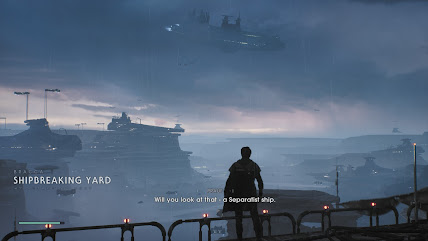
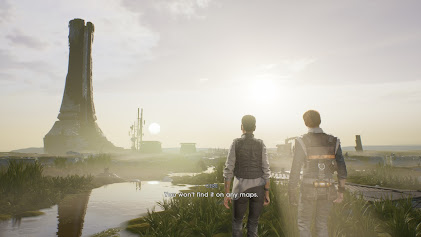
Graphically, the game looks phenomenal, although as a PlayStation 4/Xbox One game it does have that slight problem of needing to slow down progress to load the next environment in the background, leading to rather a lot of crawlingly agonisingly slowly through narrow passageways. The built-in 3D map is excellent (if occasionally confusing, especially regarding vertical travel) and the controls are mostly responsive and fluid (if occasionally requiring a bit too much ambidexterity on the keyboard).

Star Wars Jedi: Fallen Order (****) overcomes a fair bit of jank to emerge as the most satisfying Star Wars action game since Republic Commando in 2005. In terms of its mix of combat and action, it can't match the venerable Jedi Knight series - and Cal Kestis is no Kyle Katarn - and its occasional arbitrary limitations feel random. But the lightsabre duels are great fun, the level design is very solid and at 20 hours or so, it doesn't outstay its welcome. Fallen Order is available now on the PlayStation 4, PlayStation 5, Xbox One, Xbox Series X/S, Google Stadia and PC.

Tuesday, 25 January 2022

Three new STAR WARS video games announced, including what sounds like STAR WARS: XCOM

Electronic Arts and Respawn Entertainment have confirmed they are working on three brand-new Star Wars video games.


First up is Star Wars Jedi: Fallen Order 2, a sequel to the 2019 "Metroidvania"-alike which saw a young Padawan survive the Jedi Purge and attempt to lay the groundwork for the rebirth of the Jedi Order in the years between Revenge of the Sith and A New Hope. The game was extremely well-received, so a sequel is a no-brainer, and indeed, its existence was an open secret in the industry. It's believed that Respawn have already been working on the game for more than two years, so hopefully it won't be too long before it appears.

Second up is a new first-person shooter in the Star Wars universe. A lot of fans of the old Dark Forces/Jedi Knight FPS series were disappointed that Fallen Order did not lean more into that game's mix-and-match approach of allowing you to use blasters and lightsabres as you wished. It sounds like this new game will take care of the less Force-using side of the Star Wars universe. Respawn are masters of the FPS genre, having previously worked on the Titanfall series (and its popular spinoff, Apex Legends). Many of their developers were previously at Infinity Ward, where they made some of the better Call of Duty games. So this sounds like a particularly well-made match.

Third, and most intriguingly, is a strategy game that will be developed between Respawn and new studio Bit Reactor. Bit Reactor were founded just a few days ago by ex-Firaxis developers, including numerous veterans of both the XCOM and Civilization franchises, with a mission statement that they would be focusing on turn-based, cinematic experiences. That very much sounds to me like their game will be XCOM: Star Wars (or a close analogue of), which is a mouthwatering prospect, especially if they implement a proper strategy layer. This game sounds like it only literally just got off the ground, so don't expect it in the near future.

Alongside the Knights of the Old Republic Remake game currently in development at EA's Aspyr Studios, that brings the total number of Star Wars titles known to be in development to four.

The news has taken some in the gaming press by surprise, since Lucasfilm terminated their exclusivity deal with EA last year in favour of collaborating with a wider variety of studios. Ubisoft and Massive Games are making an open-world action game set in the Star Wars universe, whilst Quantic Dream is developing Star Wars: Eclipse, a story-focused game in the new High Republic time-period. A new Star Wars Lego game is also in development. The feeling was that maybe EA would focus less on Star Wars going forwards. However, their two Battlefront games and Fallen Order had sold almost 40 million copies between them, making them among EA's biggest recent successes.

Sadly missing from the announcements is any sequel or expansion for the splendid Star Wars: Squadrons. The game apparently did well (especially for a lower-budgeted game) but developers EA Motive had been put to work on a non-Star Wars project.

Friday, 21 February 2020

Yet another STAR WARS video game cancelled

The Star Wars franchise is in a really weird place right now. The movies are on hiatus (again), but the franchise is taking off on television. The pen-and-paper roleplaying game from Fantasy Flight has been canned despite good sales, but the current books and comics seem to be doing okay. Most puzzling has been the way that Electronic Arts has mishandled the video games licence since acquiring it seven years ago, with the news that an open-world spin-off from the Star Wars: Battlefront series has now been cancelled as well.


In May 2013, Electronic Arts announced that it had joined forces with Lucasfilm to develop a new generation of Star Wars video games. Previous games had been developed either by LucasArts (Lucasfilm's video games division) or in partnership between LucasArts and a host of talented third-party studios, including Totally Games, BioWare, Obsidian Entertainment, Pandemic Studios and Raven Software. These had included well-received titles including TIE Fighter, Knights of the Old Republic, Dark Forces, Jedi Academy and Republic Commando.

EA had worked closely with Lucasfilm and LucasArts on The Old Republic, a massively multiplayer game developed by EA's subsidiary BioWare and released in 2011. EA confidently believed their roster of talented subsidiary studios could release a plethora of high-quality Star Wars video games over the succeeding years. At first EA considered continuing the two Star Wars games in development at Lucasfilm, namely First Assault and 1313. The former was an online multiplayer shooter, whilst the latter was a story-focused action game set in Coruscant's criminal underworld. The former was feature-complete and beta-ready, whilst 1313 was starting to come together in a satisfying manner after several years of false starts.

Ultimately EA decided to bin both games and set their own studios to work. BioWare would continue to work on developing The Old Republic, with an eye to developing a new single-player game further down the line, possibly Knights of the Old Republic III. However, that idea never made it very far as BioWare's next several projects (Dragon Age: InquisitionMass Effect: Andromeda and Anthem) all hit hugely troubled development periods themselves.

Next up was Visceral Games, where a story-focused Star Wars heist game entered development under Uncharted producer Amy Hennig. Simultaneously, Respawn Entertainment was set to work on a story-focused Star Wars shooter/action game and DICE was to work on resurrecting the classic Star Wars Battlefront multiplayer series.

Visceral and Respawn developed their projects in tandem until late 2017, when Visceral was shut down and its Star Wars game abruptly cancelled. The assets from the game were moved to EA Vancouver to develop a brand new "open world" Star Wars game, possibly a reaction to the success of open world games like Skyrim, The Witcher III and Grand Theft Auto V. What exactly a Star Wars "open world" game would look like was rather unclear, but it sounds like it would have involved bounty hunters and space travel between several regions on several different planets. This new game was cancelled in turn in late 2018.

Respawn's project pivoted away from being a straight shooter to being a more general action game, which may have been the reason for Visceral's game being dropped (the two projects sounded more distinct at the start but then became more similar). Respawn's buy-out deal with EA was apparently very generous towards Respawn and granted the company a degree of self-autonomy which EA's other subsidiaries do not enjoy, explaining why the company got priority in this race. Respawn eventually released their game, Star Wars Jedi: Fallen Order last autumn to reasonably strong reviews.

EA Vancouver meanwhile set to work on a derivation of the Star Wars Battlefront series, potentially an open-world title which would have used the engine and systems of Battlefront but with a different focus, potentially similar to the relationship between the multiplayer Battlefield games and the single-player/coop-focused Bad Company and Hardline side-games. However, EA wanted the project for the release of the next-gen consoles in late 2020. When it became clear the game would miss that window, they cancelled it last year.

The result is that after seven years, five studios and untold hundreds of millions of dollars, precisely three games have actually been released: Battlefront (2015), Battlefront II (2017) and Fallen Order (2019). Avoiding total embarrassment, these games have sold very well: the Battlefront games have totalled over 24 million sales and Fallen Order has sold over 8 million copies in just two months on sale. But questions need to be asked about why so many promising games from talented developers have been canned and wrecked along the way.

Particularly interesting is the news that a Knights of the Old Republic reboot is in development at EA (but not with BioWare), along with a Fallen Order sequel at Respawn. The future roster of video games beyond that is doubtful at the moment, especially given that the EA deal reportedly expires in 2023, meaning that any game that started development right now is unlikely to be released before it expires.

Saturday, 13 April 2019

Respawn and EA lift the lid on STAR WARS: FALLEN ORDER

Developers Respawn Entertainment and publishers Electronic Arts have lifted the lid on their new Star Wars game, Fallen Order, with a trailer and confirmation of a release date.


Fallen Order is set a few years after the events of Revenge of the Sith and sees the player controlling a Jedi Padawan named Cal Kestis (played by Cameron Monaghan, the Joker in Gotham), who escapes the chaos of the Republic's fall to go into hiding as a mechanic. Exposed as a Force-user when he uses his powers to save a fellow worker from certain death, he goes on the run, hunted by Imperial agents.

The game is an action title with a focus on movement, speed and combat, both with blasters and a lightsabre. Most promisingly, the game is confirmed to be a single-player-focused experience with no multiplayer element. The game was apparently strongly inspired by the classic Jedi Knight series of action games released between 1995 and 2003 (Dark Forces, Jedi Knight, Mysteries of the SithJedi Outcast and Jedi Academy).

"Human stretch goal" Chris Avellone is one of the writers on the game. Avellone previously wrote for Knights of the Old Republic II: The Sith Lords (2004) and other titles including Fallout 2, Fallout: New Vegas, Neverwinter Nights II, Planescape: Torment, Pillars of Eternity, Divinity: Original Sin II and the forthcoming Dying Light 2.

The game is part of a package negotiated between EA and Lucasfilm to release a series of new Star Wars video games. However, the only releases from this deal to date have been multiplayer titles Battlefront (2015) and Battlefront II (2017) (although the latter had a brief story campaign as well). A story-focused game from Visceral Games, inspired by Uncharted, was cancelled in 2017, whilst a possible new game from BioWare, a remake or sequel to the Knights of the Old Republic series, never got off the ground. Reportedly, EA had strong issues with both projects due to their single-player focus, with them preferring "games as service" models with a heavy multiplayer focus with incremental updates and the potential for players spending more money through microtransactions.

That Fallen Order is therefore a single-player title is surprising, given that Respawn's previous single-player-focused game, Titanfall 2, sold modestly and their biggest recent success was multiplayer shooter Apex Legends. It's possible that Fallen Order survived this purge due to fast work by Respawn, superior negotiating team by the company's management (especially since Apex Legends went stratospheric) and EA's own desire for damage control to its own reputation.

Whatever the case, Star Wars Jedi: Fallen Order is the most promising Star Wars video game in many years, and it will be out on X-Box One, PlayStation 4 and PC on 15 November 2019.