Showing posts with label riftwar saga. Show all posts

Wednesday, 2 February 2022

Raymond E. Feist and Janny Wurts' RIFTWAR SAGA and EMPIRE TRILOGY optioned for television

The first six books in the enormous Riftwar Cycle of fantasy novels have been optioned for television by new production company Six Studios. The startup has already brought together an impressive array of talent to work on the project.


The Riftwar Cycle is a series of 29 epic fantasy novels, mostly written by Raymond E. Feist, unfolding over a period of some 300 years and charting the conflicts between the world of Midkemia and various other worlds which it becomes linked to via rifts in space and time. The series has sold over 20 million copies and was one of the biggest-selling epic fantasy series of the 1980s and 1990s. The series is divided into ten distinct sub-series, each with its own story arc and cast of characters. The series was originally written to provide backstory for a tabletop roleplaying campaign that Feist was playing in at university, with the world of Midkemia originally created by Steve Abrams.

The deal includes the rights to the three novels in Feist's Riftwar Saga trilogy - Magician (1982), Silverthorn (1985) and A Darkness at Sethanon (1986) - and the three books in The Empire Trilogy, co-written by Feist and Janny Wurts - Daughter of the Empire (1987), Servant of the Empire (1990) and Mistress of the Empire (1992). These two series take place simultaneously alongside one another.

The story begins by focusing on the adventures of Pug and Tomas, two young boys growing up in and around the frontier town of Crydee, located in the far west of the vast, sprawling Kingdom of the Isles, which has expanded beyond its island homeland to conquer most of the northern third of the continent of Triagia (on the planet Midkemia). It is opposed to the south by the far larger Empire of Great Kesh. Crydee, wild but tranquil, abruptly finds itself on the front lines of an unexpected war when a magical rift in time and space opens, linking the territory with the Tsurani Empire on the planet Kelewan. Kelewan is poor in metals, whilst Midkemia is rich with them, and the Tsurani embark on a military campaign to seize and hold territory and mine metals to ship home. Pug and Tomas, now an apprentice magician and warrior respectively, find their fates bound up in that of the ruling conDoin family as they seek to rally support from the rest of the Kingdom to oppose the invaders.

The Riftwar Saga tells the story of the war from the Kingdom's perspective, and subsequent events as the moredhel or dark elves of the far north take advantage of events to plot their own invasion of the Kingdom in search of a magical artefact of tremendous power. The Empire Trilogy tells the story of the war from the Tsurani perspective, in particular focusing on the adventures of Mara of the Acoma, a noblewoman who takes control of her family after the death of her father in battle on Midkemia. Mara has to navigate the labyrinth politics of the Empire to retain her position and improve the fortunes of her weakened house.

The Riftwar Saga and especially the Empire Trilogy are both critically-acclaimed, the latter in particular for its rich, compelling political intrigue as well as its focus on female characters at a time when the genre was not known for them.

The new project will be produced by entrepreneurs Jeff Huang and Carl Choi and written by Hannah Friedman (Willow, Obi-Wan Kenobi), Jacob Pinion (Fear the Walking Dead) and Nick Bernardone (Fear the Walking Dead, Unbreakable Kimmy Schmidt). Kiri Hart (Soul, Rogue One) and Stephen Feder (Solo: A Star Wars Story) will co-produce and serve as consultants. Feist and Wurts - who just wrapped up her own, massive Wars of Light and Shadow saga - are expected to consult.

Six Studios are looking for a network or streamer to collaborate with on the project.

Friday, 21 September 2018

RIFTWAR TV series in early development

Raymond E. Feist's Riftwar Cycle has been optioned for television by production company BCDF Pictures. Kurt Johnstad (300Atomic Blonde) is writing a script based on the first novel in the series, Magician, which would presumably serve as the first season of the series.


It should be noted that there is no director attached and no studio has picked up the project yet. BCDF Pictures has mostly succeeded in getting low-key, low-budget movies made like Liberal Arts and Higher Ground, so this would be quite a departure for them.

The Riftwar Cycle spans 29 novels (divided into ten smaller series), 3 short stories, a novella, a companion book and two video games, all published between 1982 and 2013. The series was based on an earlier series of roleplaying game products from Midkemia Press, released in the late 1970s. The series has sold more than 25 million copies to date, although the first novel, Magician, is by far the biggest-selling and most popular individual book in the series. Raymond E. Feist wrote 23 of the novels by himself, co-wrote 3 novels with Janny Wurts and 3 more books were written by other authors based on Feist's ideas. There have apparently been multiple attempts to option Magician over the decades, but Feist has rejected them because he found them not to be faithful enough to the series.

Magician tells the story of the Kingdom of the Isles, a nation on the world of Midkemia, which is invaded via dimensional portals by forces from the Tsurani Empire, located on another world. Later books in the series expand the setting to bring in demons, dark gods, chaos magic and other elements. Presumably no TV series would try to adapt all 29 books (especially since the latter half of the series was pretty much phoned in compared to the first), so it'll be interesting to see what the masterplan is for the project.

More news if it develops.

Tuesday, 5 June 2018

Grimoak Press to publish limited editions of the RIFTWAR and EMPIRE trilogies

Grimoak Press have announced they are releasing new, limited and illustrated editions of Raymond E. Feist's Riftwar Saga and the Empire Trilogy, co-written by Feist and Janny Wurts.


Fantasy artist Don Maitz will be handling both cover and interior artwork. Magician, Feist's seminal first novel, is first up for the treatment and will be followed by Silverthorn and A Darkness at Sethanon. Feist and Wurts' Empire Trilogy, usually acclaimed as one of the best epic fantasy trilogies of all time, will follow: Daughter of the Empire, Servant of the Empire and Mistress of the Empire.

Although much can be said about how the later books in the Riftwar Cycle (the 29-volume mega-series of which the Riftwar Saga and Empire Trilogy are the opening parts) went massively downhill, these early books are still exemplary, fun fantasy, the Empire Trilogy in particular impressive for its non-European setting, female protagonist and use of non-standard fantasy tropes.

Saturday, 12 September 2015

A History of Epic Fantasy - Part 9

If 1977 was the year that epic fantasy came of age, it took another couple of years for the genre to start unfolding in earnest.


Stephen Donaldson rapidly followed up on Lord Foul's Bane with two sequels, The Illearth War (1978) and The Power That Preserves (1979), completing The Chronicles of Thomas Covenant, the Unbeliever. He then immediately launched into The Second Chronicles of Thomas Covenant, which attempted to answer the lingering questions from the first trilogy, such as whether the Land is real or not, by introducing a second major POV character, Linden Avery. The Wounded Land (1980), The One Tree (1982) and White Gold Wielder (1983) were also big sellers, establishing Donaldson as a successful author.

However, Terry Brooks took a bit longer to follow up on the success of The Sword of Shannara. He'd taken a decade to write the first book and was still writing around his law practice hours. This problem was magnified by his originally-planned sequel being rejected by Del Rey Books when it was three-quarters done (with Brooks struggling with the ending). This necessitated a page one restart and rewrite. This proved fortuitous, for although it delayed the publication of The Elfstones of Shannara until 1982 it also resulted in a rather stronger book than otherwise may have proven the case. The Elfstones of Shannara, although another classic quest narrative, was considerably different to its predecessor (and Tolkien) and was much more warmly received. It's still widely regarded as Brooks's best novel, and forms the basis for the first season of the Shannara TV series due to start airing in January 2016. In fact, Brooks was unusually slow (compared to some of his contemporaries) to exploit the Shannara brand. The third novel, The Wishsong of Shannara, did not appear until 1985 and it would be another five years before he returned to the setting with the four-volume Heritage of Shannara series, after a stint writing the Magic Kingdom of Landover comic fantasy series.

During this period another highly influential work appeared, although it is not epic fantasy in itself. Instead, Gene Wolfe's Book of the New Sun (written as one novel but published in four volumes between 1980 and 1983) belongs to the Dying Earth subgenre of fantasy, being set on Earth in a remote future epoch when the Sun is dimming. Influenced by Jack Vance's Dying Earth series, the Book of the New Sun can be read as a sustained study of fantasy tropes. The "hero", Severian, is a torturer who has committed amoral acts and is only moved to a more repentant life when he falls in love/lust with one of his victims. As the story continues it becomes clear that Severian is some kind of "chosen one", but he is isn't necessarily a benevolent or kind one. In fact, Wolfe makes it clear that Severian is a liar, and the novel is riven with the inconsistencies and contradictions of a supremely unreliable narrator. Wolfe also equips Severian with a number of magical (or highly technologically advanced) weapons and items, such as the execution sword Terminus Est, but unlike many epic fantasies Severian is not dependent on such trinkets, and achieves his destiny by his own means. The Book of the New Sun and its sequel, The Urth of the New Sun, are both rationalised and revisionist fantasies, challenging the conventions of the genre but employing them to make their points. Two sequel series, The Book of the Long Sun and The Book of the Short Sun (the three series combined forming the 12-volume Solar Cycle), are more overtly SF.

More traditional epic fantasy had to wait until 1982, when two more important and influential books arrived within a few months of each other.


Pawn of Prophecy

David Eddings had been a frustrated writer for many years. He'd published an adventure novel, High Hunt, in 1973 but it had not been a big success. In his late forties he was considering his next writing project when he was surprised to see a copy of The Lord of the Rings on a shelf in a bookstore. His reaction was to say "Is that old turkey still around?" Then, leafing through the book, he was shocked to see it was on no less than its 78th printing. Realising there was money in them there epic fantasy hills, he went home, revised an old fantasy map he'd doodled a few years earlier and set to work.

Eddings did not write alone but collaborated with his wife, Leigh. Together they wrote a traditional (but not completely standard) epic fantasy trilogy and started shopping it around. Lester del Rey, searching for a follow-up to The Sword of Shannara, fell on it like a starving man and not only published it but blitzed it with ideas: the three books were chunky, so he divided them into five novels with slightly corny chess-inspired titles. He then decided that co-authored books would not sell (Weis and Hickman, two years later, would prove him wrong on that) so he had them credited to David Eddings alone, something that mildly irked the writers until they were able to change it a decade later. With some canny marketing and more maps than you can shake a stick at, the result was one of the key early works of epic fantasy: The Belgariad.

The Belgariad opens with a farmboy, Garion, discovering that Dark Forces are awake in the world and have taken a Special Interest in him. He is whisked away from his home by the Grumpy Mentor Wizard Belgarath and learns that he is the Chosen One who will both oppose the Dark God and is fated to rule as the High King of Riva. He reluctantly falls in love with a Feisty Princess, Ce'Nedra of Tolnedra, and eventually defeats the bad guys with the help of Prophecy.

The series is pretty standard, but has a few individual flairs. None of the standard fantasy races are involved, the tone is reasonably light-hearted throughout and the characters are all pretty damn reasonable. Sworn blood-enemies become best friends just by chilling with one another for a while and even the bad guys are treated with compassion. In fact, the sequel series (the considerably inferior Malloreon) is largely concerned with bringing in former enemies from the cold to work with them. There is a lot of humour, and although a lot of it is tired and repetitive there are some genuinely good ideas: the prophecy is semi-sentient and at times seems exasperated with the poor material it has to work with (less-whimsical echoes of this may be detected in The Wheel of Time). None of this is earth-shaking stuff, but it does make The Belgariad a little bit more interesting and bearable than it might be otherwise. The series has more recently been repackaged as a Young Adult series, which is a sensible move that has won it over a legion of new fans.


Magician

One of the curses of epic fantasy, and indeed any author who opens with a massive hit, is that authors often find it hard to achieve that success again with another work. The preponderance of long series in fantasy is partly down to this issue. Stephen Donaldson found that his sales more than halved when he completed the then-six volume Thomas Covenant series in 1983 and moved on to Mordant's Need, a less serious, more Zelazny-influenced duology. When he moved on again to space opera, with the brilliant Gap saga, his audience more than halved again. It wasn't until he returned to the Land with The Last Chronicles of Thomas Covenant in 2004 that he found his sales shooting back up again. Frank Herbert experienced the same issues when he moved away from his Dune series.

Raymond Elias Feist's experience is a bit odder. He's sold somewhere in the region of 30 million copies of his thirty novels, which is impressive. However, apparently between one-quarter and one-third of those sales have come from his debut novel alone: Magician.

Feist started writing Magician in 1977, when he was 32 years old. He was a mature student at the University of San Diego and, whilst studying, played roleplaying games with some of his fellow students, initially on Thursday nights and later on Friday nights. One of the other guys in his gaming group, Stephen Abrams, had created his own fantasy world complete with a detailed geography and history. The group collaborated on producing materials for this world, which was dubbed Midkemia. With their permission, Feist started writing a novel set 500 years before the "present" of the setting.

Magician was published by Doubleday in 1982 and was an immediate success, winning some laudatory reviews and soon some big sales. As a debut novel, it has some problems in prose and dialogue, but for the most part it is a fast-paced, action-packed and rather unusual fantasy novel which disposes of many of the key features of the genre.

The book opens with two young boys, Pug and Tomas, living and working in the castle of Crydee, the administrative capital of the lightly-settled Far Coast of the Kingdom of the Isles. This remote, largely-neglected area is thrown into chaos when a strange ship washes up on the nearby rocks and mysterious invaders are soon spotted in the nearby forests and mountains. It is soon revealed that a magical portal has been discovered, linking Midkemia to the world of Kelewan. Kelewan is light in metals and the powerful Tsurani Empire wants to establish a foothold on Midkemia to strip-mine its resources. The Kingdom, allied with the local elven and dwarven kingdoms, soon launches a military campaign against them and the result is a desperate struggle, with the Kingdom's numerical superiority threatened by the Empire's more devastating and powerful use of magic in war. Tomas inherits the magical powers of a long-vanished race and is able to turn the tide against the Tsurani at the risk of his own soul, whilst Pug is captured and taken to Kelewan.


Magician is a novel that pays homage to standard tropes: Pug is an orphan boy with a great destiny, there is a desperate journey through an ancient mine which splits the party of the heroes and there are numerous, large battles. However, the book also dispenses with other cliches: Pug's parentage is utterly irrelevant (they were just peasants and Pug has no bloodline-related fate; sometimes a spade really is just a spade), the ancient magical spirit in the mine is friendly and, very weirdly, there is no main bad guy. There are antagonists, such as the Tsurani Warlord and Guy du Bas-Tyra, but one of them is merely an opportunist and the other is redeemed in one of the sequels. The characters are instead all at the mercy of circumstances. There are no prophecies and no dark lords.

Magician is also, refreshingly, a stand-alone novel. It ends fairly decisively and the narrative is self-contained. Feist did write more material setting up sequels, but this was cut by the editors; his revised edition of the novel, published in 1992, reinstated these elements but the book remains very readable on its own terms. In fact, Feist did such a good job of wrapping up the story that only a relatively small number of readers moved onto the sequels, although still enough for them to sell very, very well.

Magician's impact on the genre can be seen in several key ways. It was the first epic fantasy novel to be spun directly off a roleplaying campaign. It was the first epic fantasy book to be built around collaborative worldbuilding. It also took on board elements of travel between multiple worlds and realities, bringing in both a second planet to serve as a location as well as different planes of reality. Sword and sorcery had dabbled with this (such as in Moorcock's own multiverse) but Feist's version was more orderly and less chaotic.

It also established a slightly iffy precedent for the publishers of epic fantasy to split up novels into smaller volumes for financial gain. Magician is not a very large book (under 300,000 words, maybe even shorter than The Sword of Shannara) but the paperback was split into two volumes for the US paperback, entitled Magician: Apprentice and Magician: Master. The UK edition remained in one volume. Annoyingly, many later and more recent books have suffered from this as well, with a lack of coherence on what makes a book too big for one volume. Obviously Tad Williams's To Green Angel Tower (at 520,000 words) was too big for one volume but it's also clear that George R.R. Martin's A Storm of Swords and A Dance with Dragons (both 420,000 words) - both split in the UK - could have both been one volume each in paperback, and in fact were in the USA. More recently, the UK edition of Pat Rothfuss's The Wise Man's Fear was published in one volume but Brandon Sanderson's Way of Kings and Words of Radiance were both split, despite the books being all the same size and the publisher being the same (Way of Kings has since been reissued in one volume, suggesting that Sanderson's sales are now high enough to justify the one-volume treatment).

Magician was a solid book with some nice humour in it, but epic fantasy as a whole remained a fairly serious field at this point. But fortunately there had already been some attempts to make a funny epic fantasy, and the biggest fantasy series since Tolkien was about to begin with a warm satirising of the genre.

Wednesday, 13 November 2013

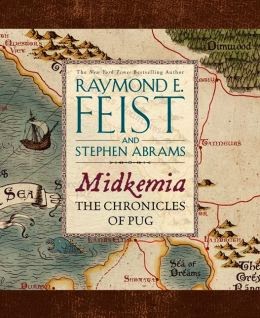
Midkemia: The Chronicles of Pug by Raymond E. Feist and Stephen Abrams

Earlier this year, Raymond E. Feist concluded his Riftwar Cycle of epic fantasy novels. The sequence that began in 1982 with the publication of Magician concluded with Magician's End, resulting in a massive series consisting of thirty novels spread over ten sub-series. Six of the novels were co-written with other authors, but the rest are solely by Feist. However, it's less well-known that the world of Midkemia is not Feist's creation, instead being conceived by Stephen Abrams. Abrams and Feist attended the University of San Diego together in the 1970s and Abrams created the world for use in roleplaying games. Feist later (with Abrams's permission) used the setting for his novels, fleshing it out further.


Thirty-five years later, Feist and Abrams have regrouped to deliver a companion book to The Riftwar Cycle, featuring maps, artwork and further information on the world of Midkemia not given out in the novels. Whilst I haven't followed the later Riftwar novels (I bowed out after the quite amazingly boring Talon the Silver Hawk), I did enjoy the early ones and particularly liked the worldbuilding (haphazard as it was) depicted in the books and the spin-off computer games (Betrayal at Krondor and Return to Krondor), so I was looking forward to seeing that background fleshed out.

I was disappointed. As a companion book, Midkemia: The Chronicles of Pug is sorely lacking in almost every department. The first thing that grates is a lack of proof-reading: the book is riddled with spelling errors on both the maps and in the text (Shamata is frequently rendered as 'Shomata', whilst 'Murmandamus' is spelt in several different ways depending on the writer's whim of the moment). The maps are pretty, but difficult to use. The fonts render many names difficult to read and the artist seems to frequently get bored and only fill in the trees around the edges of the forests, making it look like Midkemia's woodlands are all plains surrounded by a ring of trees. Also - though this is a long-standing problem from the book maps as well - the mountains are depicted as quite ludicrously-sized given the scale used. The continent of Novindus continues to look like a small island instead of a huge landmass. There is also a discrepancy between the size of the Empire of Great Kesh on the maps and its reported size in the books (several times that of the Kingdom, whilst the maps show it as roughly the same size), and contradictory statements in the book which say that Kesh is sparsely-populated with the cities separated by vast gulfs of wasteland, whilst the novels report that Kesh has many times the population of the Kingdom. There's also the problem of the maps featuring locations that don't actually exist when the map was supposedly made: Port Vykor (or Vikor, as the maps never seem to agree on a spelling), founded after Rage of a Demon King, is shown on maps pre-dating Magician, more than fifty years earlier. Oh yes, and there's supposed to be two world maps of Midkemia, showing the state of the world at the start of Magician and after Magician's End (both visible on various fansites promoting the book) but only one of the two world maps is actually in the book. The other one seems to have simply been forgotten. This is made more amusing by the surviving book having 'MAP II (2)' written on it with 'MAP I (1)' nowhere to be found (in the UK first edition, it should be noted).

Then there's the actual text itself. Those expecting a book which talks about geography, history, society, customs, cultures and so on will be in for disappointment. The text is a fairly basic plot summary of the events of The Riftwar Cycle. Sidebars and illustrations show there is some potential in this approach: a map of Sorcerer's Isle appears at the relevant point in the text, followed by maps of the Sunset Islands when they first appear and so on. Occasionally the summary of plot elements the reader is probably already familiar with is interrupted by a little bit of background information on politics or culture, but such moments are rare and fleeting. The depth and usefulness of the plot summary amusingly mirrors the general consensus of the quality of the books: the events of Magician are covered in substantial depth, then Silverthorn through Rage of a Demon King in somewhat less detail, and then all of the books afterwards (which is almost two-thirds of them) are covered in just a few pages of confusingly repeated names and events which sound generic to the point of painfulness (having bailed out after Talon of the Silver Hawk, I see I'm not missing very much).

Only one of these maps is actually in the book. Oops.

The book is accompanied by artwork from Steve Stone. These aren't actual illustrations, however, but rather stiff and unconvincing 'photo art' featuring posed models in front of CG backgrounds. Occasionally this is effective (Amos Trask's ship running the Straits of Darkness is pretty good) but most of the time it's awful, not helped by occasional re-use of the same model to depict completely different characters.

There are moments when the book comes to life: the opening couple of chapters feel more inspired and some of the maps expanding on the somewhat-confused geography of Silverthorn and A Darkness at Sethanon are genuinely useful. Occasional bursts of background material hint at much more interesting detail. Getting 'canon' maps of the Keshian Confederacy and the full Empire is also gratifying (though it turns out they are pretty much the same as the ones that have been available on the Elvandar website for many years). But ultimately this is a companion book which tells us almost nothing about the history, chronology, societies and cultures of the world it's named after, which is a baffling choice.

Midkemia: The Chronicles of Pug (**) is a disappointing volume, featuring almost none of the information that I suspect readers will really be interested in or expecting. Instead, it's an unproofed plot summary of books they've already read, interspersed with bad artwork, ill-detailed maps and an astonishing number of spelling mistakes. There are a few, scant interesting nuggets of new information to be found and some maps that helpfully clarify confusing descriptions in the books, but beyond that this book is not really that useful. One for die-hard fans and completists only. The book is available now in the UK and USA.

Thursday, 7 March 2013

RIFTWAR companion volume to be published in 2013

The last-ever novel in Raymond E. Feist's Riftwar Cycle, Magician's End, will be out in May. This is the 30th novel in the series and marks an end to the saga that began back in 1982 with the publication of Magician.


Appropriately, it has been revealed that there will now also be a companion volume to the series. Entitled Midkemia: The Chronicles of Pug, this book will be a 192-page 'coffee table' book containing illustrations and extensive maps about the world of Midkemia. The project grew out of a mooted 'Midkemia Atlas' that Feist planned several years ago. The book will also feature 'narration' from the characters of Pug and Magnus.
“In the first year of the reign of King Lyam conDoin, I, Pug of Crydee, magician to the royal court and cousin to the King by adoption, do take quill in hand and set forth this writ, that all may benefit from the knowledge I have gained…” -Pug of Stardock

So begins the narrative account of Feist’s best-selling character, Pug of Stardock, for Midkemia: The Chronicles of Pug. Part travel log/journal and part atlas, this visual compendium brings the world of Midkemia to vivid, illustrative life, and gives readers a completely new look at the creative genius of Raymond E. Feist.

Designed and illustrated by the same creative team that brought us the Harry Potter books (Film Wizardry and Page to Screen), Midkemia: The Chronicles of Pug is divided into five sections and transports readers -- via maps, blueprints, floor plans, and journal text -- to the outer reaches of the Midkemia world and into its cities. Starting at the Far Coast, Pug, the hero of The Chaoswar Trilogy, recounts his childhood, before he embarks on a journey that takes him to the Grey Towers, Sorcerer’s Isle, and Krondor. Pug also encounters several favorite characters and people along the way -- including Jimmy and Locky, the Sauur, and Erik and Roo in Ravernburg. Beautiful hand-drawn maps illustrate the changes in Midkemia’s geography as war ravages the land and physically alters the landscape; dedicated readers and fans can literally trace the changes made by each battle. Unlike anything else in the Feist oeuvre, this book is a totally immersive look into the world of Midkemia as never experienced before.
Notably, Feist is co-writing this book with Stephen Abrams. Stephen Abrams created Midkemia in the mid-1970s as a roleplaying setting. Feist, a player in Abrams's games, started writing the Riftwar Cycle to 'fill in' the history of the roleplaying setting at Abrams's suggestion, with Magician set some 500 years before the 'present day' of the setting. The original plan was for Feist to write the account of the five great Riftwars that shaped the history of the planet. Impressively, some thirty-five years after that discussion, that's pretty much the task that Feist has now completed.

The book is currently scheduled for publication on 5 November 2013 from Harper Design. A working cover is shown above. You can look inside the book and see how it's going to look here.

Thanks to Jussi from Risingshadow for discovering the above information.

Saturday, 10 November 2012

A size comparison of fantasy worlds

Something that may be of marginal interest. A size comparison of various fantasy worlds that I created:


At top-left is Westeros/Essos (the HBO version of the latter) from George R.R. Martin's A Song of Ice and Fire. Next to it on the top line is J.R.R. Tolkien's Middle-earth, with Ansalon from the Dragonlance world next to that. Below them is Robert Jordan's Wheel of Time map (which was tricky to get right, as the distances given in the books are sometimes contradictary). At bottom-right is Raymond E. Feist's Triagia (on the world of Midkemia), the setting for most of his Riftwar fiction. At bottom-left is Faerun, the principal continent of the Forgotten Realms world.

Something that is surprising here is how small Middle-earth is compared to these other, later-created fantasy worlds.

Sunday, 5 August 2012

Raymond E. Feist's MAGICIAN gets a new UK cover

Raymond E. Feist's debut novel, Magician, is getting some new cover artwork, presumably to tie in with the novel's impending 30th anniversary and the release next year of the very last novel in the Riftwar mega-saga. Here it is:


Hmm. Considering that Magician is an epic fantasy war story spanning twelve years, two planets and involving thousands of warriors and wizards fighting one another on a truly vast scale, "Hooded guy holding some keys," isn't really cutting it for me. The new edition will be published next month in the UK.