Showing posts with label the wrath of khan. Show all posts

Sunday, 23 May 2021

Wertzone Classics: Star Trek II: The Wrath of Khan

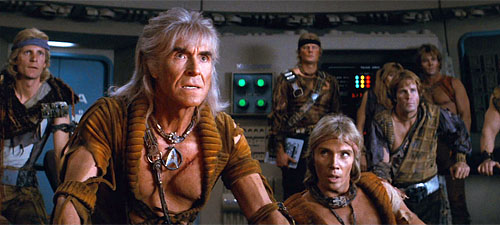
The Genesis Device: a machine of capable of terraforming a lifeless body into a terrestrial planet within hours. But it also has the potential to be used as a terrible weapon. The USS Reliant is assigned to help the Genesis science team find a planet to test the device, but inadvertently stumbles across the exiled home of genetically-engineered tyrant Khan Noonian Singh and the crew of the sleeper ship SS Botany Bay. Khan seizes control of the Reliant and develops a plan with two objectives: the capture of the Genesis Device, and the death of the man who sent him into exile for fifteen years, Admiral James T. Kirk.


If there's a list of "what not to do" when you make a popcorn-selling, blockbuster film, Star Trek II breaks every rule on it. You shouldn't make a film in which the hero and villain never come face-to-face; you should never make a film where the plot is a sequel to a single episode of television which aired fifteen years earlier (certainly not in 1982, when you can't even buy that episode on VHS); you should not have a film completely lacking in any kind of romance plot; you should not have your villain in an inferior spacecraft to the good guys; and you probably shouldn't pepper the film with quotes from literature and ensure the script is full of thematic richness.

It's by breaking every one of those rules that Star Trek II: The Wrath of Khan became not only the finest Star Trek movie ever made (a position it retains with near-contemptuous ease forty years on), but a genuinely great science fiction movie, one of the very best of the 1980s which marks a place on the podium alongside the likes of Aliens, The Terminator, Back to the Future, Predator, The Empire Strikes Back. It certainly saved the Star Trek franchise after the over-indulgence of Star Trek: The Motion Picture nearly sank it, and set the scene for everything that followed, including two direct sequels and a plethora of spin-off TV shows.

The Wrath of Khan works on every single level. Franchise newcomers Harve Bennett (writing) and Nicholas Meyer (directing) brought both a fresh viewpoint but also respect for the property when coming aboard. Bennett watched every single episode of Star Trek ever made to come up with ideas for the story, whilst Meyer engaged the actors in long conversations about their characters and motivations. The actors, who were generally not tested by the material in The Motion Picture, are given much richer material here. There seems to be more dialogue in the opening half-hour of this film than there is the entirety of its forebear, and it's great stuff. Kirk is struggling with a full-blown midlife crisis, moving between self-pity and frustration, and the oft-mocked Shatner sells that extremely well. Shatner in fact gives a career-best performance in this movie and its sequel, with the scripts calling on him to plumb emotional depths he is rarely asked to do elsewhere. DeForest Kelley also delivers impressively as McCoy tries to help his friend whilst calling him on his BS. Leonard Nimoy gives a terrific performance as Spock, as you'd expect, but goes above and beyond the call of duty, especially in his scenes at the end of the film.

The rest of the crew are under-serviced as normal, but do at least get a few good scenes: James Doohan's Scotty has to deal with the death of a family member in service and Walter Koenig's Chekov gets a promotion to first officer of the USS Reliant and more involved in the story. Nichelle Nichols and George Takei get relatively short shrift (Sulu had more material where it's revealed he's been promoted to Captain and is going out on one last hurrah, but it was cut in production). Newcomer Kirstie Alley gets a lot more great material as Lt. Saavik and is a very fine addition to the crew, and it's a shame she did not return in subsequent films. Oddly, a line referencing the fact that Saavik is actually half-Romulan, half-Vulcan was cut from the movie (and not restored in any one of the half-dozen or so different cuts and edits of the movie released over the years), whilst a later joke by McCoy referring to this fact is left in, somewhat confusingly, but it's not a major issue.

Towering over the film, however, is Ricardo Montalbán, reprising his role as Khan from the 1967 TV episode Space Seed. Montalbán was nervous at reprising the role after such a long break, especially since he'd been playing the moral Mr. Roarke on Fantasy Island for five years and was concerned about his image. However, it only took a single re-viewing of the original episode to find the character again. Montalbán is a magnetic, charismatic presence who dominates the film but never overwhelms it. Whether it's quoting Moby Dick or plotting his vengeance on Kirk, he's a formidable opponent and comfortably earns his reputation as Star Trek's greatest single villain, with his defeat coming as a result of his own hubris and inexperience at commanding a starship rather than some deus ex machina moment.

The film was famously produced for a tiny budget (barely a quarter that of The Motion Picture), restricting most of the action to the Enterprise bridge (which pulls double duty as the bridge of the Reliant) and other sets inherited from the original movie, and the Regula I space station. Fortunately, a positive studio reception to early footage saw the effects footage expanded, and the visual effects in the space battles between the Enterprise and Reliant remain outstanding four decades on. The battles are well-handled, depicting the two ships as lumbering battleships able to both dish out and withstand tremendous amounts of punishment, but every hit still hurts and can still kill people. The Enterprise is a larger, more powerful ship but the Reliant gets the drop on it in the first fight, making for an evenly-matched climactic battle in the Mutara Nebula (impressively depicted with gas and fluid tanks). The battle is also tremendously visceral, with decks collapsing and crewmen getting crushed, burned or subjected to lethal radiation in a manner that hadn't been seen previously on Trek (and led to the movie getting a hitherto unthinkable "15" certificate in the UK).

Arguably the most influential, important scene in the movie in terms of technical legacy is the still-impressive sequence depicting the Genesis Device terraforming a planet. Completely generated in a computer in 1981, it is one of the first 100% computer-generated scenes to ever appear in a movie (certainly one that wasn't a simple wireframe). The team behind it went on to other things; they later rebranded themselves under the name "Pixar."

Particularly worthy of mention is James Horner's score, which re-uses a few elements from his earlier movies (particularly Battle for the Planets) but mostly consists of new material. His new overture, used for flybys of the Enterprise and the main title theme, is an instant classic. Of course, what really got people talking when the movie was released was the jaw-dropping ending, which in the pre-Internet age had successfully been kept secret in a manner unlikely to be replicated today (and rumours about it had been deflected by the opening scene of the film, which misled audiences). It's still an emotionally powerful moment played by the actors in a convincing and almost poetic manner. In fact, despite the sometimes hokey dialogue as related above, the movie has a number of iconic lines and quotes (mostly from A Tale of Two Cities and Moby Dick) which help give the movie a thematically satisfying through-line. This is a movie about not just revenge, but age, finding your right place in the world and the fact that the needs of the many outweigh the needs of the few (or indeed, the one). There's also satisfying attention paid to not copping out on the story. The writers couldn't conceive of a way that Khan and Kirk could meet without Kirk being killed, so they simply don't meet. And whilst victory is eventually won, it is only at a hard, hard cost.

Star Trek II: The Wrath of Khan (*****) is a great movie about revenge, family, the road not travelled and aging. It's also a terrific action movie, but one where the action is not allowed to outweigh the characterisation. It's simply a classic science fiction movie and represents the standard that Star Trek would occasionally, at its very best, match (in episodes like The Best of Both Worlds, The Inner Light, The Visitor and In the Pale Moonlight), but never exceed.

A note on versions: Star Trek II has been reissued and re-released more than any other Star Trek film, and three distinct versions now exist. The original, 113-minute theatrical cut remains very fine and can be found on the 2009 Blu-Ray collected edition of the first ten films. An extended or "TV" cut, three minutes longer, adds a few scenes that were cut from the theatrical version of the film (such as Kirk's shuttle approaching the Enterprise and Kirk meeting Peter Preston in Engineering). The Director's Cut, overseen by Nicholas Meyer and released on DVD in 2002 and Blu-Ray in 2016 (as a digitally-remastered version which rebuilds the movie from scratch from the original film elements), is now definitive. It recuts several scenes to incorporate more dialogue and characterisation and confirms that Preston is Scotty's nephew. The Blu-Ray version did accidentally omit a scene where Kirk tells McCoy and Saavik that David is his son. This version of the film has also been listed several times for 4K release, which for some reason has never appeared.

Note: I previously reviewed the film here.

Thursday, 3 August 2017

CBS planning a second STAR TREK series...which is also a prequel

CBS's Star Trek: Discovery finally starts airing in September and it'll be interesting to see how well the show does. The series has already made a strong profit from overseas sales (mostly through Netflix) before it even arrives on CBS All Access in the United States, so it will be interesting to see how well it does. However, not willing to let the grass grow below their feet, CBS are already planning a second new Star Trek series.

Anyone up for 10 episodes of Khan hanging out in a spaceship in a desert? Anyone?

This new idea is...a bit unnecessary. Nicholas Meyer, who has been providing writing and production assistance on Discovery, is revisiting arguably his greatest triumph - Star Trek II: The Wrath of Khan - to plan a series (possibly a limited mini-series) exploring what happened to Khan and his band of genetically-engineered exiles on Ceti Alpha V during the fifteen years between the Original Series episode Space Seed and the events of the movie.

I should, of course, point out that The Wrath of Khan answered this pretty well: the guys and girls played chess a lot, read Moby Dick way too much, and a bunch of them died. And that's kind of it.

CBS, please listen. What most fans want is a new series set 20+ years after the events of TNG, DS9 and Voyager, really exploring the Final Frontier and setting up new characters and events that should have the chance to be as iconic as what has come before. This constant stream of reboots and prequels is unoriginal and denying a new generation of viewers the chance to get their own crew of characters to relate to. I suspect Discovery will be good and this new Meyer series will probably be good, but neither have the freedom to tell stories the way they may want, as both are handicapped by canon and continuity (or risk ignoring it and irritating fans, as the unwarranted changes to the Klingons have already shown). Let's see something new, cool and interesting.

Friday, 29 July 2016

Gratuitous Lists: All 13 STAR TREK movies...ranked!

The point of Gratuitous Lists is that the things on it are not listed in order of excellence, but are just on there so people can talk about the shows/games in question rather than argue about the order, which is often arbitrary. But sometimes arguing about the order is just too much fun. After Entertainment Weekly issued a list of Star Trek movies ranked by quality that is simply objectively wrong (how high up is Nemesis?), here's my riposte:


13. Star Trek Into Darkness

Directed by J.J Abrams • Written by Roberto Orci, Alex Kurtzman & Damon Lindelof • Released 23 April 2013

Woah! Shots fired! Into Darkness isn't a good Star Trek movie, I think most people agree, but the worst? Worse than The Final Frontier or Nemesis? That seems harsh.

But on reflection, I think not. Each of the previous eleven Star Trek movies, even the deliberately nostalgia-evoking 2009 reboot, at least had at their heart a core idea, or something they wanted to say. Not necessarily anything that was particularly original or good, but at least something that gave them a reason to exist. Into Darkness doesn't do that. Having laid down a fresh new direction in the 2009 movie, J.J. Abrams abruptly reverses course and gives us a poor remake of The Wrath of Khan whilst completely missing everything that made that earlier movie work (like the fact that it was based on us having known the characters for fifteen years, 79 episodes and another movie previously; this cast and crew hadn't earned that story yet), whilst also dialling back on screen time for everyone bar Kirk and Spock. There's a nasty, dark undercurrent to the film, a lack of respect for innocent life that just isn't very Star Trek and a horrendous casting decision in using Benedict Cumberbatch as Khan. Add to that the lacklustre final battle against a poorly-designed enemy ship and a near-total absence of plot logic, and Into Darkness becomes a sprawling, incoherent mess which aims to be gritty and morally murky and ends up just being comically inept.


12. Star Trek V: The Final Frontier

Directed by William Shatner • Written by David Loughrey, Harve Bennett & William Shatner • Released 9 June 1989

The Final Frontier is, in many respects a badly-directed, indifferently-written movie which is saved by some absolutely killer lines ("I've always known that I'll die alone" could be a Wrath of Khan line; "What does God want with a starship?" could...not) and the emotional bond between the characters. It also acts as some kind of trans-dimensional portal, through which you can gaze into the inner workings of William Shatner's mind. If you emerge with your sanity intact, congratulations, but spend too long gazing into the abyss and The Final Frontier starts looking like something approaching a good film, an offbeat and bizarre character piece with an occasional decent action beat and an ending that was so far beyond the budget's ability to deliver that someone should really have stopped Shatner from attempting it. But of course no mere mortal could stop Shatner once he had been given this kind of power.

I can see why EW put The Final Frontier further up their list. There's something compulsively watchable about the movie, if only because you're not entirely sure what the hell Shatner is going to do next (either directing, acting or writing-wise) and you have to admire the fact that a movie starring actors in their fifties and sixties went up against the Tim Burton Batman film and the Ghostbusters sequel and somehow held its own. But it does only work once. On rewatches, the film's many flaws including its howl-inducing dialogue, weak effects, uncertain tone and poor villain become almost overwhelming.


11. Star Trek: Nemesis

Directed by Stuart Laird • Written by John Logan, Rick Berman & Brent Spiner • Released 13 December 2002

Nemesis almost killed Star Trek. The only film to bomb at the box office (although thanks to DVD it did eventually turn a modest profit), it was responsible for ending Rick Berman's stewardship of the franchise and causing Paramount to completely rethink their plans for how the property would be handled going forwards. For all of that, Nemesis is not entirely without merit: in a young Tom Hardy as a Reman general (and clone of Picard) it has a reasonably good villain, the concluding space battle is one of the better in the series and both Brent Spiner and Patrick Stewart deliver killer performances, both rich in tragedy, introspection and pathos. It's also good to see some major changes to the Next Generation paradigm, with characters being promoted, getting married and moving on with their lives.

But it's also a bitty and underwritten film. The scenes focused on character development were almost entirely cut from the final movie, leaving a string of half-thought-out and underwhelming set pieces (the buggy racing scene is a bit pointless). The film also makes the mistake of killing off a major character and then bringing him back five minutes later. You can only do that once in a franchise (and Wrath of Khan and Search for Spock earned it a lot more), and doing it for the second time here (and a third time in Into Darkness) is a big mistake in terms of building suspense and tone.

Nemesis isn't the worst movie ever made or even the worst Star Trek movie. At its core it has a really strong premise, which is more than you can say about The Final Frontier, but it's certainly the most undercooked and indifferently-directed movie in the history of the series.


10. Star Trek: Insurrection

Directed by Jonathan Frakes • Written by Michael Piller • Released 11 December 1998

Insurrection is the Star Trek movie that everyone kind of forget exists. It's just kind of there. A lighthearted film, even marketed as the "Star Trek date movie" (because that is a thing that anyone ever asked for or wanted), it's completely inoffensive. The villain (played by F. Murray Abraham in fine, scenery-destroying form) is okay, the effects are okay, the story is okay and everything about it is kind of okay without ever being outstanding. It's worst sin is being boring, like a late-Season 5 episode of TNG that you completely forget ever existed until you hit it on a complete rewatch and then you've forgotten about again ten minutes after it ends. However, the film does have one outstanding moment: Data going haywire and Picard defeating him using Gilbert and Sullivan. For that gloriously demented scene, we'll forgive Insurrection its overwhelming beigeness.


9. Star Trek: Generations
Directed by David Carson • Written by Ronald D. Moore & Brannon Braga • Released 18 November 1994
Picard and Kirk meet and team up! To ride horses! And punch Michael McDowell! In the last twenty minutes of the film!

In terms of marketing, Generations oversold the idea of Kirk and Picard joining forces to take down an enemy threat. The budget wouldn't allow for the entire crews of both past and present Enterprises to meet and writers Ron Moore and Brannon Braga were distracted by also having to the write the (far superior) Next Generation series finale, All Good Things, which even Patrick Stewart admitted would have made for a better film.

As it stands, Generations isn't too bad. The saucer separation and crash-landing sequence is splendidly realised, McDowell is a reasonably charismatic bad guy and director David Carson brings a dark, subdued tone to the film which doesn't make any sense (apparently it was encouraged by the studio who loved his work on the classic TNG episode Yesterday's Enterprise) but is extremely atmospheric. Patrick Stewart also gets a meaty emotional storyline when confronting his own mortality and that of his family. But the plot is clunky and filleted with holes (why doesn't Soran just fly into the Nexus in a ship instead of blowing up entire star systems and killing billions of people?), Whoopi Goldberg doesn't get enough to do and the feeling is that they destroyed the wonderfully-designed Enterprise-D (its successor is a much less interesting design) just for shock value.


8. Star Trek
Directed by J.J. Abrams • Written by Roberto Orci, Alex Kurtzman & Damon Lindelof • Released 7 April 2009
J.J. Abrams's reboot of Star Trek is filled with problems which sound rather damning: the comedy moments are awful, there is zero respect given for science or plot logic and Chris Pine is woefully miscast and unconvincing as the young Captain Kirk. But at the same time, the film is energetic and kind of fun, the rest of the new cast (especially Zachary Quinto, Karl Urban and Zoe Saldana) is excellent and the film makes a decent fist of tying in to the existing mythology and continuity whilst also doing its own thing. You also have to give massive respect to Leonard Nimoy who delivers a well-measured performance filled with gravitas. It's also surprising and welcome that Abrams gives us a whole new villain (played with deranged intensity by Eric Bana) rather than trying to bring back any of the big Star Trek monsters or aliens. There's many wince-inducing moments and a tonal mismatch with what came before, but the 2009 Star Trek reboot hits a lot more than it misses.


7. Star Trek Beyond

Directed by Justin Lin • Written by Simon Pegg & Doug Jung • Released 7 July 2016

The newest Star Trek movie is, fortunately, one of the better ones in the series. Problematic elements in the new canon (beaming between star systems, magic blood) are simply ignored, the plot is refreshingly straightforward and mostly bereft of major lapses in logic, the cast is much-better served by the script and Starbase Yorktown is the first outright stunning piece of new Star Trek design in decades. The film moves fast, Idris Elba is a good villain and overall this feels like a fresh, breezy and massively-budgeted episode of the TV show.


6. Star Trek: The Motion Picture

Directed by Robert Wise • Written by Harold Livingston, Alan Dean Foster & Gene Roddenberry (uncredited) • Released 7 December 1979

In Gene Roddenberry's head, all of Star Trek would have looked like The Motion Picture and the first season of The Next Generation: slow, talky and only occasionally letting off a phaser for the fun of it. If the Roddenberry who made the original Star Trek series was a fast-working administrator who understood the beats and needs of action-adventure television, a decade of constant praise and being hailed as a visionary ("The Great Bird of the Galaxy") at Star Trek conventions had not so much gone to his head as triggered an explosion of vanity that could have sunk the franchise. The Motion Picture, in particular, is held up as an example of film-maker overindulgence at its flabbiest.

It's hard to argue with that. But it's also hard to argue against the idea that The Motion Picture is a good film. Whether it's a good Star Trek film is another matter, but The Motion Picture makes some quite bold decisions that, in an absolute million years, no director or writer on Earth would get away with today. It's a slow-paced movie with tons of expensive visual effects. There's lots of scenes where characters sit around and make philosophical scoring points. Spock doesn't get involved in the plot until almost halfway through the film. The Enterprise only fires its weapons once, to destroy an asteroid. There's more lip-service paid to science and the dangers of the everyday technology the characters use (the death-by-malfunctioning transporter scene is still grimly disturbing). There isn't even a bad guy. The Motion Picture is much more Solaris or 2001: A Space Odyssey than Star Wars, which for an effects SF movie released in 1979 was a very bold and counter intuitive decision.

But there's a sense of gravitas, of vision and of scale to this film that Star Trek never achieved before or since. V'Ger is a stunning creation, the best-realised Big Dumb Object in the history of SF cinema, and Kirk and crew's first reaction being to study and negotiate with it is welcome. The film is also a love letter to the starship Enterprise, which arguably has never been depicted with more aplomb than in this movie, and of course its design in this film is now the gold standard for all other attempts to depict the ship. And it easily has the best soundtrack of any Star Trek film (which given how good some of the others are, is saying something). It's not for everyone, and if Roddenberry had been allowed to continue with the franchise he probably would have wrecked it, but The Motion Picture is the oddest, weirdest and - arguably - most interesting Star Trek movie of them all. But, obviously, not the best.


5. Star Trek: First Contact

Directed by Jonathan Frakes • Written by Ronald D. Moore & Brannon Braga • Released 22 November 1996

When The Next Generation created the Borg, it always felt like they were trying to unleash an enemy they didn't quite have the money to realise fully. This, combined with the fear of over-using them and losing their implacable menace, saw them deployed on TNG in only six out of 178 episodes, and arguably only in three of those episodes were they the "proper" Borg.

Using the second TNG movie to fully realise the Borg as a horrific, invasive force of assimilation and destruction was a wise move and First Contact is full of well-directed moments showing this unstoppable enemy in full swing (all handled with aplomb by TNG actor Jonathan Frakes). It also features some rather howl-inducingly terrible moments which are best forgotten (most of the Earth subplot involving James Cromwell's spectacularly grating mad scientist), not to mention how the ridiculous ease with which the Borg cube is defeated in the opening minutes of the film reduces the threat level of the Borg quite a lot. But overlooking that, Brent Spiner and Patrick Stewart deliver killer performances, as does Alice Krige, whose Borg Queen may be the most sinister and disturbing Star Trek movie villain of them all. One ends up wishing for an adult-rated version of this movie where they really go to town with the body horror and action sequences.

We never quite get that and ultimately First Contact pulls a few too many punches. But it's a watchable, enjoyable action film featuring one of Stewart's best performances in the role of Picard, and certainly is the only TNG movie which can withstand comparisons with the best films in the franchise.


4. Star Trek III: The Search for Spock

Directed by Leonard Nimoy • Written by Harve Bennett • Released 1 June 1984

The Search for Spock is the Star Trek movie franchise's most underrated entry, and one that seems to be gaining more in popularity as time goes by. It's the film that introduces more iconic ships and ideas into the Star Trek universe than almost any other: the Klingon Bird-of-Prey, Spacedock, the Excelsior and transwarp technology go on to star in many future Trek movies and episodes. It also uses a fairly narrow plot directive - resurrect Spock - in an enjoyable and rather smart way throughout. Like The Wrath of Khan the script is built on a series of thematic elements which resonate throughout the movie. Kirk's growing age, his frustration with his desk-bound career and his mixed feelings on family: in The Wrath of Khan he gained a son but lost his best friend. The Search for Spock's absolute masterstroke is giving Kirk back his best friend, but taking away his son and his ship and his career: his very reasons for living. For a film that gets a lot of flak (some, like Christopher Lloyd's well-played but ill-defined Klingon villain and the dodgy planet sets, justifiably) The Search for Spock delivers two of the franchise's most brilliantly-staged and tensest moments: stealing the Enterprise from Spacedock and later blowing it up over the Genesis Planet. I mean, how many movies can make reversing the car out of the garage into one of the most iconic set-pieces in the franchise's history?

The Search for Spock's best moment is when Kirk nails that being human is to be irrational and illogical: "The needs of the one outweigh the needs of the many" doesn't make sense, especially when the many includes Kirk's son, his ship, his career and those of his crew. But then in the final scene Spock lives again, and more adventures are promised, and then it makes sense.


3. Star Trek IV: The Voyage Home

Directed by Leonard Nimoy • Written by Harve Bennett, Nicholas Meyer, Steve Meerson & Peter Krikes • Released 26 November 1986

A plot summary for Star Trek IV: The Voyage Home sounds like a bad acid trip. Millions of years ago, an alien probe surveying the galaxy visited Earth and made contact with the most intelligent species on the planet at that time: whales. Figuring that the whales would eventually evolve into a more impressive lifeform, the probe leaves with a promise to swing back by. It does, only to discover that the whales have been killed off by the ape-descendants who have evolved in the meantime. The probe is a bit annoyed by this and prepares to destroy the planet and everyone on it. Kirk and co., heading home to face the music after the events of The Search for Spock, realise they have no choice but to travel back in time to rescue two humpback whales and bring them back to tell the probe to bugger off.

But it works. The Voyage Home is a barmy film which starts off as a relentless, doom-laded SF thriller before turning into an 1980s-tastic comedy in the second act, complete with "nuclear wessels" and right-on ecological messages. It's also genuinely funny, with some great culture-clash moments. It's unusual because there is also no sense of tension: because Kirk and co. can return to their own time at the exact moment they left, they could spend several years in the 20th Century if they really wanted to. This results in some breezy pacing and great character interplay. The finale, where they return home and try to see if their plan worked, is predictable but effective.

The result is the most light-hearted Star Trek movie and the most atypical. It's fun and slightly cheesy but is rooted in these characters and the easy chemistry they've developed over twenty years.


2. Star Trek VI: The Undiscovered Country

Directed by Nicholas Meyer • Written by Nicholas Meyer & Denny Martin Flinn • Released 6 December 1991

After The Final Frontier's ghastly critical reception, both the original series actors and Paramount wanted to to send them out on a stronger note. Leonard Nimoy was brought in to produce and he decided to re-recruit Nicholas Meyer to direct and co-write, developing the idea of glasnost and the notion of the Federation and the Klingon Empire making peace whilst generals and spies on both sides desperately want to prolong the cold war.

The result is a film that takes the metaphor and pushes it forwards a little too obviously, but is really watchable and clever for that. The movie also tackles racism (Kirk invoking the death of his son by Klingons in The Search for Spock as a reason for hating them) and the notions of age and moving on, with Sulu and his Excelsior, a ship bigger, more powerful and faster than the Enterprise, making the Enterprise crew realise that their adventures are over. Thrown in some fun battle sequences and a great villainous turn from Christopher Plummer as a Shakespeare-quoting Klingon general and you have a perfect send-off to the original crew.


1. Star Trek II: The Wrath of Khan

Directed by Nicholas Meyer • Written by Harve Bennett, Jack B. Sowards & Nicholas Meyer (uncredited) • Released 4 June 1982

This is the film that saved Star Trek, by bringing on board a writer and director who had no knowledge about the franchise at all and letting them deliver a faster-paced and better-written movie than the ponderous Motion Picture. Harve Bennett and Nicholas Meyer hit paydirt by bringing back the powerfully charismatic Ricardo Montalban as Khan, a villain from the TV series, and turning their limited budget into a boon. More than half the film is shot on the same set standing in for the bridge of both the Enterprise and the Reliant, and a large chunk of it is a taut, expertly-directed game of cat and mouse in a nebula. The film also has one of the cleverest doomsday weapons of all time with the Genesis Device, a terraforming aid which can be perverted into a force for destruction, and it also competes with The Motion Picture for the title of "best soundtrack in the franchise", promoting James Horner to the big leagues of Hollywood composing.

But where the film works best is its exploration of age, which sees Kirk plunged into a depression as he struggles with the demands of responsibility and his desire to command a starship once again, and it is only as the film unfolds and Kirk gains a family, defeats an enemy and loses a friend that he realises how well off he really is. The film usually sees William Shatner praised - this is by a light-year his finest moment as Kirk - as well as Leonard Nimoy, but DeForest Kelley also does sterling and under-appreciated work as McCoy acting as Kirk's conscience.

Great music, fine performances, brilliantly-developed themes and a superlative soundtrack all make The Wrath of Khan the best Star Trek movie...and we haven't even mentioned the fact that its groundbreaking CG sequence resulted in the creation of Pixar Studios. Not just the best Star Trek movie, The Wrath of Khan is one of the finest SF movies of all time.

Friday, 13 May 2016

Star Trek at 50: The Genesis Trilogy

In December 1979, Paramount Pictures released Star Trek: The Motion Picture, a lavish, big-budget adaptation of the Star Trek TV series to the big screen. In public, they were confident and enthusiastic. Behind the scenes they were in a state of panic. The film's budget had tripled during production and post-production, and early reviews had not been the kindest. In the event, the movie did quite well and brought home a solid profit.

Leonard Nimoy was still not entirely comfortable with playing Spock when asked back for Star Trek II. He returned after he was told he would get a memorable death scene. His enjoyment of making the film and his involvement in creative decisions led to him committing wholeheartedly to the character for the rest of his career.


The Paramount executives quietly shuffled Gene Roddenberry into a consulting role, blaming his constant rewrites and creative meddling for causing the budget inflation on the first movie. This wasn't entirely fair, as Paramount's own prevaricating over the script, whether there were making a movie or a TV series, hiring a perfectionist director and delaying hiring an effects team until after the last possible minute all played their roles in pushing the costs upwards. But Roddenberry had certainly been the leading advocate of making a slow-paced, 2001-style cerebral film instead of an action film, which Paramount now considered a mistake.

To make the sequel, Paramount brought on board veteran TV writer and producer Harve Bennett. Bennett knew how to make projects quickly but with integrity, delivering excellent value for money and finding the cleverest ways to extract maximum bang for their buck. He was also a good judge of character and an excellent negotiator. When he called Leonard Nimoy to judge his interest in the project, Nimoy expressed concerns that the character of Spock was played out. Bennett offered him the chance for an amazing, emotional and intense death scene. Nimoy thought briefly about it and then accepted.

Bennett was an excellent producer and writer, but had a slight problem in that he'd never watched the original Star Trek series. He holed up in an office at Paramount with a screening room and all 79 episodes of the series. He made notes on each episode, searching for inspiration. Towards the end of the first season, he was intrigued by the episode Space Seed. In this episode a genetically-engineered dictator and tyrant, Khan Noonien Singh, is found on a sleeper ship in deep space. He and his followers are at first grateful to Kirk and the Enterprise crew for rescuing him, but then he tries to take over the ship with the help of a crew woman who has fallen in love with him. Khan is defeated and he and his crew are exiled on the planet Ceti Alpha V, a verdant but untamed paradise planet. Kirk promises to check up on Khan, but this never happened in later episodes. Bennett was pleased that there hadn't been a sequel as it meant he could re-use Khan as the villain for the movie. The first draft revolved around Khan manipulating Kirk's hitherto unknown son into fighting against his father. Additional drafts, plotted with the help of Jack B. Sowards, introduced a devastating Starfleet superweapon known as the Omega System that Khan is trying to steal.

Paramount and the team were pleased with the rapid progress that was being made, but they hit on a snag that it was unlikely that the Federation would create a planet-destroying weapon of mass destruction (fears of similarities with the Death Star of Star Wars may have played a part). Bennett and Soward struggled with this until the art director, Michael Minor, suggested that it could be a terraforming device instead: an object of profoundly peaceful intent that is perverted into a weapon. Bennett literally hugged Minor, declaring that he had "saved Star Trek." The Omega System was retitled the Genesis Device.

A new draft was produced which featured Spock dying very early in the script, a shocking move inspired by Psycho. Negative fan reaction after the script leak led to the studio backing away on the idea of Spock dying. Bennett hit upon a sneaky idea, however, by showing Spock dying in the opening minutes of the film only for it to turn out to be a training simulation. This would trick viewers into thinking that the story had been changed so Spock wouldn't die at all. Instead, his death was moved to the back end of the film and turned into a heroic, "blaze of glory" ending that Leonard Nimoy felt was quite moving. Although the script was becoming more familiar, it was still a bit flabby and Bennett felt a fresh pair of eyes would be useful. Nicholas Meyer, the director of Time After Time, was recommended to him. Meyer had no experience of Trek so viewed the script as a stand-alone move. He made a list of everything he liked from the previous drafts and delivered a streamlined, focused version in just two weeks. This new script had more action, space battles and explosions but also developed a strong thematic link of ageing, the next generation coming up and taking over and the old generation passing away. Meyer linked this in with the Genesis Device to create a theme of death, life and rebirth that underlines the space battles and impassioned speeches between Kirk and Khan. This impressed Paramount and Bennett so much that they offered him the job of directing the movie.

Ricardo Montalban was 61 years old and suffering from back problems when the film was shot, but still practised a formidable daily exercise regime and was in better shape than some of his younger co-stars.

Everything was in place...except for the villain. Bennett had assumed that someone in casting had checked with Ricardo Montalban's availability and his willingness to reprise the role. Casting had assumed he'd done it. In a bit of a panic, Bennett contacted Montalban. The veteran actor was uncertain if he could reprise the role, and was concerned if playing a cold-blooded villain would upset fans of his character Mr. Roarke on Fantasy Island. However, he was impressed by the script and quickly got back into character. The producers were especially impressed with Montalban's formidable physical condition: despite being in his sixties and having a back condition, Montalban still vigorously worked out every day. After the movie came out some viewers complained about Khan's "prosthetic chest", which both the producers and Montalban found deeply amusing. Initial script drafts had depicted a lengthy confrontation between Kirk and Khan, including one suggestion that fight using swords, but Meyer had disregarded these. Unable to come up with a plausible way Kirk would survive a direct confrontation (given Khan's genetically-engineered superior strength, speed and stamina), he simply didn't have them meet at all, instead exchanging threats and glowers through viewscreens.

The rest of the Star Trek cast reunited for the film with Meyer keen to give each character their moment in the sun: McCoy and Spock have a series of witty exchanges in the spirit of the TV series, whilst Scotty's nephew joins the crew. Scotty is incredibly proud, but then distraught when he dies in the opening engagement with the Reliant. Sulu is promoted to Captain of the USS Excelsior, but agrees to do "one last training mission" for Kirk. This scene was cut and in the event George Takei had to wait ten years until Star Trek VI showed him commanding the Excelsior. Bennett and Meyer liked the ship name and held onto it for the next movie. Uhura also had more dialogue and scenes, acting as a conduit of information to the bridge in a more naval command-and-control role than in the series. Finally, Chekov was promoted to first officer of the USS Reliant and forced to betray his shipmates with the use of mind-controlling eels. Meyer was worried about this plot element, feeling it was corny, but felt that casting the respected actor Paul Winfield as Captain Terrell helped sell the scene. He also cast an up-and-coming young actress, Kirstie Alley, as Spock's Vulcan protege, Lt. Saavik.

Leonard Nimoy was excited to film Spock's death scene, but when the day of filming arrived he surprised Meyer and Bennett by telling them that he had thoroughly enjoyed making the film and the more collaborative atmosphere of production. He asked them if there was a way he could return in the future if necessary, especially since Paramount had already begun talking about a third film. The death scene was rewritten to include a sequence where Spock mind melds with Dr. McCoy, and a new shot showing his funeral casket lying on the surface of the newly-created Genesis Planet was added in post production.

Star Trek II's visual effects, although fewer in number and simpler than The Motion Picture's, received praise for their clarity and quality.

Shooting began on 9 November 1981 and concluded on 29 January 1982. To reduce costs, a very large chunk of the film took place on just one set: the bridge of the Enterprise, which then doubled as the simulator room at Starfleet Academy and then as the bridge of the USS Reliant, the ship Khan steals and turns against the Federation. Initially the producers were going to depict the Reliant as a ship of the same class as the Enterprise so they could use the same model, but the special effects crew threw a fit. They hated the big, bulky and elaborate Enterprise model and said it'd be cheaper to design and build a whole new model. Bennett and Meyer agreed and the Reliant became a Miranda-class starship, smaller but more manoeuvrable than the Enterprise. The Reliant in fact became the first non-Constitution-class Federation starship to appear in the Star Trek franchise. Compared to the laborious post-production process for The Motion Picture, Star Trek II's visual effects process was more streamlined and even had time to allow for experimental shots, such as using cloud and water tanks to generate the concluding battle in the Mutara Nebula. Production of the effects also proceeded alongside shooting rather than afterwards, allowing closer integration of the effects into live-action scenes.

One area were there were problems was depicting the rapid terraforming of a planet in the Genesis Project demonstration video. Effects supervisor Jim Veilleux was frustrated and turned to Lucasfilm, who had an embryonic studio dabbling in the earliest computer-generated visual effects. They agreed to provide a wholly computer-generated 60-second animation showing the Genesis Device terraforming a planet from a ball of rock into an Earthlike world. This was the first scene in a live-action movie to be generated completely through CGI. The Lucasfilm Computer Graphics Group used the scene as a demonstration of what they could do: a few years later they spun off as a new company called Pixar.

Star Trek II: The Wrath of Khan was released on 4 June 1982, barely four months after shooting finished. It was a lean, tight and focused movie. It had been made for $11.2 million (which was considered pretty cheap even then), came in at an audience-friendly 112 minutes and was immediately showered with praise by both fans and critics alike. The film opened to a $14.3 million weekend, at that time an all-time record, and took home $80 million in the United States and $97 million in total. Although this was down on The Motion Picture, it was vastly more profitable compared to the film's production costs. There was tremendous approval of the film's action scenes and visual effects sequences, but a lot of praise was lavished on Montalban and Shatner's palpable mutual hatred, the themes of death and rebirth, on the extraordinary musical score by newcomer James Horner and on the film's focus. Even Gene Roddenberry, who had had little to do with the movie, grudgingly accepted it was "exciting".

Star Trek III introduced several of the franchise's most iconic spacecraft designs, including (pictured here) the USS Excelsior and the Spacedock station orbiting above Earth. The movie also introduced the Oberth-class science vessel and the Klingon Bird of Prey.

Paramount quickly moved forwards with a third Star Trek movie. Harve Bennett agreed to return as producer and it was decided to make the movie a direct sequel to The Wrath of Khan. They decided that the plot would focus on the return of Spock, but Bennett was keen that the resurrection could only come at a profound personal cost to Kirk. Working backwards through the script, he decided that Kirk was lose his son, David (introduced in the previous movie), he would be forced out of Starfleet and that the Enterprise would be destroyed. Nicholas Meyer was asked to return, but Meyer was unhappy with the way the final edit of the film was handled by Paramount (including much more blatant foreshadowing of Spock's survival than Meyer had intended) and decided to sit the movie out. Bennett hit on the idea of Nimoy himself directing: the actor had been directing TV episodes, plays and smaller TV films for over a decade and had familiarity with the franchise, the cast and the crew (many of them returning from The Wrath of Khan). Nimoy relished the challenge, especially since he didn't have to appear in front of the camera apart from right at the very end of the movie.

As with The Wrath of Khan it was decided to have a memorable villain, and the first draft focused on the Romulans, including a return for their Bird-of-Prey class warship from the episode Balance of Terror, now updated to a new design. However, it was later decided to change the villains to the Klingons, who a more general audience would be more familiar with. Nimoy decided to cast Christopher Lloyd as the Klingon Captain Kruge, citing his dramatic work rather than his comedy role on Taxi which viewers were more familiar with. Nimoy was particularly praised for his direction of his friend and co-star Shatner, reigning in his tendency to chew the scenery. George Takei was also impressed by how Nimoy and Bennett handled him complaining about a massive security guard calling him "Tiny," which Takei found unnecessary. However, watching the complete sequence back (including the "Don't call me Tiny," rejoinder after Sulu kicks the guard's butt) impressed Takei, who immediately apologised.


Spock's return was well-received by fans, especially given it was achieved with difficulty and only at cost.

The visual effects team had more work to do on this film, including designing no less than four iconic new designs: the Federation Spacedock, the Oberth-class USS Grissom, the Klingon Bird-of-Prey and of course the colossal USS Excelsior. All of these designs would go on to feature heavily in future Trek films and TV series. In particular, Nimoy and Bennett were able to increase the visual effects budget by reusing numerous sets, props and costumes from The Wrath of Khan, and by using an interior set for the Genesis Planet rather than most costly exterior shooting. As a result, the film's budget of $16 million (almost 50% higher than The Wrath of Khan's) went a lot further, allowing for the elaborate planet set to break apart as the Genesis Planet disintegrates and for a lengthy sequence showing the destruction of the Enterprise. Bennett was annoyed when Gene Roddenberry, who loathed the idea of destroying the ship, leaked word of the ship's destruction to fans, resulting in derogatory letters being sent in. The visual effects crew, who hated the badly-wired and unwieldy Enterprise model with a passion, were keen to take a hammer to the model to destroy it completely, but were stopped by Bennett and Nimoy, in case it was needed in the future.

Star Trek III: The Search for Spock was released on 1 June 1984. The film took $87 million worldwide and was considered a success, but the critical reception was more muted. Some reviews were critical of the obvious sets used to depict the Genesis Planet (although some said they enjoyed this was a throwback to the original series) but for the most part Nimoy's direction was praised, along with the visual effects. The film was the first in the series to be criticised for relying on continuity from the previous movie and not doing enough to work as a stand-alone film.

Paramount were keen to continue the franchise, but wanted a change of direction: this coincided with both Nimoy and Bennett's feelings as well, that the fourth movie should be a break away from the past. Nimoy in particular was to change gears and make a film that was lighter, more comedic and less reliant on staples such as warp drive, phasers and menacing villains. However, Bennett was also keen that lingering continuity issues from the previous films - such as the knowledge of the Genesis Device being made public, the Klingon outrage after the death of Kruge and Kirk and his crew being fired from Starfleet and facing criminal charges - should be addressed. However, the whole plan was nearly derailed when Shatner refused to sign up for the movie unless he got a bit pay rise. Paramount, possibly as a negotiating ploy, asked Bennet and Nimoy to consider a new film set in Starfleet Academy with the characters played by younger actors. It seems that this threat, combined with a more modest pay increase and production approval, convinced Shatner to sign on. New ideas came on board, such as time travel and the idea of something on contemporary Earth that doesn't exist in the future being key to saving the day. The idea of using humpback whales appealed to Nimoy, who wanted to include a message about conservation but not to the detriment of the drama. Wrath of Khan writer-director Nicholas Meyer returned to polish the script and help integrate the best ideas from the development process.

Star Trek IV's contemporary setting led to a well-received change of pace, but also introduced production headaches for director Leonard Nimoy.

The new film invoked time travel so that he bulk of the film was set in contemporary San Francisco. Real locations were used wherever possible to help keep costs down, along with props and models being reused from the previous movies. The Reliant model, for example, was re-employed to depict the USS Saratoga and the Klingon Bird-of-Prey, Earth Spacedock and the Excelsior models were broken out of storage. The only major new model constructed for the film was the alien probe which menaces Earth in the opening and closing sections.

Nimoy found that directing the film was a more daunting task than The Search for Spock, since he had to appear on-screen as well as direct. There were also logistical difficulties with filming scenes involving traffic (which required set-ups taking 30 minutes each) and extras recruited off the street. There were also some positive nods to long-term fans of the series, such as using the US Navy's Enterprise aircraft carrier (although the ship was actually at sea, so the USS Ranger was substituted). The film also nearly cast long-term Star Trek fan Eddie Murphy in a role as a professor, but Murphy wanted to play an alien or Starfleet officer instead. The issue was resolved when he went to film The Golden Child instead, a decision he later regretted.

Star Trek IV: The Voyage Home was released on 26 November 1986. The film was marketed differently from its predecessors, with emphasis placed on the contemporary setting, the more comedic tone and the fact there was no need to be familiar with the franchise to enjoy the film. Traditional fans were dismayed by some of these elements, such as the whales, but found that the movie handled them far better than was expected and were happy with the ending, in which Kirk is demoted from Admiral to Captain and placed in command of a new USS Enterprise. The movie attracted both critical and commercial praise and took home over $133 million, just $6 million shy of The Motion Picture's take but on less than half the cost (The Voyage Home came in on a $21 million budget).

Star Trek IV ended with the crew given a new Enterprise...but Paramount had a slightly different direction in mind for the future of the franchise.

Paramount was extremely happy with the film's profitability and critical acclaim. It was also astonished by the franchise's longevity, and the fact that the original series was still generating significant revenue in syndication twenty years after it debuted. However, the wage increases for the original actors had become significant and Paramount wanted to approach the franchise from a different angle.

On 10 October 1986, one month before The Voyage Home debuted, Paramount announced that Star Trek was coming home to television with a new, weekly TV series featuring a new ship and a new crew: Star Trek: The Next Generation.

Wednesday, 4 May 2016

New remastered version of STAR TREK II: THE WRATH OF KHAN due in June

Paramount Pictures have confirmed that they will be releasing a brand new, remastered version of Star Trek II: The Wrath of Khan in June as part of the celebrations of Star Trek's 50th anniversary.


This a new, 4K scan of the original film negative. The movie will be presented in both its original theatrical version and the director's cut, which is generally considered definitive.

The Wrath of Khan is easily the best of the twelve Star Trek movies released to date (and certainly wipes the floor with its hideous semi-remake, Star Trek Into Darkness) and a remastered re-release is certainly way past time (although the previous blu-ray release was already quite decent). However, surprisingly, Paramount have confirmed that they are not planning any further remasterings for the other Star Trek movies, where the picture quality is highly variable. There are some suggestions that Paramount may consider further remasterings if Star Trek II sells well.

In terms of further HD remasterings for the remaining Star Trek series, CBS are releasing Star Trek: The Animated Series on blu-ray later this year. They are also, very late in the day, finally issuing a one-volume complete series box set of Star Trek: The Next Generation on blu-ray in June. Next Generation blu-ray sales in the States were considered to be disappointing, which led to plans for a HD remastering of Deep Space Nine to be put on hold. However, anecdotally at least, almost every American Star Trek fan I know has been saying they were holding out for the complete series box set because the individual sets were released at a very high price point. It may be that once the complete TNG set has been out for a while we may see improved sales and a move to remaster DS9 and, if that's successful, Voyager later on.

Considering that September marks the 50th anniversary of Star Trek, it appears that CBS and Paramount have been more than slightly lacking in celebrating the fact. The new Star Trek movie, Beyond, is released in July but has had bafflingly little pre-release hype or build-up. There's the new TV series, of course, but that won't launch until January. Whilst various TV specials and documentaries have been mentioned, there's not much too hard info on what is being done for the anniversary. Compared to the celebrations for Doctor Who's 50th anniversary in 2013, it all feels a bit lacking for one of the biggest science fiction franchises in history.

Saturday, 27 February 2016

WRATH OF KHAN writer/director joins new STAR TREK TV series

Nicholas Meyer has joined the new CBS Star Trek series as a writer and producer. Meyer is the acclaimed writer/director of Star Trek II: The Wrath of Khan (1982) and Star Trek VI: The Undiscovered Country (1991), as well as a writer/producer on Star Trek III: The Search for Spock (1984) and Star Trek IV: The Voyage Home (1986). Meyer's successful handling of the franchise after the disappointing critical and commercial reception of Star Trek: The Motion Picture (1979) is credited with saving Star Trek and paving the way for The Next Generation and all the later series and films.

Nicholas Meyer (right) directing William Shatner on the set of Star Trek II: The Wrath of Khan.


Meyer joins already-announced producer/showrunners Alex Kurtzman and Bryan Fuller. The new Star Trek series is intended to go into production later this year to debut on CBS in January 2017. The show's setting, time period, premise and cast has yet to be announced.

Wednesday, 24 June 2015

RIP James Horner

One of the greats of the film composing world, James Horner, passed away on Monday. He started composing for film in 1978 with The Lady in Red and was still active at the time of his death. He is best-known for composing the soundtracks for the two highest-grossing movies of all time, Avatar and Titanic.


Horner was an concert hall composer before moving into films. His first soundtrack of genre interest was Battle Beyond the Stars in 1981, but he hit the big time when he was picked to score Star Trek II: The Wrath of Khan the following year. His score was highly praised for the way it backed both the action and character moments perfectly. He also scored Star Trek III: The Search for Spock.

This moved Horner into the big leagues and he scored many of the most well-known movies of the 1980s and 1990s, including 48 Hours, Krull, Cocoon (and its sequel), Commando, An American Tail, *batteries not included, Willow, Red Heat, The Land Before Time, Field of Dreams, Honey, I Shrunk the Kids, Glory, The Rocketeer, Patriot Games, The Pelican Brief, Clear and Present Danger, Legends of the Fall, Braveheart, Apollo 13, Jumanji, Deep Impact, The Mask of Zorro and The Bicentennial Man.


In 1986 Horner began a highly fruitful collaboration with the director James Cameron. He produced the acclaimed soundtrack to Aliens before working with the director on Titanic. Horner won his only two Academy Awards for the film, both for the score and for the song "My Heart Will Go On" (sung by Celine Dion). In 2009 they reunited so Horner could produce the score for Avatar. Both Cameron and Horner had indicated that Horner would return to score the Avatar sequel trilogy, but it's unknown if Horner had already begun working on that project at the time of his passing.

James Horner was acclaimed as one of the "Three Js" of film scoring in the latter part of the 20th Century, alongside the late Jerry Goldsmith and the still-going-strong John Williams. He soundtracked many of favourite movies of all time and he will be missed.

Sunday, 22 March 2015

Gratuitous Lists: Best Space Battles

There are two key ingredients to the perfect space opera. The first is successfully evoking a  sensawunda: the scale of the cosmos, the ingenuity of the technological developments required to space interstellar distances and the majesty of the universe. The second is to have really, really big spaceships which, at a dramatically appropriate moment, explode.

Here is a list of what I think are the best space battles of SFF TV and film are over the years, listed in no particular order but with my favourite one at the end.


Babylon 5: The Battle of Gorash VII
Season 2, Episode 20: The Long, Twilight Struggle
Airdate: 1 August 1995


Babylon 5 was the first SF show to feature 100% CGI spaceship shots and space battles. Scepticism from more established shows (who preferred to use models, although they were more complicated, limited and expensive) was replaced by them rushing to embrace computer models after Babylon 5 pioneered the concept.

The first two seasons had many, many great space battles but the most emotionally draining one came at the climax of the Narn-Centauri War. The Centauri Republic learned that the Narn Regime was going to attack their supply depot on Gorash VII and cut their supply lines leading into Narn space, forcing a temporary stalemate. The Centauri chose to instead launch a full-scale assault on the Narn homeworld using mass drivers to propel asteroids into the planet's surface and lay it waste. The defence of Gorash VII was handled by the Centauri's redoubtable allies instead, the powerful Shadows. What made this battle more interesting was a greater use of tactics: the Narn use long-range energy mines to try to disrupt the Shadow attack and later concentrate their fire on one of the Shadow ships to cripple it (the first hint in the series that the Shadows aren't completely invulnerable). In addition to Foundation Imaging's brilliant visuals, Christopher Franke (ex-Tangerine Dream) also delivered a killer score fit for the occasion.


Babylon 5: The Battle of Babylon 5
Season 3, Episode 10: Severed Dreams
Airdate: 1 April 1996


Babylon 5 was also the first show to feature a pre-planned (if not in quite as much detail as claimed at the time) five-year story arc which had several major paradigm shifts for the concept and format built into it. The biggest of these came at almost exactly halfway through the show. Having spent a season and a half covertly investigating the murder of the Earth Alliance President, the crew of the Babylon 5 station inadvertently force his tyrannical successor to declare martial law across the Alliance. In the resulting chaos, the colonies on Mars and Proxima III break away and are subjected to retaliatory bombings and air strikes. As full-scale civil war erupts, two rebel Omega-class destroyers take refuge at Babylon 5 and are cornered by pursuing forces. The crew of B5 are finally forced to make a stand.

This was a hugely important moment for the show and it delivered in spades. Unfortunately, the above video is the only decent one I can find online and omits the ending of the battle, when newly-arrived reinforcements almost force the station to surrender but Minbari cruisers led by Ambassador Delenn force them to retreat or be destroyed (and risk plunging Earth into an interplanetary war with a race who wiped the floor with them last time).

Later seasons would also feature large-scale space battles, but they lost a little something when Foundation Imaging was controversially fired from the show at the end of the third season. Netter Digital, who replaced them, showed considerably less care and attention to details (such as the proper Newtonian movement of the ships in 3D space). As computing power increased Netter also adopted a bit of a George Lucas approach to everything, chucking in tons of ships and beams in lieu of keeping things clear and well-directed. But for the first three seasons, the space battles were very cool indeed.


Firefly: Reavers vs. the Alliance
Serenity
Release date: 22 August 2005


Firefly wasn't really a show about space battles, mainly because the series is set in the aftermath of a civil war and failed rebellion and was more about surviving when your cause is taken from you. However, Joss Whedon wisely decided to cut loose in the big-budget movie spin-off. The battle is well-directed and excellently scored, but works because the tiny Serenity (which probably couldn't survive more than a couple of direct hits from any of the Reavers or Alliance's weapons) is just try to get through the blockade to reach the broadcasting centre. This makes the battle more of a chaotic backdrop to the real tension of the scene and this works pretty well. The above video omits the horrifying climax to the battle, the scene which is definitive proof that Joss Whedon is evil.


Mass Effect: The Battle of Earth
Mass Effect 3
Release date: 6 March 2012


Most video games featuring space battles have you actually taking part in them, which is a different type of list altogether. The Mass Effect trilogy is different in that the spaceships are merely a way of getting around from place to place, with the in-game battles being set on planetary surfaces or on space stations. For the conclusion of the trilogy, however, BioWare went all-out to produce a CGI firestorm for the moment when the alliances Commander Shepherd (i.e. you) had spent three games and 60-odd hours assembling finally engages the Reapers over the surface of occupied Earth. It's nicely done, especially considering that the course of the battle varies depending on your in-game actions. Spend a lot of time carefully honing your forces and getting every upgrade possible and your fleet does a lot better. Skimp out on upgrades and maybe fail to get every faction on board, and your fleet suffers much heavier losses with different CGI shots to show this.

Great stuff. Just a shame that the actual ending to the story was less impressive and less well-thought-out. [/understatement]


Battlestar Galactica: The Battle of the Resurrection Ship
Season 2, Episode 12: Resurrection Ship, Part 2
Airdate: 13 January 2006


Battlestar Galactica used many of the tricks, skills and even same artists who worked on the CGI for Babylon 5, Star Trek and Firefly, so by the time they started work on that show they were already old hands. The result was a show that used its CG brazenly and with confidence from day one, with (more or less) Newtonian physics and the use of "more realistic" bullets and missiles rather than lasers. They also inherited Firefly's "documentary in space" feel, with crash-zooms and occasionally going out of focus.

There were some great dogfights in the first two seasons, but the quality of the battles took an upswing in this episode, when the battlestars Galactica and Pegasus team up to take down the mysterious Cylon "resurrection ship". The battle, one of the first to truly look glorious in high definition, is a backdrop to the drama as Lee Adama faces a moment of nihilistic contemplation and Admiral Cain and Commander Adama have to consider whether to proceed with their plans to kill one another or not. It's an interesting, non-triumphant way of approaching the battle with its cold cut from the preceding scene to the battle already being underway and the camera cutting away from the moment where the battlestars destroy a Cylon basestar outright (the first time they do so in a fair fight in the series).


Battlestar Galactica: The Battle of New Caprica
Season 3, Episode 4: Exodus, Part 2
Airdate: 20 October 2006


For the conclusion of its four-part "New Caprica" arc, BSG faced a problem. It had created the ultimate hostage scenario, with over 40,000 civilians trapped under Cylon occupation on the colony of New Caprica. The Galactica and Pegasus have escaped with skeleton crews and only a few of their fighter squadrons (most of the pilots still being on the ground). Our protagonists have to orchestrate a rebellion against the Cylon ground forces and engage and draw off at least two basestars in orbit whilst 40,000 civilians escape. A tall order and Admiral Adama has to come up with a badass, unexpected way of doing so. Cue the most memorable moment in the series (in any series): "All hands, brace for turbulence."


Star Trek: The Battle of the Mutara Nebula
Star Trek II: The Wrath of Khan
Release date: 4 June 1982


A strong contender for the #1 spot. Admiral Kirk on the Enterprise and Khan Noonian Singh on the captured Reliant face off for the last time. Several things make this battle work so well. There's a lumbering sense of scale with these huge ships taking time to make turns, pass, reverse course and so on. They also need to strategically manoeuvre and place themselves to get the best firing angles (Kirk gains the upper hand after Khan, more used to fighting land battles on Earth, fails to properly appreciate the 3D nature of space). It feels more strategic. Other SF shows (including later Star Trek ones) tend to make the ships feel more like nimble fighters, which isn't always appropriate. More key is the fact that the two ships are actually pretty evenly matched. In fact, the larger Enterprise is probably slightly more powerful. It requires Khan to get the drop on Kirk and put him on the back foot. This is the key point the later attempts to match this battle (most notably in Nemesis and Into Darkness) ignore, as they prefer to have the Enterprise crew go up against someone in some gonzoid massive ship of mega-death, which is simply excruciatingly dull.


Star Trek: The Next Generation: Defending the Enterprise-C
Season 3, Episode 15: Yesterday's Enterprise
Airdate: 19 February 1990

 
Given its 178-episode, seven-season run it's surprising that Star Trek: The Next Generation didn't have more space battles. There were a few battles in the Klingon Civil War and the Enterprise would occasionally have to fire on alien ships which were either ridiculously inferior or, more frequently, would have no impact, but not much more than that. The highlights were the battles against the Borg, although they tended to end with the Borg victorious which wasn't so much fun. More annoying was that the most famous battle in Star Trek's history, the Battle of Wolf 359, where forty Federation starships took on a Borg cube and were obliterated, took place off-screen. A small slice of the battle is seen in the Deep Space Nine pilot episode, Emissary, but a larger and more elaborate depiction of the battle was cut for time.

That leaves TNG's sole contribution to memorable space battles being one that happened in a parallel timeline. In this timeline, created when the Enterprise-C was flung twenty-two years forwards in time, the Federation is slowly being crushed by the Klingon Empire. Realising that the Enterprise-C can restore history to its proper place if it returns to the past, Captain Picard and the crew of the Enterprise-D have to buy time for their escape...easier said than done when three Klingon K'Vort-class battlecruisers are bearing down on them. The stage is set for a pretty impressive (for 1990) space battle, and one that gleefully takes advantage of its alternate universe setting to kill off regular characters. Sadly, the scene where Wesley Cruser is decapitated by debris (no, really) was cut at the scripting stage.
 

Star Trek: Deep Space Nine: The Defence of DS9
Season 4, Episode 1: The Way of the Warrior
Airdate: 2 October 1995


Deep Space Nine was The Next Generation's grittier and more conflict-driven spin-off, where negotiations were less assured of success and desperate phaser exchanges more commonplace. There was less potential for space battles at first, with the DS9 station being too large and powerful for single ships to attack and the crew's runabout shuttles being too small and weedy to take on larger ships, but in the second and third seasons the threat of the Dominion emerges and the station prepares for war. Ironically, it isn't the Dominion who are the first force to stage a full-scale attack on the station (that will come almost two seasons later) but the Federation's own erstwhile allies, the Klingons. Manipulated by the Dominion into attacking the Cardassians and then enraged when Sisko's crew rescues the Cardassian government and proves they aren't Dominion shapeshifters, the Klingons stage a massive assault on DS9 that doesn't entirely go to plan.


Star Trek: Deep Space Nine: Operation Return
Season 6, Episode 6: The Sacrifice of Angels
Airdate: 3 November 1997


By its sixth season DS9 was struggling to produce the effects needed to match the script needs. With full-scale war raging between the Federation/Klingon alliance and the Dominion, more episodes required effects shots featuring entire fleets of ships. Motion control was poor at producing such shots in a timely fashion (earlier episodes used toys and even drawings in the far background of such shots), so the producers finally threw their hands up and embraced CGI, even calling on the ex-Babylon 5 CGI team at Foundation Imaging to assist. Sacrifice of Angels, which depicts the Federation attempting to retake Deep Space Nine from the Dominion (who had captured it at the end of the fifth season), features the biggest space battle in Star Trek's entire history: 600 Starfleet vessels, later joined by (at least) 200 Klingon warships, mount a frontal assault on 1,200 Dominion and Cardassian ships.

Its not just the sheer size or impressive (for the time) CGI which sells the battle, it's the use of tactics. If earlier Trek battles drew on naval inspiration, this one is based on Napoleonic field engagements, with fighters used as skirmishers to break up enemy formations and allow cavalry (the heavier starships) to slip in and destroy the enemy. There's also the use of the unwieldy size of the enemy fleet, and the Federation bringing more of its heavier guns to bear against the enemy's weak spots, allowing them to gain overwhelming local superiority and threaten to trigger a rout of the entire line. It doesn't work entirely as well in three-dimensional space, but it's another battle where some thought has gone into how it works.


Star Wars: The Battle of Yavin
Episode IV: A New Hope
Release date: 25 May 1977


There's not much to say about this one, is there? In 1977 audiences were blown away by this lengthy battle sequence, inspired by WWII movies like The Battle of Britain and The Dambusters, where the X-wing and Y-wing fighters mount a desperate attack on the Death Star. It still looks good now, although the fighters are a little stiff compared to how they move around in later films and TV. But given this was all pre-CGI, it's very impressive with a great use of tension and music.

Of course, George Lucas tinkered with the battle in the 1997 special edition of the film by introducing new CGI shots. These shots stick out like a sore thumb and the ships now move around too chaotically. It also feels fairly arbitrary on when a new shot is shoved in or an old one is left out. A better argument could be made for completely redoing the whole sequence in CGI or simply leaving it alone rather than this weird, distracting hybrid version which doesn't really satisfy anyone.


And my pick for the top spot:

Star Wars: The Battle of Endor
Episode VI: Return of the Jedi
Release date: 25 May 1983


The best space battle evaaah? Quite possibly. This battle shows how much Lucasfilm learned in six years since Episode IV, with some hugely impressive shots, a lot more movement in the ships and a great variety in design. The battle features designs from the two previous films (X-wings, TIE fighters, Star Destroyers) and also new ships, such as the ever-popular A-wings, TIE interceptors and Mon Calamari Star Cruisers. The designers took a leaf out of real history here, where large-scale battles feature many different designs at work (fifteen different fighter and bomber classes took part in the Battle of Midway, for example). A shame they couldn't find a satisfying way of filming the B-wings though, who disappear after the opening shots.

There's also some good tactics here. Once the Death Star becomes operational the Rebels charge the Imperial fleet, where the Death Star can't fire without hitting their own ships. Whilst expecting to get chewed up, the Rebels actually do a great job here of blowing up Star Destroyers and taking down the Imperial flagship fairly comfortably (a lucky A-wing kamikaze notwithstanding).

The battle is also completely filmed with motion-controlled models with no CGI whatsoever, which is jaw-dropping. And it's also insanely quotable thanks to the presence of Admiral Ackbar, the most grizzled alien fish-man space admiral in history.