Showing posts with label middle-earth. Show all posts

Wednesday, 20 May 2026

Warhorse Studios confirm they are making an open-world Middle-earth video game

Warhorse Studios have confirmed long-bubbling rumours that they are working on an open-world, single-player RPG set in J.R.R. Tolkien's Middle-earth legendarium.

Er, that's about it. Aside from confirming the game is on its way, Warhorse haven't shown anything else from the game. However, for the announcement they showed a classic map of Middle-earth depicting Gondor, Mordor and Rohan, hinting that the game will be set during the War of the Ring or perhaps the centuries leading up to it.

Warhorse also confirmed that they will also be releasing a new Kingdom Come "adventure," which isn't as firm a commitment to a full-scale Kingdom Come: Deliverance III. Warhorse isn't the largest studio in the world, so perhaps making two full-scale RPGs is a bit much. Warhorse may also be teasing further expansions or spin-offs from its bestselling, critically-acclaimed 2025 RPG Kingdom Come: Deliverance II.

Expect more information on both titles in the future.

Saturday, 12 April 2025

Iconic fantasy cartographer Karen Wynn Fonstad's maps are looking for a new home.

In interesting news, the map collection of fantasy cartographer Karen Wynn Fonstad is being digitised and is looking for an academic home.


Karen Wynn Fonstad was one of fantasy cartography's biggest names, best-known for her two editions of The Atlas of Middle-earth (1981, 1992). This was an attempt to create an atlas spanning the entire history of J.R.R. Tolkien's fantasy legendarium, including detailed maps of the lands explored in The Hobbit, The Lord of the Rings and The Silmarillion. The revised edition drew on Unfinished Tales and the twelve-volume History of Middle-earth series to flesh out the map collection. The Atlas had a lot of fans, with Christopher Tolkien writing warmly about its accuracy and Tolkien artist Alan Lee talking about how it was used as a reference for the making of Peter Jackson's Lord of the Rings movie trilogy.

Mrs. Fonstad herself paid tribute to earlier pioneers of Middle-earth cartography, including Pauline Baynes' A Map of Middle-earth (1970), which had the advantage of enjoying feedback from Professor Tolkien himself, and Barbara Strachey's more contemporary Journeys Frodo: An Atlas of J.R.R. Tolkien's The Lord of the Rings (1981).

Mrs. Fonstad also created other fantasy atlases, notably The Atlas of Pern (1984) based on Anne McCaffrey's Dragonriders of Pern series, and The Atlas of the Land (1985), based on Stephen Donaldson's The Chronicles of Thomas Covenant, the Unbeliever sequence. She then collaborated with TSR, Inc. on the Dungeons & Dragons projects The Atlas of the Dragonlance World (1987) and The Forgotten Realms Atlas (1990). The Forgotten Realms Atlas remains, as far the creator of the Forgotten Realms world Ed Greenwood is concerned, definitive. Many of these maps, or portions thereof, were reused in later projects like video games and novels.


Mrs. Fonstad resumed work on real-world geographical projects and did not create any more fantasy maps, but she did write a proposal for a project called The Atlas of Narnia, based on C.S. Lewis's Chronicles of Narnia sequence, including creating some sample maps. The Lewis Estate regrettably passed on the project.

Karen Wynn Fonstad passed away, far too young, in 2005 due to cancer. It was always a supreme regret of mine that she never got a chance to work on maps for more recent fantasy series such as The Wheel of TimeA Song of Ice and Fire or The Malazan Book of the Fallen. My own Atlas of Ice and Fire website project was directly inspired by her work.

Mrs. Fonstad's son Mark, now an associate professor of geography at the University of Oregon, has spent recent weeks at the University of Wisconsin-Madison's Robinson Map Library, digitising the hundreds of maps from his mother's collection for legacy purposes. The work is incomplete and it will take several trips to complete the project. Once it's done, Mark will be looking for an academic institution to house both the physical and digital maps for future generations to enjoy. It looks like the never-before-seen maps from The Atlas of Narnia proposal will be included.

Splendid stuff, and it would be amazing if the digital collection was available somewhere for everyone to enjoy.

Tuesday, 14 May 2024

HOUSE OF THE DRAGON and RINGS OF POWER both get second season trailers

HBO and Amazon have dropped the trailers for their forthcoming sophomore seasons of their big fantasy shows at the same time.

Amazon opened proceedings by deploying Hot Elf Sauron:


The first season of The Lord of the Rings: The Rings of Power can be best-summed as "okay but disappointing." Lots of potential, but mostly unrealised in the final product with some very strange plotting undercutting a killer premise and an apparent lack of trust in Tolkien's original story and timeline that makes you wonder why they bothered in the first place. Still, this might be worth watching for the insane Clark Kentness of nobody recognising Sauron because he's wearing a nice wig.

The Lord of the Rings: The Rings of Power Season 2 hits Amazon on 29 August.

Not to be outdone, HBO dropped the trailer for their second season of Targaryen Royal Rumble a few hours later:


HBO know what their audience likes here: dragons, armies marching, some nice scenery and even some Stark teasing. Nice.

House of the Dragon Season 2 rolls onto the battlefield on 16 June.

Sunday, 23 July 2023

Wertzone Classics: The Lord of the Rings by J.R.R. Tolkien

The lands of Middle-earth are threatened by the forces of the Dark Lord Sauron, who only needs to find the missing One Ring to become unstoppable. Through an unlikely chain of events, the Ring has fallen into the possession of Bilbo Baggins, an unassuming hobbit of the Shire. After Bilbo retires, the Ring falls into the possession of his cousin Frodo. Finally realising the true nature of the Ring, the wizard Gandalf tells Frodo he must travel to Sauron's stronghold of Mordor and climb the volcanic Mount Doom, the only place where the Ring can be destroyed.


Reviewing The Lord of the Rings is a bit like reviewing oxygen, or Star Trek. People are probably already going to have read it, or decided not to. I can't imagine there's too many people sitting on the fence over it. Still, having just reread the whole thing, reviewing it is only polite.

The Lord of the Rings began life as a sequel to J.R.R. Tolkien's children's novel, The Hobbit, originally published in 1937. The book rapidly spiralled out of Tolkien's control and foresight, becoming longer, darker and more epic. In truth, the book became more of a sequel to Tolkien's massive myth-cycle, the then-unfinished and unpublished Silmarillion (eventually published posthumously in 1977), adopting its epic themes but using the accessible relatability of the hobbits to make the book easier to swallow for a large audience. The Lord of the Rings was eventually published in three volumes (The Fellowship of the Ring, The Two Towers and The Return of the King) in 1954 and 1955.

The impact of The Lord of the Rings cannot be overestimated. It codified the entire category field of modern epic fantasy, and Tolkien's imitators and successors are legion, as are those consciously rejecting his influence and doing something completely different. With sales estimates running from around 150 million to almost 400 million (the confusion caused by the novel's division into one-volume, three-volume and even seven-volume editions, and vast numbers of pirate editions published globally since the book came out), The Lord of the Rings is one of the biggest-selling individual novels of all time and has spawned a multimedia empire of radio, film and TV adaptations (of wildly varying quality).

Cutting through all of this chaff, what of the novel itself? How does it hold up in 2023? The answer is very well indeed, and in some respects the novel has aged better than expected. The explosion of massive epic fantasy series with individual volumes sometimes longer than The Lord of the Rings in its entirety (achieved by Tad Williams and Brandon Sanderson, and almost so by George R.R. Martin and Patrick Rothfuss) has inverted the old criticism of the novel. Rather than overlong and ponderous, as it was felt to be by many in the 1960s and 1970s (when most SFF novels clocked in at well under 300 pages), it now feels spry and economical with its pacing. The fact Tolkien delivered a single novel that tells a massive, sweeping and complete story (even reading The Hobbit is not necessary) with almost a dozen POV characters and spanning difference races, countries and an entire war, with incredibly detailed worldbuilding (most of it created just for this book; relatively little was inherited from The Silmarillion, which took place in a different region of Middle-earth), is pretty remarkable by modern standards.

The book opens in the bucolic Shire and, despite later rewrites, this section never shakes off its origin point as The Hobbit II: Somewhere Else and Back Again, Probably. There's laughter and good cheer and a lot of light and humour. But the book switches almost on a dime when Gandalf tells Frodo of the One Ring and sinister dark-hooded Riders arrive in the Shire. The initial flight from Hobbiton to Bree, with Frodo accumulating his loyal friends and allies Samwise, Merry and Pippin, remains a masterclass of building tension. The book takes a longueur at Rivendell, but it feels earned and is important for establishing the stakes of the story and establishing the Fellowship. The remainder of the first part is Tolkien delivering one epic set-piece after another, from battling wolves on the slopes of the Misty Mountains to almost dying on the slopes of Caradhras to the transition through the Mines of Moria to the battle on Amon Hen that leads to the splitting of the Fellowship.

As Tolkien himself acknowledged many years later, The Fellowship of the Ring is very different to The Two Towers and The Return of the King. The first instalment is lighter, pacier and more focused on a small, likable band of heroes engaged in an adventure. The latter two parts split the Fellowship into smaller sub-groups and sees them allying with larger powers (the nations of Rohan and Gondor) to fight Sauron's armies on the battlefield, at Helm's Deep and the Pelennor Fields. Tolkien is superb at building tension and delivering epic speeches but seems disinclined to dwell on the horrors of warfare up-close: those used to Peter Jackson's multi-hour action sequences based on those battles may be surprised by how concisely Tolkien deals with them on the page. He is more interested in the story and what happens to his characters than filling his pages with carnage. These latter two volumes remain fascinating and enjoyable, but they are drier. The moments of humour and cheer become sparser and Tolkien's prose becomes more academic, higher and more remote.

Tolkien is also an underrated master of horror. Throughout The Lord of the Rings he adeptly deploys horror tropes to scare the bejesus out of the Fellowship and the reader. This can be seen with the Black Riders in the Shire, the barrow-wights near the Old Forest and the descent through the Black Pit of Moria, and in the later confrontations with the great spider, Shelob, and the Army of the Dead. As China Miéville once said, Tolkien also gives great monster. Between Shelob, the balrog, the cave trolls and wargs, the book is replete with excellently-designed terrors.

Ultimately our heroes achieve their goals but the novel continues for another 100 pages after that, with the hobbits returning home to find that the war has not spared the home front and they have to undertake a final quest, this time by themselves without their powerful allies. For Tolkien, the Scouring of the Shire was a vitally important part of the novel about how, after taking part in a war and experiencing trauma, you can never quite go home again. This gives The Lord of the Rings its bittersweet complexity: the war is won but the damage it wreaks on the winners - or survivors - is palpable.

The novel has its weak points. Tolkien is a skilled poet in the short form but a more awkward one at length, and the novel features several verses that go on for several pages. Whilst the novel overall packs a ton of story, character and theme into a thousand pages, it does have moments where it slows down dramatically and takes a few pages to get going again. In-depth psychological characterisation is not something that Tolkien is really interested in, along with modern ideas about when to signify POV switches. This is not to say there is no characterisation, and indeed the hobbits in particular go through impressive character growth as the book develops, but it's less obvious than in many modern novels. The greatest exception is Gollum, who is torn by competing internal forces through the book as he strives for redemption but is tempted by a return to villainy.

A more valid criticism (both modern and contemporary) is almost the complete lack of female characters: Tolkien himself had already (by this point) developed important female characters in The Silmarillion who have impressive agency and play important roles in the story (such as Lúthien, Morwen, Nienor and Melian), but in Lord of the Rings the sole female character of almost any note is Éowyn. Tolkien did write more material for Arwen, but removed most of her story to the appendices. Other female characters (Galadriel, Goldberry, Rosie Cotton) appear only fleetingly. This does add to the WWI-esque atmosphere that develops, with women as a symbol of aspiration and home, but it's probably the area where the novel has aged the most poorly.

The Lord of the Rings (*****) is a titanic presence in the field of fantasy: no other single novel is as influential in its genre, even if it's perhaps less dominant these days than it used to be. It's easy to dismiss or write it off as old-fashioned or outdated, but this would be a mistake. Tolkien delivers a huge story about fighting the forces of darkness, both the overt and the subtle, and overcoming internal trauma, in a manner that remains compelling. At its best, his prose is rich and engrossing and his descriptions impressive, although the prose does become drier as the novel proceeds and some later sections lack the flair and energy of earlier chapters. But overall The Lord of the Rings remains a towering achievement of the genre and one that is worth reading.

Thank you for reading The Wertzone. To help me provide better content, please consider contributing to my Patreon page and other funding methods.

Friday, 14 October 2022

The Lord of the Rings: The Rings of Power - Season 1

In the First Age, the great elven kingdoms made war on the Dark Lord Morgoth for his theft of the Silmarils, the greatest creations of the master craftsman Fëanor. In the War of the Jewels that followed, Morgoth was defeated and the north-west of Middle-earth laid waste and sunk beneath the waves. Although Morgoth his gone, his chief lieutenant, Sauron, survived and escaped. In the Second Age, Galadriel, whose brother Finrod Sauron murdered, has spent centuries trying to track him down, whilst her friends and her king urge her to put aside her quest. But other forces are moving. The Southlands are under renewed threat from the orcs, the dwarves of Khazad-dûm have made an amazing discovery deep under the Misty Mountains and the island kingdom of Númenor has become divided between those who would help Middle-earth and those who would remain isolated.

The Rings of Power is a television series five years in the making. Back in 2017, the Tolkien Estate relented in its decades-long practice of refusing to allow further adaptations of J.R.R. Tolkien's works beyond the rights to The Hobbit and The Lord of the Rings he himself had sold back in 1969, entertaining pitches from several studios and streaming services. Having dismissed Netflix's proposal for a series of films and shows about individual characters ("MCU Middle-earth," as it appears to have been dubbed) and HBO's questionable idea of remaking the Jackson film trilogy (bold but unnecessary), they landed on Amazon's idea for a prequel series set in the Second Age of Middle-earth's history.

The Second Age is the period when the Dark Lord Sauron forged the One Ring and made war on the elven kingdoms, as well as the time of the expanding power of Númenor, the great island-empire of the western seas. It was also the height of power for the dwarves, whose great mountain kingdom of Khazad-dûm still stood strong, long before it was brought low and transformed into the shattered ruin of Moria. There is a rich vein of material here that could be mined to produce a compelling narrative.

Unfortunately, the first problem is that the Tolkien Estate did not give away any additional rights to The Silmarillion or Unfinished Tales, the two books in which about 90% of Tolkien's information and worldbuilding for the Second Age are contained. Amazon would have to proceed solely with the information they could glean from The Lord of the Rings and its appendices, which is distinctly lacking in comparison (the show occasionally uses isolated material from elsewhere in Tolkien's notes, and it's interesting that this has never been explained).

The other problem is that Tolkien did not ever write a novel about the Second Age. He did write histories, essays and lineages, not to mention an incomplete novella (Aldarion and Erendis, which again Amazon did not have the rights to) and answered dozens of letters expanding on reader questions about the time period, but there is certainly no analogue of The Lord of the Rings or even The Hobbit for the period. This meant that the writers would have to create most of the characters, dialogue, subplots and events themselves, with not much Tolkien material to fall upon, as opposed to the Jackson movies which transposed many entire Tolkien speeches to the screen verbatim.

The result is a show which is almost good, with frustrating glimpses of greatness that could have been reached with better access to the source material and better writing. The actors are all pretty solid, the ideas are often surprisingly good but the execution leaves much to be desired.

The show breaks its large story up into different subplots. We follow one storyline with Galadriel as our major POV character, as she goes hunting for Sauron, sets sail across the ocean, arrives on the island of Númenor and tries to forge an alliance. In a second storyline we visit the Southlands, which are divided between watchful elven guardians and resentful human villagers, as they are suddenly accosted by orcs. In a third, a mysterious stranger arrives in Middle-earth on a roaring star and befriends the Harfoots, a tribe of what will one day be called the Hobbits. In a fourth, the elf lord Elrond sets out to ally with the dwarves of Khazad-dûm to help create a forge for the elven master smith Celebrimbor, and gets embroiled in politics and mysteries within the kingdom.

The problem is that the show doesn't have enough time to explore all of these elements in depth. Eight episodes, even with several that cross the hour barrier, mean that many of the storylines have to be skimmed over, with superficial action replacing deep-rooted character exploration. There are some exceptions, such as the delightful "bromance" between Elrond and Prince Durin, but these are few and far between. Some elements, such as Galadriel's characterisation, are treated poorly. Galadriel is many thousands of years old at this juncture, a respected leader of the Noldor elves and a veteran of the wars against Sauron and Morgoth. Yet she is constantly belittled, marginalised and ignored, and her actions are often inexplicably arrogant, childish and violent, and sometimes self-contradictory. Perhaps if this was the story of the still-young Galadriel making her way to Middle-earth during the War of the Jewels, this characterisation would make more sense, but here it does not.

The pacing problem also extends to entire storylines: we spend three entire episodes building up to a significant battle sequence, with plenty of longueurs, but barely ten minutes on the forging of the actual first Rings of Power and the motivation for doing so (y'know, the title and point of the entire show). The show also expands a vast amount of time on playing musical chairs with mysterious characters, any one of whom might be Sauron or Gandalf (or another Wizard), which will be redundant the second the final episode airs and we get the answers to those mysteries.

The show also suffers from the decision to collapse two separate time periods - the forging of the One Ring and the diminishing of Númenor - into just a few years. Númenor is therefore somehow an isolationist, almost paranoid kingdom with no interest in affairs in Middle-earth but also has colonies and trade with the rest of the world to make it rich. The orcs are both a scattered, decimated people but also a numerous and imminent threat to the rest of the continent. It doesn't really make sense and the story would have been better-served by keeping to the original timeline, or at least compressing things into two time-frames with a single time-jump of 1800 years or so mid-series. This would have also had the beneficial side-effect of keeping the show more tightly focused on smaller casts of characters at a time, and giving more depth and weight to events.

Once you get over those problems - and they are not insignificant - there are some things to enjoy. The actors mostly give their all, and Morfydd Clark has impressive grace and presence as Galadriel even if her storyline and characterisation doesn't always make sense. The storyline with the dwarves is excellent, the highlight of the season, rooted in superb performances by Robert Aramayo (Elrond), Owain Arthur (Prince Durin), Sophia Nomvete (Disa) and an underused Peter Mullan (King Durin III). The storyline with the Harfoots is also surprisingly effective. I was expecting this to be awful, but the characterisation and worldbuilding of the Harfoots as a nomadic people worked quite well, and Markella Kavenagh gives a solid performance as lead Harfoot Nori. Having Hobbits crowbarred into a story where they don't really belong still feels jarring, but this is a good example of good execution making up for a poor idea (the reverse of most of the season).

Production design is mostly excellent, although both costumes and CGI can be variable. Some of the CG is very good but there's also a lot of the horribly overlit, plastic-looking CG which has come to plague the modern industry. Fans of Peter Jackson's miniatures and bigatures will find themselves wishing for more tangible, three-dimensional locations. They will also probably find themselves wishing for better use of the real vistas of New Zealand. Filming in New Zealand is a huge draw of the project, but scenes shot purely on location are relatively few and far between, with most nature shots involving CGI overlays and compositing to the point that there's almost no point to them being in New Zealand anyway (presumably why Season 2 has moved production to the UK instead), which is a crying shame.

There are other highlights: Joseph Mawle (Game of Thrones) is outstanding as the orc leader Adar, Bear McCreary's score is excellent (even if Howard Shore's main theme is forgettable) and some of the shots and depictions of events better-explored in The Silmarillion, like the epic battles of the War of the Jewels and the two Trees of Light standing over Valinor, are fantastic. The prosthetics and makeup for the orcs are also terrific, and a huge improvement over the abominable CGI orcs from the Hobbit trilogy. There is a sense of scale to events which does impress.

But the show's highlights are let down by its problems. The plotting is spotty and some of the Plot Macguffins are inexplicable (how does a sword hilt function as a key to release water to detonate a lava-bomb again? Who designed this thing, and when?). The pacing is too slow in some episodes and too fast in others. And all too often the writers would have benefitted from sticking closer to Tolkien's source material instead of running off to pull some weird new idea from the ether that doesn't work, at all. And we are long, long past the point that prequels need to just stop putting characters in jeopardy when we 100% know they are just fine and will be back later on.

The debut season of The Rings of Power (***) is certainly watchable, with some great performances, some excellent individual storylines and some tremendous production design and music. It is also variably-paced, has highly variable effects and the story and character arcs don't always make a lot of sense. But there are some good ideas here and the pieces of the story they've created are promising. They just need to be assembled with a lot more care and attention in later seasons. The season is available to watch globally on Amazon Prime Television now.

Thank you for reading The Wertzone. To help me provide better content, please consider contributing to my Patreon page and other funding methods.

Thursday, 18 August 2022

Embracer Group buys Middle-earth Enterprises, acquires video game rights to Middle-earth and possible film rights

Middle-earth Enterprises, the rights-holding and media company for works related to J.R.R. Tolkien's The Lord of the Rings and, partially, The Hobbit, has been sold by its owners, the Saul Zaentz Company, to Swedish video game mega-company Embracer Group. The terms of the deal are unknown, but the Saul Zaentz Company previously valued the property at over $2 billion.


The history of the Middle-earth media rights is complex, but can be boiled down as follows: in 1968 J.R.R. Tolkien sold the screen rights and related merchandising rights to his novels The Hobbit (1937) and The Lord of the Rings (1954-55) to United Artists. United Artists sold the rights to film producer Saul Zaentz in 1976, who in turn set up Middle-earth Enterprises to handle the deal. United Artists included the full rights to The Lord of the Rings but retained some of the rights to The Hobbit, on the basis that any film adaptation would start with the first book before moving onto the sequel. However, Zaentz circumvented this by producing an animated film based directly on The Lord of the Rings in 1978, with Ralph Bakshi directing. MGM bought United Artists in 1981, acquiring their rights to The Hobbit in the process. Although Bakshi's film was unsuccessful, its existence allowed Middle-earth Enterprises to licence merchandising, including video games, colouring books and so on, as long as they were nominally related to the Bakshi film. A legal clarification also allowed the company to produce spin-off merchandise derived from the novels in very narrow fields, allowing for video games based on The Hobbit and the book version of The Lord of the Rings to follow.

In 1997, New Line Cinema acquired the film rights to The Lord of the Rings from Middle-earth Enterprises. Negotiations with MGM over The Hobbit fell through, so Peter Jackson proceeded with a feature film adaptation of The Lord of the Rings by itself, released to critical acclaim and mass commercial success in 2001-03. The legal agreement between Middle-earth Enterprises/The Saul Zaentz Company allowed for New Line to retain the film rights as long as new films were produced or fresh agreements could be made, otherwise the rights would revert. New Line merged with Warner Brothers Pictures in 2008.

After very complex negotiations, a deal was struck between New Line Cinema, Warner Brothers, Middle-earth Enterprises and MGM to produce a movie trilogy based on The Hobbit. This reached the screens between 2012 and 2014 and was commercially successful, but critically derided. In 2017 the Tolkien Estate clarified that they retained television rights to the Middle-earth franchise and reached an agreement worth $250 million with Amazon Prime Television to produce a TV show based on the books. This show, The Rings of Power, debuts on Amazon on 2 September after almost three years in production. Amazon reached a deal with New Line/Warner Brothers to allow them to use some aspects of the visual design of the films if necessary.

In June 2021, Warner Brothers announced they were developing a new animated film, The Lord of the Rings: The War of the Rohirrim, as a cinematic release. It was later claimed this was a rights-holding exercise, allowing Warner Brothers to retain ownership of the film rights for a further period of time. However, the Saul Zaentz Company argued that an animated film did not fulfil the terms of the contract. As a result, in February 2022, the Saul Zaentz Company and Middle-earth Enterprises announced they had regained control of the film rights and would be selling them off to the highest bidder, with a minimum price of $2 billion.

Warner Brothers subsequently argued that by putting The War of the Rohirrim into production, they retained the feature film rights to the franchise. It is believed the two companies then went into arbitration.

The news today, to some extent, kicks the can down the road. By selling the entirety of Middle-earth Enterprises to Embracer, the Saul Zaentz Company gets paid and basically leaves Embracer to make the legal arguments themselves.

The move certainly comes as a shock to the industry, who expected the sale to be delayed until the legal dispute had been resolved, and certainly did not expect an overseas video game company to swoop in and buy out the rights. With Amazon producing the Rings of Power TV show and having recently acquired MGM (and their rights related to The Hobbit), it was assumed that they would buy out the Saul Zaentz Company's rights. This move suggests that either Embracer offered far more money than Amazon were willing to pay, which seems highly unlikely, or Amazon decided it didn't want the extended franchise rights, which also seems unlikely. It'll be interesting to see what the explanation is for that.

In the meantime, Embracer have certainly acquired the video game rights to The Hobbit and The Lord of the Rings.

Projects already underway, such as Daedalic Entertainment's upcoming video game The Lord of the Rings: Gollum, are unaffected by the move.

Swedish video game company Embracer Group was founded in 2011 and began buying up smaller publishers and developers by the dozen, soon expanding into other media areas. As of August 2022, the company owns Dark Horse Media (owners of Dark Horse Comics), Asmodee (the owners of board game companies including Asmodee and Fantasy Flight), Gearbox Entertainment, THQ Nordic and Saber Interactive. Middle-earth Enterprises will continue to operate as a discrete company, with its video game operations to be handled in collaboration with Embracer Freemode. 

Friday, 22 July 2022

Amazon releases another RINGS OF POWER trailer

Amazon have released a new trailer for The Lord of the Rings: The Rings of Power, which is now only six weeks away from airing.

The trailer is one of the more confusing that's been released so far, mainly because it surprisingly confirms that Sauron is in the season in a villainous role, already playing some kind of priest or religious figure. Although he does take up this role in the Second Age in Tolkien's books, it's not until near the end of the age when he is a prisoner on the island of Numenor. Here he seems to be in that role in Middle-earth many years earlier.

The trailer opens with Galadriel (Morfyyd Clark) placing an elven helmet on a very large pile of other elven helmets, declaring that the elves thought the war was over, a reference to the War of the Jewels in the First Age when the elves, humans and dwarves of Middle-earth fought against the first Dark Lord, Morgoth, a war which ended in Morgoth's exile from the world and the destruction of an entire subcontinent. Gil-galad (Benjamin Walker) sets a laurel crown on Galadriel's brow and declares that the days of peace have begun. Galadriel then says they thought a time of peace, plenty and prosperity had come and would never end.

We then see clips from earlier trailers, where Harfoot chieftain Sadoc Burrows (Sir Lenny Henry) declares that "the skies are strange," and we see a meteor ploughing across the sky. On the island of Numenor we see Tar-Miriel (Cynthia Addai-Robinson) showing a palantir to Galadriel, which Galadriel grasps. We see a flashback to the War of the Jewels, where Galadriel's brother Finrod (Will Fletcher) was slain, and Galadriel tending to her brother's body.

We are told that "evil does not sleep" and we get our first glimpse of Sauron (Anson Boon) as a white-clad human, apparently some kind of cult leader or religious figure (in the books, Sauron corrupts those around him by playing the role of a priest of Morgoth).

We also see King Durin III (Peter Mullan) talking to Prince Durin IV (Owain Arthur), something sure to rankle fans of the books, where each dwarven king named Durin is separated from the last by decades or centuries, and may be reincarnations of the same dwarf (so two of them being around simultaneously is an impossibility).

We see Galadriel in the ruins of a burning port and shots of an ominous evil castle (not Barad-dur, at least not yet). An old man claps the hand of a young boy called Theo (Tyroe Muhafidin) and asks him if he has ever heard the name "Sauron."

We see orcs on the loose, Theo grasping a black sword that seems to form out of the air, a boat bursting into flames, Theo embracing his mother Bronwyn (Nanzanin Boniadi), orcs showing deference to a leader, Halbrand (Charlie Vickers) in Numenor and Bronwyn rallying a village. 

Most intriguing is a sequence where several elves are shown unsheathing their swords. It seems probable that this is a depiction of the Oath of Feanor, when Feanor, leader of the Noldor, and many of his sons and followers swore an oath to follow Morgoth to Middle-earth and recover the Silmaril jewels he had stolen. This event is depicted in The Silmarillion, offering further credence to the idea that Amazon has at least limited access to that book to depict events in this series.

We then see Galadriel boarding a ship, Arondir (Ismael Cruz Cordova) fighting various enemies, Tar-Miriel carrying a child, the dwarven Princess Disa (Sophia Nomvete) singing, Durin IV holding aloft an item of mithril, Bronwyn and Arondir together, Galadriel joining a Numenorean cavalry charge, orcs fighting in a forest, Galadriel escaping a shipwreck caused be a sea serpent, troops marching in Numenor, Durin IV leading dwarven warriors and Nori Brandfoot (Markella Kavenagh) helping the Stranger (Daniel Weyman) from a fiery crater.

We see more of Arondir fighting in a pit with orcs, Sauron casting some kind of spell and apparently speaking, "You have been told many lies of Middle-earth," Arondir being accosted in a forest (maybe by Ents?) and, finally, a Balrog roaring.

There's a lot going on in this trailer and the chronology seems confused: the name "Sauron" being openly bandied around is odd given that the elves of the First Age would know him by that name and seek his immediate destruction. Sauron also appears to be in his priest guise many years than was the case, even before the Rings of Power are forged. There's also a curious mix of styles: the palantir looks different to those in the Jackson trilogy, but the balrog is a dead ringer for the one in Moria in the movies.

The Lord of the Rings: The Rings of Power debuts on 2 September and hopefully will clear up these confused story points.

UPDATE: It's been clarified that Sauron does not appear in the trailer, and the "cultist" figure is another character played by Bridie Sisson. Anson Boon does play Sauron, presumably in his Annatar guise, but is not shown in the trailer.

Thursday, 14 July 2022

Amazon releases full trailer for THE RINGS OF POWER

Amazon have released the first full-length trailer for it's upcoming Lord of the Rings prequel TV series, The Rings of Power.

The trailer opens with a brief glimpse of the island kingdom of Numenor before it cuts to images of Galadriel (Morfyyd Clark). We get a voiceover:

"There was a time when the world was so young, there had not yet been a sunrise, but even then there was light."

We see a young elf cresting a hill to behold an elven city in the land of Valinor beyond the western ocean, when the elves and the godlike Valar dwelt together in the Elder Days. Beyond the city are the two fabled Trees of Light, golden Laurelin and silver Telperion. In this age the sun and moon do not exist, with instead the Two Trees filling the lands of Valinor with light but leaving the rest of the world, including the central continent of Middle-earth, in darkness.

These are actually images from the Elder Days, long before even the Second Age where the bulk of the series will be set.

Over singing, we see vignettes of different people in Middle-earth (including a glimpse of a giant eagle), over which another character (a Harfoot briefly glimpsed in other trailers) speaks.

"Elves have forests to protect, dwarves their mines, men their fields of grain, but we Harfoots have each other. We're safe."

We see what appears to be Rivendell (or at least an elven city of some kind), Khazad-dum and fields of wheat being harvest by men whilst Harfoots travel through a nearby forest. A flaming meteor then plunges from the sky and crashes near Elanor Brandyfoot (Markella Kavenagh), heralding darker days for Middle-earth.

We then see a frozen wasteland, where Galadriel and other elves are tracking down the last remnants of the orcs and other surviving servants of evil from the First Age. We hear in voiceover, "You have fought long enough, Galadriel."

We then move to another location where Elrond Halfelven (Robert Aramayo) asks Galadriel to put up her sword. Galadriel is unimpressed.

"The Enemy is still out there. The question now is, where?" Elrond declares, "It is over," but Galadriel responds, "You have not seen what I have seen." "I have seen my share." "You have not seen what I have seen."

We see Galadriel and her expedition pass through ice caves into some kind of fiery subterranean location, where they seem to encounter a great evil which inflicts suffering on the group.

An impressive aerial shot of an elven city follows. This is probably Mithlond, better known as the Grey Havens, the chief port of the elven nation of Lindon in the far north-west of Middle-earth.

We then see a ship pass into the harbours of Numenor, a great island located in the ocean south-west of Middle-earth. Given as a land of gift to those humans who took the elven cause in the First Age, Numenor is now at the centre of an empire that spans much of the known world, with colonies and holdings in lands far beyond Middle-earth. The only place that is denied to the Numenoreans is fabled Valinor to the west. This ban is calmly accepted by most Numenoreans...but not all.

We then cut to Gil-galad (Benjamin Walker), High King of the Elves, speaking to Elrond: "Darkness will march over the face of the earth." We cut to an army of orcs on the march. "It will be the end of not just our people, but all peoples."

We see Galadriel on a ship, and the Queen Regent of Numenor, Tar-Miriel (Cynthia Addai-Robinson) being surprised by what seems to be ash or snow falling from the sky.

We then cut to Elanor and her friend Poppy Proudfoot (Megan Richards), looking at a Stranger (Daniel Weyman) who seems bewildered to find where he is.

Elrond then visits the great dwarven city of Khazad-dum (which in later centuries will be known as Moria), here in its prime. King Durin III (Peter Mullan, reportedly) says, "I am sorry, but their time has come." We then see Prince Durin IV (Owain Arthur) smashing a chunk of rock. We then see more of Galadriel's expedition getting into trouble on a glacier.

We then see Halbrand (Charlie Vickers) appearing in a public place in Numenor, the elven archer Arondir (Ismael Cruz Cordova), a mass cavalry charge led by Galadriel, Harfoots embracing and Isildur (Maxim Baldry) on a Numenorean boat.

"The past is with us all. But the past is dead. We either move forward or we die with it."

We see Galadriel riding along the coast, a crowd in Numenor cheering the Queen's advisor Pharazon (Trystan Gravelle), a young man practicing his jousting and Prince Durin IV holding aloft a piece of metal (mithril?) and declaring, "This could be a new beginning of a new era."

We then see four elves drawing swords in what appears to be a council chamber, and Arondir fighting off a warg in a forest, followed by Galadriel fighting an ice troll.

We then see the Stranger climbing out of a circular crater of fire. The trailer ends with four Harfoots striking out across country.

The Lord of the Rings: The Rings of Power debuts on 2 September on Amazon Prime.

Wednesday, 22 June 2022

New Middle-earth book announced for 2022

A new Middle-earth book is on its way. The Fall of Númenor will be published on 10 November 2022 and will recount the events of the Second Age of Middle-earth, accompanied by new artwork by popular Tolkien artist Alan Lee.

The book will be published an impressive forty-nine years after the death of J.R.R. Tolkien and almost three years after the death of his son and literary executor Christopher Tolkien, who had been entrusted with the maintenance of his father's legacy after his death. Christopher published almost every single word his father ever wrote on Middle-earth, from the semi-complete story of The Silmarillion through numerous early drafts, incomplete short stories and esoteric worldbuilding essays on the most minor facets of live in Middle-earth. Much of this material was assembled in the twelve-volume History of Middle-earth series and books like Unfinished Tales. A further volume, The Nature of Middle-earth, was published in 2021 with Carl F. Hostetter as editor. This book included more previously unpublished material by J.R.R. Tolkien and was produced with Christopher Tolkien's permission and approval.

This volume appears to contain no "new" information in the form of previously-unpublished material by Tolkien. Instead, it appears to contain all the narratives that Tolkien wrote about the Second Age, assembled into one handy volume. This will likely include The Akallabêth, the closing part of The Silmarillion dealing with the fate of the island kingdom of Númenor; the "Second Age" section of Unfinished Tales which contains an incomplete short story, "Aldarion and Erendis: The Mariner's Wife," as well as a detailed genealogy of the kings and queens of Númenor and a map of the island; and the "Second Age" material from the appendices of The Lord of the Rings. There is also some material in the History of Middle-earth series which may be included.

The book is clearly intended as a tie-in with Amazon Prime's The Rings of Power television series, which is set in the Second Age and is concerned with elements including the forging of the One Ring and the rise and fall of Numenor. That TV show hits screens on 2 September.

The Fall of Numenor is not the first "greatest hits" repackaging of material from less-accessible, scholarly works into an easier-to-read format. Christopher Tolkien himself re-edited material from those books into three narrative tomes aimed at the layman: The Children of Húrin (2007), Beren and Lúthien (2017) and The Fall of Gondolin (2018). The Fall of Númenor follows in that tradition.

The book is edited by Tolkien scholar and expert Brian Sibley, who previously wrote the early 1980s BBC radio adaptation of The Lord of the Rings and served as a consultant on the Peter Jackson movie trilogy, penning several of the tie-in "making of" books, returning in that capacity for the later Hobbit trilogy. He also wrote the booklets accompanying John Howe's "maps of Middle-earth" series in the 1990s.

This book does mark a minor bit of history in Tolkien publishing, being apparently the first Middle-earth book to have been assembled and published without the permission or approval of either J.R.R. or Christopher Tolkien (although I suspect the latter would not have been entirely opposed, given his previous work). Tolkien fans will now be wondering what the future may hold in terms of similar "fixup" works being put together from other sources.

Thursday, 10 February 2022

First pictures, plot and character details emerge about LORD OF THE RINGS: THE RINGS OF POWER

Vanity Fair has the inside scoop on Amazon's bank-flattening Tolkien TV series, The Lord of the Rings: The Rings of Power, revealing new plot and character information about the series along with exclusive images and confirming some of the show's cast.

Elrond (Robert Aramayo) and Galadriel (Morfydd Clark) meet in the elven kingdom of Lindon.

The article confirms that the show is set in the Second Age of Middle-earth, thousands of years before the events of The Lord of the Rings. The story is set after the defeat of the Dark Lord Morgoth at the end of the War of the Jewels and the destruction of the western lands of Beleriand. The surviving elves have established new kingdoms in the north-west of Middle-earth, most notably the coastal kingdom of Lindon and the inland nation of Eregion. Their human allies from the war have been given a great gift, a new island home in the midst of the Sundering Seas, Númenor. Over the intervening centuries Númenor has become a powerful island nation, sending its ships to explore every corner of the world. Likewise, the dwarves have established new holdings and reestablished contact with old ones, such as the great subterranean empire of Khazad-dûm, lying beneath the Misty Mountains (and whose dusty ruins will one day be explored by the Fellowship of the Ring, when it is known as Moria).

Despite the defeat of Morgoth, evil has not left Middle-earth. Morgoth's lieutenant, Sauron, is missing, presumed destroyed, and some of his fell followers, including orcs and trolls, remain a problem. It is probably not a massive spoiler to reveal that Sauron (not, at this point, a flaming giant eyeball) is not dead and is plotting a comeback involving the forging of some rather familiar hand-ornaments...

The story of the Second Age is not relayed in any novel by J.R.R. Tolkien, but in historical summaries at the end of The Lord of the Rings (1954-55) and an essay called The Akallabeth, which is published at the end of Tolkien's mythic account of the wars of the First Age, The Silmarillion (1977). Additional essays, such as a detailed lineage of the Kings and Queens of Númenor, an incomplete short story about a Númenorean mariner-king and a character study of the elven leaders Galadriel and Celeborn can all be found in Tolkien's Unfinished Tales (1980). But these accounts only reveal the grand, over-arcing history of the time period, omitting the close-up details. The writing team, led by Patrick McKay and J.D. Payne, has taken advantage of this to create a narrative that both explores the unfolding main narrative but also introduce a host of new characters who will be our eyes and ears into these epic events.

The character list includes some familiar names: Galadriel and Elrond are key and important characters who play a major role in The Lord of the Rings. As the show is set thousands of years before the novels and earlier Peter Jackson film trilogy, these roles have been recast with younger actors. Characters who appeared briefly in the film trilogy, such as the Númenorean king Elendil and his son and heir Isildur (who both briefly appear in the prologue to the first movie), will play a larger role here, and of course Sauron will be the chief (but not sole) threat.

Most of the characters will be new. A young elven warrior named Arondir has found love with a human woman, something this forbidden by his culture. A mysterious human named Halbrand strikes up an alliance with Galadriel after they are both shipwrecked in a storm. Prince Durin, the heir to Khazad-dûm, has to navigate a difficult path.

Showrunners Patrick McKay and J.D. Payne have relatively few credits, but were recommended for the job by J.J. Abrams, who'd worked with them on the script for Star Trek Beyond (2016). The two writers also had a take on the Second Age story that excited Amazon. The showrunners quickly assembled an experienced writing team including Gennifer Hutchison (Breaking Bad, Better Call Saul), Jason Cahill (The Sopranos, Fringe) and Stephany Folsom (Toy Story 4, Thor: Ragnarok), whilst director J.A. Bayona (The Orphanage, The Impossible, A Monster Calls, Jurassic World: Fallen Kingdom) was assigned to produce and direct the first two episodes.

There is one major deviation with this show from the source material. In Tolkien's works, the major events of the Second Age are largely compressed into two time periods, one revolving around the forging of the Rings of Power and the resulting war between Sauron and the elves, during which Numenor makes its presence felt, and another period some fifteen centuries later when the Númenoreans capture and imprison Sauron on their home island, leading to an apocalyptic series of events culminating in the War of the Last Alliance (which opened the original move trilogy). Here the two time periods have been collapsed into one period, presumably lasting a few years or decades.

This isn't completely unprecedented - Jackson collapsed a seventeen-year time gap in the opening chapters of The Lord of the Rings into a few weeks - but the scale here is extreme, with most of the second half of the Second Age being erased. This already seems to be the most contentious change, when the writers could have either instead used a flashback framing device or multiple timelines, or simply done a mid-series time jump. How successful it is remains to be seen.


Confirmed Cast of Characters
  • Galadriel (Morfydd Clark), a much younger version of the character played by Cate Blanchett in the original trilogy. Galadriel is younger, prouder and perhaps less measured than in the Third Age. A senior leader of the elves of Middle-earth, she is utterly opposed to the machinations of the Dark Lord Sauron but is tempted by the trappings of power.
  • Elrond (Robert Aramayo), a younger version of the character played by Hugo Weaving in the original movie trilogy. Elrond Half-elven has forsaken his human heritage to become a senior leader of the elves of Middle-earth, standing as advisor to the elven High King, Gil-galad.
  • Celebrimbor (Charles Edwards), one of the highest-ranking elven survivors from the War of the Jewels. Founder and ruler of the inland elven kingdom of Eregion, which borders the dwarven kingdom of Khazad-dum. Celebrimbor is a master-smith driven by pride and the desire to forge the most beautiful artifacts ever created. Unfortunately, his pride is something that can be manipulated and used against him.
  • Arondir (Ismael Cruz Córdova), a silvan elf warrior who finds a forbidden love with Bronwyn (Nazanin Boniadi), the healer of the village of Tirharad.
  • Prince Durin (Owain Arthur), the future King Durin IV, heir to the dwarven throne of Khazad-dûm, which in later ages would be known as Moria. 
  • Princess Disa (Sophia Nomvete) of Khazad-dûm.
  • Isildur (Maxim Baldry), a young nobleman of Númenor.
  • Halbrand (Charlie Vickers), a human fleeing from his own past.
  • A Harfoot Elder (Sir Lenny Henry), a leader of the harfoot people, an early tribe of Hobbits who have come west centuries before the rest of their kin. Megan Richards and Markella Kavenagh play two harfoot youngsters who encounter a "mysterious lost man" whose identity becomes a key mystery in the story (Kavenagh's character may be called Tyra).
Rumoured Cast
  • Joseph Mawle and Simon Merrells are playing new (?) characters called Adar and Trevyn. Adar is an antagonist.
  • Gil-Galad (Benjamin Walker), High King of the Elves in Middle-earth, overlord of Lindon and the senior-most elven leader in Middle-earth.
  • Carine (Ema Horvath), Isildur's sister and a young noblewoman of Númenor.
  • Elendil (Lloyd Owen), a nobleman of Númenor, father of Isildur and Carine and a kinsman of the king.
  • Pharazon (Trystan Gravelle), a royal prince of Númenor.

The first episode of The Lord of the Rings: The Rings of Power is called Shadow of the Past and will debut on 2 September 2022 on Amazon Prime worldwide. The first trailer for the show will air on Sunday during the US Super Bowl.

Wednesday, 17 November 2021

RUMOUR: Amazon's upcoming LORD OF THE RINGS TV series will focus on the late Second Age

Multiple rumours from both Redanian Intelligence and Fellowship of Fans have suggested that Amazon's upcoming Lord of the Rings prequel TV series will be focused on the end of the Second Age, contradicting earlier reports that the show will start earlier in the Age and deal with the forging of the One Ring.


According to both sources, the show will focus heavily on the character of Isildur, to be played by Rome actor Maxim Baldry. Reportedly the show will open during the reign of Tar-Palantir, a Numenorean king who is friend and ally to the elves of Middle-earth, striving to repair their relationship after a long period of strained relations. However, Tar-Palantir is an anomaly and there are dark forces gathering on the island of Numenor which seek to return to their policies of human supremacy and domination. It falls to Elendil (Lloyd Owen) and his son Isildur, as leaders of "the Faithful," to help the righteous and true people of Numenor evade the chaos that is coming.

Viewers of Peter Jackson's Lord of the Rings trilogy may briefly recall that Elendil and Isildur appear in the prologue to The Fellowship of the Ring, played by Peter McKenzie and Harry Sinclair respectively.

News of the casting and apparent setting has come as a surprise, since the logical starting point for a Second Age-set Middle-earth show is much earlier, when Sauron the Dark Lord infiltrates the elves of Eregion in fair guise and corrupts their proud leader, Celebrimbor, into teaching him how to forge the Rings of Power, knowledge which Sauron then uses to forge the One Ring. This triggers a colossal war between the elves and Sauron, which would have ended in defeat had the men of the island empire of Numenor not landed in force to give aid to the elves. This story would have amply given rise to several seasons of content, as well as allowing a time jump to a later point in the history to tell the story of Elendil and Isildur.

Some have speculated that Isildur will be a framing character and there may be lengthy flashbacks to earlier time periods, but Fellowship of Fans has shot down this idea, claiming that whilst there will be LotR-style brief flashbacks to earlier periods (proven by the first publicity shot, which depicts the Two Trees of Light from the First Age), the bulk of the story will appear in-situ in the present.

The news does make sense of a reported new storyline, in which a tribe of Harfoot hobbits (led by a character played by Lenny Henry) appear out of the east to settle in the wild lands of western Middle-earth. This makes much more sense in the late Second Age, a millennia or so before they migrate to the Vale of Anduin (from whence they will colonise the Shire), rather than halfway through the Second Age.

The first season of the show is in post-production and will debut on Amazon Prime on 2 September 2022. Shooting of the second season is expected to begin after Christmas in the UK.

Monday, 2 August 2021

Amazon reveals LORD OF THE RINGS TV show release date...but still no title

Amazon have revealed the release date for their upcoming Lord of the Rings prequel TV series. The show will launch on 2 September 2022, exclusively on Amazon Prime Television.

The date will be disappointing to those who had anticipated an earlier release; some credible rumours had been suggesting that Amazon was eyeing a release window between February and May of next year. However, this became a bit more unlikely as reports massed that Amazon are spending absurd amounts of money on the show and its vfx budget. Such a hefty amount of effects requires a lot of post-production time. With live-action shooting on the show wrapping today, this means that that show will spend over thirteen months in post-production before airing (not to mention the early vfx work done whilst the show was filming), a truly startling amount of time for a TV show.

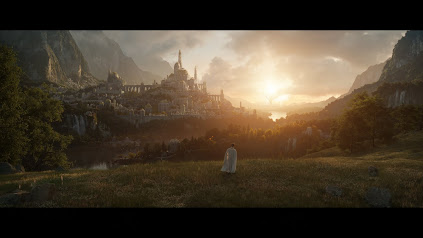
Amazon did release the first-ever publicity image from the project, showing a figure in white standing in front of typically spectacular New Zealand Middle-earth scenery, with a great city in the background and, on the horizon, what appears to the infamous Trees of Light, the Gold Tree Laurelin and the Silver Tree Telperion. This image is fascinating because it is apparently from before even the First Age of Middle-earth's history, when the godlike Valar raised the Trees of Light in the great western continent of Aman to bring light to the world of Arda before the rise of the Sun and Moon. The city in the foreground might well be Valmar, the great city of the Valar in the land of Valinor (or possibly Tirion, the great Noldor city in the Calacirya, the Pass of Light). However, all previous material for the show indicated it would be set in the Second Age. Whether this was some kind of grand misdirection or just a hint the show will feature extensive flashbacks to earlier epochs is unclear.

One thing Amazon did not confirm was a title for the show. The assumption is that the series will have a subtitle so people can differentiate it from the Peter Jackson movie trilogy, with Lord of the Rings: The Second Age or even Rise of the Lord of the Rings (urgh) mooted, as the show is expected (or at least was, until this image was revealed) to at least partially tell the story of how Sauron forged the One Ring. That title remains unknown for now.

Hopefully Amazon will release some more information over the next thirteen months. Meanwhile, the team are gearing up to start shooting Season 2 of the series, which is expected to begin in January.

Wednesday, 13 January 2021

Official summary for Amazon Prime's LORD OF THE RINGS show leaks

The One Ring has secured a copy of the official summary for Amazon Prime's Lord of the Rings TV show, which I have been unofficially referring to hitherto as The Second Age (although its final title remains unconfirmed).


The One Ring's early reporting on the new project was spotty - insisting that the show was about "Young Aragorn" long after that idea had been rejected - but their recent reporting has been more reliable, revealing several pieces of information before it was confirmed by Amazon, so this appears to be reliable.

The synopsis leaves out a lot of information - such as the show's actual name, since just calling it The Lord of the Rings will be confusing - but it does confirm a lot of the information that's been released over the past year and a half or so. The show will indeed be set in the Second Age of Middle-earth and will deal with the island kingdom of Númenor, the elven kingdom of Lindon and the first rise to power of the Dark Lord Sauron.

Not confirmed in this summary, but now overwhelmingly likely, is that the series will deal with the forging of the Rings of Power by Sauron some 5,000 years before the events of The Hobbit and The Lord of the Rings. The series as a whole, which Amazon envisages as spanning five seasons, may cover a period of many centuries or even millennia, spanning the long-running conflict between Sauron and the elves of Middle-earth, aided by their redoubtable ally of Númenor, a great island-empire in the western ocean and forerunner to the later kingdom of Gondor.

Lord of the Rings: The Second Age (tbc) is currently filming in New Zealand, with the production based in Auckland. Filming took a break over Christmas and the New Year but is due to resume shortly. It is unclear when the show will premiere, but with production expected to run for several months (having been underway since September, with the first two episodes shot back in February-March) and extensive post-production being required, it may be that the series will not debut until 2022.

More news as it emerges.

Sunday, 9 August 2020

Why J.R.R. Tolkien Never Won a Hugo Award

The Hugo Awards are the premier awards for science fiction and fantasy literature, first given out in 1953 and every year since 1955. One of the more interesting mysteries of the award is that J.R.R. Tolkien, widely regarded as the most prominent fantasy author of the 20th Century, was never given one despite being eligible on multiple occasions.

The Lord of the Rings, Tolkien's best-known work, was originally published in three volumes despite being written as a single novel: The Fellowship of the Ring and The Two Towers were published in 1954 and The Return of the King in 1955. This made the individual books eligible for the 1955 and 1956 Hugo Awards, and the novel as a whole also eligible in 1956. Similarly, The Silmarillion, published in 1977, should have been eligible in the 1978 Hugo Awards. Later Tolkien works, consisting of off-cuts from his notes and repackaged material previously published, would have been more controversial but likely could have made eligibility in other categories (particularly Unfinished Tales, effectively a short story collection, published in 1980).

The Lord of the Rings' failure to qualify is perhaps unfathomable to modern readers given its titanic impact on genre history, but more understandable when given context. When the book was originally published, it attracted strong reviews from the likes of W.H. Auden and C.S. Lewis, but opprobrium from a lot of mainstream critics. Although The Hobbit (1937) had already become a well-regarded classic of children's literature, its sequel initially was deemed too long, too weird and too unclear in its audience. There was also a modest delay between the UK and US publication, and the book was only available for more than a decade in hardcover, putting it out of the price and reach of many readers.

The Lord of the Rings also had two other things going for it: although the Hugos did not ban or omit fantasy, it was generally seen as a science fiction award first and foremost; an outright fantasy novel did not win the award for the first time until 2001, when Harry Potter and the Goblet of Fire took the top prize. Once that happened the floodgates opened and more followed (American Gods, Paladin of Souls, Jonathan Strange and Mr. Norrell, The Graveyard Book and all three volumes of The Broken Earth trilogy), but for much of its history, the award has not regarded fantasy in a good light. Secondly, Tolkien was British, and the Hugos were seen as a predominantly American award. To win a Hugo Award, British authors had to have their work published by prominent US genre publishers or become so dominant in the field that they couldn't really be ignored (as with Arthur C. Clarke). This cross-Atlantic ignorance also went both ways, with the Hugos having almost zero profile in the UK. The first Brian Aldiss knew that he'd won the 1962 Hugo Award for Best Short Story (for his Hothouse collection of interlinked stories) was when the award showed up at his house in the post. The first issue probably penalised Tolkien, although the latter did not, as his books were distributed by a reasonably big US publisher within a year of their UK release.

Although certainly not obscure on release, it was not immediately regarded as a classic and the American WorldCon attendees (the two ceremonies were held in Cleveland, Ohio and New York City, respectively) seem to have pretty much ignored it. The 1955 Best Hugo was instead given to Mark Clifton and Frank Riley's They'd Rather Be Right (later regarded by some as the "worst book ever to win the Hugo Award") and the 1956 award to Robert A. Heinlein's Double Star.

The Lord of the Rings retained a somewhat low profile until 1965, when Ace Books used a copyright loophole to issue an unauthorised American paperback edition of the book in its original three volumes. A legal kerfuffle and fan backlash followed which eventually led to the issuing of an authorised paperback edition and Ace Books agreeing to pay royalties on their pirated version of the book. The "war over Middle-earth" made national headlines and catapulted the book to superstardom, as it was then picked up by young British and American readers and became part (not entirely to Tolkien's approval) of the 1960s counter-culture movement.

In 1966, the Hugo Awards introduced a one-off "Best All-Time Series" category. It was widely assumed by many (but most notably Isaac Asimov) that the award was introduced solely to reward The Lord of the Rings and to make up for the book's initial publication being overlooked. Surprisingly, the award went instead to Asimov's Foundation Trilogy, as it then was. Although few could argue with anything remotely approaching a straight face that Asimov's work was of greater literary merit, it was inarguably Science Fiction with a capital S and a capital F, and Tolkien's fantasy was once again left out in the cold.

With J.R.R. Tolkien dying in 1973, it would appear that his chances of winning a Hugo would have been reduced to zero. However, his life's work and what he regarded as his magnum opus, The Silmarillion, remained unpublished. Working to his directions, his son and literary executor Christopher Tolkien, assisted by future fantasy author (and likewise inexplicably non-winning, and even more inexplicably, non-shortlisted) Guy Gavriel Kay, organised The Silmarillion into a publishable form and the book was released in 1977. Although "difficult" and unusual in structure, The Silmarillion received critical praise and modest commercial success, and would seem to have been a shoe-in for the 1978 Hugo Award.

Instead, it didn't even make the shortlist: Frederick Pohl's Gateway won the award and was joined by nominees Marion Zimmer Bradley (The Forbidden Tower), Larry Niven and Jerry Pournelle (Lucifer's Hammer), Gordon R. Dickson (Time Storm) and some obscure guy called George R.R. Martin (for his debut novel, Dying of the Light).

The Silmarillion not even being nominated would seem unlikely, and it turns out that it actually was nominated and may have even got enough votes to make the shortlist, but it was kept out by pedantry: a man named Jim Corrick who was in charge of eligibility that year deemed that The Silmarillion was a short story collection containing a novel-length work (the Quenta Silmarillion) and thus if people had specifically nominated the Quenta Silmarillion, it would have made the shortlist, but since they didn't, it didn't.

It seems that at this point interest in getting Tolkien a Hugo Award evaporated: Unfinished Tales and its constituent stories were not nominated in 1981, and none of the twelve volumes of The History of Middle-earth was nominated for Best Related Work. The Children of Hurin (2008), Beren and Luthien (2017) and The Fall of Gondolin (2018) would have been of questionable eligibility, since they were repackaged material that had been previously published many years earlier. However, a case could have been made for them and for the latter two making the entire Middle-earth legendarium eligible for the Hugo Award for Best Series, but it seems no attempt was made.

Tolkien himself was probably vaguely aware of the Hugo Awards. He was a fan of Isaac Asimov's fiction in the 1950s and 1960s, and during the tussle with Ace Books, he had been in communication with the SFWA (Science Fiction Writers of America) over the matter. He also had built up an extensive body of correspondence with American fans of his work. It is, however, unlikely that he spent a huge amount of time worrying about not winning awards. The immense fan recognition of his work and the resulting "grosser forms of literary success" as he put it (i.e. lots of money) was reward in itself. 

Still, although Tolkien himself never won a Hugo, adaptations of his work finally did. Peter Jackson's The Lord of the Rings: The Fellowship of the Ring won the last-ever Hugo Award for Best Dramatic Presentation in 2002, and The Two Towers and The Return of the King won the first Hugo Awards for Best Dramatic Presentation (Long Form) in 2003 and 2004 respectively. And the list of "influential writers who never won a Hugo Award" is distinguished company, also consisting of Gene Wolfe, Terry Pratchett and Iain Banks (among many others).

Monday, 15 June 2020

Creative Assembly hint at WITCHER and MIDDLE-EARTH TOTAL WAR games

Video game documentary makers Noclip have released another big project, this time delving in the history of British company The Creative Assembly, who for twenty years have been producing the Total War series of historical wargames, as well as branching out with survival horror title Alien: Isolation. The documentary is worth watching, but it also hints at a possible future direction for the series that extends to other franchises.


In the documentary, CA confirm that before securing the Warhammer licence from Games Workshop, they were actively pursuing and discussing a Lord of the Rings licence. This is interesting because two of the biggest fan mods for Medieval II: Total War (the last Total War game which allowed total conversion mods, effectively creating brand-new games out of older ones) were Call of Warhammer and The Third Age: Total War, mods for those two respective worlds. I suspect that the Warhammer mod was significantly cheaper to acquire.

With Lord of the Rings back in the zeitgeist, courtesy of the new Second Age-set TV show from Amazon Prime, it seems a good time to revisit the concept and with more money and the success of two (soon to be three) Warhammer games behind them, Creative Assembly can make a good case for acquiring the licence. The only fly in the ointment might be that the licence is currently held with Warner Brothers' gaming division (who produced Shadows of Mordor and Shadows of War) and it is unclear if they would be willing to sub-licence the property to another studio.

CA also note that they have been in discussions with Netflix over a new project. Since they've already effectively made The Last Kingdom: Total War with Thrones of Britannia and we can rule out Unbreakable Kimmy Schmidt: Total War, the most logical property to pursue would be The Witcher, which has all the ingredients for a good Total War game: numerous factions with notable troop types and general characters fighting over a fantasy landscape. CD Projekt Red, rather obviously, has a Witcher video game licence already, so the viability of this idea depends a lot on what is permitted under that licence, whether CA would work with CDPR or whether a separate licence based on the TV show (rather than the novels, which CDPR's licence covers) is possible.

Since CA note they have been in discussions with Amazon Prime, that is likely related to the Lord of the Rings idea, but it's also possible they have been considering a Wheel of Time game. The Wheel of Time world has numerous countries, empires and factions with notable characters who could serve as generals. A Wheel of Time fan mod for Rome: Total War was unfortunately aborted in the mid-2000s over the inability to get flying creatures to work in that engine, but with modern tech, that shouldn't be a problem (and flying units play a major role in the Warhammer games).

A final possibility, which is unmentioned in the documentary but has almost certainly been discussed at CA, would be for a Game of Thrones game. There is already a popular Westeros: Total War mod based on Medieval II: Total War and the success of the TV show makes a game a bit of a home run. Given the Total War franchise is all about changing history, the game would also provide the possibility for different outcomes to the TV show's storyline, which I'm sure many fans would appreciate. If you always wanted to see Robb Stark triumph and win independence for the North, or Stannis Baratheon to win at the Battle of the Blackwater, you could in such a game.

Any announcement of a new fantasy project is likely a way off. Total War Saga: Troy launches in August, whilst the company is continuing to release new material and expansions for Total War: Three Kingdoms. Total War: Warhammer III is also due in the near future, so it might be a year or two before we hear about any post-Warhammer fantasy projects.