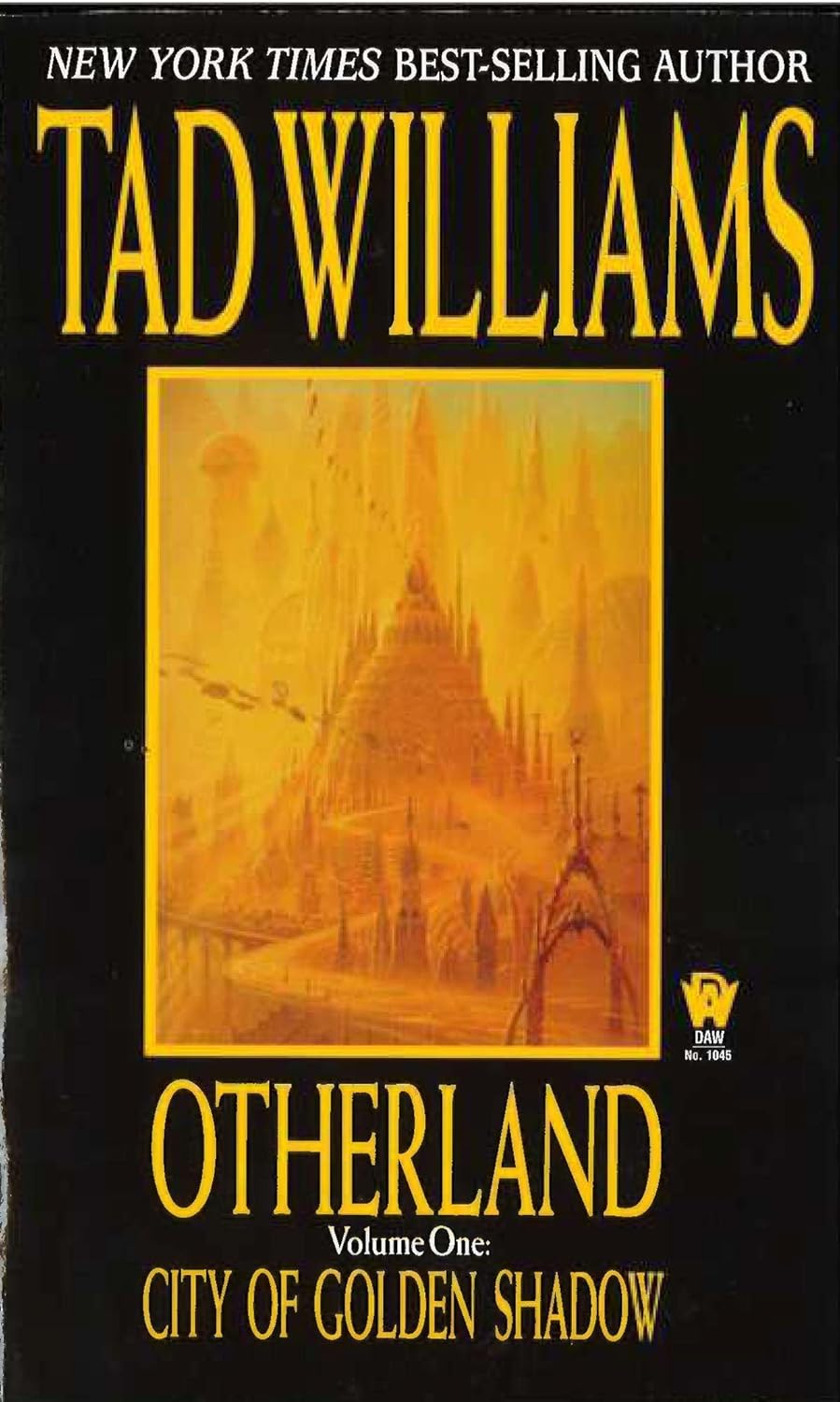
Tad Williams is an American writer of science fiction, fantasy and horror. Born in 1957 in San Jose, California, Williams has held a huge number of jobs in his time, working in theatre and television production, singing in a band and hosting his own syndicated radio show for a decade among them. In 1985 he published his first novel,
Tailchaser's Song, and has been a fixture on the speculative fiction scene ever since, publishing twelve additional novels, numerous short stories and several comic series. He currently has two more novels about to hit the stands and five more books planned.
 Tailchaser's Song
 is an animal fantasy which depicts cats as a race of intelligent beings who consider themselves the dominant species of Earth, with humans a generally untrustworthy nuisance. The book garnered some (generally favourable) comparisons to
Watership Down and marked Williams as an author to watch.
For his next project Williams decided to directly tackle the epic fantasy genre with a full-on, Tolkien-esque epic meant to rival (and in some cases redress)
The Lord of the Rings. Whilst acknowledging that the earlier work was a substantial masterpiece, Williams felt that Tolkien let some implicit suggestions of racism slide through unchallenged in the earlier work, with its depiction of the purely good elves and the purely evil orcs, not to mention the fact that all of the dark-skinned peoples in the book were allied to Sauron. Tolkien himself had noted these facts and struggled with them in various post-
Lord essays trying to explain these issues, but reached no satisfactory conclusion before his death (although
The Silmarillion did expose the ancient history of the elves in a somewhat less flattering light).

Williams' answer was to craft the vast fantasy landscape of Osten Ard, centred on the immense castle of the Hayholt, a Gormenghast-esque warren of kitchens and halls from where King John the Presbyter (also called Prester John, in a nod to the legendary figure) rules over the unified races of humanity. Upon his death, his sons quarrel for the crown and the land falls into civil war at the same time an ancient force of destruction, the Storm King, returns.
In comparison to many of the post-Tolkien fantasy potboilers, Williams attempts in
Memory, Sorrow and Thorn (the names of the three swords at the centre of the story) to create a mythic epic punching at the same weight as Middle-earth. In that he falls short (Osten Ard being the work of a few years, not the decades poured into Middle-earth by Tolkien), but it remains a noble effort. The trilogy is gargantuan - the final book,
To Green Angel Tower, is commonly split into two smaller volumes,
Siege and
Storm - and steeped in rich atmosphere, but to deliver that atmosphere Williams utilises a huge amount of words. The result is a somewhat straightforward narrative which doesn't really need the immense page-count the series spans. The result is a series that divides critics. Those who love it
really love it, whilst a lot of other critics are unimpressed with Williams' somewhat needless verbosity. Also, Williams fails at the last hurdle in challenging some of the conceits of the genre. Whilst giving the Storm King and his minions a logical rationale for their actions, the epilogue to the trilogy is somewhat cloying and invokes several of the key cliches of the genre that Williams was supposed to be subverting. As a result, the trilogy leaves the reader feeling somewhat dissatisfied, although sporadically entertained along the way.
But for all its faults,
Memory, Sorrow and Thorn did break through the barrier that had hitherto suggested that epic fantasy was solely a kid's genre, completing the work begun by Donaldson's
Thomas Covenant a decade earlier. Williams' trilogy can thus be seen as a late but key progenitor of the modern doorstopper fantasy epic, coming as it did just a couple of years ahead of Robert Jordan's
The Eye of the World. It also had an inspirational impact on other writers, as George RR Martin, who had previously been sceptical of the genre as a setting for adult stories, but read Williams' books, was fired up, and began writing
A Game of Thrones in 1991.

Despite the immense pressures of writing the trilogy (Williams has said the third book in particular demanded vast amounts of sweat, blood and tears), Williams found time to expand his short story,
Child of an Ancient City, into a novel with the help of fellow writer Nina Kiriki Hoffman. Whilst different to the trilogy - it's a historical vampire story - it didn't find as large an audience.
In a similar vein was
Caliban's Hour. Having just finished a colossal trilogy taking eight years to write, Williams chose to work on a much smaller project next, essentially a companion to
The Tempest examining the fate of the 'monster' Caliban. Despite some critical acclaim, the book also failed to shift many copies, to the author's distress and suspicion that some of his fans only wanted huge blockbuster fantasies from him, which he wasn't always prepared to do (a similar problem for many in the genre).
Despite his not-always-pleasant experiences on the trilogy, Williams did come up with an idea for another huge story, this time a science fiction epic called
North on the Data Stream which would mix in elements of SF and fantasy with a river-based narrative similar to
Heart of Darkness or
Huckleberry Finn, or indeed Dan Simmons'
Hyperion which was published around the same time he came up with the idea. Eventually coining the catchier title
Otherland, Williams set to work after finishing
Caliban's Hour, using many of the lessons learned whilst writing the trilogy and generally having a better time.
 Otherland
 was, perhaps more sensibly, planned as four big books in the first place, published between 1996 and 2001, and marked an interesting departure and contrast to the earlier fantasy epic. On the one hand, it is similar: another huge story with hundreds of named characters, dozens of major ones and vast numbers of plots and subplots. Yet the differences are notable: some of the action takes place in the recognisable real world of forty years hence, in South Africa, the USA, South America and elsewhere, whilst the majority takes place in the many virtual worlds of the Otherland computer network.
Like the fantasy trilogy,
Otherland has been accused of being too long-winded, but it's a different style of verbosity.
Otherland's extra length is mainly due to, as admitted by the author, his treatment of the story as an episodic kitchen-sink novel with tons of ideas thrown into the mix. Some of the episodes in the books are almost self-contained, more like short stories that exist within the novel with their own beginnings, middles and ends before the main narrative resumes. Reading
Otherland is an experience akin to watching a TV series with an ongoing storyline which sometimes takes a break for the odd self-contained episode along the way. Some readers hate this, others love it, and accordingly
Otherland is Williams' most divisive work. For my money, it is the best thing Williams has written, with interesting, strong characters and the worlds within the Otherland network are well-realised. There is a surprising emotional punch to the finale as well, partially continued by a subsequent novella,
The Happiest Dead Boy in the World, that answered a few dangling questions.
Otherland was a reasonable success worldwide, but proved to be unexpectedly and particularly big in Germany, where it won some mainstream success and became a national bestseller, with a German software company now working on a particularly ambitious
Otherland MMORPG.

Williams' post-
Otherland work has proven less popular.
The War of the Flowers, published in 2003, was a solid single-volume fantasy tale but a bit of a come-down after the epic SF series. More problematic has been his new work, the
Shadowmarch Trilogy. Williams had been suggesting that his next project post-
Flowers would be a return to Osten Ard for a series of short stories (presumably following the success of
The Burning Man, a novella published in the 1998 collection
Legends), but instead he chose to write a new fantasy book that would be released in stages online. The experiment was interesting, but whilst writing the book Williams was inspired to turn it into a full trilogy. Due to the break from his normal writing scheme, this meant writing the outline for the series between Books 1 and 2 rather than before the first one, and the result was a trilogy which simply didn't feel as polished as his former multi-book series. In particular,
Shadowplay, the second book, garnered some of the worst reviews Williams has received in his career. The final volume,
Shadowrise, is due in about a year's time. He is now embarking on a five-volume children's book series,
Ordinary Farm, which he is writing with his wife, Deborah Beale, whilst his next adult project will be a series of 'noir' fantasy thrillers.

Looking at Williams' body of work, the conclusion one reaches is that he is an author with a variety of interests in different genres who has been sucked into the world of the giant fat fantasy epic. It's hard to ignore the impact the two big series have had or that they are both immensely popular, but at the same time
Tailchaser's Song,
Child of an Ancient City,
Caliban's Hour and his often excellent short fiction (
The Lamentably Comical Tragedy of Lixal Laqavee is one of the highlights of
Songs of the Dying Earth) suggests an author who in his heart of hearts is perhaps more Neil Gaiman than Robert Jordan, and his concentration on huge series has perhaps deprived us of many interesting short stories, comics and single novels that he could have written in the meantime. Yet
Otherland is a singularly impressive work and
Memory, Sorrow and Thorn, if it failed at the final hurdle, is a nevertheless valiant attempt to analyse the problems within commercial epic fantasy, even if it ironically fell prey to many of them in the process. Still, with the huge epics apparently out of the way, for now, I look forward to Williams' future work with renewed interest.
BibliographyStand-alone BooksTailchaser's Song (1985)
Child of an Ancient City (1992, with Nina Kiriki Hoffman)
Caliban's Hour (1994)
The War of the Flowers (2003)
Rite: Short Work (2006, collection)
Memory, Sorrow and Thorn
The Dragonbone Chair (1988)
Stone of Farewell (1990)
To Green Angel Tower (1993)
OtherlandCity of Golden Shadow (1996)
River of Blue Fire (1998)
Mountain of Black Glass (1999)
Sea of Silver Light (2001)
Shadowmarch
Shadowmarch (2004)
Shadowplay (2007)
Shadowrise (forthcoming in 2010)
Ordinary Farm The Dragons of Ordinary Farm (2009, with Deborah Beale)
A Witch at Ordinary Farm (forthcoming in 2010, with Deborah Beale)
The Bobby D MysteriesSleeping Late of Judgement Day (forthcoming)
The Bobby Dollar Books (forthcoming)
My So-Called Afterlife (forthcoming)