Showing posts with label ron gilbert. Show all posts

Wednesday, 28 September 2022

Return to Monkey Island

Guybrush Threepwood, pirate adventurer, would-be nemesis of the ghost pirate LeChuck and implausibly successful wooer of the beautiful Elaine Marley, has finally worked out that, despite all of his adventures, he has never actually worked out what the Secret of Monkey Island actually is. Returning to his original stomping ground of Melee Island, he sets out on his new quest, only to learn with horror that LeChuck is already three steps ahead of him.

Released back in 1990, The Secret of Monkey Island almost immediately became acclaimed as one of the greatest video games of all time. Fiendish puzzles, funny writing, awful puns and the daftest protagonist name in gaming history combined to make a memorably brilliant, if rather short, game. Monkey Island 2: LeChuck's Revenge followed a year later with a better story, more interesting puzzles, a much greater variety of locations and fantastic music. It also, infamously, had a very strange ending that left a lot of people scratching their heads.

That ending was never really resolved. The creative team behind the first two games, most notably lead designer and writer Ron Gilbert, left LucasArts and moved on. A separate team eventually made a third game in 1997, but wisely skipped past the ending to the second title and picked up some years later with only minimalist references to what happened in the meantime. The Curse of Monkey Island was a great game in its own right, despite the change in ownership. Escape from Monkey Island (2000) and Tales from Monkey Island (2009) followed, to a middling reception. Better-received were HD remakes of The Secret of Monkey Island and Monkey Island 2 in 2009 and 2010, which introduced them to a new generation and got people thinking about that crazy ending again.
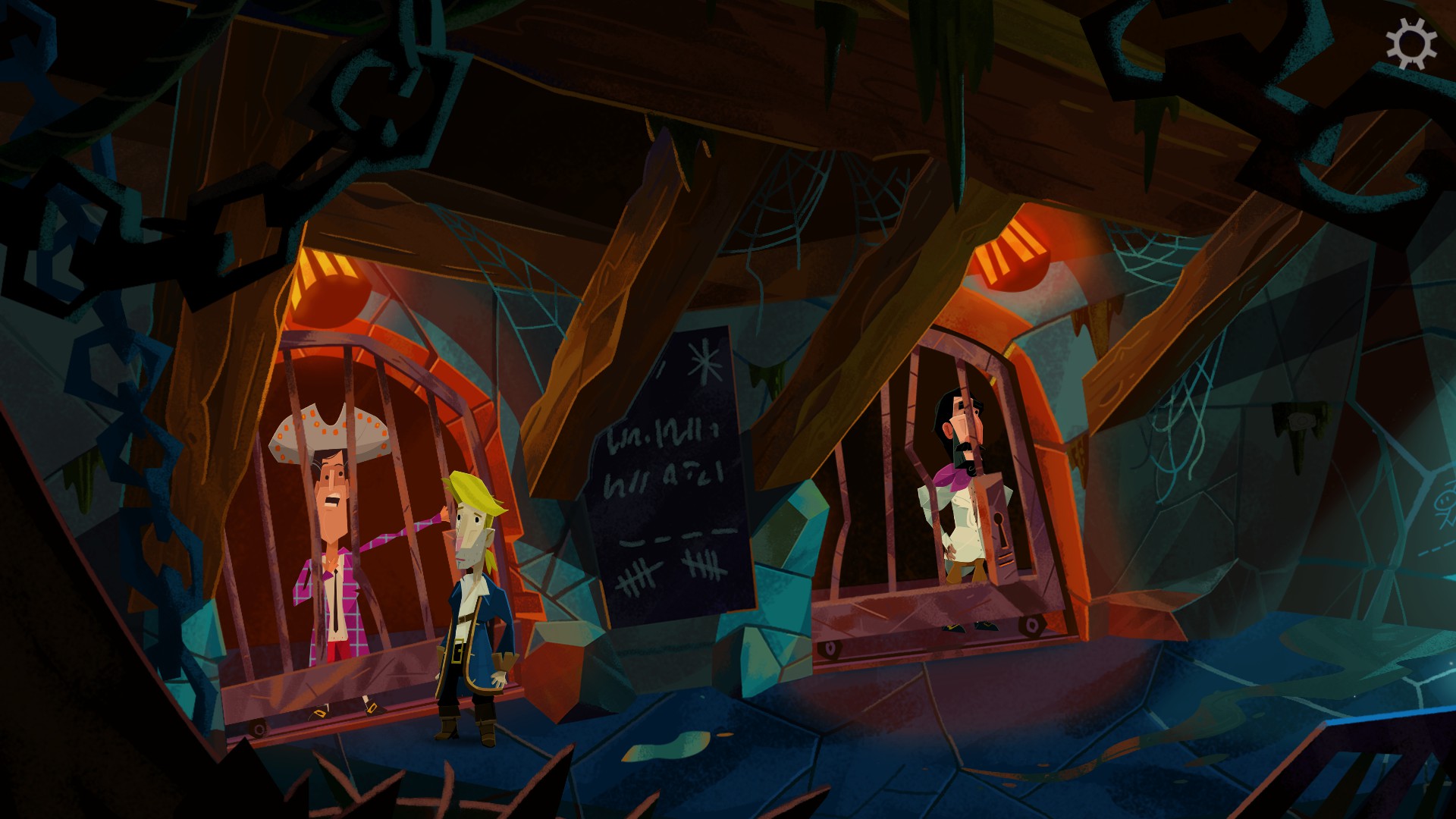
Now the unlikely has happened: Ron Gilbert and Dave Grossman have reunited to make Return to Monkey Island, a game that finally picks up after the ending of Monkey Island 2 and forges on. The new game also doesn't eject the others from continuity: having kinda explained the ending to Monkey Island 2, we fast-forwards a few years past all of Guybrush's other adventures to pick up on him returning to Melee for his new expedition. He and Elaine are now happily married and Elaine is running a campaign to eliminate scurvy from the Caribbean, leaving Guybrush free to take up his quest.

The first two-thirds or so of Return to Monkey Island is a journey which will trigger the nostalgia feels in players. This part of the game almost exclusively uses locations from the original title in the series, so once again you'll visit the SCUMM Bar, hang out at the Governor's Mansion and visit the Voodoo Lady for enigmatic advice, before visiting Monkey Island, falling off the overlook again and sneaking onto LeChuck's ship. But this is a melancholic form of nostalgia: Melee Island has had an economic crisis, a lot of the old businesses are shut down, and there's newcomers who don't recognise Guybrush or particularly care about him being a regular from years or decades before. There's still plenty of laughs here, but Return also examines its own status as a legacy sequel made years after the originals (not always the best of ideas) in a way that that is smart without vanishing up its own posterior.
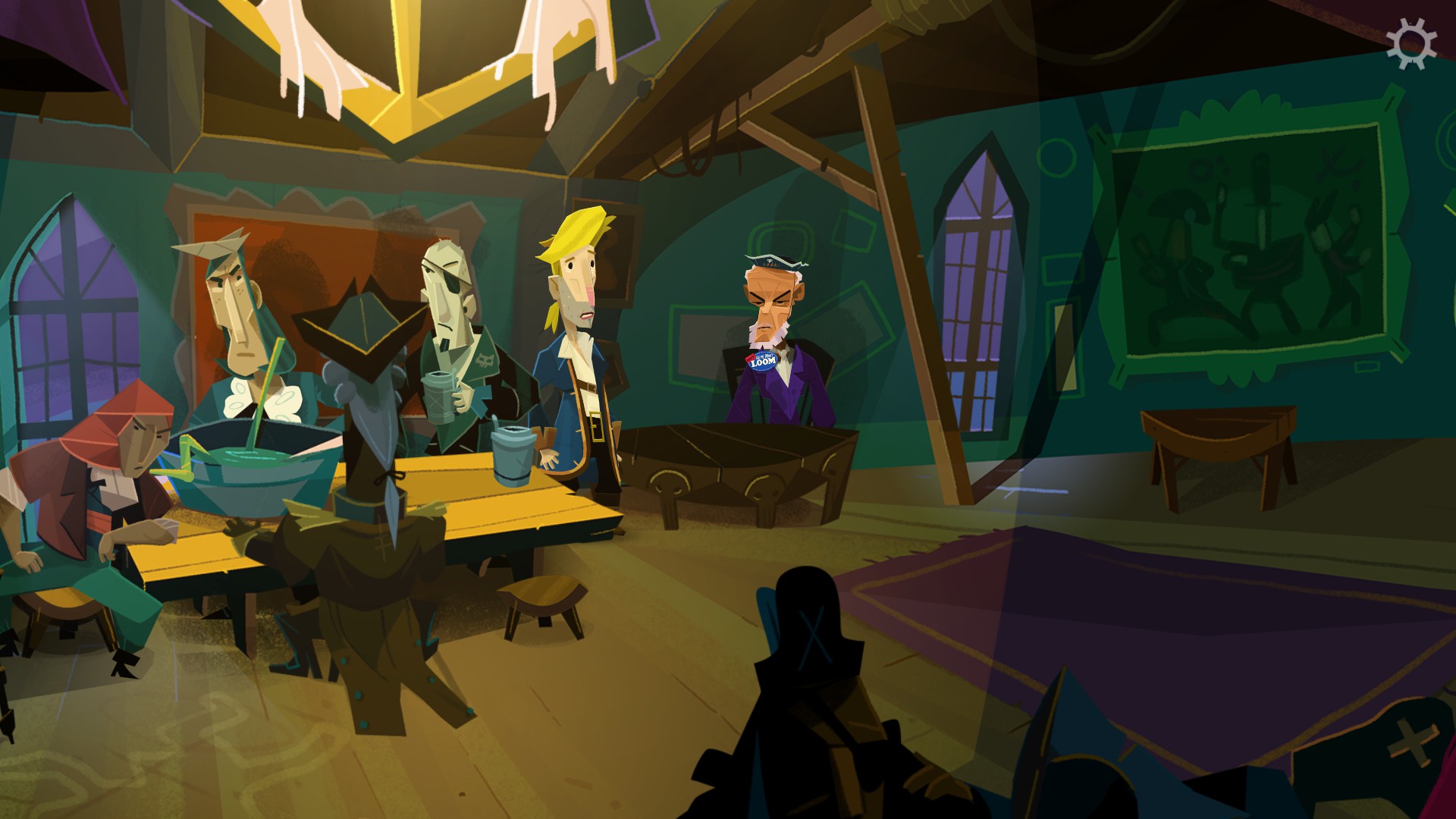
The latter third of the game opens up and Guybrush gets to explore a series of new islands and locations never before seen in the series. This sequence feels somewhat briefer than it should be, possibly a budget issue or the decision they had almost too much material for one adventure game but not enough for two, so trimmed some things to keep it in the confines of one title. This has the unfortunate effect of meaning that the game is dominated by locations you've seen before, whilst the new and fresher material is crammed into a relatively brief part of the game towards the end, before we once again return to a familiar location for the grand finale.

But ultimately it works. The puzzles are fine, not too obtuse apart from a couple of eye-rollers (a built-in hintbook pretty much means you never need to look up online solutions, although the game encourages you to use it as little as possible), and the story is entertainingly told, with that undercurrent of melancholic nostalgia running through it to make it more interesting. 
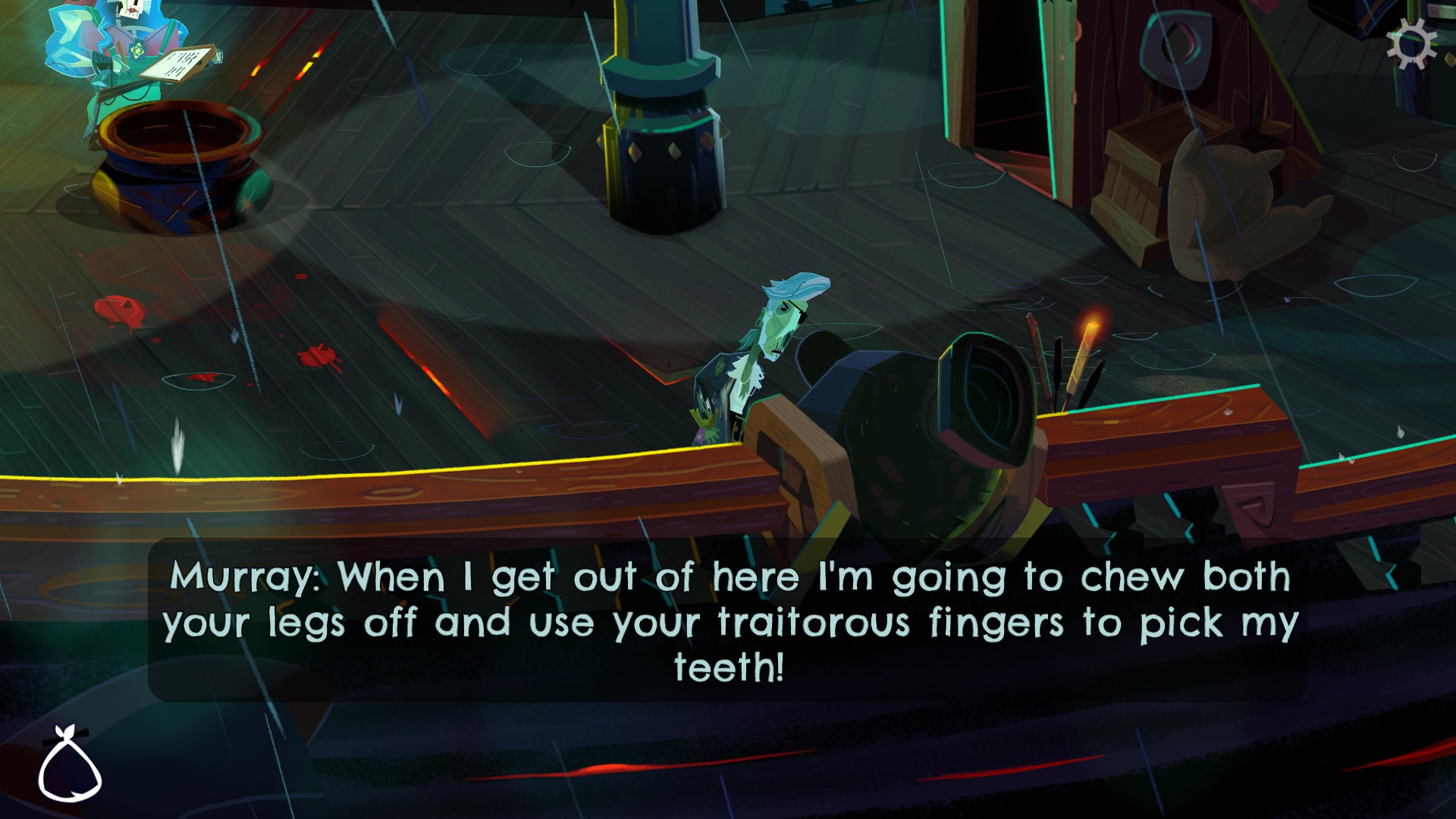
Return to Monkey Island (****½) is, improbably, excellent. Once you get over the stylised new art direction, it works really well and the music is fantastic. Creatives in their fifties revisiting the scene of their greatest hit from their twenties could have gone badly wrong, but Return to Monkey Island emerges as far smarter, funnier, emotional and engaging than it really should. Even if its own ending does definitely skim around the edges of taking the mickey, but it does earn it. The game is available now on PC, Mac and Nintendo Switch.

Thank you for reading The Wertzone. To help me provide better content, please consider contributing to my Patreon page and other funding methods.

Monday, 17 April 2017

Thimbleweed Park

1987. A dead body has been discovered on the outskirts of the town of Thimbleweed Park. FBI agents Angela Ray and Antonio Reyes lead the investigation and soon discover that there are some very weird things going on in the town. Meanwhile, Delores Edmund has been banished from her family home and fortune after abandoning the family pillow-manufacturing business to become a video games designer, but is summoned back to hear the reading of her uncle's will. And, in an abandoned fairground, Ransome the Insult Clown, dreams of escaping his fate and removing his clown makeup after he was cursed by a mysterious voodoo lady.


Thimbleweed Park is a throwback adventure game, employing the same SCUMM interface as the classic LucasArts video games of the late 1980s and early 1990s. The SCUMM system was created by Ron Gilbert, Gary Winnick and David Fox and employed in their game Maniac Mansion (1987). It would go on to be used in a further seven games in its original form. LucasArts would release another four games with a more streamlined (but less versatile) interface before ditching it in favour of a 3D engine with very awkward controls and more limited puzzle-solving. Bizarrely, Telltale Games (founded by ex-LucasArts veterans) would find great success with an even more limited engine (which almost removes all puzzles and inventory use altogether), leaving fans of real adventure games with relatively slim recent pickings.


Until now, anyway. Gilbert, Winnick and Fox have reunited and created a new game using the SCUMM interface. In Thimbleweed Park you control five very different characters and have to direct them around the town, solving puzzles, picking up useful items and discussing matters with other characters. Early in the game your main focus is on solving the murder, but later on you also have to fulfil Delores' uncle's stipulations so the will can be read and then all five characters come together to try to break into a spooky factory and confront the darkest secrets of the town.


Like the LucasArts games, it is not possible to die and it is almost impossible to bring about a failed state where you cannot continue (and the one main way of doing that does have a warning that you should save the game first). As a result, playing Thimbleweed Park is a relatively relaxed affair as you move around the town trying to solve the game's various puzzles. The game mostly plays fair, with the solutions to the puzzles being mainly logical and straightforward (and of course walkthroughs are already available if you get really stuck).


The game is funny, although it does strike a few bum notes, and the characters are reasonably interesting, especially Ransome the angry clown and Delores, the game's main protagonist. These characters are developed to the point where it feels like the designers lost interest in some of the other characters as development proceeded: Ray and Reyes have relatively limited character development in comparison. Overall, Thimbleweed Park nails the atmosphere, humour and strengths of the LucasArts adventures and improves on them in several areas, such as the addition of fast travel and a "run" ability to move around more quickly.

There are several negatives. The game has a large number of fourth-wall-breaking gags and metacommentary on old adventure games. This starts off entertaining but gets a bit old later on. I also can't help but feel that some of the humour and writing - such as the continued digs at Sierra adventure games when Sierra haven't made an adventure game in that style for over twenty years - is a tad dated and self-indulgent. As someone who's played almost every adventure game LucasArts put out and therefore gets all the gags, I found this vein of humour a little too forced. For younger players and newcomers I can imagine it could get quite alienating. It also doesn't help that a couple of puzzle solutions are dependent on foreknowledge of older LucasArts game (such as the old "Navigator's Head" trick from The Secret of Monkey Island).


Another is a complaint I've had ever since playing Maniac Mansion way back in the day. These games, in my view, don't handle multiple characters very well. Your player-controlled characters don't speak or interact with one another very much (aside from swapping the occasional inventory item), and the puzzles sometimes involve telepathy which has no in-game explanation (one character doing something in one location to trigger an event another character can capitalise on elsewhere). It's also very fiddly to discover that three inventory items are needed to solve a puzzle and you have to manually gather the characters together to swap stuff around. It's not coincidental that the best-regarded LucasArts adventures, The Secret of Monkey Island and its sequel, feature only one controllable character and only one inventory to manage.

Still, Thimbleweed Park (****) is resolutely entertaining. The pixel art is gorgeous, the music is limited but excellent, the voice acting is pretty decent (and can be turned off if you really want to pretend this 1990 again) and the writing is mostly sharp (if occasionally self-indulgent). It's not as good nor as funny as the Monkey Island titles (Tim Schafer's absurdist streak is sorely missed), not as enormous and compelling as Indiana Jones and the Fate of Atlantis, but stacks up well compared to Maniac Mansion and Zak McKraken, and is far less obtuse and stonewalling as those games could be. The game is available now on PC, Mac and X-Box One, with a PlayStation 4 version to follow shortly.

Friday, 4 September 2015

MONKEY ISLAND and COMMAND & CONQUER celebrate their birthdays

Two of the most influential names in gaming celebrated anniversaries this week.

It's been ten o'clock on Melee Island for twenty-five years now...

The Secret of Monkey Island went gold on 2 September 1990 and hit shops a couple of weeks later. It was the latest in a series of graphical adventure games released by LucasArts using the SCUMM Engine. The previous games using the engine - Maniac Mansion, Zak McKraken and the Alien Mindbenders, Indiana Jones and the Last Crusade and Loom - had all been successful, but The Secret of Monkey Island was bigger still. It may still be the funniest video game ever made, as well as one of the cleverest, with some exceptionally fiendish puzzle design and the excellent idea of insult sword fighting still resonating today.

The same team made the superior sequel, Monkey Island II: LeChuck's Revenge, but then began leaving the company. The Curse of Monkey Island (1997) and Escape from Monkey Island (2002) were made by different teams and are not counted as wholly canon (although Curse has numerous fans). Ron Gilbert, the main creative force on the first game, talks about the original game's release here and how he would handle a third canon Monkey Island game here. Gilbert is currently working on a SCUMM-esque retro adventure game called Thimbleweed Park, which he hopes to release next year.

You can play The Secret of Monkey Island and Monkey Island II today, using special editions which allow you to either play in "classic" mode or with revamped, modern graphics.


Westwood couldn't afford a lot of actors for C&C's cut scenes, so drafted in their staff to help. Joe Kucan, the director of the cut scenes, became the game's bad guy, Kane, inadvertently creating (arguably) the most iconic non-pixellated bad guy in video games.

Meanwhile, it is also the twentieth anniversary of the release of Command and Conquer. Developed by Westwood games and released on 31 August 1995, Command and Conquer had a huge impact in the way it popularised the real-time strategy genre. The same developers, Westwood, had effectively created the genre with Dune II: The Battle for Arrakis in 1992, but that game had problems with the player only being able to select one unit at a time. C&C allowed for entire armies of mixed units to be assembled and used to attack the enemy en masse. The game was also influential with its elaborate cut scenes and the focus on a narrative, the battle between the Global Defence Initiative (GDI) and the terrorist Brotherhood of Nod for control of tiberium, a potent energy source brought to Earth by meteorites.

The game was followed by three direct sequels: Tiberian Sun (1999), Tiberium Wars (2007) and Tiberian Twilight (2010). However, the game also spawned two spin-off universes. The more famous of these was the Red Alert series, which used time travel to create a series of conflicts between the Western Allies and Soviet Union (and later the Japanese Empire). The Red Alert series is considerably sillier and camper than the core series, but is also arguably superior, with better units. This sub-series consists of Red Alert (1996), Red Alert 2 (2000) and Red Alert 3 (2008). The second spin-off was Command and Conquer: Generals (2002); a sequel/reboot was in development before being canned a couple of years ago.

The influence of the C&C games can be seen and felt in all the RTS games that followed, from StarCraft to Homeworld to this week's Act of Aggression (a self-aware homage to the original series), even if EA has seemingly abandoned the franchise.

You can get most of the C&C games on Origin.

Monday, 8 December 2014

GRIM FANDANGO REMASTERED release date, DAY OF THE TENTACLE REMASTERED announced

Double Fine have confirmed that their remastered edition of classic 1998 adventure game Grim Fandango will be released on 27 January, along with a new trailer.


The new version of the game has been optimised for modern PCs and will also include versions for Mac, Linux, PS4 and PS Vita.

Double Fine have also confirmed that they are bringing back Day of the Tentacle, the sequel to the original LucasArts adventure game Maniac Mansion. Originally released in 1993, Day of the Tentacle was hugely critically acclaimed on release and is sometimes described as the best adventure game ever made (an honour it sometimes exchanges with Monkey Island II and Sam and Max Hit the Road). This new version will likely be more akin to the Monkey Island re-masters from a couple of years ago, allowing gamers to play both the original and a graphically updated version of the game. In fact, it sounds like this new version is based on the already-in-progress remastering work that LucasArts was undertaking when it was shut down by new owners Disney back in 2012.

Meanwhile, Ron Gilbert, the original creator of Maniac Mansion (and The Secret of Monkey Island), is crowdfunding a new, classic-style adventure game called Thimbleweed Park. With more than a week to go, the game has raised more than $100,000 over its originally-requested target amount.