Showing posts with label tawny man. Show all posts

Wednesday, 17 October 2018

Fool's Fate by Robin Hobb

FitzChivalry Farseer has, reluctantly, re-entered the corridors of power in the Six Duchies. Posing as guardsman Tom Badgerlock, he has been assigned to journey with Prince Dutiful to the Outislands, where the Prince seeks to win the hand in marriage of the Outislander Narcheska, ending all enmity between the two nations. But there are other agendas at work. To win a lasting peace, Fitz must help his prince slay a dragon…and take a stand against his greatest and best friend.


The concluding novel in Robin Hobb’s Tawny Many Trilogy is something I was bracing myself for. Previously, Hobb’s form has been to write an exciting, busy opening volume in a trilogy and then have a slow middle volume which leaves the final book with a lot of heavy lifting to do to end the story, usually resulting in a third book which wraps up the story but with serious issues with structure and pacing. Ship of Destiny deal with the problem somewhat well, but Assassins' Quest really suffered from it. The relatively slow pace of The Golden Fool was also not a good sign.

Fool’s Fate, fortunately, rejects this issue. Whilst you could never call any Hobb novel fast-paced and action-packed, this enormous book (or rather the first two-thirds of this book) comes as close as she gets.

The book consists of a long sea voyage, an exploration of Outisland culture and then an expedition to the island of Aslevjal, where a dragon is said to sleep in the ice. These sequences of explorations on a glacier and survival in freezing temperatures with unknown dangers lurking in the dark are atmospheric and effective, with occasional scares reminiscent of Dan Simmons’ The Terror.

There is then an epic showdown and an appropriately grand finale…which takes place 200 pages before the book ends. The rest of the book is an extended epilogue in which everyone’s fate is revealed and – dare we say it – a couple of characters are even allowed to have happy endings. There is, however, enough material left dangling for both the Rain Wild Chronicles quartet and the Fitz and the Fool trilogy.

As with most of Hobb’s work, and this trilogy in particular, the book is deliberately paced and introspective, with Fitz ruminating on his mistakes a lot. Fortunately, he is also allowed to develop more as a character and even – gasp! – to actually make amends for past mistakes and move forward with his life rather than just moaning about his lot in life. The ending to Fool’s Fate is suspiciously uplifting, in fact, to the point I’m suspicious Hobb is just keeping her powder dry to make things even worse in later books.

There is also a sense of completeness to this book. It addresses outstanding elements from the Liveship Traders books and even finishes off a whole host of storylines left unresolved from the original Farseer Trilogy. The result is a book that works as a finale to one trilogy and an effective epilogue to two others, and is one of Hobb's strongest books to date.

As usual for Hobb, the characterisation is rich, the emotional storyline is impressive and, less usually, even the worldbuilding is impressive. It also brings enough closure to the story to make the trilogy stand alone. Fool's Fate (****½) is available now in the UK and USA.

Sunday, 9 September 2018

The Golden Fool by Robin Hobb

Fitz has returned to Buckkeep, but it's far from the hero's welcome that might have been imagined. He serves the Queen and spymaster Chade incognito, posing as Tom Badgerlock, bodyguard and servant to the visiting "Lord Golden" (in reality, the Fool, likewise in disguise). He now has to train Prince Dutiful in the ways of both the Skill and the Wit, whilst also investigating the threat the Piebald (militant Witted rebels) pose to the crown. But delegations from overseas arrive, one from the Outislands to the north and another from the Liveship Traders of Bingtown, both emissaries bringing opportunity...and great danger.


The Golden Fool is the middle volume of the Tawny Man trilogy, as well as the eighth book in the wider Realm of the Elderlings series, bringing the overall series to its halfway point. Its predecessor, Fool's Errand, was one of the stronger single novels in the series, with a very good, mostly self-contained storyline. The Golden Fool, alas, isn't quite as strong at standing on its own two feet, but it is very much what readers have come to expect from a Robin Hobb novel: introspective, brooding but also a deeply human work of fantasy fiction.

The Golden Fool centres itself on Fitz's relationships at Bukkeep, with Queen Kettricken, Chade, his foster-son Hap, Prince Dutiful and, most notably, the Fool. The Fool has always been the most enigmatic character in the series (for all that he is the only character to appear in every book to date) and Hobb has been very careful not to give away too much of his secrets. This book doesn't really get into that either, instead being more interested in the ambiguities of Fitz and the Fool's relationship.

That's not to say there isn't any action - the plot turns on a very brutal sword fight - but it's definitely a quieter and more introspective book than even the norm for Hobb. At first I thought the detailed account of Fitz's everyday comings and goings for the Fool, Chade and the Queen was a prelude to a more traditional fantasy narrative (as was well-done in Fool's Errand) but instead it turns out to be the whole book. This makes The Golden Fool a prime example of "middle-book" syndrome, one which exists to bridge the start of the story to the end.

Still, even a slow, bridging Robin Hobb novel is a cut above most fantasy. The prose is exemplary, the characterisation is absolutely first-rate and it's a brave and refreshing fantasy novel where the most important thing that happens is a quiet (but brutally honest) conversation between two old friends. And it does leave the story in a very interest place for the next novel in the series, Fool's Fate.

The Golden Fool (****) is available now in the UK and USA.

Thursday, 30 August 2018

Fool's Errand by Robin Hobb

Fifteen years have passed since the end of the Red Ship War. FitzChivalry Farseer is believed dead, with only a few knowing the truth that he survived and helped end the war and the threat of the cruel King Regal. Living a comfortable life as a smallholder with his wolf Nighteyes and an adopted son, Hap, Fitz occasionally has strange dreams. He dismisses these, until his old friend the Fool visits with news: Prince Dutiful, the son of Queen Kettricken and the late King Verity, has vanished in a very strange manner. Reluctantly, Fitz returns to Buckkeep and a life he thought he'd left behind.


Fool's Errand is the fourth novel featuring the adventures of FitzChivalry Farseer, picking up after the events of the original Farseer Trilogy. It's also the seventh novel overall in the Realm of the Elderlings setting, which now extends across sixteen books. It's a bit of a fresh start in the series, as although it follows up on events in the Farseer books (and a brief mention is made of the Liveship Traders trilogy), it also introduces new characters and new storylines.

Fool's Errand is a slow book, at least to start with. The first 200 pages - more than a third of the novel - are taken up by Fitz's home life and routine, with lengthy ruminations on chicken-farming. Fitz's main concern isn't war, death or assassinations, but instead raising enough coin to find his adopted son a good apprenticeship. Some may find this sequence interminable, but Hobb uses this sequence to establish Fitz's good, comfortable and quiet life away from the mayhem of the court, and what it means when it is taken away when a new crisis erupts.

The rest of the novel is more familiar: a prince has gone missing, the Witted people of the Six Duchies are rebelling against the persecution and murder of their kind by forming an armed resistance and a new peace treaty between the Duchies and the Outislands is in jeopardy. Keen for people to not realise he's survived, Fitz adopts a new identity (the uncouth Tom Badgerlock) and undertakes clandestine mission for the crown. This results in some splendid, classic epic fantasy elements such as an awkward cliffside sword fight against superior enemy numbers, the experimental use of magic and the gradual teasing and unravelling of a labyrinthine conspiracy.

This doesn't mean that Hobb's straying too far from her established tropes. When in doubt about what to do next, she just makes Fitz's life more miserable and horrible than ever before, killing off loved ones and finding ways to put him in as awkward and painful a situation as possible. It's all vaguely depressing, which is an odd juxtaposition given that the second half of the novel is as lively and swashbuckling as Hobb has ever gotten.

Still, if you're in the mood for a beautifully-written, somewhat melancholy fantasy where the focus is firmly on the characters rather than magic or battles, Fool's Errand (****) is a very fine novel. It's also surprisingly stand-alone: you'd definitely miss a fair amount if you hadn't read the Farseer trilogy, but the plot is focused on a new story and situation. Also, whilst the story clearly is set to continue after the final page, there's no major cliffhanger ending. The novel is available now in the UK and USA.

Saturday, 5 December 2015

TAWNY MAN trilogy gets spectacularly awful new covers

For inexplicable reasons, the American editions of Robin Hobb's Tawny Man Trilogy have been given some new covers which are quite remarkably terrible.

Fool's Errand: 17th Century gentleman out for a stroll after a hard day oppressing the peasantry.


Golden Fool: Benedict Cumberbatch playing a dapper version of the Witcher.


Fool's Fate: Art director trudges into Swiss mountains in search of John Howe to beg for his return.


This is a series of books that was once (in the UK) graced by cover art from the monumental John Howe. Even the original American covers were better than this. Urgh.

They also revealed a preview of the next reprint cover they are planning for the series:


(thanks to my friend Carol for that idea)

Sunday, 15 November 2015

A History of Epic Fantasy - Part 27

Summing up what epic fantasy is and is not is difficult. The barest tropes of the genre - big armies, travelogues, magic - can be used to define it, but it always feels like it's describing the symptoms and not the causes of why people write the genre, and why people read it. One potential definition is that epic fantasy is the story of big events channelled through the eyes of a small number of well-defined characters whom the audience invests in.


Or to put it another way, we may be interested in Middle-earth as a place and a collection of societies, but we only get interested in it through the actions of characters we empathise with: Bilbo, Frodo, Gandalf, Gollum etc. The same with Westeros. The war for the Iron Throne is irrelevant if the reader does not care about Ned Stark or Tyrion Lannister or Daenerys Targaryen. Arguably epic fantasy can go off the rails when the scope balloons and so many characters are brought in that the tension and pace can become diffuse, a problem struggled with by many of even the best and most critically lauded authors in the genre. This tension between the macro and micro-scale, between the personal stories of characters we love and the epic struggle of clashing armies and gods and philosophies, arguably lies at the core of the appeal of epic fantasy and how different authors approach it can determine their success. It often feels like fantasy authors, when in doubt, move in favour of the massive, epic scale and throw so many new ideas, new characters and new magic systems into their narratives that they can risk overload or crashing the momentum of their series.

In 1995 a novel was published which firmly tilted in the opposite direction, where big things happened but the perspective was tightly limited (at least for most of the books). This gave rise to one of the biggest-selling, most critically lauded and respected fantasy series of the last fifteen years: The Realm of the Elderlings mega-sequence by Robin Hob.


Assassin's Apprentice & Ship of Magic

Of course, it didn't start out that way. Margaret Astrid Lindholm Ogden had published her very first novel, Harpy's Flight in 1983. By the early 1990s she'd been writing novels for ten years and had released ten books in the adventure fantasy field (and also a single SF novel, Alien Earth). These had been released under pen-name, Megan Lindholm. In July 1993 she concluded a deal with Bantam for three further books, this time an epic fantasy trilogy. The first volume at this point had the working title Chivalry's Bastard.

By the time the book was completed and delivered, the author and her publisher agreed it was a very different kind of novel for her. It was longer, more complex and much more adult. It was decided to remarket the novel as coming from a new author. She picked the name "Robin Hobb" after discovering that the "H" row was often on a perfect eyeline for an adult browsing the shelves in a bookstore.

Retitled Assassin's Apprentice, the novel was released in April 1995 and was immediately successful. Two heavyweight fantasy artists - Michael Whelan in the United States and John Howe in the United Kingdom - provided excellent covers. Reviews were very strong. The book was fairly traditional, focusing on the character of Fitz, the bastard son of the king's heir who is reluctantly allowed to live in the royal household but finds himself at something of a loose end. He is trained by the royal assassin, Chade, and uncovers political intrigue with his half-uncle Regal seeking to usurp the throne, the Six Duchies facing attacks by the mysterious Outislanders and relations with the Mountain Kingdom being strained. Royal Assassin (1996) and Assassin's Quest (1997) continue and resolve these issues, the three books together forming The Farseer Trilogy.

However, although the books feature political intrigue, two magic systems (the Skill and the Wit) and occasional bouts of violence, their popularity rested on a series of relationships: between Fitz and his wolf, Nighteyes; between Fitz and his mentor Chade, and his uncle Verity; and, most tantalisingly, between Fitz and the highly enigmatic Fool. The trilogy ended on a positive note, but Fitz did not seem to have truly found happiness at its conclusion.


Robin Hobb went on to write The Liveship Traders (1998-2000), a further trilogy set in the same world but along the coast of the continent to the south. This trilogy focuses on the families of Bingtown, who have developed the ability to carve ships controlled by sentient figureheads. Initially the books revolve around the battle within a family for ownership of the liveship Vivacia, but as the narrative unfolds the scope expands. Unlike the Farseer series, which was written in first-person, Liveship is written from a more traditional third-person viewpoint and encompasses a wide range of characters living in different locales. This trilogy features more compelling and original worldbuilding than Farseer, which is very traditional, but also is notable for giving the primary villain a journey and arc of his own that is understandable and sympathetic. Indeed, Hobb arguably is too successful in making Kennit a relatable figure and the decision to have him revert to pure villainy by becoming a rapist feels heavy-handed. But overall The Liveship Traders is as strong and readable a series as its forebear, benefiting from the shift in location and theme.

Hobb returned to Fitz's story in The Tawny Man (2001-03), which followed up on his adventures fifteen years after the events of Farseer. More intriguingly, it touched on events in The Liveship Traders and started pulling together story threads revolving around the Liveships, sea serpents, dragons and the extinct race of mysterious Elderlings, providing a larger-scaled and more mythic backdrop for the series. However, the focus remained resolutely on the key characters.

Hobb took a break from Fitz's world to write the Shaman's Crossing trilogy (2005-08), set on a completely different world with gunpowder. Although well-regarded, it wasn't as successful critically as her Elderling mega-series. She subsequently returned to the setting of the Rain Wilds, touched on in both the Farseer and Liveship story strands, for a four-volume series expanding on that region, The Rain Wild Chronicles (2009-13). This led Hobb to write Fitz and the Fool (2014-17, est), a new trilogy continuing (and perhaps wrapping up) the story of Fitz and his enigmatic friend, now emerging as arguably the central figure of the entire saga.


The Robin Hobb books feature all the hallmarks of epic fantasy, but her prose and dialogue style are a marked improvement over much of the genre and her focus on character over the furniture of the setting is highly laudable. Her approach is also hugely appealing on a wide level. Her books were Harper Voyager's biggest-selling series until A Song of Ice and Fire overtook them in the early 2000s, and she has enormous respect from her peers. Authors as different as George R.R. Martin and Steven Erikson are big fans, and The Telegraph even called the first book of the Fitz and the Fool sequence "High art." If the books have a weakness it may be a traditional one: excessive verbiage with the streamlined opening volumes of both Farseer and The Liveship Traders being dwarfed by the concluding volumes of each trilogy (each almost double the size of the first), and the Rain Wild Chronicles expanding almost uncontrollably from a duology to a four-volume series.

But at her best Robin Hobb is one of the most human and humane writers in the field, writing intelligently and with clarity about people and what makes them tick, whilst also remembering to throw in the requisite fantasy cool stuff like dragons and sentient sailing ships.


By the end of the 1990s the genre's success appeared secured through the arrival and establishing of a new breed of epic fantasy authors writing with greater skill and interest in characters and people, whilst also being more willing to delve into the darker side of the genre. But a parallel subset of fantasy was also developing which wanted to turn over all the rules and do something really different. Really...weird.

Saturday, 6 February 2010

Interesting map for Robin Hobb fans

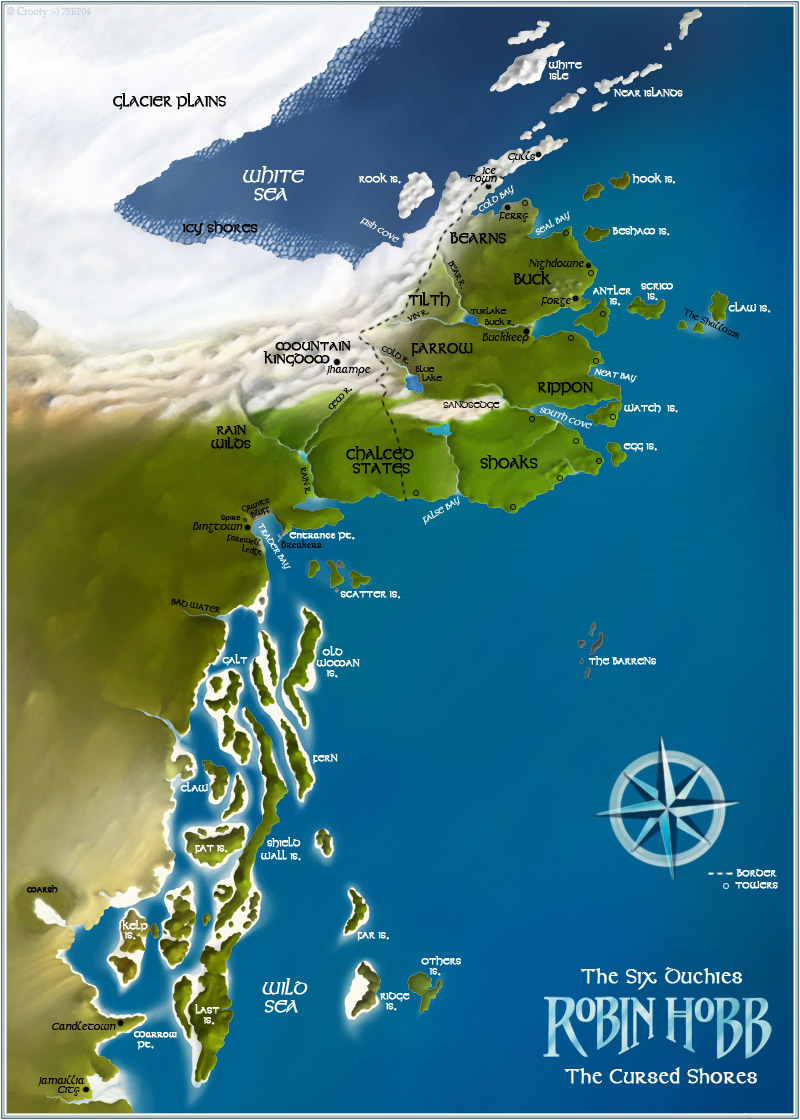
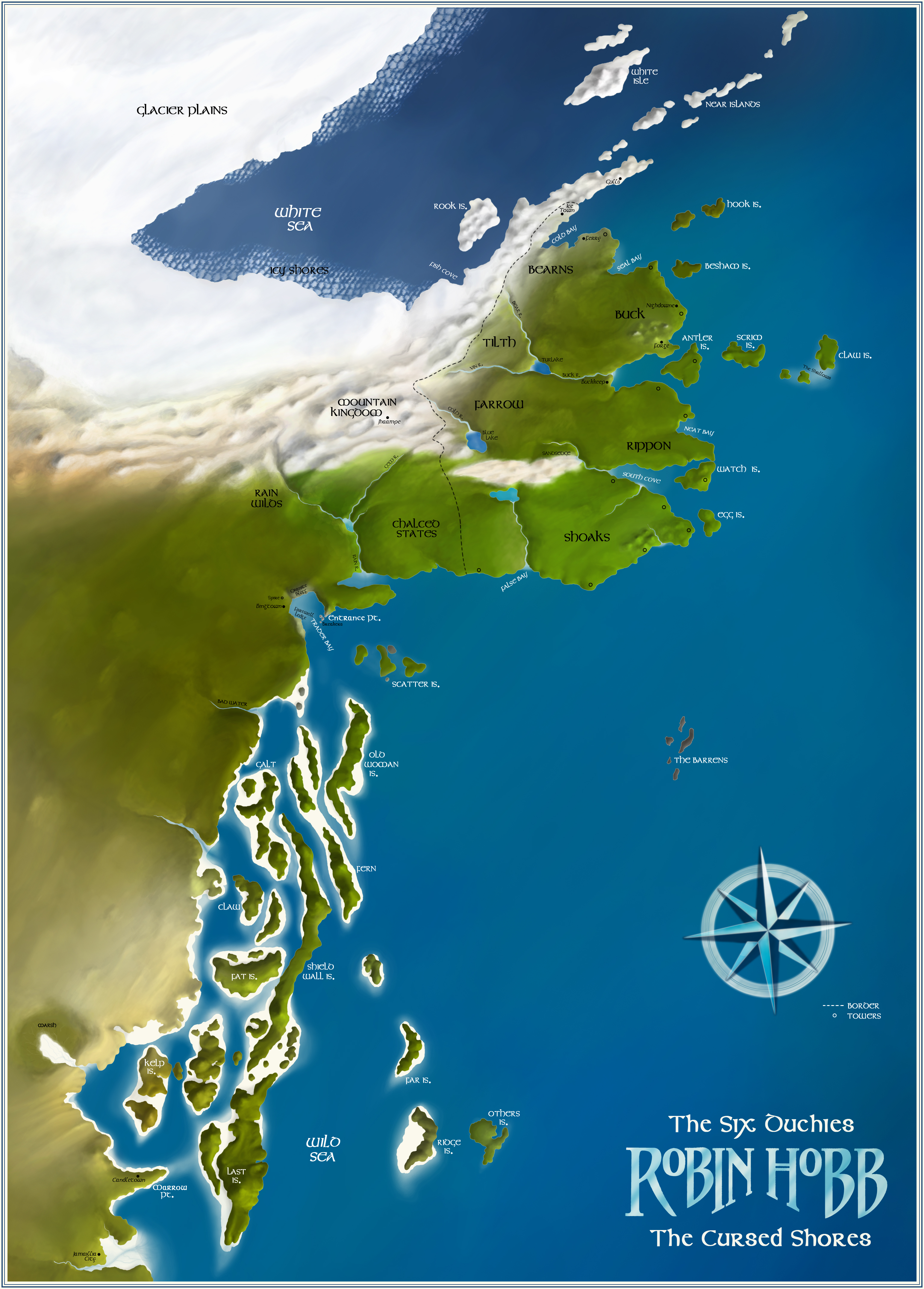
A very nice combined map of the Six Duchies and Cursed Shores regions from Robin Hobb's Farseer Trilogy, Liveship Traders, Tawny Man and Rain Wild Chronicles series can be seen here. A mega-resolution version for download and printing can also be found here. The same artist has some other Hobb-inspired artwork here.


Interesting stuff for the fantasy cartography fans out there.