Betrayed, tortured and left for dead, Fitz has survived the depredations of his mad uncle Regal and been taken to safety in the countryside of the Six Duchies. Plagued by nightmares and trauma, Fitz eventually recovers enough to swear himself to two tasks: the murder of Regal and the safe rescue of Verity, the long-missing true king.
Assassin's Quest concludes the Farseer Trilogy in a manner that I don't think anyone was quite expecting. The first two volumes of the Farseer series are traditional epic fantasies in many respects, but ones where more overt displays of magic and violence are rolled back in favour of a deeper emotional storyline and character development. Still, with their intrigue, battles, romance and betrayals (if separated by lots of long-winded introspection), there is much of the standard fantasy template within them.
Assassin's Quest is completely different. In fact, it's a very strange book. For most of the novel we are firmly in Fitz's head as he undergoes what can best be described as a PTSD-induced nervous and near-mental breakdown after the trauma he suffered at the end of Royal Assassin. Suffering severe depression and making awful judgement calls (as everyone calls him on but himself), Fitz has to first find himself and restore his confidence before he can embark on his long-delayed true quest, which is to find and rescue Verity. Eventually, after crossing (with agonising slowness and quite astonishing amounts of angst) the entire length of the Six Duchies, Fitz overcomes his demons and gets on with the story. The problem is that this happens some around page 500, meaning that the novel only then has 300 pages to wrap the entire trilogy up in.
You might imagine this means that those last 300 pages are full of incident and plot and character development as Hobb brings the story across the finish line? Not so much. Those 300 pages still meander, circling around major plot and character moments for dozens of pages before landing (and often exactly where the reader can see them going). Eventually, in the last few pages of the book, the author explains the background of the Elderlings, Forging, the Red Ship Raiders, the Skill and many other aspects of her world, but it comes so abruptly after almost 800 pages of slow-burning despair that it feels highly anti-climactic.
In some ways you have to respect Hobb for crafting such an utterly strange ending to a fantasy trilogy, one that shys away from convention and ignores every rule of plot structure and pacing. In many respects Hobb was writing a profoundly anti-epic fantasy, something similar to what Patrick Rothfuss appears to be doing with his trilogy (only with rather less humour), and in its sacrifice of plot and action and exposition for character and a realistic approach to how a real human mind might cope with the craziness of your average epic fantasy adventure, Hobb is clearly doing something different.
But different does not mean good and the thing about experiments is that they sometimes just don't work. Assassin's Quest has fine moments of characterisation (probably best exemplified in the relationship between Fitz and the Fool), some real moments of jaw-clenching terror and some very odd moments of real magical weirdness, but it is also a novel that unfolds with all the verve, pacing and tension of watching a lethargic snail travel thirty miles. The massive stakes and tensions raised over the course of almost 1,200 pages across the first two volumes are effectively handwaved away at the end of the novel: the Red Ship Raiders are defeated off-screen, the Fool remains resolutely unexplained and most of Fitz's friends and allies remain in complete ignorance that he is alive.
Obviously we know now there is more to come in the Tawny Man and Fitz and the Fool trilogies, but on its own merits Assassin's Quest (**½) is an altogether unsatisfying conclusion to the first series, languid to the point of unconsciousness until the too-rushed ending. There are some wonderful atmosphere moments and some occasionally effective dialogue, but overall it is a disappointing novel. Still, it is followed up by the far superior Liveship Traders trilogy. The novel is available now in the UK and USA.
Showing posts with label farseer trilogy. Show all posts
Monday, 26 September 2016
Thursday, 15 September 2016
Royal Assassin by Robin Hobb
Winter has fallen, bringing a brief respite from the depredations of the Red Ship Raiders. Fitz, returning to Buckkeep from the Mountain Kingdom, finds Prince Verity working hard to build ships and watchtowers to defend the coast, but everywhere the conniving Prince Regal is working to undermine his brother and pave his own way to the throne. When Verity embarks on an ill-advised quest to help save his kingdom, it falls to Fitz to try to hold everything together in his absence.
The middle volume of The Farseer Trilogy is Robin Hobb's attempt to avoid "middle book syndrome", that annoying situation where a book has no real opening or ending. As such, Royal Assassin tries to work as its own self-contained story in the structure of both the larger trilogy and the much larger Realm of the Elderling sequence beyond that.
In this endeavour, the author is mostly successful. Royal Assassin continues the storyline of Assassin's Apprentice, with FitzChivalry Farseer trying to overcome his status as the illegitimate son of a dead prince and a secret assassin to become a respected member of the court. He hopes to woo his childhood love, but King Shrewd wants him to marry for political advantage instead. Regal hopes to undermine and destroy Fitz, but Fitz's willingness to lead from the front and throw himself into battle against the Red Ship Raiders stymies him, as do Fitz's growing magical powers (in both the animalistic Wit and the telepathic Skill) and his canny support of Verity's bride, the Queen-in-Waiting Kettricken. Events boil over at the book's ending, which features a powerfully emotional moment of catharsis (arguably still the highlight of the entire sixteen-volume Elderling series to date) and setting the scene for the final confrontation in Assassin's Quest.
Hobb's facility with prose is enviable, creating a rich and engrossing fantasy world. Things may not move too far from the medieval fantasy norm and some of the worldbuilding doesn't entirely ring true (such as the vast size of the Six Duchies but the tiny size of its settlements and its apparently extremely low population), but for the most part the world of the Six Duchies is vividly and memorably portrayed. Her facility for characterisation also remains intact, with Kettricken, Patience, Burrich, Molly and Nighteyes all being well-drawn and convincing characters as well as Fitz himself.
Fitz has always been a problem for some readers, especially since the trilogy is told in the first person from his perspective. In the first volume Fitz was a little too passive and reactive and that problem persists into this second volume. However, in the latter half of Royal Assassin he does become more proactive in opposing Regal's plans. He even engages in some very mild political intrigue. It's no A Game of Thrones, but it does up the stakes a little at a key moment of the story.
Some of Hobb's key weaknesses as a writer do re-emerge in this volume, however. Her ability to conjure up the unfairness of life and the mountain of problems Fitz must struggle to overcome is remarkable, but there is also chapter after chapter where Fitz stews in the alleged utter misery of his life - as a favoured servant and assassin with a cool telepathic wolf companion and a beautiful, strong-willed girlfriend who loves him absolutely - whilst not really doing anything. It's still not as much of a problem as in later novels, but there is an interminable middle section to the novel and it feels like a comfortable 200 pages could have been shaved off the page count (already approaching twice the length of Assassin's Apprentice) without too much trouble.
Royal Assassin (****) is a bigger novel than its forebear and one with more political intrigue and action, at land and at sea. However, it's also overlong and suffers the same issues as its forebear but stretched over a longer page count: a plot that kicks into gear only intermittently and a protagonist too reactive for his own good. But Hobb's skills with character and emotion, and evoking her world in rich detail, continue to prove remarkable. The novel is available now in the UK and USA.
The middle volume of The Farseer Trilogy is Robin Hobb's attempt to avoid "middle book syndrome", that annoying situation where a book has no real opening or ending. As such, Royal Assassin tries to work as its own self-contained story in the structure of both the larger trilogy and the much larger Realm of the Elderling sequence beyond that.
In this endeavour, the author is mostly successful. Royal Assassin continues the storyline of Assassin's Apprentice, with FitzChivalry Farseer trying to overcome his status as the illegitimate son of a dead prince and a secret assassin to become a respected member of the court. He hopes to woo his childhood love, but King Shrewd wants him to marry for political advantage instead. Regal hopes to undermine and destroy Fitz, but Fitz's willingness to lead from the front and throw himself into battle against the Red Ship Raiders stymies him, as do Fitz's growing magical powers (in both the animalistic Wit and the telepathic Skill) and his canny support of Verity's bride, the Queen-in-Waiting Kettricken. Events boil over at the book's ending, which features a powerfully emotional moment of catharsis (arguably still the highlight of the entire sixteen-volume Elderling series to date) and setting the scene for the final confrontation in Assassin's Quest.
Hobb's facility with prose is enviable, creating a rich and engrossing fantasy world. Things may not move too far from the medieval fantasy norm and some of the worldbuilding doesn't entirely ring true (such as the vast size of the Six Duchies but the tiny size of its settlements and its apparently extremely low population), but for the most part the world of the Six Duchies is vividly and memorably portrayed. Her facility for characterisation also remains intact, with Kettricken, Patience, Burrich, Molly and Nighteyes all being well-drawn and convincing characters as well as Fitz himself.
Fitz has always been a problem for some readers, especially since the trilogy is told in the first person from his perspective. In the first volume Fitz was a little too passive and reactive and that problem persists into this second volume. However, in the latter half of Royal Assassin he does become more proactive in opposing Regal's plans. He even engages in some very mild political intrigue. It's no A Game of Thrones, but it does up the stakes a little at a key moment of the story.
Some of Hobb's key weaknesses as a writer do re-emerge in this volume, however. Her ability to conjure up the unfairness of life and the mountain of problems Fitz must struggle to overcome is remarkable, but there is also chapter after chapter where Fitz stews in the alleged utter misery of his life - as a favoured servant and assassin with a cool telepathic wolf companion and a beautiful, strong-willed girlfriend who loves him absolutely - whilst not really doing anything. It's still not as much of a problem as in later novels, but there is an interminable middle section to the novel and it feels like a comfortable 200 pages could have been shaved off the page count (already approaching twice the length of Assassin's Apprentice) without too much trouble.
Royal Assassin (****) is a bigger novel than its forebear and one with more political intrigue and action, at land and at sea. However, it's also overlong and suffers the same issues as its forebear but stretched over a longer page count: a plot that kicks into gear only intermittently and a protagonist too reactive for his own good. But Hobb's skills with character and emotion, and evoking her world in rich detail, continue to prove remarkable. The novel is available now in the UK and USA.
Sunday, 28 August 2016
Assassin's Apprentice by Robin Hobb
The Six Duchies are troubled by internal strife. King Shrewd's eldest son and heir, Prince Chivalry, has fathered an illegitimate son. Riven by guilt and controversy, Chivalry abdicates his position and goes into into exile. His son, Fitz, is raised in Buckkeep and tutored in the ways of becoming an assassin. For King Shrewd, Fitz is a weapon he can use to further the cause of his kingdom. But all Fitz wants is a home and a place to belong.
Assassin's Apprentice, originally published in 1995, is the first volume in The Farseer Trilogy, the first of nine books focused on the character of Fitz and also the first book in a sixteen-volume series entitled The Realm of the Elderlings. For a book that launched an enormously successful series, it is relatively small-scale and restrained.
This is traditional epic fantasy, but one that is slanted a little from the standard. It's medieval faux Europe, but the land of the Six Duchies is based on Alaska (albeit a slightly warmer one) and the neighbouring Mountain Kingdom is more inspired by Tibet. There are existential threats - the Red Ship Raiders who ravage the coastline and the threat of civil war - but for the most part these are kept firmly in the background. Assassin's Apprentice is primarily the coming of age tale of FitzChivalry Farseer as he grows up, gains allies, masters the art of the assassin and encounters two forms of magic: the Skill, a form of telepathic communication and control, and the Wit, a bond of empathy with animals.
Robin Hobb's greatest strength is her deft hand with charaterisation and her naturalistic way of presenting the world. Her greatest weakness is a tendency to meander, to have characters sitting around talking about the plot rather than getting on with things and taking a hundred pages to do what a more concise author would do in ten. These weaknesses manifest much more strongly in the later volumes of the series, however. Assassin's Apprentice is, at 480 pages in paperback, relatively short and breezy by Hobb's standards with both a strong character focus and clarity of storytelling.
Much of your enjoyment of these books relies on your engagement with the main character, Fitz. Fitz is an introverted, introspective young man who spends a lot of time reacting to events rather than taking decisive action (this changes in later novels, in which he is a lot less passive). This can be frustrating, but it is also realistic: Fitz occupies a place less than nobility but more than being a peasant, and this dichotomy leaves him isolated and almost friendless, his position in the world uncertain and unreliable. It is only towards the end of the volume, when he visits the Mountain Kingdom and encounters people less concerned with rank and pomp, that he is able to come out of his shell a little. As it stands, Fitz is a mildly engaging but far-from-compelling central character. However, he does serve as an effectively unreliable narrator: the further things and events are from Fitz's perspective, the less reliable they are. This serves to upset reader expectations several times over the course of the trilogy. It's not exactly Gene Wolfe, but it is an effective way of getting the reader to share in Fitz's biases and ignorance before presenting them with the truth of events later on.
Hobb is a superior prose writer and a gifted communicator of emotions and atmosphere. Although it's not a primary focus of her writing, she is also a good writer of horror: the Forged, people with their morals stripped away to be turned into monstrous echoes of their former selves, are a truly disturbing fantasy creation. In terms of politics she stumbles a little. Concluding events in the Mountain Kingdom are highly implausible and the way that Fitz escapes retribution for the events people genuinely believe that he has committed is extremely unconvincing. Fitz should be dead three times over before the book ends and the fact he isn't stretches the suspension of disbelief to the breaking point.
But there's also a lot to enjoy here. Fitz's tortured upbringing, his relationship with Burrich and Chade, and his punishing tutelage under Galen are all vividly (and sometimes painfully) described. The Red Ship Raiders are an intriguing enemy and the Forged a horrifying creation. Certainly the novel leaves one wanting to move onto the sequel, Royal Assassin.
Assassin's Apprentice (****) is thus a conflicted book: extremely well-written with a interesting backdrop and a terrific atmosphere, but with a plot that is a bit start-stop and political intrigue that is rather undercooked. But in terms of emotional engagement and its use of an unreliable narrator, Hobb is a formidable writer. The novel is available now in the UK and USA.
Assassin's Apprentice, originally published in 1995, is the first volume in The Farseer Trilogy, the first of nine books focused on the character of Fitz and also the first book in a sixteen-volume series entitled The Realm of the Elderlings. For a book that launched an enormously successful series, it is relatively small-scale and restrained.
This is traditional epic fantasy, but one that is slanted a little from the standard. It's medieval faux Europe, but the land of the Six Duchies is based on Alaska (albeit a slightly warmer one) and the neighbouring Mountain Kingdom is more inspired by Tibet. There are existential threats - the Red Ship Raiders who ravage the coastline and the threat of civil war - but for the most part these are kept firmly in the background. Assassin's Apprentice is primarily the coming of age tale of FitzChivalry Farseer as he grows up, gains allies, masters the art of the assassin and encounters two forms of magic: the Skill, a form of telepathic communication and control, and the Wit, a bond of empathy with animals.
Robin Hobb's greatest strength is her deft hand with charaterisation and her naturalistic way of presenting the world. Her greatest weakness is a tendency to meander, to have characters sitting around talking about the plot rather than getting on with things and taking a hundred pages to do what a more concise author would do in ten. These weaknesses manifest much more strongly in the later volumes of the series, however. Assassin's Apprentice is, at 480 pages in paperback, relatively short and breezy by Hobb's standards with both a strong character focus and clarity of storytelling.
Much of your enjoyment of these books relies on your engagement with the main character, Fitz. Fitz is an introverted, introspective young man who spends a lot of time reacting to events rather than taking decisive action (this changes in later novels, in which he is a lot less passive). This can be frustrating, but it is also realistic: Fitz occupies a place less than nobility but more than being a peasant, and this dichotomy leaves him isolated and almost friendless, his position in the world uncertain and unreliable. It is only towards the end of the volume, when he visits the Mountain Kingdom and encounters people less concerned with rank and pomp, that he is able to come out of his shell a little. As it stands, Fitz is a mildly engaging but far-from-compelling central character. However, he does serve as an effectively unreliable narrator: the further things and events are from Fitz's perspective, the less reliable they are. This serves to upset reader expectations several times over the course of the trilogy. It's not exactly Gene Wolfe, but it is an effective way of getting the reader to share in Fitz's biases and ignorance before presenting them with the truth of events later on.
Hobb is a superior prose writer and a gifted communicator of emotions and atmosphere. Although it's not a primary focus of her writing, she is also a good writer of horror: the Forged, people with their morals stripped away to be turned into monstrous echoes of their former selves, are a truly disturbing fantasy creation. In terms of politics she stumbles a little. Concluding events in the Mountain Kingdom are highly implausible and the way that Fitz escapes retribution for the events people genuinely believe that he has committed is extremely unconvincing. Fitz should be dead three times over before the book ends and the fact he isn't stretches the suspension of disbelief to the breaking point.
But there's also a lot to enjoy here. Fitz's tortured upbringing, his relationship with Burrich and Chade, and his punishing tutelage under Galen are all vividly (and sometimes painfully) described. The Red Ship Raiders are an intriguing enemy and the Forged a horrifying creation. Certainly the novel leaves one wanting to move onto the sequel, Royal Assassin.
Assassin's Apprentice (****) is thus a conflicted book: extremely well-written with a interesting backdrop and a terrific atmosphere, but with a plot that is a bit start-stop and political intrigue that is rather undercooked. But in terms of emotional engagement and its use of an unreliable narrator, Hobb is a formidable writer. The novel is available now in the UK and USA.
Sunday, 15 November 2015
A History of Epic Fantasy - Part 27
Summing up what epic fantasy is and is not is difficult. The barest tropes of the genre - big armies, travelogues, magic - can be used to define it, but it always feels like it's describing the symptoms and not the causes of why people write the genre, and why people read it. One potential definition is that epic fantasy is the story of big events channelled through the eyes of a small number of well-defined characters whom the audience invests in.
Or to put it another way, we may be interested in Middle-earth as a place and a collection of societies, but we only get interested in it through the actions of characters we empathise with: Bilbo, Frodo, Gandalf, Gollum etc. The same with Westeros. The war for the Iron Throne is irrelevant if the reader does not care about Ned Stark or Tyrion Lannister or Daenerys Targaryen. Arguably epic fantasy can go off the rails when the scope balloons and so many characters are brought in that the tension and pace can become diffuse, a problem struggled with by many of even the best and most critically lauded authors in the genre. This tension between the macro and micro-scale, between the personal stories of characters we love and the epic struggle of clashing armies and gods and philosophies, arguably lies at the core of the appeal of epic fantasy and how different authors approach it can determine their success. It often feels like fantasy authors, when in doubt, move in favour of the massive, epic scale and throw so many new ideas, new characters and new magic systems into their narratives that they can risk overload or crashing the momentum of their series.
In 1995 a novel was published which firmly tilted in the opposite direction, where big things happened but the perspective was tightly limited (at least for most of the books). This gave rise to one of the biggest-selling, most critically lauded and respected fantasy series of the last fifteen years: The Realm of the Elderlings mega-sequence by Robin Hob.
Assassin's Apprentice & Ship of Magic
Of course, it didn't start out that way. Margaret Astrid Lindholm Ogden had published her very first novel, Harpy's Flight in 1983. By the early 1990s she'd been writing novels for ten years and had released ten books in the adventure fantasy field (and also a single SF novel, Alien Earth). These had been released under pen-name, Megan Lindholm. In July 1993 she concluded a deal with Bantam for three further books, this time an epic fantasy trilogy. The first volume at this point had the working title Chivalry's Bastard.
By the time the book was completed and delivered, the author and her publisher agreed it was a very different kind of novel for her. It was longer, more complex and much more adult. It was decided to remarket the novel as coming from a new author. She picked the name "Robin Hobb" after discovering that the "H" row was often on a perfect eyeline for an adult browsing the shelves in a bookstore.
Retitled Assassin's Apprentice, the novel was released in April 1995 and was immediately successful. Two heavyweight fantasy artists - Michael Whelan in the United States and John Howe in the United Kingdom - provided excellent covers. Reviews were very strong. The book was fairly traditional, focusing on the character of Fitz, the bastard son of the king's heir who is reluctantly allowed to live in the royal household but finds himself at something of a loose end. He is trained by the royal assassin, Chade, and uncovers political intrigue with his half-uncle Regal seeking to usurp the throne, the Six Duchies facing attacks by the mysterious Outislanders and relations with the Mountain Kingdom being strained. Royal Assassin (1996) and Assassin's Quest (1997) continue and resolve these issues, the three books together forming The Farseer Trilogy.
However, although the books feature political intrigue, two magic systems (the Skill and the Wit) and occasional bouts of violence, their popularity rested on a series of relationships: between Fitz and his wolf, Nighteyes; between Fitz and his mentor Chade, and his uncle Verity; and, most tantalisingly, between Fitz and the highly enigmatic Fool. The trilogy ended on a positive note, but Fitz did not seem to have truly found happiness at its conclusion.
Robin Hobb went on to write The Liveship Traders (1998-2000), a further trilogy set in the same world but along the coast of the continent to the south. This trilogy focuses on the families of Bingtown, who have developed the ability to carve ships controlled by sentient figureheads. Initially the books revolve around the battle within a family for ownership of the liveship Vivacia, but as the narrative unfolds the scope expands. Unlike the Farseer series, which was written in first-person, Liveship is written from a more traditional third-person viewpoint and encompasses a wide range of characters living in different locales. This trilogy features more compelling and original worldbuilding than Farseer, which is very traditional, but also is notable for giving the primary villain a journey and arc of his own that is understandable and sympathetic. Indeed, Hobb arguably is too successful in making Kennit a relatable figure and the decision to have him revert to pure villainy by becoming a rapist feels heavy-handed. But overall The Liveship Traders is as strong and readable a series as its forebear, benefiting from the shift in location and theme.
Hobb returned to Fitz's story in The Tawny Man (2001-03), which followed up on his adventures fifteen years after the events of Farseer. More intriguingly, it touched on events in The Liveship Traders and started pulling together story threads revolving around the Liveships, sea serpents, dragons and the extinct race of mysterious Elderlings, providing a larger-scaled and more mythic backdrop for the series. However, the focus remained resolutely on the key characters.
Hobb took a break from Fitz's world to write the Shaman's Crossing trilogy (2005-08), set on a completely different world with gunpowder. Although well-regarded, it wasn't as successful critically as her Elderling mega-series. She subsequently returned to the setting of the Rain Wilds, touched on in both the Farseer and Liveship story strands, for a four-volume series expanding on that region, The Rain Wild Chronicles (2009-13). This led Hobb to write Fitz and the Fool (2014-17, est), a new trilogy continuing (and perhaps wrapping up) the story of Fitz and his enigmatic friend, now emerging as arguably the central figure of the entire saga.
The Robin Hobb books feature all the hallmarks of epic fantasy, but her prose and dialogue style are a marked improvement over much of the genre and her focus on character over the furniture of the setting is highly laudable. Her approach is also hugely appealing on a wide level. Her books were Harper Voyager's biggest-selling series until A Song of Ice and Fire overtook them in the early 2000s, and she has enormous respect from her peers. Authors as different as George R.R. Martin and Steven Erikson are big fans, and The Telegraph even called the first book of the Fitz and the Fool sequence "High art." If the books have a weakness it may be a traditional one: excessive verbiage with the streamlined opening volumes of both Farseer and The Liveship Traders being dwarfed by the concluding volumes of each trilogy (each almost double the size of the first), and the Rain Wild Chronicles expanding almost uncontrollably from a duology to a four-volume series.
But at her best Robin Hobb is one of the most human and humane writers in the field, writing intelligently and with clarity about people and what makes them tick, whilst also remembering to throw in the requisite fantasy cool stuff like dragons and sentient sailing ships.
By the end of the 1990s the genre's success appeared secured through the arrival and establishing of a new breed of epic fantasy authors writing with greater skill and interest in characters and people, whilst also being more willing to delve into the darker side of the genre. But a parallel subset of fantasy was also developing which wanted to turn over all the rules and do something really different. Really...weird.
Or to put it another way, we may be interested in Middle-earth as a place and a collection of societies, but we only get interested in it through the actions of characters we empathise with: Bilbo, Frodo, Gandalf, Gollum etc. The same with Westeros. The war for the Iron Throne is irrelevant if the reader does not care about Ned Stark or Tyrion Lannister or Daenerys Targaryen. Arguably epic fantasy can go off the rails when the scope balloons and so many characters are brought in that the tension and pace can become diffuse, a problem struggled with by many of even the best and most critically lauded authors in the genre. This tension between the macro and micro-scale, between the personal stories of characters we love and the epic struggle of clashing armies and gods and philosophies, arguably lies at the core of the appeal of epic fantasy and how different authors approach it can determine their success. It often feels like fantasy authors, when in doubt, move in favour of the massive, epic scale and throw so many new ideas, new characters and new magic systems into their narratives that they can risk overload or crashing the momentum of their series.
In 1995 a novel was published which firmly tilted in the opposite direction, where big things happened but the perspective was tightly limited (at least for most of the books). This gave rise to one of the biggest-selling, most critically lauded and respected fantasy series of the last fifteen years: The Realm of the Elderlings mega-sequence by Robin Hob.
Assassin's Apprentice & Ship of Magic
Of course, it didn't start out that way. Margaret Astrid Lindholm Ogden had published her very first novel, Harpy's Flight in 1983. By the early 1990s she'd been writing novels for ten years and had released ten books in the adventure fantasy field (and also a single SF novel, Alien Earth). These had been released under pen-name, Megan Lindholm. In July 1993 she concluded a deal with Bantam for three further books, this time an epic fantasy trilogy. The first volume at this point had the working title Chivalry's Bastard.
By the time the book was completed and delivered, the author and her publisher agreed it was a very different kind of novel for her. It was longer, more complex and much more adult. It was decided to remarket the novel as coming from a new author. She picked the name "Robin Hobb" after discovering that the "H" row was often on a perfect eyeline for an adult browsing the shelves in a bookstore.
Retitled Assassin's Apprentice, the novel was released in April 1995 and was immediately successful. Two heavyweight fantasy artists - Michael Whelan in the United States and John Howe in the United Kingdom - provided excellent covers. Reviews were very strong. The book was fairly traditional, focusing on the character of Fitz, the bastard son of the king's heir who is reluctantly allowed to live in the royal household but finds himself at something of a loose end. He is trained by the royal assassin, Chade, and uncovers political intrigue with his half-uncle Regal seeking to usurp the throne, the Six Duchies facing attacks by the mysterious Outislanders and relations with the Mountain Kingdom being strained. Royal Assassin (1996) and Assassin's Quest (1997) continue and resolve these issues, the three books together forming The Farseer Trilogy.
However, although the books feature political intrigue, two magic systems (the Skill and the Wit) and occasional bouts of violence, their popularity rested on a series of relationships: between Fitz and his wolf, Nighteyes; between Fitz and his mentor Chade, and his uncle Verity; and, most tantalisingly, between Fitz and the highly enigmatic Fool. The trilogy ended on a positive note, but Fitz did not seem to have truly found happiness at its conclusion.
Robin Hobb went on to write The Liveship Traders (1998-2000), a further trilogy set in the same world but along the coast of the continent to the south. This trilogy focuses on the families of Bingtown, who have developed the ability to carve ships controlled by sentient figureheads. Initially the books revolve around the battle within a family for ownership of the liveship Vivacia, but as the narrative unfolds the scope expands. Unlike the Farseer series, which was written in first-person, Liveship is written from a more traditional third-person viewpoint and encompasses a wide range of characters living in different locales. This trilogy features more compelling and original worldbuilding than Farseer, which is very traditional, but also is notable for giving the primary villain a journey and arc of his own that is understandable and sympathetic. Indeed, Hobb arguably is too successful in making Kennit a relatable figure and the decision to have him revert to pure villainy by becoming a rapist feels heavy-handed. But overall The Liveship Traders is as strong and readable a series as its forebear, benefiting from the shift in location and theme.
Hobb returned to Fitz's story in The Tawny Man (2001-03), which followed up on his adventures fifteen years after the events of Farseer. More intriguingly, it touched on events in The Liveship Traders and started pulling together story threads revolving around the Liveships, sea serpents, dragons and the extinct race of mysterious Elderlings, providing a larger-scaled and more mythic backdrop for the series. However, the focus remained resolutely on the key characters.
Hobb took a break from Fitz's world to write the Shaman's Crossing trilogy (2005-08), set on a completely different world with gunpowder. Although well-regarded, it wasn't as successful critically as her Elderling mega-series. She subsequently returned to the setting of the Rain Wilds, touched on in both the Farseer and Liveship story strands, for a four-volume series expanding on that region, The Rain Wild Chronicles (2009-13). This led Hobb to write Fitz and the Fool (2014-17, est), a new trilogy continuing (and perhaps wrapping up) the story of Fitz and his enigmatic friend, now emerging as arguably the central figure of the entire saga.
The Robin Hobb books feature all the hallmarks of epic fantasy, but her prose and dialogue style are a marked improvement over much of the genre and her focus on character over the furniture of the setting is highly laudable. Her approach is also hugely appealing on a wide level. Her books were Harper Voyager's biggest-selling series until A Song of Ice and Fire overtook them in the early 2000s, and she has enormous respect from her peers. Authors as different as George R.R. Martin and Steven Erikson are big fans, and The Telegraph even called the first book of the Fitz and the Fool sequence "High art." If the books have a weakness it may be a traditional one: excessive verbiage with the streamlined opening volumes of both Farseer and The Liveship Traders being dwarfed by the concluding volumes of each trilogy (each almost double the size of the first), and the Rain Wild Chronicles expanding almost uncontrollably from a duology to a four-volume series.
But at her best Robin Hobb is one of the most human and humane writers in the field, writing intelligently and with clarity about people and what makes them tick, whilst also remembering to throw in the requisite fantasy cool stuff like dragons and sentient sailing ships.
By the end of the 1990s the genre's success appeared secured through the arrival and establishing of a new breed of epic fantasy authors writing with greater skill and interest in characters and people, whilst also being more willing to delve into the darker side of the genre. But a parallel subset of fantasy was also developing which wanted to turn over all the rules and do something really different. Really...weird.
Saturday, 6 February 2010
Interesting map for Robin Hobb fans
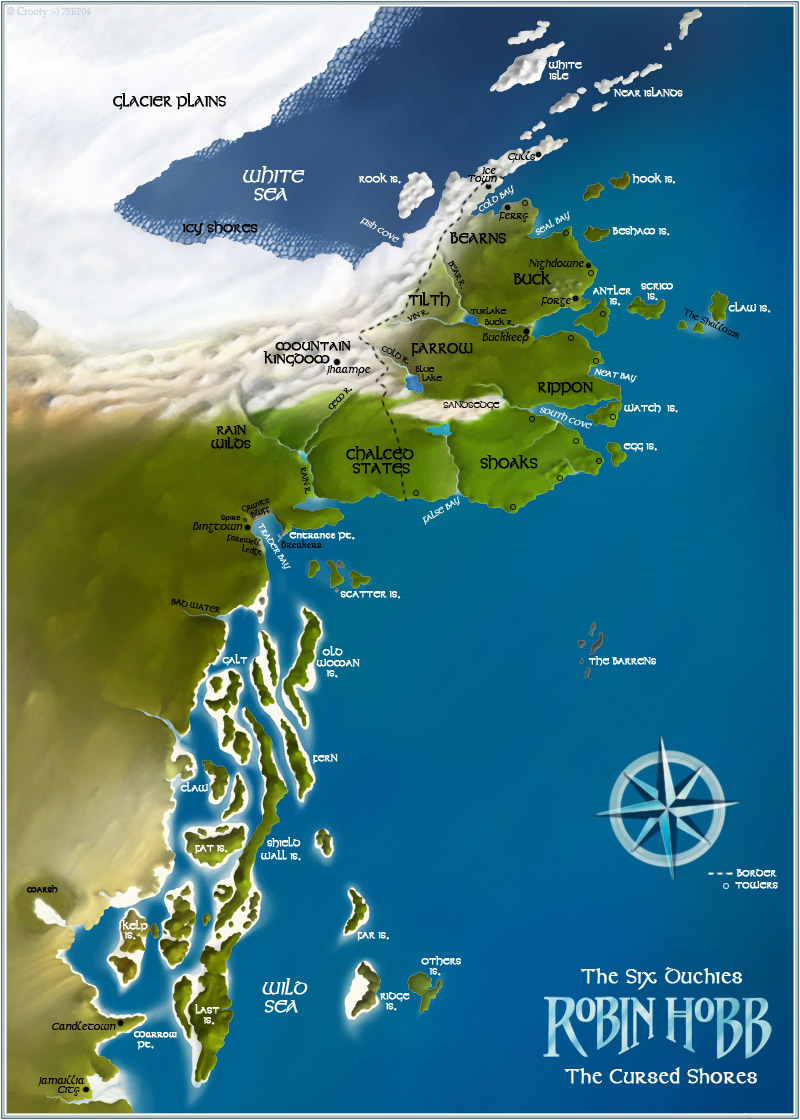
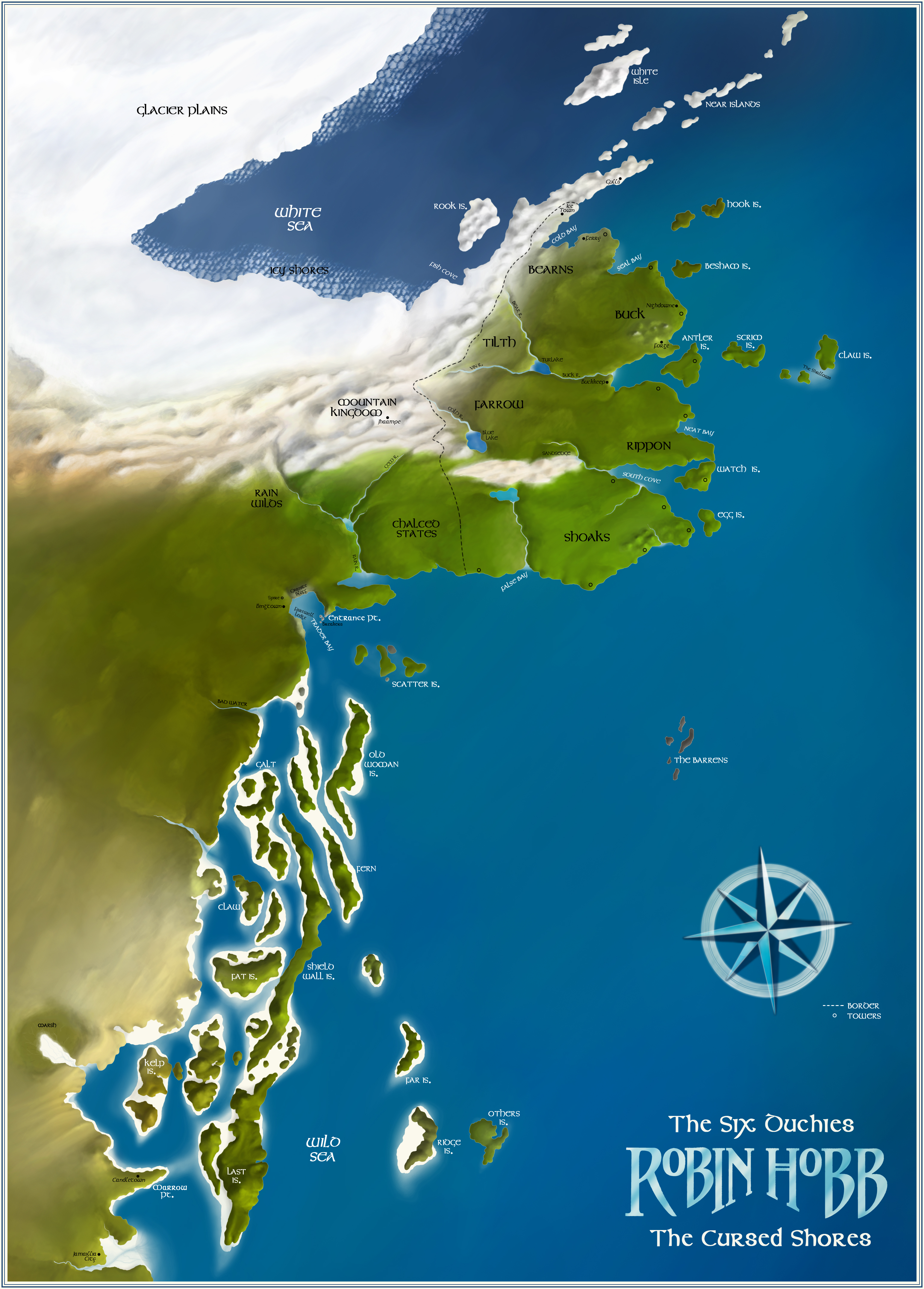
A very nice combined map of the Six Duchies and Cursed Shores regions from Robin Hobb's Farseer Trilogy, Liveship Traders, Tawny Man and Rain Wild Chronicles series can be seen here. A mega-resolution version for download and printing can also be found here. The same artist has some other Hobb-inspired artwork here.

Interesting stuff for the fantasy cartography fans out there.

Interesting stuff for the fantasy cartography fans out there.
Subscribe to:
Posts (Atom)