Monday, 9 May 2016

The Lost Reviews: Part 7 - Season 2, Episodes 5-8

Welcome to the Lost rewatch project. I am currently rewatching all 121 episodes of the TV series which aired for six seasons from 2004 to 2010. This is very much a rewatch thread, with the show watched with knowledge of what is to come in later seasons. If you've never watched Lost before, you definitely do not want to read this blog series.

Without further ado, let us continue after the jump.

Jin and Sun's first meeting.


Sunday, 8 May 2016

Paul Kearney's new novel out now

Paul Kearney's new novel, The Wolf in the Attic, is out now (UK, USA). This is the author's first new novel in four years, since he completed his Macht Trilogy with Kings of Morning in 2012.


This book is set in Oxford in 1929 and sees the protagonist, a young Greek refugee named Anna, drawn into unusual events involving her father, the loss of her home in Smyrna and two Oxford dons named Lewis and Tolkien. It's a move away from the epic fantasy series that Kearney is perhaps best-known for, and more of a return to his early stand-alone novels that melded the fantastic with the real world.

There's been some good coverage of the book and some excellent reviews:

Guest blog from Paul at Pat's Fantasy Hotlist.
Interview at Sci-Fi Bulletin.
Interview at Rising Shadow.


Review at Living For Books.
Review at My Books, My Life, My Escape.
Review at Lipstick and Libraries.
Review at Bastian's Book Reviews.
Review at Queen of Blades.
Review at Adventures in Sci-Fi Publishing.
Review at Bookhaunt.
Review at City of Lost Books.
Review at My Bookish Ways.
Review at The Quidnunc.


I am currently about halfway through the novel and hope to bring you all a review shortly.

Friday, 6 May 2016

Blogging in the Age of Austerity

This week the veteran, multi-award-winning science fiction and fantasy blog SF Signal announced it was shutting down. The news sent shockwaves through SFF fandom: SF Signal was founded in 2003, in the earliest, most nascent days of the blogosphere when the world was still young. Other blogs had come and gone, but SF Signal was an eternal presence on the scene. Indeed, with three Hugo Awards to its name and a large number of guest and contributing editors providing content under the eyes of founders John DeNardo and JP Frantz, the future looked quite bright for SF Signal.


Their reasons for shuttering the blog are very understandable: even if others could provide content, the blog was still their baby and still consumed a lot of their free time. Both editors had reached a point where they could not justify giving up that time at the expense of spending time with their families, so decided to shut down the blog. No doubt there were options for passing SF Signal onto other writers and editors, but the site was theirs and they didn't want it to continue without them, hence the closure. This news came on the heels of Charlie Jane Anders stepping away from SFF mega-site io9 to concentrate on her fiction. That was a different case, as Gawker Media who hosted, paid for and maintained io9. Anders was the co-founder and helped establish the tone and direction of the site, but as a corporate entity io9 could keep going under new management in the form of long-time contributor and arch-snarkmaster Rob Bricken. More distinctively, as a corporate media concern, the people working on io9 get paid. The people working on SF Signal do not.


Back in the autumn of 2005, for the first time in my life, I was finally able to move into a house with broadband. Before that my web-browsing was carried out in internet cafes and libraries. As a lifelong fan of SFF, this had been rather frustrating but I wasted no time in hanging around. Within hours of getting my first broadband connection installed I had signed up on several of the major SFF forums: Westeros, Wotmania (defunct), SFX (defunct) and Dragonmount. In the following weeks and months I would join many others: SFF Chronicles, SFFWorld, Malazanempire, Paizo and SFX. Due to good timing and good fortune, I would meet George R.R. Martin for the very time within a few weeks of that time and post a detailed report of that meeting on Westeros, leading to me becoming a moderator there. I posted numerous book reviews over the following months, which led to people suggesting that I start my own blog, which I finally did in November 2006. And here we are, ten years later (well, nine and a half).

Writing the blog has been immensely satisfying, especially when I've reviewed a less well-known book and seen dozens of people go and buy a copy. For a few people, it was on the Wertzone that they first heard there was a new Star Wars movie coming out, or that A Dance with Dragons finally had a publishing date, or that Fallout 4 existed. The satisfaction of writing and working on the blog for a reading audience is tremendous, and I often feel the need that my readers deserve and need the best content I can put out. Hence how a planned mild rebuttal to a cheesy "Best Fantasy Evaaah" article on another website ended up becoming a 66,000-word series on the history of the entire genre. I like to think that this commitment to original content, long posts and a fairly prolific output is why the blog is doing so well. Since 2011, during the period when I've been repeatedly told that blogging is dead, the Wertzone has increased its hit rate to unprecedented heights. All of this is fantastic and has had significant knock-on effects: attending conventions, hosting and taking part on panels, and - very occasionally - doing paying work for publishers or magazines.

All of this requires a substantial time investment, however. It's frequently involved coming in from eight hours at the day job to jumping straight into four or five hours on the site, several times a week. Sometimes that's been fine and sometimes it hasn't, and I've scaled things back. The balance of investment and reward in any activity needs to be weighed, and for the most part I've been happy with that balance.

As I get older, though, it becomes harder to justify spending so much time blogging in favour of doing other things, such as spending more time with friends, family or a significant other or just more time relaxing after work. Right now, I don't actually have a significant other (for the last couple of months) or a day job (for the last month), hence why the Wertzone was unusually busy in April. I made a conscious decision last month to, whilst undertaking my normal jobsearching activities, to also put eight hours a day into the blog and treating it like a day job. This is why there double the normal number of posts last month, and a corresponding rise in hits, social media activity, getting new Twitter followers etc. It was fortuitous that a couple of big, attention-grabbing stories came up during that time (most notably the Wheel of Time TV series news).

This never happens.

For bloggers who do have day jobs and families, it's become clear that the lack of material reward for blogging means greater pressure to step away and spend that time instead with loved ones or doing other things. And that's why it's easy to see why the guys at SF Signal decided to step away. If I get one of the several jobs I'm currently going through the recruitment process for, the amount of blogging on the site will have to fall as I devote time to that instead.

Is there a way around this? Should there be? Kind of. For a lot of bloggers, blogging is a springboard into writing fiction and once they make that transition, the blogging is left behind. For me, I have no interest in writing fiction day in, day out. I may one day try my hand at writing a short story or a novel if a story demands to be told, but I'm never going to be a career fiction writer. I much prefer writing about the genre as a critic, but the paid market for that is much smaller. After over five months doing the rounds with my agent, A History of Epic Fantasy has failed to garner as much as the merest flicker of interest from a professional publisher, despite the people nominating it for awards (and in any year but this one, it might even have stood a chance of making the shortlist) and clamouring for the book version (look for an update on that soon). But even if that takes off, that's just one project. Being an SFF critic isn't much of a career path these days, especially with venues drying up (even the mighty SFX Magazine seems to be in financial trouble and may not last much longer).

This never happens. Well, not any more anyway.

Hey, don't you get paid in free books?

Nope, or at least not any longer. Back in the day, being a successful book-focused blogger meant receiving lots of ARCs (Advanced Reading Copies), pre-release editions of books sent out for free to reviewers to drum up interest in novels before they come out. Some took this to be a reward in itself, and for a year or two there was a "controversy" about conflicts of interests and these things constituting bribery and so forth. But ARCs have largely become a thing of the past: I received over 150 in 2010 and in 2016 so far I have received exactly four (Children of Earth and Sky, The Call and The Wolf in the Attic for those curious, with The Great Ordeal on its way). ARCs have been largely replaced by e-ARCs and NetGalley, and since I can't read novels from a computer screen (vision issues; sometimes even just the blogging and internet research causes me problems), the result of that is that I no longer receive, and almost never ask for, ARCs any more. So they're out, and that's not a problem. I still have the better part of 200 books on the to-read pile and that will take me years to get through if I never buy or receive another book during that time.

So to justify continuing to blog at my current rate, I really need to make the blog pay, either enough for me to work on it full-time or enough to mean that I only need to get a part-time job. And to date I've tried two ways of generating income from the blog.

The first thing I did was put up a tipjar on the blog for contributors to make donations. I did that on 30 October 2012, so three and a half years ago. In that timeframe, I've received in total about £300 (and £100 of that from one very generous donor). That is absolutely fantastic, and that money went back into the site in the form of sourcing more content, travelling to events and buying more books and other media for review on the blog. But, to put it in perspective, that's about one-quarter of one month's pay at the UK minimum wage (and rather less than the actual living wage). It's a lovely bonus, but it will never pay for me to work full-time on the site.

More recently, back in October last year, I instigated advertising on the site, at a (hopefully) low-key and unobtrusive level. This brings in approximately £60 every four months. Again, excellent and gratefully-received, but it's not going to be paying for me to run the site any time soon. I could ramp up the advertising, even do those wrap-around adverts that would bring in a bit more, but I find those insanely annoying and it really would constitute a conflict of interest if I got paid to host an advert for a book I then reviewed.

Two additional ideas have been floated to me. The first is that I try my hand at podcasting. I've always been reluctant to try this because I read information at a vastly faster rate that watching or listening to it. I once sat down and tried to listen to the A Game of Thrones audiobook and it drove me crazy because in the time that it took Roy Dotrice to read the prologue I could have easily read three or four chapters of the book with my actual head-eyes. However, I am assured that there a lot of other people don't have that issue and there are certainly time efficiencies from podcasting (being able to listen or watch them on the move, at work, on headphones, in the car etc) that text blogging can't compete with. I don't actually have any equipment to do podcasting with, but it is something I'll probably look into later this year, especially when we move closer to the History of Epic Fantasy project moving forwards, as that would be a good way of introducing the book.

The second one is a bit more straightforward: Patreon. For those unaware of it (as I was until a few months ago), this is a crowdsourcing site where you basically get people to pledge a monthly payment in return for exclusive content/rewards (either completely exclusive or time-sensitive, so you'd get an article a month before non-pledgers). This doesn't seem like such a bad idea, although I'm dubious about the support I'd get and I do have a slight location-based issue: I have the temerity to be based in the UK, with a highly unfavourable exchange rate with, well, most of the rest of the world but especially the USA, where a large number of my readers are. But it's certainly worth a look and I'll probably be pursuing that in the near future.

Like Neo, I do always have the option of making a new Bill & Ted movie to fall back on.

But what if you fail?

Er, then I'll carry on as I am now. I don't see a situation where I'll ever quit, give up or retire from blogging, but certainly I can see situations where I have to drastically reduce my output and contributions due to other commitments. Which would suck.


But hey, do we even need bloggers in the first place?

I think the genre needs as many voices in it as possible discussing books, authors, TV shows, video games and the other things that make the genre what it is. The more voices, the more chances of the good stuff rising to the top and the stronger and healthier the field. Whether the field needs me, or any individual blogger specifically, is a different question and one that's down to the readers.

DARKOVER TV series moving forwards at Amazon

Amazon have named the showrunners for their TV series based on Marion Zimmer Bradley's Darkover series of novels and short stories.


Elizabeth Sarnoff (a writer-producer on Lost) and Patrick Macmanus (who recently worked on Marco Polo) will run the show and co-write. Amazon are developing the series to add to their line of original content.

The books are set on Darkover, a planet orbiting a red giant star. Shortly after an attempted colonisation, the colonists lose their technology and regress to a primitive state, before gradually rediscovering it and renewing contact with Earth thousands of years later. Bradley wrote the first Darkover short story in 1958. More than thirty novels and fifteen anthologies have been published in the setting, featuring stories primarily by Bradley but also other authors.

Bradley died in 1999 and her reputation has recently been marred by claims she was complicit in the sexual abuse of her daughter. Given Bradley's death it is assumed that any of the financial gain from this TV adaptation will go to her estate and her children. Some of the proceeds of recent posthumous Darkover books by other authors have also been donated to anti-abuse charities.

SF Signal closes down

In a surprising move, SFF website SF Signal is shutting down after thirteen years.


The blog's editors, John DeNardo and JP Frantz, have announced the news is because the time invested in making the website work had become overwhelming and they wanted to spend more time with their families. The website has won three Hugo Awards and over the years has become one of the tentpoles of online genre discussion.

I wish the editors well in their future endeavours, and it is a shame to see such a powerhouse of online discussion shutting down.

Thursday, 5 May 2016

The Lost Reviews: Part 6 - Season 2, Episodes 1-4

Welcome to the Lost rewatch project. I am currently rewatching all 121 episodes of the TV series which aired for six seasons from 2004 to 2010. This is very much a rewatch thread, with the show watched with knowledge of what is to come in later seasons. If you've never watched Lost before, you definitely do not want to read this blog series.

Without further ado, let us continue after the jump.


Desmond's reaction to yet another Jack flashback episode.

Wednesday, 4 May 2016

New remastered version of STAR TREK II: THE WRATH OF KHAN due in June

Paramount Pictures have confirmed that they will be releasing a brand new, remastered version of Star Trek II: The Wrath of Khan in June as part of the celebrations of Star Trek's 50th anniversary.


This a new, 4K scan of the original film negative. The movie will be presented in both its original theatrical version and the director's cut, which is generally considered definitive.

The Wrath of Khan is easily the best of the twelve Star Trek movies released to date (and certainly wipes the floor with its hideous semi-remake, Star Trek Into Darkness) and a remastered re-release is certainly way past time (although the previous blu-ray release was already quite decent). However, surprisingly, Paramount have confirmed that they are not planning any further remasterings for the other Star Trek movies, where the picture quality is highly variable. There are some suggestions that Paramount may consider further remasterings if Star Trek II sells well.

In terms of further HD remasterings for the remaining Star Trek series, CBS are releasing Star Trek: The Animated Series on blu-ray later this year. They are also, very late in the day, finally issuing a one-volume complete series box set of Star Trek: The Next Generation on blu-ray in June. Next Generation blu-ray sales in the States were considered to be disappointing, which led to plans for a HD remastering of Deep Space Nine to be put on hold. However, anecdotally at least, almost every American Star Trek fan I know has been saying they were holding out for the complete series box set because the individual sets were released at a very high price point. It may be that once the complete TNG set has been out for a while we may see improved sales and a move to remaster DS9 and, if that's successful, Voyager later on.

Considering that September marks the 50th anniversary of Star Trek, it appears that CBS and Paramount have been more than slightly lacking in celebrating the fact. The new Star Trek movie, Beyond, is released in July but has had bafflingly little pre-release hype or build-up. There's the new TV series, of course, but that won't launch until January. Whilst various TV specials and documentaries have been mentioned, there's not much too hard info on what is being done for the anniversary. Compared to the celebrations for Doctor Who's 50th anniversary in 2013, it all feels a bit lacking for one of the biggest science fiction franchises in history.

CBS confirms weekly release model for new STAR TREK series

CBS have given some more details on their new Star Trek series, in particular how they plan to release it.

The Federation's Excelsior-class was its most powerful and impressive starship design during the rumoured timeframe of the new series.

It was assumed in some quarters that CBS would release the entire season in one go, as with the Netflix model. However, CBS have now confirmed that after the first episode simultaneously airs on CBS and the CBS All Access digital streaming service, the rest of the season (currently believed to be 13 episodes in total length) will air once a week only on CBS All Access. CBS All Access costs American viewers $6 a month, but, controversially, still carries advertising. This distribution model will prevent people from subscribing, binge-watching the whole season in a weekend and then unsubscribing, at least not until the season has finished airing.

The exclusivity to CBS All Access, a rather niche and small service compared to the likes of Hulu, Amazon and Netflix, has irritated some fans who didn't want to pay yet more money and add yet another service to the increasingly long list of services demanding their time and money. It's just fortunate for CBS that there's no way for people who don't want to be hooked into yet another service to get hold of the episodes shortly after airing.

It's likely that the new series will air in a more traditional manner in other countries, but CBS have not yet announced any international partners for the series.

The new Star Trek series is currently in pre-production and should begin shooting in Toronto in the late summer for a January 2017 debut. Alex Kurtzman and Bryan Fuller are running the series, with veteran Star Trek movie writer and director Nicholas Meyer also producing and writing. No further details have been revealed, but apparently credible leaks have suggested that this will be a self-contained, serialised story that will be set somewhere in the seventy-year gap between Star Trek: Generations and Star Trek: The Next Generation, in the original or prime Trek timeline, and will involve Klingons as antagonists. The new series will not be set on a ship named Enterprise. It sounds like CBS are considering an anthology model for this series (similar to Fargo), with future seasons able to jump around to different times and places in the Star Trek universe.

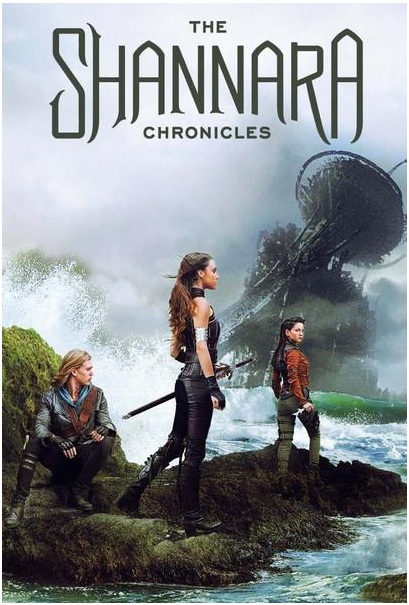
The Shannara Chronicles: Season 1

The Four Lands is threatened with a devastating invasion from demons. Millennia ago, the demons were imprisoned in the Forbidding, an alternative dimension warded shut by the Ellcrys, a giant magical tree. Now the Ellcrys is dying and the Forbidding is failing, allowing the demons to return. It falls to Wil Ohmsford (the half-elven descendant of the Shannara bloodline), Princess Amberle Elessedil and Eretria, a rover girl, to travel across the Four Lands and restore the Ellcrys and the Forbidding.


Terry Brooks's Shannara series holds an important place in the history of epic fantasy. The first novel in the sequence, The Sword of Shannara (1977), was the first big epic fantasy novel to hit the New York Times bestseller list since Tolkien, and along with Stephen Donaldson's Thomas Covenant series ushered in the modern era of fantasy novels. However, The Sword of Shannara has also become a byword for poor-quality fantasy that knocks off Tolkien rather than furthering the development of the genre. Given that the Shannara series (now encompassing twenty-eight novels) has sold almost fifty million copies worldwide, making it one of the biggest-selling fantasy series of all time (only A Song of Ice and Fire, The Wheel of Time, Discworld, Narnia, Middle-earth and Harry Potter - if you count it as epic fantasy - have sold more), it's surprising that it's taken this long for someone to attempt an adaptation.

MTV, sensibly, have ignored the first book in the series (presumably for fear of legal action from New Line) and have instead picked up with the events of the second, The Elfstones of Shannara. These early books in the series were stand-alones, so it's not too much of a problem. It was also a good idea to start with Elfstones as it is possibly the best book Brooks has ever written. MTV also made the very wise choice to emphasise the fact that the Shannara books are set in a post-apocalyptic version of the United States's west coast. Unlike the books, where geography has completely shifted and only vaguely recognisable remnants of the prior age can be seen, the TV show is partially set in the still-recognisable ruins of Seattle and San Francisco and at times adopts a post-apocalyptic vibe far more reminiscent of The 100 rather than Game of Thrones.

These attempts to give The Shannara Chronicles its own character and atmosphere are both laudable and ultimately futile. No design work, exceptional CGI or occasionally inventive genre-bending can make up for serious deficiencies in the script and casting, and the show suffers from both. Dialogue is frequently awful and occasionally reduces the viewer to tears of laughter. Characterisation is deeply flawed, with characters goals and motivations being artificially obvious and change at the whim of the plot. A lot of time is spent on subplots that go nowhere, and there is significant wheel-spinning (a visit to a town called Utopia is total padding). There is also a lot more sex and violence (if mostly of a PG-13 kind) than I remember from the book (including a tiresome  lesbian titillation scene) and a few "shock" twists that serve no purpose.  The villains are charismaless, boring monsters who are more than slightly reminiscent of the orcs from Peter Jackson's Middle-earth movies.

Among the major actors, John Rhys-Davies brings his standard avuncular charm to the role of the elven king but it falls to the charismatic Manu Bennett to single-handedly raise the acting bar for the whole cast. Ivana Baquero builds on the early promise she showed as a child star in Pan's Labyrinth to deliver a good performance as Eretria, ploughing through terrible lines with admirable enthusiasm. Poppy Drayton overcomes early episode woodenness to deliver some better moments as Amberle, but both actresses feel a little wasted on the material. Austin Butler, on the other hand, delivers a flat, one-note performance as Will that never rises above the mediocre. Of the other actors the only one who really stands out is James Remar, a veteran American actor who can chew scenery with the best of them and makes the best of a bad script.

Visually, the show is stunning. Some of the scene-setting CGI is remarkable and the use of the New Zealand landscape is often very well-done. Certainly the show is worth catching in HD if you do plan to watch it. Unfortunately the same cannot be said for the music, which draws on a range of MOR American pop with the occasional more interesting track thrown in (Ruele's title song is, fortunately, very good and props to the show for dropping in Woodkid's excellent "Run Boy Run"). But those looking for an original, sweeping, epic score will be let down badly.

The first season of The Shannara Chronicles (**) isn't a complete waste of time. It's visually impressive and cleverly overcomes both the limitations of the so-so soure material and the inevitable comparisons with other fantasy works by playing to its main strength, the post-apocalyptic setting. But in terms of writing, dialogue, acting (a few honourable exceptions aside) and soundtrack, it's a major disappointment. The season will be released on DVD (UK, USA) and Blu-Ray (UK, USA) on 7 June. It has, somehow, been renewed for a second season to air in 2017.

Tuesday, 3 May 2016

The 100 Best SFF Books by Women

Bookriot has published a list of the 100 best science fiction and fantasy novels written by women.


It's an interesting list (and it's good to see titles listed alphabetically instead of some arbitrary list of quality), although I would quibble with a new absences: Mary Gentle's Ash: A Secret History and Nancy Kress's Beggars in Spain should definitely be on such a list, and the absence of anything by Kate Elliott is surprising. But there's definitely some very good books on there, well worth checking out.