Showing posts with label final fantasy vii. Show all posts

Saturday, 6 June 2026

Square confirm FINAL FANTASY VII: REVELATION for early 2027 release, completing the REMAKE trilogy

Square has confirmed that their long-gestating Final Fantasy Remake Trilogy will finally be completed early next year, with the release of Final Fantasy VII Revelation.

The game follows Final Fantasy VII Remake (2020) and Final Fantasy VII Rebirth (2024). The trilogy retells the story of the original Final Fantasy VII (1997), a pivotal and influential title for the original PlayStation console and the biggest-selling game in the venerable Japanese roleplaying series (currently up to sixteen mainline titles). The remake trilogy expands on the original storyline by adding numerous new subplots, quests, side-quests, characters and Easter eggs, with some hints that this remake story is a parallel universe version of the original instead of a straight retelling.

Fan response to the trilogy has been mixed, with some praising the radically improved graphics and deeper exploration of areas and characters only lightly touched on by the original game, but others unimpressed by the monstrously bloated length (Rebirth alone is roughly three times longer than the original entire game), the move away from turn-based combat and changes to the original story/canon. Most annoying is the fact that a new "man in the van" character, the profoundly irritating Chadley, has more dialogue lines than anyone else in the games. Hopefully his presence in the third game has been moderated.

Another shift this time around is that the game will be a multi-platform release, launching simultaneously on PlayStation 5, Xbox Series X/S and PC in Spring 2027.

Tuesday, 4 March 2025

Final Fantasy VII Rebirth

The resistance group Avalanche has been fighting a desperate war with Shinra, the ruthless corporation that rules the city of Midgar and its surrounding regions with an iron fist. However, the return of Shinra's ex-special forces operative Sephiroth, now with his own agenda that may imperil the entire world, has caused a rethink of priorities. The Avalanche splinter cell led by Barret Wallace has joined forces with Cloud Strife, Sephiroth's former protege, and set out in pursuit of the ruthless soldier. His aims remain murky, and may extend far beyond this one world...

So here we are again. Five years ago, Square released Remake, which took the opening 5-7 hours or so of the original Final Fantasy VII and expanded it into a 35-hour long epic JRPG, complete with gorgeous (if often interminable) cutscenes, spectacular battle sequences and enhanced scenes of world and character-building. When it worked, it was brilliant, adding texture and depth to the great, but occasionally sparse, original. When it faltered, you abruptly realised you were wading waist-high through sometimes repetitive and often tedious filler which, due to the game's relentless linearity, you had no choice but to engage with.

Rebirth picks up the story immediately after the events of Remake and adapts the middle 20 hours or so of the original game into a staggering 100-odd hour odyssey. Rebirth is a lot of game, hurling so many stories, characters, quests, side-quests, minigames and cutscenes at the player that it sometimes feels genuinely overwhelming. But it also has a huge strength over Remake: this time most of the filler stuff is easily identifiable and can be avoided to focus on the main storyline.

Rebirth also opens brilliantly, with our heroes taking refuge in the town of Kalm after their flight from Midgar at the end of the first part. During this sojourn, Cloud regales his team with the story of his visit to his home town of Nibelheim with Sephiroth five years earlier, culminating in the destruction of the town and the slaughter of most of its citizens after Sephiroth discovered the secrets of his own origin, hidden from him by the merciless Shinra Corporation. This flashback sequence - fully playable as it was in 1997 - serves as a new tutorial section and reacquaints the player with the controls and combat from Remake.

From there the players can explore the town of Kalm, picking up side-quests and learning to play Queen's Blood, a popular card game. Having as much interest in digital card minigames as a capybara has in nuclear physics (New Vegas' Caravan and The Witcher III's Gwent both left me cold), I was prepared to play the required one game to advance the main quest and then forget it even existed, only instead to find the best card minigame ever put in a video game. Queen's Blood is brilliant and, to my eternal shame, I spent a nontrivial amount of Rebirth's run time enhancing my deck and defeating every player I came across. More bemusingly, Queen's Blood turns out to have an entire questline dedicated to the dark secret of its creation and the fate of its creator which brings in at least one other iconic Final Fantasy VII character and ended up being very compelling despite an abruptly anticlimactic ending, making me wonder if the final game in the trilogy will revisit it. This turns out to be a recurring theme in the game, which puts what appears to be filler candyfloss in front of you which you think you can ignore but then turns out to be unexpectedly great.

From Kalm you can venture into the first of six open world zones, each one of which replicates a distinct biome or area from the original Final Fantasy VII world map. The main difference between Remake and Rebirth is the open-world approach of the latter, with a main quest marker leading you to the next chunk of the main narrative, but a whole ton of secondary icons leading you to other objectives. Seasoned Ubiclone veterans may be surprised to see the unexpected return of that old open world standby, the Radio Tower which lights up the surrounding part of the map like it's still 2013. Each one of the zones has a distinctly similar array of side-options, including finding Mako crystal formations to scan, altars to various powerful monsters to gain the insight needed to summon them on the battlefield, and Moogle traders to convince to sell stuff to you (by collecting their wayward itinerant children; by the end of the game you really want to report the Moogle parents to some sort of safeguarding authority for cute Japanese fantasy creatures, they are really terrible parents).

None of the zones apart from Corel are truly massive and are helped by different traversal options, starting with your feet but then expanding to the chicken-like chocobos, and then later a desert buggy and an aircraft that is forcibly converted into a boat. But they are absolutely packed with stuff to see and do, which can be thoroughly enjoyable but then start leaning towards the exhausting. Final Fantasy VII Rebirth often put me in mind of Baldur's Gate III for its sheer, unrelenting assault on the player's free time and focus. Arguably Rebirth suffers a bit more from this, as its story is somewhat simpler (in the original you're basically chasing Sephiroth through these zones to a showdown at an ancient temple, with Shinra occasionally showing up to throw curveballs at you) and wholly unchangeable, without the multiple endings BG3 offered. Its side-quests are also much more of a mixed bag than BG3's mostly great side-offerings, though some of them (like Barrett and Red XIII helping a Gongaga local write a children's book based on their adventures) are very charming.

Some of these side-activities are very repetitive (scanning Mako formations or doing limited Quick-Time Events to get more Summoning intel gets boring around the third time you do them, out of forty-plus times you have to do it in the whole game) and are made worse in that they are foisted on you by disturbing boy-android Chadley, whose "man in the van" role in the first game was tolerable by a relatively limited amount of screen-time but here he is an almost constant presence, constantly yelling at you through largely unskippable cutscenes to scan things or fight things for his intel purposes. Apparently he has more dialogue in the game than any of your party members, which is ludicrous. Ignoring side-missions in favour of the main quest does mean reducing your interactions with Chadley to a bare minimum, which is a strong argument in itself for that approach.

The game is at its best when it refocuses on the very things that made Final Fantasy VII so incredibly iconic: the central narrative, with its three-sided battle between Avalanche, Shinra and Sephiroth; and the superb cast of characters. Remake focused on Cloud, Barret, Aerith and Tifa, not to mention Yuffie in the Intergrade DLC (Rebirth integrates Yuffie into the main team, but takes its sweet time about it). Rebirth furthers their stories but also focuses on Red XIII (introduced at the end of Remake but here expanded to main character status) and Cait Sith. Cait Sith is easily Rebirth's biggest success over the original game, with the fairly flat original cartoon character here enhanced into a deeper and more interesting character with an endearing Scottish accent and far more useful combat utility.

But all the characters get their time in the sun: we visit Barret's home town and uncover more of his personal history and what happened to Marlene's biological parents; Tifa gets to relive the events in Nibelheim and later makes a special connection with the planet itself; Aerith uncovers more information about her ancestors and her role in the events to come; and Cloud himself uncovers more information about his past, and his muddled memories. These aspects, all highlights of the original game, are given much greater depth here and represents the remake project at its best, enriching the original to make something better.

Combat is another aspect that Rebirth has improved on. The combat system from Remake was broadly similar to the original but, instead of your characters standing around like lemons whilst their time gauges slowly filled up, they could launch basic attacks and block, filling up their time bars faster. When the time bars filled up, they could unleash special attacks or use magic or items. That system is still the same here, but now enhanced by synergy abilities, where your party members can cooperate in carrying out attack moves in concert. Combat is certainly more complex here, as you can reach a much higher level than in Remake with access to a much vaster array of Materia and weapons, but not overwhelmingly so, with a nice array of tactical options and the game almost urging you to find broken and overpowered builds. Combat can look insane and random in videos, but when you're in the thick of them they can be surprisingly deep and tactical. That said, some boss fights (like the final one of the game) do go massively overboard in how long and gruelling they can be.

Environments are impressive, with a nicely evolving sense of locations as the game continues. You start in the medieval throwback town of Kalm and then cross the vast Grasslands to the swamps and mountains, beyond which lies the rocky coastlands around Junon. Then it's across the ocean to the balmy seaside resort of Costa del Sol and then the Corel Region, with its mixture of desert badlands and temperate woods (plus the gleaming techno-paradise of the Gold Saucer, this world's Las Vegas but only somehow more garish, fake and tiresome). South lies the thick jungles of Gongaga, whilst the vast Cosmo Canyon lies to the west. To the north lies Nibelheim and its mountains and islands rearing out of the ocean. A final journey sees you crossing the Meridian Ocean in search of pirate treasure and the fabled Gilgamesh Island (site of the game's most insane, but fortunately ignorable, battle challenges). These environments are all well-realised, and the best thing about Remake - taking those grainy 2D backgrounds from the original game and turning them into amazing 4K locations, fully explorable - is turned up to eleven here. Iconic locations like Junon Harbour, the Gold Saucer and the Temple of the Ancients are realised here on a scale and in a fidelity utterly unthinkable in 1997.

Graphically, though, the game can be a little of a mixed bag. The character models, especially of the main cast, are all incredible, with amazing detail, skin textures and hair. But the environments can sometimes feel a bit undercooked, with weirdly low-res textures on mountains, rockfaces and roads even with everything turned up to eleven. The game's graphical options are also limited (particularly annoyingly trying to turn frame generation on even if your hardware is good enough not to need it). The PC version of the game still does look amazingly beautiful at times, but Final Fantasy VII Rebirth definitely isn't quite challenging recent games like S.T.A.L.K.E.R. 2, Alan Wake 2 or Baldur's Gate III in terms of consistent visual quality.

Like Remake before it, though, the soundtrack cannot be faulted. OG Final Fantasy VII has one of the best soundtracks of all time and both Remake and Rebirth faithfully recreate the original soundtrack and then enhance it with stunning and far more epic new arrangements of the classic songs, as well as wholly new tracks. The amount of music in the game will cause your brain to start melting at a certain point, especially when you realise Rebirth's most random new mission type - escort missions for certain types of cats and dogs (!) - has its own dedicated set of songs.

Rebirth does eventually come to an end, and like Remake before it, the ending is a bit too smart-arse for its own good. The remake trilogy is not just retelling the original Final Fantasy VII story but expanding it with some kind of parallel universe/alternate timeline gubbins. Some of this new material is great - a chance to play as perennial FF7 also-ran character Zack in an alternate version of Midgar in brief interstitial storyline moments is surprisingly enjoyable - but it's a ton of complicated new material on top of a game that already famously has a dense, complex storyline complete with fake memories, plot twists and intricate politics. Rebirth's endgame is even more interminable than Remake's and the crowning emotional moment of the entire FF7 narrative (you know the bit if you know) is left a bit swamped by vagueness in its retelling here.

Final Fantasy VII Rebirth (****) is a vast amount of video game, with a colossal amount of story, characters and gameplay. Fans of the original game with its much tighter focus and story may find the constant interruptions from new side-activities in this remake extremely frustrating, but at least this time around you can mostly ignore that material. But some of that stuff is great, and genuinely worth a look for how it enhances the original story and character arcs. There is so much in this game that I've barely scratched the surface here. I haven't even mentioned the Gold Saucer opera that you get to take part in, or the full-blown J-pop number that greets you on your arrival there, or Cloud's potential new careers as a professional photographer or Segway advertiser, or the stuff related to late-arriving party members Cid and Vincent or...you get the idea.

The game is overstuffed, sometimes too silly, sometimes too grimdark and sometimes too disrespectful of your time, but it's also heartfelt, funny, touching, action-packed and epic in a way too few video games genuinely are. It's also a major improvement over Remake, and leaves the decks clear for the third and final game in the trilogy to end things (hopefully more concisely) in style.

Thank you for reading The Wertzone. To help me provide better content, please consider contributing to my Patreon page and other funding methods.

Friday, 17 June 2022

Square Enix confirm CRISIS CORE remake this year, FINAL FANTASY VII REMAKE sequel next year

Square Enix have been celebrating the 25th anniversary of Final Fantasy VII, arguably the most important and popular game in their long-running RPG series. As part of the news they confirmed both a remake of their 2007 mobile action RPG Crisis Core: Final Fantasy VII and released a teaser for the sequel to Final Fantasy VII Remake, confirming that the remake will span three games in total.


Crisis Core is a prequel to Final Fantasy VII and focuses on the character Zack Fair. The story follows Zack as he is assigned to look for a missing military officer, Genesis Rhapsodos, and intersects with the backstory to Final Fantasy VII, where protagonist Cloud Strife knew Zack and took up aspects of his personality and backstory as the result of a mental breakdown. Crisis Core was well-received, but had a limited audience due to only being available on the PlayStation Portable.


The remake, Crisis Core: Final Fantasy VII Reunion, will be available on PlayStation, PC and Xbox later this year.

Square have also confirmed that the Final Fantasy VII Remake project will now span three games, plus possible expansions. Final Fantasy VII Remake was released in 2020, followed by Final Fantasy VII Remake Intergrade in 2021 (including an expansion focused on the character of Yuffie). The second part, Final Fantasy VII Rebirth, will be released in late 2023 and will focus on the adventures of Cloud and his team after they leave the city of Midgar.

An as-yet untitled third part will follow and wrap up the project, presumably around 2026. The next mainline game in the series, Final Fantasy XVI, is due for release in summer 2023.

Tuesday, 31 May 2022

Wertzone Classics: Final Fantasy VII

Cloud Strife, mercenary for hire, is contacted by his childhood friend Tifa to help out an ecological resistance group she's part of, AVALANCHE, which is resisting the despoiling of the planet by the Shinra Company. Cloud joins up for the money, not the cause, but almost against his will he's drawn into their struggle, especially when his old superior officer turned enemy Sephiroth shows up. As a three-way battle for the fate of the planet takes shape, Cloud must overcome his own demons and devastating losses to preserve the planet.

Two years ago, Square Enix released Final Fantasy VII Remake, the first part of a series of games updating their classic 1997 roleplaying game to modern standards. The game was pretty good (some quibbles aside), but it only adapt the first part of the game. The second part still doesn't have a release date and any further parts (if needed) will be years after even that. Of course, one cunning way to get around this is to just replay the original game.

Final Fantasy VII is regarded as one of the most important video games ever made. A huge unit-shifter for the original Sony PlayStation console, it demonstrated the console's graphical capabilities (through enormously impressive CGI cutscenes) whilst retaining the depth of gameplay and customisation that the series had previously become famous for on the NES and SNES. The game's story, characters and shock plot twists became iconic, and the game arguably did more for popularising Japanese RPGs outside of Japan then any game before or since. Its anime stylings also helped the burgeoning popularity of manga and anime in other countries.


The game could also be famously obtuse: it was one of the biggest-selling video games on the original PlayStation but it was also one of the most heavily-resold, with as many players bouncing off its confusing storyline and poorly-translated characters as those who loved and embraced it. A lot of players in 1997 (and 1998, when it first hit PC) really got into FF7 because there were not too many exciting alternatives around, whilst that is definitely not true in 2022, where even its own sequels are more approachable (Final Fantasy IX, which uses the same engine, has many of FF7's strengths and fewer of its weaknesses, for example).

That said, Final Fantasy VII still has a lot to offer and as a classic of the genre, it's definitely worth a look. Whether players will stick with it is another matter.

FF7 sees you controlling a party of three characters at any one time, drawn from a wider pool that can grow to nine characters (two of whom are optional and can be missed if you're not careful). Each character has their own distinct personality and specialisations, but a key selling point of FF7 is its deep customisability: you can rename every character and you can tailor characters' growth how you want. Tifa may be presented as a melee specialist, but if you want to pour magic upgrades into her and turn her into a formidable spellcaster, there's nothing stopping you. Compared to the class systems from prior Final Fantasy games (and most other fantasy CRPGs), this is tremendously freeing. Most characters also work as solid jack-of-all-trades, with great combat and magic skills.

The game's magic system remains superb. Magic is used in the form of crystals called materia. Materia can be assigned to weapons and armour, granting the wielder access to their associated spells but also giving them bonuses. There is a colossal amount of materia which can do everything from healing to hurling fire to learning enemy skills to granting support abilities, like your character will immediately automatically counter-attack enemy strikes, or when asked to use a spell once will instead cast it four times. Towards the end of the game, the type and applicability of materia can get completely crazy, in a pleasing, almost game-breaking kind of way. The materia system remains brilliant, and fun to play around with and experiment with different character builds. As you use materia, it also levels up, unlocking new spells or new tiers of existing spells. You can also level up materia and then give it to another character to use, or sell at a huge profit.

You also have weapon and armour upgrades, acquired at a steady pace through gameplay or bought at stores. Each weapon and armour has a different amount of materia slots, and these don't always scale linearly: the best weapons in the game don't permit any materia growth, so are best held back for the final battles in the game. Some formidable weapons don't allow you to use any materia at all but have massive damage bonuses, and so on. The weapon and armour system is less extensive than the materia one, but adds a nice amount of added depth to the game.

In terms of gameplay, the game runs in three different modes. For most of the game you control a party of three (usually led by Cloud) who run around on painted backdrops. In this mode the game controls like an old adventure game like Grim Fandango, or a faster-paced Resident Evil. You can search for treasure chests, talk to other characters, go into shops or just make your way to the next destination. The hand-painted backdrops are gorgeous but, in their original format, very low-res and somewhat confusing. Various mods have remastered the painted backdrops via AI with varying degrees of success, but have improved matters.

In the second mode, you have access to the world map, a 3D representation of the entire planet which you can run your party around on either on foot or by vehicle (buggy, a plane converted into a boat, a submarine and, later, an airship). You are mostly directed to the next destination required by the story, but later in the game you can travel across the map freely to carry out side-quests, find obscure loot and fight optional enemies.

In both modes (apart from when in cities or other "safe areas") you can get into combat at absolutely any moment. You can't see enemies before they attack, and it's a bit disconcerting by modern standards to be wandering around an empty screen and suddenly combat kicks in with its very jarring (but excellent) music. Combat is semi turn-based, with timers that rise for both sides before you can act. You can speed up these timers with certain hasting spells and abilities, whilst enemies can slow them down with magic. During combat you can attack with your default weapon, use magic or use an item. Combat can be satisfyingly tactical, with you having to strike a balance between attack, using defensive magic (to put up shields to reduce physical or magical damage from heavy-hitting enemies, for example) or using items to heal the party or wake up KOed allies. Just following the story will give you plenty of combat and opportunities to improve your skills, but you can also grind areas to level up faster.

Of course, you need a good reason to do all of this, and Final Fantasy VII delivers an excellent, if unoriginal, premise. It's basically Star Wars with the evil Shinra Corporation (the Empire) despoiling the planet and ruling with a tyrannical fist, and AVALANCHE (the Rebels) are out to stop them. There is a wild card in the form of a second enemy, Sephiroth, who looks amazing and has cool hair but ends up being a bit under-cooked as an enemy compared to the numerous faces of Shinra. The good guys are an iconic if archetypal bunch, from brooding soldier Cloud to sunny-optimistic Aerith to tough guy Barrett. The characters are great, but they are severely under-developed compared to modern game protagonists, with a relative lack of dialogue and background depth apart from Cloud, Tifa and Aerith. Still, they're fun if shallow.

Where the game does falter is how it tells its story to the player. The opening, with AVALANCHE mid-operation and the player joining in media res and having to quickly get up to speed, is rightfully iconic, showcasing the game's unusual steampunk-meets-fantasy-meets-modern-day world and throwing up some good action sequences. However, it doesn't take long for players to run into the game's famously iffy translation issues. The game was translated from Japanese into English quickly and a bit too cheaply, resulting in confused dialogue and head-scratching moments that don't make much sense. This is not entirely helped by the game undergoing some changes via different editions over the years and the dialogue not keeping up (Weapon is referred to as a single enemy, for example, whilst the international version of the game expands this enemy to five different entities). You always get the general gist of what's going on, but occasionally opening the game's wiki entry to find out what is actually going on can be quite helpful. Particularly irritating are a couple of moments mid-game when the very clear objectives you've had on what to do next dry up and the game leaves you to wander the world map until bumping into the next objective, which can take a long time without consulting a walkthrough. 

The game also has little truck with a lot of UI standbys that were becoming standard at the time, let alone now. There is no autosave, so you have to manually save every chance you get (something even its near-contemporary, Baldur's Gate, did for the player). This is not helped by the fact you can only save at certain points or on the world map, not everywhere, which can occasionally put you in difficulty spikes where you can die and then have to retrace the last ten minutes or so. FF7 is not a really hard game by any standards, especially the occasionally crippling standards of some JRPGs, but it can catch you out if you don't stay on top of upgrading your weapons and materia.

The game also has a lot of systems which it doesn't really explain to you, again leaving you consult online guides. Particularly undersold is how incredibly powerful the Enemy Skill materia is (allowing you to use enemy abilities once they've been used on you), and the game doesn't tell you which enemy skills can be learned and which cannot, again encouraging the use of outside help.

These negatives, jank and dated systems will no doubt be more aggravating for newer players than for seasoned veterans. But there is a lot to enjoy with the original Final Fantasy VII (****). Its relatively fast pace, especially compared to its drawn-out remake, is refreshing and keeps the game ticking over breezily for all of its 35-40 hour length (considerably more if you grind your characters to maximum level or try to fight some of the optional bosses). The iffy translation can mostly be overcome and the three-way fight between AVALANCHE, Shinra and Sephiroth becomes quite intriguing, with numerous betrayals and unexpected alliances. Enhanced with mods, the game can also still look quite amazing, considering it's now (screams) a quarter of a century old, whilst the soundtrack remains one of the best in gaming history. The combat depth is also still remarkable, and the magic system one of the best ever seen in a CRPG.

Final Fantasy VII is available on PlayStation, Android, Xbox and Nintendo systems, as well as on PC via GoG and Steam. For this replay I used the SYW Mod, which uses AI to upscale both the FMV video and painted backgrounds in the game, and is still being updated and supported. The results can be variable, but in most cases the background art was hugely improved and made clearer, although the FMV was more hit-and-miss and could occasionally get a little smeary. Other mods are available, such as Remako which is no longer supported but gives a better finish to the FMV and backgrounds but the 3D models and combat is not as enhanced.

Thank you for reading The Wertzone. To help me provide better content, please consider contributing to my Patreon page and other funding methods.

Monday, 3 January 2022

Final Fantasy VII Remake Intergrade

Mercenary Cloud Strife is hired by Avalanche, a band of freedom fighters, in their mission to bring down Shinra, a powerful corporation which it believes is irreparably harming the planet by building energy reactors tapping into the planet's very life force. As Avalanche knocks out the reactors powering the huge city of Midgar, a greater threat is discovered. The enigmatic war hero Sephiroth has returned, with his own agenda that conflicts with that of both Avalanche and Shinra. As the conflict rages, it becomes clear that something is trying to throw destiny off course, and destiny itself is fighting back...
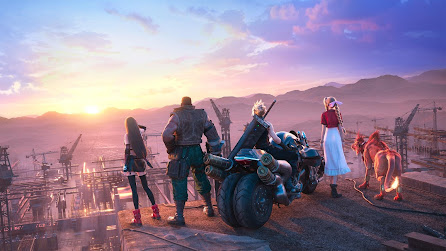

Originally released in 1997, Final Fantasy VII remains the most iconic game in the venerable Japanese roleplaying series. Other games in the series individually have better graphics, more interesting characters, more advanced controls or a stronger story, but none have perhaps succeeded in hitting every criteria as well as the seventh entry. The steampunk-magitech world remains one of the most compelling in the series, the story of a band of rebels fighting the evil (corporate) empire may be overly familiar but it is executed extremely well, and the way the story evolves from a low-key ecological parable to a ferocious fight for the future of the world remains gripping. Final Fantasy VII's status as iconic has survived a quarter of a century of attempted revisionism and re-releases, mobile ports and spin-off media of wildly varying quality.

Final Fantasy VII Remake is, as the name subtly hints, a full-blown remake of the original game in a modern game engine, rather than a more modest remaster. This is an absurdly ambitious project, since it was possible to make games in 1997 in a fraction of the time of modern titles, even a cutting-edge (for the time) 2D/3D hybrid with many thousands of pieces of background artwork and advanced CG cutscenes. Translating that into a modern, real-time, fully-3D game running at 4K resolutions seemed impossibly expensive, but Square Enix have managed to achieve it by splitting the game into three parts and turning each part into a full game rivalling the original in total content and playtime. Part 1 focuses on the city of Midgar, where you spent around 5-7 hours in the original game, or maybe 15-20% of the total length of the game, now extended out to about 35 hours of new gameplay. This has resulted in some predictable complaints, but practically there was no other real way of doing this project at this level of ambition.
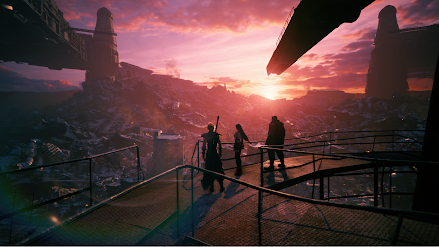

That doesn't mean it's an unqualified success, of course, and Final Fantasy VII Remake spends most of its time imparting conflict feelings in the player, especially veterans of the original game. On the one hand, walking around inside environments from the original game, now rendered in stunning full 3D, gives a nostalgia rush like no other video game remake before it. The fidelity to the original game and the attention to detail is at times absolutely mind-boggling. Key moments include going into the 7th Heaven Bar for the first time, or especially Aerith's church, where it feels like the designers have directly stepped back in time and translated the original, pixilated 2D location into a full environment you can walk around in and interact with. However, at other times it feels like that designers have struggled to maximise the use out of these (very expensive) assets in an organic way, resulting in significant chunks of the game being slowed down by filler and makework.

The game's story remains the same as the original game's opening section: we join the action with an Avalanche cell led by Barret Wallace attacking a Mako reactor in Midgar. Cloud Strife has joined the team to lend his considerable combat expertise. After taking out the reactor, the team prepare for a second attack, but this one goes considerably wrong. The crew are framed for Shinra's subsequent retaliatory strike, which causes a large number of civilian casualties, and one of their number is kidnapped. They launch an attack on Shinra Headquarters to rescue their comrade and discover a much bigger threat is at work. After escaping the building, they find their path leads them out of Midgar and into the wider world.

Avalanche side-members Jessie, Wedge and Biggs are the biggest beneficiaries of Remake, all gaining substantial amounts of backstory, characterisation and their own side-quests.

Remake fleshes out this story in several respects. It "zooms in" and provides much finer levels of detail of the characters and events. The first and most obvious beneficiaries of this approach are the secondary Avalanche members: Jessie, Wedge and Biggs. In the original game they got maybe a few lines of character development and were then shoved aside to focus on the main cast. In Remake they have a lot more detail attached to them. You can visit their homes and discover that Jessie used to be a professional dancer and has a father with a terminal disease, whilst Wedge looks after his neighbourhood's cats and Biggs helps out at an orphanage. They have their own storylines and quests attached to them, which fleshes them out as characters. Their quests also add texture to the worldbuilding, especially the somewhat under-developed relationship between Barret's Avalanche cell and the rest of the organisation at large. These are all examples of excellent ways in which Remake fleshes out the original game and adds finer detail which extends the game's length in a constructive, enjoyable way.

A more important change is that Aerith is given a lot more to do in Remake, including having more background story and larger parts of the game where she joins Cloud on his missions (in the original game you had more control over selecting who is in your party, which Remake has not truck with, at least in this first part). Aerith's personality is defined a lot more and the vague hints of a possible love triangle in the original game with Cloud and Tifa are here reset to be a much more equal friendship between the three of them. Whilst all the characters benefit from more scenes of characterisation and dialogue, Aerith is by far the most-improved. Cloud probably benefits the least, since his stoic demeanour, apparent motivation only by money and possible PTSD from his time in the SOLDIER organisation are all traits they had to carry over from the original game. Since you control Cloud for about 95% of the game (bar a couple of sequences where you control two parties simultaneously, switching over to Tifa, Aerith or Barret at key moments), this leaves the game's main protagonist as a bit of a blank cipher.
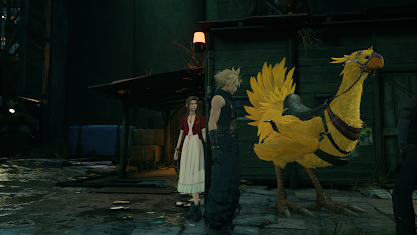
Though you can't ride or breed them (yet), chocobos are present and correct in Remake.

In terms of controls, the game is definitely improved over the original. Seeing everything in 3D instead of from overhead in blocky 2D allows you to plot your next move better, and you can now see enemies on the map before engaging in battle (the original game would have you ambushed out of nowhere on a fairly regular basis). Battles are now real-time/turn-based hybrids where you can engage in real-time combat, carrying out minor attacks and blocking, whilst a two-stage time-bar fills up. This can be sped up by attacking or slowed down by dodging. Once a time stage activates, you can carry out special attacks, use magic or use an item. All three characters in battle have their own bars and you can flip between them on the fly. This can be useful since if a wounded character is too slow in filling up their time bar to heal themselves, you can flip to another character and get them to use healing magic or a potion on the wounded character first. Some special attacks and abilities require you to fill up both bars before using them.

As in the original game, there are a wide variety of enemy types. Some might be flying, making them difficult to hit with melee characters, which is where ranged characters come into their own. At certain points you trigger "limit breaks" (having taken x amount of damage or after a certain amount of time has passed) and can unleashed a massive, high-damage attack. You can also generate different types of attacks depending on elemental modifiers (electric, fire, cold etc), which is handy when you work out what weaknesses an enemy has. Finally, you can carry out "Summons" attacks, where you summon an otherworldly creature to fight for you. It has to be said that Summons are rather disappointing: the summoned character stays on the battlefield and carries out low-level attacks on the enemy before eventually disappearing in a big attack that does decent damage, but rarely outstanding. In the meantime you can use your time bars to trigger special attacks by the summoned entity, but half the time these do less damage then your own personal ability. You are also limited to one summons per battle, which feels limiting compared to the original game (where you could go crazy and unleash multiple summons in a row if you wanted to.

The new battle system is quite good, despite looking like a brainless button-mashing exercise on first glimpse, with deeper tactics and more innovative approaches emerging through experimentation. The game is helped by retaining the materia system from the original, where you can add magical abilities via the use of special crystals which are implanted in your weapons, armour or equipment. Each materia orb levels up on its own through use, unlocking more powerful abilities as it improves. Brand new to Remake is a system of upgrading your weapons over time, meaning your starting weapons can be kept relevant against high-level enemies rather than having to constantly swap them in or out. However, this system is somewhat flawed: in almost every case, keeping your starting weapon and improving it is preferable to picking up a brand new weapon. However, if you max out a weapon's upgrades, some of the weapon's abilities will be permanently added your arsenal even if you're not physically using the weapon at the time. This requires you to constantly be upgrading all your weapons for all four of the main characters through the game, which by the end becomes quite time-consuming (not helped by the unnecessary and time-consuming mini-animations accompanying the upgrades). Since it's unlikely you'll 100% upgrade a weapon in one playthrough (you'll probably need the New Game+ mode), it's also something you can completely ignore in favour of only upgrading your favoured weapon.
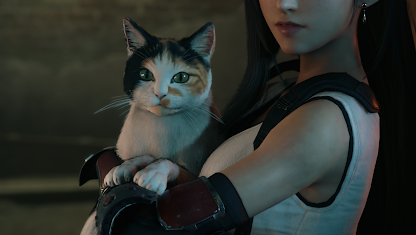
Cats play a surprisingly major role in the game, and there are absolutely tons of them.

So the graphics, controls and battles are improved and many side-characters and stories are improved by the game focusing more on them. The flaws do become more obvious over time. The game has added a stream of side-quests in hub areas. These correspond to the towns from the original game: the Sector 7 Slums (where Avalanche is based), the Sector 5 Slums (where Aerith lives) and Wall Market, a seedy town overseen by the extremely pervy and murderous Don Corneo. I was fully expecting the side-quests from these areas to be substantial storylines involving new characters, locations and stories in their own right. Unfortunately, I think I'd been spoiled by the likes of The Witcher 3 and Cyberpunk 2077, where side-quests are fleshed out be engrossing, gripping stories of their own. The comparative optional side-quests in Final Fantasy VII Remake are extremely brief, usually only calling on you to run around the local town picking up collectibles or fighting some enemies in a nearby area before running back.

Where, instead, the game gets its length from is by massively complicating the big story missions. So now the attack on Mako Reactor 5, which takes maybe 15 minutes in the original game, is now an absolutely massive rigmarole involving spending ages travelling through tunnels to get near the reactor, then ascending the underside of the reactor, then making your way across a huge area with moving bridges, switching mini-reactors on and off before you finally reach the reactor itself, which then incurs a massive series of battles and more running through corridors before the point of the story is reached. This is where the game almost kills its pacing stone dead, with throwing filler after filler at the player to try to maximise the game's length (and thus justify its fairly exorbitant cost). I very nearly stopped playing during such an interminable sequence.
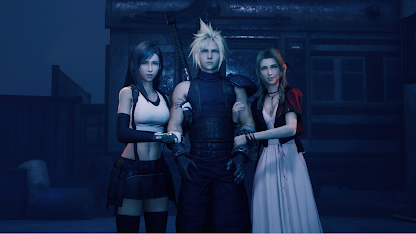
Unexpectedly, Remake plays down the love triangle elements between Tifa, Cloud and Aerith from the original game, instead focusing more of Tifa and Aerith's friendship and Cloud's struggles to find acceptance.

Things do improve towards the end. Surprisingly, the attack on Shinra Headquarters, although similarly padded out immensely, works a lot better. The original game rushed through this plot-critical sequence and left some story and character beats feeling underdeveloped or vague, which is a problem that doesn't exist here. The internal political infighting between different branches of Shinra is spelled out better, the more interesting antagonists are fleshed out and you get to spend a lot more time working with Red XIII in this sequence then you did in the original game.

The story does go rogue at the very end. Throughout the game you have occasional encounters with weird ghostly figures, which, it turns out, are "Arbiters of Fate," trying to keep the timeline intact. At the end of the game there's a rather jarring and abrupt pivot to dealing with these characters, who did not exist in the original, and you realise that Final Fantasy VII Remake is also something of a sequel, as well as a retelling, of the original game. Given that OG FFVII doesn't exactly have the simplest or more straightforwards of stories, adding a new meta-narrative to the story doesn't really help it very much. As long as the whole thing is just a way of warning the player that things are not going to 100% unfold as they did in the original and the stakes are still valid, this is fine. If the sequels continue to disappear up their own posteriors in a Kingdom Hearts level of narrative confusion, that will be less interesting.
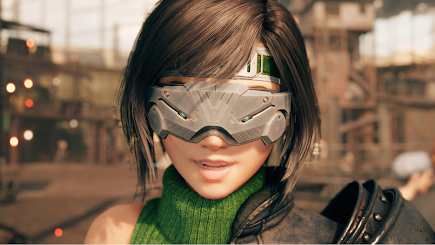
Both Cloud and Yuffie can use a VR simulator to hone their combat skills and gain access to powerful new Summons materia.

This edition of the game (Final Fantasy VII Remake Intergrade, and yes, that's its actual title) is enhanced by the addition of a new episode focusing on Yuffie. Probably the least-developed character in the original game, Yuffie here gets a dedicated, six-hour solo adventure as she arrives in Midgar, joins forces with a second Avalanche cell and raids Shinra HQ's Advanced Weapons division in search of a secret new form of materia. Much breezier and less "heavy" than the main game, with much fewer cutscenes and a better sense of pace, this episode is enjoyable and fun, with its irreverent tone coming as a relief after 30+ hours of Cloud brooding.

I should also make special mention of the game's soundtrack. Nobuo Uematsu's original soundtrack was already rightly considered a masterpiece, but the new edition's soundtrack elevates it to an even higher level. Old themes are reworked (often in multiple different ways), new themes are added and the resulting experience is maybe one of the very best video game soundtracks of all time. It's a genuine work of art.

As with the original, the Battle for the Sector 7 Pillar is one of Remake's setpiece highlights.

Final Fantasy VII Remake Intergrade (****) looks great, has fantastic music, a great battle system and much-improved controls compared to the original. Many of the storytelling and gameplay changes are improvements, resulting in better characterisation and storytelling. However, pacing is uneven, with well-judged new episodes and stories being let down by large chunks of padded, filler content that do nothing other than slow the story down. There's also an added new "metaplot" which is low-key in this part of the game, but threatens to go really weird and bizarre in the sequels. It's an odd choice that makes this remake in many ways a better experience for veterans of the original game rather than total newcomers. Final Fantasy VII Remake Intergrade is available now on PlayStation 5 and PC (Epic Store only), whilst the standard Remake edition is also available on PlayStation 4. Final Fantasy VII Remake Part II is currently in development, but it's unclear when it will be released.

Technical Note: I played this game on PC via the Epic Store-exclusive edition of the game. As has been widely reported elsewhere, this a bare-bones port of the original, very surprisingly given Square's comprehensive PC remasters and ports of other games including Final Fantasy XV. There are limited graphics adjustment options and the mouse/keyboard controls are more functional than instinctive to use, with particularly poor keybindings for using the map. However, for movement and combat the controls are fine. Technical performance on my aging 2060 graphics card was outstanding even on maximum detail (though without any ray tracing options, and only running at 1080p), though the game did keep defaulting to the wrong monitor and I kept having to drag it over at the start of every session. However, the game is phenomenally quick to start, going from being on the desktop to in-gameplay in less than 15 seconds. A more comprehensive port would be nice, but this gets the job done.

Thursday, 25 February 2021

FINAL FANTASY VII gets yet another remake before the main remake is even finished

In welcome-but-confusing news, Square has confirmed that Final Fantasy VII is getting another remake which is much more faithful to the original 1997 game, with similar controls but a total graphical overhaul.

Final Fantasy VII Ever Crisis is (currently) a mobile-only game which will simultaneously upgrade Final Fantasy VII with new graphics, whilst also bringing in storylines and elements from spin-off games Before Crisis, Crisis Core and Dirge of Cerberus and animated film Advent Children. The game will apparently feature most or all of the content from these games upgraded to modern standards but playing the same way as the original Final Fantasy VII. Ever Crisis is slated for 2022.

Square are simultaneously remaking Final Fantasy VII as a modern, AAA action-CRPG in multiple parts. The first part, Final Fantasy VII Remake, was released on PlayStation 4 last April to critical acclaim and over 3.5 million sales in its first week. There is no release date set for the second part of the remake, although there are strong rumours that the first part will be ported to PC and X-Box later this year or in 2022.

In June Final Fantasy VII Remake is also getting a free expansion and upgrade called (get this) Final Fantasy VII Remake Intergrade, which is a graphical upgrade for the PlayStation 5 platform. The upgrade adds a new storyline and mission revolving around the fan-favourite character of Yuffie, which brings Yuffie to Midgar during the events of the first part of the game. She doesn't meet the rest of the team, but does manage to get into trouble before escaping the city. The update should be available in June.

Square also confirmed a spin-off Battle Royale game, Final Fantasy VII: The First Soldier (because you might as well turn up three years late to a party) is in development - bizarrely - also for mobile only.

There's a lot of news today, most of it interesting (if weird), but the absence of hard info on Final Fantasy VII: Remake Part II (or whatever it ends up being called) will be disappointing to fans.

Monday, 10 June 2019

FINAL FANTASY VII REMAKE (Part I) gets release date

The first part of Final Fantasy VII Remake will be released worldwide on 3 March 2020.


Square Enix have spent the last five years or so working on an ambitious, ground-up remake of their classic 1997 RPG Final Fantasy VII. Rather than settling for a simple re-release with better graphics, they have instead completely rebuilt the game, as if they were making it for the first time in 2019.

This means a considerably longer game, with previously closed-off areas of the game now available to explore in an open-world fashion, with more side-quests, new enemies and new content in the game. This has also meant splitting the game into multiple parts for release. Part I is expected to include at least the opening part of the game, set in the city of Midgar. In the original game the Midgar episode took roughly 5-6 hours to complete, but the Remake version sounds like it may last for several times that amount.

More information will be released on the game in the next few days, including hopefully more information on the release schedule for the remaining parts.


UPDATE: Square Enix have released more information about the game, including a new cinematic which reveals the character of Tifa for the first time and a more extensive gameplay demo. They have also confirmed that the first part of the game will focus almost entirely on Midgar and will fill two Blu-Ray discs for the physical version of the game. At the moment they don't have a confirmed timescale for release of the other episodes, although in previous interviews they had compared their plans for Final Fantasy VII Remake to be similar to those for Final Fantasy XIII, which ultimately took four years to release all three of its parts.

The game will initially be released on PlayStation 4, with X-Box One and PC versions of the game likely to follow (based on Final Fantasy XV, probably within 18 months of the original release).

Friday, 10 May 2019

Square release trailer for FINAL FANTASY VII REMAKE

Square Enix have released a new trailer for Final Fantasy VII Remake, their upcoming remake of their classic 1997 RPG Final Fantasy VII (as indicated by the title).


Square have not yet confirmed a release date for the game, which has been in full development since 2015. They have revealed that more footage will be released next month. Square also confirmed some time ago that the game will have an episodic release, but not how many episodes or a release schedule for them. They have suggested that the release scope and schedule may be similar to the Final Fantasy XIII trilogy (which was released in 2009, 2011 and 2013 respectively).

Thursday, 7 September 2017

Cities of Fantasy: Midgar

Gaia is a vast and exotic world, ranging from the freezing arctic north to the lush forests and burning deserts of the Western Continent. Many interesting races and people inhabit this world, and the greatest and most famous of its cities can be found on the Eastern Continent: Midgar, capital of the lands dominated by the Shinra Corporation.

Midgar as it will appear in the upcoming Final Fantasy VII Remake.

Location

Midgar is located near the north-western coast of the Eastern Continent, north of Junon and south-west of Kalm. It is located close to the Western Ocean, which is dominated by Shinra’s warships and cargo vessels, which constantly keep Midgar supplied from the mines on the Western Continent. Cost del Sol, a beautiful port city due west of Midgar across the ocean, is a popular getaway and retreat for senior Shinra officials.

Midgar as depicted in the original 1997 release of Final Fantasy VII.

Physical Description

Midgar was originally a network of villages and towns of wooden and stone buildings, linked together by roads and surrounding relatively fertile farmland. After Shinra ascended to power and rapidly developed high technology, by pursuing a mix of scientific research and magical exploitation of materia (magical crystals), they constructed a new city directly over the old towns. The “new” Midgar consists of a massive circular dish with many buildings built on top, suspected directly above the “old” city below (which is now left in perpetual gloom). The surface-dwelling inhabitants of Midgar disparagingly refer to the new city above them as a “pizza”.

The new city of Midgar is suspended by a single, massive pillar and other supports located around the edge of the dish. The dish is divided into nine sectors, with massive Mako Reactors located between each sector. The Reactors fuel the enormous, power-hungry city, but the area around Midgar has gradually become more barren and lifeless as a result. According to the freedom fighters known as AVALANCHE (dismissed as terrorists by Shinra), the Reactors are draining the life force of the very planet itself and will eventually turn all of Gaia into a desert, but Shinra dismisses this claim.

Sectors 1-8 run around the dish, whilst Sector 0 is located at the very centre. Shinra Headquarters, a massive skyscraper and Mako Reactor, is located in the middle of the dish.

The slums below the “pizza” are where poorer residents of the city live. Climbing from the slums to the main city is possible via the central pillar or the city’s train system, which carries workers from below the city to their work places on top. There is an elevated freeway which runs around the city and then descends to ground level outside.

A subterranean city, Deepground, is located in the bedrock below even the slums. Its existence is relatively little-known.

The total size of Midgar is unclear, but it appears to be several miles across.


Population

The population of Midgar, at least prior to the Meteor/Jenova incident and the downfall of the Shinra Corporation, appears to be comfortably in the tens of thousands and possibly hundreds of thousands. Midgar is the largest and most technologically-advanced city on the planet.

Midgar as depicted in Final Fantasy VII: Advent Children.

History

The Shinra Corporation evolved out of Shinra Manufacturing Works, a company specialising in weapons manufacturing. When Shinra discovered how to convent the planet’s Lifestream into Mako energy, they began building Mako Reactors all over the globe. This further propelled both their scientific research and technological advancement, resulting in the development of many powerful weapons, advanced vehicles and other wonders…and terrors.

The town of Wutai rejected Shinra’s proposal to build a Mako Reactor near their settlement, resulting in a nine-year war. During this time Midgar was constructed by Shinra over several pre-existing towns in a relatively defensible part of the eastern continent, becoming both Shinra’s capital and also its greatest achievement. The Wutai War ended in a Shinra victory, but survivors of the Wutai forces and other groups opposed to Shinra’s ultra-capitalist ideology – and horrified by the growing evidence that the Mako Reactors were sapping the Lifestream of the planet – joined forces to form AVALANCHE, a rebel organisation dedicated to destroying the Mako Reactors.

The first incarnation of AVALANCHE operated out in the countryside, hitting isolated reactors (such as the one at Corel). This group become more hardline and ruthless until one member, a scientist named Fuhito, considered the sacrifice of humanity itself to be a worthwhile consequence of destroying the Mako Reactors and saving the Planet. He tried to summon a powerful magical force named Zirconiade to wipe out Shinra forever, but was stopped and killed by the Turks, Shinra’s special operations combat team.

Barret Wallace, a native of Corel, worked with the Turks to defeat AVALANCHE, but was horrified when Shinra laid waste to Corel in retaliation, killing his wife and (apparently) his best friend. Swearing vengeance, Barret moved to Midgar and restarted AVALANCHE as a freedom-fighting organisation. This second version of the rebel group avoided civilian casualties where possible, but sometimes they were incurred. During this period Barret allied with a young, canny fighter named Tifa and her childhood friend, a former Shinra soldier named Cloud Strife.

The conflict between Shinra and AVALANCHE became quite intense, to the point where Shinra destroyed the Sector 7 pillar and dropped the entire sector onto the slums below, including the districts where AVALANCHE’s headquarters were located. Most of AVALANCHE was wiped out in this attack and AVALANCHE were blamed for the cataclysm, which caused thousands of casualties. Barret, Cloud and others launched a retaliatory strike on Shinra Headquarters. During these events AVALANCHE learned of a much more sinister series of experiments going on behind the scenes, involving the Ancients, the mysterious progenitor race who nearly destroyed the world two thousand years earlier. Sephiroth, the former Shinra military commander (and Cloud’s mentor), liberates the team after they are captured and kills President Shinra before escaping with the remnants of one of the Ancients, Jenova. 

Eventually it was revealed that Sephiroth (sometimes possessed by Jenova, sometimes acting on his own) planned to use the fabled Black Materia to summon a massive Meteor to devastate Gaia. The planet’s Lifestream would respond to heal the wound and Sephiroth would seize the resulting flow of power for himself. Working together, the former members of AVALANCHE (helped, if unwittingly by Shinra) defeated Sephiroth and destroyed the Meteor; unfortunately, in the final battle Midgar was partially destroyed.

After the final battle, Midgar was repopulated. The overhanging main plate had mostly been obliterated, opening the city up to the sky once again. The governance of the city was disputed between the surviving remnants of Shinra and other factions, but eventually the World Regenesis Organisation was formed by several groups to take over governance (in a fairer, more democratic form and help the planet heal from the immense damage wreaked upon it).


Hengsha in Deus Ex: Human Revolution

Origins and Influences
The city of Midgar first appeared in the iconic, classic video game Final Fantasy VII (1997). During the writing and planning of the game, the team at Squaresoft briefly considered setting the game in the real world, with New York City being the main city. This was a significant shift from the previous six games, which were each set in a new, original fantasy world. Ultimately, the team decided to continue in this vein and created a new planet, Gaia, for the game, although some of the original ideas for a New York game did resurface in Parasite Eve.

However, the team did like the idea of starting the game in a large metropolis, not dissimilar to modern-day cities. This would continue upping the technological level of the series (which had previously moved from a traditional, medieval setting to steampunk) and give fans something new to experience. As the first game designed for the original PlayStation, it had a much more ambitious design than the previous games, with lots of complex, dazzling CGI cut scenes.

Art director Yuusuke Naora was given the task of design Midgar and early on moved it away from the New York concept. He hit on the idea of making the city look like a “pizza” early on and this went down well with the rest of the creative team. Nods to this inspiration can be found throughout the game, with Mayor “Domino” and his deputy Hart (Hut) being named after pizza chains.

Final Fantasy VII was an enormous success on its first release, selling millions of copies. Midgar was the main setting for the entire first quarter or so of the game, with several return visits later on. This made Midgar a highly iconic location. Originally, Midgar was destroyed at the end of the game and this is seemingly confirmed by a cut scene showing the city completely in ruins and given back over to nature. The prequel games Before Crisis: Final Fantasy VII (2004) and Crisis Core: Final Fantasy VII (2007) are both partially set in Midgar before the events of FF7 itself, whilst the sequel film Final Fantasy VII: Advent Children (2005) and action game Dirge of Cerberus: Final Fantasy VII (2006) both show the city recovering from the events of FF7 and inhabited once more.

Some fans interpret this to mean that Advent Children and Dirge of Cerberus take place before the final abandonment of Midgar (hence the last FF7 cut scene); others suggest that the ending of FF7 itself has simply been retconned out of existence.

Although these are the only canonical appearances of Midgar, various other games feature “cameos” from the city, such as the FF7-themed battle arenas in the various Super Smash Bros. games.

In 2018 or (more likely) 2019, Midgar will return in Final Fantasy VII Remake, an ambitious, modern remake of the original game with all-new graphics, gameplay and technology.

Midgar is important as a fantasy city that eschews many traditional fantasy elements altogether, instead appearing primarily as a modern city of skyscrapers and towers (albeit suspended in the air above more traditional, medieval fantasy structures), with characters driving cars, taking trains and riding bikes into battle. This moves on even from “steampunk” into a more contemporary form of fantasy, little-explored by fantasy novelists. Square would go on to explore this theme of “contemporary fantasy” even further in Final Fantasy XIII and XV.

In terms of cities most directly influenced by Midgar, the most obvious is Hengsha in Deus Ex: Human Revolution. In this game – created by Western studio Eidos Montreal but published by Squaresoft’s successor company, Square Enix – the Chinese have built an entire utopian sky city above Hengsha Island (just off the coast around Shanghai), suspended over the city below by immense towers. The undercity has become a place of crime, squalor and corruption, whilst the city above is far more beautiful and seemingly perfect.

Midgar is an idea ahead of its time, a city of literal and geographic divisions and levels which reflect the ideological and political divisions riven through its society and through the story. It remains, twenty years on, one of the most iconic video game fantasy cities ever created.

Thank you for reading The Wertzone. To help me provide better content, please consider contributing to my Patreon page and other funding methods, which will also get you exclusive content weeks before it goes live on my blogs. The Cities of Fantasy series is debuting on my Patreon feed and you can read it there one month before being published on the Wertzone.

Wednesday, 11 January 2017

Polygon on the making of FINAL FANTASY VII

Polygon has published an absolutely massive article about the making of Final Fantasy VII.


Released on 31 January 1997 by Squaresoft, Final Fantasy VII was a vast, sprawling 3D roleplaying game which has been credited with helping to drive the success of the original Sony PlayStation console. It also popularised the use of advanced CG cut scenes in video games and drove an explosion in the success of Japanese video games in the West. It was also the first Japanese RPG to also be a best-seller on PC, helping drive the current success of the genre on PC and mobile platforms.

Polygon's article is remarkably thorough in talking to those responsible for the game's creation, prototyping, publishing and marketing. It brings together several of the creative forces involved in the game for group discussions of its creation, as well as one-on-one interviews with other personnel. The game also touches on Squaresoft's decision to terminate its relationship with Nintendo to work with Sony (some cite Square's move as helping drive the nail in the coffin of the N64 console) and the difficulties faced in marketing Japanese titles in the US and European markets.

A fine piece of video games journalism and well worth a read.

Square is currently working on a high-tech remake of Final Fantasy VII for modern consoles (and probably PC). The game is not expected to be released until 2018 or 2019. Final Fantasy XV was recently released on PlayStation 4 and X-Box One, with a PC version rumoured for later this year or next.