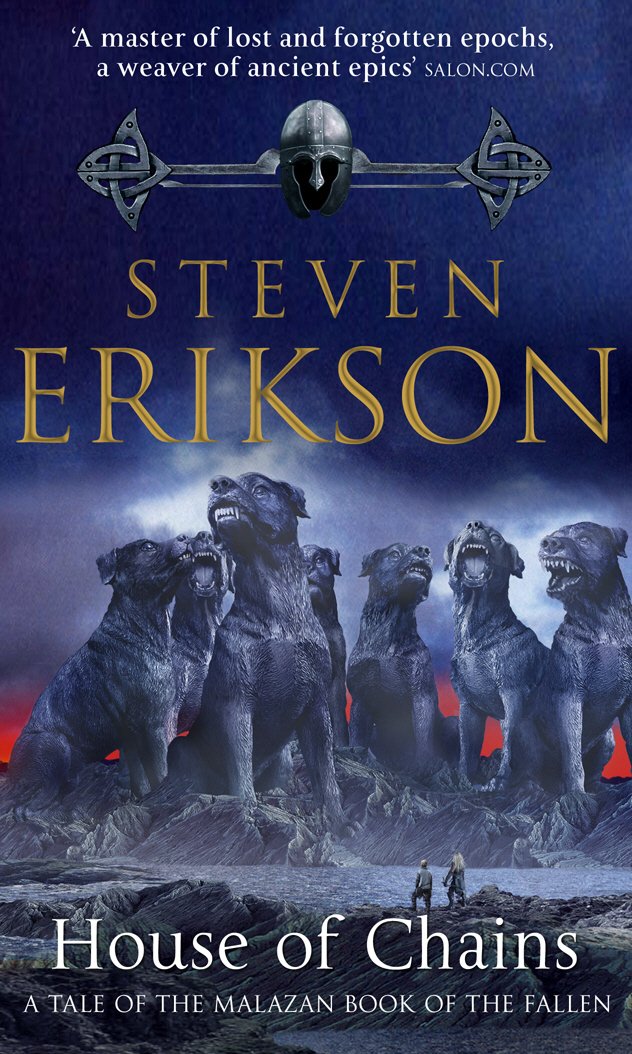
Months later, the Malazan 14th Army arrives in Seven Cities to crush the rebellion known as the Whirlwind. Newly-appointed Adjunct Tavore Paran is untested, and so are most of her troops. Only a few key veterans can be found to hold the force together. Ranged against them are veterans of years of raiding and war, the Dogslayers and the formidable sorcery of the Whirlwind Goddess herself. The seeress Sha'ik's victory appears inevitable, but internal divisions threaten to tear her army apart. As the 14th Army marches on the Holy Desert, the Seeress chooses to wait. Elsewhere, a new threat has arisen: strange ships bearing powerful warriors sailing out of the western seas, seeking the Throne of Shadow on remote Drift Avalii. The god known as Cotillion seeks champions to defend the Throne, whilst one of those strange warriors - the disgraced Trull Sengar - turns traitor to redeem his honour, and that of his entire race.
For the three previous books in the Malazan Book of the Fallen, Steven Erikson adopted a similar structure: the introduction of multiple plot threads which proceed in apparently isolated tandem for many hundreds of pages before meeting in an almighty final battle at the end. This structure didn't entirely work for Gardens of the Moon (due to a somewhat confusing opening) but was spectacularly successful for Deadhouse Gates and Memories of Ice, two of the finest epic fantasy novels published this century so far. For House of Chains, Erikson decided to change things up.
This is more of a collection of two separate novels rather than one long narrative. The first 270 pages or so form a continuous, self-contained story focusing on Karsa Orlong (think of Conan the Barbarian dialed up to 11) and his quite spectacularly bloody journey of self-realisation across Genabackis, a bit like The Pilgrim's Progress if the pilgrim was a psychotic ten-foot tall barbarian warrior wielding a sword so massive it would struggle to get into a Final Fantasy game. Karsa is the favourite character of many Malazan readers, for his clear character arc and growth (from psychopathic murderer to philosophical warrior-savant), his straightforward approach to solving problems (destroying them utterly), his clear nod to fantasy antecedents (like Conan and Fafhrd) and his cool action scenes. However, it's also worth noting that in his origin story, he's also a bloodthirsty maniac, repeat rapist and murderer. Erikson himself has noted that Karsa is a problematic character and was intended to be so. Karsa's odyssey is fascinating, well-written (Erikson's growing confidence in his prose skills from book to book is impressive to behold) and raises important questions, such as interrogating Robert E. Howard's old notion that barbarism is the natural state of humanity with civilisation as a brief interregnum which will end as soon as natural resources run out. There's plenty of black humour in the sequence as well, and it does explain at least part of what on earth was going on with that ship in the Nascent (a plot thread that's been running for three books now), but it's hard to entirely enjoy a story which relies so much on human suffering.
The remaining 750-odd pages of the book return to a more traditional format, with multiple story threads unfolding in tandem: Trull Sengar and his rescue from the Nascent by a band of T'lan Imass; the misadventures of a Tiste Liosan warrior party (who learn that their overwhelming arrogance is not helpful when asking others for help); scheming and backstabbing in the Whirlwind camp; Crokus, Apaslar and Kalam being recruited by Cotillion for various missions; and the march of the 14th Army towards Raraku (a sort-of reverse Chain of Dogs, except we spend far fewer pages on it). The shorter page count for this sequence requires greater focus from Erikson, which he achieves admirably: each story unfolds with verve and pace, and there's less long-winded moments of moral reflection as Memories of Ice occasionally threatened to unleash. The shorter page count does occasionally mean that some story arcs are sold a bit short, and the occasional Gardens of the Moon-esque moment of total confusion (such as the introduction of a new pack of psychotic magical hounds who are not the same pack of psychotic magical hounds as those who appeared in the three previous books, but are very similar) does threaten, but is mostly averted.
The book is also something of an anti-epic fantasy, and indeed, an anti-Malazan novel in structural terms. When I first read the book fifteen years ago I regarded it as a massive anti-climax, as the novel builds and builds to what appears to be a huge conflagration which never quite arrives (we do get it in the sixth volume, The Bonehunters, instead, which makes me occasionally wonder if Erikson could have restructured things so Karsa's arc was removed to its own novel and the Battle of Y'Ghatan was moved into the end of House of Chains; I suspect this would not be practical). On rereads the reasoning behind the far less epic (although still very bloody) ending is much clearer, and more laudable. House of Chains is a dark book in a sometimes very dark series, but also a series where compassion and shared humanity are key themes. These themes are explored further in this novel and given greater weight, contrasted against the dark insanity of characters such as the loathsome Bidithal. This is good, but it can make for hard going at times.
House of Chains (****½) is not operating on quite the same qualitative plain as Deadhouse Gates and Memories of Ice. It's a faster and more concentrated read, but it's also a darker and much murkier one, where the reader has to follow some very unpleasant characters for large stretches of the book. It's also the most philosophically and intellectually stimulating book in the series so far, asking big questions and refusing to offer pat answers. For some readers House of Chains marks a shift in the tone and feel of series which they don't much care for, away from a epic fantasy narrative and more towards musings on the human soul (which threaten to overtake later books in the series altogether), but for others it's the moment that Malazan grew up and started staking a claim to being the most literate epic fantasy ever attempted. The novel is available now in the UK and USA.
