Showing posts with label chris chibnall. Show all posts

Monday, 2 June 2025

Doctor Who: Series 13 (Season 39) - Flux

A mysterious force known as the Flux is extending across space and time, threatening vast areas of the universe with total annihilation. The Doctor, still reeling from revelations on Gallifrey, is called in to help stop the threat before it is too late.

The twelfth series of the revitalised Doctor Who was a mixed bag, with several very solid episodes alternating with some outright terrible ones, and the season finale being an attempt to restore the mystery to the Doctor's origins, but coming across as a dull overload of exposition instead. With half of the fanbase apparently fuming over this, showrunner Chris Chibnall chose to come out punching with both a third series under his watch and a series of specials designed to see out his (and Jodie Whittaker's) era.

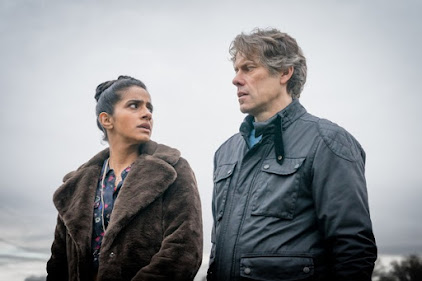
For only the third time in the show's history, after Season 16 in 1978 (The Key to Time) and Season 23 in 1986 (The Trial of a Time Lord), it was decided to have the whole season telling one story, given the overall title Flux. The Doctor would have to face multiple ongoing threats linked together by an over-arcing story. This would be complicated by the loss of companions Graham and Ryan from the season before, so a new companion (comedian John Bishop as Dan) would need to come in, alongside a sizeable recurring cast of characters extending across the whole season.

Chibnall's task was eased - if that is the right word - by the global COVID pandemic, which reduced the number of episodes to just six, making pacing and structure a lot easier than the normal ten. However, a Christmas special and two additional specials airing the year after would extend the season to something approaching a more normal length.

Things get off to a barmy start in The Halloween Apocalypse as the dog-headed Karvanista, of the Lupari species, arrives on Earth and kidnaps Liverpool tradesman Dan Lewis (Bishop). The Doctor and Yaz rescue Dan but discover that the Lupari are coming to Earth not to conquer it but to protect it from a massive space/time distortion known as the Flux. The situation is complicated by an enigmatic creature known as Swarm escaping from a prison where he's been held for millennia, a mysterious woman known as Claire accosting the Doctor before running afoul of the Weeping Angels, and a space adventurer called Vinder who flees the Flux only to run into the Sontarans.

All of this makes for a very busy opener, but a very fun one, with shrinking houses and more plot twists and villains then you can shake a sonic screwdriver at. After the dour and depressing Timeless Children, this is a fun, almost bouncy episode that has no pretensions other than setting up a whole load of guns and firing them off to see what happens. The sheer business of the episode keeps Chibnall's eternal nemesis, stodgy pacing, at bay.

War of the Sontarans keeps things flowing by immediately pitting the Doctor and her companions against the Sontarans in two different time periods, with the Doctor teaming up with Mary Seacole to fight the Sontarans in the Crimean War whilst Dan confronts them in contemporary Liverpool. In a side-plot, Yaz meets up with Vinder and both run afoul of Swarm and his sister, Azure. This is another very solid episode, restoring a sense of real menace and threat to the Sontarans whom had previously been reduced to comic relief. There's also an outstanding turn by Sam Spruell and Rochenda Sandall as the Ravager siblings, Swarm and Azure, who have presence and outstanding prosthetics to become two of the most intimidating Doctor Who enemies we've seen for some time. Also a nod to Jacob Anderson (Game of Thrones) for a fun turn as effective semi-companion Vinder, and Sara Powell as Mary Seacole.

Chibnall can't quite keep the quality up, though, and Once, Upon Time disappoints slightly as we get extended, illusory flashbacks for the characters. Craig Parkinson delivers a splendid performance as the villainous Grand Serpent and Thaddea Graham is appealing as Bel, who is on a mission so urgent that armies of Daleks and Cybermen cannot stop her, but the episode lacks the dynamism of the first two. Still, solid.

Village of the Angels returns to form with a great, Pertwee-esque story of the Doctor, Yaz and Dan trapped in an English village with a bunch of Weeping Angels. Annabel Scholey and Kevin McNally give great performances as the time-displaced Claire and Professor Jericho, a Doctor Who character so traditional (well-meaning, slightly bumbling, awed by the Doctor's knowledge and determined to help) he might as well have beamed in from the set of The Daemons. Probably the season highlight, aided by a killer twist ending.

Survivors of the Flux unfortunately sees Chibnall having to do something he has always struggled with, starting to deliver a satisfying finale. The revelation of the Flux's origins is disappointing, and the scale of what we are told is happening (large parts of the universe being destroyed) clashes with what we see (a few Dalek, Cyberman, Lupari and Sontarans impacted, and maybe four or five planets). Barbara Flynn gives a solid performance as the originator of the Flux, but she vanishes from the story a bit too abruptly and before we get too many solid answers about what's going on. The episode is mostly saved by a subplot in which the Grand Serpent orchestrates a time-skipping plan to weaken UNIT, but runs afoul of Kate Stewart (the always-splendid Jemma Redgrave), but otherwise is a bit of a sloppy mess.

The Vanquishers resolves the Flux storyline semi-satisfyingly, with a complex, multi-front conflict which literally sees the Doctor split in three to lead different plans to defeat the Ravagers, the Sontarans and some Daleks and Cybermen for good measure. The finale is somewhat nonsensical - the Ravagers go out with an extreme whimper after five episodes of being genuinely threatening - but there's a certain "gleeful romp" feeling to events that's somewhat infectious.

Overall, the Flux experiment is successful. Losing four episodes from its length stopped it becoming interminable and annoying, but also resulted in some episodes feeling rushed and a bit overstuffed. The weight of events is undersold (a large chunk of the universe is destroyed and never comes up again, though this has happened before, in Logopolis), and the apparent annihilation of the Daleks is a bit undercut by the next episode confirming that loads of Daleks survived, but this is Chibnall's strongest continuous run of episodes.

This continues into the 2022 New Year's Special, Eve of the Daleks, in which the Doctor and her companions and two people are trapped in a storage facility by a repeating time loop and a Dalek. The only way to start the loop again is to embrace being exterminated. This is one of Chibnall's best single scripts, with an ingenious premise and excellent performances by guest stars Aisling Bea and Adjani Salmon. It's an episode that makes the most of a limited number of sets and actors and constantly finds ways to refresh the premise and become more compelling as it goes along, with one of the better uses of the Daleks since their return in 2005.

Unfortunately, Chibnall's strongest run on the show comes to a screeching halt with Legend of the Sea Devils. Both the Flux season and Eve of the Daleks were clearly compromised by COVID filming restrictions but found clever ways around them. Legend of the Sea Devils does not. The episode features a ton of painful greenscreen work and some very poorly-staged fight scenes and action beats. This may be the worst-directed episode of Doctor Who since its return in 2005, with basic beat-to-beat continuity being a total mess. The guest cast (Marlow Chan-Reeves, Crystal Yu, Craige Els, Arthur Lee and David K.S. Tse) give good performances, and the script has a ton of really great ideas, but awful direction, and some poor dialogue constantly sap any sense of momentum from the episode. It's very annoying because the idea of the Sea Devils returning and fighting Chinese pirates with the Doctor getting involved is an original and fun one.

The Power of the Doctor sees the Thirteenth Doctor out in style with a truly epic storyline involving the Master at his gleeful, plate-spinning best (Sacha Dhawan gets some joyously great lines here), teaming up with both the Daleks and Cybermen in a crazy plan to force the Doctor to regenerate into a clone of the Master. UNIT gets involved, having brought in former companions Tegan (Janet Fielding) and Ace (Sophie Aldred) to help out. In fact, The Power of the Doctor becomes the most Classic Who-friendly episode of all time, with cameo appearances of all of the surviving classic Doctors (bar Tom Baker) thanks to visions, and multiple companions appearing as part of a self-help group for ex-companions. This risks self-indulgence, but by also keeping the focus on Thirteen and her relationships with Yaz and this diabolically satisfying version of the Master (whose turn as Rasputin is genuinely, gloriously unhinged), it also does what it needs to do in delivering a satisfying send-off for Jodie Whittaker's Doctor.

As the overall season goes, this is easily (****) Chibnall and Whittaker's best, with only Legend of the Sea Devils being really poor. There's a sense of fun here that was largely missing from their other two seasons and minimising the Timeless Child stuff but not completely ignoring it feels like the best solution. There's a lot of fanservice here, but it's usually done to enhance the current storylines rather than distract from them. There are some weaknesses - Yaz's characterisation remains rather thin, despite Mandip Gill being a very good actress, and bringing Vinder back to Power of the Doctor to not do much risks making the episode overstuffed - but these are minor compared to the issues in the prior two seasons.

The uptick in quality - and certainly what happens next - may actually make you ponder if it might have been better for Chibnall to have stayed on for another season or so. But I can't blame for the BBC rushing to get Russell T. Davies and David Tennant back on board.

  • 13.1: The Halloween Apocalypse (****)
  • 13.2: War of the Sontarans (****)
  • 13.3: Once, Upon Time (***½)
  • 13.4: Village of the Angels (****½)
  • 13.5: Survivors of the Flux (***)
  • 13.6: The Vanquishers (***½)
  • 13X1: Eve of the Daleks (****½)
  • 13X2: Legend of the Sea Devils (**)
  • 13X3: The Power of the Doctor (****½)

Thank you for reading The Wertzone. To help me provide better content, please consider contributing to my Patreon page and other funding methods.

Thursday, 22 May 2025

Doctor Who: Series 12 (Season 38)

The Doctor continues her adventures through time and space with her new companions, Ryan, Graham and Yasmin. But the return of both an old enemy and an old friend sparks new question: who is the Timeless Child, and what is the threat posed by the Lone Cyberman?


The twelfth series of the revitalised Doctor Who aired in 2020, and saw showrunner Chris Chibnall taking stock after his debut season, which could be called the very definition of a mixed bag. On the one hand, Series 11 had shown that a woman playing the role of the Doctor could be successful, and had several solid stories. Unfortunately, it also had several very poor ones, and arguably the lowest consistent quality since the show had returned in 2005. The season was also the first since then not to have any kind of over-arcing story, with Chibnall instead focusing on mysteries and monsters of the week. The fan response to this approach had been muted, so for Series 12, he decided to return to featuring some kind of season-spanning mystery, as well as fully embracing the show's history by bringing back fan-favourite villains including the Master, the Daleks, the Cybermen and the Judoon. The result is a busy season, and a better one that its immediate forebear, but one that is overshadowed by the clunky and decidedly divisive finale which tries to do nothing less than retcon the entire history of the franchise in the most boring way possible.

Before we get there, the season gets off to an epic start with Spyfall, an elaborate two-part story in which the Doctor gets drawn into an alien incursion on Earth that starts off by targeting the planet's intelligence agencies. This is an interesting idea, buoyed by the enjoyable casting of Stephen Fry as the head of MI6 and by Lenny Henry as a corporate billionaire who, obviously, is in league with the bad guys. A promising opening part is subverted by the unexpected return of the Master, played here with charismatic relish by Sacha Dhawan (fresh from The Punisher), and who shifts the second part into a time-travelling thriller where the Doctor has to team up with Ada Lovelace (Sylvie Biggs) and Noor Inayat Khan (Shobna Gulati) to halt the Master's evil plans. To be honest, the main plot is gubbins and a potentially fascinating interdimensional alien threat in the form of the Kasaavins is under-utilised, but the two-parter succeeds thanks to its splendid guest cast. Fans may also bemoan a lack of any explanation for how the Master (last seen only in Series 10, apparently dying for good - twice!) has returned with no trace of the "goodness" the Doctor helped impart to them in that storyline. Still, as a statement of intent, this is a solid start.

Orphan 55 starts off as Doctor Who-by-the-numbers, with our heroes visiting an idyllic holiday resort which - shockingly! - becomes less idyllic as it comes under attack by aliens. Again, a solid supporting cast (including the always-splendid Laura Fraser) prop up a pedestrian script, but the story struggles with pacing (a perennial problem of the Chibnall era) and the ending is decided woeful, with a "twist" that you can spot coming a mile away.

Nikola Tesla's Night of Terror gets bonus points for a great title, and it's mildly surprising that this is the Doctor's first on-screen encounter with both Nikola Tesla (a charismatic and tragic Goran Višnjić) and Thomas Edison (a bumblingly malevolent Robert Glenister). It's a fine slice of sci-fi pulp, though perhaps the alien threat underwhelms. The Skithra feel like a redo of the Racnoss, to the point of pondering why they didn't just bring the Racnoss back. Still, a firmly enjoyable episode.

Things take an upwards turn with arguably the highlight of the entire Chibnall era. Fugitive of the Judoon sets up a straightforward-looking story, with a disguised alien who many not even know their own identity being hunted down by the Judoon whilst hiding in Cheltenham. The Doctor has to work out who the alien is and how to save them. What feels like a breezily solid mid-Russell T. Davies tier episode abruptly shifts tone and direction three-quarters of the way through and executes a mind-boggling twist that elevates the whole episode. The episode hinges on outstanding guest performances by Jo Martin and Ritu Arya, and a doom-laden cameo from Captain Jack (a returning John Barrowman after a near-decade's absence). I think this episode has been downgraded a bit because of how incredibly well it sets up a compelling mystery that the season finale totally fails to deliver on, but in isolation it's an outstanding slice of Doctor Who.

Unfortunately the season can't really sustain that level of interest. Praxeus starts off "big," with the Doctor and her companions splitting into multiple teams to deal with a threat to Earth that simultaneously unfolds in Peru, Hong Kong and Madagascar. The episode's huge scope and fun dialogue (Bradley Walsh is on fine form here) can are let down by a late-episode turn into a lecture on microplastics. A reasonable cause, but it feels like this saps the drama from the resolution of the story.

Can You Hear Me? has huge potential, featuring two ultra-powerful beings inadvertently unleashed from their prisons to rain terror on the universe. The epic scale of the story and compelling performances by Ian Gelder and Clare-Hope Ashitey, as well as Aruhan Galieva as Tahira, is very impressive, as well as featuring an intriguing setting with medieval Aleppo. Unfortunately, the episode feels a bit short-changed. The story is so epic that its resolution after just 50 minutes only feels perfunctory. This at least is the reverse of most Chibnall stories, which often feel like a great 30-minute idea stretched to almost an hour with filler. Unfortunately, the episode also features one of the most reviled scenes in the show's history, as Graham comes clean to the Doctor on his battle with cancer only for the Doctor to really not show much interest or empathy, which was certainly a choice.

The Haunting of Villa Diodati is another good one, with the Doctor and her companions stuck in the famous house where Mary Shelley was inspired to write Frankenstein. A haunted house tale turns into a surprisingly effective horror story as the house is invaded by the foretold Lone Cyberman (a formidable performance by Patrick O'Kane). This episode succeeds thanks to a very fine guest cast (Lili Miller as Mary Shelley, Jacob Collins-Levy as Byron, Nadia Parkes as Claire Clairmont and Maxim Baldry as Dr. Polidori) and a rich atmosphere.

Ascension of the Cyberman is effectively a modern remake of classic Doctor Who episode Earthshock, where the Cybermen, driven to the brink of extinction, recover an army of Cyber-warriors from a spaceship and prepare to conquer the universe. The episode does a lot with not too many resources, achieving a surprisingly epic scale at times, and a foreboding sense of the distant future where all hope is lost, reminiscent of Series 3's Utopia. A subplot in which we follow a young boy growing up in Ireland to become a policeman is well-made, but feels disconnected from the rest of the plot (at least until the following episode). The episode is great right up until the cliffhanger, when you can feel everything is about to go wrong.

That cliffhanger ending takes us into The Timeless Children, easily the most controversial episode since the show's return in 2005. This is also possibly the most awkwardly-structured and paced episode of the entire franchise, with the episode being part standard run-around-and-blow-things-up romp (complete with regenerating Cyber-Time Lords, a brilliant concept here mostly wasted) and part massive TED Talk about the Doctor's backstory. The running-around bit is mostly okay (livened up by a splendid guest turn by Game of Thrones' Ian McElhinney) but the scenes of the Master lecturing the Doctor on her hitherto unknown backstory drag on, as well as being somewhat eyebrow-raising in its connotations.

The Doctor being a super special Time Lord destined for greatness was always a hokey and cliched idea, her just being a rebel who ran away and got into hijinks after being bored was more entertaining (helping the idea that anybody can be a hero in the right circumstances). Not only does the retcon itself feel unconvincing, it's also portrayed in a redundant manner: the Master has - somehow - destroyed Gallifrey and wiped out the Time Lords again, making the entire Time Lord arc in the Steven Moffat period feel like a complete waste of time. The Doctor also already had one secret incarnation she didn't want anyone to know about, so giving her a bunch more here is just the same idea repeated. It also doesn't help that the Doctor here is written in an incredibly passive way, not asking questions or shouting out observations, just staring dumbly as the Master (hardly a trustworthy character) unloads the mother of all infodumps on her. I wouldn't mind so much if this massive backstory revelation actually leads anywhere but, over five years on, it hasn't, making the exercise feel pointless. Babylon 5's second season episode In the Shadow of Z'ha'dum shows how to make a massive backstory revelation story really work in a clever way, which Doctor Who (and Battlestar Galactica's No Exit, for that matter) fails to match here.

Still, watching Barristan Selmy fight Cybermen is undeniably a lot of fun, so it has that going for it.

After that confusing morass, the New Year's special Revolution of the Daleks throws subtlety out of the window and opts to have some laughs. Captain Jack returns (again) and teams up with the Doctor and the gang to fight a Dalek incursion on Earth. The entertaining bit here is that these are actually human-built Dalek drones that aren't too much of a problem until an overeager employee clones some of the surviving Dalek DNA from the previous year's Resolution, which is of course a Very Bad Idea. The episode improves further when the real Daleks show up, disgusted with these Dalek-human-robot hybrids, and set out to annihilate them (which is great) as a prelude to annihilating Earth (not so great). The escalating threat levels are well-handled, there's a lot of explosive action and the episode sets up the possibility of future troubles with amoral American businessman (and possible future President) Robertson. Any plans in that direction were thrown out by subsequent misconduct allegations levelled against actor Chris Noth. Still, the episode is a strong, if inconsequential, action piece with a surprisingly emotional ending.

Series 12 of Doctor Who (***½) is a significant improvement over the previous season in terms of general and individual episode quality. There is more action, more humour, some great guest stars, and some very solid ideas. Some of the hallmark problems of the Chibnall era remain: the TARDIS is too crowded with too many storylines for each episode for any to land extremely well (and by trying to further the characterisation of four regulars at once, it doesn't do a great job of any). It's notable the best episode of the season basically sidelines Yaz, Ryan and Graham for most of its going whilst the Doctor is confronted by a genuinely mind-blowing mystery with a great resolution. Otherwise pacing remains an issue, with Chibnall being given generally more time than either Davies or Moffat had (with several episodes clocking in at 60 minutes and most over 50, compared to the stricter 45-ish minutes of previous eras) and not knowing what to do with it.

The season also highlights what is Chibnall's key weakness: he seems to find it very difficult to write for Jodie Whittaker's Doctor. The Doctor is at her best when she storms into a situation, takes over and uses her natural authority and intelligence to investigate a problem and come up with a solution, overcoming rising complications along the way. When the script allows her to do that here (particularly against the Judoon and Cybermen, known threats she is confident of handling), the episode sings. When the script fails to do that, the episode turns into a leaden mess. This is particularly notable whenever Chibnall pairs Whittaker's Doctor with Dhawan's Master. Chibnall has a great handle on this Master's voice, his viciousness and evil really coming through in a chilling way. But the Doctor can't afford to let the Master run roughshod over her as happens in all four episodes of the season here where they face off. The Doctor standing mutely whilst the Master outlines her revised backstory is deeply bizarre, and leaves the audience losing respect for the character, which the show can never afford to happen.

But still, outside of those moments there is a feeling here that things are, if not back on track, at least sidling in that direction. Fugitive of the Judoon is a great episode, and The Haunting of Villa Diodati is almost as good, whilst Revolution of the Daleks, Nikola Tesla's Night of Terror and Ascension of the Cybermen are all very solid romps. But you'll probably never feel an urge to revisit Orphan 55 or Praxeus ever again. And The Timeless Children remains a deeply odd idea, strangely-executed and, so far, totally unresolved.
  • 12.1: Spyfall, Part 1 (***½)
  • 12.2: Spyfall, Part 2 (***½)
  • 12.3: Orphan 55 (**½)
  • 12.4: Nikola Tesla's Night of Terror (****)
  • 12.5: Fugitive of the Judoon (*****)
  • 12.6: Praxeus (***)
  • 12.7: Can You Hear Me? (****)
  • 12.8: The Haunting of Villa Diodati (****½)
  • 12.9: Ascension of the Cybermen (****)
  • 12.10: The Timeless Children (**½)
  • 12X: Revolution of the Daleks (****)

Thank you for reading The Wertzone. To help me provide better content, please consider contributing to my Patreon page and other funding methods.

Thursday, 17 March 2022

Doctor Who: Series 11 (Season 37)

The newly-regenerated Thirteenth Doctor crashes to Earth and makes new friends, beginning a new series of adventures in time and space.


The eleventh series of the revitalised Doctor Who aired in 2018 and marked the second major refresh of the show's creative team since the new show started airing in 2005. Jodie Whittaker became the first actress to canonically play the role of the Doctor, new companions were introduced, a new TARDIS set was built, a new filming style was adopted and Chris Chibnall took over as showrunner and head writer.

Chibnall's appointment caused consternation among Who fans. His work on Doctor Who itself had been highly variable in the past and his stint showrunning Torchwood was not particularly successful (resulting in Cyberwoman, one of the very worst episodes in the entire Doctor Who canon to date). However, some hope was raised due to the immense success of his critically-acclaimed mainstream drama, Broadchurch, also starring Whittaker.

The season opens with The Woman Who Fell to Earth, a busy episode which has to introduce both Whittaker's fast-talking Doctor and no less than three companions: Mandip Gill as Yasmin Khan, Tosin Cole as Ryan and Bradley Walsh as Graham O'Brien. It also sets up a recurring villain and a bunch of new format ideas, including a more epic filming style and new composer. For such a busy episode it does okay: the villain is a little bit silly and overwrought, but Sharon Clarke is excellent as Grace and the new companions all have a lot of promise. The Ghost Monument continues in this vein, with spectacular location shooting in South Africa and great guest actor support from Susan Lynch, Shaun Dooley and an underused Art Malik propping up a solid story about robots and a scavenger hunt, with the Doctor's missing TARDIS as the prize.

Rosa is the season's most notable episode, with the Doctor and her companions travelling to 1955 Alabama and meeting Rosa Parks. With two of the Doctor's companions being people of colour, it's a wrought episode balancing commentary on racism and social issues with an SF story of its own. There are splendid performances (particularly Vinette Robinson as Rosa) and a ticking sense of dread that doesn't come from aliens for once. However, the villain is quite spectacularly underwhelming and his motivations don't really stand up to scrutiny. The episode also struggles with balancing historical information with telling a strong narrative, rather than elegantly combining the two. It's good to see Who tackling a sensitive bit of history with the noblest of intentions, but the execution is flawed.

Arachnids in the UK is the season nadir, with the Doctor and team fighting alien spiders in Sheffield. What could have been a goofy, Russell T. Davies-esque lark turns into a painful slog in its second half. The Tsuranga Conundrum is better, with a stacked cast who have gone on to greater things (like Ted Lasso's Brett Goldstein), but the monstrous alien is inexplicably cute and the visuals don't really fit the horrible things it does, leading to an inconsistent episode.

Demons of the Punjab is the season highlight. Like Rosa it's taking a real historical event and mining it for story ideas and pathos. Unlike Rosa, the Partition of India is a much bigger event with lots of spaces to tell stories in it. The cast is absolutely outstanding, and the episode mixes the historical events with the SF elements much more successfully. One complaint is that the aliens are a bit too close to Testimony (from Twice Upon a Time) in their motivations.

Kerblam! feels like a 2007 Russell T. Davies script that's been dusted down and put into production, which is both good (it has a very winning RTD sense of charming whimsy) and bad (TV production in general and Who in particular have moved on from 2007). The analogies to Amazon are so on-the-nose it's painful and the eventual resolution is pat, but it is better-paced than most stories this season and the guest cast is solid.

The Witchfinders tries to be a gritty historical story about hunting down witches in early 17th Century Lancashire. However, it is let down by Alan Cumming's ridiculously hammy performance and the story not being anywhere near strong enough to support the length of the episode. After a promising start it runs out of steam and never regains it.

It Takes You Away starts off as a classic, creepy "haunted house" story centred on a rich performance by Ellie Wallwork as Hanne, before metamorphosing into a dimension-hopping lark and ending up as a surprisingly powerful reflection on grief and loss, with Bradley Walsh delivering his best performance as Graham. The shifts in tone and setting help overcome the pacing problems much of the season has struggled with, and the episode has a great atmosphere. I must admit the ending, where Hanne goes off with her father rather than him being arrested for child abandonment and neglect, is a bit odd though.

The Battle of Ranskoor Av Kolos is the season finale and easily the weakest finale since the show's return in 2005. The episode starts off a bit too reminiscent of The Ghost Monument and then brings back the underwhelming and very cheesy villain from The Woman Who Fell to Earth. Guest stars Phyllis Logan, Percelle Ascott and Mark Addy all do great work, but the episode ping-pongs between different ideas and never really settles down into a good rhythm. Still, some good vfx.

Christmas special Resolution sees the Thirteenth Doctor confronting the Daleks again, or in this case, just one Dalek. The episode channels Series 1's Dalek in how it depicts a single Dalek as a formidable foe and something to be feared (I guess their intelligence drops the more of them are in a room), with a great sense of escalating menace and good guest performances by Daniel Adegboyega and Charlotte Ritchie. I'm not in love with the idea of Daleks being able to survive outside their casings for so long, though, or their ability to use humans as puppets.

The eleventh series of Doctor Who (***) is a mixed bag, and possibly its weakest season since its return. The decision not to have an over-arcing story for the entire season is a good one, allowing each episode to focus on its main storyline, but this is hampered by several episodes having weak stories. Chibnall fails to strongly characterise the Thirteenth Doctor in a way that makes her stand out from her predecessors (beyond the obviously superficial) and the decision to have a regular cast of four, although a good one for filming practicalities (previous Doctors had complained about their absurd screen time resulting in serious exhaustion), also dilutes characterisation. Nobody is able to get good development because the episodes are too crammed. The actors are all great, but they're not the best-served by the scripts. There is also a recurring problem with pacing, with several episodes feeling repetitive, leaden and drawn-out over far too long a period.

Still, several solid episodes and the very impressive new filming style mean that the season is not a complete write-off. The season is available to watch on BBC iPlayer in the UK and on HBO Max in the USA.

  • 11.1: The Woman Who Fell to Earth (***½)
  • 11.2: The Ghost Monument (***½)
  • 11.3: Rosa (***)
  • 11.4: Arachnids in the UK (**)
  • 11.5: The Tsuranga Conundrum (***)
  • 11.6: Demons of the Punjab (****½)
  • 11.7: Kerblam! (***)
  • 11.8: The Witchfinders (**)
  • 11.9: It Takes You Away (***½)
  • 11.10: The Battle of Ranskoor Av Kolos (**½)
  • 11X: Resolution (***)
Thank you for reading The Wertzone. To help me provide better content, please consider contributing to my Patreon page and other funding methods.

Thursday, 30 December 2021

DOCTOR WHO companions appear to confirm departure from the show, leaving clean slate for return of Russell T. Davies

It's been known for a while that lead actor Jodie Whitaker and showrunner Chris Chibnall were leaving Doctor Who and former showrunner Russell T. Davies was returning. There was a bit of a question mark over whether incumbent companions Mandip Gill and John Bishop would also be leaving or continuing into Davies' second era, but that now seems to have been resolved. Bishop posted a Twitter video in September confirming he is wrapped on the show, and Mandip Gill has followed it up in Doctor Who Magazine's 2022 Yearbook (published today) by confirming she is not returning. The BBC has so far not confirmed the news.

The news was fully expected: unlike the classic series, the rebooted Doctor Who has tried to arrange a "clean sweep" of introducing a new Doctor and new companions simultaneously whenever a new showrunner takes over. This happened in both 2010, when Steven Moffat took over with Matt Smith as the Eleventh Doctor and in 2018 when Chris Chibnall took over the show with Whitaker as the Thirteenth Doctor. In addition, John Bishop is one of Britain's most famous, successful and in-demand comedians and TV presenters, so was unlikely to take a long-term career break to do Doctor Who.

It does mean that Mandip Gill will manage the feat of fully matching the tenure of the Doctor she started with, previously only achieved by Billie Piper as Rose Tyler, who was companion for the full length of the Ninth Doctor's tenure (albeit that was only a single season) and a full year beyond, alongside the Tenth Doctor. Gill's character, Yasmin "Yaz" Khan, debuted in the Thirteenth Doctor's first full story, The Woman Who Fell to Earth, in 2018, and will depart in her final episode, a special set to air around October 2022 which also sees the Thirteenth Doctor's regeneration into the Fourteenth. This will make Yaz the longest-running Doctor Who companion of all time in terms of tenure (serving over four years), although only around the ninth-longest-running in terms of screen time, just beating Amy and Rose, but not quite matching Clara among modern companions, and some way behind the likes of Jamie and Sarah Jane Smith among classic companions.

This will allow Russell T. Davies to start with a completely blank slate for his first episode (already written), which will serve as the show's 60th anniversary special and is already slated to air in the week of 23 November 2023. Davies's return is also accompanied by the news that production (but not ownership) of Doctor Who has been outsourced to the independent production company Bad Wolf Productions in a deal which will hopefully allow for a larger budget and more editorial independence from the BBC. Production of Russell T. Davies's (second) first season is expected to begin next year.

Friday, 24 September 2021

Russell T. Davies returns to guide DOCTOR WHO through its 60th anniversary

In a surprise announcement, it's been confirmed that writer-producer Russell T. Davies is returning to Doctor Who in its 60th anniversary year, and possibly for an extended stay afterwards. He will be helming at least one full season of the show.


Davies previously executive produced and showran the franchise from 2005 to 2010, overseeing the reigns of both Christopher Eccleston and David Tennant, the most popular Doctor since the show's return. Davies will also be responsible for choosing the actor likely to play the fourteenth incarnation of the time traveller.

Davies will take over the reigns in 2023. Outgoing producer Chris Chibnall has overseen a curtailed six-part thirteenth season (of the reboot), which was cut from ten episodes due to the ongoing COVID19 pandemic. This season is expected to start airing in November or December this year. Chibnall and incumbent Doctor Jodie Whittaker will return for three specials to air through 2022, with the Doctor expected to regenerate in an extended episode to air at Christmas or New Year's next year. Davies will then take over after that point.

It's unclear if there will be a fourteenth season of the show in 2023, with the 60th anniversary special to air as part of it in November, or a special followed by a full season in 2024.

In potentially more interesting news, from a longer-term perspective, Davies' reign will be run in conjunction with the aptly-named Bad Wolf Productions, an independent production company set up by former Doctor Who producer Julie Gardner and former BBC Controller of Drama Commissioning Jane Tranter, who made the final call in 2003 to bring Doctor Who back from the dead with Davies in creative control. This will mark the first time - aside from the one-off 1996 TV special, produced in conjunction with Fox - that Doctor Who will be produced with a non-BBC production partner. The move may help the show overcome the severe (and worsening) budget problems it has endured as an inhouse BBC production. The show recently moved from the BBC Drama Department to BBC Studios to help alleviate these issues and a coproduction with Bad Wolf may help further.

Bad Wolf recently produced His Dark Materials (a third and final season is currently shooting) alongside the BBC and HBO, and A Discovery of Witches with Sky. It's possible that Bad Wolf could team with an American partner like HBO or BBC America to give Doctor Who a further cash infusion to help it compete in the international marketplace.

Davies himself returns to the show on the crest of a critical wave, having scored two of the most critically-acclaimed British dramas of recent years with near-future dystopian drama Years and Years and period drama It's a Sin. Davies' re-appointment has been seen by some as an attempt to right the ship, with Doctor Who having slipped in relevancy in recent years, with variable ratings and critical acclaim, despite the generally positive reception to Jodie Whittaker in the role of the first female Doctor. Chris Chibnall's writing has come in for heavier criticism.

Other showrunners had been considered, with the high popular American SFF producer J. Michael Straczynski having thrown his hat in the ring. However, the decision to return to Davies is likely to be seen as a confidence-boosting measure and to win back fans who had drifted away in recent years (ratings have been on a gradual downward spiral since Matt Smith's second season in the role, almost ten years ago), as well as re-ignite interest in the USA, where the show's cult profile has dipped in recent years.

The news will come as a relief to many Doctor Who fans, but may disappoint those who were looking for a completely new, fresh voice to take over and guide the show towards the future, not the past.

Thursday, 29 July 2021

Jodie Whittaker and Chris Chibnall to depart DOCTOR WHO at the end of 2022

Doctor Who star Jodie Whittaker and showrunner Chris Chibnall have announced their plans to depart the series at the end of 2022.

Both Whittaker and Chibnall joined the show in 2018, with Whittaker playing the Thirteenth Doctor (succeeding Peter Capaldi in the role) and Chibnall taking over the creative direction of the show from Steven Moffat, who had helmed the show since 2011. Whittaker is the first woman to play the role of the Doctor since the character's inception in 1963, whilst Chibnall is the third showrunner to helm the series since its return in 2005.

Whittaker's departure after the forthcoming thirteenth season (of the reboot) was widely anticipated; no actor has played the role of the Doctor for more than three seasons since Tom Baker departed the role after seven seasons in 1981. However, Chibnall's departure is more surprising; barring the one-off 1996 TV movie, no other showrunner has done less than five years in the role since Graham Williams (1977-80) and Philip Hinchcliffe (1975-77). Traditionally, most showrunners have since 1980 have stayed on for the run of at least two Doctors whilst Chibnall will have done just one.

Their tenure on the show has been something of a mixed bag. Whittaker's energetic performance has mostly been praised and her first full season in the role was something of a relief, with more of a focus on historical stories and comprehensible storylines with clear stakes and more logical resolutions than the preceding seasons, which often relied on hand-waved solutions and variably comprehensible plotting. The season was also notable for not having any kind of over-arcing storyline, for the first time since 2005. However, her first season failed to produce an outstanding, classic episode of note and there was criticism of the decision to give her three companions, making for an overcrowded TARDIS and there not being enough story to service four regular characters plus the guest star of any given week. 

These problems persisted into her second season in the role, but were also accompanied by some backsliding into the fast-paced but nonsensical plotting that characterised the worst of both the Davies and Moffat eras. Chibnall also put into motion a planned story arc that would retcon the Doctor's backstory and origins, a decision that would draw a very mixed response from hardcore fans and seemingly baffled more casual viewers, for whom one of the main draws of Doctor Who is much less of a reliance on long-running storylines and impenetrable background lore compared to other SFF franchises. Viewers would seem to agree, with ratings (particularly first-night ratings, although these have been in global decline as people switch en masse to streaming and timeshifting) slumping by almost 50% over the course of the two seasons (although, once the the initial bump caused by Whittaker's arrival is factored in, ratings remained somewhat comparable to Capaldi's run).

Although Chibnall's writing and plotting attracted a number of complaints, some commentators offered other explanations: Doctor Who is about to air its thirteenth season in sixteen years, a relatively high rate of output for the BBC and British television in general. "Franchise fatigue" was blamed for the Star Trek franchise flaming out in 2005 (ironically just as Doctor Who was returning after sixteen years off-air), after seventeen years of continuous production and it might be that Doctor Who has simply become over-familiar and safe, with kids no longer excited about the show as they were during the Christopher Eccleston and David Tennant years.

Additionally, Doctor Who finds itself in a very different competitive landscape to when it relaunched in 2005. Back then, the BBC gave the show the budget to at least try to vaguely compete with procedural, network American series (Doctor Who reportedly was given a then-generous budget of around $1 million per episode, compared to the $2-3 million of an American network show like, say, Battlestar Galactica or Star Trek: Enterprise). Between 2005 and 2010 the show was given budget bumps to stay competitive, but it suffered budget cuts and freezes in the wake of the financial crisis. These have reportedly remained in place (especially as the amount of money the publicly-funded BBC spends comes under more scrutiny), which due to inflation means that the show has been effectively suffering continuous, annual budget cuts for the last decade.

These have resulted in the show taking increasingly obvious cost-cutting measures, including reducing the number of episodes per season and increasing the gaps between seasons to audience-infuriating levels. At the same time, the competition has started coming from streaming and premium cable, with shows like Star Trek: Discovery and The Witcher spending seven times the budget per-episode than Doctor Who. Amazon's even more expensive forthcoming Wheel of Time and Middle-earth shows could fund an entire season of Doctor Who for less than the cost of a single episode. Much like in 1989, when the BBC "rested" Doctor Who in the face of absurdly superior overseas fare, Doctor Who is looking increasingly threadbare compared to its contemporaries.

Officially, the BBC is saying that Doctor Who will continue and a new actor and showrunner will be announced in due course. Before then, the thirteenth season will air this autumn with six episodes (the lowest number in the show's history, due to COVID restrictions) forming one continuous storyline. Three TV specials will follow next year, airing on New Year's Day, around Easter and either at Christmas or New Year's Eve 2022, with the Fourteenth Doctor taking over at that point.

Thursday, 17 November 2016

Major DOCTOR WHO revamp on the way

British tabloid newspaper The Mirror is hardly a bastion of reliability, but its entertainment sources are usually pretty good. This week The Mirror has been reporting on large changes coming to Doctor Who.


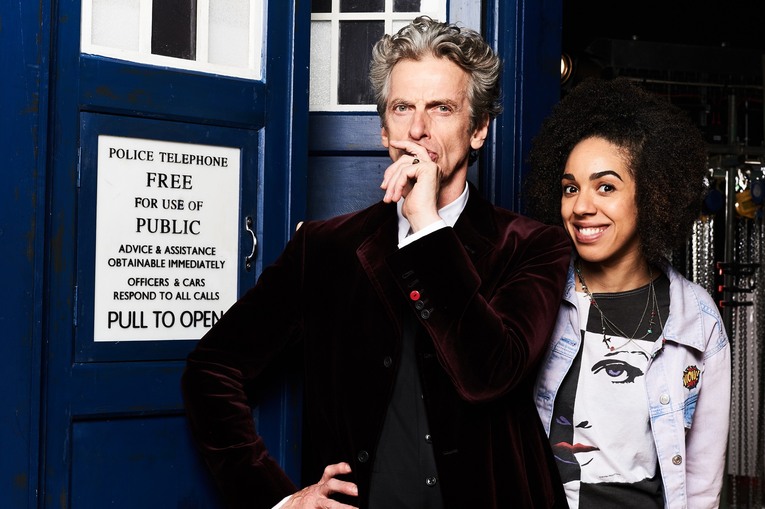
Doctor Who returns to our screens next month for a Christmas special, followed by a season of new episodes in the spring, possibly March or April. This season - the 10th since the show's return in 2005 and the 36th overall - will also be the last to be helmed by Steven Moffat, who has been in charge of the series since Russell T. Davies departed in 2010. Peter Capaldi returns as the Twelfth Doctor and Pearl Mackie will be introduced as the Doctor's latest companion, Bill.

According to The Mirror, the BBC is planning major changes after this season. Chris Chibnall, a former Doctor Who and Torchwood writer better-known these days for working on Broadchurch (the third and final season of which will air next year), will be taking over as showrunner from the 11th/37th season in 2018. According to the reports, he will be ditching the Bill character immediately (which seems a bit harsh, but follows in the Davies tradition of having only one companion/Doctor combo per season) and replacing her with a new character. More importantly, that season will also allegedly see Peter Capaldi being replaced by a new Doctor.

According to the report, the BBC wants a complete revamp and reboot of the show, apparently unimpressed by declining merchandise sales and lengthy periods where no new episodes air. They want a return to 12-13 episodes per year, airing in the same slot, believing this predictability helped give the show its cachet and popularity during the David Tennant years (as well as, y'know, David Tennant).

Given the future of the show was in question a couple of years ago, it's heartening to hear (even if not confirmed) that the BBC is committing to the show's future. It does feel a little disingenuous of the BBC to be blaming the show's intermittent scheduling as a problem when it's the BBC's own budget crisis that caused and mandated it in the first place though.

If the story is true, it'll be interesting to hear if Capaldi has chosen to go - which is quite possible - or if he's been encouraged to leave by the BBC so they can cast a younger actor. If the latter is the case, it will be annoying as Capaldi's performance has been absolutely splendid.

We should learn the truth next year.