Showing posts with label wizards of the coast. Show all posts

Thursday, 3 September 2026

Netflix cancels FORGOTTEN REALMS TV show mid-development, pivots to RAVENLOFT

Netflix has ceased development work on The Forgotten Realms, a Dungeons & Dragons-based TV show in the titular setting. Shawn Levy and Drew Crevello had been developing that project for around eighteen months before Netflix decided to move on. However, Netflix remain in the D&D game, as they have now pivoted to a new TV project based on the horror setting Ravenloft instead, with Alfonso Cuarón on board.

The move clears up a potentially complicated clash, as Netflix were developing The Forgotten Realms whilst HBO are working on Baldur's Gate, a TV show sequel to the popular video game sequel headed by Craig Mazin of Chernobyl and Last of Us fame (Baldur's Gate is a major city within the Forgotten Realms). Levy and Mazin had agreed to cooperate on a shared continuity, but it was always regarded as dubious that they'd be able to coordinate this across two separate production partners. Mazin's Baldur's Gate project remains in development at HBO and is likely to be his next project once work on the third and final season of The Last of Us wraps.

Whilst Netflix has passed on The Forgotten Realms, it's possible that project could be redeveloped elsewhere, maybe even at HBO as well, but that remains highly speculative.

The new Ravenloft project will instead be divorced from the wider D&D multiverse, and will focus on the tragic villain of Strahd von Zarovich of Barovia. Alfonso Cuarón, Richard Swartz and Gaby Rodriguez will produce for Esperanto Filmoj whilst Gabriel Marano produces for Hasbro. Frequent Tim Burton collaborator John August will be head writer and likely showrunner.

Ravenloft was created by Tracy and Laura Hickman as a stand-alone adventure for D&D 1st Edition back in 1983, but was expanded into a full campaign setting for 2nd Edition via boxed set releases in 1990 and 1994, expanded upon by additional sourcebooks and a line of novels. The setting was developed under licence by Sword & Sorcery Studios during 3rd Edition but the licence withdrawn so Wizards of the Coast could release their own version for 4th Edition. However, the early termination of 4th Edition saw that project cancelled. The setting returned to prominence through adventures and source material in both 5th Edition and the current 5.5 Edition.

Tuesday, 29 July 2025

The original author of the Dragonlance Chronicles (not!) revealed for the very first time

Update: YoDanno has retracted the claim, after Margaret Weis confirmed the contract was for a Western series of novels and not Dragonlance.

Way back in 1983, when TSR was plotting what they called "Project Overlord", they had a plan for a line of gaming materials and a line of tie-in novels. Margaret Weis would edit the novels and Tracy Hickman, along with TSR's editorial team, would oversee the whole story and the gaming materials. TSR hired a "proper" science fiction/fantasy author of significant experience to write the books, similar to how SFF megastar Andre Norton had written the first Greyhawk novel a few years earlier under Gary Gygax's direction.

However, that author failed to deliver. It's been suggested that they kept creating their own plot twists and story ideas (that dragged the story away from the outline, which it needed to stick to to tie-in properly with the gaming storyline), and basically were not gelling. Eventually TSR cancelled the contract and Weis & Hickman agreed to join forces to write the novels directly, with the rest becoming history: The Dragonlance Chronicles trilogy, by some estimates, is the biggest-selling epic fantasy trilogy of the 1980s.

The identity of that original author has never been revealed, at least until today. Dragonlance historian YoDanno received a copy of the TSR contract confirming that SFF author Ron Goulart (1933-2022) was the original contracted author for the trilogy. Goulart worked extensively in SFF media tie-ins, as well as mysteries and original fiction, and is known to have been the "actual" author of the TekWar series, working on an outline provided by William Shatner.

This wasn't the first time a relative SFF "big name" nearly got involved in the franchise. In 2009 Jim Butcher, author of The Dresden Files and the Codex Alera series, was asked to write a "reboot" of the original trilogy. Butcher came on board under the impression that the project had the approval of Weis & Hickman, only to withdraw when it became clear that was not the case. Weis & Hickman have subsequently returned with new Dragonlance novels.

Thursday, 13 February 2025

Netflix and Wizards of the Coast put FORGOTTEN REALMS live-action show into development

Netflix and Wizards of the Coast have joined forces to put a Dungeons & Dragons TV project into development, tentatively called The Forgotten Realms. The show will be set in the D&D game's most popular world, the recent setting for hit video game Baldur's Gate III and the well-received movie Honor Among Thieves.


Shawn Levy, the producer of Stranger Things and director of movies including Date Night, Night at the Museum and Deadpool & Wolverine, will executive produce the show via his existing deal with Netflix, and will likely direct several episodes. Drew Crevello will write and showrun. Crevello previously worked at Fox on the X-Men franchise and the first two Deadpool movies, and co-wrote and produced the mini-series WeCrashed.

There have been multiple attempts to get a Dungeons & Dragons multimedia franchise off the ground in recent years. Baldur's Gate III has been the biggest success, selling over 20 million copies since its August 2023 release and becoming one of the highest-rated video games of the last decade, if not more (PC Gamer US gave the game its highest rating in over twenty years). Honor Among Thieves landed with impressive critical scores and rave audience reviews, but moderate box office; the film failed to recoup its costs at the box office, but a long tail on physical media and streaming has helped in the longer term. At various times, Hasbro and Wizards have looked at developing projects in both the Forgotten Realms and Dragonlance worlds. Paramount+ was the logical destination for the project after the studio's collaboration on Honor Among Thieves, but the service's increasingly shaky performance led Hasbro to reconsider and start putting out feelers with Netflix.

Discussions with Netflix have been underway for some time, and at one point it was rumoured they were considering an adaptation of the Baldur's Gate video game trilogy. However, that idea seems to have cooled. The current proposal seems to be for an original story following new characters, with the door left open for popular franchise characters from the roleplaying source material, video games and novels to make an appearance.

The Forgotten Realms world was created by Canadian writer Ed Greenwood in the late 1960s as a setting for his own stories (the city of Baldur's Gate first appeared in a tale written to amuse his father in 1967). In 1978 he started playing Dungeons & Dragons and adapted the world for his home campaign. He started contributing articles to Dragon Magazine and quickly started referencing the world, its heroes, villains and iconic locations. In 1986 TSR decided to adopt a new "standard" fantasy setting to replace Greyhawk and Dragonlance, and agreed to purchase the Forgotten Realms from Greenwood.

The Forgotten Realms Campaign Setting appeared in print for the first time as a boxed set in 1987. New editions of the campaign setting core product appeared in 1993, 2001, 2008 and 2015, with two new campaign books planned for later this year. More than 250 other sourcebooks, adventures, board games, boxed sets and gaming materials have also been released. Forgotten Realms is notable as the only D&D campaign setting to remain continuously in print since its first launch, and to have new products for it launched almost every year since its first release.

A range of novels simultaneously launched, with R.A. Salvatore's The Crystal Shard (1988) rapidly attracting huge sales for his iconic hero, the renegade dark elf Drizzt Do'Urden. More than 35 million Drizzt books have since been sold, and the Forgotten Realms novel line has reportedly sold almost 100 million copies. Greenwood himself became a bestselling author with his novels about the iconic wizard Elminster the Sage, with other bestselling authors in the setting including Troy Denning, Doug Niles, Jeff Grubb & Kate Novak, Paul Kemp, James Lowder, Elaine Cunningham and Erin Evans.

The first Forgotten Realms video games were released in 1988 from Strategic Simulations Inc., and were followed by a large number of successful titles. The most notable early success was the Eye of the Beholder trilogy from Westwood Games. In 1998 the Canadian company BioWare teamed up with Black Isle and Interplay to release Baldur's Gate. The game was an immediate smash hit, and was followed by Baldur's Gate II: Shadows of Amn in 2000 and Neverwinter Nights in 2002. Black Isle themselves developed Icewind Dale (2000) and Icewind Dale II (2002), also set in the Realms and using the same engine as Baldur's Gate. After Interplay's collapse, Obsidian Entertainment (made up of Black Isle veterans) released Neverwinter Nights II in 2006. The online roleplaying game Neverwinter was released in 2013, followed by Sword Coast Legends in 2015. Baldur's Gate III, developed by Larian Studios and released in August 2023, is easily the biggest and most successful video game in the setting to date.

This new project is only in development for the time being, with a pilot written. It remains to be seen if Netflix chooses to move forward with a series order.

Sunday, 2 April 2023

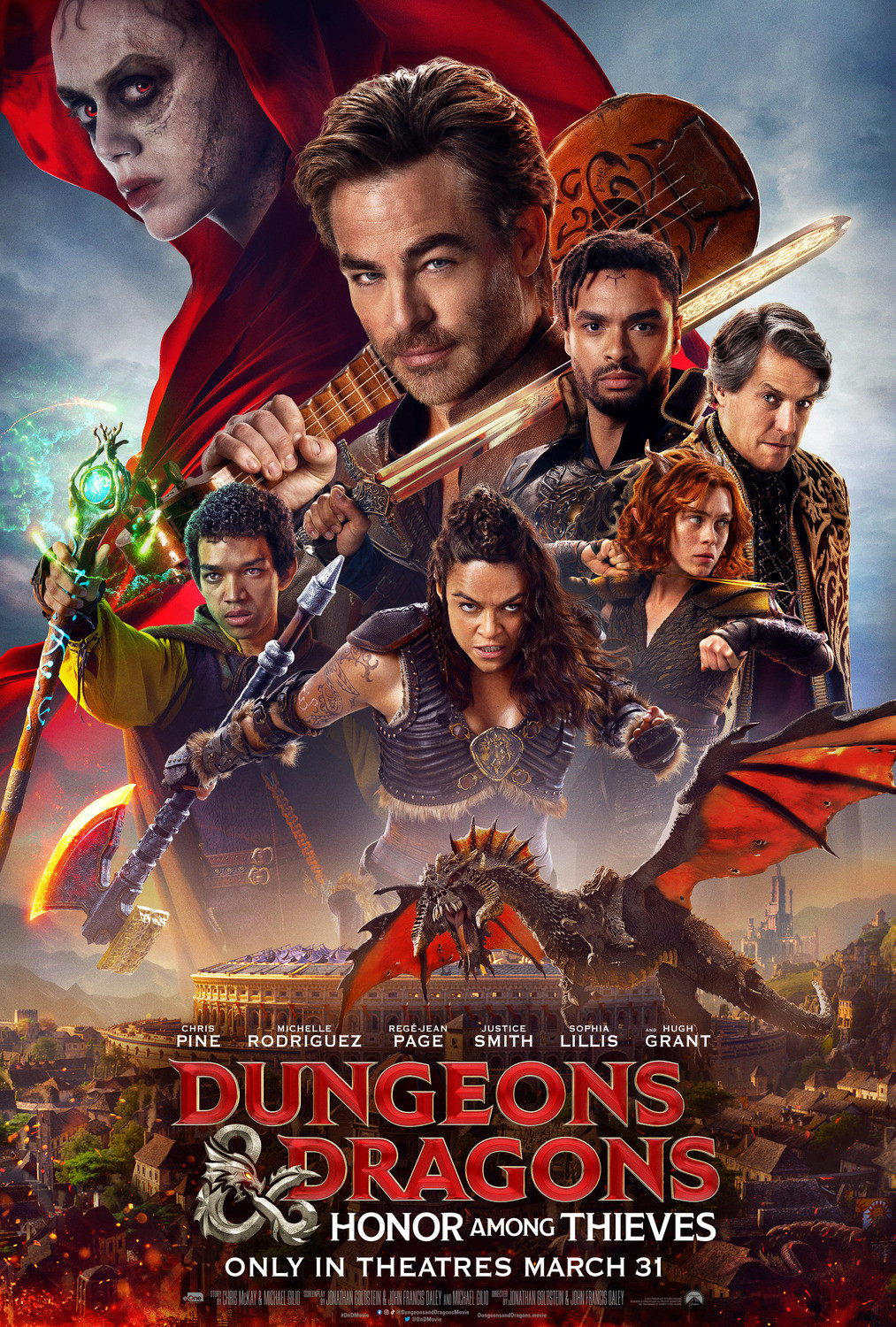
Dungeons & Dragons: Honor Among Thieves

Edgin Darvis, a former member of the Harpers, is serving time in the prison of Revel's End for a heist gone wrong. Together with his barbarian partner, Holga Kilgore of the Tribe of the Elk, he breaks out of prison to try to reunite with his daughter, Kira, who is in the safe keeping of their former partner Forge Fizwilliam. Holga and Edgin discover that Forge is the new Lord of Neverwinter, something he accomplished with the aid of the evil Red Wizards of Thay, and has nefarious plans for the city.


Edgin and Kira recruit a former sorcerer ally of theirs, Simon, and set about assembling a team to break into Neverwinter during the Highsun Games, rescue Kira and find an artifact capable of resurrecting Edgin's slain wife. Each plan runs into new problems, but the gang have to find a way to win through to save Neverwinter.

Next year marks the 50th anniversary of Dungeons & Dragons, the first tabletop roleplaying game which allowed players to undertake stirring and dramatic adventures with nothing more than a couple of rulebooks and some dice. There have been various attempts to adapt D&D to the screen, resulting in some fifty video games, a 1980s animated series and four previous feature films, although only one of them made it to the cinema screen. It was not very good.

Honor Among Thieves is the latest attempt to make such a film and both immediately and comfortably becomes the best-in-class. It helps that the film uses the established world of the Forgotten Realms as its setting, with various cameo appearances by various creatures, spells and locations. It also helps that director-writers Jonathan Goldstein and John Francis Daley (Game Night) have gotten the assignment, making a film that's fully accessible to everyone who's never held a 20-sided dice or knows what a beholder is.

Instead, the film emerges as the finest slice of film fantasy since at least Stardust, if not the Lord of the Rings trilogy. The tone is somewhat light, with plenty of gags and moments of humour, but it does darken considerably whenever the evil Red Wizards of Thay appear. This tonal variation is handled well, making the film both entertaining but with moments of real stakes and dramatic tension. The film is aiming for the same kind of tone as Stardust and in the ballpark of The Princess Bride, and more or less nails that target. Those hoping for a gritty and darker film will be disappointed, but it feels like the creators have found a tone close to that of the D&D tabletop game.

The film dodges some of the balls of other recent, disappointing blockbusters. An extended post-production schedule has allowed for a good mix of live-action, prosthetics, physical locations and real stunts with CG enhancements, and only a few 100% CG scenes, and what there are are mostly very good. After some recent movies from the Marvel stable with very embarrassing CG, it's a relief to be able to say that the effects in this film do their job.

The actors are all on board with the tone, with the MVP being Hugh Grant. Grant adopts his typical British fop/cad accent and mannerisms to the material, but there are several moments in the film where Grant's character drops his facade and a much more ruthless character appears. It's fleeting, but hints at much greater character depth. The rest of the case do their jobs well: Chris Pine brings roguish charisma as the protagonist, Michelle Rodriguez delivers taciturn violence well, Sophia Lillis is the best owlbear you'll ever see on screen, Justice Smith manages to stay just on the right side of irritating and Regé-Jean Page is easily the best depiction of a paladin seen to date. None of them are fascinatingly deep characters, but they are a likeable bunch and it's easy to root for their success. The film even nails some of the brilliantly over-elaborate plans that D&D gaming groups can come up with if left loose with the rulebooks and a flexible Dungeon Master.

The film falters on occasion. It is slightly overlong and maybe a little too flabby, with maybe one extra setpiece than is strictly necessary. But each setpiece is quite good fun, and it's hard to suggest one to fully cut. It's possible the ancillary worldbuilding is not fully explored, such as why the Red Wizards think their plan would be tolerated by the other powers of the Sword Coast, but halting the movie for a ten-minute lecture on Faerûnian geopolitics would have likely not improved it much. It's really not that kind of film.

Honor Among Thieves (****½) gets the assignment and executes it well. This is a well-played, engaging slice of fun with some great D&D references and cameos for hardcore fans, but which is accessible to everyone. A great cast, excellent effects, a terrific score (from Lorne Balfe) and a fun, relaxed tone makes for an engaging, fun but not disposable movie. Assuming it makes a nice bit of change, I think we can expect this to be only the beginning of the D&D multiverse on screen. The film is on general release worldwide.

Thank you for reading The Wertzone. To help me provide better content, please consider contributing to my Patreon page and other funding methods.

Friday, 27 January 2023

Wizards of the Cost scraps plans to revamp the OGL and moves D&D to a Creative Commons licence

It's been a bruising few weeks for Wizards of the Coast and parent company Hasbro, whose plans to monetise the never-more-popular Dungeons & Dragons brand by removing the Open Game Licence 1.0 ran into fierce opposition from fans and fellow businesses alike.


Wizards initially offered a partial compromise, allowing existing OGL products to remain on sale and removing plans for licence charges for successful products using the D&D rules, but confirming they were pressing ahead with eliminating the OGL 1.0 for new products moving forwards. Creators would instead have to sign up to the OGL 2.0, which was still significantly more restrictive than the old 1.0 model that company had employed since 2000, and changes to the rules pertaining to the virtual tabletop (VTT) market would remain in place, effectively forcing online players to use Wizards' own D&D Beyond service with a subscription fee.

However, the creators of the OGL 1.0 voiced doubts that the original OGL could be legally revoked (they'd deliberately included language suggesting not), several companies mulled over legal challenges and multiple other RPG companies announced the creation of a rival open licence, which soon saw a large chunk of the tabletop RPG industry come on board.

Today Wizards of the Coast announced a comprehensive climbdown. They will no longer try to revoke the OGL 1.0, they will no longer try to impose their changes on the burgeoning virtual tabletop (VTT) market (with the 1.0 remaining in place, that's no longer possible) and they are in fact scrapping the entire OGL 2.0 initiative in favour of moving to a Creative Commons licence instead. They are releasing the rules for Dungeons & Dragons 5th Edition via a Systems Reference Document for use with either licence. Effectively, this is a return to the status quo, with a more comprehensive 5th Edition SRD as a result.

Wizards likely decided on the climbdown after seeing over 40,000 subscribers abandon their D&D Beyond platform in the space of three weeks, as well as a burgeoning campaign to boycott the forthcoming Dungeons & Dragons movie, Honor Among Thieves, which launches on 31 March. The film is the opening salvo of a broad-spectrum D&D assault on the multimedia space, with Hasbro keen to bring the franchise to film and television, as well as reinforcing its presence in video games (the highly-anticipated Baldur's Gate III launches later this year).

Whilst likely to be welcomed by those whose livelihoods were threatened, the climbdown is unlikely to erase the memory of Wizards' behaviour. Other companies have benefitted, most notably Paizo who make the rival Pathfinder fantasy RPG which was previously the dominant tabletop RPG from 2009 to 2015 before D&D supplanted them. Paizo reports selling out of all of its physical stock of its core rulebook in the last fortnight and is rushing reprints to meet renewed demand. Some other RPG creators are also reporting increased sales. Work on the rival open gaming licence is likely to continue.

Thursday, 19 January 2023

New DUNGEONS & DRAGONS rules to use a Creative Commons to replace the Open Game Licence

In a remarkable turnabout, Wizards of the Coast have confirmed that the next edition of Dungeons & Dragons will move to a Creative Commons licence. This follows two weeks of turmoil following the leak of a more restrictive Open Game Licence 1.1 which threatened to revoke the previous OGL 1.0 (in operation since 2000) and had dramatic implications for the third-party D&D field, and could have put numerous companies out of business and forced others (even industry giants like Paizo) into costly legal action.

After initial non-apologies, Wizards of the Coast seemed to have been moved to swift face-saving action after a costly online campaign to boycott D&D products saw remarkable success, with reportedly over 40,000 subscriptions on online portal D&D Beyond cancelled, a number that continues to grow.

The new OGL 1.2 will be published under a Creative Commons licence, effectively moving the later ability to change or alter the OGL out of Wizards' hands. The new OGL will (apparently) be truly "irrevocable." Existing content published under 1.0a will not be impacted and can continue to be published. In addition, the new OGL 1.2 will remove the previously controversial clauses on royalty payments and financial reporting, and also will apply to the tabletop experience (real and virtual), suggesting that streamers and video games will no longer be impacted. 

However - and this remains a primary bone of contention - Wizards plan to continue "deauthorising" the OGL 1.0. No new content can be published under 1.0 once 1.2 is introduced. This will likely not mollify many of the critics, who will likely continue to push for attempts to deauthorise 1.0 to be abandoned. Wizards maintain that the 1.0 licence could theoretically allow third-party publishers to release "hateful content" that could damage the D&D brand and name.

In addition, Wizards note in their small print that they alone will be the sole arbiters of what is "hateful content" and by agreeing to use the OGL 1.2, licencees will lose the ability to contest that via any future legal action.

Although this is movement on Wizards' part, it does not seem to address some of the core concerns about the prior licence proposal, and the controversy will likely roll on.

Tuesday, 10 January 2023

Tabletop RPG industry in uproar over leaked changes to the Open Game Licence

The tabletop RPG industry has endured a tumultuous week after io9 secured a copy of the proposed 1.1 revision of the Open Game Licence. Version 1.0 of the OGL, popularised by Dungeons & Dragons, has allowed third parties to create and monetise content for the game for almost a quarter of a century. The proposed changes could drive many content creators out of business.


The OGL was introduced when the 3rd Edition of D&D was released by Wizards of the Coast in 2000. Dungeons & Dragons had been created by Gary Gygax and Dave Arneson via the company TSR in 1974 (although both were gone from the company barely a dozen years later), but significant financial mismanagement and poor investments had driven the company deep into debt by 1997, with the company threatened with bankruptcy. D&D had also dropped in popularity massively, with games like the World of Darkness family (most famously, Vampire: The Masquerade) supplanting its market share. Wizards of the Coast, a relatively young company which had skyrocketed to success with its card game, Magic: The Gathering, bought TSR and D&D in 1998 and set about revising the game for a new generation.

The 3rd Edition of D&D was hugely popular and successful, and was credited with revitalising the entire TTRPG (tabletop roleplaying game) industry in the early 2000s. Many d20-branded games, using the OGL and rules compatible with D&D, were released to great success and entire companies were created to cash in on the phenomenon. Significant d20 games include the Babylon 5 and Judge Dredd licensed games and Wizards of the Coasts' own Star Wars line of RPGs. 

In 2008 the 4th Edition (4E) of D&D was released under a more restrictive licence, but a similar public outcry saw the OGL maintained. With the 4E rules proving very controversial, this allowed Paizo Publishing to release their own fantasy roleplaying game called Pathfinder, effectively using a fork of the 3E rules set. Vast numbers of Dungeons & Dragons players defected to playing Pathfinder instead. D&D lost significant market share, dropping behind first Pathfinder and then the Star Wars RPG to third place in the rankings.

In 2014, Wizards of the Coast released the 5th Edition of D&D, using a revamped and more popular rules set and returning to the OGL. The company was bolstered by the launch of Critical Role in 2015, a popular web series featuring a group of popular voice actors playing a D&D campaign on screen. In 2016, D&D featured heavily in the first season of the Netflix smash hit success Stranger Things. These factors drove D&D back to its traditional level of popularity and market dominance. Paizo released a 2nd Edition of Pathfinder in 2019 which has done well (and deviated further away from the D&D rules system), but not threatened to unseat D&D's position.

Wizards of the Coast has recently confirmed that the next iteration of D&D is in development. Code-named "One D&D," the new version of the game aims for backwards compatibility with 5E as well as having a less restrictive and more freeform rules system. However, the biggest change sounds like it will be to the Open Game Licence. Wizards and Hasbro will now take a cut of any RPG using the system that makes more than a certain amount of money per year, as well as automatically owning original ideas and creatures from products. More ominously, they are threatening to "deauthorise" anything published under the OGL 1.0 licence, theoretically impacting hundreds of products that are still on sale from dozens of companies.

These are not limited to just tabletop RPGs, but also products including video games such as Pathfinder: Kingmaker and Pathfinder: War of the Righteous by Owlcat Games and Solasta: Crown of the Magister from Tactical Adventures (although Tactical Adventures have indicated they have already been in conversation with Wizards of the Coast over the matter).

The blowback from the industry has been significant in the last few days, and it remains to be seen if Wizards will push forwards with their plans. Notably, they have already received legal pushback from lawyers pointing out that the OGL 1.0 was released as a non-revocable agreement, and Wizards' subsequent quarter-century of honouring that position makes it hard for them to backtrack on it now. However, the legal departments and resources of Wizards of the Coast and their owners Hasbro are formidable, to say the least.

This situation continues to unfold.

DUNGEONS & DRAGONS TV series greenlit for Paramount+

Dungeons & Dragons is getting its first live-action television series. Streamer Paramount+ has greenlit an eight-episode show from Rawson Marshall Thurber. Thurber will produce the show and write and direct the opening episode.

Thurber is best-known for his work in comedy, directing and writing Dodgeball (2004), Central Intelligence (2016) and Red Notice (2021). Red Notice was Netflix's biggest original movie and Thurber is currently developing two sequels to that film. He is also attached to a live-action Voltron feature film for Amazon.

This TV project is not related to Honour Among Thieves, the feature film starring Chris Pine which is set for release on 31 March this year. Nor is it related to a separate TV project being helmed by John Wick writer Derek Kolstadt, potentially involving signature Forgotten Realms character Drizzt Do'Urden.

The details of Thurber's project remain under wraps. It is not known which of the numerous D&D settings will be used for the series, or if it will use an original world or location.

Friday, 7 October 2022

Slaying the Dragon: A Secret History of Dungeons & Dragons by Ben Riggs

In 1974, wargamers Gary Gygax and Dave Arneson created the world's first roleplaying game: Dungeons & Dragons. An immediate, enormous hit, the game fuelled the creation of the TSR company and a quarter of a century of classic gaming products, not to mention power struggles and dubious corporate decisions.


The story of TSR, its rise and fall, has been told before and the narrative is familiar, from Gygax and Arneson's early days in miniature gaming to coming up with the first dungeons and the first campaign settings (Blackmoor and Greyhawk). They then start TSR and Dragon Magazine, Arneson is maneuvered out of the picture and the game's immense success sees Gygax living the high life in Los Angeles trying to get a movie made whilst the company teeters on without him. Then Lorraine Williams takes over, forces Gygax out, and the company sees renewed success in the late 1980s from new campaign settings (such as Forgotten Realms), a second edition of the game and entries to the video game and novel markets, which keeps things going until everything blows up spectacularly in the late 1990s, resulting in the sale of the company to Magic: The Gathering creators Wizards of the Coast.

Whilst the story is familiar, there's a lot more detail in Ben Riggs' book, which calls upon interviews with a huge number of ex-TSR luminaries, although there are two notable absences. Gygax passed away in 2008, so is only represented through archive interviews. Williams declined to be interviewed for the book, so Riggs has to rely on second-hand accounts, interviews with some of her close co-workers and a few archive interviews (particularly drawing on David Ewalt's Of Dice and Men, the last book Williams was interviewed for). This leaves the book feeling oddly structured: a heroic saga where both the main protagonist and main antagonist (who is who depends on your point of view) are absent for large stretches of it.

To be honest, the main narrative of the book is well-known to the point of overfamiliarity to any long-standing roleplaying fans (newcomers who have come to the game in the last few years - and there's a lot of them - will find much more of interest here), so it's more in the details where it shines. The saga of TSR West, the California-based publishing initiative with its own products and an ill-advised idea to branch into comic books (costing TSR it's very lucrative licencing contract with DC in the process), is mostly new to me and fascinating. Additional details on how badly TSR could treat its superstar authors, and how some of the corporates who came in later on simply didn't understand the first thing about the product they were selling, are also intriguing. There some fascinating almost-ran stories, like when TSR nearly acquired the Middle-earth licence but foundered on Christopher Tolkien refusing to grant them permission to publish original fiction.

One of Riggs' biggest successes is getting his hands on hard sales data from TSR. In some cases, some of TSR's own big names were unaware of what the hell was going on with the company's products, and their reactions to learning how bad sales really were in the 1990s are startling. Learning that Forgotten Realms sold well, but not quite as well as some earlier, retired settings was a surprise.

The book is a goldmine of interesting trivia, but the writing tone is inconsistent. Sometimes the tone is serious and analytic, and sometimes jokey and anecdotal, and the tonal shifts sometimes feel random. There's also a marked difference in how Riggs talks about deceased people and folded companies and how he talks about still-living individuals and extant corporate entities. There's also a lack of deeper analysis on well-regarded stories. The suggestion that TSR collapsed due to an overload of campaign settings is taken as fact throughout, and the oft-mentioned idea that D&D faltered in the 1990s more because of an increasingly unwieldy rules set (contrasted to the streamlined rules of its biggest competitor, Vampire: The Masquerade) and the refusal to slay sacred cows with a more thorough revision - seemingly proven by the monstrous success of D&D 3rd Edition after the move to Wizards of the Coast and the even bigger success of the even more streamlined 5th Edition - is not really given any shrift.

There's also a distinct lack of coverage of the video game side of things, which mostly gets a few brief mentions and little more. The book may actually suffer from its conciseness: 278 pages to cover twenty-five years of history is not really enough, and several chapters halt just as they are starting to get interesting. There's also the fact that the revival of D&D's fortunes with 3rd Edition in 2000 and the subsequent appalling misjudgements that led to the ill-conceived 4th Edition in 2008 and the brand's subsequent eclipsing by former allies-turned-competitors Paizo with their Pathfinder game are just as fascinating a story, but the book decides not to pursue the story into that era. That's fair enough, but it seems to leave the book begging for a sequel (which, given Wizards of the Coast and Hasbro's legal firepower, might never happen).

Slaying the Dragon (***½) contains enough new revelations and interesting analysis to be worthwhile for seasoned D&D players, and newcomers to the game unfamiliar with all the old anecdotes will likely enjoy the book far more. But it does feel like the book could have gone into some areas in more detail and depth, and been a bit more consistent in tone.

Thank you for reading The Wertzone. To help me provide better content, please consider contributing to my Patreon page and other funding methods.

Wednesday, 5 October 2022

DUNGEONS & DRAGONS to get two new novels to tie in with upcoming movie

Dungeons & Dragons is getting back into the novel market, at least tentatively, with two new novels commissioned to celebrate the release of the feature film Honor Among Thieves in March.


The two books are called The Druid's Call and The Road to Neverwinter, written by E.K. Johnston and Jaleigh Johnson respectively. Both books are set in the Forgotten Realms world, as is the movie, and will be set before the events of the film. The Druid's Call tightly focuses on the character of Doric, the tiefling druid we saw wildshifting into an owlbear in the trailer, whilst The Road to Neverwinter explores how the rest of party got together and headed for Neverwinter in the first place, and is a much more direct prequel to the film.

E.K. Johnston is a newcomer to the franchise, having previously written a series of stand-alone novels and contributing to the Star Wars setting with the novel Ahsoka (2016) and an additional trilogy. Jaleigh Johnson is a D&D and Forgotten Realms veteran, with five previous novels in the setting to her name: The Howling Delve (2007), Mistshore (2008), Unbroken Chain (2010), The Darker Road (2011) and Spider & Stone (2012).

More than two years ago, I noted the bizarre decision by Wizards of the Coast to terminate the extremely lucrative D&D fiction line several years earlier. Starting in 1984 and running until 2016, first TSR and then Wizards of the Coast published some 623 novels and short story anthologies set in the various Dungeons & Dragons campaign settings. These books shifted vastly in excess of 100 million copies (probably closer to 200 million) and made best-selling superstars of R.A. Salvatore and the team of Margaret Weis and Tracy Hickman, whilst authors like Paul S. Kemp, Elaine Cunningham, Troy Denning and Forgotten Realms creator Ed Greenwood did very well indeed. The novels were credited with bringing hundreds of thousands and possibly millions of people into playing the D&D tabletop game.

However, Wizards of the Coasts' corporate overlords, Hasbro, were apparently always unhappy with running a publishing arm, despite it being an incredibly successful one, as it did not fit in with their core business model focusing on toys and games. After the launch of D&D 5th Edition in 2014, they decided to terminate the publishing business and switched instead to licensing their worlds to third-party publishers. But the cost of the licence was so extortionate that publishers felt it was not worth the effort of publishing authors even like Paul Kemp, Elaine Cunningham and Ed Greenwood, who were usually guaranteed at least a hundred thousand sales in hardcover and much more in paperback and ebook (and these are not chump figures at all). Only R.A. Salvatore seemed worthwhile, and between the end of 2016 and just a couple of months ago, the only D&D-branded novels still coming out were additions to Salvatore's Legends of Drizzt series, with two new trilogies being published. A couple of months ago, Margaret Weis and Tracy Hickman joined the party with the first book in a new Dragonlance trilogy.

Whether this is a limited marketing event solely related to the film coming out, or it might be the first signs of a wider publishing effort to bring more D&D novels to the shelves, remains to be seen.

Thursday, 21 July 2022

The DUNGEONS & DRAGONS movie gets its first trailer

The first trailer has been released for the upcoming Dungeons & Dragons movie, Honor Among Thieves.

The trailer sees bard Edgin Darvis (Chris Pine) and barbarian warrior Holga Kilgor (Michelle Rodriguez) assembling a team to take on evil-doers. The rest of their party is rounded off by a paladin (Regé-Jean Page), half-elven sorcerer Simon (Justice Smith) and tiefling druid Dorig (Sophia Lillis), who specialises in transforming into an adorably murdery owlbear during combat. They have to face off against a number of foes, including the foppish Forge Fitzwilliam of Neverwinter (Hugh Grant), although they also have their work cut out facing down a displacer beast, a black dragon, a gelatinous cube and several evil sorcerers.

The movie is set in Ed Greenwood's Forgotten Realms world, specifically along the Sword Coast North with a focus on the city of Neverwinter (well-known from video games like Neverwinter Nights), and marks the first time the Realms - which have sold somewhere in the region of 100 million novels, over 10 million video games and several million RPG products - has ever been portrayed in live action. Reportedly we may see some cameos from major Forgotten Realms characters, so keep those eyes peeled for Elminster or Drizzt Do'Urden (who is also having his own live-action TV series developed back at Hasbro's production arm).

The film was written by Chris McKay and Michael Gilio, with Jonathan Goldstein and John Daley directing. The film hits cinemas on 3 March 2023, and looks like a cheesy fun time. It will have to go some to be worse than the four previous attempts to bring D&D to the screen, resulting in one dubious cinematic feature in 2000 (although worthwhile for Jeremy Irons' mind-boggling performance as the villain), two unwatchable straight-to-DVD attempts in the 2000s and a forgettable, animated Dragonlance film in 2007.

A first look at the characters from the upcoming DUNGEONS & DRAGONS / FORGOTTEN REALMS movie

Early visitors to the San Diego Comic-Con in California have gotten their first glimpse of the characters from the upcoming Dungeons & Dragons movie, set in the Forgotten Realms world.

SDCC has a "virtual experience" set up in the form of a D&D tavern, where people can go for a drink and be treated to visuals from the film, including a dragon flying by. These visuals include our first looks at the main cast from the film.


Relatively little is known about the movie, except that it is set in the Forgotten Realms, in the Sword Coast city of Neverwinter, and features an unspecified threat unleashed by Hugh Grant's villain, which a band of heroes (or hero-adjacent protagonists) have to deal with.

Dungeons & Dragons: Honor Among Thieves is set for release on 3 March 2023.

Friday, 22 April 2022

DUNGEONS & DRAGONS movie gets title

The new Dungeons and Dragons live-action film has finally gotten a title. The film will be called Honor Among Thieves and will be released on 3 March, 2023.

The film stars Chris Pine, Justice Smith, Rege-Jean Page, Sophia Lillis, Michelle Rodriguez and Hugh Grant. The film is written and directed by John Francis Daley and Jonathan Goldstein. Relatively little is known about the movie, except it is set in the Forgotten Realms fantasy world and the city of Neverwinter will feature.

Two classic DUNGEONS & DRAGONS settings to return this year

Wizards of the Coast have confirmed they are resurrecting two classic Dungeons and Dragons settings from the 1980s and revamping them for the current 5th Edition of the tabletop roleplaying game.


The older and better-known of the two is Dragonlance. Originally appearing in print in 1984, Dragonlance melds the traditional fantasy adventuring of D&D with a Lord of the Rings-style epic over-plot. Set on the continent of Ansalon on the world of Krynn, the original Dragonlance campaign pitted the players against Takhisis, the multi-headed draconic goddess of evil, as she tried to conquer the world with her army of dragon-riding warriors. The campaign was adapted into the mega-bestselling Dragonlance Chronicles novel trilogy by Margaret Weis and Tracy Hickman, which has now (along with several sequel series) sold over 30 million copies.

Despite the immense success of the original Dragonlance campaign and the ongoing success of the novel line, later editions of the campaign setting sold poorly. In 2003 it was outsourced to Margaret Weis's own company, Sovereign Press, where it enjoyed considerable renewed success as a setting for Dungeon & Dragons' 3rd Edition. In 2009 Wizards of the Coast revoked the licence, with the last tabletop material and the last novel for the setting appearing in that year. Despite various discussions, the setting languished unloved until last year, when it was confirmed that Weis and Hickman would be returning with a new Dragonlance novel, Dragons of Deceit, for publication later this year.

The new D&D material will comprise two products. The first, Shadow of the Dark Queen, is an adventure and setting book. The second, Warriors of Krynn, is a board game which will interface with the tabletop RPG experience and allow the player characters to recruit armies and fight in large battles, similar to the old Battlesystem expansion for D&D 2nd Edition. Warriors of Krynn is designed by Stephen Baker (the creator of the old Battle Masters miniatures wargame) and Rob Daviau, best-known for his work on the "Legacy" school of board games (like Risk Legacy and Pandemic Legacy). Both games will be set during the original War of the Lance time period.


More obscure, but potentially more interesting, is Spelljammer. Created by Jeff Grubb and originally appearing in 1989, Spelljammer introduced space travel to the D&D game. However, rather than mechanical spacecraft moving via physics, Spelljammer features elaborate craft resembling ocean-going galleons, huge pieces of coral or animals. Rather than flying through space as we know it, they traverse "wildspace," the space between planets, and the "phlogiston," the sea-like space between star systems. Spelljammer features a strong "Age of Sail" flavour, although the rules also allow for concepts like worlds with different atmospheres and different levels of gravity. A number of expansions, adventures and a series of novels were released for the setting.

Despite praise for the offbeat setting, it was discontinued at the end of 1992. Fan efforts were made to keep the setting going, and material in both the 3rd and 4th Editions of D&D referenced Spelljamming. The 5th Edition adventure Waterdeep: Dungeon of the Mad Mage and the Early Access video game Baldur's Gate III both feature Spelljammers prominently, leading to speculation about the setting's return.

The setting is returning in force as well, with three books to be released simultaneously in August 2022 (available separately or in a boxed set). The Astral Adventurer's Guide is the new setting core rulebook, featuring rules on creating new characters and adventuring in the setting. Boo's Astral Menagerie is a guide to monsters and new races, featuring vampirates, sentient comets and space dragons, among many others. Wrapping things up is Light of Xaryxis, a 12-part epic adventure. The boxed set also contains a DM's screen and a fold-out map of the Rock of Bral, an asteroid located in orbit above Toril (the Forgotten Realms planet), the traditional starting place for Spelljammer adventures (though, as with the original game, you will likely be able to place the Rock of Bral wherever you like).

Monday, 23 August 2021

DUNGEONS & DRAGONS movie wraps

Co-director John Francis Daley has confirmed that shooting has wrapped on the new Dungeons & Dragons feature film.

Shooting began on or around 29 April, with shooting based at the Titanic Studios in Belfast, Northern Ireland (previously home to Game of Thrones). Location shooting has taken place in Northern Ireland, Iceland and at Alnwick Castle, Northumberland.

Daley co-directed the film with his long-term collaborator Jonathan Goldstein. Their previous projects include the comedy films Horrible Bosses and Game Night, and writing the MCU movie Spider-Man: Homecoming.

This is, technically, the fifth Dungeons & Dragons feature, following on from three increasingly low-budget movies in the 2000s (only one of which was theatrically released) and an animated Dragonlance movie. However, this project has a vastly greater budget.

The film is set in the Forgotten Realms world and the city of Neverwinter will feature. Beyond that, little is known of the plot. The cast includes Chris Pine, Michelle Rodriguez, Justice Smith and Regé-Jean Page, who are believed to be members of an adventuring band who run afoul of a villainous plot orchestrated by Forge Fletcher, played by Hugh Grant.

The film is currently set for release by Paramount Pictures on 3 March 2023. A D&D TV series is also in development with John Wick writer Derek Kolstad developing a concept. Wizards of the Coast have teased this project may involve Forgotten Realms signature character Drizzt Do'Urden in some capacity.

Friday, 21 May 2021

Wizards of the Coast confirm FORGOTTEN REALMS setting for DUNGEONS & DRAGONS movie

Wizards of the Coast, the creators and publishers of the Dungeons & Dragons tabletop roleplaying game, have finally confirmed that the in-production D&D movie will take place in the Forgotten Realms world, ending years of speculation.

The city of Neverwinter on the Sword Coast North, a rumoured location for the film. Art: Jedd Chevrier

A much earlier, long-superseded draft of the script was set in the Realms, specifically in the city of Waterdeep and the dungeon of Undermountain beneath it, but since then the film has passed through multiple writers, rewrites and directors, leading to some confusion over the film's setting. Yesterday a film synopsis leaked placing the action in the Realms, in and around the city of Neverwinter, but according to Screenrant this is an old synopsis which is no longer completely accurate.

WotC have now confirmed that the setting is indeed the Realms, but nothing specific beyond this. This will mark the first appearance of the Forgotten Realms - history's most popular and successful epic fantasy shared world setting - in a live-action adaptation. More than 290 novels have been published in the Forgotten Realms setting, with cumulative sales approaching 100 million, well over 30 million alone sold by R.A. Salvatore in his popular Legend of Drizzt series. Authors such as Paul Kemp, Ed Greenwood, Troy Denning, Elaine Cunningham and Erin Evans have sold many millions more novels in the setting.

Around fifty video and mobile games in the setting have also been released, including the highly popular Baldur's Gate, Dark Alliance, Icewind Dale and Eye of the Beholder series. Dungeons & Dragons: Dark Alliance, starring Drizzt Do'Urden and the Companions of the Hall, will be released next month, whilst the long, long-awaited Baldur's Gate III is aiming for release next year.

The Forgotten Realms world was created by Canadian author Ed Greenwood in 1968 as a setting for stories he was writing at school. He expanded the setting as a Dungeons & Dragons campaign world in 1976 and began writing D&D articles for Dragon Magazine in 1978, frequently mentioning characters and locations from his home setting. TSR, Inc., the publishers of D&D, bought the setting from Greenwood and brought it into print in 1987. It has never been out of print since, enjoying the distinction of being the only D&D campaign setting supported for every edition of the game and the setting most frequently used in D&D-branded adventures, novels and video games. With the release of D&D's 5th Edition in 2014, the world became the "default" setting for D&D, although recently Wizards (who bought TSR in 1997) have backed off a bit on that in favour of supporting gaming groups in creating their own worlds, or using other settings.

Alongside this news, Wizards of the Coast confirmed that 2020 was the most successful year in D&D's history with over 30% sales growth on the previous year. They confirmed plans in the coming months to bring back two "classic" and long-out-of-print campaign settings (one heavily rumoured to be Dragonlance, to accompany the release of the first new Dragonlance novels in over a decade by setting writers Margaret Weis and Tracy Hickman), as well as releasing a Forgotten Realms card set for the Magic: The Gathering collectible card game.

The D&D movie is currently shooting in the Titanic Studios in Belfast, Northern Ireland, and stars Chris Pine, Hugh Grant, Michelle Rodriguez, Justice Smith and Regé-Jean Page. The film is currently scheduled for release on 3 March, 2023.

Monday, 3 May 2021

DUNGEONS AND DRAGONS movie starts production

After many, many years of delays, legal action and a lot of writer and director turnover, filming is finally underway on the new Dungeons and Dragons film.

Shooting appears to be underway at the main production base in the Titanic Studios in Belfast, Northern Ireland, where the production is using the studio facilities previously employed by Game of Thrones. Second unit location shooting has also already taken place in the south of Iceland.

Production is set to run through the summer, with next year devoted to post-production and effects. The film is directed by Jonathan Goldstein and John Francis Daley and starts Chris Pine, Hugh Grant, Michelle Rodriguez, Regé-Jean Page and Justice Smith. The film is currently set for release on 3 March 2023.

Tuesday, 2 March 2021

Hugh Grant to play the villain in the DUNGEONS AND DRAGONS movie

In a high-profile bit of casting, Paramount has tapped British actor Hugh Grant (The Undoing, Four Weddings and a Funeral, Love Actually) to play the main villain in the new Dungeons and Dragons movie.

Grant is the quintessential British gentleman actor for his roles in 1990s romcoms, but has recently enjoyed a career resurgence thanks to HBO's The Undoing and Amazon's A Very English Scandal.

The film starts shooting in the next few weeks in Northern Ireland and has already tapped Chris Pine, Michelle Rodriguez and Justice Smith for roles, with Regé-Jean Page playing the protagonist. So far no character names or plot or setting details have been revealed.

Deadline have also confirmed that Sophia Lillis (IT, IT: Chapter Two, I Am Not Okay With This) has joined the cast in an unspecified role.

Jonathan Goldstein and John Francis Daley are writing and directing the film for a 2022 debut.

Wednesday, 17 February 2021

DUNGEONS & DRAGONS movie gets its star

The new Dungeons & Dragons movie has found its lead actor, with Regé-Jean Page (Bridgerton) being cast in the lead role.


British-Zimbabwean actor Page is currently a hot property following his star role as Simon Basset, the Duke of Hastings, on Bridgerton, which is now Netflix's biggest-ever TV show. His previous credits include Fresh Meat, Waterloo Road, Roots and For the People on television, and Survivor, Mortal Engines and Sylvie's Love in film. Page is slated to host Saturday Night Live in the USA this week, a sure sign of him being a hot ticket of the moment.

Page is joining an already-impressive cast, including Chris Pine, Michelle Rodriguez and Justice Smith. Jonathan Goldstein and John Francis Daley (Spider-Man: Homecoming, Horrible Bosses, Game Night) are writing and directing the picture for Paramount.

Production is expected to start on the movie in the next few weeks at the Titanic Studios in Belfast, Northern Ireland, formerly home to Game of Thrones.

Tuesday, 9 February 2021

Michelle Rodriguez and Justice Smith join the DUNGEONS & DRAGONS movie

The Dungeons & Dragons movie is finally gearing up for production. With Chris Pine rumoured to have signed on the dotted line, it's now been confirmed that he'll be joined by Michelle Rodriguez and Justice Smith.


Rodriguez is best-known for her recurring role in the Fast and the Furious franchise and appearances in TV shows like Lost, whilst Smith rose to attention for his starring role in Detective Pikachu.

The new Dungeons & Dragons film has been gestating for the better part of a decade, churning through scripts and directors whilst Hasbro fought a major legal battle to regain control of the film rights from Sweetpea Entertainment (who produced three terrible, low-budget films based on the franchise in the 2000s).

The movie is expected to go before cameras in the coming weeks, shooting in the Paint Hall/Titanic Studios in Belfast, Northern Ireland (in the same studio where the entire run of Game of Thrones was shot). Jonathan Goldstein and John Francis Daley (Game Night) are directing from a script they wrote (they previously wrote the script for Spider-Man: Homecoming).

Relatively little is known about the movie. A previous iteration of the film was set in the city of Waterdeep in the Forgotten Realms world, but that script was thrown out so Goldstein, Daley and Michael Gilio could start fresh. It's unknown what world the film is now set in, or what iconic characters, storylines, monsters or spells will appear.

The film is currently scheduled for release on 27 May 2022, but this is likely to shift due to the delays to the start of filming.