Thursday, 28 April 2016

WHEEL OF TIME TV series officially in development

The Robert Jordan Estate has confirmed that a Wheel of Time television series is in development with a major studio.


A more detailed announcement is to follow, but the Jordan Estate has confirmed that protracted legal disputes between themselves and Red Eagle Entertainment, who previously held the TV and film rights, have been resolved, clearing the way for a television series.

The timeline of previous events is as follows:

  • 1990: Publication of the first Wheel of Time novel, The Eye of the World, by Robert Jordan.
  • 2000: NBC options the Wheel of Time as a network TV show, but drops the option after the people developing the series depart the company.
  • Early 2000s: A Japanese anime company proposes an edited version of the story which adapts only the first three books into an animated series and concludes the story there. Robert Jordan declines.
  • 2004: Robert Jordan sells the film, TV, comic book and video game rights to Red Eagle Entertainment, a rights-holding company, for $600,000.
  • 2007: Robert Jordan passes away from cardiac amyloidosis. Brandon Sanderson agrees to complete the novel series, working from Robert Jordan's notes.
  • 2008: Universal options the movie rights to The Wheel of Time from Red Eagle for "a seven-figure sum" and a film script for The Eye of the World is developed.
  • 2013: The final Wheel of Time novel, A Memory of Light, is published. Around this time Universal drops its film option.
  • 2014: Sony Television develops an interest in developing a television series based on The Wheel of Time. No option is purchased, but they hold meetings with Red Eagle and with the Robert Jordan Estate.
  • January 2015: The media rights are due to revert to the Robert Jordan Estate (aka the Bandersnatch Group). Red Eagle self-produce a 22-minute test film starring Billy Zane as Ishamael and air it as a paid-for infomercial on FX, claiming this allows them to retain the TV rights. The Jordan Estate disagrees and requests legal clarification of the situation. Red Eagle count-sues for defamation.
  • August 2015: Red Eagle withdraws its counter-suit.

At the time Red Eagle withdrew its suit, there was speculation that this was part of a legal manoeuvre which would allow Red Eagle to retain a production credit on the project as it went forward. The full details should be made clearer in the coming days and weeks.


The question now is who has won the rights and where will the show end up being broadcast? I addressed this in my "Wheel of Television" blog series a few years ago (I may reprint and update in the coming weeks in light of this news), but we know that Sony were very interested in the project before the legal storm erupted. Assuming they retain that interest, they have to be the firm favourites to have won the rights. It is very likely that one of the major US cable channels would also be in the running, most likely AMC as they have the financial firepower, the timespan allotment (the 16-episode seasons they are giving - unnecessarily in some cases - to The Walking Dead would be pretty essential for The Wheel of Time), the genre savviness and the pre-existing Sony relationship (from Breaking Bad). Starz, Showtime and FX would also be other potential candidates to be interested. HBO is pretty much out of the running due to their refusal to double-dip in the same genre at the same time, or even within a few years of their previous genre show ending. However, we cannot rule out the possibility that Amazon or Netflix has swooped in on the project as well.

The Wheel of Time spans 14 novels, a prequel, two companion volumes and a computer game. Worldwide sales of the series are approximately 90 million, with over 56 million sales in the United States alone and another 5 million sales in the United Kingdom. It is the biggest-selling work of epic fantasy series* since The Lord of the Rings, dwarfing the sales of all other works in its subgenre, including Shannara (which has just had a second season of its TV adaptation on MTV greenlit) and The Kingkiller Chronicle (which has both a film and TV series in development at Lionsgate). Only A Song of Ice and Fire (the book series that Game of Thrones is based on) is in any danger of overtaking Wheel of Time in sales any time soon. In terms of unoptioned fantasy series, it was by far the highest-profile.

More news as it comes in.

* If you don't count Harry Potter as epic fantasy, which some people do, but that's a separate argument.

Timeline and Map of Joe Abercrombie's FIRST LAW world

Joe Abercrombie and his publishers have unveiled the complete world map (well, the explored bit, anyway) for his First Law novels, and a timeline of when the works take place.


The map shows all the lands that lie within the Circle of the World. Midderland, the island in the centre, is the heart of the Union and the location of Adua, the capital city. Styria, the setting for Best Served Cold, is the island or subcontinent to the east. The North lies to the, er, north with the Orsrung Valley (the setting for The Heroes) located in the mountains and hills south of Carleon. The Far Country, the setting for Red Country, is located to the west of Midderland. Dagoska and the Gurkhal Empire are to the south.

The timeline of stories and books is as follows, with novels in bold and short stories in italics. These short stories can all be found in the new First Law collection Sharp Ends, which was published this week.

566 (spring): A Beautiful Bastard
570 (summer): Made a Monster
573 (autumn): Small Kindnesses
574 (autumn): The Fool Jobs
575 (summer): Skipping Town 
575 (spring-autumn): The Blade Itself
575-576 (autumn-spring): Before They Are Hanged
576 (spring): Hell
576 (summer): Two's Company
576-577 (summer to winter): Last Argument of Kings
579-80: Best Served Cold
580: Wrong Place, Wrong Time
584 (summer): Some Desperado 
584 (autumn): Yesterday, Near a Village Called Barden 
584: The Heroes
587 (autumn): Three's a Crowd
590 (summer): Freedom!
590: Red Country
592 (spring): Tough Times All Over
605: New Trilogy Book 1 (due in 2017 or 2018)

The new trilogy, which Joe is writing now, will begin 28 years after the events of Last Argument of Kings (although this may change).

Tuesday, 26 April 2016

What will HBO's next big show be?

HBO have a problem, they've had it for a couple of years and it's getting more of a pressing issue as time goes on. In 2018, Game of Thrones will end and HBO will be left, for the very first time since 1998, without a big hit show that everyone is talking about.


Way back in 1998 HBO, still new to the original scripted drama game, debuted Sex and the City. It was a massive success, got lots of people talking and won HBO a huge number of subscriptions. HBO doubled down on this a year later when it began airing The Sopranos, a violent crime series about the life of mob boss who tries to keep his business running under constant surveillance. Over the next decade HBO aired many critically-acclaimed and popular dramas (including Six Feet Under, Carnivale, Deadwood, Big Love, Rome and The Wire, as well as mini-series like Band of Brothers, The Corner and John Adams) but The Sopranos and Sex in the City were the jewels in the network's crown.

Sex and the City ended in 2004. The Sopranos followed suit in 2007 and it looked like HBO might have to survive without a big, successful show on the air. However, by luck the following season they debuted a TV drama series about vampires. True Blood would go on to almost match the success and buzz of The Sopranos (although not quite the same level of critical acclaim). And just at the point that True Blood's critical and commercial success began waning in 2011, they debuted Game of Thrones, which would go on to become the most successful show in the network's history.

According to HBO, they've never "needed" a massive, genre-defining show to lead with. They get a lot of subscriptions for their sports and movie channels, and their original drama and comedy programming has really been an added bonus on top of that. Their top executives seem relatively sanguine about the possibility that they may end up in a situation where they have no massive, subscription-encouraging series on the air for a few years. How the reality of that feels after twenty years of being the top dogs will likely be a different story, however. More of an issue for HBO has been that original scripted cable drama used to be very much the field they owned exclusively, but now other channels such as Starz (Black Sails and Outlander), AMC (The Walking Dead, Breaking Bad) and Showtime (the new Twin Peaks) are fighting for that space, not to mention the competition posed by Netflix and Amazon with their original programming. HBO isn't the automatic "go-to" network any more for talented creators who want to get a pet project on the air any more.

Paradoxically, despite HBO making quite staggering amounts of money, they have also become more risk-averse. They have cancelled shows after producing pilots and canned projects that should appear to be slam-dunk successes. Embarrassingly, some of these projects have gone on to great success on other networks and in other venues (most famously Mad Men, which HBO turned down and went to air with AMC).

More impressive is the fact that HBO turned down no less than three absolutely killer shows based on books which would have been a perfect fit for them and perfect follow-ups for Game of Thrones, being fantasy shows but "different" kinds of fantasy to Thrones. The first of these was The Dark Tower, based on the Stephen King novels. HBO developed this both as a joint TV-film cross-media project and then just as a TV show. However, HBO got cold feet and dropped it. It's been picked up by Sony Pictures as a major film project and shooting starts in a few weeks with Idris Elba and Matthew McConaughey starring. The second was Preacher, based on the violent but critically-acclaimed graphic novel series by Garth Ennis. The series was in an advanced state of development when HBO apparently (and uncharacteristically) got cold feet over the show's controversial stance on religion and dropped it. AMC picked it up and shooting has wrapped on the first season, which should debut in a few months. Early buzz on pilot screenings is extremely positive, and the show should make an excellent companion series for The Walking Dead. Finally, there was American Gods. HBO had developed multiple pilot scripts with Neil Gaiman, the writer of the novel, and had looked virtually certain to greenlight it when they very abruptly dropped it, to the puzzlement of just about everybody. Starz has since picked up the series and production is currently underway in Toronto.

So, we have to ask, what does HBO have on its development plate right now, what is available and what could they do to produce a follow-up hit show to Thrones? Let's take a look.


Westworld

Westworld is based on Michael Crichton's 1973 film of the same name and is set in a futuristic theme park where the robot exhibits start to break free and take control. This has an absolutely stellar cast, with Sir Anthony Hopkins, Ed Harris, Evan Rachel Wood, James Marsden and Thandie Newton starring and Jonathan Nolan writing and directing. The series is in the final stages of filming right now for a debut airdate expected at the end of this year. However, the show has experienced major production problems including a four-month filming shutdown amidst rumours over writing problems and controversy over some of the actors' contracts. In addition, the show seems to be mainly a cerebral affair about the future of artificial intelligence and consciousness, which will make for a stirring SF series (and this is HBO's first-ever outright science fiction show) but is unlikely to win over a mass audience.


Watchmen

Director Zack Snyder (The 300, Man of Steel, Batman vs. Superman: Dawn of Justice) actually made a movie of Watchmen in 2009, to a mixed critical reception (I liked it). However, even the most ardent admirers would have to admit that the film had to rush a lot of Alan Moore's material from the seminal 1985 graphic novel to fit into just two hours, so Snyder has gone to HBO with the intention of re-staging the story as a TV show (possibly drawing on some of the materials published since, such as the Beyond Watchmen project). HBO seem to be interested, but have not formally greenlit the project yet. With Snyder committed to Superman and Justice League movies for some time, this would likely be handled by other writers. To be honest, this could be a really good series, but I suspect it would only work as a mini-series rather than an ongoing, multi-year project.


Foundation

Jonathan Nolan has proposed a TV adaptation of Isaac Asimov's seven Foundation novels to HBO, who have optioned the book rights ahead of further discussions and seeing a script. HBO took the step of buying the rights whilst they were already held by Roland Emmerich (who was developing a film before the buy-off), so seem to be pretty serious about this project. However, Nolan is now working on Westworld so this project has likely been kicked down the curb a fair ways.

Foundation is one of science fiction's most famous series. Set 22,000 years in the future, it chronicles the collapse of the vast Galactic Empire and the attempt by a scientific thinktank, the Foundation, to preserve scientific knowledge and wisdom through an estimated thousand years of barbarism to follow. The novels span roughly the first half of this period, culminating in the rediscovery of the long-forgotten homeworld of humanity, Earth.

This could make for an interesting series, especially if HBO adopt an anthology approach and jump forward decades or centuries between seasons a la True Detective. However, there will have to be a lot of invention for the series as Asimov's view of the future is seriously outdated by this time.


I, Claudius

As has been said a few times, Game of Thrones feels very much like a spiritual successor to Bruno Heller's excellent historical drama series Rome, which aired for two seasons and 23 episodes between 2005 and 2007. Rome was cancelled due to budgetary concerns, something HBO later regretted when they checked the DVD and foreign screening sales. However, HBO left the elaborate outdoor set in Italy standing as a tourist attraction and a filming location for other series and documentaries. In 2011 HBO announced that they were developing a fresh adaptation of Robert Graves's classic novels I, Claudius and Claudius the God, previously filmed by the BBC in 1976. Given that the original plan was for Rome to jump forward to this story in its fourth or fifth season had it stayed on the air anyway, this could be very much a clever way of getting Rome back on the air, potentially using the same sets but sadly (due to a time-skip forward of several decades) not the same actors. However, HBO have not commented on the project in some years, so the enthusiasm for it may have fizzled out, which would be a shame as a new series set in Ancient Rome would be very welcome.


The Warlord Chronicles

HBO don't have the rights to this book trilogy, but Bad Wolf Productions do, having optioned it a few months ago. Bad Wolf also have a co-development deal with both HBO and the BBC, but the BBC are likely too busy with Bad Wolf's His Dark Materials series to take this on as well. Hopefully, HBO will give this a look. Written by Bernard Cornwell (The Last Kingdom, Sharpe), The Warlord Chronicles are a "realistic" take on the legend of King Arthur, set during the 5th and 6th Centuries in a Britain riven by religious and political turmoil. The Roman Empire has collapsed, but some of the Roman settlers and armies remain. The native Britons are trying to re-establish themselves, but the first waves of Saxons are starting to invade from the east. Roman religious cults and the newly-arrived religion of Christianity are struggling against the native pagan druids and other old faiths. It's a time of great danger, enhanced when King Uther Pendragon dies and the protection of his infant son and heir Mordred falls to Uther's bastard child Arthur. Unable to ever become king, Arthur instead takes on the mantle of Warlord.

It's a rich and atmospheric take on the legend of King Arthur, noted for its much greater focus on realism. There were no knights (in the medieval sense), massive stone fortresses or armies in the tens of thousands at this time, so the focus is on fighting with spears and shields, holdfasts are mostly made of wood and a formidable army might only consist of a few hundred - or even a few dozen! - men. Merlin is a randy priest of the old faith, Guinevere is a warrior chief and Lancelot a warrior with tremendous PR skills. The whole story is being related in exacting detail by a warrior of the Round Table, Derfel Cadarn, to some monks. To his horror, they start "sexing up" the stories with magic swords and ladies in lakes, forming the legend as we currently know it.

This would make for a great follow-up to Game of Thrones, especially if handled by a good writer. It might only be a three-season project (the books are quite slim) but there's still plenty of excellent material to get onto the screen.


Wild Cards

This would be a very different kind of story to Thrones, but potentially one with broad appeal. This series of short story collections and "mosaic novels" began in 1987 with Wild Cards and now extends across 23 books and several comics. George R.R. Martin created the universe, edits all of the books and has written several stories for the series, but the stories are the actual creation of many other writers. It seems likely, especially if HBO decides not to proceed with Watchmen, that they'll want to dip their toes into the superhero genre at some point and this story of flawed people who are more likely to be broken or corrupted by their powers than turned into paragons is right up HBO's alley. It would also tie in with HBO's development deal with Martin and give them lots of stories to adapt as well as the freedom to create their own material. The rights were until recently held by SyFy, but are due to lapse imminently.

The premise of the series is that in 1946 an alien virus is released on Earth. Thousands of people are affected: 90% are killed, 9% turn into malformed "Jokers" with useless powers and abilities and 1% into "Aces" or outright superheroes. An alternative history of the 20th Century unfolds as the Aces and Jokers take part in historical events, face discrimination and try to make their own lives in a changed world.


Temeraire

This is a bit more of a stretch because HBO's name has not come up in relation to it. However, it would be a good fit. Years ago, Peter Jackson eyed Naomi Novik's Temeraire novels with the intention of turning them into films. However, first the Tintin trilogy and then the Hobbit movies got in the way. With two Tintin movies still to make and other projects on the fire, Jackson is likely years away from even getting close to making this as a film. A few years back he acknowledged this, combined with the problem of adapting nine books, and confirmed he was repurposing it as a TV series with him only taking a producer's credit.

HBO joining forces with Weta Workshop to make a TV show about dragons fighting for both sides during the Napoleonic Wars? That's a high concept that I think would be up HBO's street and I think could make for an entertaining (if highly-budgeted) show.

The Lost Reviews: Part 3 - Season 1, Episodes 8-12


Welcome to the Lost rewatch project. Over the next few months I plan to watch all 121 episodes of the TV series which aired for six seasons from 2004 to 2010. This is very much a rewatch thread, with the show watched with knowledge of what is to come in later seasons. If you've never watched Lost before, you definitely do not want to read this blog series.

Without further ado, let us continue after the jump.

Josh Holloway rocking the smart business look as Sawyer in full conman mode.

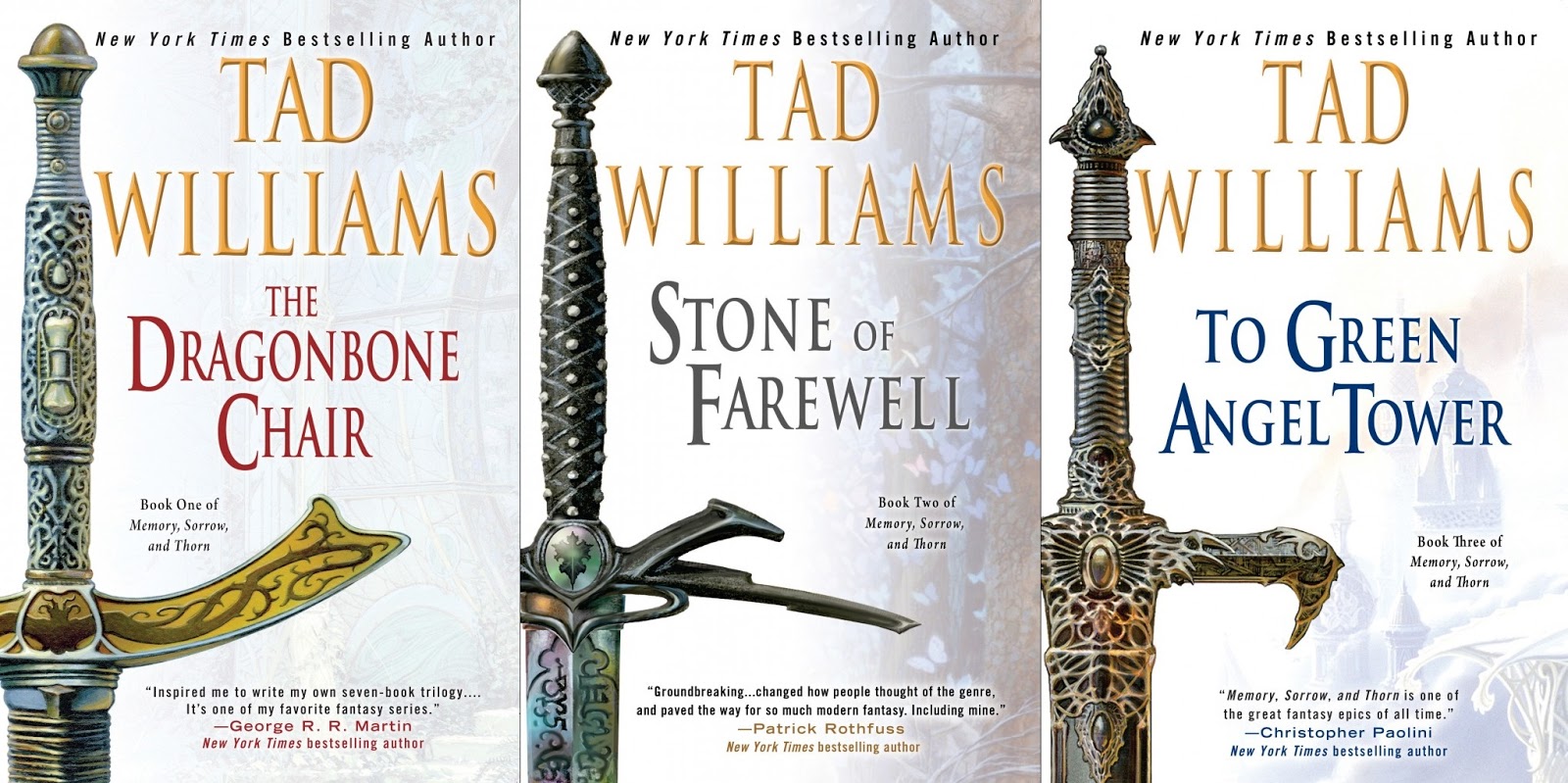
New US covers for MEMORY, SORROW AND THORN

Tad Williams's classic Memory, Sorrow and Thorn trilogy is being rejacketed for a new American trade paperback edition being launched later this year.


The new editions come ahead of the publication of two new novels set in the same world, the stand-alone (ish) The Heart of What Was Lost in January 2017 and then The Witchwood Crown, the opening volume of The Last King of Osten Ard, in April 2017.

The new cover art is also, like the original editions, by the supremely talented Michael Whelan. George R.R. Martin, Patrick Rothfuss and Christopher Paolini provide fresh cover blurbs as well.

Saturday, 23 April 2016

New STAR TREK series to film in Toronto this autumn

The new Star Trek TV series will start shooting in September in Toronto.

The Excelsior-class USS Enterprise NCC-1701-B, previously seen in Star Trek: Generations, will likely be around during the timeframe of the new series, but will not be the setting.

Relatively little has been confirmed about the new series, but rumours hint that it will be an anthology series which will jump between different eras and locations in Star Trek's history from season to season. The first season is rumoured to take place between the events of Star Trek VI: The Undiscovered Country and Star Trek: The Next Generation and will not involve a ship called Enterprise.

This is the first Star Trek TV series to shoot in Canada: all five previous live-action shows were shot in and around Los Angeles.

Casting has been underway for the last few months, so hopefully we'll start getting casting news soon.

Friday, 22 April 2016

GAME OF THRONES showrunners confirm number of episodes left is still being discussed

David Benioff and D.B. Weiss have expanded on previous reports that Game of Thrones is fast approaching its endgame, with their preference being to end the series 13 episodes after the end of Season 6. Their previously-mooted suggestion was a seven-episode seventh season followed by a six-episode eighth season. However, in a new interview with the Hollywood Reporter, they have confirmed there is some flexibility.


They now say that the story could be concluded in 10 episodes - potentially a seventh season of ten episodes as normal - but may require as many as 15. In that case we may see both the seventh and eighth seasons shortened to spread them out more evenly (so maybe eight episodes in Season 7 and seven in Season 8). They're currently mapping out how the story ends - and most of the scripts for Season 7 should have been written by now given they start shooting in just a couple of months - so there should be a firm plan in place shortly.

This does explain why the show was not renewed for an eighth season, because if they do decide they can get the story done in just 10 more episodes, they won't need an eighth season. However, my gut feeling is that 10 episodes is just not enough to wrap the story up and there will be a shortened eighth season of some kind.


The Lost Reviews: Part 2 - Season 1, Episodes 4-7

Welcome to the second in a new project for the blog: a rewatch of the TV series Lost. Over the next few months I plan to watch all 121 episodes of the TV series which aired for six seasons from 2004 to 2010. This is very much a rewatch thread, with the show watched with knowledge of what is to come in later seasons. If you've never watched Lost before, you definitely do not want to read this blog series.

Without further ado, let us continue after the jump.

One of Lost's earliest moments of pure WTFery.


Thursday, 21 April 2016

GAME OF THRONES renewed for a seventh season, but not an eighth yet

HBO has renewed Game of Thrones for a seventh season, but - so far - not an eighth. HBO has been in discussions with Game of Thrones producers and showrunners David Benioff and D.B. Weiss about when to end the show and how many episodes are left.


Just a few days ago, Benioff and Weiss confirmed that after the sixth season (which starts airing in the USA on Sunday) of 10 episodes, they believe there are only 13 hours worth of story left to wrap up the saga. Their preferred plan is for a shortened seventh season of 7 episodes in 2017, followed by an eighth and final season of 6 episodes in 2018. This would also allow them to concentrate more budget and allow more writing and shooting time for each episode.

HBO's preference has been for more episodes, and discussions have been in place on how to best achieve that. However, fans have been vocal in suggesting that, if there are really only 13 episodes left, then it may be better for HBO to order a larger, longer single season of 13 episodes with a corresponding budget hike, perhaps dividing the seventh season into two parts airing four or six months apart. Alternatively HBO may order a single season of 13 episodes, but split in the manner Benioff and Weiss suggested for a "Season 7, Part 1" and "Season 7, Part 2", similar to what HBO has done in the past for The Sopranos and Oz. AMC also did something similar for the final seasons of both Mad Men and Breaking Bad.

Whichever solution HBO has come up with, or whether they're waiting until a few episodes of the new season have aired and seeing what the ratings are like before committing to a plan, we should find out soon.

Tuesday, 19 April 2016

THE BANNER SAGA 2 released today and why you should play it

The gods are all dead, leaving remnants of their glory scattered all over the world. Three great races - humans, varls (giant Vikings) and horseborn (centaurs) - have survived the downfall of religion only to face a long, grinding war against the dredge, a plague of metal horrors that have emerged from the uttermost north. After years of fighting the dredge and skirmishing with one another and within their own ranks, humanity and varlkind have united...just as the dredge pour out of the north in a horde of unstoppable thousands and the sun halts in the sky. The great cities of the north are destroyed and warriors of men and varl alike have to fleet to survive, guiding thousands of refugees to safety with them. Two great caravans, one on the west coast and one on the east, assemble and attempt to flee to safety.


It's a rich, compelling backdrop for a fantasy narrative, but this isn't a novel. Released in January 2014 on PC, The Banner Saga is a video game that borrows from many that come before it but assembles numerous tropes into something new, fresh and interesting. The strategy side of the game comes in the form of a survival game where you have to make some very tough choices: push your caravan on to the limits of their endurance to reach the next town more quickly, but risk being exhausted if the dredge attack? Do you peacefully negotiate with the ruler of the next town who is skeptical of the news of the dredge invasion, taking up valuable time, or seize his town's supplies for the good of the caravan? Like The Oregon Trail or Battlestar Galactica, balancing survival, prudence, caution and the need for morale-boosting military victories can be tricky and, if you make the wrong choice, the results can be catastrophic.

There's also a more personal element to these decisions. Both caravans are led by generals and heroes, along with a mixture of ambassadors, archers and other personalities. These heroes can take part in direct combat with the dredge, which plays out on an XCOM-style turn-based battlefield. There are some differences to the formula: there is no cover, since fighting is mostly done hand-to-hand, and combat requires breaking through an enemy's armour before inflicting actual damage on them. Your heroes level up, but you have to be careful as you use "renown" to level your characters, buy better gear and buy more supplies for your caravan. Don't concentrate on your heroes enough and you risk falling behind the tougher dredge in combat. Focus on them too much and you may not be able to feed your refugees.

There's also a striking imbalance between the two caravans: the one heading along the coast to the west is mostly a military force, comprised mainly of varls whose skills on the battlefield are immense. The one in the east is comprised mainly of humans, who are great for hit and run, fast attacks and have ranged archers, but can't go toe-to-toe with the tougher dredge as easily. The game alternates between the two caravans until they come together to defend one central location.

It's a rich, compelling game backed up by some excellently-written characters, such as reluctant archer-turned-leader Rook, the sneering human prince Ludin whose arrogance hides a genuinely brave warrior, and Hakon, a skilled and mighty varl warleader whose gruff confidence belies his uncertainties at being a leader. On the darker side of things are heroes who say the right things and do well on the battlefield, but whose ambitions and true nature are much darker. Treachery is never too far away in The Banner Saga. But this is also a remarkably beautiful game, with a striking, rich art style and an utterly fantastic soundtrack.

The game is the creation of Stoic, a studio of ex-BioWare writers and anyone who's familiar with the Mass Effect or Dragon Age series should be aware of their ability to force the player into a position where they have to make tough decisions. However, the two Banner Saga games are these guys with the EA-branded training gloves of BioWare firmly removed. Choices this time around are harsher, the consequences grimmer if things go wrong and there are times when there is no optimal solution, only the one that will save the largest number of people. Don't expect too much in the way of exposition, either: you are thrust into the midst of a desperate struggle for survival and the explanations for why and how things are happening will only emerge in quieter moments between battles.

The Banner Saga wasn't a perfect game, with some apparently random difficulty spikes in battles and a final engagement that could be almost unwinnable, but later patches solved these problems and The Banner Saga 2 has addressed these problems with more enemy and ally types and the introduction of a whole new race, the horseborn, who can provide formidable support on the battlefield.

The Banner Saga and The Banner Saga 2 are both available on Steam now. The Banner Saga is also available on Apple and Android mobile devices, as well as X-Box One and PlayStation 4. The Banner Saga 2 should also be making its ways to those devices in the future.