Thursday, 9 February 2017

TORMENT: TIDES OF NUMENERA story trailer released

inXile Studios have released the story trailer for their roleplaying game Torment: Tides of Numenera. This is the "spiritual successor" to the classic Black Isle CRPG Planescape: Torment, set instead in Monte Cook's Numenera roleplaying setting.


A billion years into the future, a man strives to escape death by transferring his consciousness from body to body. However, each time he leaves a body, a new consciousness is born within. At first he embraces these entities as his "children" but as time passes he becomes colder and more remote, more willing to cast off these offspring. Until he transfers to his last body, and a new being is born...you.

Colin McComb, who co-designed and developed both the Planescape roleplaying game and Planescape: Torment itself, is the project lead on the game. Chris Avellone (CRPG demigod and lead developer of Planescape: Torment back in the day) has contributed quests and characters to the game, as has fantasy novelist Patrick Rothfuss (The Name of the Wind).

Torment: Tides of Numenera will be released on 28 February.

Wednesday, 8 February 2017

RIP Richard Hatch

Richard Hatch, an actor and writer best-known for his work on the Battlestar Galactica franchise, has passed away at the age of 71 from complications related to pancreatic cancer.


Born in 1945 in Santa Monica, California, Richard Hatch began acting in the Los Angeles Repertory Theatre in the 1960s. He broke into television in 1970 with a regular role on the soap opera All My Children. He left after two years and became a reliable guest star, appearing in TV shows such as Cannon, The Waltons and Hawaii Five-O. In 1976 he gained some acclaim and notice for his season-long recurring role on The Streets of San Francisco.

In 1978 he played the role of Captain Apollo in Glen A. Larson's space opera Battlestar Galactica. He played the serious straight man to Dirk Benedict's more flamboyant Lt. Starbuck, setting up a strong leading man double act. Hatch identified with the character strongly, as well as the epic story Larson was trying to tell. He was bitterly disappointed when the show was cancelled despite very strong ratings and declined to return for the heavily-derided, low-budget spin-off Galactica 1980.

Hatched continued to appear as a recurring guest star throughout the 1980s on shows such as Dynasty, Santa Barbara and Fantasy Island. In the 1990s he turned his attention back to Battlestar Galactica. Glen A. Larson had struck the terrible Galactica 1980 from the canon and planned a comeback series which would feature Apollo, and thus Hatch, in a leading role (effectively replacing his character's father, Commander Adama, after the death of actor Lorne Greene in 1987). Hatch wrote or co-wrote seven Battlestar Galactica novels in support of this effort.

In 1999 Hatch financed a trailer called Battlestar Galactica: The Second Coming as a proof-of-concept for a revival of the show. Universal, who then held the rights, decided to reject both The Second Coming and a pitch by Larson focusing on the missing Battlestar Pegasus for a complete, fresh reboot project from Star Trek writer Ronald D. Moore. The rebooted Battlestar Galactica launched with a TV mini-series in 2003 before becoming an ongoing series lasting from 2004 to 2009.

Unlike co-star Dirk Benedict, who was critical of the show's diverse casting and the recasting of his role with a female actress (Katee Sackhoff, whom Benedict later admitted was good in the role and met her for a coffee and photo-op in, appropriately, Starbuck's), Hatch was more open-minded about the reboot. To his surprise, he was offered a role in the series in the recurring role of former terrorist-turned politician Tom Zarek. Relishing the character, who was multi-faceted and complex, Hatch committed to the role and appeared in all four seasons of the ongoing show. He was written out in the final season, but criticised some of his character's final decisions as being uncharacteristic and bizarre (a view echoed by many critics), a shame after the much more nuanced portrayal of the character in the first three seasons.

Subsequent to his final appearance on BSG in 2009, Hatch created a new space opera franchise called The Great War of Magellan, consisting of a roleplaying game and comic book. He also appeared in the Star Trek fan film Prelude to Axanar as a Klingon general and was due to reprise the role in the full-length follow-up before this was canned by CBS and Paramount's legal department.

Richard Hatch was notable for his strong involvement with fandom and winning fan support for attempting to resurrect the Battlestar Galactica franchise. Although his project failed, it certainly helped contribute to the momentum that led to the franchise's return in 2003. Hatch also gave an excellent, layered and nuanced performance as Tom Zarek, a role that challenged him much more than the straightforward hero Apollo of the original series, showing that he was a much more capable actor than perhaps some had first thought. He will certainly be missed.

Tuesday, 7 February 2017

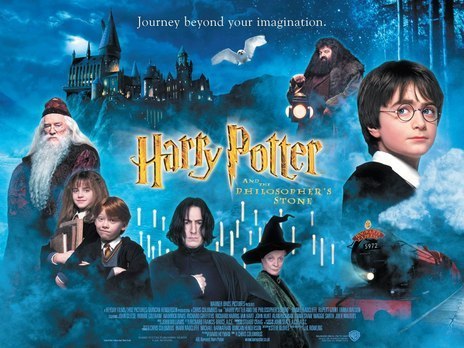
Harry Potter and the Philosopher's Stone

Twenty years ago, a children's book about a young boy fated to become a wizard was published. Along with its six sequels, it went on to sell half a billion copies and created one of the biggest film franchises in history. Reviewing it is only marginally less futile than reviewing oxygen, as you'll have likely watched this film years ago or already decided to never watch it at all. But the biggest fantasy franchise of the last generation is certainly something that should be up for review and criticism.


Harry Potter and the Philosopher's Stone (Sorcerer's, if you're of an American persuasion) was released in 2001, adapting the first book in the series. That first novel in the Harry Potter series is also the shortest, meaning that the film had to make very little alterations or changes to fit the entire story into one movie. This is something in its favour over the later films: as the novels got longer and longer, the films had to make more and more substantial cuts and alterations to maintain a coherent story on screen.

This first movie follows the book closely. We're introduced to Harry Potter, an 11-year-old potential wizard raised by his non-magical (or "Muggle") aunt and uncle after the murder of his parents at the hands of the evil wizard Voldemort during a magical war. Potter survived, somehow deflecting the spell that Voldemort tried to use to kill him back at its wielder, leaving a strange scar on his head. Voldemort hasn't been seen since and is presumed dead. Potter is rescued from the negligent care of his aunt and uncle to attend Hogwarts School of Witchcraft and Wizardry, where the reputation of his parents (and his own involvement in Voldemort's ultimate defeat) precedes him. At the school Harry makes friends with classmates Hermione and Ron and ultimately gets drawn into a disturbing series of events culminating in a showdown with a powerful magical foe.

The structure of the story is an extremely strong one. In the original novel Rowling set up Harry's world with skill and economy, establishing backstory, motivations and carrying out a fair bit of worldbuilding whilst also getting across a fairly intricate story, all in a very limited page count. The film does the same, with scriptwriter Steve Kloves and director Chris Columbus letting the story unfold with verve and economy. Columbus, a rather hit-and-miss director in his other work, knows when to let the story breathe and the camera linger on a magical moment and when he needs to get on with business and maybe cut some minor ancillary material from the book to accomplish that. Major set pieces from the book, like the Quidditch match, are fast-paced and exciting and the encounters with the shadowy figure in the forest and the final confrontation are effectively creepy. The highlight might be the life-sized wizard chess match, which is surprisingly brutal.

In terms of atmosphere and tone, Kloves and Columbus do mostly good work. In terms of acting and dialogue, the film is a bit less successful. Exposition is the order of the day and much of the dialogue, especially in the first half of the movie, tends to the clunky. The movie breaks the "show, don't tell" rule a few times, although it is able to deploy flashbacks to spice things up a bit. The adult actors also seem to start off struggling with their dry dialogue, with the notable exception of Alan Rickman who just commits 100% from his first appearance on screen, before getting to grips more with it later on.

Where the film lives and dies is on the performance of the three leads. Daniel Radcliffe, Emma Watson and Rupert Grint were all very young and inexperienced, and certainly give rough and unpolished performances. But they also have a huge amount of energy for their roles, making up in raw enthusiasm what they lack in experience at this stage.

The film is sixteen years old, so the CGI and effects have definitely dated, in some cases (particularly the troll, centaur and some of the actor replacement in the Quidditch match) quite badly. But for the most part it holds up well and the sets and overall production value remain impressive.

The biggest success of the film is that the film-makers recognise that the novels work because Rowling combined childhood whimsy with some very well-constructed worldbuilding and brief-but-effective moments of terror and action. This is a children's story, but one with some character and story depth to it.

Harry Potter and the Philosopher's Stone (***½) is at times a rough movie with clunky dialogue and stilted performances, not to mention some cliched British story tropes (like the elaborate private boarding school). But once it relaxes and gets underway, the story becomes more enjoyable and the performances more nuanced. A long way from being a perfect movie, it's certainly an entertaining one that opens the series very well. The movie is available now in the UK (DVD, Blu-Ray) and USA (DVD, Blu-Ray) as part of the Complete Harry Potter Movie Collection.

Cities of Fantasy on Patreon: Sigil

My second post for Patreon backers has gone live.


This is the first part of the Cities of Fantasy project and explores the city of Sigil, the bizarre and wonderful (if dangerous) city that lies at the very heart of the multiverse, originating from the Planescape setting for Dungeons & Dragons.

This will be exclusive on Patreon for one month and will then be reposted in full here on 7 March.


This article drew on research from my earlier Worlds of D&D fantasy series from 2009, particularly the article on Planescape that can be found here.

Cover art for THE WITCHWOOD CROWN unveiled

Tad Williams has revealed the American cover art for The Witchwood Crown, the upcoming first volume in his Memory, Sorrow and Thorn sequel series, The Last King of Osten Ard.


As with the original trilogy, The Witchwood Crown's cover art is by genre star Michael Whelan. It depicts Hjeldin's Tower in the Hayholt, the great castle around so much of Memory, Sorrow and Thorn revolved.

The new book picks up thirty years after the events of To Green Angel Tower and the recent bridging novel, The Heart of What Was Lost. The novel will be released on 27 June.

Monday, 6 February 2017

STRANGER THINGS Season 2 teaser

To celebrate the arcane American ritual of the Superb Owl, Netflix have released the first teaser trailer for the second season of Stranger Things. Actually, it's a bit longer than a teaser but certainly isn't a full trailer.


The trailer does confirm that the show will not premiere until around Halloween, so there's still a good seven months to wait until we see the gang (including Eleven, apparently) back in action.

New DEUS EX games "on hold" after "disappointing" sales

Square Enix have put the Deus Ex video game series on indefinite hold following disappointing sales of the latest game in the series, Mankind Divided.


The official reason is that Square has signed a massive, multi-million dollar deal with Marvel to develop a series of new games based on their superheroes, with a major new Avengers game being the first out of the gate. Square has moved the Crystal Dynamics team (responsible for the latest Tomb Raider games) over to The Avengers and reassigned Eidos Montreal from the next Deus Ex game to pick up the next Tomb Raider title, provisionally entitled Shadows of the Tomb Raider, instead.

This move has attracted controversy. Unlike the previous Deus Ex game, Human Revolution, Mankind Divided was supposed to be the opening title in either a two or three-game series that would have completed the story of Adam Jensen and the rise of the world seen in the original Deus Ex games. Although the primary storyline of Mankind Divided is resolved in that game, there some dangling plot threads that were due to be picked up in the next game. Indeed, Eidos Montreal were several months into the development of the next game when Mankind Divided was released, suggesting the millions of dollars of work may have now been abandoned already.

However, Eidos Montreal does have two teams; their second team was working on the Thief reboot whilst the first was working on Mankind Divided. The possibility that one of these teams could continue working on Mankind Divided II has unfortunately been shot down: the second team is now working on a Guardians of the Galaxy game, part of the same Marvel deal.

Given the titanic money involved in the Marvel deal and the disappointing sales of Mankind Divided, it seems unlikely that we are going to see a new Deus Ex game in the near future. This is disappointing, but nothing new to fans of the franchise, which previously had an eight-year hiatus between Invisible War and Human Revolution. The game universe and fiction is compelling enough that, even if Adam Jensen's story is over, we will likely see it return at some distant point in the future.

It's also unclear if Mankind Divided's sales were disappointing, in that Eidos and Square lost money, or didn't meet unrealistic sales expectations. Apparently Square felt that the performance of the 2013 Tomb Raider reboot game was disappointing despite selling over a million copies in its first months on sale, which by any sane metric is actually very impressive. Mankind Divided's sales have been described as a bit less than Human Revolution's in a comparable time period, but harder figures have not been released.

In the meantime, dystopian SF RPG fans are holding out hope for CD Projekt Red's epic Cyberpunk 2077, although that is not expected for a couple more years.

Thursday, 2 February 2017

THE EXPANSE Season 2 delayed outside the USA

Season 2 of The Expanse began airing yesterday in the United States on SyFy, to a strong critical reception. Fans outside the US were confidently expecting to watch the show today, as Netflix have picked up the rights outside the United States and their usual release schedule is one day after US transmission. However, this is not the case with The Expanse. Some sources are reporting that SyFy actually has an exclusivity period and the show will not be released on Netflix until Season 2 finishes airing in the States in May.


This is a very curious move. International sales are increasingly important to American shows, especially expensive ones (The Expanse is SyFy's highest-budgeted show of all time), and pre-selling a show's international rights to Netflix or Amazon for release within a day or two of the American transmission is a great way of ensuring a global audience is built up, fees are paid and piracy is minimised. Preventing the show from reaching an international audience for twelve weeks seems self-defeating, since this cannot but encourage piracy in the short term for the most devoted fans.

A spotty and poor international release scheme for The Expanse's first season (which was not available in the UK until the end of last year) was a big mistake and own goal for SyFy. This is not quite as bad a mistake, but it's a curious and backwards move which, once again, seems almost deliberately designed to stop the show gaining the profile and momentum it really needs.

Wednesday, 1 February 2017

ARRIVAL and BLADE RUNNER 2049 director signs on for new DUNE movie

Denis Villeneuve, the director of Arrival and this year's Blade Runner 2049, has signed on to direct the new Dune movie for Legendary Pictures.


The news hasn't been officially confirmed through Villenueve or his representatives, but Brian Herbert, son of the late Frank Herbert and a member of the rights-owning estate, confirmed the news via Twitter.

Legendary purchased both TV and film rights to the Dune novels after Paramount let them lapse last year. It sounds like the plan is to lead with a film or multi-film adaptation of at least Dune and perhaps its immediate sequels (Dune Messiah and Children of Dune), and use a TV show to flesh out the larger universe, which includes four later books by Frank Herbert set thousands of years after the events of the original trilogy, and a lengthy series of prequels and side-novels written by Brian Herbert with Kevin J. Anderson. These later novels have been critically slated and many Dune fans do not regard them as canon.

Dune was previously adapted as a movie in 1984 by David Lynch, which was praised for its art design, excellent casting, music and general atmosphere, but criticised for its confusing storyline. There was also a SyFy mini-series in 2000 which was better-received for its clearer storytelling but suffered from poor production values (including, ludicrously, having to film the desert scenes on a soundstage). There was a sequel mini-series in 2003 which adapted Dune Messiah and Children of Dune.

Villeneuve is an excellent director, but I must admit that film is not a natural home for Dune, which is far too big a novel to be adapted by itself, let alone its five sequels. I'd much rather have seen a big-budget HBO series. However, it may be possible to adapt Dune more effectively as two films shot back-to-back, and I hope this is the path Legendary takes.

I suspect we won't see the film until late 2019 or early 2020 at the earliest.

STAR TREK: DISCOVERY begins production

After more delays and personnel changes than you can shake a stick at, Star Trek: Discovery has finally entered production in Toronto. To celebrate, CBS has aired the following teaser:


There's a hint of the new uniforms and starship designs, including the USS Discovery itself (the big triangular ship) and what is probably the USS Shenzhou (likely the ship resembling the NX-01 Enterprise).

The first season of Star Trek: Discovery consists of 13 episodes, each being shot on a budget of around $6 million. Sonequa Martin-Green, Anthony Rapp and Doug Jones star, with James Frain and Michelle Yeoh in recurring roles. The first episode will air on CBS in the United States, with the rest of the season airing on CBS All Access. Netflix will air the show internationally.

There is no confirmed airdate at the moment, with the show no longer being tied to its previous May launch date. Most likely the show will now debut in the summer or autumn.