Creative Assembly and Sega have lifted the lid on their new survival horror game, Alien: Isolation 2.
The game is, as subtly hinted by the title, the sequel to Alien: Isolation, released in 2014. That game saw the player take on the role of Amanda Ripley, the daughter of the movies' Ellen Ripley, as she is summoned to the Sevastopol space station only to find it infested with the traditional xenomorphs.
The sequel takes place planetside, at the Kurasaki Colony. A crashed ship, possibly related to the events of the original game, has unleashed at least one xenomorph upon the facility. The protagonist - Amanda's return has not yet been confirmed - takes on the xeno in the new setting. I'm assuming, like the first game, this one will de-emphasise combat in favour of stealth, horror and survival mechanics. The trailer does hint at the return of the Sevastopol androids, who provided a far more beatable enemy to go alongside the standard acid-and-claw threat of the xeno.
Alien: Isolation 2 does not yet have a release date, but based on the pre-alpha state of the footage, 2028 might be a more realistic guess than 2027.
Creative Assembly have held a showcase to celebrate twenty-five years of their Total War video game franchise, as well as confirming that two new games are in development.
Alongside new updates and heroes and villains for Total War: Warhammer III, the headline news was the confirmation that Total War: Medieval III is in early development. Medieval: Total War was released in 2002 and Medieval II: Total War in 2006, so this marks the first new game in the sub-series for well over two decades by the time it is released.
Like the previous two games, Medieval III will start in the early medieval period and unfold across centuries, with players taking their kingdom to glory or ruin. The game will apparently focus more on the impact of changing the course of history, with historical events occurring early or later depending on your actions, such as the Reformation or the unification of Germany. This may mark a swing towards the alternate histories created by player actions in games like Crusader Kings III.
The game is "very early" in development, which by Creative Assembly standards might mean two years from release or four or five, so when the game will arrive is unclear. CA have suggested they want player ideas and feedback to be incorporated from much earlier on than is normal in the process, though whether this hints at some kind of eventual Early Access model is unclear.
The game is also being developed on WarCore, a total revamp and rebuild of the existing Warscape engine, which has powered all Total War games since 2009's Empire: Total War. WarCore will allow for the use of vehicles on the battlefield and Havok physics for dynamic building destruction.
Creative Assembly also confirmed an additional game is in development and this will be unveiled with a full trailer at the Game Awards on 11 December (so a week today), where people are also hoping to hear news about Half-Life 3 and other rumoured titles. This additional game is believed, based on leaks, to be either fantasy or science fiction in nature and will represent a radical shift from any game that CA has made previously. There is speculation, fuelled by alleged insider information, that this game will be based on the Warhammer 40,000 or Star Wars IPs, though a 40,000 game would have to compete with next year's Dawn of War IV. In a documentary a few years ago, CA confirmed they had considered strategy games set in the Middle-earth, Witcher and Game of Thrones universes, but those titles are not being seriously rumoured at this time.
In the last few days British video game developers Creative Assembly have announced their latest Total War video game, Total War: Pharaoh. The Total War series is now one of the biggest-selling strategy video game series of all time, shifting more than 40 million copies of sixteen games and numerous expansions since the turn of the century. Only Sid Meier’s Civilization titles have been more successful among turn-based strategy games, and its lead is now very narrow. A lot of people have recently been discussing the franchise, its history and future, but what if you have no idea what they are going on about? Time for a Franchise Familiariser course.
Total War is a video game series which sets out to recreate some of the most notable wars and military campaigns in human history, as well as, more recently, conflicts from the Warhammer fantasy setting. Each Total War game stands alone as its own, self-contained title, although the three Warhammer games can be combined into one larger game.
The earliest setting in the games is the Peloponnesian War of Ancient Greece in 432 BC. The latest setting is the Bakumatsu period of Japanese history, ending around 1868 AD.
Each Total War game works as both a grand strategy and a small-scale tactics game. Every game has a large, turn-based campaign map on which you can assemble armies, construct buildings and engage in diplomacy, technological research and espionage. When armies meet, the game switches to a real-time 3D battlefield where you take direct control of your army and direct the course of battle using realistic and – somewhat – historically accurate tactics.
The Series
The Total War series consists of sixteen stand-alone games, nine expansions and a large number of small expansions and unit packs, sold as downloadable content (DLC). There are also a significant number of fan-made “mods” for the games, doing everything from tweaking unit stats and artwork to adding entire new maps and campaigns.
The series to date consists of the following titles (along with their approximate historical settings and the major expansion packs for each game indented, although not every optional bit of DLC is listed for clarity):
Shogun: Total War (2000) – Sengoku Japan, 1467-1603
Shogun: Total War – Mongol Invasion(2001) – Mongol invasion of Japan, 1274-81
Medieval: Total War(2002) – Medieval Europe, 1087-1453
Medieval: Total War – Viking Invasion(2003) – Viking invasions of Britain, 793-1066
Rome: Total War (2004) – Roman Europe, 270 BC-14 AD
Rome: Total War – Barbarian Invasion(2005) – Roman Europe, 363-476
Rome: Total War – Alexander(2006) – Greece, Persia, India, 336-323 BC
Medieval II: Total War (2006) – Medieval Europe, 1080-1530
Medieval II: Total War – Kingdoms (2007) – various, 1174-1520
Empire: Total War (2009) – Europe, North America, India, 1700-1800
Empire: Total War - Warpath Campaign(2009), North America, 1783-1825
Napoleon: Total War (2010) – Europe, 1780-1820
Napoleon: Total War - The Peninsular War (2010) - Portugal & Spain, 1807-14
Total War: Shogun II (2011) – Sengoku Japan, 1467-1573
Total War: Shogun II - Rise of the Samurai (2012), Genpei War, 1180-85
Total War: Shogun II – Fall of the Samurai(2012) – Bakumatsu Japan, 1853-67
Total War: Rome II (2013) – Roman Europe, 272 BC-28 AD
Total War: Rome II- Caesar in Gaul (2013) - Roman invasion of Gaul, 58-50 BC
Total War: Rome II - Hannibal at the Gates (2014) - Second Punic War, 218-201 BC
Total War: Rome II - Imperator Augustus (2014) - War of the Second Triumvirate, 32-30 BC
Total War: Rome II - Wrath of Sparta (2014) - The Peloponnesian War, 431-404 BC
Total War: Rome II - Empire Divided (2017) - The Crisis of the 3rd Century, 270-284 AD
Total War: Rome II - Rise of the Republic(2018) - 399-272 BC
Total War: Attila(2015) – Roman Europe, 395-453
Total War: Attila - The Last Roman (2015) - Gothic War, 535-551
Total War: Attila - Age of Charlemagne (2015) - Charlemagne's War, 768-814
Total War: Warhammer(2016) – The Old World
Total War: Warhammer II(2017) – The New World
Thrones of Britannia: A Total War Saga (2018) - The Viking Invasion of Britain, 878 AD
Three Kingdoms: Total War(2019) - The Three Kingdoms, China, 190-278
Yellow Turban Rebellion (2019) - The Three Kingdoms, China, 190-278
Eight Princes (2019) - War of the Eight Princes, China, 291-306
Mandate of Heaven (2019) - The Yellow Turban Rebellion, 182-278
A World Betrayed (2020) - China, 194-278
The Furious Wild (2020) - The Three Kingdoms, China, 190-278
Fates Divided (2021) - Battle of Guandu, 200
Troy: A Total War Saga(2020) - The Trojan War, 1194-1184 BC
Total War: Warhammer III (2022)
Total War: Pharaoh (2023) - The Great Bronze Age Collapse, 12th Century BC
There are also a series of spin-off games, either action titles for console or highly-simplified games for mobile devices. These are: Spartan: Total Warrior (2005), Viking: Battle for Asgard (2008), Total War Battles: Shogun (2012), Total War: Arena (2013) and Total War Battles: Kingdom (2015). Aside from borrowing the franchise title, these games are not related to the main series at all.
Franchise History
The Creative Assembly was founded in 1987 in Horsham, West Sussex, UK. The company originally worked on porting games from the Amiga and Spectrum formats to the PC, as well as developing numerous games with Electronic Arts under the EA Sports brand. The company gained a great deal of financial success from the unglamorous but profitable job of porting games like the FIFA series to PC.
In 1999 the company began work on its first original project. The first proposal had been for a hack-and-slash action game set in ancient China. This shifted after the team began playing a samurai-based board game, which quickly made them rethink the game with a Japanese title with a more strategic focus. The small scale of the game, with several very similar sides, shared units and a relatively small map based on Japan, allowed the game to be developed quickly. The breakthrough moment in development came when a designer decided to move the battle camera from a fixed overhead perspective to a 3D viewpoint and found this worked very well and improved immersion. However, it did cause issues with the 2D units moving across a 3D environment. It was ultimately decided that this was a worthwhile price to pay for the improvements to gameplay.
Shogun: Total War
Released on 13 June 2000, Shogun: Total War took much of the gaming press by surprise. Coming from a publisher with no strategy track record, the quality and depth of the title was remarkable. The setting is Sengoku Japan, the lengthy period running from roughly 1467 to 1603 when Japan was almost constantly at war with rival clans battling for the title of Shogun.
The strategic map was presented as a tabletop planning session, with units presented as beautiful wooden pieces being pushed around like a general planning his next move. The map is divided into provinces and units are moved from province to province one square at a time (a key difference to later games in the series). It is also possible to undertake naval operations (by putting ships in to sea squares to form an effective bridge) and send agents including ninja assassins to kill enemy generals rather than having to face them on the battlefield.
Many of these ideas would make their way into later versions of the games in more sophisticated forms, but it’s surprising how much of the core Total War mechanics and feel is already in place with this first game.
The game was released to critical acclaim, catching the eye of reviewers in a period noted for its numerous, excellent strategy games (Homeworld, Ground Control and Hostile Waters would all come out within a year of Shogun’s release). It also sold well, despite some early fears that the non-European setting would put some buyers off.
A year later the game was given an expansion, The Mongol Invasion, which chronicled the Mongol Empire’s two ill-fated attempts to invade Japan between 1274 and 1281. Whilst neither invasion got very far in real life, the expansion posits a “What if?” scenario and asks what would have happened if Kublai Khan’s forces had successfully landed.
Medieval: Total War
Given Shogun’s success, Creative Assembly began work immediately on two follow-ups: one using the same engine and an all-new and far more powerful engine that would ultimately take four years to bring to fruition. In the meantime, Medieval: Total War was announced and got people very excited.
Shogun: Total War was noted for its tight focus but Medieval was epic and sprawling. The entire continent of Europe, the north coast of Africa and parts of the Middle East were now on the map and instead of the variations on a theme of Shogun, the game now had over a dozen very different factions. Spanning the period 1087 to 1453, the game featured countries such as England, France, the Holy Roman Empire, Castile, Aragon and the Byzantine Empire fighting for control of Europe, all the while trying to keep the Pope happy. The game played very similarly to Shogun, but the theme had a wider appeal. Medieval: Total War was released in 2002 to rapturous reception and outsold its predecessor significantly.
A year later, once again, the game was expanded. The Viking Invasion added a new map to the game, an expanded one of the British Isles, and Scandinavia, and focused on the Viking raids on the British coast between 793 and 1066, following up by settlements and invasions. The expansion was a big success and once again showed that Total War could be both a sprawling, epic title and a very focused one with equally strong results.
Rome: Total War
After two games built on the same, slightly archaic engine, Creative Assembly decided to change things up. Rome: Total War was released in 2004 and saw the biggest shake-up in the series to date. The battlefield maps were now full, proper 3D environments with proper 3D units: each soldier in each legion was a full, detailed 3D figure: the game used some exceptional scaling technology to make it possible to get thousands of such figures on screen at once without destroying players’ computers.
More striking was the campaign map. Formerly a 2D tabletop image divided into provinces, it was now a 3D environment in its own right. Armies now have to march across territory rather than just hopping from province to province and where your armies meet on the map determines the terrain of the battlefield. So whilst the previous two games had only one battle map per province and town, Rome has thousands of possible maps to fight on.
The game’s strategic layer now had a full overhaul. Although still straightforward, it had a more complex trade model under the hood and a greater focus on diplomacy and things to do in peacetime. The game also had a nice endgame situation where your faction, if it became too powerful, would be declared traitors by a fearful senate and attacked in a brutal Roman civil war. The game also allowed you to play other factions, such as an ahistorical version of Egypt, one of several Greek factions or a “barbarian” faction such as the Britons.
The game was also given a fresh UI, a welcoming tutorial mode and a lot of advice so newbies, put off by the game’s perceived complexity in the past, could now get stuck in with little problem.
Rome: Total War was the best-reviewed game of the series to date and outsold its predecessors significantly, and managed to do well despite coming out just a few weeks ahead of one of the biggest behemoths in PC gaming history, Half-Life 2.
As usual, the game was joined by expansions. In 2005 Barbarian Invasion is set at the end of the Roman Empire and sees the player controlling either the faltering Western or strong Eastern Roman Empire, or one of the invading migratory tribes. The expansion was noted for its extreme difficulty compared to the base game. More importantly, Barbarian Invasion fixed some niggling AI and control problems the base game had shipped with.
Released in 2006, Alexander was a mini-campaign focused on the adventures of Alexander the Great. A very tightly focused campaign, given a dramatic voiceover by actor Brian Blessed, the expansion required the player to use Alexander’s actual tactics to win enormously lop-sided battles, with a few hundred elite Macedonian and Greek soldiers attacked by thousands of Persians or Indians. The campaign was an experiment by Creative Assembly in creating digital-only content for one of their titles and charging only a modest amount for it, and it was a success.
Rome: Total War was also noted for shipping with completely open and modifiable game files, allowing fans to adjust unit stats, replace 3D models or even completely replace the campaign map, leading to a popular, sprawling and inventive modding scene.
Rome later became the first game in the series to be ported to smartphones (in 2018) and then remastered fully for PC (in 2021), the latter released to acclaim as Total War: Rome Remastered.
Medieval II: Total War
Released in 2006, Medieval II did pretty much what the title suggested: it updated the Medieval: Total War paradigm into the Rome engine, allowing for a much more visually spectacular game.
The Creative Assembly pulled out all the stops for this title, increasing the graphical fidelity of the models, giving players more stuff to do on the campaign map and adding gunpowder and cannons to the game. It also made the 3D maps more interactive and more complex, with castles and cities now sprawling over hills with multiple layers of fortifications. A late-game development also allowed players to send ships to the New World and land on the coasts of North and South America for the first time in the series.
Medieval II was easily the biggest and most visually spectacular game on the market when it shipped and it was highly praised for this. It was also somewhat bugged when it shipped, with the game’s AI often stymied by sieges and unexpected tactics. These problems were eventually fixed and Medieval II is often, even now, cited as the best game in the series for its mix of visual splendour, tactical complexity and its excellent modding scene.
Medieval II was the last game in the series with open source files, allowing players to modify the game any way they wanted. Given the greater variety of troop types and superior graphics, the Rome modding scene moved almost entirely over to Medieval II, and soon “total conversion” mods were appearing for franchises including A Song of Ice and Fire (aka Game of Thrones), Lord of the Rings, Warhammer and even Zelda. It’s likely that fears over copyright claims led CA to dropping the open modding in later games (which only permit modest tweaks to unit stats).
Medieval II was expanded by Kingdoms in 2007, a major expansion which was divided into four sub-campaigns. One fleshed out the New World, featuring the player establishing colonies in the Americas and fighting off hostile natives and rival colonial powers. Another focused on the Crusades and the battle for control of the Holy Land. Another focused on Eastern Europe and the battle for control of the region by the Teutonic Knights. The final campaign focused on the British Isles in the 13th Century.
Medieval II became the second game in the series to get a smartphone port, released in 2022, with a possible PC remaster to follow.
Empire: Total War
For the next game in the series, Creative Assembly decided to go big. The success of the gunpowder and cannon units in Medieval II and Kingdoms had encouraged them to move the time period further towards the present. They also accepted the frequent player complaints that having naval battles being auto-resolved was dull. Finally, they felt that players had outgrowing the map of Europe they’d used for three games in a row and wanted something bigger and more expansive.
Empire: Total War was released in 2009, after the biggest delay in the series to date, and featured a new engine, the “Warscape Engine” (which has powered all Total War games since). The scale of the game was jaw-dropping. Spanning the 18th Century, the game had three campaign maps linked together, allowing players to sail from North America to the far east of India if they wished, as well as fighting more focused, smaller campaigns in North America (including the War of Independence). It was the first (and, to date, only) game in the series to focus on North America and to feature the United States as a playable faction.
The battle maps were more impressive than ever, with even more detailed figures and changes to accommodate the greater user of rifles and cannon. The strategy map featured a more complex economic and political model, to reflect the more tangled web of family and diplomatic ties in this period, and, most striking, naval battles were now present, featuring massive galleons destroying one another with broadsides.
It was all very impressive, with a scale that was incredible, but there was one slight problem: it didn’t work. Or at least, it didn’t work very well. The game shipped with a large number of bugs, AI problems and technical issues. CA had normally been quick to fix the immediate problems with patches and the bigger issues with the expansion, but with Empire for some reason the problems were more persistent and weren’t cleaned up for some considerable time.
More frustrating for players, the game was not moddable in the same way previous titles were, and “total conversion” mods like the popular Middle-earth game, Third Age: Total War, were simply impossible to create in the new engine.
A digital-only expansion, The Warpath Campaign, was released, focusing on the struggles between the American colonists and the Native American tribes, but that was it. No big expansion, which traditionally would fix the game’s bigger technical problems, was released, surprising and frustrating many players.
Napoleon: Total War
Napoleon: Total War (released in 2010) started life as Empire’s big expansion pack, but the scale of the game soon led CA to turn it into a (more expensive) stand-alone title. The game focuses on the Napoleonic Wars, with the player taking on the role of either Napoleon or one of his many enemies and fighting for control of the continent. The vast scope of Empire was reduced to just Europe (with sub-campaigns focusing on the Italian and Egyptian theatres) and the game was applauded for bringing back focus and a more constrained scope to the franchise. The game also had its own expansion, The Peninsular War, focusing on the military campaign of the Duke of Wellington across Portugal and Spain.
Napoleon was well-received and free of the technical issues that had plagued Empire but also criticised by fans for not being a cheaper expansion to the base game, and also for not porting its bug fixes and technical stability over to the older game.
Total War: Shogun II & Fall of the Samurai
Released in 2011, Total War: Shogun II (the titles were now reversed so all the games in the series would be listed next to one another on online services like Steam) was seen by some as a soft reboot of the series, despite having the same engine as Empire and Napoleon. Returning to the setting of the original Shogun, Shogun II has a very small, tight and focused campaign map and focuses on presentation, with beautiful period Japanese artwork informing the game’s interface and animated sequences. The focus this time was on interesting battles, with the AI able to far better-handle the more limited avenues for advancing across Japan compared to wide-open Europe.
In this regard, Shogun II was successful and won back some fans to the series who’d been concerned by the situation with Empire and Napoleon. The game’s expansions were also well-received, the digital-only Rise of the Samurai depicting the emergence of the samurai faction in the years prior to the outbreak of war and Fall of the Samurai depicting the Bakumatsu Period of the mid-19th Century, when Japan was forced to modernise at a rate that appalled traditionalists. This expansion, which is the most recently-set Total War game, is also the first to feature automatic weapons such as gatling guns and led to speculation that CA was preparing to move into more advanced times, with the next game focusing on either the American Civil War or even World War I.
Total War: Rome II
As it turned out, CA had other plans. Rome: Total War had arguably been the most popular Total War game released to date and CA decided to return to its setting with their new engine to create an even bigger and more enthralling game. There was a much greater focus on historical realism than the original Rome and the game was going to have a complex strategy mode which required the organisation of provinces into regions, with each region granting specific bonuses and units.
The result was an unmitigated disaster. Released in 2013, Rome II was released in a heavily bugged state, with major graphical problems and near-non-existent AI. The technical problems were deeply embarrassing, forcing CA to release no less than seventeen major patches to try to desperately fix the problems (with only moderate success). The game was also fiercely criticised for its stupendously enormous map, which meant it took half a dozen turns just to walk up the coast of Italy, and the resulting slow pace of gameplay.
Rumours spoke of a rift between CA and Sega (who had published every game in the series since Rome: Total War’s expansion), who had forced CA to release the game before it was ready. This was fiercely denied. CA did swing into action, eventually releasing an entirely new version of the game complete with a new, elaborate campaign based on the War of the Second Triumvirate (the civil war for control of the nascent Empire following Caesar’s death). The “Emperor Edition” fixed most of the technical and AI issues and was given free to every owner of Rome II, but CA’s reputation was badly damaged. Could the series survive its worst launch to date?
Total War: Attila
As it turns out, yes. Released in early 2015, Attila had started life as a Barbarian Invasion-style expansion for Rome II but had grown substantially in the planning into its own title. Unlike Napoleon, which never quite escaped its “overblown expansion pack” feel, Attila easily did so. It was enormous, with an immense scope which was increased further by its own expansion, Age of Charlemagne, which meant the game could now depict the entire Dark Ages period of European history.
The game was critically acclaimed on release. It was free of the problems that had blighted Rome II and was inventive and impressive. Total War had gotten its mojo back.
Total War: Warhammer, Warhammer II & Warhammer III
Since the beginning of the franchise, fans had suggested that the game’s engine would be a great fit for not just historical battles, but also epic fantasy ones. The mods for Rome and Medieval II had showed the potential of this, particularly the spectacular and popular Third Age: Total War mod which provided a strategic map of Middle-earth and recast the factions as Mordor, Gondor, Rohan, the elves of Lorien etc, all fighting the War of the Ring.
Sega, which had bought CA in 2005, had also recently acquired the rights to the Warhammer fantasy world from Games Workshop. They suggested that CA shift gears and make a game based on the Warhammer world for its next title. CA were keen to do something fresh that would completely invigorate the franchise, and relished the challenges that would come from introducing elements such as flying units and magic to the series. However, they were also concerned about losing fans who were not interested in fantasy games. When Total War: Warhammer was announced, they made it clear that the historical games were going to continue as well, with Warhammer as a side-project, albeit an ambitious and lengthy one.
The result was highly successful. Released in 2016, Total War: Warhammer (alas, they were unable to call it Total Warhammer) was the fastest-selling game in the series and brought in a whole load of fantasy fans who had never sampled the series before. The traditional Total War rules and structure was tweaked to better fit the setting and the four main races (plus the numerous other ones introduced in DLC) gave the series its most diverse roster and feel to date. Some fans complained about the focus on “hero” units, but there was little doubt that the game had reinvigorated the series.
More was to come. In 2017 Total War: Warhammer II was released, expanding the story to incorporate the western continents of the Warhammer world. An optional mode, Mortal Empires, was also released which combined the Warhammer and Warhammer II maps into one massive campaign map, the largest ever officially supported by Creative Assembly. The game had even better reviews than its predecessor, and likewise sold well on release.
After a fairly hefty wait, Total Warhammer III was finally released in 2022, completing the trilogy. A further optional mode, Immortal Empires, combined all three games into one mega-map covering the entire globe of the Old World, making easily the largest game in the Total War series to date.
Total War: Three Kingdoms
Although the Total Warhammer trilogy had brought the series to a massive new audience - lifetime sales of the series would double in the seven years after Warhammer's release, compared to the sixteen years prior - Creative Assembly were keen to assure fans that the historical games would continue.
In 2019 they released Total War: Three Kingdoms, based on the Three Kingdoms era of Chinese history. The new game was marketed heavily in China, where the series had relatively little traction beforehand, and picked up huge sales as a result. However, traditional fans of the series were concerned about the introduction of "hero" units into a historical title, with some complaining of "fantasy content" creeping into what should have been a historical-only title. Despite these concerns, the game sold well and generated a significant amount of minor expansions and DLC.
Total War Sagas: Thrones of Britannia & Troy
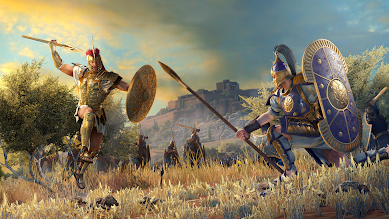
Due to the critical acclaim given to some of the shorter, focused games in the series, CA decided to develop a spin-off series - Total War Saga - which would feature much more focused conflicts. This resulted in Thrones of Britannia, based on the conflict between the native British kingdoms and the invading Danes in the 9th and 10th centuries, and Troy, based on the Trojan War.
Both games attracted only modest acclaim, and Troy's sales were muddied by a deal which saw the game given away for free during its first 24 hours on sale, resulting in 7 million downloads. Thrones of Britannia may have also suffered from featuring an over-exposed period of history in the series, with both the Viking Invasion expansion for Medieval: Total War and the Kingdoms expansion for Medieval II: Total War featuring extensive campaigns based on the British Isles. Troy's critical reception was again muted by fans of the historical games again noting the creeping onset of fantasy elements into a historical game (although the mostly-mythical nature of the Trojan War makes that more understandable in this context).
The Future
The healthy sales of the Warhammer games have assured that CA will have the freedom to continue the Total War series for many years to come.
In late 2023 they will release Total War: Pharaoh, set during the Great Bronze Age Collapse period of Mediterranean history and focusing on Egypt. The game appears to be operating at a smaller scale than the likes of Warhammer III or Three Kingdoms, but at a larger scale than the Total War Saga titles. It may represent an attempt to gauge sales interest in a purely historical title and to see if these can match the enormous sales of the fantasy games. Fans have frequently requested Medieval III or Empire II as the next game in the series, but these titles would require a significant investment that CA may not feel comfortable making until they know they can match the sales of their other games.
Although the Warhammer trilogy is concluded, Creative Assembly are keeping their eye on further opportunities to exploit fantasy properties. In a documentary made by Noclip in 2020, CA representatives voiced both J.R.R. Tolkien's Middle-earth legendarium and Andrzej Sapkowski's Witcher books as possible properties they could look at developing in the future as Total War titles, and between properties such as Game of Thrones and Wheel of Time, there's no shortage of possible franchises that could be exploited (and almost all of these have appeared in the form of mods for the existing titles).
Whatever the case, the future of one of PC gaming’s longest-lived gaming franchise seems very bright.
Thank you for reading The Wertzone. To help me provide better content, please consider contributing to my Patreon page and other funding methods.
The Roman Republic is expanding in all directions, bringing more civilisations around the Mediterranean into its sphere of influence. A canny new family leader arises and is given the task of expanding the Republic. But will they be happy with just doing that, or will the allure of conquering Rome itself prove too strong?
You could make a good argument that late 2004 was one of the greatest periods for video game releases ever. In rapid succession, Grand Theft Auto: San Andreas, World of WarCraft, Half-Life 2, Counter-Strike: Source, Halo 2, Vampire: The Masquerade - Bloodlines and Knights of the Old Republic II were released to a joyful public. Also in that mix was Rome: Total War.
Rome was the third game in the Total War series that began with 2000's Shogun: Total War and then expanded with 2002's Medieval: Total War. However, it was a startling reinvention of the series, both graphically and in terms of how it played. The basic premise of the game was the same: you establish an empire through military conquest, building armies and developing your civic infrastructure to build better troops. You switch between an overhead, turn-based strategic map on which you build and move your armies, and engage in side-activities like assassination or spying, and a 3D real-time battle map in which armies clash and you control your forces directly.
Rome seriously upped the presentation though. For the first time, both the overhead map and battles were in full, glorious 3D, packed with detail. Moving around the map you can see trade caravans moving between cities, cargo ships ploughing the Mediterranean, lava spewing from active volcanoes and the land turning white as winter advances. The attention to detail was amazing in 2004 and, now rendered at much greater resolutions, still impresses today. The 3D map is now divided into tens of thousands of individual tiles, which are used to generate the map for any battle that takes place on that tile. This makes the game much more immersive; if you fight a battle next to a city, that city will be visible during the battle. If it's a coastal battle with a fleet nearby, you can see the ships in the distance as combat commences. Fight near a major landmark, like the Pyramids or Colossus of Rhodes, and that landmark will likewise appear in the distance. The strategy map and the battle map feel like a unified whole, unlike the earlier games in the series and, bafflingly, most of the later games.
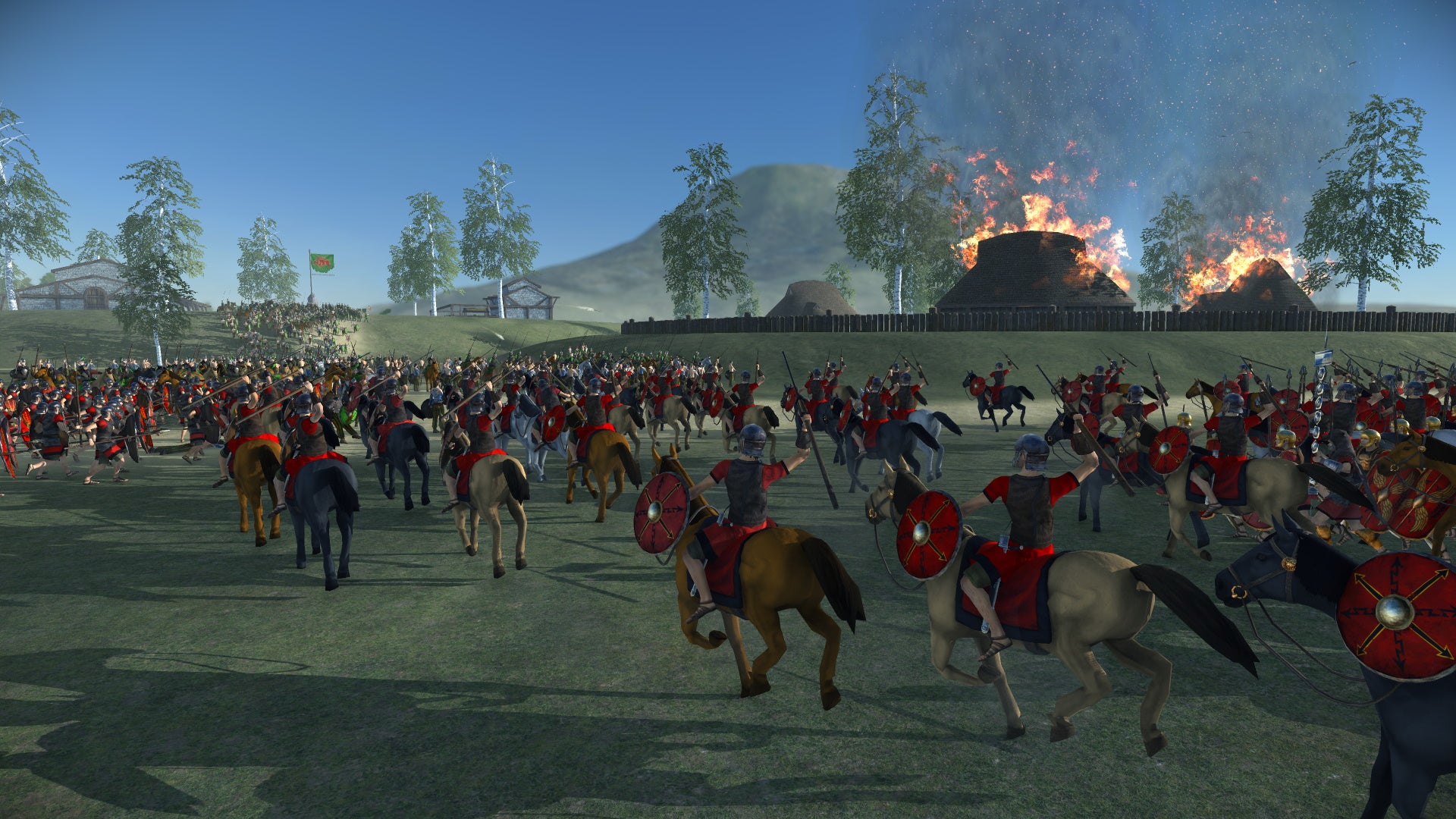
Battles are the main appeal of the game and in 2004 Rome offered the amazing vista of armies that looked and felt real (barring the scale, which is often significantly smaller than in reality). Roman units can use their javelins - pila - to inflict heavy losses on an enemy unit before closing to melee combat, archers can send arrows hurtling into combat (difficulty levels determine if friendly fire is possible), and cavalry can smash into enemy flanks and send individual soldiers flying. Roman legionaries can employ the Tetsudo formation to minimise missile damage, and Greek hoplites can lower their massive spears to inflict horrendous damage on cavalry. The earlier Total War games used 2D bitmaps on 3D backgrounds to depict battles, but Rome renders everything in full 3D. It was so impressive in 2004 that it even generated a spin-off TV show (Time Commanders).
The battles are excellent and the strategic gameplay was revolutionary at the time and still strong today. The game did innovate by also being more of an actual economic/empire-building game, rather than just a pure strategy game. Cities in Rome have no limit on what can be built in them, so you are free to construct buildings to recruit new and more advanced military units; ones that help eliminate squalor and improve public hygiene; ones that improve income; and ones that entertain the masses so they forget about their daily woes. Keep the people happy and prosperous and you can build a colossal empire spanning the continent. Fail to do so and you will fail, mired down in constant rebellions and religious strife.
The city-building part of the game is excellent - there's more than a bit of Civilization in it, though you can't build cities completely from scratch - and surprisingly detailed (you can even view your peaceful cities in full 3D at any time, a feature missing from every other game in the series). More recent Total War games have gone in a very different direction by giving each city only a few "slots" for new buildings, severely limiting what you can do with them in an attempt to re-orient the focus on the battles. Understandable from one angle (rotating through up to 50 cities in the late-game to see what needs to be built does become a problem), but disappointing from another. Total War is fun when it sprawls and the period from Rome to Shogun II is when it sprawled most engagingly; later games have eliminated that sprawl (at least in terms of detailed city-building and managing numerous armies simultaneously), to the joy of some players but the disappointment of others.
Rome Remastered improves the graphical quality over the original, replacing the identikit armies of clones with a variety of faces and individual armour variations, although battlefields do tend towards happening on flat fields and cities tend to look very samey (problems resolved in Medieval II). This period of the Total War series has been criticised for a focus on sieges and those used to the modern games may take some getting used to the sheer number of engagements happening on city walls or holding gates against invaders. However, the quality of sieges has been upped by improvements to AI. Although the AI is still capable of occasionally baffling behaviour, there has been a notable upgrade since 2004 in both strategic and battlefield AI. In particular, the AI will punish the Roman factions for following orders from the Senate too vociferously, embroiling them in multiple wars on multiple fronts that can quickly sap their strength. Weaknesses from the original game have been largely negated and many improvements made in terms of the user interface (being finally able to reorganise the arrangement of units in the UI is a huge relief) as well.
The biggest weakness of Rome is arguably the same one it had in 2004: the game really hates it when you're not at war with someone and will often have smaller, weaker factions attacking you just to get some action flowing again. Sure, the franchise title is Total War, but the game's relentless insistence on being all battles, all the time and denying you much time to rest and regroup between conflicts can be wearying, not to mention bafflingly illogical.
In terms of the package, it also includes the original Rome expansion, Barbarian Invasion, and the later Alexander expansion, notable as an early digital-only expansion (it did get a physical release some time later, though). Barbarian Invasion is set in the twilight of the Roman Empire as it teeters on the edge of collapse and is significantly tougher than the base game. Alexander is a narrative-based game following the life and career of Alexander the Great (narrated by Brian Blessed) through a highly-focused campaign. The campaign is more limited than a standard Total War grand campaign, but it's still a lot of fun, and a good example of how a short, detailed Total War game can be as much fun as a sprawling, epic game lasting many tens of hours. Disappointingly, though, the Sons of Mars mini-campaign included in the original Rome is missing, replaced by a very bare-bones tutorial.
As the Total War series has gone on, it has become more divisive amongst its fanbase. More recent games have focused on hero units, special abilities and cooldowns, simplifying unit recruitment, army management and sieges. For those who've enjoyed that movement, Rome might feel too complex, sometimes too ponderous and too enamoured of micro-management. For those who prefer having much finer, more granular control of their empires and armies, Rome Remastered (****½) is a deeply rewarding, enjoyable turn-based strategy game and a very solid real-time battles game. Improved graphics, controls and UI make this one of the finest remasters in recent memory. Roll on the inevitable Medieval II remaster!
Total War: Rome Remastered is available for PC and on mobile devices now.
Thank you for reading The Wertzone. To help me provide better content, please consider contributing to my Patreon page and other funding methods.
Relic Entertainment have announced a third full game in their Company of Heroes real-time strategy series.
Company of Heroes 3 is the follow-up to the original Company of Heroes (2006), which focused on the campaign in Normandy, and Company of Heroes 2 (2013), which depicted events on the Eastern Front. This time the game focuses on the Mediterranean Theatre, with a campaign which takes in battles in North Africa, Sicily and Italy, with the Allies versus the German Wehrmacht. The theatre was selected after discussions between Relic and fans on their forums (presumably at the expense of the Pacific, which we can guess will form the basis of a future fourth game).
Unlike the previous games, which had a linear story-based campaign, Company of Heroes 3 has a dynamic, non-linear campaign which unfolds on a large campaign map, similar to the Total War series (both Relic and Total War developers Creative Assembly are owned by Sega). Players can deploy and move units on the campaign map and use things like naval support and air power to clear the way for the ground forces to advance. Standard real-time battles unfold when ground forces meet in combat. This mode was previewed in the previous Ardennes Assault expansion for Company of Heroes 2, but CoH3 develops the idea in a lot more depth.
The actual battles are now brighter and sunnier, taking place in the desert or on the Mediterranean shore, and there is more focus on detailed infantry combat. Units can fortify buildings as before but they can also breach and storm fortified buildings. Single-player mode has a new "tactical pause" feature which allows players to pause the game and issue orders, a familiar technique from other strategy games but a first for this series.
Allied players will now get rewards for minimising collateral damage to civilian buildings, such as gaining intel from grateful locals or recruiting partisans to add extra firepower to their units. Allied players will also be able to sortie American or British forces, or on some missions a mixture of the two.
Company of Heroes 3 will launch in late 2022, though players will be able to take part in a pre-alpha demo study starting today.
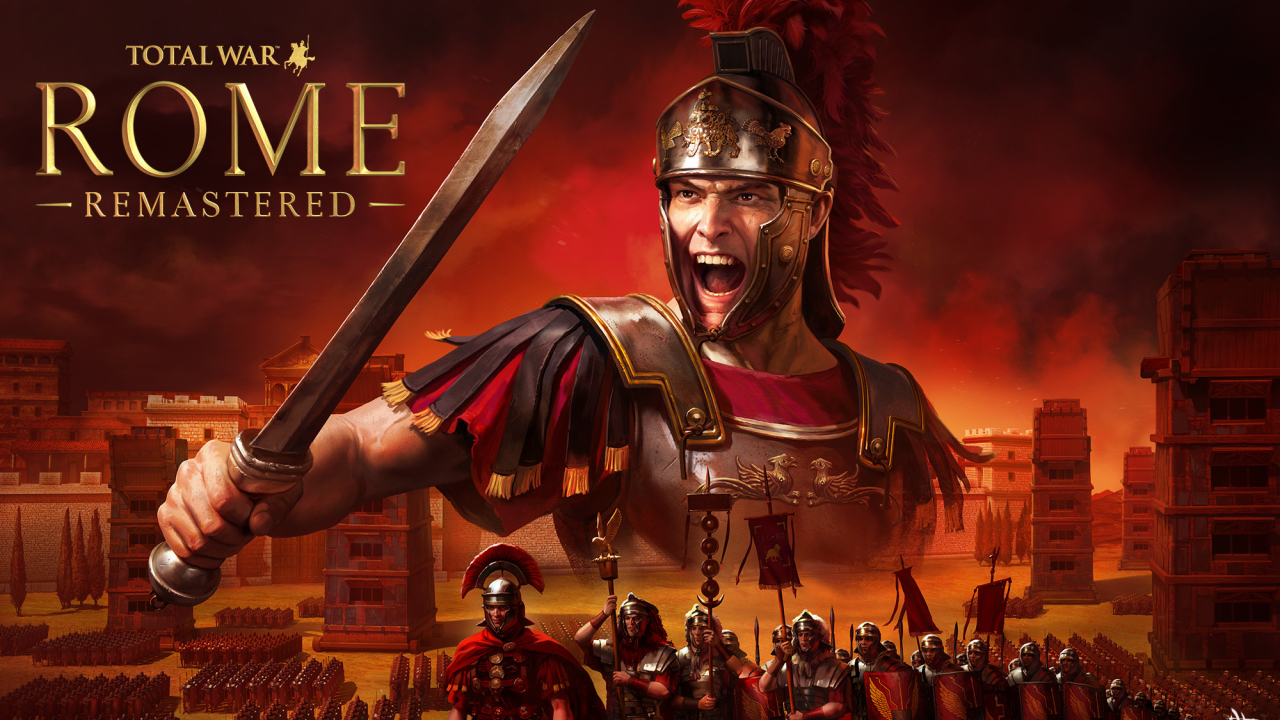
In surprising but very welcome news, Creative Assembly and Sega have announced the almost-imminent release of Total War: Rome Remastered.
Rome: Total War (as it was then called) was the third game in the Total War series and was released in late 2004. It immediately became the biggest-selling game in the series and its graphics engine even powered a historical re-enactment TV show, Time Commanders. Rome's success was all the more impressive given it launched at the same time as Half-Life 2, World of WarCraft and Grand Theft Auto: San Andreas and still managed to be a huge success.
Rome: Total War introduced series staples such as 3D battle and strategy maps, enhanced UI and finer control of units. It also had features oddly missing from later games, such as the ability to view your cities at will in 3D to see how they looked in peacetime with civilians wandering around, and that sites of interest on the campaign map would appear on the battle-map if combat erupted in that area (so if you fought near the Pyramids, the Pyramids would appear on the actual battle map, even though you could easily play a hundred games with that eventuality never arising).
Rome: Total War massively expanded the scope of the series beyond any game before or after (at least until the 2016 release of Total War: Warhammer) and is still-regarded by a hardcore contingent of old-skool fans as the best game in the series.
The remaster upgrades all of the graphics to 4K standards, reworks the UI to something a bit more contemporary and will also take full advantage of modern hardware, overcoming hardcoded engine limitations that mean that both Rome and its successor, Medieval II: Total War are unable to fully use modern amounts of RAM and VRAM (meaning that Medieval II in particular can still chug even on modern machines with preposterously more power than it was ever designed for). You will also be able do unnecessary-but-cool things like fully rotating the battle map and render the game on ultrawide monitors.
Gameplay will mostly be kept the same - which makes sense as change that too much and you might as well just make Rome III - so there won't be any 3D naval battles or armies magically turning into boats, but there will be some tweaks, such as a new roster of civilisations (possibly replacing the generic "Rebels" of the original) and some tweaks to the old ones. It is unclear if the controversial "Fantasy Egypt" faction will be included or replaced by a proper, age-appropriate Greek-Egyptian faction. Merchant agents from Medieval II will also be available for use in Rome.
The game will include both the Barbarian Invasion and Alexander expansions, the latter presumably retaining the appropriately epic narration of Brian Blessed.
One question is mod support. The games released after Medieval II have severely curtailed modding, allowing unit tweaks and reskins but not the "total conversion" mods of Rome and Medieval II that transformed them into completely new, fantastic games like Third Age: Total War (a Middle-earth mod), Call of Warhammer: Total War, Hyrule: Total War and Westeros: Total War. The official PR copy confirms there will be mod support, but not if total conversions will remain supported.
The remaster is being handled by Feral Interactive, who have handled the mobile remasters and ports of other Total War games for the past few years.
Total War: Rome Remastered will be released on 29 April. Those who already own Rome: Total War will get a 50% discount until the start of June.
Creative Assembly and Sega have confirmed that the long-awaited Total War: Warhammer III will be available later this year.
This is the fifteenth game in the Total War series and the third game in the Warhammer subseries, following on from Total War: Warhammer (2016) and the unsurprisingly-named Total War: Warhammer II (2017). The long gap in release was due to the studio refocusing on their historical games for several years, resulting in Thrones of Britannia: A Total War Saga (2018), Total War: Three Kingdoms (2019) and Troy: A Total War Saga (2020).
Warhammer III focuses on the icy arctic wastes, featuring four Chaos factions (one each for the minions of Khorne, Nurgle, Slaanesh and Tzeentch), the noble kingdom of Kislev and at least part of the great Empire of Grand Cathay. These faction can engage in battle with one another for supremacy for their part of the Old World. Additional factions will, inevitably, be added in post-release DLC.
Warhammer III can also merge its campaign map with that of Warhammer I and II in the Mortal Empires campaign, which will now become a near globe-spanning megagame including all or most of the factions from the first two games.
A release date has not yet been set apart from "late" 2021, but the game will launch on PC simultaneously on Steam and Epic Game Store (no split release strategy as with Troy). CA do advise that at the moment it will only be possible to merge the three games into one on the same platform, so owners will need all three games on either Steam or Epic, not split between them.
They may be release synergy (gags) between Total Warhammer III and a new miniatures game from Games Workshop, Warhammer: The Old World, which is also set for a late 2021 release.
The Atlantic Federation has launched a massive counter-offensive against the East Europan Imperial Alliance, driving its armies back as it makes a determined push against the enemy capital of Schwartzgrad. Squad E of the Ranger Corps is part of the attack, known as Operation Northern Cross. Early successes are followed by difficult reversals, and the revelation of a second, even more dangerous Federation offensive. Squad E is pushed to the limit as the Federation seeks to end the Second Europan War before it can become a global, bloodier conflict.
Valkyria Chronicles was released in 2008 and was a modest success on the PlayStation 3 console. The publishers, Sega, decided to continue the franchise on handheld, with Valkyria Chronicles 2 and 3 being exclusive to the PSP (and Valkyria Chronicles 3 never being released outside of Japan). The franchise remained a low-seller, and may have faded into obscurity if a PC port of the original Valkyria Chronicles had not been a surprise massive success in 2014. This led to the release of a spin-off game set in a completely different universe, the ill-conceived Valkyria Revolution and, finally last year, Valkyria Chronicles 4.
Set alongside and after the original game and before the events of Valkyria Chronicles 2 and 3, VC4 is effectively the second game in the series, as well as being the closest in tone, style, interface and controls to the original Valkyria Chronicles, so it can be played safely without any knowledge of the other games in the franchise.
The dog is the best character in the game. Alas, he is not a controllable character.
As with the original, the game is set during the Second Europan War and sees the player control a squad of soldiers in the fight against the Empire. You have a large roster of soldiers to choose your main squad from, consisting of important story-critical characters (who can't die, but sometimes losing them mid-battle can result in an instant fail) and other recruits who can be killed permanently. In Valkyria Chronicles 4 these side-characters are much more important, with many of them having their own solo or group missions which will not trigger if any of them fall or aren't levelled up, so both preserving your troops and using a wider variety of them is encouraged.
As before your troops fall into several classes: Scouts can move huge distances but do relatively little damage, although once you upgrade them they can be formidable; Engineers can move almost as far but are less effective in battle, and are better-used for resupplying troops with ammo, repairing tanks and healing; Lancers are hardy anti-tank troops; Snipers can take out enemies at extreme range; and Tanks are, well, tanks, formidable machines with great anti-personnel and anti-armour capabilities but tend to attract the fire of every enemy on the map. To this roster this game adds an Armoured Personnel Carrier (which can pick up troops and deposit them elsewhere on the map) and the Grenadier, a formidable class which can target enemies at range with indirect fire, and can specialise in anti-personnel or anti-armour tech trees.
The game does continue the original's veritable obsession with quality baked goods.
On each turn you have a number of ability points. You can move each character a set distance and then either fire their weapon, throw a grenade, heal or use a special ability. Classes vary wildly in their capabilities: Snipers can't move far but make up for this with lethal range, whilst Scouts can move halfway across most maps in one go, but are less capable in combat until they've upgraded their weapons and skills. Characters can move more than once per turn, but on their second turn they have half the ability points of their first turn, then half again and so on. You can trigger reaction fire from enemies if you get too close, so you have to be wary of where you're moving troops to, what enemies they may encounter and if there is cover they can use (which dramatically reduces damage).
Valkyria Chronicles 4 improves on the first game by re-balancing the classes, so units like Shocktroopers whose low movement points made them relatively unappealing are now much more versatile, whilst upgraded Scouts can no longer win entire missions by themselves in the late game stage, which was an issue in the first title. Otherwise, Valkyria Chronicles 4 plays exactly like the first game, down to even using mostly the same music, sound effects, UI and controls. I must admit it's a bit odd playing a game released in 2019 to find it being a virtual clone of one released in 2008. Even the usual difference you'd expect - much better graphics - isn't really the case because the Valkyria Chronicles series uses a highly stylised, painting-like style for its art which means the two games do look very similar.
As with the original game, missions become vastly less interesting when the super-powered glowing women from beyond the dawn of time who can one-shot your entire army show up.
The game also plays the same off the battlefield. You have a headquarters where you can research new technology, unlock new characters, train up classes using experience points gained in battle and read the news about how the war is going on the larger scale. Before each mission there are also numerous, numerous cut scenes expanding on the plot and story. I'd have more time for these if they didn't use somewhat stilted and repetitive animations for the characters and you didn't have to manually hit enter after every line of dialogue. This wasn't too bad in the original game, which lasted for a breezy 35 hours with only a moderate amount of dialogue before each battle. In Valkyria Chronicles 4 the game lasts for around 60 hours and there is vastly more dialogue before each battle and sometimes after. There's also far more side-missions in VC4 (optional missions which are not part of the main storyline), more character stories and more skirmishes of differing difficulty tiers. Valkyria Chronicles 4 is a much longer game than the original, which is good in some respects, but it also massively expands the amount of tedious cut scenes you have to sit through.
It doesn't help that the writing and characterisation in Valkyria Chronicles 4 is a big step back from the original. The new characters are mostly walking archetypes with little or no actual character (lead hero Claude is an absolute blank slate with no discernible character traits other than "good leader"), or are horrendous cliches (Raz is appallingly badly-written throughout the game, and his character's eventual fate seems based on the mistaken idea that he is likeable at that moment). The secondary cast of optional recruits is a lot better fleshed-out than in the original game, which is good, but when the main cast is so bland and they're the people that 90% of the game and it's stories revolve around, it's a big problem.
A cameo appearance by the cast of the original Valkyria Chronicles doesn't exactly help this game stand out from its shadow.
It also doesn't help that VC4 leans into the worst excesses of anime tropes, which the original definitely didn't do. Apart from some questionable uniform choices, the original game was pretty good in depicting a mixed-gender unit fighting in a decidedly grim conflict which raised questions about bigotry and xenophobia (through the uncomfortable but relatively sensitively-handled parallels between the Holocaust and the treatment of the in-game Darcsen race, a storyline that the fourth game barely even acknowledges). VC4, on the other hand, is outright sexist, treating its female characters pretty poorly throughout. Early on it appears that the game is actually trying to address sexism as a key theme of the game in a similar manner as racism was in the first title, with Raz's uncomfortably sexist harassment of Kai clearly being condemned and Raz eventually cleaning up his act. However, later side-missions and optional, fanservice-oriented DLC depicting the female characters in various stages of undress rapidly see this excuse dissipating.
If it was possible to ignore the ham-fisted writing and the cliched storytelling and just enjoy the actual gameplay, Valkyria Chronicles 4 (***)would be an easy recommend, especially to people who already enjoyed the first game. The combat missions are pretty solid, the new Grenadier class is pretty cool, the side-characters are much more interesting and the individual missions are a bit more forgiving than the first game. But as it stands, you can't, with the story, cliches and more obnoxious characters rammed down your throat at every opportunity and a good quarter of the game spent clicking through story episodes before you can actually play the missions. Combined with an absolute overload of content which makes the game seriously outstay its welcome, and a decidedly ridiculous price tag (at this time of writing), these make the game less attractive than simply firing up Valkyria Chronicles for another run-through, which is a huge shame. The game is available now via Steam on PC, and also on PlayStation 4 and X-Box One.