I'm not sure anything more can or should be said. This is a thing that has happened.
Showing posts with label skyrim. Show all posts
Showing posts with label skyrim. Show all posts
Thursday, 10 September 2026
IKEA releases SKYRIM mod featuring Matt Berry as a talking Kallax shelf
Yes, that is a real headline. Swedish purveyors of reliable flat-pack furniture IKEA have created a mod for 2011 video game The Elder Scrolls V: Skyrim. The mod introduces a new companion character, a Kallax shelf, which follows the character around and is voiced by Matt Berry.

Tuesday, 25 February 2025
SKYBLIVION developers re-commit to 2025 release
The developers of fan mega-mod Skyblivion, which seeks to update venerable fantasy RPG The Elder Scrolls IV: Oblivion (2006) to modern-ish standards, have re-committed to releasing the game in 2025, as they originally promised two years ago. The project is almost feature-complete, with developers and testers now able to run through entire quests, as they have demonstrated in a new video.
The original idea behind the project was to remake Oblivion in the upgraded Creation Engine of its successor, Skyrim (2011). However, the project stalled after several years and was relaunched before the pandemic under new management. The title is somewhat misleading, as the game now features improvements from later versions of the engine and features from other modders, including better 4K textures and enhanced lighting. The mod is also not a straightforward remake, as it redesigns and enhances some areas of the games, for example replacing the identikit caves with different designs based on their descriptions (i.e. mines and random caverns no longer look identical) and making the infamously tiny forts larger and more imposing. The city of Leyawiin, which was massively scaled back in development, has been returned to its original, imposing design straddling a major river with a drawbridge to allow ships to pass.
The creators have kept in touch with Bethesda during development to confirm what they can and can't do: they've kept the original soundtrack and even added to it with new material, but have had to re-record all dialogue for legal reasons (presumably the need not to pay Sean Bean and Patrick Stewart lots of money again). This will probably be a boon, as Oblivion infamously had a tiny voice cast, and it wasn't uncommon to stumble across three people with the exact same voice talking to one another, which was weird.
Playing the mod will require the player owns copies of both Oblivion and Skyrim. As noted before, the plan is to release the mod before the end of 2025 via Steam, GoG and Nexus Mods. A console version is currently impossible due to the massive size of the new files (which outsizes the limits Bethesda put in place for console modding).
In 2023 it was rumoured that Bethesda were considering their own remaster of Oblivion, which sounds like an exercise in futility compared to the scale of Skyblivion. It'll be interesting to see if that project is actually something that's happening.
Sunday, 27 October 2024
BATTLESTAR GALACTICA, SKYRIM and FALLOUT: NEW VEGAS actor Michael Hogan makes first convention appearance since serious injury
In very welcome news, actor Michael Hogan has made his first public convention appearance in almost five years, since he suffered a serious head injury. Hogan is best-known for playing the role of Colonel Saul Tigh in the second iteration of Battlestar Galactica, and subsequently playing the role of Doc Mitchell in the 2010 video game Fallout: New Vegas and General Tullius in Skyrim (2011).

Hogan suffered the injury in February 2020, which happened backstage at another event. He was subsequently given excellent but expensive medical treatment, with his family setting up a Gofundme account. His Battlestar costars publicised the appeal. Fans have since contributed almost half a million dollars towards his treatment and rehabilitation.
Hogan made his appearance at the "Salute to Battlestar Galactica 20th Anniversary" convention in Chicago, appearing alongside much of the cast of the show and showrunner Ronald D. Moore. Hogan made an appearance alongside Edward James Olmos (Admiral Adama) and another alongside his on-screen wife Kate Vernon (Ellen Tigh), sporting an eyepatch and his screen uniform in honour of his character.
As part of his rehabilitation, Hogan had to learn to speak and walk again from scratch, no mean feat for an actor who is now 75 years old. Hogan has been supported in his recovery by his family, particularly his wife Susan who has acted as a spokesperson for him, as well as his co-stars. Impressively, he has already returned to work, recently doing voice work for the children's animated series Sonya from Toastville.
This is of course splendid news, and I believe all of his many fans will continue to wish him the best recovery.
Wednesday, 14 June 2023
Sales of SKYRIM pass 60 million copies
Bethesda Games Studios director Todd Howard has indicated that The Elder Scrolls V: Skyrim has passed 60 million copies sold. The news comes a few weeks after CD Projekt Red confirmed their similarly open-world mega-RPG The Witcher 3: Wild Hunt has passed 50 million copies sold.

This would make Skyrim the seventh-biggest-selling video game of all time, and would drop The Witcher 3 down to a still-very-respectable joint-tenth (with rough sales parity with Blizzard's Overwatch). Ahead of Skyrim are Minecraft (238 million sales), Grand Theft Auto V/Grand Theft Auto Online (180 million), Tetris (100 million), Wii Sports (82 million), PUBG: Battlegrounds (75 million), Mario Kart 8 (62 million) and Super Mario Bros. (58 million). Note these lists do not include free-to-play games like World of WarCraft and Fortnite, which both have conservative estimates of at least 100 million players apiece since their respective launches.
Launched in 2011, the game casts players into the northern, subarctic province of Skyrim, part of the Empire of Tamriel, where they have to deal with a civil war, an invasion of dragons, stirring undead in ancient ruins and the vagaries of the weather. The game was enhanced with several expansions (Hearthstone, Dawnguard and Dragonborn) and has since been re-released twice with upgraded graphics and features, as well as being ported across three generations of video game consoles and PCs, with re-releases and ports becoming so commonplace that it became a meme that even the developers commented on.
Skyrim is the fifth game in the Elder Scrolls fantasy series, which also consists of Arena (1994), Daggerfall (1997), Morrowind (2002), Oblivion (2006) and spin-off games Battlespire (1997), Redguard (1998) and The Elder Scrolls Online (2014). Oblivion is currently getting a fan-led remaster called Skyblivion, with a planned release date of 2025. The Elder Scrolls VI is currently in pre-production, and the hope it will be out before the end of this decade.
Bethesda are also the studio behind the Fallout post-apocalyptic series, having developed Fallout 3 (2008), Fallout 4 (2015) and Fallout 76 (2018), as well as publishing Obsidian Entertainment's Fallout: New Vegas (2010). Bethesda's next game is the science fiction epic Starfield, which is due for release on 6 September this year.
Tuesday, 17 January 2023
ELDER SCROLLS IV: OBLIVION remake targets a 2025 release date at the latest
Whilst The Elder Scrolls V: Skyrim has been remastered for more platforms than you can shake a stick at, its 2006 forebear has gotten much less official love. However, Oblivion has been getting a major makeover thanks to a large collection of modders and fans who took it upon themselves to remake the entire game in Skyrim's engine, whilst also upgrading that engine considerably.
The result, the slightly-painfully-named Skyblivion (I would give Bethesda serious money if they give them permission to just call it "Oblivion Remade" or something), has been making serious progress for the last couple of years, with increasingly impressive dev diaries and YouTube videos exploring the rebuilt version of Tamriel's Imperial Province of Cyrodiil.
The team have now confirmed a 2025 release date. If that seems a bit far off given how much progress they've made recently, the team agrees and notes this is a worst-case scenario date and they don't get any more resources to help bring the game across the finish line. However, if they are able to recruit more people to help out, they might be able to shave some months off that and bring the game out in 2024 instead.
Skyblivion has ported the entirety of Oblivion into the upgraded engine, but the team have gone back and recreated almost all of the textures, models and effects in the game. Some of the geographic areas have been reworked and resized to make a bit more sense, and the city of Leyawiin has been almost completely redesigned in line with its original, more ambitious, concept art. The biggest change will be with the dungeons. Oblivion used very repetitive and simple dungeon designs, with even some dungeons being simple copy+pastes of others. Every dungeon in Skyblivion has been redesigned and many are now larger and more sprawling. The game will also use Skyrim's more balanced level-scaling system rather than Oblivion's deranged version, but will retain the original game's spellcrafting mechanics.
Skyblivion will launch by 2025 at the latest, and will require the player to have purchased copies of both Skyrim and Oblivion. Bethesda themselves are working on their brand new, space-based roleplaying game, Starfield, which should be out later this year. Bethesda are also in pre-production on The Elder Scrolls VI, but that is many years away.
Wednesday, 27 January 2021
OBLIVION remaster inching towards completion
A fan-made remaster of The Elder Scrolls IV: Oblivion has released a major update on progress, for the first time making positive noises about completion in the not-too-distant future.
The remaster is called Skyblivion, although that's become a bit of a misnomer. The starting point was remaking Oblivion in the somewhat updated engine of The Elder Scrolls V: Skyrim, but in the years since then they have also redone the lighting and rendering engine, so it's even better than Skyrim and looks a lot more modern.
At the moment the exterior worldspace is almost complete and the team are working on the dozens of dungeons and shops in the game. For the dungeons they are going beyond just recreating locations but also redesigning dungeons to be larger and more interesting (Oblivion's dungeons were infamously tiny, often not being more than very modest caves). They are also creating new art assets for the entre project and have integrated every quest from the original into the game, although there are lots of issues and bugs they are tracking down and resolving.
No timeframe for completion is given, but from the look of it and bearing in mind this is a small team working in their own time, this may now be down to a couple of years away. Impressive given the mod's long, long-gestating status.
Bethesda themselves have been supportive of mods, especially mods that update and upgrade their older games. Despite re-releasing Skyrim on multiple platforms with updated graphics, Bethesda have indicated a reluctance to go back and update Morrowind, Oblivion, Fallout 3 and Fallout: New Vegas, noting that the technical compromises they made to get those games out were severe and they'd feel the need to completely remake them, which would be a huge amount of work they'd rather divert to working on their new games.
Bethesda are currently working on a new game in a new franchise, Starfield, and Oblivion's successor, The Elder Scrolls VI. Neither project has a timeframe for release at the moment.
Monday, 4 January 2021
Bethesda tease new ELDER SCROLLS video game project
Bethesda have posted an image hinting at new developments in their Elder Scrolls line of fantasy RPGs.

The Elder Scrolls is a bestselling series of video games, comprising the main games Arena (1994), Daggerfall (1997), Morrowind (2002), Oblivion (2006) and Skyrim (2011); and the spin-offs Battlespire (1997), Redguard (1998) and The Elder Scrolls Online (2014). The last main series title, Skyrim, is one of the biggest-selling games of the last decade, with over 30 million copies and sold and being ported to multiple platforms. With this year making the ten-year anniversary of the last game in the series, fans are increasingly antsy over when a sequel will be released.
Bethesda released their last big single-player CRPG, Fallout 4, in 2015, whilst a secondary team at the company developed a controversial multiplayer spin-off, Fallout 76, which was released in 2018. Bethesda also confirmed in 2018 that they are working on two new single-player games, a new IP title called Starfield and The Elder Scrolls VI, although they cautioned that the latter game was in a very early stage of development. Bethesda have repeatedly said that Starfield is their current main project and will precede The Elder Scrolls VI by several years.
For this reason, it is highly unlikely that the image Bethesda has posted has anything to do with Elder Scrolls VI, or if it does, it will be fairly obliquely, since Elder Scrolls VI is likely still many years away.

More likely is that the image refers to recent and possible future plans for The Elder Scrolls Online. The map has a candle located over the city of Solitude in Skyrim Province, a key setting for the recent Dark Heart of Skyrim expansion; other candles located near a set of coins, which were given away as collectibles for the recent Greymoor expansion for The Elder Scrolls Online (set in Skyrim), and a candle burning in the province of Hammerfell. We know the next expansion for Online is The Gates of Oblivion, and will tie in with the other-dimensional realm of Oblivion as well as possible new content in the Imperial Province of Cyrodiil (probably non-coincidentally tying in with the 15-year anniversary of the release of Oblivion), although intriguingly the map is oriented so Cyrodiil (south-east of Skyrim and east of Hammerfell) is not a focal point.
The candle burning in Hammerfell though may be a nod at The Elder Scrolls VI, as that province has been long-rumoured to be the main setting for the game. Hammerfell is the home of the Redguard, an important faction in the Empire, and a likely flashpoint between the Empire and the rival force known as the Dominion, whose machinations drove much of the main plot of Skyrim. This would also explain the game's long-rumoured working title, Redfall (although recently a freelancer who worked on Skyrim and may be working on Elder Scrolls VI has said that this is not the title, implying Bethesda secured the IP for another project).
I suspect we won't learn much more about The Elder Scrolls VI for a long, long time. In the meantime Bethesda are hard at work on their new IP, Starfield, reportedly a large-scale science fiction game set in the distant future and which will allow players to visit different planets. Bethesda Vice-President Pete Hines has hinted that we will get more news about Starfield this year, which excited some fans who noted that Bethesda's last two games have been formally announced and had release dates set within only four months, which has helped them avoid the problem of "overhype" which has beleaguered some other recent releases.
Thursday, 28 May 2020
A legal dispute may have confirmed the ELDER SCROLLS VI subtitle
A legal tussle between Bethesda Softworks, their owners Zenimax Media and a small-press publisher may have inadvertently given away the subtitle of their next Elder Scrolls video game.

Bethesda filed a trademark claim for the name "Redfall" over a year ago, prompting a response from BookBreeze, the publisher of author Jay Falconer. Falconer had written a series of post-apocalyptic novels under the Redfall banner title.
After the threat of legal action, Zenimax and BookBreeze reached an out-of-court settlement (read: money exchanged hands) in May 2019 which appears to allow both Zenimax to use the title in the future and for BookBreeze to continue publishing books under that name.
The story has resurfaced in recent weeks due to a series of alleged leaks about The Elder Scrolls VI, most of which later turned out to be false. However, the "Redfall" title tussle is one of the view hard pieces of information we have about the game. Based on the very brief teaser released two years ago, it is widely expected that the game will take place in the provinces of High Rock and Hammerfell, the home of the Redguards, who loom large in Elder Scrolls lore. There is also the matter of a side-quest in The Elder Scrolls V: Skyrim (2011), which hints that a "red plague" is currently loose in High Rock and a character is headed back there (Bethesda had previously lined up Skyrim with repeated references to that province in The Elder Scrolls IV: Oblivion back in 2006).
The Elder Scrolls VI: Redfall or Whatever will very likely not be released until the middle of the next decade, as Bethesda are still hard at work on their epic SF CRPG Starfield, as well as further expansions to online survival shooter Fallout 76.

Bethesda filed a trademark claim for the name "Redfall" over a year ago, prompting a response from BookBreeze, the publisher of author Jay Falconer. Falconer had written a series of post-apocalyptic novels under the Redfall banner title.
After the threat of legal action, Zenimax and BookBreeze reached an out-of-court settlement (read: money exchanged hands) in May 2019 which appears to allow both Zenimax to use the title in the future and for BookBreeze to continue publishing books under that name.
The story has resurfaced in recent weeks due to a series of alleged leaks about The Elder Scrolls VI, most of which later turned out to be false. However, the "Redfall" title tussle is one of the view hard pieces of information we have about the game. Based on the very brief teaser released two years ago, it is widely expected that the game will take place in the provinces of High Rock and Hammerfell, the home of the Redguards, who loom large in Elder Scrolls lore. There is also the matter of a side-quest in The Elder Scrolls V: Skyrim (2011), which hints that a "red plague" is currently loose in High Rock and a character is headed back there (Bethesda had previously lined up Skyrim with repeated references to that province in The Elder Scrolls IV: Oblivion back in 2006).
The Elder Scrolls VI: Redfall or Whatever will very likely not be released until the middle of the next decade, as Bethesda are still hard at work on their epic SF CRPG Starfield, as well as further expansions to online survival shooter Fallout 76.
Tuesday, 14 June 2016
Bethesda confirm that ELDER SCROLLS VI is in development
Bethesda have confirmed that a sixth game in their Elder Scrolls fantasy roleplaying saga is in development, surprising absolutely no-one. However, they have stressed that this is not a formal announcement of the game, merely the fact that they are working on it. The setting, title and what kind of game it will be all remain to be seen.

The previous Elder Scrolls game, Skyrim, was released in 2011 and was enormously successful, selling tens of millions of copies. A new version of the game, with upgraded graphics, will launch this October on PS4 and XB1. Bethesda's last game, Fallout 4, was released at the end of 2015 and has also been a huge success. Partner company Zenimax Studios released The Elder Scrolls Online two years ago which has been more of a moderate success, and panicked some fans into thinking we weren't going to get a new single-player Elder Scrolls game. This announcement fortunately confirms that this isn't the case and a new CRPG in Tamriel will - eventually - arrive.
According to Bethesda, their plans for the new game are extremely ambitious and rely on technology that is still in development. This suggests that Bethesda may - finally! - be working on a new engine to power the game. They have also said that the game is a long, long way off. I suspect we'll be lucky to see it this side of 2020.
Bethesda have also confirmed that they are working on two other "large projects", and we may hear more about these before The Elder Scrolls VI is officially announced.

The previous Elder Scrolls game, Skyrim, was released in 2011 and was enormously successful, selling tens of millions of copies. A new version of the game, with upgraded graphics, will launch this October on PS4 and XB1. Bethesda's last game, Fallout 4, was released at the end of 2015 and has also been a huge success. Partner company Zenimax Studios released The Elder Scrolls Online two years ago which has been more of a moderate success, and panicked some fans into thinking we weren't going to get a new single-player Elder Scrolls game. This announcement fortunately confirms that this isn't the case and a new CRPG in Tamriel will - eventually - arrive.
According to Bethesda, their plans for the new game are extremely ambitious and rely on technology that is still in development. This suggests that Bethesda may - finally! - be working on a new engine to power the game. They have also said that the game is a long, long way off. I suspect we'll be lucky to see it this side of 2020.
Bethesda have also confirmed that they are working on two other "large projects", and we may hear more about these before The Elder Scrolls VI is officially announced.
Monday, 15 April 2013
Bethesda confirm they are now moving on from SKYRIM
Bethesda have confirmed that they have completed their release schedule for Skyrim, the fifth title in the Elder Scrolls series. Work is now underway on their next game, which will most likely be Fallout 4 based on the company's previous comments.

The news surprised some people, first for suggesting that work on the next game was not further advanced than it appears to be: Fallout 4's release had been anticipated for 2014, if not a surprise release for late 2013, as Bethesda had indicated that their next game would be on the current-gen Creation Engine that Skyrim also used. This news hints that Fallout 4 (assuming it is their next game) will not be out until a lot later and will either use a new engine or the current one will be tweaked for next-gen systems (given the impressive scalability of the engine on high-end PCs, this is possible).
More surprising is the indication that Skyrim's expansion cycle is complete. Bethesda had suggested that their DLC (downloadable content) packs for Skyrim would be substantial in size and quality. However, they only released one such substantial expansion with Dragonborn. The first DLC, Dawnguard, was a relatively short adventure, whilst the second, Hearthfire, only added a few cosmetic tweaks to the game. Rumours had abounded that two more substantial DLCs were planned. If this was true, they clearly have now been abandoned.
Whilst we are unlikely to see Elder Scrolls VI for another five or six years, hardcore fans will get to play The Elder Scrolls Online before the end of this year. An MMORPG, The Elder Scrolls Online has been developed by Bethesda's sister company, Zenimax Online Studios, but (personally speaking) looks rather underwhelming at this point.


The news surprised some people, first for suggesting that work on the next game was not further advanced than it appears to be: Fallout 4's release had been anticipated for 2014, if not a surprise release for late 2013, as Bethesda had indicated that their next game would be on the current-gen Creation Engine that Skyrim also used. This news hints that Fallout 4 (assuming it is their next game) will not be out until a lot later and will either use a new engine or the current one will be tweaked for next-gen systems (given the impressive scalability of the engine on high-end PCs, this is possible).
More surprising is the indication that Skyrim's expansion cycle is complete. Bethesda had suggested that their DLC (downloadable content) packs for Skyrim would be substantial in size and quality. However, they only released one such substantial expansion with Dragonborn. The first DLC, Dawnguard, was a relatively short adventure, whilst the second, Hearthfire, only added a few cosmetic tweaks to the game. Rumours had abounded that two more substantial DLCs were planned. If this was true, they clearly have now been abandoned.
Whilst we are unlikely to see Elder Scrolls VI for another five or six years, hardcore fans will get to play The Elder Scrolls Online before the end of this year. An MMORPG, The Elder Scrolls Online has been developed by Bethesda's sister company, Zenimax Online Studios, but (personally speaking) looks rather underwhelming at this point.
Sunday, 24 February 2013
The Elder Scrolls V: Skyrim - Dragonborn
A failed assassination attempt on the Dragonborn hints that an ancient evil has returned to the island of Solstheim, located off the north-eastern coast of Skyrim and north of Morrowind's foreboding Red Mountain. The Dragonborn sets sail for the island and is confronted by a mystery that will take them across the island and into the Oblivion realm of Apocrypha to confront Miraak, the first Dragonborn.

Dragonborn is the third piece of DLC (downloadable content) for Skyrim, the monstrously successful fifth game in The Elder Scrolls. Unlike Hearthfire, which simply added the ability to build houses to the game, and Dawnguard, which was a short, linear quest adding the ability to transform into a vampire lord, Dragonborn is a proper expansion like we used to get in the good old days. The setting is Solstheim, previously the setting for Bloodmoon, an expansion to The Elder Scrolls III: Morrowind. The island has changed a lot in the subsequent 200 years, with the eruption of the Red Mountain covering much of the southern half of the island in ash. However, the central mountains and the north coast retain that mountainous, sub-arctic feel that Skyrim evoked so successfully.
Dragonborn starts when your character - the Dragonborn - is attacked whilst going about his or her daily business (the Dragonborn questline only starts once you have completed a few of the main storyline quests in Skyrim itself and been proclaimed Dragonborn). Clues on the attackers lead you to a boat moored in Windhelm. The captain - reluctantly - agrees to sail you to Solstheim. Upon arrival in the main settlement at Raven Rock, you are confronted by houses built out of the shells of long-dead giant crustaceans and a wizard living inside a gargantuan mushroom. You are not in Skyrim any more.
The dominant race in the southern half of the island are the dunmer or dark elves, who were allowed to settle on Solstheim by the Nord High King after being driven out of their homeland. After 200 years living together with the Nords and other races, a tolerant multi-racial community has grown up that is a pleasant change after the prejudices of Skyrim proper (where the Nords treat any non-Nord characters with disdain, if not outright hostility). The smaller size of Solstheim - a fraction the size of Skyrim but still big enough to contain dozens of main quests, side-quests and missions, as well as dozens of locations and vast quantities of loot - also allows for a more focused game without sacrificing the freedom the series is renowned for.
As is traditional with the gameplay of the series, you can completely ignore the main storyline in favour of the side-quests. I actually did this for about eight or nine hours, simply traipsing around the island pursuing optional missions or just exploring and checking out locations I'd discovered. Dragonborn does a good job of adjusting to where you are in the main game's quests: being a member of the Thieves' Guild immediately gave me an 'in' to the town, with the local blacksmith being related to one of the senior guild members. A bunch of hunters living up in the mountains have a quest that will only be activated if the player is a werewolf. There are different dialogue options depending on if you play the expansion before or after the defeat of Alduin in the main game's storyline. In particular, Dragonborn improves upon Skyrim by making its NPCs more memorable and interesting than that in the main game. The aforementioned mushroom-dwelling wizard is a total nutjob, with some very amusing lines, whilst it's possible for the player to win the allegiance of a tribe of Rieklings (think of a race of demented Ewok-goblins) who will then follow the player around and randomly help out in combat.

As well as Solstheim itself, the game features sequences set in Apocrypha, the home of the daedric prince Hermaeus Mora. This is an alternate dimension made up of stacks of billions of books, guarded by psychotic librarians known as Seekers (Cthulu-like tentacled horrors). Traversing these chunks of Apocrypha - accessed by the foreboding Black Books - rewards the player with different powers and effects, and is required to find and defeat Miraak. Unlike the repetitive Oblivion Gate towers in Oblivion, these sojourns to Apocrypha are shorter, more concise and more imaginative. You also only need to do a couple of them to finish the expansion's storyline, at which point finding more of them becomes purely optional.
On the negative side of things, Miraak is a dull enemy and the expansion's biggest selling-point, being able to ride around on dragonback, is severely underwhelming. There's also perhaps an over-relianced on draugr (undead) as enemies in the new dungeons, when they'd already become quite played out in Skyrim itself. Fortunately, these make for surprisingly tiny parts of the expansion and it gets just about everything else right, breathing fresh life back into a game that was starting to feel a little stale.
Overall, Dragonborn (****) makes for a very welcome return to the world of Skyrim. The changes to the game's visual style are refreshing, and there's some better writing and characterisation than in its parent game. The expansion takes that everything that worked well in Skyrim and packages it into a smaller, more focused and more concise (though, at well over 30 hours worth of content, in no way tiny) gaming experience. Recommended to all fans of Skyrim, especially those underwhelmed by Dawnguard and Hearthfire. The game is available via Steam for PC owners, PSN for PS3 owners and X-Box Live for X-Box 360 owners.
Dragonborn is the third piece of DLC (downloadable content) for Skyrim, the monstrously successful fifth game in The Elder Scrolls. Unlike Hearthfire, which simply added the ability to build houses to the game, and Dawnguard, which was a short, linear quest adding the ability to transform into a vampire lord, Dragonborn is a proper expansion like we used to get in the good old days. The setting is Solstheim, previously the setting for Bloodmoon, an expansion to The Elder Scrolls III: Morrowind. The island has changed a lot in the subsequent 200 years, with the eruption of the Red Mountain covering much of the southern half of the island in ash. However, the central mountains and the north coast retain that mountainous, sub-arctic feel that Skyrim evoked so successfully.
Dragonborn starts when your character - the Dragonborn - is attacked whilst going about his or her daily business (the Dragonborn questline only starts once you have completed a few of the main storyline quests in Skyrim itself and been proclaimed Dragonborn). Clues on the attackers lead you to a boat moored in Windhelm. The captain - reluctantly - agrees to sail you to Solstheim. Upon arrival in the main settlement at Raven Rock, you are confronted by houses built out of the shells of long-dead giant crustaceans and a wizard living inside a gargantuan mushroom. You are not in Skyrim any more.
The dominant race in the southern half of the island are the dunmer or dark elves, who were allowed to settle on Solstheim by the Nord High King after being driven out of their homeland. After 200 years living together with the Nords and other races, a tolerant multi-racial community has grown up that is a pleasant change after the prejudices of Skyrim proper (where the Nords treat any non-Nord characters with disdain, if not outright hostility). The smaller size of Solstheim - a fraction the size of Skyrim but still big enough to contain dozens of main quests, side-quests and missions, as well as dozens of locations and vast quantities of loot - also allows for a more focused game without sacrificing the freedom the series is renowned for.
As is traditional with the gameplay of the series, you can completely ignore the main storyline in favour of the side-quests. I actually did this for about eight or nine hours, simply traipsing around the island pursuing optional missions or just exploring and checking out locations I'd discovered. Dragonborn does a good job of adjusting to where you are in the main game's quests: being a member of the Thieves' Guild immediately gave me an 'in' to the town, with the local blacksmith being related to one of the senior guild members. A bunch of hunters living up in the mountains have a quest that will only be activated if the player is a werewolf. There are different dialogue options depending on if you play the expansion before or after the defeat of Alduin in the main game's storyline. In particular, Dragonborn improves upon Skyrim by making its NPCs more memorable and interesting than that in the main game. The aforementioned mushroom-dwelling wizard is a total nutjob, with some very amusing lines, whilst it's possible for the player to win the allegiance of a tribe of Rieklings (think of a race of demented Ewok-goblins) who will then follow the player around and randomly help out in combat.

As well as Solstheim itself, the game features sequences set in Apocrypha, the home of the daedric prince Hermaeus Mora. This is an alternate dimension made up of stacks of billions of books, guarded by psychotic librarians known as Seekers (Cthulu-like tentacled horrors). Traversing these chunks of Apocrypha - accessed by the foreboding Black Books - rewards the player with different powers and effects, and is required to find and defeat Miraak. Unlike the repetitive Oblivion Gate towers in Oblivion, these sojourns to Apocrypha are shorter, more concise and more imaginative. You also only need to do a couple of them to finish the expansion's storyline, at which point finding more of them becomes purely optional.
On the negative side of things, Miraak is a dull enemy and the expansion's biggest selling-point, being able to ride around on dragonback, is severely underwhelming. There's also perhaps an over-relianced on draugr (undead) as enemies in the new dungeons, when they'd already become quite played out in Skyrim itself. Fortunately, these make for surprisingly tiny parts of the expansion and it gets just about everything else right, breathing fresh life back into a game that was starting to feel a little stale.
Overall, Dragonborn (****) makes for a very welcome return to the world of Skyrim. The changes to the game's visual style are refreshing, and there's some better writing and characterisation than in its parent game. The expansion takes that everything that worked well in Skyrim and packages it into a smaller, more focused and more concise (though, at well over 30 hours worth of content, in no way tiny) gaming experience. Recommended to all fans of Skyrim, especially those underwhelmed by Dawnguard and Hearthfire. The game is available via Steam for PC owners, PSN for PS3 owners and X-Box Live for X-Box 360 owners.
Friday, 11 January 2013
Friday, 6 April 2012
The Elder Scrolls V: Skyrim
Two centuries after the Oblivion Crisis and the death of Emperor Uriel Septim VII, the Empire of Tamriel is a shadow of its former self. A powerful new nation has arisen in the south and pushed the boundaries of the Empire back, forcing the near-bankrupt Empire to accept its religious pogroms or face open war. In the north, the province of Skyrim, home of the Nords, has become divided between those who wish to support the Empire in its moment of weakness and those who are enraged at the oppression of their religion and seek to make Skyrim an independent kingdom once again. Against this backdrop, chaos is unleashed when the elder god Alduin returns, unleashing a storm of dragons to devastate Skyrim. Only a warrior known as the Dragonborn can stop Alduin and save Skyrim and all of Tamriel from his wrath.

Skyrim is the fifth game in The Elder Scrolls series, following on from Arena, Daggerfall, Morrowind and Oblivion. As usual with this series, the game contains only minor continuity references to the previous titles and can be enjoyed on its own. As normal, you get to create a character, choosing their stats, background, gender and race, before being unleashed into the wilds of the Imperial Province of Skyrim. You can follow the main storyline, pursue side-quests or simply strike off into the wilderness to kill some wolves. If you're really into role-playing you can even go off and split some logs or pursue a career as a blacksmith. The game is an immense toybox and it's up to you how you play it.
Those who've played Bethesda RPGs before, particularly the recent era beginning with Oblivion and continuing through the SF Fallout 3 and New Vegas games, will find much here that is familiar. The ageing Gamebryo Engine has been given an overhaul and renamed the Creation Engine, but it's the same old technology propelling the title along (particularly noticeable with the still-clunky movement and jumping). The upgrades are impressive, with much-improved graphics (particularly in the departments of wind and snow effects) and character animation. The stiff, robotic figures of the previous Bethesda games are thankfully gone and people are now less off-putting to interact with. Bethesda have also provided a full voice cast for the game, which is a relief after Oblivion's tiny pool of voice actors resulted in some serious immersion-breaking moments. In Skyrim this is limited to a few of the various city guards, who have the same voice and even the same dialogue (the oft-repeated, "Arrow to the knee," complaint) no matter where they are, which is more amusing than problematic.
The game has also had a major overhaul to its rules system. Oblivion's level-scaling mechanic (where the whole world levels up with you) has been chucked, thankfully, and the skill system has now been made sane (in Oblivion it was a valid tactic to choose a mage class and then increase your opposing sword skills, so you wouldn't level up and make the entire world tougher). Bethesda have chucked out the class system altogether, so now you can tailor your character precisely. If you want to play a magic-fuelled archer of death, you can do that, as well as a rapid-casting pyromaniac or a sword-slinging barbarian who's also handy with a lockpick. The result is a 'streamlined' system which is actually just that, streamlined and made more logical without sacrificing depth or complexity. The perk system, where you gain impressive skills and powers in return for levelling up skills, also works well in the game.
Combat is mostly unchanged from Oblivion, particularly in the sword-swinging side of things. Whilst combat remains chunky and satisfyingly physical, it's still a button-mashing affair, disappointing in an RPG. Some sort of fantasy implementation of the VATS system from the Fallout games could have been a really good idea, but Bethesda chose not to do that. However, Skyrim permits dual-wielding, or dual-spellcasting, or using one hand to cast a spell and another to use a sword, which adds a greater tactical nuance to the game. There are also now animated sequences for impressive creature deaths, which is nice but only of cosmetic value. More interesting are Shouts, super-powered spells that you have access to as a Dragonborn. These can blow people off the side of mountains, fill a subterranean corridor with fire or carry you through the air in a mini-whirlwind. They're pretty cool and tie in directly with the game's other big change: dragons!
At first glance the dragons of Skyrim merely replace the Oblivion Gates of Oblivion: a hazard that can show up at any time in the wilderness and cause mayhem, often when you're simply trying to get from Point A to Point B hassle-free. However, the dragons are (normally) visible from miles away, so it's much easier to avoid them. Dealing with the Gates was also a major pain, as you had to fight your way through a mini-dungeon and steal an orb for each Gate to shut them down. With the dragons you just have to kill them, which is surprisingly straightforward (dragons can be dealt with relatively easily from about Level 8 or 9 onwards, maybe even lower if you trick the dragon into attacking a settlement or bunch of tough monsters, like giants). Every time you kill a dragon you open a slot for a new Shout power, which is filled by visiting major dungeons and searching them for magical symbols. It's an elegant process which ties the game's primary enemies, the myriad tons of dungeons in the game and a cool new magic system together into an impressive whole.
The game has the standard Bethesda set-up of having a major storyline quest, a number of important subquests and a bajillion side-quests. The major storyline is relatively entertaining (Skyrim's dragons are pretty cool and getting to talk to them and then kill them is enjoyable), certainly moreso than Oblivion's, but Bethesda's biggest problem of poor writing remains in place. Dialogue is po-faced and characterisation of the major NPCs is limited at best. Some of the major subquests, such as the Guild storylines, are also a lot of fun. The side-quests are variable, running from straightforward fetch quests to quite major episodes in themselves taking hours to complete. Many of the quests involve dungeons, and compared to Oblivion's small caves the dungeons in Skyrim are stunning, often spanning multiple levels and varying art styles (Skyrim contains lots of fortresses belonging to the long-vanished but technologically advanced Dwemer, so there's a brilliant genre cross-slide into steampunk in the game as well). They're impressive but also disappointingly linear with the game often holding you by the hand as you make your way through them lest you get lost, despite the fact that getting lost is half the fun of a good dungeon-delve.

The game scores big on atmosphere, as well. Trekking through an alpine forest with the snow streaming down and something growling nearby in the fog is suitably disconcerting, especially when the cloud breaks, revealing the northern lights in all their glory (and an ice troll charging at you). The environment is depicted superbly throughout, aided by an excellent musical soundtrack.
Where Skyrim falls down is the typical Bethesda problem of providing an immense world packed with things to do, but no real emotional reason to do them. The world is stunning, but populated by thinly-drawn characters who lack motivation or depth (though this is still better than Oblivion's world of disconcerting mannequins), and provide you with no real reason to help them beyond financial rewards or greater power. You can spend almost the whole game with a companion, but beyond swapping items with them, you can't talk to them about anything of interest, leaving them as little more than an an extra inventory and sword-arm. The 'civilised' parts of the game are among the most disappointing due to the lack of good writing and the resulting lack of emotional investment in the people you meet. The game even fails to have major NPCs recognise changes in the game's storyline: after completing the main quest with all its world-altering conclusion, it's astonishing how few people take notice of the fact.
However, the game is at its best when you are stuck on the side of a mountain exchanging spells with a dragon, or exploring a vast subterranean city whilst battling ancient steam-powered robots from before the dawn of recorded time. Or to put it another way, it's at its best when it puts you in charge of it and deciding what you want to do with it rather than following the developers' choices. On that level, Bethesda succeed more completely than with any of their previous games to date.
Skyrim (****) is rich in atmosphere and represents a significant improvement over Oblivion on almost every level. However, Bethesda's poor writing, dialogue and characterisation continues to hold The Elder Scrolls series back from fulfilling its true potential. The game is engrossing and interesting whilst it's you against the wilderness, but becomes flat and dull when you enter more civilised area. Still, it's a stunning technical achievement with some fabulous artwork and design. The game is available now on the PC (UK, USA), X-Box 360 (UK, USA) and PlayStation 3 (UK, USA). The PC version has some highly impressive mods for it, not to mention comprehensive content-creation tools, to the point where the PC version of the game gets an extra half star from me.

Skyrim is the fifth game in The Elder Scrolls series, following on from Arena, Daggerfall, Morrowind and Oblivion. As usual with this series, the game contains only minor continuity references to the previous titles and can be enjoyed on its own. As normal, you get to create a character, choosing their stats, background, gender and race, before being unleashed into the wilds of the Imperial Province of Skyrim. You can follow the main storyline, pursue side-quests or simply strike off into the wilderness to kill some wolves. If you're really into role-playing you can even go off and split some logs or pursue a career as a blacksmith. The game is an immense toybox and it's up to you how you play it.
Those who've played Bethesda RPGs before, particularly the recent era beginning with Oblivion and continuing through the SF Fallout 3 and New Vegas games, will find much here that is familiar. The ageing Gamebryo Engine has been given an overhaul and renamed the Creation Engine, but it's the same old technology propelling the title along (particularly noticeable with the still-clunky movement and jumping). The upgrades are impressive, with much-improved graphics (particularly in the departments of wind and snow effects) and character animation. The stiff, robotic figures of the previous Bethesda games are thankfully gone and people are now less off-putting to interact with. Bethesda have also provided a full voice cast for the game, which is a relief after Oblivion's tiny pool of voice actors resulted in some serious immersion-breaking moments. In Skyrim this is limited to a few of the various city guards, who have the same voice and even the same dialogue (the oft-repeated, "Arrow to the knee," complaint) no matter where they are, which is more amusing than problematic.
The game has also had a major overhaul to its rules system. Oblivion's level-scaling mechanic (where the whole world levels up with you) has been chucked, thankfully, and the skill system has now been made sane (in Oblivion it was a valid tactic to choose a mage class and then increase your opposing sword skills, so you wouldn't level up and make the entire world tougher). Bethesda have chucked out the class system altogether, so now you can tailor your character precisely. If you want to play a magic-fuelled archer of death, you can do that, as well as a rapid-casting pyromaniac or a sword-slinging barbarian who's also handy with a lockpick. The result is a 'streamlined' system which is actually just that, streamlined and made more logical without sacrificing depth or complexity. The perk system, where you gain impressive skills and powers in return for levelling up skills, also works well in the game.
Combat is mostly unchanged from Oblivion, particularly in the sword-swinging side of things. Whilst combat remains chunky and satisfyingly physical, it's still a button-mashing affair, disappointing in an RPG. Some sort of fantasy implementation of the VATS system from the Fallout games could have been a really good idea, but Bethesda chose not to do that. However, Skyrim permits dual-wielding, or dual-spellcasting, or using one hand to cast a spell and another to use a sword, which adds a greater tactical nuance to the game. There are also now animated sequences for impressive creature deaths, which is nice but only of cosmetic value. More interesting are Shouts, super-powered spells that you have access to as a Dragonborn. These can blow people off the side of mountains, fill a subterranean corridor with fire or carry you through the air in a mini-whirlwind. They're pretty cool and tie in directly with the game's other big change: dragons!
At first glance the dragons of Skyrim merely replace the Oblivion Gates of Oblivion: a hazard that can show up at any time in the wilderness and cause mayhem, often when you're simply trying to get from Point A to Point B hassle-free. However, the dragons are (normally) visible from miles away, so it's much easier to avoid them. Dealing with the Gates was also a major pain, as you had to fight your way through a mini-dungeon and steal an orb for each Gate to shut them down. With the dragons you just have to kill them, which is surprisingly straightforward (dragons can be dealt with relatively easily from about Level 8 or 9 onwards, maybe even lower if you trick the dragon into attacking a settlement or bunch of tough monsters, like giants). Every time you kill a dragon you open a slot for a new Shout power, which is filled by visiting major dungeons and searching them for magical symbols. It's an elegant process which ties the game's primary enemies, the myriad tons of dungeons in the game and a cool new magic system together into an impressive whole.
The game has the standard Bethesda set-up of having a major storyline quest, a number of important subquests and a bajillion side-quests. The major storyline is relatively entertaining (Skyrim's dragons are pretty cool and getting to talk to them and then kill them is enjoyable), certainly moreso than Oblivion's, but Bethesda's biggest problem of poor writing remains in place. Dialogue is po-faced and characterisation of the major NPCs is limited at best. Some of the major subquests, such as the Guild storylines, are also a lot of fun. The side-quests are variable, running from straightforward fetch quests to quite major episodes in themselves taking hours to complete. Many of the quests involve dungeons, and compared to Oblivion's small caves the dungeons in Skyrim are stunning, often spanning multiple levels and varying art styles (Skyrim contains lots of fortresses belonging to the long-vanished but technologically advanced Dwemer, so there's a brilliant genre cross-slide into steampunk in the game as well). They're impressive but also disappointingly linear with the game often holding you by the hand as you make your way through them lest you get lost, despite the fact that getting lost is half the fun of a good dungeon-delve.

The game scores big on atmosphere, as well. Trekking through an alpine forest with the snow streaming down and something growling nearby in the fog is suitably disconcerting, especially when the cloud breaks, revealing the northern lights in all their glory (and an ice troll charging at you). The environment is depicted superbly throughout, aided by an excellent musical soundtrack.
Where Skyrim falls down is the typical Bethesda problem of providing an immense world packed with things to do, but no real emotional reason to do them. The world is stunning, but populated by thinly-drawn characters who lack motivation or depth (though this is still better than Oblivion's world of disconcerting mannequins), and provide you with no real reason to help them beyond financial rewards or greater power. You can spend almost the whole game with a companion, but beyond swapping items with them, you can't talk to them about anything of interest, leaving them as little more than an an extra inventory and sword-arm. The 'civilised' parts of the game are among the most disappointing due to the lack of good writing and the resulting lack of emotional investment in the people you meet. The game even fails to have major NPCs recognise changes in the game's storyline: after completing the main quest with all its world-altering conclusion, it's astonishing how few people take notice of the fact.
However, the game is at its best when you are stuck on the side of a mountain exchanging spells with a dragon, or exploring a vast subterranean city whilst battling ancient steam-powered robots from before the dawn of recorded time. Or to put it another way, it's at its best when it puts you in charge of it and deciding what you want to do with it rather than following the developers' choices. On that level, Bethesda succeed more completely than with any of their previous games to date.
Skyrim (****) is rich in atmosphere and represents a significant improvement over Oblivion on almost every level. However, Bethesda's poor writing, dialogue and characterisation continues to hold The Elder Scrolls series back from fulfilling its true potential. The game is engrossing and interesting whilst it's you against the wilderness, but becomes flat and dull when you enter more civilised area. Still, it's a stunning technical achievement with some fabulous artwork and design. The game is available now on the PC (UK, USA), X-Box 360 (UK, USA) and PlayStation 3 (UK, USA). The PC version has some highly impressive mods for it, not to mention comprehensive content-creation tools, to the point where the PC version of the game gets an extra half star from me.
Tuesday, 7 February 2012
New SKYRIM update adds PORTAL 2 space core to the game
Whilst playing Skyrim, it has often occurred to me that what the game really lacked was that space core from the end of Portal 2 floating around like ten feet behind you occasionally bellowing, "SPAAAACE!" in its unique style.
 "I'm in space. And by 'space' I mean 'Tamriel'."
Of course, Valve and Bethesda have recognised this glaring deficiency in the game, and created a mod that allows the space core from the end of Portal 2 to float around behind you and etc.
The same update also adds high-resolution texture packs to make the PC version of the game look totally awesome(r) and activates the Creation Kit, which allows you to adjust and tweak all aspects of the game, but frankly this is just small fry compared to the space core thing.
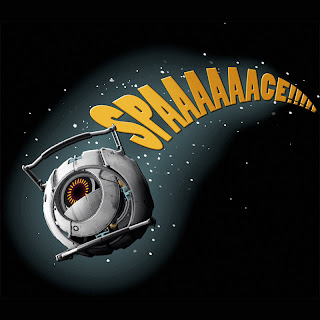
So, does this mean that it is now canon that the Half-Life/Portal and Elder Scrolls franchises take place in the same universe? Will we see headcrabs and Combine invade Tamriel in The Elder Scrolls VI? Will Dragonborn and Mammoths show up in Half-Life 3? No. Don't even go there.
 "I'm in space. And by 'space' I mean 'Tamriel'."
Of course, Valve and Bethesda have recognised this glaring deficiency in the game, and created a mod that allows the space core from the end of Portal 2 to float around behind you and etc.
The same update also adds high-resolution texture packs to make the PC version of the game look totally awesome(r) and activates the Creation Kit, which allows you to adjust and tweak all aspects of the game, but frankly this is just small fry compared to the space core thing.

So, does this mean that it is now canon that the Half-Life/Portal and Elder Scrolls franchises take place in the same universe? Will we see headcrabs and Combine invade Tamriel in The Elder Scrolls VI? Will Dragonborn and Mammoths show up in Half-Life 3? No. Don't even go there.
Sunday, 12 December 2010
Two major new game sequels on their way
Two of the biggest computer game franchises are returning in 2011 for new instalments.

First up, the fifth game in The Elder Scrolls series is landing on 11 November (11/11/11). Skyrim is set in the frigid northern country of the same name, located to the north of Cyrodiil (the setting for The Elder Scrolls IV: Oblivion) and west of Morrowind (the titular setting of the third game). Expect lots of snow, ice, mountains and bad Viking impersonations. The game seems to be more of a sequel to Oblivion than previous games (which were pretty much divorced from other games in the setting), with the events of that game referred to in the trailer. Also, dragons will apparently play a role, or so Max Von Sydow tells us. Encouragingly, the game will use a new engine rather than the Gamebryo engine that powered Morrowind, Oblivion, Fallout 3 and Fallout: New Vegas.
Secondly, the third and apparently final game in the Mass Effect trilogy should also appear somewhere around the same time. Mass Effect 3 opens with Earth under assault by alien forces with Shepard and his crew having to find reinforcements and save the day. For a change, the game trailer depicts London as being the main city under attack rather than an American population centre.
As with the previous game in the series, you can transfer existing characters and saves into the new title and events in the game will vary depending on decisions you made in the prior two games.

First up, the fifth game in The Elder Scrolls series is landing on 11 November (11/11/11). Skyrim is set in the frigid northern country of the same name, located to the north of Cyrodiil (the setting for The Elder Scrolls IV: Oblivion) and west of Morrowind (the titular setting of the third game). Expect lots of snow, ice, mountains and bad Viking impersonations. The game seems to be more of a sequel to Oblivion than previous games (which were pretty much divorced from other games in the setting), with the events of that game referred to in the trailer. Also, dragons will apparently play a role, or so Max Von Sydow tells us. Encouragingly, the game will use a new engine rather than the Gamebryo engine that powered Morrowind, Oblivion, Fallout 3 and Fallout: New Vegas.
Secondly, the third and apparently final game in the Mass Effect trilogy should also appear somewhere around the same time. Mass Effect 3 opens with Earth under assault by alien forces with Shepard and his crew having to find reinforcements and save the day. For a change, the game trailer depicts London as being the main city under attack rather than an American population centre.
As with the previous game in the series, you can transfer existing characters and saves into the new title and events in the game will vary depending on decisions you made in the prior two games.
Subscribe to:
Posts (Atom)