Showing posts with label bethesda. Show all posts

Friday, 17 July 2026

Bethesda confirm FALLOUT remasters and new games from themselves and Obsidian Entertainment

Bethesda have issued a major update on their game projects and franchises, confirming that they are deep in development on Elder Scrolls VI, in pre-production on Fallout 5 and are partnering with Obsidian Entertainment on a new Fallout game. They also confirm that remasters for both Fallout 3 and Fallout: New Vegas are in development.


There's quite a lot packed into the update. They confirm that Fallout 4 (2015) has surpassed 35 million sales since a boost from the popularity of the TV series. Online game Fallout 76 (2018) continues to see new expansions, and next year's big expansion, Raven Rock, will act as a prequel to Fallout 3 (2008).

That makes more sense as Bethesda have confirmed that Fallout 3 Remastered is now in development, and presumably will launch in 2027. That matches the leaked timescale some time ago that predicted a two-year gap between Oblivion Remastered (2025) and Fallout 3 Remastered. More intriguingly, they confirm that Fallout: New Vegas Remastered is also in development. This makes sense as FO3 and New Vegas share a lot of assets, so updating the former means you've also done a lot of work for the latter already.

Bethesda are also planning a special event for the 30th Anniversary of the original Fallout on October 10th next year, with a special event in Washington DC (it might be smart money to circle that potential date for Fallout 3 Remastered's release, as FO3 is set in DC).

Bethesda confirmed last week's rumour that a new Fallout game is in development at Obsidian, and also went further by confirming that this game will be a new spin-off title like New Vegas, not Fallout 5 (though this is somewhat a distinction without much of a difference). Fallout 5 itself is in pre-production at Bethesda themselves, but they will not be able to start full production until work on The Elder Scrolls VI is completed. They confirm that ES6 remains their current priority and is currently looking in a good shape, but no release date is projected (previous leaks suggest the game won't launch until 2028-29 at the earliest). They also confirm that The Elder Scrolls V: Skyrim has now surpassed 65 million sales and Starfield has passed 17 million in sales.

This news confirms Microsoft's decision to have its studios pivot to their most famous and popular franchises and shorten development timelines (and thus costs). By the time Elder Scrolls VI launches, it will be around eighteen years since Skyrim was released, a huge amount of time to expect fans to wait between games.

It will be interesting to see when we start getting more information on these developments, such as confirmation of ES6's subtitle and setting.

Wednesday, 8 July 2026

VERY STRONG RUMOUR: Obsidian Entertainment to develop a new FALLOUT game

As has been widely reported elsewhere, Microsoft have embarked on a massive restructuring of their video game business. Thousands of staff are to be laid off and around five studios are to be sold or spun off into independent businesses. Even the company's more successful studios are being reconfigured, with Obsidian Entertainment re-tasked to help Microsoft focus on its most successful IP. To this end, according to highly reliable industry insider Jason Schreier, Microsoft have commissioned Obsidian to make a new game in the Fallout series.


Obsidian Entertainment were founded in 2003 but many of the key founders had previously worked for Black Isle Studios, formerly the internal development studio at Interplay. There, several staff had worked on Fallout (1997), Fallout 2 (1998) and the original Fallout 3: Van Buren, which was cancelled when Interplay collapsed around 2003. The IP was sold in full to Bethesda Game Studios, who proceeded to develop Fallout 3 (2008), Fallout 4 (2015) and the multiplayer-focused Fallout 76 (2018). However, Bethesda partnered with Obsidian to develop Fallout: New Vegas (2010), often (but not universally) cited as the best game in the series.

In the meantime, the Fallout franchise has acquired a substantially more massive fanbase, with the arrival of the Fallout TV series on Amazon Prime Video in 2024. The show has already produced two seasons and a third began shooting this week. There have also been new tabletop games. Aside from the ongoing development of Fallout 76 through expansions, Bethesda had admitted they were still years away from starting work on Fallout 5 due to their prior commitments to Starfield (2023) and its DLC, and the in-progress Elder Scrolls VI, which will be the sequel to the 60 million+ selling Skyrim (2011). Also according to Schreier, The Elder Scrolls VI is not expected to be released before 2028 at the earliest, likely punting off any Fallout 5 to the early-to-mid 2030s, by which time the TV show will almost certainly be over.

The only Fallout game on the horizon is Fallout 3 Remastered, which has not been formally confirmed but reliable leaks suggest it is in development as a co-production between Bethesda and Virtuos Studios, who previously handled The Elder Scrolls IV: Oblivion Remastered (2025).

Obsidian were acquired by Microsoft in 2018 and have since released The Outer Worlds (2019), Grounded (2022), Pentiment (2022), Avowed (2025) and The Outer Worlds 2 (2025). Grounded 2 is currently in Early Access.

Obsidian's regular release cadence has been extremely impressive by modern standards, especially compared to other Microsoft studios (in the same timeframe, Bethesda have only released Starfield). However, these games' critical and commercial success has been mixed; Pentiment was a critical darling but a low-key release that sold only moderately. Grounded is Obsidian's most successful game in its history, acquiring over 20 million players in a couple of years (shading even Fallout: New Vegas's success), but has largely gone unrecognised due to its perceived children's focus and not being in Obsidian's usual core RPG wheelhouse. Avowed did reasonably well (over 6 million players in its first month on sale) whilst Outer Worlds 2 was a major commercial disappointment, with both games reviewing only moderately. Grounded 2 has picked up some major plaudits in Early Access, but is largely being developed by an external partner studio.

As part of the strategic shift, work on Avowed 2 has been downgraded, with a small team to continue work whilst most shift to the Fallout game. An unannounced major new RPG project, claimed by ex-Obsidian founder Chris Avellone to be set in the Shadowrun universe, has been paused, again with the team expected to be redeployed to the Fallout game. Work on the DLC for The Outer Worlds 2 is expected to be completed shortly.

The new Fallout game will apparently be headed by Josh Sawyer, who was previously the director of Fallout: New Vegas. New Vegas writer John Gonzalez, as well as Fallout co-creators Tim Cain and Leonard Boyarsky, are all working at Obsidian and may work on this new project as well.

No information about the game's setting or title is known, and may still be in flux as apparently this strategic decision may have only been made this week. Microsoft are likely to want to call the game Fallout 5 to capitalise on interest in the series and the length of time since the last mainline release, but whether that's the case remains to be seen.

More on this when it appears.

Tuesday, 19 August 2025

First trailer for FALLOUT: Season 2 released

Amazon have released the first trailer for the second season of their Fallout TV series.

The trailer confirms the second season will be set in and around the city of New Vegas, Nevada, the same setting as the iconic 2010 video game Fallout: New Vegas. The TV show will revisit some of the same locations and factions, including the Strip and the Lucky 38 casino, the robot Victor, the Novac dinosaur, the antagonistic Caesar's Legion and the enigmatic Mr. House, now played by The Leftovers' Justin Theroux. The show also hints at a civil war within the Brotherhood of Steel, the first show appearance for the Deathclaw (Fallout's most iconic monster), and even suggests that VATS - the PipBoy-generated targeting system which seems to slow down time to allow for better combat reactions - might be an in-universe thing (or it might just be really cool slowmo).

Fallout's second season debuts on Amazon Prime Video on 17 December this year. After the massive success of the first season, the show has already been renewed for a third season, presumably to follow in 2027.

Tuesday, 22 April 2025

THE ELDER SCROLLS IV: OBLIVION REMASTERED announced and released

As was prophesised in the ancient texts (well, yesterday), Bethesda Game Studios have announced and released their remake of The Elder Scrolls IV: Oblivion on the same day. The game is available right now on PlayStation 5, Xbox Series X/S and PC.


French studio Virtuos created the remaster, working under the watchful eye of Bethesda. The game features a completely reworked graphics engine, with Unreal Engine 5 now handling rendering, though the original GameBryo Engine is apparently still working somewhere under the hood. Every graphical asset in the game was recreated from scratch and some areas have been given a serious glow-up. The game's infamously janky levelling system has been reworked, and combat is more responsive. The game has added new combat animations and physics reactions, and the voice cast has been hugely expanded with many new voice actors added. However, the original voice actors' performances (including Sir Patrick Stewart and Sean Bean) have also been preserved. As expected, the remaster includes both the Knights of the Nine and Shivering Isles expansions.

The Skyblivion remake mod team can take some heart from the fact that Oblivion Remastered appears to not have thoroughly reworked area design or the game's infamously samey dungeons. Skyblivion has focused on expanding those areas of the game, which should be a major improvement. Skyblivion has committed to a 2025 release date as well.

The same leaks indicating the existence of Oblivion Remastered a few months ago also claimed that Bethesda are working on Fallout 3 Remastered, which is also a very interesting prospect.

Monday, 21 April 2025

Bethesda to announce THE ELDER SCROLLS IV: OBLIVION REMASTERED tomorrow

Bethesda have confirmed they will be making a big announcement about The Elder Scrolls IV: Oblivion Remastered tomorrow, April 22nd 2025, at 11am EST, 8am PST and 4pm BST. This follows weeks of speculation and leaks about the game, and widespread rumours the game would be "shadow-dropped" (released with absolutely no preamble or warning) today.


The Elder Scrolls IV: Oblivion was originally released in 2006 as, obviously, the fourth game in that venerable series, following on from Arena (1994), Daggerfall (1996) and Morrowind (2002). Only one additional game in the mainline series has been released since then, the infamous Skyrim (2011), although The Elder Scrolls Online (2014) has kept some attention on the franchise. Bethesda have confirmed that The Elder Scrolls VI (no subtitle confirmed) is their next project but no release date has been mooted.

Oblivion was noteworthy for its very impressive graphics (for the time), its status as a unit-shifter for the Xbox 360 console (the game was later also released on PlayStation 3), its huge open-world environment, outstanding and quirky side-quests and its employment of top vocal talent, including Patrick Stewart and Sean Bean. The game eventually saw some criticism for its weird levelling mechanics, the tiny pool of voice actors (often leading to two NPCs with identical voices talking to one another) and the irritating Oblivion Gates, which had a tendency to crop up and interfere with whatever side-quest the player was trying to do at the time. The game was also seen as too much of a standard fantasy, after the extremely weird Morrowind; Skyrim was seen as a more halfway house between Oblivion's conservatism and Morrowind's bizarre experimentation. Finally, Oblivion was the first high-profile game to feature paid DLC, in the form of the infamous "horse armour" upgrade, which some players despise to this very day. Still, Oblivion was well-regarded for its atmosphere, rich assortment of weaponry, interesting bestiary of enemies and its extremely epic conclusion.

Given the number of times that Skyrim has been upgraded, remastered and re-released, fans had been speculating for years about the same attention being given to Oblivion, giving it broadly shares similar technology and a graphics style to the later game (Skyrim's Creation Engine being only a moderate development of Oblivion's GameBryo Engine). Bethesda themselves always seemed cool on the idea, saying they'd rather spend time working on a new game and pointing to numerous fan projects doing similar things. Oblivion has had mods available for many years to improve its mechanics and graphics, to a point.

However, Bethesda may have been slightly disingenuous, having outsourced development of the remaster to Virtuous Studios whilst maintaining oversight from afar.

News broke in 2023 that Bethesda were planning remakes of both Oblivion and Fallout 3 as far back as 2020, as well as considering a Dishonored 3 from their subsidiary studio Arkane. Dishonored 3 never happened - Arkane instead released Deathloop and Redfall, and are now making a video game based on the Marvel character Blade - leading to scepticism about the other claims. These were emphasised by the impressive and sterling work done on the unofficial fan remaster Skyblivion, which was of a very high quality and had committed to a 2025 release, leading to speculation that Bethesda might consider that project for an official release.

Based on the (mostly credible) leaks, Oblivion Remastered will include expansions Knights of the Nine and Shivering Isles (and, yes, the horse armour) and will release on PlayStation 5, Xbox Series X/S and PC, and will be available on Game Pass on both PC and Xbox. The game's graphics have been reworked from the ground up, possibly in Unreal Engine 5, with significant visual upgrades. The UI, combat and levelling also appear to have been reworked for a more modern feel. To what degree other elements have been upgraded is unclear; Skyblivion has redesigned every fort, cave and dungeon in the game to be larger, more expansive and more unique, but it's unclear if Remastered has gone that far.

It's also unclear if tomorrow will be an announcement about the remaster or just the actual straight-up release of the game. We will need to see how that unfolds.

Tuesday, 25 February 2025

SKYBLIVION developers re-commit to 2025 release

The developers of fan mega-mod Skyblivion, which seeks to update venerable fantasy RPG The Elder Scrolls IV: Oblivion (2006) to modern-ish standards, have re-committed to releasing the game in 2025, as they originally promised two years ago. The project is almost feature-complete, with developers and testers now able to run through entire quests, as they have demonstrated in a new video.


The original idea behind the project was to remake Oblivion in the upgraded Creation Engine of its successor, Skyrim (2011). However, the project stalled after several years and was relaunched before the pandemic under new management. The title is somewhat misleading, as the game now features improvements from later versions of the engine and features from other modders, including better 4K textures and enhanced lighting. The mod is also not a straightforward remake, as it redesigns and enhances some areas of the games, for example replacing the identikit caves with different designs based on their descriptions (i.e. mines and random caverns no longer look identical) and making the infamously tiny forts larger and more imposing. The city of Leyawiin, which was massively scaled back in development, has been returned to its original, imposing design straddling a major river with a drawbridge to allow ships to pass.

The creators have kept in touch with Bethesda during development to confirm what they can and can't do: they've kept the original soundtrack and even added to it with new material, but have had to re-record all dialogue for legal reasons (presumably the need not to pay Sean Bean and Patrick Stewart lots of money again). This will probably be a boon, as Oblivion infamously had a tiny voice cast, and it wasn't uncommon to stumble across three people with the exact same voice talking to one another, which was weird.

Playing the mod will require the player owns copies of both Oblivion and Skyrim. As noted before, the plan is to release the mod before the end of 2025 via Steam, GoG and Nexus Mods. A console version is currently impossible due to the massive size of the new files (which outsizes the limits Bethesda put in place for console modding).

In 2023 it was rumoured that Bethesda were considering their own remaster of Oblivion, which sounds like an exercise in futility compared to the scale of Skyblivion. It'll be interesting to see if that project is actually something that's happening.

Sunday, 12 January 2025

Indiana Jones and the Great Circle

1937, Marshall College, Connecticut. Renowned archaeologist Indiana Jones is back teaching when an imposing man breaks into the college and steals an ancient cat mummy. An incensed Jones pursues the man, following clues to the Vatican, where the Catholic Church is negotiating a delicate coexistence with Mussolini's fascist government. Allying with an old friend and an intrepid Italian reporter searching for her missing sister, Jones runs afoul of an old German nemesis and embarks on an epic journey that will take him all over the world in pursuit of the greatest archaeological discovery of all time.

Indiana Jones is one of the most beloved film franchises of all time, with the collaboration between Steven Spielberg, George Lucas and Harrison Ford delivering two of the best action-adventure films ever made, two okay ones and one stinker (your mileage may vary on which is which), whilst also delivering a ton of decent spin-off media, including books and a TV show. However, the franchise has often faltered in the sphere of video games. A lot of titles have been generic action games wearing a Fedora and leather whip skin, diverting but not really nailing the spirit of the movies or the character. Arguably the last all-time classic Indiana Jones video game was Indiana Jones and the Fate of Atlantis, released way back in 1992.

Now there's a new challenger. Indiana Jones and the Great Circle has an original story and was developed by Machinegames - best known for the Wolfenstein action series - for Bethesda and Microsoft. The game is mostly played from a first-person perspective, and sees the player controlling Indiana as he goes on a round-the-world trip to stop the Nazis from getting their hands on a number of powerful, ancient artefacts. Harrison Ford declined to return as Indy, so omnipresent voice acting superstar Troy Baker takes up the role, delivering a performance which both nails Ford's sound and cadence, and is a good performance in its own right.

Where The Great Circle really succeeds is taking a step back and thinking thoughtfully about who Indiana Jones is and isn't as a character. Jones is happy to whip out a gun and shoot enemies in a pinch, but he isn't a seasoned sharpshooter. He's happy to sneak up on a bad guy and knock them out, but he's not a stealth assassin. His main skills are deduction, speaking a dozen or more languages, and exploring ancient ruins filled with curiously well-maintained traps. He is also kinda goofy as a character, prone to the occasional terrible joke and being a bit cack-handed, factors which the game also tries to invoke.

As a result, the game allows you to fire guns, but sees this as a fail state and usually this results in you getting overwhelmed, unless you are able to escape in the confusion, or you're dealing with very isolated enemies. Indy is awkward with guns and sometimes panics during reloading, which can be frustrating but does dissuade you from relying on them (headshots or pointblank shotgun blasts not resulting in instant kills is very dumb, though). You can sneak up behind people and knock them out, but doing this with your bare hands is tricky, so grabbing a blunt instrument and whacking them on the back of the head is often a better move. In theory, enemies are supposed to panic and sound the alarm upon discovery of bodies, so you can move bodies elsewhere, but in practice this only seemed to work about half the time, and never if you've moved the bodies from elsewhere. Fighting a bunch of bad guys in the Vatican and hurling their bodies from a balcony just to find the enemies below politely stepping around them without comment was odd.

Indy's most reliable weapon is his straight-from-the-films ability to wear somewhat flimsy disguises and, despite not looking like any locals at all, immediately fit in. Arriving in a new location can see a lot of careful travelling until you find a local uniform and then just stroll into enemy bases. Of course there are ways of still being discovered - enemy officers know who all their men are and will get suspicious at a new guy loitering around - as well as there being drawbacks. Otherwise friendly locals may refuse to help you if they see you in a German military uniform, but you can find local garb or just Indy's standard gear to regain their trust.

The game isn't an open-world affair, but instead has three open-ish maps which you can traverse, each one of which has multiple ruins you can explore, to service the main story, side-quests or optional activities. Penetrating ruins requires some jumping, using your whip to traverse distances or climb to higher exits, and solving puzzles. All of this is done in a very enjoyable way, and after years of solid Tomb Raider and Uncharted games, it's satisfying to see their main inspiration finally getting a game worthy of his name. Optional activities include finding relics for a museum, taking photographs of impressive sights and locating notes on everything from local cuisine to personal correspondence. Indy also spends a lot of time undercover in Italian and German military camps, where he can find locked safes and cases containing useful equipment. There are also collectibles including comic books and more useful skill books, which allow Indy to learn new skills to enhance everything from combat to stealth to improved medical skills.

Structurally, the game has some light Metroidvania elements as you can revisit previous locations with later-acquired skills or equipment to open new areas, although this element is not strongly publicised, and in fact is a bit weird: you have to wait until the game autosaves before leaving for a new location, otherwise anything you've done since will be deleted, and the game's incredibly urgent and pressing storyline means that Indy can't fly between, say, the Vatican and Connecticut willy-nilly, so any re-visits to previous areas is "non-canonical," you're really just remembering your original time in that location in a different way. This is an awkward mechanic that never really feels right, but is necessary since finding all the collectibles and side-objectives on your first visit to an area is almost impossible. It can be amusing to go back to earlier areas after levelling up your fighting skills in later areas, as the blackshirts in the Vatican are laughably easy to take out in fistfights once Indiana as even just moderately improved his unarmed combat. Watching cardinals and nuns step gingerly around a substantial pile of unconscious fascists never stops being entertaining.

You also spend a lot of the game with a companion, in this case Italian journalist Gina Lombardi (Alessandra Mastronardi) who is working hard to expose the dangers of Italian fascism and also looking for her sister, an archaeologist who fell in train with Indy's German rival, Emmerich Voss (Marios Gavrilis, who not so much chews the scenery as gloriously consumes it wholesale). Gina can be useful in helping solve puzzles and provide hints if you get stuck in a particular area, though she does have a slight tendency to get in your way and block doorways (though she gets out of the way sharpish if you have problems). Gina fits right into the classic pantheon of Indy love interests who can hold their own. Voss is also a glorious opponent, prone to tedious pontificating and lording it over Indy despite being mostly reliant on Indy to work out the location of the artefacts and then trying to steal them. Also an honourable mention to the late Tony Todd, who provided a fine performance (mocap and voice) before passing away in November.

Despite the mounds of side-content, the game does not outstay its welcome: I finished the whole game, in fact almost 100%ing it (and only being prevented from doing so by a bug), in a very reasonable 38 hours. It's refreshing to play a game that isn't so overstuffed with optional side-content that it becomes a tedious grind. The game also mixes up its small open-world-ish hub areas with much more focused interstitial levels (like a trip to the Himalayas and a side-visit to Shanghai), which also helps pacing.

Indiana Jones and the Great Circle's biggest success is feeling like the Indiana Jones movies. The writing, dialogue and puzzles are all on-point, and the revelation of the final objective of the game is genuinely impressive (to the point you can imagine Spielberg and Lucas cursing as to why they never had that idea). If it was a movie, it would probably be at least the third-best one in the series. Like Batman: Arkham Asylum before it, The Great Circle feels like an authentic, additive entry to its franchise, not just a generic tie-in with some iconography slapped on the top.

The game does have flaws. Although I understand why they made guns awkward to use, there are moments where it can be very frustrating, and headshots not killing someone immediately is daft. The mechanic for revisiting previous location is awkward. The game is graphically beautiful (stunning, in fact) in terms of environments and lighting, but character models aren't quite there and can slip into the uncanny valley (Indy is also prone to making some odd faces and expressions). Idle dialogue can be gratingly repetitive (the sixty-first time Gina reminded me she couldn't swim felt a bit unnecessary). There are also some bugs with the game tripping over itself in trying to track objectives and some achievements not triggering until you run backwards and forwards a few times. During the game's finale a door opened but didn't "really" open, leaving the area beyond an empty void until I worked out how to trigger the proper cut scene. Early patches have eliminated some of these issues but others remain (being on 98% completion despite completing 100% of the game, but the game not recognising the last 2%, is irritating, if inconsequential).

But overall, Indiana Jones and the Great Circle (****½) is easily the best Indiana Jones video game ever made, true to the spirit of the source material and a cracking good adventure even for casual fans of the franchise. The game is available now on PC and Xbox, and should launch on PlayStation 5 this spring.

Thank you for reading The Wertzone. To help me provide better content, please consider contributing to my Patreon page and other funding methods.

Thursday, 7 November 2024

Starfield: Shattered Space

A year ago, Bethesda released Starfield, their massive space RPG that was a decade in the planning. It's fair to say it underwhelmed, despite some enjoyable moments. The game had a laudably weird, off-kilter main storyline and Bethesda's best combat to date, but bland writing, dry characters and a lack of the curated exploration that characterised their best games made it a frustrating experience.

In particular, Starfield suffered from its structure, which encouraged you to jump from star system to star system not via its space travel system but by fast-travelling. Given that both involved faffing around with menus and loading screens rather than engaging in rip-roaring space adventures, why not just do the faster method? Although more efficient, it arguably defeated the object of a space game to mostly avoid the space bit of it.

Shattered Space, the first major Starfield expansion, tries to grapple with this problem head-on. The expansion starts in a very promising way, with you being drawn to an abandoned space station without gravity, and having to fight what appear to be "space ghosts." The mystery of the space station is unusually gripping (by Starfield standards, anyway) and lasts just the right amount of time before you get some exposition which leads you to Va'ruun'kai, the homeworld of House Va'ruun, a faction mostly represented in the mothership game by fanatical space pirates worshipping a great serpent.

Your arrival on Va'ruun'kai is not welcomed and you'd have probably been ventilated in short order, but fortunately there was some kind of "incident" just before you arrived which blew up half the capital city, created gravitation anomalies through the area and brought in yet more space ghosts. Thanks to your knowledge of weird space phenomena from the OG game (and the incredible desperation of the planet's leader), you're recruited to help them out even if you're not totally convinced that their big space serpent god is actually a thing.

After the initial space station episode, the entire game takes place on Va'ruun'kai. The generously-sized new map is handcrafted and covered with story-critical locations, locations essential to side-quests and even locations just there for you to stumble across in random exploration. This is a huge change from the base game where most planetary areas are procedurally generated with identikit bases with the same layout, and the same small pool of events constantly happening. If anything, Shattered Space might spoil you (well, more) for the main game.

The collection of quests here is a notch above the original game, and occasionally it surprised me. One quest involved helping out a confused elderly gentleman after his daughter and only carer disappeared in the incident. This quest makes a big play for an emotional story - something not so much not in modern Bethesda's normal wheelhouse as not even in their galaxy - and almost pulls it off. A lot of the side-quests tie into the annihilation of half the city and its people, selling it as a big, traumatic event in these people's lives (and perhaps explaining a bit better than usual why they immediately trust the total rando who's shown up to save their arses for them). The main mission chain is more predictable, requiring you to bring the three ruling factions of the city in line by doing favours for them, then recovering vital equipment to allow you to get inside the lab where the incident began. But it's executed at least moderately better than the original game.

Where the expansion falters, not unlike the core game, is in comparison to its forebears and contemporaries. It feels like the expansion is aiming at a similar experience to Fallout 4's splendid expansion Far Harbor, including the hand-crafted smaller map, better story focus, and even its focus on one of your companion characters (Andreja is from this planet and bringing her along can open new dialogue options). But the game isn't quite as compelling as Far Harbor's, which had much more bittersweetness and character depth, and a really thorny moral quandary at the end. Shattered Space is less engrossing, and Andreja's extra ten lines of dialogue or whatever it is can't compare to Nick's much greater direct involvement in the Far Harbor narrative. Also, as a lot of people compared Starfield to Cyberpunk 2077 (both being first-person SF RPGs with an open world) and found it critically wanting, so Shattered Space is not even operating on the same level as Phantom Liberty.

Shattered Space is basically 12-15 hours or so of more Starfield, which some might find a questionable proposition, but the more focused storytelling and characterisation is at least a moderate improvement over the base game, even if that does insanely mean dropping the space travel bit from your sci-fi RPG. Graphically it's very pretty (especially if you're a big fan of purple), and it feels like the environments are a step up over the base game. Still, it's hard to conclude anything different to the original game: Shattered Space (***½) is solid but underwhelming. The expansion requires Starfield to run and is available on PC and Xbox Series X/S, and via the Xbox Game Pass service.

Thank you for reading The Wertzone. To help me provide better content, please consider contributing to my Patreon page and other funding methods.

Sunday, 21 April 2024

Fallout: Season 1

2296. Two hundred and nineteen years have passed since the world was devastated in the Great War. Tens of thousands of people in the United States survived in vaults, vast underground complexes dedicated to human survival. When Vault 33, under Santa Monica, Los Angeles, is raided by surface dwellers and its Overseer captured, it falls to his daughter Lucy to set out in search of him. She finds her search complicated by an overlapping quest to find a technological gizmo that could save the wasteland, with multiple other factions searching for the same device, including the Brotherhood of Steel and a ghoul bounty-hunter. Lucy has to overcome her initial naivete about the world to accomplish her mission.

Fallout is a video game franchise which has worn a lot of hats over its twenty-seven years in existence. It's been a dark comedy, a horror fable, a tale of political intrigue, a survival story and an action piece. Each one of the nine games to bear the Fallout banner has been notably different from the others, with different emphases on things like comedy, character or worldbuilding. This has made Fallout almost uniquely contentious as a franchise: every game in the series is somebody's favourite (okay, maybe not 2004's terrible action game Fallout: Brotherhood of Steel) or somebody's most reviled. Each game has a different tone and style, and as each game is somebody's first Fallout experience, they go away thinking of that as being "real Fallout" and anything that deviates from that is a mistake.

When you're making a Fallout TV show, that gives the production team a headache. How can you thread the needle between sometimes wildly different source material, with an infamously contentious fanbase, which also appeals to the general audience? It turns out, pretty well.

Fallout: The Show on Television takes advantage of its format to have an ensemble cast. We mostly focus on Lucy (Ella Purnell) as she leaves Vault 33 and steps onto the surface world for the first time and has to contend with its whacky and weird inhabitants, but we also follow the misadventures of Squire Maximus (Aaron Moten) of the Brotherhood of Steel as he tries to rise through the ranks. No less than two storylines follow the character of Cooper Howard (Walton Goggins), the first as he experiences the events leading up to the Great War first-hand, and the second in the present, where Howard, now transformed into an immortal ghoul by radiation, is a bounty hunter searching for the tech-macguffin. Amusingly, these characters map to three distinct playstyles for the game: Lucy as the optimistic do-gooder, Maximus as the bumbling anything-goes character, and Cooper as the murderhobo whose first response to even the merest hint of a challenge is comically over-the-tope ultraviolence.

These characters are surrounded by an utter galaxy of great supporting turns, from the small to the substantial. Johnny Pemberton as Squire Thaddeus steels every scene he's in (and demonstrates what over-encumbrance would look like in real life). Moises Arias has the meatiest dramatic subplot as Lucy's brother, who stays behind in Vault 33 to investigate some weird goings-on at home (ably supported by Dave Register as Cousin Chet). Leslie Uggams (Deadpool's Blind Al) is outstanding as Betty, a senior member of Vault 33's ruling council. Kyle MacLachlan as Lucy's father Hank is obviously brilliant. Lost and Person of Interest's (strangely ageless) Michael Emerson is terrific as a troubled scientist on the run. Matt Berry, Michael Rapaport and Chris Parnell all have small, but memorable moments of scene-stealing excellence. Also a word of approval to the latest incarnation of  Dogmeat (sorry, CX404), who is present and correct and portrayed as they would appear in-game (and you start realising that such a canine might not be altogether right in the head).

As excellent as the cast is the production design. Many production designs on adaptations like to change all the designs (presumably so they can put the new designs in their portfolios), but the guys on Fallout clearly just took designs from the games and whack them on screen. The vaults all look like they've been snapped together from the prefab pieces in Fallout 4's Vault-Tec DLC. Even the door buttons look exactly the same. Characters improbably heal quickly from ludicrous injuries by just injecting lore-accurate stimpaks. The creatures are pretty much high-res versions from the game, although they do throw in a couple of new entries. The Brotherhood power armour is all fantastic. Nothing's been changed here for the sake of change, and, to paraphrase someone involved in the franchise, it just works.

The TV show certainly is not perfect, though. At eight hours there's a couple of moments of wheel-spinning. The shifts in tone mostly work, but there's a few jarring shifts that aren't as well-signposted. The Vault 33 storyline is a bit thin and is strung out across the entire season through relatively brief sequences, maybe that could have been punched up a little bit. There's one continuity error regarding a date on a chalkboard which caused some fans to freak the hell out, but the debate over that was later shut down (and also by the cliffhanger ending of the season). This isn't a very weighty series, it doesn't have the emotional depth of, say, The Last of Us, but then it's not really aiming for that so that's not much of a complaint.

Fallout: The Gogglebox Version - Season 1 (****) is relentlessly entertaining, well-acted with just the right degree of dark humour, tragedy and horror. It's good pulp entertainment which is both true to the source material but also brings some more interesting ideas to the franchise (like the ensemble cast and the greater focus on the pre-war era). It's not the highest of art, and some will bounce right off it, but it does what it's trying to do with aplomb. The show is available now worldwide on Amazon Prime Television. A second season has already been commissioned.

Thank you for reading The Wertzone. To help me provide better content, please consider contributing to my Patreon page and other funding methods.

Thursday, 11 April 2024

Fallout Franchise Familiariser (2024 Edition)

Earlier today, Amazon Television released the first season of their Fallout TV show. Millions of people wholly unfamiliar with the franchise will be tuning into the setting for the very first time.

But what if you want to know more? Why do cows have two heads? Who's the cartoon guy with the nuclear thumb? What year is it? Time for a Franchise Familiariser course!

(note: an earlier version of this article was published here)

Vault Boy is the emblem of Vault-Tec, the corporation that built the vaults designed to protect humanity from nuclear war.


Fallout is a video game series set in the aftermath of the Great War, a nuclear exchange between the United States and China which utterly destroyed civilisation as we know it in the late 21st Century. In the backstory to the games this event took place on 23 October 2077. The original Fallout video game takes place almost a century later in 2161. The series then jumped forwards another hundred years, with Fallouts 2 to 4 taking place between 2241 and 2287. The Fallout TV series begins in 2296.

Fallout also takes place in an alternate timeline, one where transistor and microchip technology developed a lot later than it did in our world and nuclear power was embraced much more enthusiastically. Thus, whilst Fallout is set in a post-apocalyptic future it also channels the visual design and spirit of a lot of 1950s and 1960s pulp sci-fi novels and films, a design theme known as retrofuturism (sadly, my term "Americanapunk" failed to catch on).

Apart from Fallout 2 and New Vegas, each of the core Fallout games starts with your character in a Vault, one of 122 different, massive underground facilities designed to protect people from the radiation outside. For different reasons, your character has to leave the Vault and explore the outside world for some purpose. This usually leads into conflicts with the various factions that have emerged in the wake of the nuclear war, with the player's character having a decisive role to play in events. All of the main games take place in the same continuity and some characters appear or are referenced in more than one game, but each title is designed to stand alone with only light references to the events of the other games.

The Fallout franchise originally consisted of a series of video games. The first two were developed by the internal development studio at Interplay (this studio was renamed Black Isle whilst working on Fallout 2). Fallout 34 and Fallout 76 were made by Bethesda Game Studios. Fallout: New Vegas was outsourced by Bethesda to Obsidian Entertainment, the successor studio to Black Isle after Interplay went bust. The two development teams have adopted different focuses for the games, with Black Isle/Obsidian focusing on the American West and Bethesda so far focusing on the east coast of the former United States.

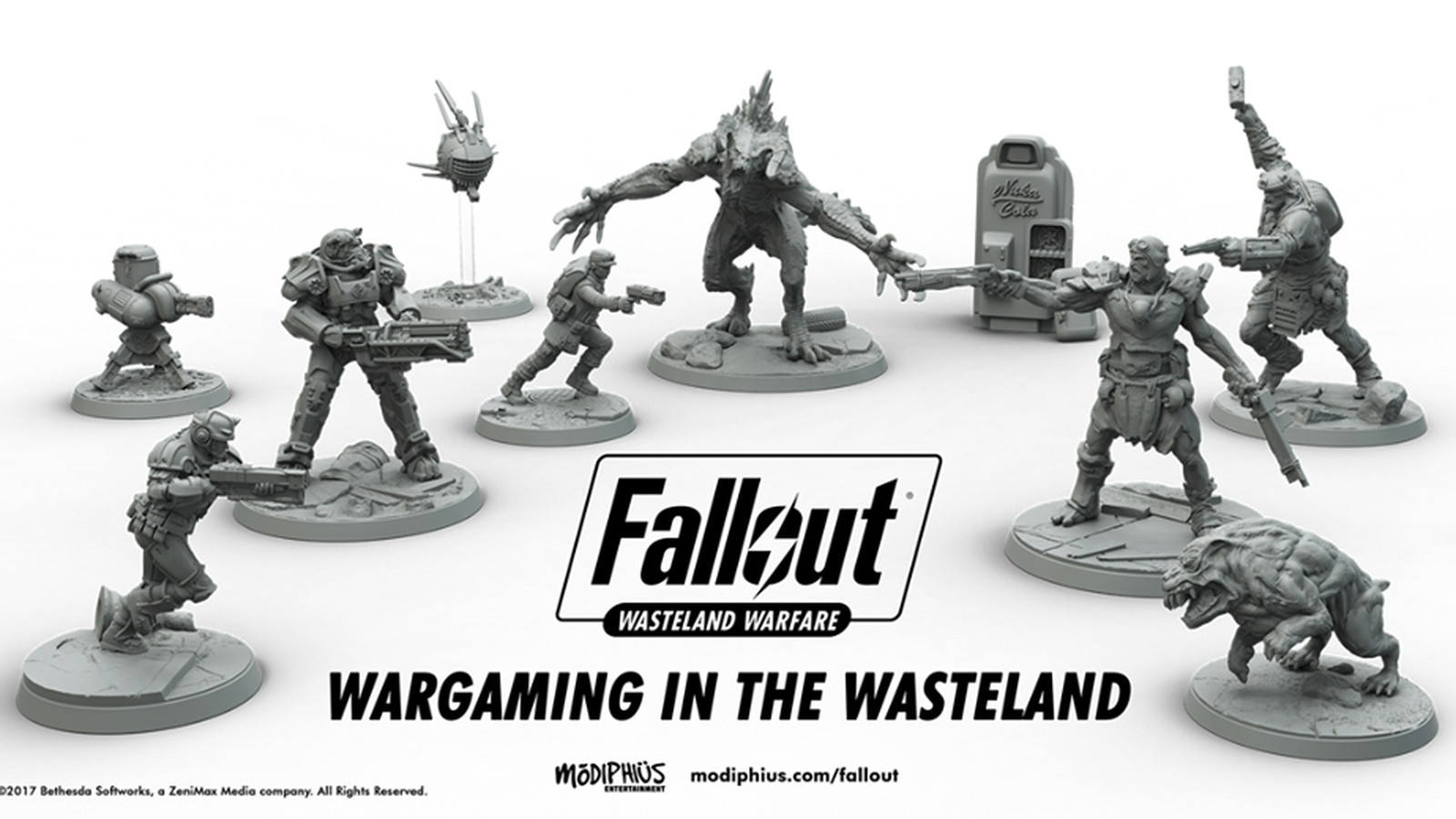
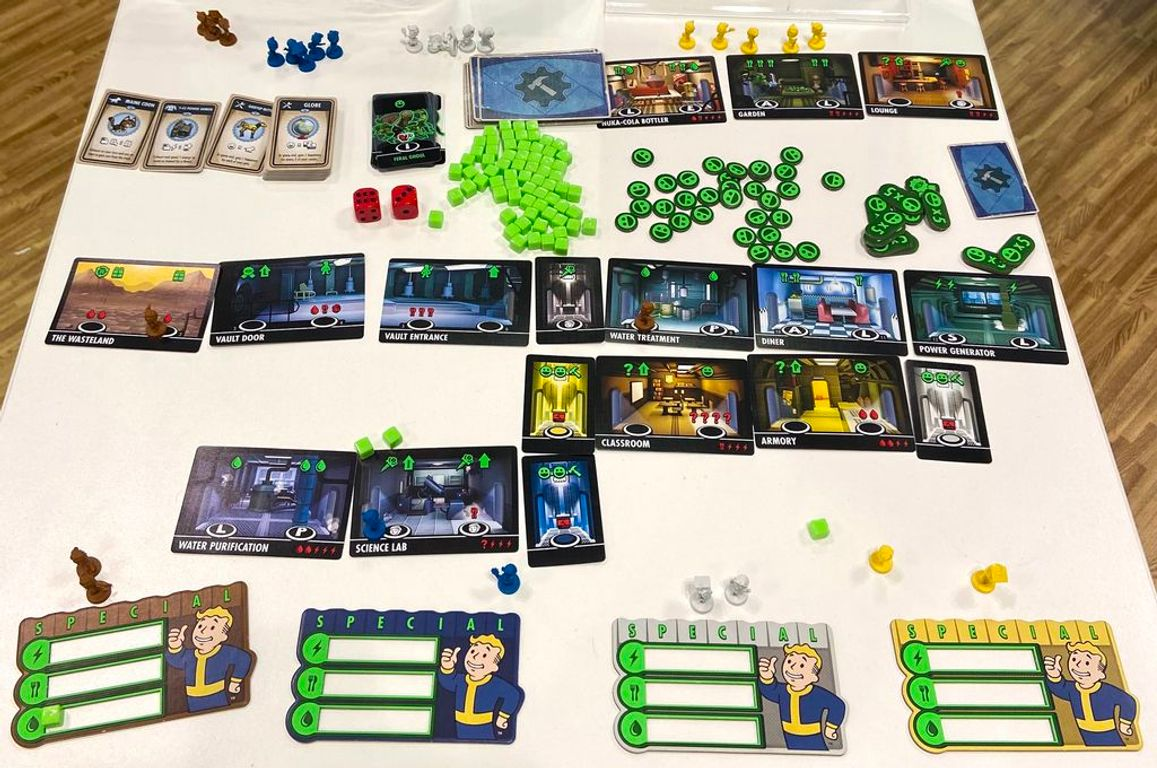
Since 2017, Fantasy Flight Games in the US and Modiphius Entertainment in the UK have been releasing tabletop games based on the franchise, including two board games, two tabletop wargames and a tabletop roleplaying game, along with a vast selection of miniatures.

There are no novels set in the Fallout universe, slightly unusually, although there are some art books and other "behind the scenes" materials that have been released.

The world as it stands in the latter part of the 23rd Century, two centuries after the Great War.


The Fallout canon consists of eight video games, five of which are considered part of the "core canon" and another three are spin-offs of debatable status.

The core canon consists of:
  • Fallout (1997)
  • Fallout 2 (1998)
  • Fallout 3 (2008)
  • Five expansions to Fallout 3Operation AnchorageThe PittBroken SteelPoint Lookout and Mothership Zeta (all 2009)
  • Fallout: New Vegas (2010)
  • Four expansions to New VegasDead MoneyHonest HeartsOld World Blues and Lonesome Road (all 2011)
  • Fallout 4 (2015)
  • Three expansions to Fallout 4Automatron, Far Harbor and Nuka World (all 2016).
  • Fallout 76 (2018)
The series also has three side or spin-off games, the official and canon status of which have been debated:
  • Fallout Tactics: Brotherhood of Steel (2001)
  • Fallout: Brotherhood of Steel (2004)
  • Fallout Shelter (2015)
Although unrelated in terms of setting, canon, characters or fiction, the Fallout franchise developed out of an earlier game series known as WastelandWasteland (1988) and especially Wasteland 2 (2014) and Wasteland 3 (2019) may therefore be of interest to players who are fond of the post-apocalyptic setting.

One of the primary inspirations for the Fallout series is the movie A Boy and His Dog, reflected in the iconography of the games.


Fallout's timeline diverges from our own after 1945 and the end of World War II. The transistor was not developed as it was in our history and human technology continued to favour big, bulky designs. The Soviet Union did not collapse as it did not in our world and China did not adopt free market reforms after the 1970s.

By the mid-21st Century the world had become gripped in a desperate energy crisis. The United States adjusted to this by creating small nuclear power generators and even fusion generators to power everything from cars to homes to aircraft. However, this process was slow and the country's reliance on oil remained high. In 2052 these strains resulted in the Resource Wars, with countries in Europe and Asia invading the Middle-East to claim the last remaining oil resources on the Eurasian continent. The result was a bloodbath which resulted in the first use of nuclear weapons on the battlefield in a century. The United Nations was powerless to intervene and the body was disbanded on 26 July 2052. In 2056, Tel Aviv was destroyed in a nuclear exchange between regional powers.

The United States stayed out of this conflict, choosing instead to develop the final oilfields in North America, located in Alaska. Immense pipelines were built and fortified, with the United States deploying enormous military resources to defend Alaska. This led to tensions with Canada, with both the pipeline and transport links running through Canadian territory to the fury of several Canadian nationalist movements. The nuking of Tel Aviv also sparked fears in the United States of a full-scale, global war.

The Battle of Anchorage in late 2076/early 2077 broke the back of the Chinese invasion of Alaska.

The Vault-Tec Corporation was founded to address this issue, and over the next twenty years they constructed 122 huge Vaults in various parts of the country. The aim was to provide shelter and food for anyone who could reach them in time. However, with an American population of over 400 million, the Vaults were woefully inadequate to help everyone. In reality the United States government did not originally believe that a nuclear war was likely, so with Vault-Tec's cooperation developed the shelters as social conditioning experiments.

In 2066, China launched a full-scale invasion of Alaska in an attempt to seize the pipeline. The Americans resisted the initial attack but soon fell into a deadly war of attrition. The Chinese numbers were overwhelming, but American technology and resources proved resilient. In 2074 the United States outflanked the invading armies and landed troops on the Chinese mainland, opening a second front in the war. At the same time, more confident in securing the oil pipeline and in its transfer to fusion power, the United States walked away from peace talks designed to end the crisis. In 2075 the USA formally annexed Canada and the following year deployed the formidable and iconic T-51b Power Armour, giving its troops a sizeable advantage on the battlefield. The Chinese forces in both Alaska and at home began to collapse, drained of fuel and unable to combat the new technology.

The United States appeared to be on the verge of victory, but only at a terrible cost: the country had become more militarised, with the deployment of military robots, biological weapons and devastating laser and plasma-based weaponry. Civil rights riots had broken out in several cities, only to be put down with terrifying, lethal force. Some American military units had rebelled when ordered to fire on civilians. Civil war appeared possible, even as the Chinese faced total defeat.


The Great War on 23 October 2077 ended human civilisation over the course of approximately two hours.

On 23 October 2077 the Great War took place. It lasted only two hours. It remains unknown who launched the first ICBM: the increasingly desperate Chinese, facing defeat at home and overseas; the American government, forced into desperation by the imminent collapse of social order at home; or other, unknown forces. What is known is that by the end of the day the entire world had been wracked by multiple nuclear explosions, human civilisation had effectively ended and a terrible nuclear winter had begun. 90%+ of the human race was wiped out, with the majority of the survivors being those in government shelters, or the lucky few tens of thousands who managed to get into the vaults before (or as, in some cases) the bombs fell. The only American city to survive largely intact was Las Vegas, as a wealthy (and fortuitously paranoid) industrialist living in the city, Robert House, had equipped the city with point-defence lasers and satellite-based countermeasures which scrambled the warheads on their way to the city.

In the aftermath of the atomic holocaust, most of the world suffered a devastating nuclear winter. Poisoned, radioactive rain wiped out a large number of animals and humans. The radiation either killed people outright or mutated them in bizarre ways. One of the most unexpected consequences was the transformation of some people into "ghouls." Some ghouls were feral and zombie-like, but others were intelligent and reasoning. Ghouls took on a hideous appearance but also appeared to be functionally immortal, with their ageing halting altogether. The radiation also mutated creatures like scorpions and cockroaches into much larger and deadlier versions of their former selves ("radscorpions" and "radroaches").

Adding to the chaos was the fact that during the war the United States had been experimenting with genetic engineering to help replace troops on the battlefield and greatly increase their strength and stamina. One result of this was the extremely lethal, huge and ferocious creature known as the deathclaw. The initial deathclaw specimens escaped the labs in the wake of the war, made their way into the wilderness and began to breed. Another experiment led to the creation of the Forced Evolutionary Virus (FEV) which would force the evolution of the subjects into a superior form. This led to the creation of the Super Mutants, tall and lumbering humanoids possessing tremendous physical strength. The FEV labs were located in two separate locations, one in Mariposa, California and the other in Washington, D.C. The FEV escaped from both, but due to differing strains they had slightly different effects: in the west the resulting Super Mutants were mostly still reasoning and intelligent, able to cooperate alongside other people, but in the east they became mostly savage and violent creatures, with the smart ones being very rare in comparison.

However, despite the near-total destruction of the world, humanity prevailed. Tiny pockets of survivors avoided starvation, radiation poisoning, gangs of raiders, mutated monsters and despair. They formed communities and survived. They eked out a living in the ruins of the old world, but as more and more time passed they began to build new settlements, form new alliances...and make the same old mistakes.


Released in 1997, Fallout was a roleplaying game viewed from an overhead, isometric viewpoint. The game allowed you to create a character via the SPECIAL (Strength, Perception, Endurance, Charisma, Intelligence, Agility, Luck) system and walk around in real time to talk to people and solve puzzles. When danger threatened, the game switched to a turn-based combat mode which allowed you to target specific body parts on enemies to incapacitate or kill them.

The game was initially conceived, at least briefly, as a sequel to Wasteland, an RPG created by Interplay and released by Electronic Arts in 1988. It was successful, but Electronic Arts didn't really do anything more with it. Interplay went solo, became a publisher in its own right and tried to buy the Wasteland IP, but EA refused to sell. Fallout was developed instead as a "spiritual" successor. The alternate timeline setting, single character focus and retrofuturistic art style were deliberately created to differentiate the game from Wasteland. The primary designer on the original Fallout was Tim Cain.

Fallout is set in 2161, eighty-four years after the Great War. The player's character - referred to as the Vault Dweller (their actual name is up to each individual player) - is an inhabitant of Vault 13, located under Mount Whitney in the Sierra Nevada Mountains of eastern California. The vault has ridden out the nuclear war and its aftermath in isolation from the outside world, with several generations growing up inside. The vault's water chip, which is responsible for recycling all water in the facility, fails and the player is tasked by the Vault Overseer with venturing outside to find a replacement. To help him (or her), the Vault Dweller is given some basic equipment and the Pip-Boy 2000, a wrist-mounted computer which contains mapping information, a Geiger counter and a system for keeping track of mission objectives. The Vault Dweller has approximately 150 days to find the water chip or Vault 13 will run out of water and have to be abandoned.

Venturing into the exterior world, the Vault Dweller discovers, to her (or his) surprise that many settlements exist and are thriving, and several factions have formed to control them. These include several raider gangs (the Khans, Jackals and Vipers), the Brotherhood of Steel (a high-tech group obsessed with acquiring technology) and several groups of traders. One of these groups, the Water Merchants, can temporarily supply Vault 13 with water, extending its operating period by 100 days for each caravan that is sent. However, this increased trade exposes the existence of the vault to outsiders, resulting it the vault being attacked 400 days into the game (this happens 500 days into the game if the Water Merchants are not hired to supply the vault).

In order to complete the game, the Vault Dweller has to win the trust of the locals in various towns by solving problems for them. This gives the Dweller experience, allowing them to level up, gain additional funds and equipment, and also recruit allies to help them in combat. The most loyal ally is a canine named Dogmeat, who soon becomes an iconic part of the game series (descendants of Dogmeat, or simply namesakes, show up in most games in the series). Eventually the Vault Dweller successfully locates a replacement Water Chip and saves Vault 13. However, in doing so they discover that a mysterious leader known as "the Master" is gathering (and, with the help of a supply of the FEV from Mariposa, expanding) an army of Super Mutants to the west, in Los Angeles, and plans to use them to conquer all of California. The Dweller has to use their newly-acquired skills, gear and allies to mount an assault on Los Angeles and kill the Master.

The game ends on an unusually sombre note. In most endings, the Dweller returns to Vault 13 only to be told that their experiences have changed them and their stories about the outside world would likely lead many to abandon the vault and seek out a new life. As a result, the Dweller is banished. If the Dweller has undertaken a "low karma" play style, by killing innocents or resorting to violence rather than diplomacy, the Dweller can also kill the Overseer. He or she can also join forces with the Master and help them conquer the California wasteland, but both of these endings are non-canon. In a possible homage to The Searchers, the Vault Dweller has to leave their home and head off in search of a new life.

Fallout was extremely well-received when it was released in 1997. The retrofuturistic setting, characters and both the SPECIAL and turn-based combat system were all praised, although the game also got some criticism for being quite tough and unforgiving, as well as some bugs related to how companion characters acted (most notably, if you accidentally gave them a key item the only way to get it back was to pickpocket it from them!).


Fallout 2 entered development as work wound down on the original game. At this point Interplay were very excited about their new roleplaying games. At the same time they were making Fallout and its sequel they had also partnered with a newly-formed Canadian studio, BioWare, to release some new games based on the Dungeons and Dragons licence. In fact, the licence and BioWare's exceptionally impressive Infinity Engine nearly killed the Fallout games as Interplay wanted to use the engine for a run of in-house games as well. Fortunately, the work done on the original Fallout and the first game's warm reception convinced them to continue development of the sequel. During development the internal studio was renamed Black Isle, and Fallout 2 was the first game released under that soon-to-be-famous logo.

Fallout 2 is very similar to Fallout in appearance and gameplay, although there are slight improvements in graphics and the user interface. The biggest difference is in tone, with Fallout 2 engaging with more adult topics such as prostitution and drug use. The game also poses some harder moral questions. The biggest difference is that whilst Fallout is located a bit more firmly in the post-apocalyptic genre, Fallout 2 examines what happens when societies start emerging from the ashes and begin operating properly. This has been dubbed the post-post apocalyptic subgenre.

Fallout 2 takes place in 2241, eighty years after the events of Fallout. As the game opens, it is explained that the Vault Dweller of the original game established a new settlement called Arroyo north of Vault 13. The settlement prospered for many years, until it was threatened by a drought. The village elder asks one of the villagers, a descendant of the Vault Dweller, to embark on a perilous mission to find a Garden of Eden Construction Kit (GECK), a fabled device capable of terraforming the local landscape into something more habitable. The villager, the "Chosen One" (as with Fallout, their actual name and capabilities are determined by the player), sets out equipped only with a Pip-Boy 2000 and some basic equipment (possibly inherited from the Dweller).

As with the first game, Fallout 2 sees the player visit several distinct locations and become embroiled in local politics, factional squabbles and desperate battles for survival. The greater passage of time from the first game and the war means that society has continued to recover from the Great War and new nation-states have begun to emerge. The first of these to be encountered is the New California Republic, based in Shady Sands. The Chosen One discovers that his ancestor, the Vault Dweller, inspired the founding of the NCR through his heroic ways. The NCR is dedicated to democracy, peace and security. A rival power is also established in the form of the Enclave, which claims continuity from the old pre-war United States government. Unfortunately, that government had become dictatorial, controlling and militaristic towards the end of the Resource Wars and the Enclave has continued to operate in that style.

The player's mission to find the GECK means negotiating missions with several factions before they are able to locate Vault 13, the home of the Vault Dweller. However, they find the vault abandoned and the GECK missing. Returning home, they discovers that the Enclave have invaded Arroyo and taken everyone prisoner back to their base of operations, an oil rig in the Pacific Ocean. This is also where the survivors from Vault 13 have been taken. Eventually, it is revealed that the Enclave plan to use the FEV to create their own Super Mutant army to assist them in re-conquering North America. The Chosen One stops them by blowing up the oil rig and killing the corrupt President. After the end of the crisis, the survivors from Vault 13 are allowed to settle in Arroyo, which in turn is saved by the use of the GECK to create a lush garden from the surrounding wilderness.

Fallout 2 was well-received on release and was praised for its stronger writing than the first game (it was the first game worked on by the soon-to-be-famous Chris Avellone, who went on to work on Planescape: Torment straight from this game) but criticised for more bugs and a use of humour and darker topics which were felt not to be completely consistent with the tone of the first game. The game was also criticised for some by being too similar to the original. The game was well-received and sold initially well, but it also had the misfortune of coming out just weeks before Baldur's GateBaldur's Gate received massive praise and sold enormously well, somewhat overshadowing its label-mate.


With Black Isle working on other games for the foreseeable future, Interplay outsourced development of the next game in the series to an external studio, Micro Forte. It was decided that this game would not be a "proper" Fallout 3, but instead a spin-off that de-emphasised roleplaying and story in favour of a more focused, linear and combat-heavy game. Its full title was Fallout Tactics: Brotherhood of Steel, but the game is almost exclusively referred to now as Fallout Tactics to avoid confusion with the 2004 game Brotherhood of Steel.

The plot has the player take on the role of the Warrior (as usual etc), a new recruit in the Midwest Brotherhood of Steel, based in the ruins of Chicago. The Brotherhood plays a small role in the first two games, but is iconically linked to the franchise due to its use heavy of the T-series of Power Armour, the most famous armour in the series which appears on the covers of most of the games. The Brotherhood encountered in the first two games is apparently good-intentioned but also arrogant, believing that only it has has the moral right to use and control advanced pre-war technology to avert a future second apocalypse. The Midwest Brotherhood is different in that it believes in recruiting from outsiders and also forming government and police forces is a good idea.

The game proceeds with the Midwest Brotherhood defeating a local group of "beastlords" (who control deathclaws for use in battle) before commencing a long-running, desperate battle with Super Mutants operating from St. Louis. Eventually they achieve victory, but only because the mutants were suddenly attacked by robots invading from the west. The Brotherhood learns that the robots are under the direction of the Calculator, a computer intelligence located in Vault 0 under Cheyenne Mountain, Colorado. Using a still-operational nuclear warhead, the Brotherhood blast their way into the vault and are able to confront the Calculator. They can destroy it (apparently the canon ending), reprogramme it to operate more beneficially, or help it conquer North America.

Although reasonably well-received as a combat/tactics game, Fallout Tactics was met with some disappointment for not being a full RPG, for some inconsistencies with the pre-existing lore and for its use of modern weapons over the retrofuturistic weapons of the other games, as well as its lack of period music. The game was rushed and under-budgeted, with Interplay starting to experience financial issues which meant there was limited time for testing and polish. Sales were poor, leading to the cancellation of the planned Fallout Tactics 2Tactics 2 would have taken place in Florida, which would have been ravaged by an irradiated GECK and turned into a nightmarish landscape of monstrous creatures, opposed by a Brotherhood of Steel chapter that had given up on morality to become as harsh and oppressive as the landscape it was challenging.

Fallout: Tactics was generally regarded as non-canon for some time, although the Midwestern Brotherhood of Steel is mentioned and dismissed as a "rogue unit" in Fallout 3. However, Fallout: Tactics appears on lists of canonical Fallout games provided by Bethesda, and in interviews Bethesda representatives have indicated that the broad beats of the story are canon, but perhaps not every singel detail. There are some superficial similarities between Tactics and inXile Entertainment's Wasteland 2, made by some ex-Interplay veterans of the Fallout series.


Following the development of Fallout 2, Black Isle Studios became sidetracked with the Dungeons and Dragons licence. They developed Planescape: Torment (1999), Icewind Dale (2000) and Icewind Dale II (2002) to great success, but had always planned to return to the Fallout universe for a main series CRPG. Work on Van Buren, as the game was called in internal development documents (although it was planned to be finally called Fallout 3, the game is now referred to as Van Buren to avoid confusion with the actually-released sequel), began in 2001 or 2002. It was planned that the game would use an all-new engine featuring 3D character models. The same engine would also power the planned Baldur's Gate III: The Black Hound, which Black Isle planned to develop internally after BioWare split off to make Neverwinter Nights and Knights of the Old Republic.

In 2003 Interplay collapsed due to financial problems. Technically, it continued to operate but it no longer had any capital to actually make games and Black Isle Studios was disbanded. Work on Van Buren was halted, despite the fact that the engine was complete, and roughly 50% of the game was complete, at least in an early alpha build. Staff from Black Isle would reform as two other studios, Obsidian Entertainment and Troika Studios, but as Interplay retained the Fallout licence they had to move onto other projects (Knights of the Old Republic II for the former and Vampire: The Masquerade - Bloodlines for the latter). Van Buren, and indeed Fallout overall, would appear to be dead.

The storyline for Van Buren would have been set in 2253, twelve years after the events of Fallout 2, and would have sprawled across Arizona, Utah, Colorado and Nevada. It would have seen the player, known as the Prisoner because he or she starts in jail (possibly an echo - conscious or not - of Bethesda's Elder Scrolls games), fall into a conflict between the New California Republic established in Fallout 2 and a new threat spreading from the east, Caesar's Legion, an army of Roman-inspired fascists who believed in racial supremacy and absolute law enforcement. The real threat would have turned out to have been a lunatic scientist called Victor Presper who was trying to both spread a virus and gain control of a still-functioning weapons platform to conquer the world.

Van Buren is very much non-canon, although a playable tech demo exists. Some elements of the game were repurposed in 2010 for Fallout: New Vegas.


Through four games Fallout had resolutely been a PC-only experience, but in its dying days Interplay hit on the idea of trying to get the franchise onto the PlayStation 2 and Xbox consoles. The result was an action-heavy game set in 2208 and featuring the player as one of three possible Initiates of the Texas branch of the Brotherhood of Steel (Cyrus, Nadia or Cain). Later in the game, other characters become available, including the Vault Dweller, the protagonist of the original Fallout.

The game doesn't have much of a plot, instead pitting the player against waves of Fallout enemies in several locations. The enemy is a mutant leader who must be eliminated.

Unlike Tactics, which is considered at least partially canonical, Brotherhood of Steel is not only regarded as non-canon but some of the franchise's other creators have indicated they would be happy removing it from existence. It is arguably the total nadir of the Fallout franchise to date and can be safely ignored.

In mid-2004 it was unexpectedly announced that Bethesda Softworks had bought the Fallout intellectual property rights from Interplay for a large sum of money. Bethesda were best-known for their fantasy roleplaying series, The Elder Scrolls, and it was assumed that they would continue focusing on that series. The Elder Scrolls III: Morrowind had been released in 2002 to a very positive reception, so the news that Bethesda had bought the Fallout IP was cautiously greeted with optimism by the fanbase. In early 2006 The Elder Scrolls IV: Oblivion was released to a generally positive response, but it was felt that the game had dumbed down somewhat from Morrowind. But Bethesda then announced that their next game would be Fallout 3, restoring life to a franchise that had appeared dead.


Released in 2008, Fallout 3 marked the biggest shift in the franchise's history. The game was now viewed from a first-person 3D viewpoint (an optional third-person mode is included), with combat taking place in real time. An optional VATS (Vault-Tec Assisted Targeting System) mode allows the player to pause the game and target enemy body parts in a nod to the turn-based gameplay of the original. However, the SPECIAL character development system remains in place.

The game takes place in 2277, on the 200th anniversary of the Great War. There is a dramatic shift in location for the game, which now takes place on the Eastern Seaboard of the former United States, in and around the ruins of Washington, DC, in what is called the Capital Wasteland. Bethesda wanted a total break from the original game and the freedom to develop new locations and characters without getting bogged down in too much continuity from the earlier games. Indeed, it has been rumoured that originally the game was planned to take place much earlier in the timeline, between the war and the original Fallout, thus explaining the still-ruined state of the post-apocalyptic world. However, a desire to include such Fallout stalwarts as Super Mutants, the Enclave and the Brotherhood of Steel eventually compelled them to move it to after Fallout 2, explaining the game's inconsistent worldbuilding. This rumour has never been confirmed.

The game has the player create a new character, the Lone Wanderer, who grows up in Vault 101, located just outside the capital. A prologue sequence shows the character growing up and their father, James, becoming more and more concerned about the world outside. In 2277 James leaves the Vault and goes outside, throwing the carefully-constructed society inside into paranoia. The Overseer charges the Wanderer with finding James and returning him home. However (and traditionally), the Wanderer soon becomes involved with local politics between bickering factions. These include the DC chapter of the Brotherhood of Steel, who have relaxed their technology-seizing ways and now serve as an army of techno-knights, and the (relatively) civilised settlements of Megaton (built around an inactive nuclear warhead) and Rivet City (built on a derelict aircraft carrier). Opposition comes in the form of various bands of Super Mutants, who are more aggressive and openly hostile than their western counterparts, and the Enclave.

It is eventually revealed that James has created Project Purity, a machine based in the Jefferson Memorial that can purify all of the water in the Potomac and surrounding hydration systems. This will restore life to the Capital Wasteland and allow civilisation to flourish again. However, the Enclave wants to combine the project with the FEV in order to poison and kill all mutated animals and life in the Wasteland, including Super Mutants, Ghouls and humans. Only the Enclave, whose citizens have lived in total isolation from the radiation outside their bases, will survive. The Wanderer has to choose which side to support. The canon ending assumes that the Wanderer will complete James's work and use the Water Purifier to save the Wasteland. In this ending the player joins forces with the Brotherhood of Steel, destroys the Enclave army with the help of a colossal war machine called Liberty Prime and uses the Purifier for its originally-intended purpose.

Rivet City, a repurposed aircraft carrier located in the ruins of Washington, DC.

The original ending to Fallout 3 required the player to sacrifice themselves (by passing through a radiation-filled chamber) to carry out the mission. However, this attracted tremendous criticism because the player would likely have allies (including Super Mutants and Ghouls) at this point who were immune to radiation. Bethesda retconned this ending with the Broken Steel expansion, allowing the player to survive the ending and then take part in a final assault on the Enclave.

Fallout 3 was massively well-received on release, attracting high review scores. Bethesda spent a substantial amount on marketing the game, emphasising that it was not necessary to play the previous games in the series, and trading on their reputation from the highly acclaimed Morrowind and Oblivion. The result was that Fallout 3 sold three million copies in its first month on sale, exceeding the combined lifetime sales of the previous games in the series. The game would go on to sell many millions of copies more on PC, X-Box 360 and PlayStation 3.

The general critical reception was very high, but the game had a cooler reception amongst hardcore, long-term Fallout fans. The primary criticisms related to an incompatibility between the game and the "post-post apocalyptic" setting of the previous games, in which the bombs had fallen 200 years ago and humanity had actually made some headway in rebuilding. Fallout 3 ignores this by having the city look like the bombs fell a few weeks earlier at best, using the Super Mutants (apart from one) as mindless monsters rather than the more nuanced characters in the original games and by recasting the Brotherhood of Steel as noble-intentioned knights of justice and honour rather than the arrogant technological conquerors of the previous games. However, the latter criticism was itself deemed unfair due to the previous games establishing that there are many chapters of the Brotherhood of Steel, each with its own variation on the organisation's core ideology.

More problematic for Fallout 3 are issues with writing (especially of dialogue), a plethora of bugs (mostly unmentioned by the reviewers) and a very linear main storyline which does not react well to different player choices. However, the game is certainly very good and succeeded in its primary goal of bringing the franchise back to life and introducing all of the previous games to legions of new fans.

Liberty Prime assists the Lone Wanderer and the Brotherhood of Steel in assaulting the Enclave base at Adams Air Force Base.


Following Fallout 3's release, Bethesda released five expansions for the game in the form of downloadable content (DLC). Each expansion has its own new areas to explore, its own storyline and own themes. Thanks to the third DLC rewriting the end of the core game, the expansions can be played either before or after completing Fallout 3.

In Operation Anchorage the Wanderer discovers a hidden technological facility including a VR simulation of the Battle of Anchorage, an epic final assault by the Chinese forces in Alaska on the US positions. The player can gain experience for taking part in the VR simulation and also gets some pretty hefty equipment after completing it, including Power Armour. As the DLC can be played almost immediately after leaving Vault 101, it can somewhat unbalance the rest of the core game by making your character very tough. This DLC is noteworthy for being set mostly before the Great War in a completely new type of environment, but it is extremely linear and focused almost entirely on combat.

The Pitt sees the Wanderer accept a commission to travel to the ruins of Pittsburgh, Pennsylvania, where the vast steel mills now serve as a refuge for survivors. The Wanderer becomes embroiled in a battle between the slave-owning elite who run the Pitt, their servants and raiders. The Pitt has a renewed focus on melee combat over guns, giving the player some formidable weapons to use in close-quarters battle.

Broken Steel expands on the end of Fallout 3, allowing the Wanderer's adventure to continue after the end of the main game. It introduces some new side-quests in the Capital Wasteland, reflecting on the aftermath of the main game, but it also features a new area in the form of Adams Air Force Base, which is being used as a forward operating base by the Enclave. The Wanderer once again teams up with the Brotherhood of Steel and the massive warbot Liberty Prime to drive the Enclave from the DC area once and for all.

Point Lookout sees the Wanderer called away to Point Lookout State Park, Maryland, located at the confluence of the Potomac and Chesapeake Bay to the south-east of the city. The area is infested with powerful enemies called "Tribals" and the Wanderer is commissioned by various locals to help defeat them. There is less emphasis on a core storyline in Point Lookout and more on exploration and salvaging.

Mothership Zeta is the final DLC for Fallout 3. It sees the Wanderer investigating a radio signal only to be abducted by an alien spacecraft. The existence of aliens in the Fallout universe has been strongly hinted at prior to this expansion, with the crashed remnants of what appear to by flying saucers locatable in both Fallout 2 and 3, and an "Alien Blaster" is one of the most powerful weapons in the franchise (although ammo for it is scarce). Mothership Zeta goes all-out on this idea, with the Wanderer waking up on the alien mothership discovering he or she is about to be probed. Escaping captivity, the Wanderer frees several other captives, some of whom have been in suspended animation for centuries, and forms a combat team consisting of themselves, a samurai, a Great War-era American soldier and a cowboy. They fight their way through the ship and eventually take control of it, shooting down a second alien ship when it intervenes. Subsequent to these events, the Wanderer can use the alien vessel as a base of operations and teleport at will between it and the Capital Wasteland.


Fallout 3 and its DLC were extremely successful, leading to Bethesda Softworks wanting to release a relatively rapid follow-up. However, the core development team at Bethesda had already started work on The Elder Scrolls V: Skyrim, meaning a new Fallout game was likely going to be at least five or six years away. A solution was found when the Fallout 3 developers suggested outsourcing development to Obsidian Entertainment. Obsidian consisted of many of the creators and programmers of FalloutFallout 2 and the cancelled Van Buren, so were already very familiar with the franchise. Bethesda also believed this would be a goodwill gesture towards fans who felt that Bethesda had "muscled in" on the franchise without involving the original creators.

Fallout: New Vegas plays in an almost identical fashion to Fallout 3, as it uses the same engine. The biggest difference is the introduction of iron sights, to allow for more authentic shooting, and a hardcore "Survival Mode" which makes carrying vast amounts of ammo more difficult and requires the player to eat and drink on a regular basis. More significant are the differences in tone, narrative and design philosophy, which all hew back much more closely to the original two Fallout games.

The game opens with the player controlling the Courier, a simple worker tasked with taking a message to the city of New Vegas in Nevada. Along the way the Courier is captured, forced to dig her (or his) own grave and is then shot in the head. Thanks to a passing robot, the Courier survives and is able to continue his (or her) mission. However, New Vegas and the surrounding Mojave Wasteland are in the grip of a terrible conflict between the New California Republic and Caesar's Legion, with Mr. House, the enigmatic ruler of New Vegas, caught in the middle. Other factions, such as the Brotherhood of Steel and a community of Super Mutants trying to live peacefully, are also involved in the crisis. Unlike the more straightforward factions of Fallout 3New Vegas's sides are more conflicted, with each faction riven by internal divisions. There are also complicated backstories, with the Brotherhood and the NCR both opposing the Legion but refusing to work with one another due to a bloody military conflict between them in the recent past.


New Vegas is unprecedented in the series in how much freedom it gives to the player. The player has the freedom to kill everyone in the game apart from one robot vendor, regardless of how many quests this makes it impossible to complete. The game's storyline is divided into two parallel paths, one involving Mr. House's plans for New Vegas and the other involving the NCR/Legion conflict. The combination of these two paths, with the player able to choose between multiple states, gives the game dozens of different endings (compared to Fallout 3's two, both very similar). The game is also unusual in that it allows you to adopt a selfish route in which you solve the problems to your personal gain, seize control of an army of laser death robots and take over the Mojave Wasteland yourself as a dictator (benevolent or otherwise).

New Vegas had a mixed reception on release, not helped by launching with a large number of bugs. Players enjoyed the greater freedom and more flexible narrative of the game, as well as the much-improved combat, vastly stronger writing and dialogue and the much deeper companion characters (who had their own storylines and allegiances) but were put off by a much less welcoming opening area and set of quests, and perceived linearity. There were also criticisms that the game forced the player to pick sides at different times, closing off other storylines and quests (although this was also praised for encouraging replayability). Since its original release, and with the bugs fixed and the DLC added, the game has been critically reappraised and is now often cited as the single finest Fallout game to date.

The game sold extremely well on release, shifting almost twice as many copies as Fallout 3 did in its first month on sale. However, the game also attracted controversy when it was revealed that Bethesda witheld a bonus payment to Obsidian (worth approximately a million dollars) after the game failed to hit its metacritic review target by a single percentage point. This was especially deemed unfair since the review mark-downs were mostly down to the early bugs, the identification and fixing of which were Bethesda's responsibility rather than Obsidian's. Obsidian have since distanced themselves from the controversy, pointing out the bonus system is something they had proposed themselves.

Despite this controversy, Obsidian and Bethesda have both said they enjoyed the collaboration and would be open to future joint endeavours. Since 2021, Microsoft have owned both companies, making such future collaborations possible.


Like Fallout 3New Vegas had a number of expansions released for it. Unlike Fallout 3, these expansions are linked by a common (if subtle) storyline and each one is bigger than its Fallout 3 equivalents, with each one introducing a new area to explore, new PCs and in some cases new game mechanics.

Dead Money sees the Courier receive an odd radio signal leading to Sierra Madre, Arizona, a casino and supporting town located out in the desert. Upon arrival, the Courier is captured by unknown forces, has their equipment seized and a bomb placed around their neck which will detonate if they do not cooperate with the instructions of the mysterious Elijah. Joining forces with other captives lured to the area, the Courier must outwit and defeat Elijah. Dead Money is very linear but is also remarkable for its tremendous sense of atmosphere, with eerie lighting and music not quite like anything else in the franchise.

Honest Hearts sees the Courier recruited to help guide a caravan to New Canaan, near the Great Salt Lake. However, the caravan is ambushed at Zion Canyon, Utah, and is destroyed. Escaping, the Courier meets the mysterious Burned Man who reveals that New Canaan has been laid waste by the White Legs, a primitive tribe of raiders allied to Caesar's Legion. The Courier has to choose to join forces with the Burned Man to help defend Zion and defeat the White Legs, or to allow the White Legs to destroy the survivors of New Canaan. Like FO3's Point Lookout, the storyline in Honest Hearts is fairly straightforward and light, with more of an emphasis on exploring the large canyon.

Old World Blues is set at the Big MT, a huge scientific research station in California. The Courier is abducted and brought to the MT by the Think Tank, a group of scientists who have transplanted their brains into robots and, in the process, have gone a bit crazy. The Think Tank initially take a hostile stance towards the Courier, but eventually agree to let him go. Unfortunately, one of their number, Dr. Mobius, has stolen the Courier's brain (their body is currently on remote control) and gone rogue. The Think Tank and the Courier join forces to defeat Mobius and retrieve the Courier's brain. This expansion is notable for massively raising the tech level of the game, giving the Courier access to a personal teleportation device as well as providing a high-tech base of operations they can teleport to at will from anywhere in the Mojave. The expansion also has a crazy sense of humour and is filled with references to things like Doctor WhoStar Trek and Red Dwarf.

Lonesome Road has the Courier receive a message from the Divide, Nevada, a formerly prosperous community that was drawn into the conflict between the New California Republic and Caesar's Legion. Arriving at the Divide, the Courier discovers the place has been completely obliterated by multiple nuclear explosions, far more recently than the Great War. The Courier is drawn into the Divide, still inhabited by raiders as well as a dangerous new type of deathclaw, by messages from a man called Ulysses who seems to have unusual amounts of knowledge about the Courier. Eventually, in the final confrontation with Ulysses, it is revealed that the Courier themselves was inadvertently responsible for destroying the Divide when he (or she) delivered a package to the community some years before the job to New Vegas. In turn, Ulysses manipulated events to send the Courier to New Vegas and the fate they suffered there. Lonesome Road is very linear, but the game attempts to make a philosophical point about volition and the "chosen one" of video game heroes by casting the Courier as an unwitting, duped NPC in another character's personal story. How successful (or "pretentiously wankish") that is varies by player, but it's an interesting viewpoint.


Fallout Shelter was initially a mobile-only game, released for iOS and Android in 2015 and later for PC. The game casts the player as the Overseer of a Vault which has survived the Great War and is now expanding, attracting outsiders to the vault as well as growing the population internally and building new facilities whilst fending off attacks by raiders.

Fallout Shelter is a fun, free game which whiles away a couple of hours quite nicely. It's a highly repetitive game, however, and I would strongly recommend against spending any actual money on it. As a brief stopgap before Fallout 4 came out, it was fine.


Fallout 4 was released in November 2015, having only been announced a few months earlier. The game runs on the same engine as Fallout 3 and New Vegas (as well as MorrowindOblivion and Skyrim), but it has been upgraded to allow for more impressive graphical effects and improved real-time combat, including the limited use of jetpacks. VATS has also been adjusted so that it slows time down rather and freezing it altogether. The biggest change to the gameplay is that the player can now construct buildings and even entire settlements at will, adding defences and attracting other people to stay in them.

Fallout 4 starts in October 2077, with the player choosing to create a male or female character. Unlike previous games in the series, this protagonist - the Sole Survivor - is fully voiced. The opening prologue has the character living in his or her house on the outskirts of Boston, Massachusetts, dealing with their partner and baby. A representative from Vault-Tec reminds the family that they can take shelter in the nearby Vault 111 if the worst should happen and war should erupt. Air raid warnings start sounding, so the family flee to the vault.

Unlike other vaults, which were generational affairs with people growing up and never seeing the sun before dying of old age, Vault 111 is equipped with cryogenic stasis pods, allowing the populace to ride out the period of radioactive contamination before emerging. When the Sole Survivor wakes up, however, they find the vault empty and the other people missing or dead. It is now 2287, 210 years after the Great War (ten years after the events of Fallout 3 and six after New Vegas). The Survivor makes her (or his) way into the ruins of Boston to find other people, survive and find out what's going on in the world.

As with previous games, Fallout 4 sees the player torn between several different factions. In this case, the Institute plays a major role. Located under the ruins of MIT, the Institute has been creating human-like robots known as synths for purposes unknown (this follows up on a side-quest in Fallout 3, in which such a synth flees to Rivet City). This has attracted the enmity of several factions who are suspicious of their motives and wish to destroy them. The player has the ability to choose which factions to support whilst trying to discover what's really going on. Factions include Ghouls, Super Mutants, the Railroad, the Minutemen and a settlement called Diamond City.

A major upgrade to Fallout 4 was released in 2024, improving the visual quality of the game.


Following Fallout 4's release, Bethesda once again released a series of expansions. These consisted of small, minor expansions which expanded the game's settlement building options, and three somewhat larger ones.

Automata gives the player the ability to create their own custom robot companions and adds several quests which explore the robot culture of the Fallout universe in slightly more detail.

Far Harbor is a story-based expansion which takes the player to Far Harbor - actually Bar Harbor, Maine - where they've picked up an SOS. Their mission delves into the backstory of Fallout 4 fan favourite character Nick Valentine and uncovers a threat to the Commonwealth which the player has various options in how to defeat.

In Nuka World, the Sole Survivor discovers a Nuka Cola theme park which has been taken over by a Raider faction. For the first time, the player can join the Raiders and try to curtail their attacks on civilians, or increase them further. The expansion is notable as being the first aimed primarily at "evil" players, who have substantially more content in the expansion versus good players.

Unlike previous Fallout expansions, none of Fallout 4's expansions really excited fans or critics.


In May 2018, Bethesda announced that the next Fallout game would be a spin-off with more of a survival horror vibe and, for the first time since the disappointing Brotherhood of Steel, a multiplayer focus.

Brotherhood of Steel starts in October 2102, just twenty-five years after the bombs fell. The inhabitants of Vault 76, located in West Virginia, had been led to believe that when they emerged, the world would be pristine and ready for resettlement. They were wrong. The hope of Reclamation Day quickly turned to horror, the discovery that the world had been reduced to a charred, radioactive ruin. Raiders and mutants are everywhere, supplies are scarce and none of the nation-building from the other games has even really begun yet. That said, very early versions of the Brotherhood of Steel and Super-Mutants exist.

It falls to the inhabitants of Vault 76 to begin the task of taming the wasteland, with a focus on survival, scavenging and settlement building.

Fallout 76 had a very rough launch but has since been improved upon with expansions and major revisions to the gameplay.


Tabletop Games

Since 2017, both Fantasy Flight Games and Modiphius Entertainment have released tabletop games set in the Fallout universe. These are as follows.


Fallout: The Board Game

Released by Fantasy Flight Games in 2017, the Fallout board game sees players exploring the Wasteland and undertaking missions to build up experience and renown. The original game is based on Fallout 3 and Fallout 4, whilst the New California expansion (2018) introduces elements from Fallout: New Vegas. Atomic Bonds (2020) responds to fan criticisms of the game not featuring much cooperation by reworking the rules into a more team-based game.


Fallout: Wasteland Warfare

Released by Modiphius in 2017, Fallout: Wasteland Warfare is a tabletop skirmish wargame, allowing players to undertake combat missions in the world of Fallout. The game uses 32mm miniatures; the miniatures range was wildly successful, leading to a much larger range than was originally planned. Like Warhammer 40,000, a lot of people collect and paint the miniatures without even playing the game. Numerous expansions have been released, including a roleplaying expansion in 2019 that adds narrative objectives to the game.


Fallout: The Roleplaying Game

Released in 2021, the Fallout Roleplaying Game introduces the Fallout world to tabletop roleplaying groups, using Modiphius' successful 2d20 rules system. The game allows players to play Super Mutants, Ghouls or robots as well as humans from a wide variety of factions and backgrounds. Several expansions have followed, including a large adventure based around the Children of the Atom and rules for adventuring in the Wasteland and building up your own settlement from scratch.


Fallout Shelter: The Board Game

Released by Modiphius in 2020, Fallout Shelter: The Board Game is unusual in being far superior to the video game it's based on. Like the video game, you're building a vault. Unlike the video game, you're competing with up to three other players to do so, with the winner becoming the new Overseer. The game is extremely fast-playing, has some entertaining strategies and even works as a splendid introduction to worker placement games for new gamers.


Fallout: Factions

Released by Modiphius in 2024, Factions is a smaller-scaled game than Wasteland Warfare that is mean to be fast-playing out of the box, operating on a skirmish/squad level. The game is compatible with Wasteland Warfare and uses the same miniatures line.


The TV Show

Released on Amazon Prime Television in April 2024, Fallout is an eight-episode TV show set in 2296. The show follows three primary characters through post-apocalyptic California: Lucy (Ella Purnell), an inhabitant of Vault 33 who ventures into the Wasteland after her home is attacked by raiders; Scribe Maximus (Aaron Moten), an initiate of the Brotherhood of Steel who gets in over his head; and Cooper Howard aka "The Ghoul" (Walton Goggins), a 200-year-old Ghoul chasing down a bounty.

Debuting to strong reviews, the TV show has already been renewed for a second season.


The Future

The Fallout TV show will return for a second outing and Bethesda is planning additional content for Fallout 76. The most eagerly-awaited news is about a new, mainline Fallout video game. Bethesda have confirmed that Fallout 5 is in the planning stages but they will not start serious work on it until The Elder Scrolls VI is released, which is not expected until the late 2020s. Whether we get any more Fallout content before then remains to be seen.


Nukapedia, the Fallout Wiki is an essential source of information on the setting.

Thank you for reading The Wertzone. To help me provide better content, please consider contributing to my Patreon page and other funding methods.