Showing posts with label starfield. Show all posts

Thursday, 7 November 2024

Starfield: Shattered Space

A year ago, Bethesda released Starfield, their massive space RPG that was a decade in the planning. It's fair to say it underwhelmed, despite some enjoyable moments. The game had a laudably weird, off-kilter main storyline and Bethesda's best combat to date, but bland writing, dry characters and a lack of the curated exploration that characterised their best games made it a frustrating experience.

In particular, Starfield suffered from its structure, which encouraged you to jump from star system to star system not via its space travel system but by fast-travelling. Given that both involved faffing around with menus and loading screens rather than engaging in rip-roaring space adventures, why not just do the faster method? Although more efficient, it arguably defeated the object of a space game to mostly avoid the space bit of it.

Shattered Space, the first major Starfield expansion, tries to grapple with this problem head-on. The expansion starts in a very promising way, with you being drawn to an abandoned space station without gravity, and having to fight what appear to be "space ghosts." The mystery of the space station is unusually gripping (by Starfield standards, anyway) and lasts just the right amount of time before you get some exposition which leads you to Va'ruun'kai, the homeworld of House Va'ruun, a faction mostly represented in the mothership game by fanatical space pirates worshipping a great serpent.

Your arrival on Va'ruun'kai is not welcomed and you'd have probably been ventilated in short order, but fortunately there was some kind of "incident" just before you arrived which blew up half the capital city, created gravitation anomalies through the area and brought in yet more space ghosts. Thanks to your knowledge of weird space phenomena from the OG game (and the incredible desperation of the planet's leader), you're recruited to help them out even if you're not totally convinced that their big space serpent god is actually a thing.

After the initial space station episode, the entire game takes place on Va'ruun'kai. The generously-sized new map is handcrafted and covered with story-critical locations, locations essential to side-quests and even locations just there for you to stumble across in random exploration. This is a huge change from the base game where most planetary areas are procedurally generated with identikit bases with the same layout, and the same small pool of events constantly happening. If anything, Shattered Space might spoil you (well, more) for the main game.

The collection of quests here is a notch above the original game, and occasionally it surprised me. One quest involved helping out a confused elderly gentleman after his daughter and only carer disappeared in the incident. This quest makes a big play for an emotional story - something not so much not in modern Bethesda's normal wheelhouse as not even in their galaxy - and almost pulls it off. A lot of the side-quests tie into the annihilation of half the city and its people, selling it as a big, traumatic event in these people's lives (and perhaps explaining a bit better than usual why they immediately trust the total rando who's shown up to save their arses for them). The main mission chain is more predictable, requiring you to bring the three ruling factions of the city in line by doing favours for them, then recovering vital equipment to allow you to get inside the lab where the incident began. But it's executed at least moderately better than the original game.

Where the expansion falters, not unlike the core game, is in comparison to its forebears and contemporaries. It feels like the expansion is aiming at a similar experience to Fallout 4's splendid expansion Far Harbor, including the hand-crafted smaller map, better story focus, and even its focus on one of your companion characters (Andreja is from this planet and bringing her along can open new dialogue options). But the game isn't quite as compelling as Far Harbor's, which had much more bittersweetness and character depth, and a really thorny moral quandary at the end. Shattered Space is less engrossing, and Andreja's extra ten lines of dialogue or whatever it is can't compare to Nick's much greater direct involvement in the Far Harbor narrative. Also, as a lot of people compared Starfield to Cyberpunk 2077 (both being first-person SF RPGs with an open world) and found it critically wanting, so Shattered Space is not even operating on the same level as Phantom Liberty.

Shattered Space is basically 12-15 hours or so of more Starfield, which some might find a questionable proposition, but the more focused storytelling and characterisation is at least a moderate improvement over the base game, even if that does insanely mean dropping the space travel bit from your sci-fi RPG. Graphically it's very pretty (especially if you're a big fan of purple), and it feels like the environments are a step up over the base game. Still, it's hard to conclude anything different to the original game: Shattered Space (***½) is solid but underwhelming. The expansion requires Starfield to run and is available on PC and Xbox Series X/S, and via the Xbox Game Pass service.

Thank you for reading The Wertzone. To help me provide better content, please consider contributing to my Patreon page and other funding methods.

Saturday, 10 February 2024

Starfield

Back in the mists of time, or 1998 to be precise, I bought my first-ever gaming PC (233mhz, Pentium II). The very first game I purchased for it was The Elder Scrolls II: Daggerfall, from Bethesda Game Studios. I thoroughly enjoyed the huge, open-world roleplaying adventure with its interesting quests and main story, obfuscated as it was by a vast number of bugs and by a huge amount of jank generated by its world being so vast it had to be procedurally generated. Bethesda themselves seemed to agree this was a problem, dropping the procedurally-generated part of the game to focus on smaller, more handcrafted worlds through sequels Morrowind (2002), Oblivion (2006) and Skyrim (2011), as well as the similar games in their Fallout series: Fallout 3 (2008), Fallout: New Vegas (2010, not made by Bethesda but using their tech and game design paradigm), Fallout 4 (2015) and Fallout 76 (2018). I played and enjoyed all of these, some more than others.


Launched in late 2023, Starfield is Bethesda’s latest take on their traditional gaming structure, in a brand-new universe. If the Elder Scrolls series is high epic fantasy and Fallout is post-apocalyptic SF, then Starfield is full-on space opera. Set 300 years in the future, after Earth has been rendered uninhabitable and a human diaspora to other worlds has taken place, Starfield casts you as a space adventurer. You choose your gender, name, homeworld, stats, skills and even things like if you have parents or not (and if you say yes, your parents periodically show up throughout the game to offer support, with appropriate levels of embarrassment).

The game opens with you taking part in a mining operation, but it’s not long before you have encountered a Weird Space Rock™, touching which grants you mystical visions. An organisation called Constellation soon gets in touch. Other Weird Space Rocks™ have been found and they think these objects hold the key to proving whether or not sentient alien life exists elsewhere in the galaxy. Soon you find yourself with a spaceship, a credit balance and a growing arsenal of weapons as you scour the Settled Systems for more Space Rocks™. Along the way you bump into a vast array of factions, corporations and individuals who are eager to employ you to sort their problems out for them (which you do, easily and almost instantly), resulting in a vast tapestry of missions and options on how to proceed. As you complete missions you gain in experience and money, allowing you to level up your skills and get better equipment, weapons and ships.


This is all pretty standard for a computer/console roleplaying game in 2024. The gameplay loop here is also very familiar to anyone who’s played a Bethesda RPG before, as you cycle through missions, gain faction loyalty and occasionally have to make morally murky, tough decisions. You can be helped in this by a growing crew of companion characters, some of whom you meet at Constellation, others encountered throughout the game. These companions can be assigned to your ship or to outposts, bases you can build on planets through the game to mine resources at a larger scale. These in turn allow you to build better bases, ships and equipment. One companion at a time can also join you on missions, lending an extra gun and inventory space, and occasionally generating new missions.

Again, nothing shockingly original here. We’ve seen it all before, but it works, and is indeed quite a lot of fun. Customisability is a cornerstone of the game’s design and getting just the right combination of gear, ships, spacesuits, jetpacks and guns can be quite entertaining.


Where the game starts to falter is in something it can’t really afford to falter on: its core structural design. Every previous Bethesda game back to Morrowind has worked in an identical manner. You have a reasonably large map and you explore each map, going to specific locations to fulfil quests but having random encounters along the way. In a Fallout game you might be directed to go to an abandoned factory to root out some bandits, but along the way you bump into a band of rogue droids and then some Brotherhood of Steel soldiers who you have to fight or ally with, leading to other missions. In an Elder Scrolls title, you might be on your way to a cave to locate a missing magical artifact only to end up in a desperate duel with a dragon. In either, you might spot a weird-looking structure in the distance and decide to investigate, leading to more encounters. The earlier games combined hand-crafted quests with random events to generate memorable moments, what some people like to call emergent gameplay.

Starfield’s very design makes this harder to enact: you can’t walk 15 light-years to your destination, so obviously you have to traverse the distance in your spacecraft. And you do control your spacecraft directly, and you can get into space battles and boarding actions and all kinds of cool, fun stuff in the space part of the game. But this is limited. You can only fly around a small area of space before doing anything else becomes impossible, at which point you have no choice but to hyper-jump to another system, and then land on a planet’s surface wherever the mission is going to take place. Often the ship lands right next to your objective, leaving little opportunity for exploration.

 
Even if you do decide to strike out to explore random areas – and to the game’s credit, it does allow you to land anywhere on a planet’s solid surface, although you are restricted to a radius of around 4km from your ship – you’ll quickly start to find things getting predictable. The game dynamically generates points of interest around you, and these can vary a bit depending on the type of planet or moon, but these will quickly descend into being the same few types of caves, or abandoned installations, or a spaceship landing nearby (generating a rescue mission because the ship has crashed or combat because the ship is full of pirates, or sometimes an opportunity to buy and sell because it’s a merchant). Even worse, there seem to be very few combinations of some of these points of interest: if you encounter a randomly-generated base on a random planet, there seem to be maybe three different layouts for them resulting in extreme fatigue setting in as you keep encountering them copy-pasted everywhere.

You can do other things on planets, like gather survey data on them. This involves scanning for flora (plants), fauna (animal life) and mineral resources. However, the Settled System seem to have been pollinated from the same, relatively small pool of such things. The same animals and plants can be found repeated across planets dozens of light-years apart, which seems unlikely. Scanning each planet in full requires repeatedly scanning these elements, sometimes relocating if an animal or plant species only exists in another biome (particularly notable with aquatic species). The limitations on the game also become more obvious over time: clearly not having enough resources to develop undersea biomes, the game just makes almost every single ocean, lake and pond in the game about two feet deep, which is bizarre.

 
I have to admit the first couple of times I surveyed a planet in full like this it could be fun, and the game occasionally generates those moments of sparse beauty that Skyrim and Fallout 3 could be famous for, with you feeling alone in a hostile but scenic landscape. Starfield goes a step further by making you feel like you might be the only living, sentient being for many light-years in any direction (at least until walking around for another ten minutes invariably triggers a landing spaceship or a pirate base spontaneously appearing three kilometres away). As the game continues, you invariably start seeing through the illusion more and more quickly, and eventually visiting these random locations loses its lustre.

The game’s spine is its core storyline, which is heavy on the Space Rocks™. Bethesda at least have poured more time and attention into this story than some of their others. The story is not ultra-urgent, giving you plenty of time and reasons to pick up side-quests (unlike Fallout 4 where you were tracking down your recently-kidnapped son but also had time to cosplay as a 1930s pulp action hero for the sake of random comedy). But it’s also surprisingly interesting, unpredictable and the direction it goes in is way more 2001: A Space Odyssey or Interstellar than Mass Effect. It’s a cerebral SF story that takes the game in a gratifyingly weird direction as it goes along. It’s more original than I was expecting from Bethesda, although as usual it’s not very long (maybe 20-25 hours and that’s being generous).

 
The meat of the game lies with side-quests and especially the faction storylines. The United Colonies, Freestar Collective, Ryujin Industries, Constellation and the Crimson Fleet pirates all have their own storylines, some of them quite long and detailed, with their own array of sub-quests and objectives. Doing each faction storyline takes some time, and allows you to level up and build up new networks of allies and assets, some of which you can continue to tap later on. These questlines have different focuses, with some on undercover operations and stealth, and others on all-out combat. For the most part they are entertaining, although there are also a few fetch quests which may make your eyes roll in boredom.

There are also the offbeat, weird quests that Bethesda have become known for, like having to negotiate a legal dispute between a generation ship crew who arrive at their destination to find it having been colonised decades earlier by FTL-equipped explorers, or arriving on a planet inhabited by clones of famous Earth figures who are having an almighty barney over who’s in charge (similarities to the classic Red Dwarf episode Meltdown are, I’m sure, purely coincidental). There’s definitely fewer of these than in some of their prior games, but their deranged nature comes as a sharp relief after so many po-faced missions lacking in humour or originality.

 
Combat is very solid and the best it’s ever been in a Bethesda game, with a reactive feel to weapons and a solid choice of guns and grenades. Enemy AI is slightly better than earlier games, with more attempts to flank you and flush you out with explosives, but still no great shakes. Your Weird Space Rock™ encounters grant you superpowers which nobody else has, which soon allows you to curb-stomp any opposition with ease. Space combat is less accomplished, with you simply keeping an enemy ship in your sights until they explode, occasionally executing an afterburner boost to lose missile locks or ordering an emergency repair.

Graphically, this is easily Bethesda’s best-looking-on-release game since Oblivion, with well-rendered environments. Unfortunately, people still look plasticky and firmly in the uncanny valley, with dead, bulging eyes. Character animation is also stiff and uncomfortable. NPC characters also don’t have the schedules they did in other Bethesda games, working in the day and sleeping at night, instead staying where they are at almost all times. The cities are busier than in any previous Bethesda game, but the cities are still microscopically tiny for what they are supposed to be, still feeling like the medieval towns of Skyrim rather than bustling future metropolises. The worldbuilding is also dubious, particularly merchants having tiny amounts of money on them to buy things and almost nobody having a car, mobile phone, bank account or email account, forcing you to traipse 50 light-years to just report to somebody in person that you’ve completed a mission for them.


Starfield’s problems also feel exacerbated by a very poor choice of release date. The game came out a month after Baldur’s Gate III, one of the best-written, most reactive, funniest and most characterful RPGs of the last decade. It makes Starfield feel undercooked, underwritten, predictable and flat in comparison. It also came out a month ahead of Cyberpunk 2077: Phantom Liberty, whose dynamism, amazing character animation, superb voice acting and excellent first-person action all show up Starfield fairly badly. Bethesda got away with a lot of iffy design decisions on their earlier games due to a lack of competition (Fallout 4 did start to suffer from comparisons, as it came out just after The Witcher 3). In the face of high-quality alternatives, Bethesda can’t really afford to keep on pretending it’s still 2006.

Still, Starfield is very far from unenjoyable, or awful. There are some great moments, some fun quests and some very solid battle sequences. The main quest, although artificially extended and repetitive in places, goes in a cosmic, weird SF direction that is pleasingly unconventional. Some of the planets are downright gorgeous and fun to explore. The game has a very chill atmosphere which I found welcome after very intense sessions of playing Baldur's Gate III where your brain needs to be in first gear. There is enormous, untapped potential here. Whether Bethesda can extract that potential through updates and expansions remains to be seen. As it stands, Starfield (***½) is solid but underwhelming.

 
The game is available now on PC and Xbox. A PlayStation 5 version is rumoured for latter this year. The first expansion to the game, Shattered Space, is expected later this year.

Thank you for reading The Wertzone. To help me provide better content, please consider contributing to my Patreon page and other funding methods.

Sunday, 11 June 2023

Bethesda Game Studios drop a deep look at STARFIELD

Bethesda Game Studios have hosted a deep dive into their latest open-world RPG, Starfield.

Set in 2330, Starfield depicts a galaxy where humanity has settled dozens of worlds and established several interstellar alliances and governments (Earth's fate is somewhat nebulous, but appears to have been rendered inaccessible or uninhabitable, although you can visit Io, Mars and the Moon). However, the cost of further expansion is ruinous and most exploration programmes have been curtailed. Constellation is the last organisation trying to keep deep space exploration going. Their efforts appeared for naught until they discovered tantalising evidence of intelligent life elsewhere in the galaxy, which is where their latest recruit (i.e. you) comes in. As a new recruit, it's up to you to investigate this mystery or leave that to others whilst you undertake side-missions and additional jobs for other factions, which you can even join.

The game's setting is around 1,000 planets, moons and asteroids scattered over 100 star systems within a relatively short distance from Sol. A gravity drive allows for FTL travel between these worlds. The game allows you to land on and explore any of these worlds, either at pre-existing towns or colonies or wilderness areas where you can set up your own bases. You can also design, adjust and customise your own spacecraft, and even steal new spacecraft by boarding them in combat. Flying between planets allows you to engage in combat, trade with other vessels and undertake piracy. Planets will also have variable gravity, allowing you to jump further, or unbreathable atmospheres, requiring you to use breathing apparatus.

You will have a lot more company than is normal in a Bethesda game, being able to recruit crewmembers for your ship and staffmembers for your colonies. However, you will have more traditional, high-profile companions who accompany you on your quests, such as the robot Vasco (who, like Cosworth in Fallout 4, can address you by your actual name, if it's one of the thousands of names programmed into the game).

The game has a very robust character creation system and a massive skill tree. In fact, the RPG elements seem much stronger in this than in Fallout 4, which was criticised for streamlining the RPG mechanics compared to earlier Bethesda games.

Starfield will be released on 6 September this year on PC, Game Pass and Xbox Series X/S.

Wednesday, 8 March 2023

STARFIELD acquires (probably) final release date

Bethesda Game Studios has confirmed the (probably) final release date for Starfield, their massive space-based roleplaying game. The game will launch on 6 September 2023.


Set in the early 24th Century, Starfield will see the player take control of a space pilot recruited by Constellation, the last human organisation interested in large-scale, interstellar exploration. Some unusual artefacts have been discovered on the outskirts of known space, sparking the possibility of contact with intelligent alien life. But to discover the secrets of those artefacts, the player will have to navigate interstellar politics, mine barren moons for resources and align (or fight) against myriad factions.

Similar to the Elder Scrolls and Fallout series, Starfield will feature a vast open world to explore, this time expanding across 1,000 planets and moons in more than a hundred star systems. Players will be able to explore, mine, build their own settlements, engage in combat and travel from planet to planet on a starship that they can customise or replace. Players can even design new ships from scratch and then fly them into combat. Companion characters acquired through the game can serve as crewmembers on the ship. The game will also feature the traditional epic main quest and a plethora of side-missions and randomly-generated objectives. The game should play like Fallout 4 bolted onto a somewhat more limited version of Elite: Dangerous.

The game will launch on PC and Xbox Series X/S.

Sunday, 12 June 2022

Bethesda shares first in-depth look at STARFIELD

Bethesda Game Studios have unveiled a major deep dive into their upcoming science fiction RPG, Starfield.

Starfield is set in the year 2330, after humanity has expanded into space and colonised numerous worlds, but has halted large-scale exploration efforts into unknown space. You are initially a solo operator with your own spacecraft, the Frontier, which you use to do odd jobs. Early on in the game you get an offer to work for Constellation, the last organisation trying to carry out exploration efforts. Constellation has uncovered artefacts of possibly alien origin and want you to help out in finding more. As normal for a Bethesda game, however, you can choose to join other factions (the United Colonies, Freestar Collective or Crimson Fleet) or ignore the factions altogether and strike out on your own path. As usual there is a central storyline you can follow or ignore, and a vast number of side-quests and AI-generated missions to undertake.

You also have your very own spacecraft, the Frontier, which you use to move between star systems and planets. You can customise the Frontier, or ditch it and get a new spacecraft, or even design your own starship completely from scratch. You can recruit crewmembers for your ship to improve its effectiveness and abilities. And yes, you can manually pilot your ship from planet to planet and engage in space combat when provoked.


Base-building from Fallout 4 returns. You can now set up outposts on different planets with different focuses, including gathering resources or defending important areas. You can also recruit crewmembers for bases and build defences for them. There's also a swish new interface for building bases (a top-down design system rather than having to walk around and manually place everything yourself). During gameplay you can walk around and gather resources, including using a mining laser to acquire minerals.

The biggest surprise is the scale of the game. There are more than 100 star systems with multiple planets in each system, for more than 1,000 visitable planets in total. You can land anywhere on a planet and set up bases, explore or gather resources. There are set locations on planets where stories and quests unfold, and presumably you can only land at proper starport facilities there, but otherwise the worlds are your oyster. A key question is what there will be to do on these (presumably) procedurally-generated planets or if too many of them will be empty.

Something the game does improve on versus Skyrim and Fallout 4 (Bethesda's last two single-player RPGs) is the actual RPG system. Character creation is more in-depth than ever before (you can even choose between different walking gaits) and you can select backgrounds which grant you disadvantages or advantages (including Traveller-inspired background careers you had before becoming a freelance space person). As well selecting new skills, you can improve skills through use in-game. It sounds like you will also gain in-game advantages from unlocking achievements, which is an interesting idea.

The game is an interesting mix of standard Bethesda gameplay - complete with familiar, slightly janky combat, weapon customisation and lockpicking - and new ideas which have been inspired by other games, such as The Outer Worlds and especially No Man's Sky. It'll be interesting to see how it plays.

Starfield launches on Xbox and PC in "early 2023."

Thursday, 12 May 2022

STARFIELD delayed until early 2023

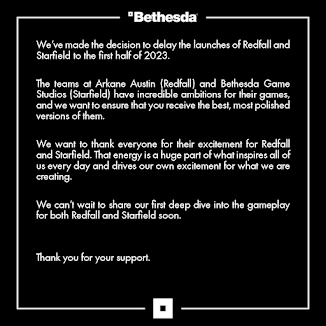
Bethesda Game Studios have announced they are delaying their new science fiction roleplaying game, Starfield, to the first half of 2023. They had previously committed a release date of 11 November this year.

Starfield is the latest open-world CRPG from Bethesda Game Studios, best-known for their Elder Scrolls and Fallout games. Starfield is a brand new IP, set in the early 24th Century and seeing the player working for Constellation, the last human organisation dedicated to interstellar exploration. During the game the player becomes embroiled in a central mystery, possibly related to the discovery of alien life, and has to choose which one of several factions to work with. As usual with a Bethesda RPG, there will be significant freedom in allowing players to choose where they go and what to do next.

Starfield is also the first game to use the new generation of Bethesda's Creation Engine to create larger and more impressive environments than previously, as well as featuring new mechanics. The same engine is also being used for The Elder Scrolls VI, the long-awaited sequel to Skyrim, which is now in pre-production.

Redfall, a co-op action game from fellow subsidiary Arkane Studios, has also been delayed in the same time window.

Bethesda announced the 11-11-22 release date in June 2021, and reportedly it was already considered ambitious. However, Bethesda have always been aggressive in announcing release dates, announcing both Fallout 4 and Fallout 76 just six months before release, and Skyrim around a year. The eighteen month lead-time seemed reasonable on that basis. However, Bethesda have confirmed that the technical challenges of getting the game ready in time have proven greater than expected. Aware of the controversies of other games that were not ready and then rushed out in a buggy state (such as Cyberpunk 2077), Bethesda have chosen a more cautious approach.

Starfield's precise launch date in early 2023 has not yet been confirmed. More information on the game is expected to be revealed at the Xbox Game Showcase on 12 June.

Thursday, 26 August 2021

Bethesda posts three location guides for STARFIELD

Bethesda have unveiled three short videos looking at key locations for their next open-world RPG, Starfield.

The videos briefly explore New Atlantis, the capital city of the United Colonies; Neon, the pleasure city of the Xenofresh Corporation; and Akila, the capital of the Freestar Collective, a loose-knit alliance of three star systems.


Starfield is currently scheduled for release on Xbox and PC on 11 November 2022.

Tuesday, 15 June 2021

What we know about STARFIELD

Bethesda did a reveal of their upcoming CRPG Starfield on Sunday. With the game still almost eighteen months away, it was more of a prolonged teaser than a deep dive on the game's systems. Still, eager-eyed fans have been scouring the trailer (thanks to Reddit), an accompanying behind-the-scenes look at the game and various interviews done by the team over the last few days (mostly behind paywalls) and have assembled a surprising amount of information on the setting and background. A summary follows.

  • Release Date: 11 November 2022
  • Platforms: Xbox Series S/X, Xbox Game Pass via compatible devices, PC
  • Inon Zur (Fallout 3, Fallout 4, Fallout 76) providing the soundtrack.
  • Built using the new Creation Engine 2 (presumably an upgraded Creation Engine 1, which was used to make Skyrim and, modified further, Fallout 4 and Fallout 76).
  • The game is a "bit more hardcore of a roleplaying game" than Bethesda's last few games. The game brings back roleplaying systems they have not used in a while. In particular, your character's customisable background is a much bigger part of the game.
  • The game was inspired by the Traveller tabletop RPG (which Bethesda had the rights to in the 1990s, but didn't do anything with).
  • The game will feature big changes to the traditional Bethesda way of doing things (probably related to you having your own spacecraft) but will also lean hard into some of their normal approaches. The designers call the game "Skyrim in space."
  • The team did field research at Space X's headquarters and rocket factory. The art direction vibe was given as "NASApunk."
  • The game was directed to have a "more realistic" feel, with lower tech than other SF games. However, there are some conceits to space opera tropes such as sound and visible lasers in space.

The game is heavily based around your ship. It is unknown if this is the only ship you have or if you can buy/acquire others later on: 

  • The ship is called the Frontier and was either built by Nova Galactic, or it's a Nova Galactic-class vessel. Its registry is NG1350.
  • The ship is armed with two distinct cannon systems and a missile launcher.
  • The ship appears to have artificial gravity and an FTL drive, the GFLA (Graviton Field Loop Array), which is a fancy name for the theoretical Alcubierre Drive, a type of warp drive.
  • However, according to Todd Howard there are no FTL communications. So you can fly to other stars at FTL speeds, but you can't make a Zoom call across interstellar distances.
  • The ship has a big navigation table which shows gravitational waves propagating in space, suggesting the ship may harness these waves for travel and maybe artificial gravity.
  • The same table has around twenty star systems marked on it, though half the table is obscured. That may indicate 20-40 systems are visitable in the game, or only a few them can actually be reached.
  • Every switch, button, toggle and screen in the game was designed with a function. You won't be able to press every button yourself, but they have a purpose in mind.
  • The ship has a robot engineer/servant called Vasco. Obviously, the Internet already loves him.

The background lore appears to be as follows:

  • The game is set "a bit more" than 300 years in the future. A photograph in the trailer is date-stamped 2320, so it's possible the game will take place in 2321-30 or thereabouts.
  • The player-character works for Constellation, the "last" human organisation interested in interstellar exploration. This suggests that interstellar settlement and colonisation has either failed or the idea of exploration for its own sake has become unpopular.
  • The dominant government appears to the United Colonies. The United Colonies has two military wings, UC Vanguard and SysDef, presumably Systems Defence.
  • The Freestar Collective is mentioned. This may be part of the UC or a separate, external human government.
  • The Crimson Raiders and Crimson Fleet appears to be a loosely-organised coalition of pirates and bandits, possibly this game's equivalent to Fallout's raiders and Elder Scrolls' bandits as a low-level threat you'll encounter throughout the game. The Raiders seem to have been plaguing the Freestar Collective but have recently started appearing in UC space.
  • The United Colonies has an organisation or agency called MAST, the Military, Administrative and Scientific Triumvirate.
  • "Ranger" is a rank, probably in Constellation but possibly in MAST, Vanguard or SysDef.
  • Mentioned planets or star systems include Cheyenne, Sagan, Lunara and Narion.
  • A city or base called New Atlantis is located on the planet Jerrison in the Alpha Centauri star system (our nearest interstellar neighbour).
  • "Cydonia Security" is mentioned. Cydonia is a region on Mars, indicating that Mars has been colonised.
  • Various patches and emblems mention "the Livingstone Project," the "Ferrera 4 Expedition," the "New Discoveries Expedition," "The 10th Planet" and the "New Age Resolution."
  • A company called Chronomark makes watches (presumably smart watches) for use by Constellation. Chronomark was founded in 2188, seemingly confirming that Starfield does not take place in the Fallout universe (humanity is still living in the ruins of the atomic war in 2188 and is barely doing any better in 2287 in Fallout 4, only forty years before the events of Starfield) and is its own setting.
  • There are two real-life books in the ship: Sailing Alone Around the World (1900) by Joshua Slocum is about the first solo circumnavigation of the Earth (Slocum later vanished on another expedition in 1909). Omega: The Last Days of the World (1898) by Camille Flammarion is a disaster novel about the Earth being destroyed by cometary fragments. This may hint that Earth has been destroyed or too badly damaged in this future, forcing humanity to flee into space.
  • An unusual artifact/object has been discovered, which is being studied. The object may be some kind of FTL gateway, and might be the focus of the Livingstone Project. The object may be alien in origin.
  • Aliens will be in the game, but it sounds like they will not be playable, or commonplace, and the game's story may revolve around First Contact.

Bethesda will be gradually unveiling more info about the game ahead of its launch in November 2022.

Sunday, 13 June 2021

Bethesda unveils more info and a release date for their upcoming CRPG STARFIELD

Bethesda and Microsoft have lifted the lid - at least a bit - on their new forthcoming CRPG, Starfield.

The game is notable for being Bethesda Game Studios' first new IP since the first Elder Scrolls game, Arena, in 1994 (they inherited Fallout from another company, Interplay), and their first game to be released since they were acquired by Microsoft last year.

Like their previous single-player games, Fallout 4 (2015) and The Elder Scrolls V: Skyrim (2011), Starfield appears to be an open-world game giving the player the choice on where to go and what to do, to follow a central narrative or ignore it as they see fit, in favour of side-missions or exploration.

The game pits the player as an explorer, part of a group called Constellation, with a fully-customisable spacecraft and capable of flying between different planets.The video only showcased one wild, unkempt planet environment, but concept art suggested multiple planets, including a lush jungle world, subterranean caves, factories, a low-tech outpost, a settlement on stilts located in the ocean and a huge, technological-looking city. The game takes a somewhat low-tech approach but Bethesda claim to want to present a more optimistic view of the future, rooted in our shared humanity, compared to the more dystopian vision presented in Fallout.

The game utilises the "Creation Engine 2," a significant revamp of the technology used to power Skyrim, Fallout 4 and Fallout 76. The trailer was rendered in-engine, suggesting a hefty improvement to visual fidelity over their previous games and the ability to use ladders (a lack fans have mocked Bethesda over for years).

Starfield will be console-exclusive to Xbox Series X/S and will also release on PC via Steam and Xbox Game Pass. The title is scheduled for release on 11 November 2022.

Thursday, 20 May 2021

STARFIELD not likely to appear before 2022

After a number of recent reports that Bethesda Game Studios' latest huge RPG, Starfield, could be released this autumn, there has been pushback by a number of industry insiders. Jason Schreier of Forbes (and formerly Kotaku) has said that the game is being envisaged as a 2022 release as an Xbox exclusive. Tom Warren of the Verge concurred. Schreier did say that the game would be featured at the E3 gaming expo next month, as has been rumoured for a while.

If true, this would mark an interesting shift in Bethesda's release schedule. Bethesda formally announced a trailer and release date for Fallout 4 at E3 in June 2015 and the game was released in November that year. They formally announced a trailer and release date for Fallout 76 at E3 in June 2018 and the game was released in October of that year. Bethesda's had previously announced their games around a year before release, or even longer.

Another possibility is that Bethesda envisage a release date later than 2021 but before E3 2022, so will take advantage of E3 to announce the release date, even if it is closer to a year from release rather than a few months. They may also do this if the release date is soon after E3 2022, but too close for them to start the pre-release hype at that event (exactly why Bethesda seem intent on using E3 as an announcement platform when they have the Internet is another question).

Since Bethesda are now owned by Microsoft, it may also be the case that Microsoft want to do a grand reveal of a large slate of upcoming games up to a couple of years out, regardless of if this clashes with Bethesda's previous way of doing things.

A final point to consider is that Fallout 76 performed badly by Bethesda's normal standards, selling far fewer copies and reviewing very poorly compared to their prior games. With Starfield being a new IP, Bethesda and Microsoft might also want to start the pre-release hype for the game earlier than normal, to get the message out to more people that the game exists. However, they have to be careful about not over-hyping the game given the recent blowback received by Cyberpunk 2077 for doing the same thing.

In any case, it looks like a 2022 release for Starfield is most likely. This will disappoint those waiting for the game and also for The Elder Scrolls VI, which is unlikely to scale up to full-time production until Starfield is on shelves. That puts a potential Elder Scrolls VI release date well off to potentially 2026 or 2027, or later. And those hoping for a Fallout 5 had better really learn the art of patience, or hope that Microsoft will assign that project to a different team.

More information, hopefully, to come at E3 on 12-15 June.

Update: Schreier has confirmed that his information is that Starfield is now targeting a late 2022 release date.

Friday, 30 April 2021

Bethesda copyrights STARFIELD for 2021 release

Bethesda Games Studios are gearing up for the release of their first big, open-world CRPG in six years. Starfield is a brand-new IP, a far-future space opera, but is expected to use a format and style of gameplay that will be very familiar to fans of Bethesda's Elder Scrolls and Fallout franchises. As usual, Bethesda have kept their cards close to their chests, but a new copyright filing backs up recent, less-substantiated rumours of a 2021 release.


For their last few games, Bethesda have preferred to keep details about their current in-progress game to an absolute minimum and then release a trailer and confirm the release date just a few months out from release; they announced Fallout 4 on 14 June 2015 and released the game on 10 November the same year. They then announced multiplayer spin-off Fallout 76 on 30 May 2018 and released the game on 14 November the same year. So it's entirely likely that they will repeat the same format when it's time to fully unveil Starfield to the public.

Bethesda issued a new copyright claim for Starfield with a date of 2021 just a few weeks ago. Games companies usually only issue copyright claims for the year of release, indicating that Bethesda are indeed planning to release the game before the end of 2021. Note that this is not set in stone: if the game was delayed to 2022, they could amend the copyright claim to that year instead. So this is not cast-iron 100% proof that the game will come out this year, but indicates strongly that this is their current plan. Certainly last year, Bethesda claimed that this year would be the earliest fans could expect to hear more news about the game.

Microsoft, who completed their purchase of Bethesda a few weeks ago, will no doubt be keen for the game to come out this year to strengthen their portfolio of games launching this winter. That includes Halo: Infinite, the first Halo title in six years, and reportedly a new Forza racing game. Unconfirmed reports also suggest that Starfield will be exclusive to the Xbox platform on console, although it will get a PC release as well. PlayStation owners will be left out in the cold, as many feared would be the case when Microsoft acquired Bethesda.

If this news is accurate, it could be confirmed as soon as E3 2021, which runs from 12-15 June; Bethesda confirmed their last two release dates at E3 events in 2015 and 2018.

Although it appears likely that Bethesda are targeting a 2021 release date, there is one fly in the ointment, namely the ongoing COVID19 pandemic. Like most developers, Bethesda have mostly been working from home which has slowed game development and quality assurance down. If there are major bugs or problems found in this process, the game could be delayed into 2022 fairly easily.

Bethesda are also working on a new Elder Scrolls game, the follow-up to the massive-selling Elder Scrolls V: Skyrim, which celebrates its ten-year anniversary this year. That game is not expected to be released until 2024 at the earliest, and potentially a lot later than that. A new Fallout game is even further off at this point, unless Bethesda collaborates with another studio to help them get their games out faster.

Monday, 28 September 2020

Images from Bethesda's STARFIELD reportedly leak

Images purported to be from Bethesda's upcoming science fiction roleplaying game, Starfield, have leaked onto the Internet.


The images show a figure in a spacesuit outside some kind of modular space habitat (which may hint that settlement building from Fallout 4 and 76 may return in some fashion), and the second image shows a spacecraft. The images are reportedly from a 2018 build of the game and are not necessarily representative of the final look of the title.

The images include a look at the game's UI, which seems to have settings for gravity, oxygen and carbon dioxide, suggesting the game may implement different levels on gravity and different atmospheres on different worlds, something we haven't seen often in AAA space games.

Starfield has been in full-time development at Bethesda Maryland since 2016, although early prototyping began back as far as 2012. A second team at Bethesda Austin has been working on the multiplayer-focused Fallout 76, whilst additional teams have been helping the Maryland crew on Starfield, as well as spinning up early pre-production and prototyping for The Elder Scrolls VI (which reportedly has the working title Redfall).

Apart from a very brief teaser trailer released in 2018, Bethesda have kept quiet about the game. Vice-President Peter Hines has recently confirmed that Bethesda will not speak further about the game until 2021 at the earliest. Given Bethesda's preference to do a "big reveal" of a game only 3-4 months ahead of release, it's possible that this may indicate that the game itself could be released by the end of 2021.

Bethesda was recently acquired by Microsoft for $7.5 billion, leading to the possibility that Starfield and all future Bethesda projects will be exclusive to the PC and Xbox platforms, although they have agreed to honour promises that in-development games already announced for the PlayStation will be released on that console.

Bethesda have not yet commented on the leaks, although they have deleted the images from their own social media channels and forums.

Wednesday, 5 August 2020

Bethesda confirm no news on STARFIELD until 2021

Bethesda have confirmed they will not be giving any further news or updates on their next big CRPG, Starfield, until next year.


The confirmation came in a rather odd way: a fan via Twitter said their boyfriend had a dream about Bethesda announcing the game will not be out or have any news relayed about it until 2021, meaning he could relax, presumably from the tension of not knowing when an announcement might emerge. Bethesda Vice-President Pete Hines advised the fan that their boyfriend was "very smart."

Starfield is Bethesda's next big open-world CRPG, their effective follow-up to 2015's Fallout 4 and 2011's Skyrim. It's their first new, original IP since the first Elder Scrolls game, Arena, was published all the way back in 1994. Bethesda have revealed very little about the game aside from the fact that it's set in space in the distant future and will involve travel between different planets. The game had been in the planning stages for around a decade before development began in earnest after the release of Fallout 4's last DLC in 2016 (multiplayer game Fallout 76, released in 2018, was largely developed by a different team).

Given Bethesda's preference for confirming the release date for their games just 3-4 months before that date, some fans were holding out hope for a surprise announcement followed by a late 2020 release, but that's now comfortably out of the question.

Various rumours have been voiced about Starfield, including that it will abandon the protagonist voice acting of Fallout 4, is set in the distant future of the Fallout universe (after humanity has recovered from the nuclear war) and it will use new technology to provide a seamless experience with no need for separate indoor/outdoor loading areas, but these all remain unconfirmed. It is known that after Starfield, Bethesda will switch to full production on The Elder Scrolls VI, which is believed to have the (at least working) subtitle Redfall.

Gamers will have plenty to tide them over in the meantime, including CD Projekt Red's massive SF roleplaying game Cyberpunk 2077, which is due for release on 19 November this year.

Thursday, 14 May 2020

Bethesda updates STARFIELD website for the first time

Bethesda Game Studios have updated their website for their forthcoming new open-world RPG, Starfield, for the first time since launching it in 2018. The update merely consists of adding newly-acquired age certificates, but this is significant and may indicate that Bethesda are planning a bigger reveal of the game later this year.


Bethesda are best-known for their two ongoing, open-world RPG franchises: the Elder Scrolls (set in a fantasy world) and Fallout (set in a post-apocalyptic setting). Starfield is significant as the first new IP launched by Bethesda since releasing the first Elder Scrolls game, Arena, way back in 1994; they acquired the Fallout IP from Interplay, who had previously produced two main games and two spin-offs, in 2004.

Bethesda have been working on Starfield since the release of Fallout 4 in 2015, although they did divert some resources and a newly-acquired team to work on multiplayer shooter Fallout 76, which was released in 2018 and has recently seen a major new expansion released. Relatively little is known about Starfield apart from a very short video showing a space station floating in space. Leaks of varying degrees of reliability suggest that Starfield will be an open-world, space opera game consisting of a space station hub, spacecraft and several different regions on several planets the player can move between (possibly similar to Obsidian's recent SF CRPG The Outer Worlds, although Starfield is expected to be much larger). More fanciful leaks suggest that Starfield is set hundreds of years in the future of the Fallout setting, although this seems less likely.


The ESRB and PEGI-18 age certifications do not necessarily mean an imminent release, as Bethesda could have used early demos and builds rather that submitting the full, finished game for certification. That said, it's unusual for certification to take place more than a year or so before release, unless there are dramatic, last-minute delays.

Bethesda have hinted at announcements later this year to lay out their plans moving forwards. Bethesda's preferred release schedule is to fully unveil their game in the spring or summer and then release the game in the autumn, ahead of the Christmas rush: Fallout 4 was announced in June 2015 and released in November that year, whilst Fallout 76 was announced in May 2018 and released (at least in beta) in October that year. A surprise 2020 release for Starfield is therefore possible, although a 2021 release may be more realistic; even Bethesda might be wary of releasing a new game close to the release of CD Projekt Red's Cyberpunk 2077, another SF CRPG and widely anticipated to be the biggest game of the year, in September. Bethesda have ruled out any major new announcements in June, which suggests that if the game is to be fully unveiled, it will be much later in the year, making a 2021 release far more likely.

After Starfield, Bethesda's next project will be The Elder Scrolls VI, the eagerly-awaited sequel to their all-conquering 2011 game Skyrim. It is likely that that game will not follow until at least 4-5 years after Starfield.

Monday, 11 June 2018

Bethesda confirm that STARFIELD and ELDER SCROLLS VI are in development

Following the presentation of Fallout 76, a controversial online-only spin-off from the popular single-player RPG series, Bethesda Game Studios also confirmed long-standing rumours that they are developing two new single-player epic RPGs.


First up is Starfield, the first new franchise launched by Bethesda Game Studios since the original Elder Scrolls: Arena in 1994. Details were thin on the ground, but Starfield will be in the science fiction genre and will be set in space and on alien planets.

Long-standing rumours about Starfield suggest that the game will be set predominantly on a gigantic space station, with the player undertaking missions and solving quests in the standard Bethesda manner. At key points, the player can also leave the space station and travel to other planets to undertake extra mission objectives. This makes the game sound very similar to the Mass Effect franchise from BioWare, although presumably Starfield will use Bethesda's traditional first-person perspective and will focus more on solo play than forming parties. The same reports claim that Starfield is set in the far future of the Fallout franchise and may link that universe to the Elder Scrolls setting, although this sounds less likely, especially after Todd Howard's insistence that this is an all-new and totally new franchise.

Starfield has no release date as yet, but late 2019/early 2020 seems feasible given that the game has been in full-time development since Fallout 4's release in 2015, and was in pre-production for some years before that.


Secondly, and far further in the future (as the game is listed as only in "pre-production"), is The Elder Scrolls VI, the follow-up to the immensely successful Elder Scrolls V: Skyrim, which has sold approximately 40 million copies since its release in 2011, making it one of the most successful individual video games of all time. Apart from a logo, a brief burst of the series theme music and a landscape flypast, the teaser video didn't reveal very much. Fan speculation based on the landscape seems to be that the game will be set in High Rock - the southern coastal region of which appeared in The Elder Scrolls II: Daggerfall back in 1997 - with Valenwood as an outside, alternative possibility.