Monday, 10 July 2017

Nnedi Okorafor's WHO FEARS DEATH optioned by HBO

Nnedi Okorafor's 2010 novel Who Fears Death has been optioned as a mini-series (or potential ongoing series) by HBO.


The novel, which melds elements of fantasy with post-apocalyptic science fiction, is set in a futuristic version of the Sudan, where a young woman named Onye is born after her mother is raped. She discovers she has remarkable powers, and sets out to defeat her evil, abusive father. The novel won the 2011 World Fantasy Award for Best Novel and the 2010 Carl Brandon Kindred Award, and was nominated for the Locus and Nebula awards.

The novel can be a harsh work, featuring as it does rape, sexual abuse and female genital mutilation. But the book has also been highly praised for tackling those issues in an adult and serious manner, and for continuing a recent trend of SF and fantasy for exploring African (or African-esque) milieus, given that most SF completely ignores the continent.

According to Okorafor, George R.R. Martin is on board as an executive producer (as part of his development deal with HBO), although given his workload this is more likely to be in the form of advice and possibly having brought the book to HBO's attention in the first place. The project has taken four years to get the green light, and it remains to be seen if HBO takes the project to the screen. This is a challenging project to get right and something rather different from HBO's usual fare, but it's good to see them tackling a different of kind TV series.

BABYLON 5 Rewatch: Season 1, Episodes 5-6


A5: The Parliament of Dreams
Airdates: 23 February 1994 (US), 13 June 1994 (UK)
Working Title: Carnival!
Written by J. Michael Straczynski
Directed by Jim Johnston
Cast: Catherine Sakai (Julia Nickson), Tu’Pari (Thomas Kopache), Du’Rog (Mark Hendrickson), Narn (Joy Hardin), Guard (Calvin Jung), Pilgrim (Michael McKenzie), Head Waiter (Glenn Robinson), Businessman 1 (Randall Kirby), Businessman 2 (Erich Martin von Hicks), Station One (Marianne Robertson)

Plot:    A week of religious celebration is being held on Babylon 5 where all the different cultures can celebrate their numerous belief systems. Ambassador G’Kar is distracted when an old enemy, Du’Rog, dies and leaves G’Kar something in his will: a promise that an assassin is on his way to Babylon 5 to kill him. Not long after this, G’Kar’s new diplomatic aide, Na’Toth, arrives and reports in to G’Kar, raising G’Kar’s suspicions.

Whilst monitoring the docking bays as hordes of pilgrims arrive on the station, Garibaldi spots and recognises a familiar face: Catherine Sakai, an old girlfriend of Sinclair’s. Sinclair decides to talk to her and they renew their romance. Sakai is now an exploration pilot, using her ship, the Skydancer, to find new worlds ripe for colonisation and mineral exploitation.

Ambassador Delenn greets her new diplomatic aide, Lennier, who arrives from Minbar just in time to help her prepare the Minbari religious ceremony. The ambassadors and command crew attend the Centauri religious ceremony, which involves music, dancing and the consumption of much alcohol. The Minbari ceremony is much more dignified and reserved, though charged with meanings that the non-Minbari present do not understand. Sinclair is bemused to later learn the ceremony is also used as a marriage ritual.

G’Kar hires a bodyguard from local crime lord n’Grath (last seen in episode A2) but the bodyguard is killed. The assassin turns out to be Tu’Pari, the courier who brought Du’Rog’s message from Narn. Tu’Pari captures G’Kar and begins torturing him, since this was part of Du’Rog’s instructions, but Na’Toth turns up and beats him senseless. By the time Tu’Pari recovers the deadline for completing his contract has expired. Worse still, G’Kar has deposited enough money in Tu’Pari’s account to make it look like that Tu’Pari has accepted a bribe. Horror-struck, Tu’Pari flees the station, knowing the Assassin’s Guild will be after him for betraying their honour.

Sinclair, after much deliberating, hits upon a novel way of showing the alien ambassadors humanity’s ideas about faith by introducing them to a representative from each religion on Earth. It’s a long line...

MORE AFTER THE JUMP

GAME OF THRONES Season 7 Primer

Season 7 of Game of Thrones commences next week, so here's a look at the state of play as of the first episode of the new season.


SPOILERS FOR THE END OF GAME OF THRONES SEASON 6 FOLLOW

Click to embiggen.

State of Play

The War of the Five Kings was believed over, but House Stark has proven unexpectedly resurgent. In an impressive display of both military and political acumen, the Starks have led a massive uprising against House Bolton, won the alliance of House Arryn of the Vale (as yet unengaged in the war, with completely fresh forces) and toppled the Boltons, retaking Winterfell in battle and executing Ramsay Bolton (who had already betrayed and murdered his father Roose).

Jon Snow, the bastard son of Eddard Stark who had been sent to the Wall and briefly ruled as Lord Commander of the Night's Watch before being stabbed (and, some say, killed and resurrected), was declared by the Lords of the North as King Jon Stark, the King in the North, succeeding his half-brother Robb, slain over two years earlier at the Red Wedding. Jon has allied with his half-sister Sansa, who commands the loyalty of the Knights of the Vale through her own alliance with Lord Petyr "Littlefinger" Baelish, the Protector of the Vale. This alliance appears strong, but trouble may lie ahead, especially given Jon Stark's willingness to ally with the wildlings from beyond the Wall, the sworn foes of the North.

Meanwhile, in the west Euron Greyjoy has murdered his brother Balon and usurped the Seastone Chair, seizing command of the Iron Islands. His original plan, to force an alliance with Daenerys Targaryen, has been upset by his niece and nephew, Yara and Theon, seizing more than half of the Iron Fleet and sailing to Slaver's Bay to ally with Daenerys themselves. Euron's next move, whether to re-invade the North or seek alliances elsewhere, remains uncertain.

In King's Landing, Cersei Lannister has brutally moved against her enemies, wiping out the High Septon, the Most Devout and almost the entire the leadership of House Tyrell in one fell swoop. She now sits the Iron Throne as Queen Cersei I Lannister in her own right. Her rule of King's Landing is absolute and House Lannister remains a powerful force under her leadership, with its armies now under the direct command of the Queen's brother, Ser Jaime Lannister. The Crownlands also remain loyal to the capital. On paper, Cersei also commands the allegiance of the Riverlands through House Frey and, after the death of King Stannis, the Stormlands, the former vassals of her deceased husband, King Robert. In practice, the reliability of these forces, both fighting the Lannisters until just a few months ago, remains a chancy thing.

However, a new force has now entered the war decisively. Daenerys Targaryen, the Stormborn, the daughter of the Mad King, has arrived off the shores of Westeros with a vast fleet. She has forged an alliance with Houses Tyrell and Martell, who between them command the largest extant land armies in Westeros, and also with the bulk of the forces of House Greyjoy under the command of Yara and Theon Greyjoy. She also commands her own army of Unsullied warrior-eunuchs, the finest spearmen in the world, as well as several tens of thousands of Dothraki horse-warriors. Most formidably, she has the counsel and advice of both Tyrion Lannister and Lord Varys, two of the most cunning strategists in the Seven Kingdoms, and the service of her three dragons.

On paper, Daenerys Targaryen's victory over the Lannisters and her reconquest of King's Landing is inevitable, with the question then arising as to how she and Jon Stark will resolve any potential differences. But it would be foolish to so easily count out Cersei Lannister, who has overcome every obstacle thrown at her so far.

There are also wild cards in these wars to come. From the Wall flies news of vast armies of the dead gathering in the former wildling territories. The seer-prophet Bran Stark flees south ahead of this tide with news of his own. Rumour speaks of turmoil and bloody murder in the Twins, the stronghold of House Frey. There may also yet be fresh betrayals: not all of the Tyrell and Martell bannermen may welcome a return of Targaryen rule.


Season 7 of Game of Thrones starts airing on HBO in the United States on Sunday 16 July. Sky Atlantic will follow up in the UK a day later.

Sunday, 9 July 2017

Babylon 5 Rewatch: Season 1, Episodes 3-4


A3: Born to the Purple
Airdates: 9 February 1994 (US), 30 May 1994 (UK)
Working Title: Amaranth
Written by Lawrence G. DiTillio
Directed by Bruce Seth Green
Cast: Adira Tyree (Fabiana Udenio), Trakis (Clive Revill), Ko D’ath (Mary Woronov), Ock (Jimm Giannini), Andrei Ivanov (Robert Phalen), Gera Akshi (Laura Peterson), Norg (Robert DiTillio), Butz (Mike Norris), Dr. Goyokin (Momo Yashima), Dancer (Katharine Mills), Gunman (Tom Lowe), Station One (Marianne Robertson)

Plot:    The Centauri Republic and Narn Regime are finalising a new treaty normalising relations after the recent Ragesh III controversy (episode A1) and resolving a dispute over the Euphrates sector. However, negotiations are proceeding slowly since Londo keeps disappearing.

Londo has taken a new lover, a young Centauri dancer named Adira Tyree, and is neglecting his duties so he might relive his youth. Londo is unaware that Adira is actually a slave of Trakis, an alien with a score to settle with the Centauri. On Trakis’s orders, Adira drugs Londo and then steal his Purple Files, the intelligence he keeps on the other Centauri noble families for blackmail purposes. Trakis can use these files to blackmail the entire Centauri nobility himself. Adira takes the files, but then has second thoughts, since she has really fallen in love with Londo. She hides in Downbelow, but Trakis bugs Londo when he questions one of Adira’s friends about where she is and manages to capture her first. Londo learns of Adira’s connection to Trakis and with the help of Sinclair and Talia Winters manages to locate and free Adira. Trakis is arrested and Adira becomes a free woman. Londo arranges for her to settle on a Centauri colony world and she promises to one day come back to him.

Meanwhile, Garibaldi discovers that someone on the station is making unauthorised use of the Gold Channel communication system, which allows real-time communications with Earth. Garibaldi’s initial investigations fail to identify the source, since they are using ICE (Intrusion Counter-Measure) systems, but he becomes suspicious of Lt. Commander Ivanova’s relaxed attitude to the problem, since she is usually much more hands-on in such matters. Garibaldi pretends to attend to an urgent call, but sends his backup team and then catches Ivanova using the Gold Channel system without permission. However, she is using it to have a series of last talks with her father, who is dying back home on Earth. Garibaldi deletes all trace of the unauthorised use of the system and lets Ivanova know that there will be no further problems.

MORE AFTER THE JUMP:

Emperor of Thorns by Mark Lawrence

Jorg of Ancrath now rules seven kingdoms and is one of the most powerful rulers on the continent. The time is coming when he will make his claim to the throne of the Broken Empire and try to unite the nations behind him. But there are forces gathering in the world which want to stop him. Powerful, ancient machines, like those that broke the world with their weapons of fire, are debating whether to scour the world of life and start again from scratch. The enigmatic Dead King has conquered the islands of Brettan and now marches on the mainland. This time, Jorg faces enemies that even he may struggle to master.


Emperor of Thorns concludes the Broken Empire series that started with Prince of Thorns and continued with King of Thorns. This trilogy tells the story of Jorg, a young man with the quick wits of Locke Lamora, the charm and resourcefulness of Kvothe but (to start with, anyway) the moral compass of Gregor Clegane. He has a rough loyalty to his men and those members of his family he doesn't want to actively murder, an unhealthy obsession with his young aunt and an inability to let any insult, challenge or threat pass unmolested.

Emperor of Thorns presents Jorg with his biggest challenge yet, although it's also one he's rather well-prepared to face. When Frodo Baggins reached Mount Doom, he didn't really have much more to hand than the clothes he left the Shire in, and had to face his destiny alone, apart from his plucky sidekick Sam. By contrast, Jorg of Ancrath reaches his fate in this book equipped with a neural link to a sophisticated AI and an orbiting array of satellites, in-depth knowledge of the world before the breaking and a magic sword. Although the odds are still against Jorg, I felt a surprising lack of tension in this novel, despite Lawrence's track record with both murdering major characters without much warning and throwing in interesting curveballs to the narrative. Some of these things happen here as well, but for the most part Jorg has a smooth ride across the continent to Vyene, and his ultimate destiny.

The novel alternates sections set in the present day, chronicling Jorg's ride across post-apocalyptic Europe, with sections set in the past, as Jorg has to travel deep into Africa to confront an old enemy and try to woo an ally. There's some interesting twists and turns here, but ultimately the flashbacks slow down the main narrative (this problem also afflicted King of Thorns). A "special edition Godfather" version of this trilogy which re-orders the flashbacks and present-day storyline into a linear sequence of events may be a worthwhile endeavour, and prevent the issue of Jorg apparently being out of his depth and incapable of handling the next challenge, but then a flashback reveals he picked up some awesome knowledge or ability four years earlier which means he can now deal with the problem.

At the same time, Lawrence remains one of epic fantasy's most interesting writers, of both prose and character, and Jorg develops in interesting ways in this book, leading to the conclusion being both logical and appropriate. A sequence set in a town that's been stripped of life is creepy and eerie and the concluding sequence in Vyene is appropriately blood-splattered, giving us back the uber-ruthless Jorg of the first novel. The first-person narrative means that some of the secondary characters are not as fleshed out as perhaps they could be (getting someone else's opinion of Jorg's activities from the outside would be interesting), but we do get to learn more about recurring semi-enemy Chella as we get chapters from her POV as well and discover more about the Dead King and his plans.

Emperor of Thorns (****) concludes one of the more narratively interesting epic fantasies of recent years with fire and wit, but it's grasp of structure and tension is not as effective as it could be. The novel is available now in the UK and USA.

Thursday, 6 July 2017

Babylon 5 Rewatch: Season 1, Episodes 1-2


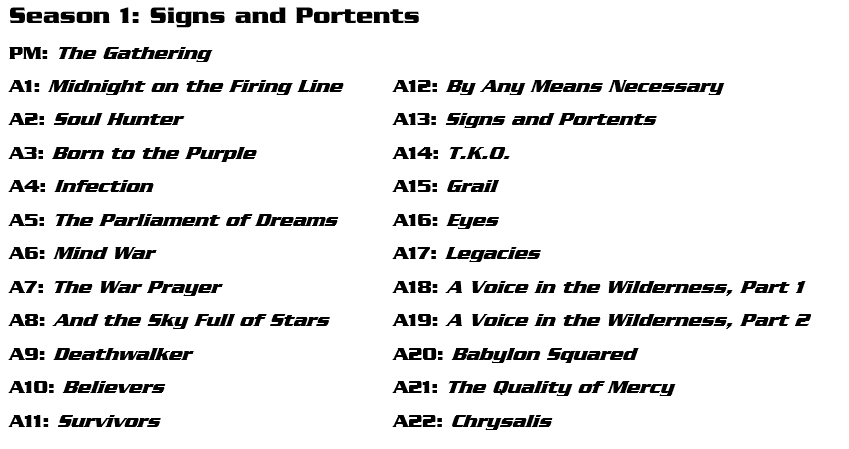
Season 1: Signs & Portents

“It was the dawn of the Third Age of Mankind, ten years after the Earth-Minbari War. The Babylon Project was a dream given form. Its goal: to prevent another war by creating a place where humans and aliens could work out their differences peacefully. It’s a port of call, home away from home for diplomats, hustlers, entrepreneurs and wanderers. Humans and aliens wrapped in two million, five hundred thousand tons of spinning metal, all alone in the night. It can be a dangerous place, but it’s our last, best hope for peace.

“This is the story of the last of the Babylon stations. The year is 2258. The name of the place is Babylon 5.” 
- Earthforce Commander Jeffrey Sinclair

Regular Cast
Commander Jeffrey Sinclair                          Michael O’Hare
Lt. Commander Susan Ivanova                     Claudia Christian
Security Chief Michael Garibaldi                  Jerry Doyle
Ambassador Delenn                                       Mira Furlan
Dr. Stephen Franklin                                      Richard Biggs
Talia Winters                                                  Andrea Thompson
Vir Cotto                                                        Stephen Furst
Lennier                                                           Bill Mumy
Na’Toth                                                          Caitlin Brown
Ambassador G’Kar                                        Andreas Katsulas
Ambassador Londo Mollari                           Peter Jurasik


Credits
Creator                                                            J. Michael Straczynski
Producer                                                         John Copeland
Executive Producers                                      J. Michael Straczynski & Douglas Netter
Co-producer (episodes A1-A5, A7-A8, A10, A15)  Richard Compton
Script Editor                                                   Lawrence G. DiTillio
Conceptual Consultant                                   Harlan Ellison
Production Designer                                       John Iacovelli
Costume Designer                                          Anne Bruice
Visual Effects Designer                                  Ron Thornton
Visual Effects Producers                                Foundation Imaging
Makeup Supervisor                                        John Vulich
Makeup Producers                                         Optic Nerve Studios
Music Composer                                            Christopher Franke
Music Performers                          Christopher Franke & the Berlin Symphonic Film Orchestra


Pre-Season Changes
A number of large changes were made between production of the pilot and the first season proper, as is usually the case in American television.

The biggest changes were in the regular cast. Tamlyn Tomita, Johnny Sekka, Patricia Tallman and Blaire Baron did not return in their roles as Lt. Commander Laurel Takashima, Dr. Benjamin Kyle, telepath Lyta Alexander and free trader Carolyn Sykes, respectively.

Early reports suggested that Tomita and Sekka did not have the right “energy levels” to continue in the series, although this was later contradicted: Tomita did not want to commit as a regular on a long-running television series and was concerned about her image as a military officer. She instead picked up several roles in film, most notably The Joy Luck Club, and has continued acting to this day. This sabotaged Straczynski’s plan to set up Takashima as a traitor, working under outside influence to sabotage Babylon 5. Elements of this storyline were transferred instead to two other characters, as evidenced in A22, B2 and B6, before coming to fruition in B19.

Johnny Sekka chose not to return after long-standing health issues became more noticeable and prevented him from enduring a rigorous filming schedule. He passed away in 2006 from lung cancer, at the age of 72. The Gathering was actually his last screen acting role, the final act in a career that had begun in 1959 and blazed a trail for British actors of colour. The original plan for Dr. Kyle was that he would have been a wiser old head to the (mostly) younger rest of the crew and would have become something of a mentor to the other characters, particularly Sinclair.

Patricia Tallman was keener on returning in the series proper, but her agent got into a disagreement with the production company and advised her against returning. Straczynski was irritated by this, feeling it was both unnecessary and also sabotaged some of his plans for the series. He was able to convince Tallman (having then taken alternate representation) to return to the series for episodes B19, C4 and C18 before becoming a regular for the final two seasons.

Blaire Baron’s decision not to return seems to have come from her desire to continue in film roles and also develop a new career behind the camera as a director. She later became a successful playwright. Straczynski had planned for Sykes to come into conflict with Interplanetary Expeditions and possibly end up in a role similar to Anna Sheridan and/or Catherine Sakai, her effective replacement on the show.

For their replacements, Sinclair decided to develop both very different characters – Lt. Commander Susan Ivanova and Dr. Stephen Franklin – and very similar ones – Talia Winters and Catherine Saki.

During discussions of the pilot episode on CompuServe, JMS was asked if the ambassadors had diplomatic staffs, such as aides or attachés. Realising they should, JMS created the characters of Na’Toth, Vir Cotto and Lennier to serve as diplomatic aides – and narrative sounding boards – to G’Kar, Londo Mollari and Delenn, respectively.

Foundation Imaging, the company who produced Babylon 5’s CGI (computer-generated imagery) effects, upgraded their computers between the pilot and Season 1, giving the effects a better polish. For the pilot episode the effects were exclusively generated on Commodore Amiga 2000s with Video Toasters. Season 1 continued to use Amigas, but higher-end graphics PCs were also brought in (noticeable on some of the more challenging issues, particularly the highly complex Babylon 4 model). By Season 2 they were using PCs exclusively.

Stewart Copeland chose not to return to produce the score for the series. He had been offered a new touring opportunity and chose to take that instead. Ex-Tangerine Dream member Christopher Franke was brought in to score a more traditional orchestral theme. The soundtrack for the series went on to win a number of awards and resulted in several successful albums of the music being released. Franke mostly created the music himself, but for several key themes employed the Berlin Symphonic Orchestra, on several occasions remotely conducting them from a studio in Los Angeles.

A “conceptual consultant” was hired for all five seasons to help work out ideas and concepts for the series. Harlan Ellison is one of the most famous SF short story writers in the world and has worked on scripts for TV and movies. His most famous work is inarguably the classic Star Trek episode City on the Edge of Forever, probably the best-known individual episode of the franchise in its entire history. Among his other jobs on the series was approving story concepts, creating characters such as the Ombuds and generally acting as JMS’ sounding board for ideas (it was Ellison who fine-tuned the opening narration for the first two seasons). Contrary to popular belief, it’s not Ellison who voices the “Produced by Babylon Productions Inc.” spiel at the end of every episode, but co-producer George Johnson (before he is replaced by a burst of music from Season 2 onwards).

Several ideas for scripts were discussed for the series but never commissioned. Two story ideas by David Gerrold – Metaphors and Body-Counts and Target Unknown - were outlined but not commissioned. Creative consultant Harlan Ellison also had plans for two episodes, Midnight in the Sunken Cathedral and Demon on the Run, but nothing materialised. Demon on the Run, would have actually been a sequel to his 1964 Outer Limits episode about time travel, Demon with a Glass Hand (the plot of which bears a passing resemblance to the 1984 film The Terminator, to the point where Ellison actually sued the film company). The title “Midnight in the Sunken Cathedral” was reused by Ellison for an issue of his Harlan Ellison’s Dream Corridor comic.

The opening narration was switched from Londo (in the pilot) to Sinclair for Season 1. Straczynski's original plan was for Ivanova to voice Season 2's narration, Garibaldi for Season 3, G'Kar for Season 4 and Delenn for Season 5. This plan did not long survive contact with the reality of cast changes.

Season 1 was shot almost entirely out of order, due to actor availability, the need to construct sets or conduct complex CGI shots. The results of this are confusing: Walter Koenig, scheduled to play Knight One in episode A8, had a heart attack and was unable to appear for several months, resulting in him getting the replacement role of Bester in A6, which aired before his planned role in A8. Another confusing moment is that Ed Wasser shot his first appearance as Morden (in A13) only after filming his second appearance in A22 (which, to totally confuse people, was shot twelfth in the season). Luckily, the remaining seasons were shot almost entirely in order.

An Earth Alliance Starfury one-man space superiority fighter. The frontline combat fighter of the Earth Alliance, noted for its powerful offensive cannons, rugged armour and ability to spin on a dime.


MORE AFTER THE JUMP

Tuesday, 4 July 2017

Shooting wraps on Season 1 of ALTERED CARBON

Shooting concluded yesterday on Season 1 of Netflix's TV adaptation of Richard Morgan's classic cyberpunk noir novel, Altered Carbon.


The 10-episode season will air on Netflix in February 2018. It stars Joel Kinnaman as Kovacs, James Purefoy as Laurens Bancroft, Kristin Lehman as Miriam Bancroft, Martha Higareda as Kristin Ortega,  Chris Conner as Poe, Alika Autran as Okulov, Tahmoh Penikett (late of BSG) as Dimitri Kadmin, Matt Frewer as Carnage, and Teach Grant as Jimmy DeSoto among many others.

The project is the second-most-expensive in Netflix's history, coming in only behind the second season of Sense8. It'll be interesting to see if Netflix can make a success of what will be the first major attempt to make literary cyberpunk work as a live action TV show.

Monday, 3 July 2017

Babylon 5 Rewatch: The Pilot


The Pilot Movie

“I was there at the dawn of the Third Age of Mankind. It began in the Earth year 2257 with the founding of the last of the Babylon stations, located deep in neutral space. It was a port of call for refugees, smugglers, businessmen, diplomats and travellers from a hundred worlds. It could be a dangerous place, but we accepted the risk because Babylon 5 was our last, best hope for peace.

“Under the leadership of its final commander, Babylon 5 was a dream given form, a dream of a galaxy without war, where species from different worlds could live side by side in mutual respect, a dream that was endangered as never before by the arrival of one man on a mission of destruction.

“Babylon 5 was the last of the Babylon stations. This is its story.”
          - Centauri Ambassador Londo Mollari

Regular Cast
Commander Jeffrey Sinclair                           Michael O’Hare
Lt. Commander Laurel Takashima                 Tamlyn Tomita
Security Chief Michael Garibaldi                   Jerry Doyle
Dr. Benjamin Kyle                                          Johnny Sekka
Lyta Alexander                                                Patricia Tallman
Ambassador Delenn                                        Mira Furlan
Ambassador G’Kar                                         Andreas Katsulas
Ambassador Londo Mollari                            Peter Jurasik

Credits
Producer                                                          Robert Latham Brown
Co-Producer                                                    John Copeland
Executive Producer                                         Douglas Netter
Co-Executive Producer                                   J. Michael Straczynski
Production Designer                                        John Iacovelli
Visual Effects Designer                                   Ron Thornton
Visual Effects Producers                                 Foundation Imaging
Costume Designer                                           Catherine Adair
Makeup Supervisor                                         John Criswell
Music Composer                                             Stewart Copeland

"MISTER GARIBALDI!"

PM: The Gathering
Airdates: 22 February 1993 (US), 9 October 1994 (UK)
Written by J. Michael Straczynski
Directed by Richard Compton
Cast: Carolyn Sykes (Blaire Baron), Del Varner (John Fleck), Senator (Paul Hampton), Eric (Steven A. Barnett), Lt. Guerra (Ed Wasser), Smuggler (William Hayes), Hostage (Marianne Robertson), Businessmen 1 (F. William Parker), Businessmen 2 (David Sage), Station One (Linda Hoffman), Station Two (Robert Jackson)
Date: 3 January 2257 (according to episode B19)

Plot:    Earth Alliance diplomatic station Babylon 5 has been operational for several months and representatives from the Centauri Republic, Narn Regime, Minbari Federation and the smaller worlds have arrived to engage in trade and diplomacy. The crew now anxiously await the arrival of Ambassador Kosh Naranek of the enigmatic, powerful Vorlon Empire. The Vorlons rarely leave their own space and have next to no relations with other powers. Securing their cooperation in the Babylon Project is quite a coup. Whilst preparations are made for Kosh’s arrival, Commander Jeffrey Sinclair and Security Chief Michael Garibaldi welcome new resident telepath Lyta Alexander on board. A commercial telepath belonging to Psi Corps (Earth’s one and only telepathic organisation), Lyta’s job will be to oversee business transactions and make sure no cheating or foul play takes place.

Meanwhile, Ambassador G’Kar of the Narn complains angrily to executive officer Lt. Commander Laurel Takashima after a Narn cargo ship is refused permission to dock. Takashima tells him that the Narn captain has refused to allow a search party to scan for hidden weapons on board and station policy is that all vessels must submit to a weapons scan before docking. G’Kar denounces this as hypocrisy, since Earth Alliance military ships are allowed to dock with weapons, but Takashima stands firm. A little while later a one-man pod leaves the Narn ship before attaching itself to Babylon 5’s hull. The occupant burns his way through the hull. G’Kar goes back to Takashima, apologises for his earlier outburst, and agrees that the Narn ship can be searched, but suggests waiting until after the reception for Ambassador Kosh. Takashima is nonplussed by G’Kar’s change of heart.

Kosh’s Vorlon transport comes through the jump gate and approaches the docking bay. The various dignitaries assemble in the reception chamber, whilst Takashima and Garibaldi wait for Sinclair at the docking bay. Sinclair is delayed by a lift malfunction, but just as he arrives an alarm signal blares out. They enter the docking bay to find Kosh unconscious, his form concealed by a bulky encounter suit containing his own atmosphere. Kosh is rushed to Medlab and Doctor Benjamin Kyle prepares to treat him, although he has to alter the isolab’s atmosphere first. The Earth Alliance government contacts Sinclair and tells him that the Vorlon High Command has denied them permission to open Kosh’s encounter suit, even if he dies. Sinclair refuses to destroy everything Babylon 5 has achieved just to preserve an alien race’s sense of mystery. He shuts down all recorders and cameras and orders Kyle to proceed, trusting in the doctor’s oath of confidentiality. Kyle stabilises Kosh’s condition, but fears he will still die unless he can identify the source of the attack and how it is still affecting him.

Kyle and Takashima convince Lyta to telepathically scan Kosh, even though it is an invasion of privacy to do so. Lyta only agrees when she learns that if Kosh dies the Vorlons may retaliate against Babylon 5, if not the whole Earth Alliance. She has to physically touch Kosh to scan him – the encounter suit blocks telepathic signals – and sees an image in his mind of Commander Sinclair attacking him! Kosh has been poisoned and Lyta is able to identify the entry wound. From there Kyle is able to make an antitoxin and Kosh begins to recover.

The Babylon 5 Advisory Council meets to discuss the revelation that Sinclair may be implicated in the attempted murder. There is no record of the lift malfunction that Sinclair claims made him late for the meeting. Ambassador G’Kar has been in communication with the Vorlon homeworld and they concur that Sinclair should be taken into Vorlon custody pending a further inquiry. The Earth Alliance - represented by Takashima - votes against the proposal, whilst Ambassador Delenn of the Minbari Federation abstains. Ambassador Londo Mollari, surprisingly, sides with G’Kar and the Vorlons. A Vorlon transport is dispatched to Babylon 5 immediately to take Sinclair into custody. Garibaldi confronts Londo, shocked that the Centauri would agree with the Narn about anything, and Londo tells him that G’Kar has secured certain records confirming the involvement of Londo’s grandfather in atrocities committed against civilians during the Centauri occupation of the Narn homeworld. Londo was forced to side with G’Kar or have this information revealed. Londo also tells Garibaldi that he has been fleeced by a human con-man named Del Varner.

A robotic maintenance probe is destroyed whilst investigating the air leak caused by the assassin’s transport pod, still attached to the hull. A security team manages to shut down the pod and Garibaldi is alerted. Realising this is how the assassin got on board, Garibaldi runs security checks on the current visitors to the station and learns that Del Varner is a wanted criminal for smuggling technology to bronzetech worlds (worlds of low technological capability). Breaking into Varner’s quarters, Garibaldi finds Varner’s corpse and records indicating that Varner smuggled a changeling net on board from the Antares sector. Changeling nets can alter someone’s physical appearance. The assassin is confirmed as using a changeling net when he disguises himself as Lyta Alexander and attacks Kosh again in Medlab before being driven off by Dr. Kyle and a surgical laser.

Sinclair re-programmes the station’s external sensor grid to scan the interior of the station for the energy signature of a changeling net. He and Garibaldi, accompanied by a security camera, confront the assassin but Garibaldi is wounded and forced to retire. Sinclair and the assassin fight, just as the jump gate opens and a huge Vorlon battle fleet emerges to surround the station and demand that Sinclair be turned over to them at once. Takashima patches them into the security camera and they observe the fight. Sinclair overcomes the assassin by throwing him into a power grid, overloading the changeling net and shorting it out. The assassin is revealed to be a Minbari warrior. He tells Sinclair, “You have a hole in your mind,” before triggering a suicide bomb. Sinclair makes it out just before the blast doors seal. The contained explosion blows out the hull and causes the station to lose orbital stability until the stabilising thrusters kick in. Satisfied that Sinclair is innocent, the Vorlons depart.

Kosh recovers and takes his place among the other ambassadors, whilst Ambassador Delenn tells Sinclair that the Minbari assassin was a member of a group of soldiers who, refusing to accept the surrender order ten years ago, went into voluntary exile. The warrior presumably wanted to have the Vorlons wipe out humanity by killing Kosh and framing Sinclair. When he asks Delenn about the curious final phrase the Minbari uttered, she tells him it’s just a Minbari insult, although Sinclair does have a hole in his mind: he cannot remember the final 24 hours of the Earth-Minbari War, when the Minbari surrendered on the eve of total victory. Whilst Sinclair ponders this, Takashima declares Babylon 5 back on-line and once again fully open for business.

Dating the Episode: According to episode B19, the events of this episode begin on 3 January 2257. However, a Season 5 episode states that these events took place in “summer 2257”. In addition, Straczynski said during Season 1 that about six months passed between the pilot and the start of Season 1 proper (Season 1 spans the entire year 2258). Sinclair also says that the Battle of the Line took place “almost” ten years ago, which conflicts with later material placing the Battle of the Line in 2248 (although almost all in-series references point to a mid-to-late 2247 date for the Line anyway).

MORE AFTER THE JUMP:

Sunday, 2 July 2017

Babylon 5 Rewatch: Canon and Sources


Before we start the Babylon 5 Rewatch series, some notes on the formatting, references and sources I'll be using in this guide.


Canon

Babylon 5 was the first multimedia franchise which tried to count everything passed under its banner as being fully, 100% creator-approved canon. Joe Straczynski, Babylon 5's creator, showrunner and chief writer, planned to approve every novel and comic, review every piece of merchandise and make sure everything fit together in the massive tapestry he was building.

However, due to simple workload and time, this ultimately provided unworkable and Straczynski was later forced to clarify what was canon and what was not.

All five seasons and 110 episodes of the TV show, plus the pilot and the six TV movies are counted as canon. The 13 produced episodes of the spin-off series Crusade are also counted as canon, although there is significant discussion among fans of the best viewing order for the series, since the production order, Straczynski's recommended viewing order and the actual chronological order of the episodes all differ from one another.

Of the novels, the three trilogies released by Del Rey (The Psi Corps Trilogy by Greg Keyes, The Legions of Fire Trilogy by Peter David and The Passing of the Techno-mages Trilogy by Jeanne Cavelos) are all counted as canon. The earlier novels The Shadow Within by Jeanne Cavelos and To Dream in the City of Sorrows by Kathryn Drennan are also both counted as 100% canon. The storylines for all of these novels were provided by Straczynski and these books were approved and reviewed by him.

The other seven novels are specifically non-canonical, as Straczynski was not as closely involved in their production and some of their elements contradict other sources. In particular, the events of the novel Personal Agendas do not appear to be possible as it is almost impossible for them to have taken place during the period they are supposed to happen. The first book, Voices, on the other hand features allusions to the main story arc and fits into the early Season 2 Psi Corps arc of episodes quite well, and helps resolve some minor continuity issues, so is often regarded as, at least, fanon.

Of the comics, the opening issue In Darkness Find Me and the following Price of Peace and Shadows Past and Present story arcs are both heavily referenced in the TV show itself (the TV show even features a later flashback to events in the comic, a notable first for multi-media projects) and are 100% regarded as canon. The Psi Corps and You! one-shot is likewise regarded as canon, since it features events later expanded on in Greg Keyes's novels.

The Laser-Mirror-Starweb duology, which was written by David Gerrold without any oversight from Straczynski, can be counted as non-canon due to featuring technology (such as energy shields on an Earthforce shuttle) and character developments not in keeping with the rest of the setting. The concluding story arc, In Valen's Name, was written by Straczynski directly and can also be counted as canon.

The Babylon 5 Interactive CD-ROM released in 1998 featured material directly written and contributed to by Straczynski, and is therefore counted as canonical. A lot of later materials, such as the timeline on the DVD box sets, also draws on this as a primary source and can also be counted as canon, even if debatable (such as the conflicting accounts given for the date of the Battle of the Line).

Other elements were not originated by Straczynski but created by others and found their way into common usage. These include many of the ship classes, names and technical specifications which were created by co-producers, other writers on the show or the effects teams at Foundation Imaging and Netter Digital. In many cases these names were picked up on fans and Straczynski himself, thus becoming canon after the fact.

The Babylon 5 Wars miniature game and the Babylon 5 D20 Roleplaying Game by Mongoose Publishing are both non-canon but draw on and incorporate a vast amount of canonical sources (including all of the above). Both projects got underway after Straczynski established an official channel for establishing canon information through his assistant Fiona Avery and thus incorporate a lot of reliable information. However, both also utilise a lot of original material created by the game writers themselves and this is often not differentiated from the canon material. Complicating matters further, Straczynski and Mongoose Publishing later fell out and Straczynski declared their material to be unreliable.

Material specifically regarded as non-canon includes The A-Z of Babylon 5 by David Bassom, The Babylon 5 Security Manual by Jim Mortimore and The Babylon Project Roleplaying Game by Titan Books (along with its sourcebooks). The almost-finished but unreleased Babylon 5 video game, Into the Fire, is also deemed non-canon.

Recently, a new, two-volume Babylon 5 Encyclopedia has been produced by B5 Books, a venture Straczynski is involved in. At over 800 print pages in length, the encyclopedia draws exhaustively on every episode, book and comic to create the most accurate guide to the B5 universe yet created whilst jettisoning non-canon elements. Unfortunately, it is also cripplingly expensive, so I have not been able to use it as a source. This is particularly irritating as the Encyclopedia also uses every single deleted scene from the series itself, which is material not available anywhere else. Hopefully at a future point the price will drop to the point where it becomes a reasonable purchase.


Sources

During the course of Babylon 5 being on-air and the nineteen years that have elapsed since, the show has been discussed and dissected online in astonishing detail (even by modern standards). Actors, writers, producers, effects personnel and, of course, J. Michael Straczynski himself would frequently comment on the series as it aired in online and print interviews, and Straczynski made a point of discussing each episode with fans after they aired. Almost all of this material is collected together at the still-extant Lurker's Guide to Babylon 5 (the first website I ever bookmarked, back in 1996) and the J. Michael Straczynski Message Archive, which collates discussions about the TV series going right back to January 1991, just after Warner Brothers formally optioned the project but twenty-five months before the pilot movie even aired!

Additional official sources include David Bassom's 1996 book Creating Babylon 5, which contains invaluable information on how the show was shot on a day-to-day basis, and the five Babylon 5 Season-by-Season books by Jane Killick, which contain episode-by-episode production discussions about the show. This series of books is particularly useful for sourcing comments and information by people involved in the show other than Straczynski. About 99% of the comments ever made about the show come from Straczynski, which is mostly great but occasionally these comments drown out the contributions of everyone else, so it's good to get an alternative perspective.

Likewise of value is the Babylon 5 Scrolls resource, which is currently being renovated but much of its content is available via Facebook. B5 Scrolls is an interesting project which looks at CG, production design and artwork and features extremely extensive interviews with just about every major behind-the-scenes figure apart from Straczynski, including producer John Copeland (who dealt with the nuts and bolts of production from the studio floor while Straczynski handled writing duties and post) and the late CGI genius Ron Thornton, who created many of the show's more iconic ships and designs. This site has been extremely useful in clarifying many technical points, particularly the early days of the show and how it was originally commissioned, as well as the contentious replacement of Foundation Imaging with Netter Digital halfway through the show's run.

Of the various books and websites covering the series from a critical perspective, Andy Lane's Babylon File (two volumes, published in 1997 and 1999) is easily the best, dissecting the series from various thematic angles and not being afraid of calling out weaker episodes and moments of confused and muddled storytelling. It also quite rightly praises the show for its strengths and better episodes.


The Guide

Throughout the guide the following system to is used to refer to episodes, comics and novels in the Babylon 5 universe. For the television series each season is denoted by a letter: A for Season 1, B for Season 2, C for Season 3, D for Season 4 and E for Season 5. A number denotes which episode of which season is in question. For example, A21 is the twenty-first episode of Season 1, The Quality of Mercy. D9 is the ninth episode of Season 4, Atonement. PM stands for "Pilot Movie" and denotes the pilot episode, The Gathering. The six Babylon 5 TV movies made for the TNT and Sci Fi Channel networks are denoted TVM1 (In the Beginning), TVM2 (Thirdspace), TVM3 (River of Souls), TVM4 (A Call to Arms), TVM5 (The Legend of the Rangers) and TVM6 (The Lost Tales). That covers all of the TV episodes.

The novels follow a similar pattern, with each book being branded NOV followed by a number. There is a slightly more complicated pattern here, because the novels do not take place in the same order they are published and they also tend to leap around the time-frame of the series, some taking place long before the series itself begins, others decades later. Additional confusion is caused because the books are published by two different companies. NOV1-NOV9 were published by Dell (Boxtree in the UK) and numbered as Babylon 5 #1: Voices, Babylon 5 #2: Accusations and so forth. However, the books from NOV10 onward were published by Del Rey. To clear up any confusion, The Psi Corps Trilogy is covered in NOV10-NOV12, The Legions of Fire Trilogy is NOV13-NOV15 and The Passing of the Techno-mages Trilogy is NOV16-NOV18. Just to create more confusion, the novelisations of the TV movies have extra scenes and background information not found in the episodes (but these are covered under the episode entries themselves).

As mentioned earlier, only NOV7 and NOV9 onwards are regarded as 100% canon.

The comics are slightly easier to follow, since they can be easily divided between three big stories which are all sequential and straightforward, and a few independent storylines. These are coded DC since they were published by DC in the USA (and as graphic novel collections by Titan in the UK). The only confusion to be found here is that what I have chosen to label DC12-DC14 (the In Valen’s Name storyline) was actually published as a stand-alone mini-series of comics with its own numbering system (i.e. Babylon 5: In Valen’s Name #1-#3) rather than as part of the on-going monthly series which wrapped up eighteen months beforehand.

Each episode, movie, comic or book is given a plot synopsis, notes on the arc and background info, and, where possible, a date. Dates are either directly given, appear on computer displays, or are worked out due to anyone mentioning how much time has elapsed since such-and-such event. The Babylon 5 DVDs also have a timeline included in their special features. It is assumed for the purposes of this guide that these dates are correct, save for where they conflict with the series itself. Each episode is also given its production number (since the order the episodes was made in was not always the same as the order it was transmitted in) and its first UK and US airdates. Notice that ten episodes aired in the UK before the USA due to a variety of production and scheduling factors.


The Series and the Spin-Offs

The story told by Babylon 5 is a huge one, spanning around two dozen major characters and extending back and forth across thirty-six years of history (from the start of In the Beginning in 2245 to the end of Sleeping in Light in 2281). This isn’t helped by the story being an essentially multimedia one. Unlike, say Star Trek, where the novels and comics are not canonical (i.e. they are never referenced in the series itself), Babylon 5's novel and comic spin-offs are considered as reliable as sources as the series itself (though the series is always considered right when the two sides contradict one another).

The continuity order for the different incarnations of Babylon 5 to be fully appreciated is as follows. Codes are as explained above and are followed in brackets by the years they take place in. NOV10 (2115-89), NOV11 (2195-2258), TVM1 (2245-47), NOV7 (2256-57), PM (2257), A1-A22, NOV16 (2258), DC1, B1-B2, DC2-DC4, NOV1, NOV 17, B3-B4, DC5-DC8, B5-B8, NOV3, DC9-DC10, B9-B10, NOV2, B11-B19, NOV6, B20-B21, NOV4, DC11 (2259), B22-C2 (2259-60), NOV5 (2260), C3-C17, NOV 9, C18-C22, NOV18 (2260), D1-D3 (2261), NOV8, D4-D6, DC12-DC14, TVM2 (2261), D7-E21 (2261-62), TVM3, NOV12 (2263), TVM5 (2264), TVM4 (2267), NOV13-NOV15 (2263-78) and, finally E22 (2281). The Crusade spin-off series takes place shortly after the events of TVM4, in 2267-68 (although it was supposed to run from 2267 to 2271).

The above list is not totally official and it should be pointed out it is the order events take place in, not necessarily the best order to view the series in to preserve the central mystery of the main storylines. My recommended viewing order for a beginner would be to simply start with the pilot and then watch the first four seasons in order, then the first two TV movies, then Season 5 and the third, fourth and fifth TV movies before sampling the debatable pleasures of Crusade. The books and comics generally add background detail not essential to enjoy the series by itself, but if possible try and read issues 5-8 of the comic series before watching episode C8, as it makes for quite an interesting (and possibly unprecedented) cross-over between the two mediums. Books 13-15 also resolve one of the major plotlines left dangling from the TV series, namely the fate of Londo, G’Kar, Vir and Centauri Prime after the events of Season 5. Book 12 also deals with the ultimate fate of semi-regular villain Bester.

The next entry will actually kick off the rewatch project with the pilot movie itself, The Gathering.

Saturday, 1 July 2017

Baby Driver

"Baby" is a young and talented driver. After inadvertently stealing a car belonging to master criminal "Doc", Baby finds himself employed as a getaway driver. His natural skill is enhanced by his listening to music (a way of dealing with tinnitus, a consequence of the childhood car accident that killed his parents). Having paid his debt to Doc, Baby is ready to start a life with his new girlfriend Debora...until Doc offers him one more job which will set him and Debora up for life.


Edgar Wright is one of the UK's most interesting directors, one of the (surprisingly) few modern directors who has a style and energy that is immediately recognisable. That style was immediately obvious in his first project with Simon Pegg, the superb TV show Spaced, and carried on through their three films together (the Three Colours Cornetto TrilogyShaun of the Dead, Hot Fuzz and The World's End). But it went to 11 in his first Pegg-less movie, Scott Pilgrim versus the World, a hyperkinetic comic book movie which had a colossal amount of style, wit, charm and heart. Hell, it even permeated through his script for Ant-Man (even thought Wright was - ill-advisedly - removed from the movie as director shortly before production began).

Baby Driver is Wright's first movie as sole writer and director, and isn't based on any pre-existing property. It does draw, however, on his music video for "Blue Song" by Mint Royale (which gets a cameo appearance in the movie as a nod of thanks). It's a movie which combines its story with its soundtrack, with Baby (Ansel Elgort) using multiple iPods and different playlists to soundtrack his motoring adventures. Wright balletically choreographs the car chases so they run in time to the music and it's all breathlessly exciting.


It's also a little bit misleading: the low budget means this movie can't be The Fast and the Furious But Directed By a Brit and Actually Funny, at least not for any sustained length of time. Instead the movie diverts a lot of its run-time to exploring Baby's relationship with his foster father Joe (CJ Jones) and his new girlfriend Debora (Brit Lily James nailing - to these limey ears - a terrific Southern accent), soundtracking both storylines as well. There's also a great deal of tension between Baby and one of his fellow criminals, "Bats"(a menacing Jamie Foxx) as well as a reluctant friendship with "Buddy" (Jon Hamm), formed over their mutual love of Queen. Spacey shows up and gives a typically intense Spacey-esque performance, but there's some interesting twists in his character and he ends up going in a different (and less Spacey-esque) direction than you're expecting, which is welcome.

The film has a few issues, however. It can't quite sustain the vibe and energy the movie opens with, unlike Scott Pilgrim, and starts flagging in its second half. In particular, the female characters have relatively little to do (Eiza Gonzalez's female gang member doesn't get much to do, but does nail one of the best scenes in the film when she shoots down Foxx's character's macho posturing). James risks feeling wasted, especially after she learns about Baby's double life and rather than freaking out as expected actually steps up and starts playing a more prominent role in the story, only to fall back into a supporting role. The film also feels unsure in where it's taking Baby, with it being never entirely clear if he really wants to go straight or if he needs the buzz and energy of his driving. The gunfights in the conclusion feel a bit rote and the movie doesn't even have a concluding car chase, which is surprising.

Still, Baby Driver's first half is a masterclass of direction, editing and music: look out for a lengthy opening one-shot, a tip of the hat to Shaun of the Dead, which is subtle but impressive. Music lovers will also get a kick out of the huge number of music cameos in the film: Flea, Sky Ferreira, Big Boi, Killer Mike, Paul Williams and Jon Spencer are among those who make guest appearances. There's also quite a few good laughs (even if it's arguably Wright's least funny film, there's still a few laugh-out-loud moments) and some terrific performances.

Baby Driver (****) is on general release in the UK and USA now.