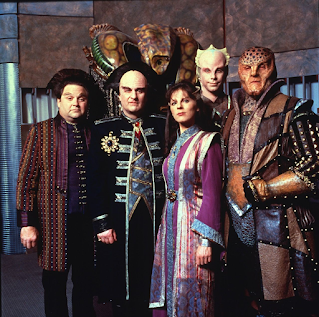
Babylon 5, one of the greatest SF shows of all time, is leaving its current streaming home on Amazon next week.
Babylon 5 has not had a regular streaming home, being bounced from service to service for several years. It landed on Amazon Prime in June 2018, but after eighteen months it will leave the service on 31 January. Where it will land next is unclear, but it's long-term home will likely be Warner Media's new streaming platform, HBO Max, which is due to launch in May this year.
If you haven't checked out Babylon 5 yet, it may be too late to do so unless you can cram 110 episodes into seven days. The show remains available on DVD.
Showing posts with label j. michael straczynski. Show all posts
Friday, 24 January 2020
Thursday, 1 August 2019
J. Michael Straczynski and Brandon Sanderson developing a new urban fantasy TV show
In very interesting news, SF TV writing legend J. Michael Straczynski (Babylon 5, Sense8) is working on a new urban fantasy project with bestselling fantasy author Brandon Sanderson (Mistborn, The Stormlight Archive).
A pilot for the prospective series is being written for the USA Network, with Straczynski promising to "turn the tropes of the genre on its head." Not much more information is available than that, but arguably the best SF TV scriptwriter in the business and one of fantasy's best worldbuilders joining forces is exciting news.
Straczynski, whose autobiography Becoming Superman is earning rave reviews this month, is also working on a novel for HarperCollins Voyager, whilst Sanderson is hard at work on his fourth Stormlight Archive novel.
Updated with Comments from Brandon Sanderson:
A pilot for the prospective series is being written for the USA Network, with Straczynski promising to "turn the tropes of the genre on its head." Not much more information is available than that, but arguably the best SF TV scriptwriter in the business and one of fantasy's best worldbuilders joining forces is exciting news.
Straczynski, whose autobiography Becoming Superman is earning rave reviews this month, is also working on a novel for HarperCollins Voyager, whilst Sanderson is hard at work on his fourth Stormlight Archive novel.
Updated with Comments from Brandon Sanderson:
Hey, sorry I've been slow to reply to this thread. This is Dark One, the story I've talked about for years--and which I think I finally cracked open how to do a few summers ago. I wrote what I think is a pretty solid outline, but it was obvious to me it was paced more like a television show than a novel, so I went hunting some partners.
Basic premise is that a guy from our world finds out that a fantasy world has prophesied he'll become the next Dark One of their world, so they decide to assassinate him before that can happen. It's been fun to work with Joe; he's quite the character. We did pitches for this early in the spring, and got some good reactions and some nibbles from Hollywood. That's about all I can say right now, unfortunately, but hopefully Joe will be writing up a pilot soon and we can see where that takes us.
Friday, 15 June 2018
Sense8: The Finale
Wolfgang is a prisoner of BPO, but his fellow sensates have taken the enigmatic "Whispers" prisoner in turn. The two sides arrange a prisoner swap in Paris, but both are eager to double-cross the other and gain the upper hand in their clandestine war. For BPO, the sensates are a weapon and a resource to be exploited. All the sensates want is freedom. The two sides are poised for a final confrontation.
Sense8 is one of the oddest shows on television, an anthology show with eight main characters in which the central character of each story can call upon the skills and advice of the other seven, despite each story being very different in tone and ideas. It's also a show that is fairly over-brimming with positivity about humanity and about life. If the relentless cynicism of the likes of Game of Thrones and The Walking Dead gets too much for you, than Sense8 is the antidote, a show in which the characters can escape murderous torture, gun down some bad guys, and then get together with their cluster for a telepathically-communicated musical throwdown to Depeche Mode. As you do.
When Sense8 was cancelled after its second season, it was the raucous reception by the fans that saw Netflix agree to commission a TV movie to round off the story. This presented Lana Wachowski with a difficult choice to make. Sense8 was envisaged as a five-season project. With more than half of that material remaining, should she chuck all of that out and craft a simpler resolution to the story, or try to cram in another 36-odd episodes worth of plot into a single special? Her conclusion was to try to do a bit of both. So the central struggle of this finale is firmly on the sensates vs. BPO, with Whispers as the key in that conflict. That's fine and focused, but Wachowski also brings in a huge number of other elements which there is simply no time to develop, such as a neutral council of sensates who have so far stayed out of the struggle but are now willing to support one side and then don't do very much. Some of this excess baggage should have been dropped.
Sense8's finale gives fans a lot more of what they've seen so far: our characters swapping skills, having emotional heart-to-hearts and a couple of musical numbers and party scenes, along with the show's standard, fantastic location filming (the use of Naples is excellent, but the actual use of the real Eiffel Tower for the grand finale is jaw-dropping). However, it also drops the characters' individual storylines to focus on the grand mystery. This is possibly unwise, as the show's central storyline of shadowy government or trans-national organisations and mysteries dating back decades always felt a bit undercooked and took too much time away from the characters (a similar problem to Orphan Black and latter-day Lost). Still, at least the finale straightens out the show's mythology and resolves it with admirable efficiency.
Possibly less successful is the decision to pay off every single character in the show. And I mean every single character. Sylvester McCoy's elderly sensate has a part to play, as does Wolfgang's Conan the Barbarian-quoting best friend, and Kala's eternally confused husband and Capheus's political team and Will's cop partner from Chicago and Riley's chill hippy dad and Nomi's transphobic/homophobic mother and Sun's Korean cop nemesis/boyfriend and that bald girl from the second season and Angelica and her cluster (despite them all being dead) and pretty much everyone who hasn't been killed off. Jamming all of these characters into the special is nice, but unwieldy, massively self-indulgent and not very logical. Even worse, the proliferation of characters beyond the central eight means that some of the main cast of characters, most notably Capheus and Lito, don't really get much to do.
The finale also has some decidedly undercooked action scenes. Sense8's action scenes have always been phenomenal, the Wachowskis relishing their relatively low budget to get back to the ground-level tricks for shooting gunfights and martial arts they haven't had to employ since the original Matrix. For the finale, they clearly had much less money and time available than normal. The fight scenes feel perfunctory and the CG in the gunfights (to simulate bullet sparks) is poorly integrated with the live action. Given there's quite a few action scenes in the finale, this is definitely a bit of an issue, but ultimately a minor one.
But these questions of logistics and over-indulgence and logic are perhaps the wrong ones to address. Sense8 was a show about eight well-drawn characters from completely different backgrounds coming together and finding commonality despite their very different origins, and overcoming the obstacles in the way. The show wasn't perfect - bum dialogue and a tendency to schmaltz dogged it from early on - but its flaws were often endearing, its characters resolutely human and its message determinedly hopeful. Hopefully we will see its like again.
Sense8's finale (****) is available to watch on Netflix worldwide now, along with the rest of the series.
Sense8 is one of the oddest shows on television, an anthology show with eight main characters in which the central character of each story can call upon the skills and advice of the other seven, despite each story being very different in tone and ideas. It's also a show that is fairly over-brimming with positivity about humanity and about life. If the relentless cynicism of the likes of Game of Thrones and The Walking Dead gets too much for you, than Sense8 is the antidote, a show in which the characters can escape murderous torture, gun down some bad guys, and then get together with their cluster for a telepathically-communicated musical throwdown to Depeche Mode. As you do.
When Sense8 was cancelled after its second season, it was the raucous reception by the fans that saw Netflix agree to commission a TV movie to round off the story. This presented Lana Wachowski with a difficult choice to make. Sense8 was envisaged as a five-season project. With more than half of that material remaining, should she chuck all of that out and craft a simpler resolution to the story, or try to cram in another 36-odd episodes worth of plot into a single special? Her conclusion was to try to do a bit of both. So the central struggle of this finale is firmly on the sensates vs. BPO, with Whispers as the key in that conflict. That's fine and focused, but Wachowski also brings in a huge number of other elements which there is simply no time to develop, such as a neutral council of sensates who have so far stayed out of the struggle but are now willing to support one side and then don't do very much. Some of this excess baggage should have been dropped.
Sense8's finale gives fans a lot more of what they've seen so far: our characters swapping skills, having emotional heart-to-hearts and a couple of musical numbers and party scenes, along with the show's standard, fantastic location filming (the use of Naples is excellent, but the actual use of the real Eiffel Tower for the grand finale is jaw-dropping). However, it also drops the characters' individual storylines to focus on the grand mystery. This is possibly unwise, as the show's central storyline of shadowy government or trans-national organisations and mysteries dating back decades always felt a bit undercooked and took too much time away from the characters (a similar problem to Orphan Black and latter-day Lost). Still, at least the finale straightens out the show's mythology and resolves it with admirable efficiency.
Possibly less successful is the decision to pay off every single character in the show. And I mean every single character. Sylvester McCoy's elderly sensate has a part to play, as does Wolfgang's Conan the Barbarian-quoting best friend, and Kala's eternally confused husband and Capheus's political team and Will's cop partner from Chicago and Riley's chill hippy dad and Nomi's transphobic/homophobic mother and Sun's Korean cop nemesis/boyfriend and that bald girl from the second season and Angelica and her cluster (despite them all being dead) and pretty much everyone who hasn't been killed off. Jamming all of these characters into the special is nice, but unwieldy, massively self-indulgent and not very logical. Even worse, the proliferation of characters beyond the central eight means that some of the main cast of characters, most notably Capheus and Lito, don't really get much to do.
The finale also has some decidedly undercooked action scenes. Sense8's action scenes have always been phenomenal, the Wachowskis relishing their relatively low budget to get back to the ground-level tricks for shooting gunfights and martial arts they haven't had to employ since the original Matrix. For the finale, they clearly had much less money and time available than normal. The fight scenes feel perfunctory and the CG in the gunfights (to simulate bullet sparks) is poorly integrated with the live action. Given there's quite a few action scenes in the finale, this is definitely a bit of an issue, but ultimately a minor one.
But these questions of logistics and over-indulgence and logic are perhaps the wrong ones to address. Sense8 was a show about eight well-drawn characters from completely different backgrounds coming together and finding commonality despite their very different origins, and overcoming the obstacles in the way. The show wasn't perfect - bum dialogue and a tendency to schmaltz dogged it from early on - but its flaws were often endearing, its characters resolutely human and its message determinedly hopeful. Hopefully we will see its like again.
Sense8's finale (****) is available to watch on Netflix worldwide now, along with the rest of the series.
Saturday, 2 June 2018
BABYLON 5 Viewing Order & Chronology
I've covered this before in a few different ways, but I thought it'd be good to put this one to bed by combining two distinct orders for Babylon 5 - the ideal viewing order and the actual chronological order of the episodes - into one post.
All episodes/TV movies are listed in optimal viewing order. I list next to them their chronological dates (where known) so viewers can assemble a chronological date if they really want to.
For the benefit of Amazon Prime viewers, you need to select the pilot episode, The Gathering, from the "Season 1 Bonus Features" at the bottom of the season list, and then watch Episode 1 (Midnight on the Fire Line) afterwards and go from there. The six TV movies and spin-off series Crusade are not yet available on Amazon Prime but apparently are on their way.
Optimal Viewing Order
The Gathering (original pilot movie)
Season 1 in order.*
Season 2 in order apart from making sure A Race Through Dark Places goes before Soul Mates and that Knives goes before In the Shadow of Z'ha'dum, as both Soul Mates and Z'ha'dum depend on character motivations changing due to events in the episode before.
Season 3 in order.**
Season 4 in order.
In the Beginning and Thirdspace (TV movies)
Season 5 in order.
River of Souls and Call to Arms (TV movies)
Crusade in one of the orders listed on the Wiki page. The precise order for Crusade is highly debatable.
Legends of the Rangers and The Lost Tales (TV movies)
Some fans will suggest holding back the final episode of Season 5 proper, Sleeping in Light until after everything else as it is set later and puts the final capstone on the Babylon 5 arc. This is a viable moderation to the viewing order.
Chronological Order of Episodes (spoilers)
This is not a viable viewing order, because the prequel movies and so on spoil events from chronologically later episodes. However, this may be of interest. Confirmed dates - ones given in dialogue, captions or can be inferred by the episode's relationship to episodes with confirmed dates - are given in bold. All other dates are speculative or unknown.
Please note that SPOILERS FOLLOW for new viewers so only click past the jump if you're sure:
All episodes/TV movies are listed in optimal viewing order. I list next to them their chronological dates (where known) so viewers can assemble a chronological date if they really want to.
For the benefit of Amazon Prime viewers, you need to select the pilot episode, The Gathering, from the "Season 1 Bonus Features" at the bottom of the season list, and then watch Episode 1 (Midnight on the Fire Line) afterwards and go from there. The six TV movies and spin-off series Crusade are not yet available on Amazon Prime but apparently are on their way.
Optimal Viewing Order
The Gathering (original pilot movie)
Season 1 in order.*
Season 2 in order apart from making sure A Race Through Dark Places goes before Soul Mates and that Knives goes before In the Shadow of Z'ha'dum, as both Soul Mates and Z'ha'dum depend on character motivations changing due to events in the episode before.
Season 3 in order.**
Season 4 in order.
In the Beginning and Thirdspace (TV movies)
Season 5 in order.
River of Souls and Call to Arms (TV movies)
Crusade in one of the orders listed on the Wiki page. The precise order for Crusade is highly debatable.
Legends of the Rangers and The Lost Tales (TV movies)
Some fans will suggest holding back the final episode of Season 5 proper, Sleeping in Light until after everything else as it is set later and puts the final capstone on the Babylon 5 arc. This is a viable moderation to the viewing order.
Chronological Order of Episodes (spoilers)
This is not a viable viewing order, because the prequel movies and so on spoil events from chronologically later episodes. However, this may be of interest. Confirmed dates - ones given in dialogue, captions or can be inferred by the episode's relationship to episodes with confirmed dates - are given in bold. All other dates are speculative or unknown.
Please note that SPOILERS FOLLOW for new viewers so only click past the jump if you're sure:
BABYLON 5 hits Amazon Prime in the USA
Babylon 5 arrives on Amazon Prime in the United States as of today! You can watch the entire series right now for free if you're an Amazon Prime customer.
There are a few caveats. Amazon Prime's deal only includes the pilot movie, The Gathering, and the five seasons of the show itself. The six other TV movies (In the Beginning, Thirdspace, River of Souls, Call to Arms, Legends of the Rangers and The Lost Tales) are not included at present, although some reports are saying they may be added next month. Spin-off series Crusade is also not included at this time.
Also, awkwardly, Amazon have not placed The Gathering at the start of Season 1. Instead, it's listed under "Bonus Material" at the bottom of the Season 1 list, after the Season 1 finale. You should watch The Gathering first, followed by Midnight on the Firing Line and then on from there.
Babylon 5 is a great show, but it takes a while to really start firing on all cylinders. The early episodes are there to set up the world and characters, and some of them aren't great on their own terms. If you get to Episode 4, Infection, and find it's unwatchably awful, the show's creator agrees with you noting that he occasionally wishes the negatives would fall off a pier somewhere). Season 1 starts really taking off with episodes like The Parliament of Dreams (Episode 5), And the Sky Full of Stars (Episode 8) and Signs and Portents (Episode 13), and the last few episodes of the season are all absolute hum-dingers.
My own episode guide to Babylon 5 starts here and may be of interest (and yes, I need to go back and do Season 5 which can also be hard going).
There are a few caveats. Amazon Prime's deal only includes the pilot movie, The Gathering, and the five seasons of the show itself. The six other TV movies (In the Beginning, Thirdspace, River of Souls, Call to Arms, Legends of the Rangers and The Lost Tales) are not included at present, although some reports are saying they may be added next month. Spin-off series Crusade is also not included at this time.
Also, awkwardly, Amazon have not placed The Gathering at the start of Season 1. Instead, it's listed under "Bonus Material" at the bottom of the Season 1 list, after the Season 1 finale. You should watch The Gathering first, followed by Midnight on the Firing Line and then on from there.
Babylon 5 is a great show, but it takes a while to really start firing on all cylinders. The early episodes are there to set up the world and characters, and some of them aren't great on their own terms. If you get to Episode 4, Infection, and find it's unwatchably awful, the show's creator agrees with you noting that he occasionally wishes the negatives would fall off a pier somewhere). Season 1 starts really taking off with episodes like The Parliament of Dreams (Episode 5), And the Sky Full of Stars (Episode 8) and Signs and Portents (Episode 13), and the last few episodes of the season are all absolute hum-dingers.
My own episode guide to Babylon 5 starts here and may be of interest (and yes, I need to go back and do Season 5 which can also be hard going).
Thursday, 17 May 2018
HD version of BABYLON 5 may be possible after all
In a surprising move, Babylon 5 creator/showrunner/writer J. Michael Straczynski has revealed on Twitter (whilst announcing the news that B5 will be available on Amazon Prime next month, at least in the USA) that it may be possible to remaster the show in HD after all...with a few caveats.
To reiterate the previous situation: Babylon 5 was shot in widescreen on Super 35mm film - from which a HD image can be extracted from the original film stock rather easily - and then mastered (having CGI, sound and music added) on standard-definition video. The SD video master tapes of Babylon 5 have been the source for the original broadcast version of the show, the VHS and DVD releases and the various streaming options available over the last few years. It is not possible to extract a HD image from video, so that was assumed to be it for Babylon 5.
The only way to get a HD Babylon 5 would be to go back to the original film stock and extract a new HD image of all the live-action footage - which is time-consuming and tedious, but straightforward - and then re-render all of the thousands of CG effects and composite shots* in the show from scratch - which would be mind-bogglingly time-consuming and expensive. Star Trek: The Next Generation took this approach, but the show didn't have much CGI to re-render, as most of the effects were handled in-camera on film, so it was straightforward to remaster. It still took four years and cost $20 million, and took years to break even across multiple media releases and years of streaming on Netflix and CBS All Access. Babylon 5 would cost around twice that as it had far more CG than ST:TNG and in fact far more effects shots in total, despite being almost seventy episodes shorter in length. Given the relative obscurity of Babylon 5 compared to ST:TNG, this would appear to be commercially unviable.
(* a composite shot is one that combines live-action footage with effects, so any shot which has weapons being fired, the characters standing in front of a green or blue screen, interacting with CG characters etc)
However, Straczynski has completely upended this understanding of the situation with new information.
It turns out that at the end of every season of Babylon 5, Warner Brothers requested that every episode be completely re-mastered on 35mm film. This was for an archival copy to sit in the WB archives and to match the show as broadcast. This process involved taking the digital elements - including the original CG shots in their original resolution (noticeably higher than what we saw on TV from the video master) - and putting them on film.
So in order to get a full HD version of Babylon 5, all one has to do is extract a broadcast copy from each film reel, and since everything is on there already - including CG - that's all you need to do. It's extremely cheap.
This may sound too good to be true, and there is a hitch. Because this was an archival copy of the episode as already aired, it only involved the 4:3 TV format, not the widescreen master which only exists on video. Or to put it another way, Babylon 5's HD edition would only be available in 4:3, not widescreen, despite Babylon 5 being the first TV show ever filmed directly in widescreen. Which is both ironic and immensely frustrating. As long-term B5 fans know, the CGI for Babylon 5 only exists in 4:3, with the widescreen CG shots seen on the DVD release coming about from cropping the image (which is incredibly annoying, and loses information from the top and bottom of the image), so this would both restore the original CG image and in a much higher resolution, but at the cost of losing the live-action widescreen shots.
There is the possibility of going back to the original film stock for the live-action-only shots and combining those with this new master to get at least some of the show in widescreen HD at a still-reasonable price, but the series would need to switch to 4:3 for every CGI and composite scene, which would be rather distracting.
Whilst it's not a perfect solution, it does open up the possibility of seeing Babylon 5 in high definition, at level of visual quality never seen before. Whether Warner Brothers are prepared to invest such a remaster remains to be seen, but at least now, in the long, twilight struggle of rewatching your favourite twenty-year-old SF show, there is the possibility of hope.
The original Babylon 5 and EAS Cortez CG models re-rendered to modern HD standards (with a new background). Whilst the Warner Brothers film masters wouldn't look this good, they'd be big improvement over the DVD versions of the show.
The only way to get a HD Babylon 5 would be to go back to the original film stock and extract a new HD image of all the live-action footage - which is time-consuming and tedious, but straightforward - and then re-render all of the thousands of CG effects and composite shots* in the show from scratch - which would be mind-bogglingly time-consuming and expensive. Star Trek: The Next Generation took this approach, but the show didn't have much CGI to re-render, as most of the effects were handled in-camera on film, so it was straightforward to remaster. It still took four years and cost $20 million, and took years to break even across multiple media releases and years of streaming on Netflix and CBS All Access. Babylon 5 would cost around twice that as it had far more CG than ST:TNG and in fact far more effects shots in total, despite being almost seventy episodes shorter in length. Given the relative obscurity of Babylon 5 compared to ST:TNG, this would appear to be commercially unviable.
(* a composite shot is one that combines live-action footage with effects, so any shot which has weapons being fired, the characters standing in front of a green or blue screen, interacting with CG characters etc)
However, Straczynski has completely upended this understanding of the situation with new information.
It turns out that at the end of every season of Babylon 5, Warner Brothers requested that every episode be completely re-mastered on 35mm film. This was for an archival copy to sit in the WB archives and to match the show as broadcast. This process involved taking the digital elements - including the original CG shots in their original resolution (noticeably higher than what we saw on TV from the video master) - and putting them on film.
So in order to get a full HD version of Babylon 5, all one has to do is extract a broadcast copy from each film reel, and since everything is on there already - including CG - that's all you need to do. It's extremely cheap.
This may sound too good to be true, and there is a hitch. Because this was an archival copy of the episode as already aired, it only involved the 4:3 TV format, not the widescreen master which only exists on video. Or to put it another way, Babylon 5's HD edition would only be available in 4:3, not widescreen, despite Babylon 5 being the first TV show ever filmed directly in widescreen. Which is both ironic and immensely frustrating. As long-term B5 fans know, the CGI for Babylon 5 only exists in 4:3, with the widescreen CG shots seen on the DVD release coming about from cropping the image (which is incredibly annoying, and loses information from the top and bottom of the image), so this would both restore the original CG image and in a much higher resolution, but at the cost of losing the live-action widescreen shots.
There is the possibility of going back to the original film stock for the live-action-only shots and combining those with this new master to get at least some of the show in widescreen HD at a still-reasonable price, but the series would need to switch to 4:3 for every CGI and composite scene, which would be rather distracting.
Whilst it's not a perfect solution, it does open up the possibility of seeing Babylon 5 in high definition, at level of visual quality never seen before. Whether Warner Brothers are prepared to invest such a remaster remains to be seen, but at least now, in the long, twilight struggle of rewatching your favourite twenty-year-old SF show, there is the possibility of hope.
Wednesday, 25 April 2018
SENSE8 finale gets airdate
The series finale of Sense8 has been given an airdate. The movie-length grand finale to the story will air on Netflix on 8 June.
Netflix cancelled Sense8 last year after, curiously, airing the second season with almost no marketing, meaning that even big fans of the show were unaware it had returned. Netflix had chosen instead to keep marketing 13 Reasons Why, despite that show already being a big hit, and the need to get eyes on Sense8 being much greater because of its larger budget (Sense8's second season cost an eyewatering $9 million per episode). This was a bit of an own goal, to put it mildly, and after a fan campaign which involved mass rewatches of the first two seasons, Netflix agreed to fund a two-hour finale. This will wrap up the second season's cliffhanger ending and will provide a conclusion to the series overall, despite writers J. Michael Straczynski and the Wachowskis previously saying that the show was meant to run for an additional three seasons.
Some fans are hoping that the finale is successful enough to warrant a third season being commissioned, although that seems unlikely.
Netflix cancelled Sense8 last year after, curiously, airing the second season with almost no marketing, meaning that even big fans of the show were unaware it had returned. Netflix had chosen instead to keep marketing 13 Reasons Why, despite that show already being a big hit, and the need to get eyes on Sense8 being much greater because of its larger budget (Sense8's second season cost an eyewatering $9 million per episode). This was a bit of an own goal, to put it mildly, and after a fan campaign which involved mass rewatches of the first two seasons, Netflix agreed to fund a two-hour finale. This will wrap up the second season's cliffhanger ending and will provide a conclusion to the series overall, despite writers J. Michael Straczynski and the Wachowskis previously saying that the show was meant to run for an additional three seasons.
Some fans are hoping that the finale is successful enough to warrant a third season being commissioned, although that seems unlikely.
Sunday, 8 April 2018
SF&F Questions: Will there ever be a BABYLON 5 reboot?
The Basics
After the main series wrapped up twenty years ago, it was resurrected for a series of TV movies and a spin-off show, Crusade, which only lasted half a season. In 2007 there was a further straight-to-DVD movie which sold very well, The Lost Tales, but since then no further Babylon 5 material has been released. Since then fans have asked for either a continuation of the series via a movie or new TV show, or a HD remastering of the original series of the kind that many contemporary shows (such as Buffy the Vampire Slayer and Star Trek: The Next Generation) have received, to keep it relevant and watchable for future generations.
Who owns the rights?
Babylon 5’s TV rights are held by Warner Brothers, who produced the first four seasons of the original series and the pilot movie, as well as the Legends of the Rangers and Lost Tales TV/DVD movies. TNT funded the fifth season, Crusade and several of the TV movies, but no longer have the rights to them.
Babylon 5’s creator, J. Michael Straczynski, held onto the movie rights and he alone has the right to make and market a Babylon 5 film for theatrical release.
Authorship
Babylon 5 is unusual in that it is almost completely identified with the work of one man, its creator J. Michael Straczynski. Straczynski wrote 91 of the show’s 110 episodes, most of Crusade and all of the TV movies, as well as acting as executive producer and showrunner. Most Babylon 5 fans would be reluctant to watch or accept a B5 project that Straczynski was not involved in or did not at least have his seal of approval. Although Warner Brothers have the legal right to make a new B5 series without Straczynski’s involvement, it’s clear they are reluctant to do so due to the negative coverage this would engender from fans.
Success of the Original Series
A B5 reboot, remake or remaster is only viable if the original show was successful in the first place. Babylon 5 actually had reasonably strong ratings when it was on-air, often outperforming its alleged rival, Star Trek: Deep Space Nine. It had a very strong and passionate fanbase. Most crucially, it has made a lot of money for Warner Brothers. Given the original show was made on a shoestring budget – 110 episodes for $91 million – it had made Warner Brothers over $500 million in profit by around 2010 in overseas sales, licensing, merchandising and DVD box sets alone. Podcasts, YouTube rewatches and rewatch blogs for the show are all very popular. Straczynski has a popular and well-followed Twitter account where he talks about the show and his other projects.
The show also has major name recognition, first among fans from that era and people who’ve watched it since, and also due to the show being the subject of a long-running joke on popular (but terrible) sitcom The Big Bang Theory.
The name recognition and the strong profits made by the show mean that the series is ripe for resurrection in some form.
Why a reboot or remake? Why not just make more stories with the original cast?
Tragically, despite having a relatively young cast and only airing a quarter of a lifetime ago, Babylon 5’s cast has had a ridiculously high attrition rate. Since the show ended the following castmembers have passed away:
- Michael O’Hare (Commander Sinclair)
- Jerry Doyle (Security Chief Michael Garibaldi)
- Andreas Katsulas (Ambassador G’Kar)
- Richard Biggs (Dr. Stephen Franklin)
- Johnny Sekka (Dr. Benjamin Kyle)
- Jeff Conaway (Security Chief Zack Allan)
- Stephen Furst (Vir Cotto)
- Tim Choate (Zathras)
- Robin Sachs (Satai Hedronn and Warleader Na’Kal)
Making a new Babylon 5 TV movie or series not involving any of these characters (almost all of whom survive to far beyond the lifespan of the series) would be logistically difficult, if not impossible.
Why not just remaster the original show in HD to introduce it to a new audience?
This has been mooted several times but it is particularly challenging for Babylon 5 due to the sheer volume of CGI (computer-generated imagery) used in the show. All of this CG was rendered in standard definition only and mastered on video, so it would need to be re-rendered from scratch. This includes not only every space scene, but every composite scene, every scene with weapons fire, every scene with the characters on a virtual set and every scene with a CG creature. A conservative estimate has it that Babylon 5 had approximately three times as many scenes involving a CG or effects element as Star Trek: The Next Generation, despite having 68 fewer episodes to work with.
This makes putting Babylon 5 through a HD remaster prohibitively expensive. Another conservative estimate of the process is that it would cost between $30 million and $40 million, twice what ST:TNG cost to go through the same process, and ST:TNG struggled to make a profit on its remastering despite being the most-watched and most popular space opera TV show ever made (which is why a HD remastering of Deep Space Nine and Voyager has not taken place yet).
In addition, Babylon 5 had production restrictions when it was made which might make remastering it less feasible: many of the sets were made out of wood and painted to look like plastic or metal, and the limitations of this would show up more in HD. In addition, all of the viewscreens in the show are actual CRT monitors, and of course it’s not possible to “fix” those without invoking time travel, otherwise you’d have pristine HD images of people looking at fuzzy viewscreens.
B5 was also digitally upscaled (a little) for the DVD release and running the DVDs through a Blu-Ray player (which upscales them further) results in a very fine, good-quality (almost 720p, but of course nowhere near 1080p) image that looks pretty damn sharp. The quality decreases whenever effects scenes take place, but the non-effects footage already looks perfectly decent. The whole show being shot in widescreen has already helped it age better than many of its contemporaries, which have had to run through hoops to be converted to widescreen (like Buffy and The X-Files) or it’s simply been impossible to render them in widescreen in the first place (ST:TNG).
Okay, so is anyone interested in doing a remake or reboot?
Yes. Warner Brothers has said they consider Babylon 5 to be a valuable franchise to them and it’s certainly in the zone for a remake/reboot. I can imagine Amazon or Netflix being interested in the idea if they proceed, especially if they can keep the budget down to a sane level (which is what led to Sense8’s cancellation). J. Michael Straczynski also said a few years ago he had plans for a Babylon 5 reboot movie before he started work on Sense8 with the Wachowskis. Both projects appear to have stalled – and never got beyond idle musings at Warner Brothers – but I imagine behind-the-scenes discussions on the idea take place on a regular basis.
One thing holding back the idea is that, at this point, Straczynski seems to favour a movie over a TV series. As he notes in this interview, he’s already made the TV show once and it was an extremely stressful and time-consuming process. So, making a film as an alternate (and presumably much more concise) way of telling that story is understandable. However, most B5 fans, I suspect, want to see a version of the story unfolding over the long-term, as that’s what Babylon 5 was most successful at. Reducing 80½ hours of storytelling into maybe three or four coherent movies would be extremely challenging.
The result of this appears to be a logjam: Warner Brothers are at least open to the idea of doing a new Babylon 5 series but seem to be reluctant to proceed without Straczynski’s involvement due to the fan blowback they’d likely receive. Straczynski seems more interested in the possibility of a feature film, which Warner Brothers don’t seem to be as interested in. If this logjam can be cleared, progress could be made on a new project.
Answer: A Babylon 5 remake or reboot seems inevitable at this point and there is interest from all quarters (studio, creator, fans), it just depends on the creative personnel having an alignment of vision and agreeing on a project that is acceptable to all of them.
Thank you for reading The Wertzone. To help me provide better content, please consider contributing to my Patreon page and other funding methods, which will also get you exclusive content weeks before it goes live on my blogs. SF&F Questions and The Cities of Fantasy series are debuting on my Patreon feed and you can read them there one month before being published on the Wertzone.
Saturday, 24 February 2018
Happy 25th Birthday to BABYLON 5
Twenty-five years ago today, the pilot episode of Babylon 5 aired on US television for the first time. It was the culmination of five years of hard work, as I have detailed here.
Babylon 5 was an important and influential TV show. It was the first network American TV series to have a detailed, pre-planned, multi-year story arc. It eschewed the normal format of episodic television to deliver an epic, massive saga, told over five years and 110 stories that cumulatively tell one story with a beginning, a middle and an end. Although several writers contributed to the show - including veterans of the original 1960s Star Trek and even Neil Gaiman - it was largely the work of one man, J. Michael Straczynski, who wrote 91 of the 110 episodes (including the entire third and fourth seasons), plus the pilot and a further six TV movies. It certainly wasn't auteur television but in terms of being the creative vision of one showrunner who was responsible for the direction of the series, it helped consolidate a trend (previously hinted at by Stephen Bochco and David Lynch) that is in full flow in television culture today.
Babylon 5 is the story of the titular space station, a five-mile-long trade hub and diplomatic gathering place functioning as an interstellar United Nations. Five major powers - the Earth Alliance, Centauri Republic, Narn Regime, Minbari Federation and Vorlon Empire - and two dozen or so lesser ones (the League of Non-aligned Worlds) have come together to help keep the peace and facilitate interstellar commerce and diplomacy. It's revealed early on that the human race and the Minbari fought a devastating war that ended with the Minbari battle fleet closing in on a barely-defended Earth, only to mysteriously abandon the campaign and leave. It's regarded as an act of mercy by a more powerful and advanced race towards a lesser one...apart from by the station commander, Jeffrey Sinclair, who has no memory of the final 24 hours of the war, and was bizarrely chosen to command the station over a dozen more experienced officers.
Over the course of the first season, the show focused on crisis-of-the-week storylines, such as the station dockers going on strike after Earth refuses to pay for more advanced and safer equipment after a horrendous accident kills several workers, and also on a series of longer-running mysteries. Sinclair's missing memories (which gradually start to return) is the most prominent of these, but there are also the military provocations by the resurgent and belligerent Narn Regime against their former conquerors, the Centauri, which infuriate the proud Centauri Ambassador, Londo, whose constant plans to stymie the Narn are frustrated by what he considers to be a cowardly government...until he is offered a deal with the devil that rapidly spirals out of control. Other storylines are more mundane, such as Security Chief Garibaldi's constant struggles to stay sober and first officer Ivanova's constantly painful family and love life. In Season 2 the show unexpectedly has the Babylon Project's mission of peace ending as two of the major powers go to war, manipulated by shadowy forces behind the scenes. Later seasons see the outbreak of a massive galaxy-spanning conflict, with the station's crew going from bureaucrats and pen-pushers to big damn heroes, doing whatever it takes to make sure they and their homeworlds survive.
Babylon 5 is unapologetically big, brash and fun space opera, but layered inside it are many other stories, some of them comic, some of them desperately tragic. The cast of characters (regular and recurring) is huge, most of them well-played and given often joyously brilliant dialogue to play around with. Babylon 5 can also be a satire, particularly of the American Dream and how easy it is for democracy to be subverted into fascism. Babylon 5 is also a great tribute to many other works of science fiction, name-checking authors like Isaac Asimov and Alfred Bester and employing Harlan Ellison, David Gerrold and Neil Gaiman directly as writers. Babylon 5 is noteworthy for winning the Hugo Award for Dramatic Presentation twice, back-to-back, at a time when the award was still given to both TV shows and movies.
Babylon 5 also broke the mould in its ground-breaking use of CGI for visual effects, being way ahead of the curve in the use of computers to do what only models had done up to that point. It was also influential in how it was shot and filmed on an incredibly tight budget, becoming one of the most critically-acclaimed SF shows on-air despite having a budget roughly one-third that of the Star Trek series airing at the same time.
Babylon 5 was far from perfect. There are quite a few weak episodes, most of them in the first and fifth seasons, and there were frequently cheesy lines or slightly awkward exposition scenes. Several times the carefully-planned storyline was thrown for a loop by an actor quitting the show unexpectedly, leading to some course-correcting. But each time, Straczynski and his team righted the boat and got the show back on course.
The influence of the show is tremendous. Joss Whedon watched and enjoyed the show, and made the character of Xander on his Buffy the Vampire Slayer series a Babylon 5 fan (he even had the collector's plates!), as well as drawing on some of the show's structural ideas for his own shows. Firefly's use of actual Newtonian physics in space can also be seen as a nod to B5, which pioneered the idea. Damon Lindelof was also a big fan, citing Babylon 5 as a major structural influence on Lost. George R.R. Martin, an old sparring partner of Straczynski's from the SF convention scene, was an appreciator of the show. Daniel Abraham drew on the show for ideas for his Dagger and the Coin fantasy series (which also mixes politics, military action and economics alongside the return of an ancient, spider-like force). The Wachowskis were also big fans of the show, and later worked with Straczynski on the Netflix series Sense8.
Happy 25th Birthday, Babylon 5. Possibly no other series - book or TV - has had such an important impact on myself and my appreciation for writing and scriptwriting. It may also hold a special place in the pantheon of TV series, even today in the so-called "Golden Age of Television." There are shows since B5 aired that had better effects and better individual episode scripts but none (maybe excepting - and maybe only excepting - The Wire) have executed a multi-season, multi-character storyline on such a scale anywhere near as successfully. For that reason, it is a show that must be respected and given its due.
Just a reminder that I am also currently engaged in the great Babylon 5 Rewatch Project, which is approaching the end of Season 4.
Babylon 5 was an important and influential TV show. It was the first network American TV series to have a detailed, pre-planned, multi-year story arc. It eschewed the normal format of episodic television to deliver an epic, massive saga, told over five years and 110 stories that cumulatively tell one story with a beginning, a middle and an end. Although several writers contributed to the show - including veterans of the original 1960s Star Trek and even Neil Gaiman - it was largely the work of one man, J. Michael Straczynski, who wrote 91 of the 110 episodes (including the entire third and fourth seasons), plus the pilot and a further six TV movies. It certainly wasn't auteur television but in terms of being the creative vision of one showrunner who was responsible for the direction of the series, it helped consolidate a trend (previously hinted at by Stephen Bochco and David Lynch) that is in full flow in television culture today.
Babylon 5 is the story of the titular space station, a five-mile-long trade hub and diplomatic gathering place functioning as an interstellar United Nations. Five major powers - the Earth Alliance, Centauri Republic, Narn Regime, Minbari Federation and Vorlon Empire - and two dozen or so lesser ones (the League of Non-aligned Worlds) have come together to help keep the peace and facilitate interstellar commerce and diplomacy. It's revealed early on that the human race and the Minbari fought a devastating war that ended with the Minbari battle fleet closing in on a barely-defended Earth, only to mysteriously abandon the campaign and leave. It's regarded as an act of mercy by a more powerful and advanced race towards a lesser one...apart from by the station commander, Jeffrey Sinclair, who has no memory of the final 24 hours of the war, and was bizarrely chosen to command the station over a dozen more experienced officers.
Over the course of the first season, the show focused on crisis-of-the-week storylines, such as the station dockers going on strike after Earth refuses to pay for more advanced and safer equipment after a horrendous accident kills several workers, and also on a series of longer-running mysteries. Sinclair's missing memories (which gradually start to return) is the most prominent of these, but there are also the military provocations by the resurgent and belligerent Narn Regime against their former conquerors, the Centauri, which infuriate the proud Centauri Ambassador, Londo, whose constant plans to stymie the Narn are frustrated by what he considers to be a cowardly government...until he is offered a deal with the devil that rapidly spirals out of control. Other storylines are more mundane, such as Security Chief Garibaldi's constant struggles to stay sober and first officer Ivanova's constantly painful family and love life. In Season 2 the show unexpectedly has the Babylon Project's mission of peace ending as two of the major powers go to war, manipulated by shadowy forces behind the scenes. Later seasons see the outbreak of a massive galaxy-spanning conflict, with the station's crew going from bureaucrats and pen-pushers to big damn heroes, doing whatever it takes to make sure they and their homeworlds survive.
Babylon 5 is unapologetically big, brash and fun space opera, but layered inside it are many other stories, some of them comic, some of them desperately tragic. The cast of characters (regular and recurring) is huge, most of them well-played and given often joyously brilliant dialogue to play around with. Babylon 5 can also be a satire, particularly of the American Dream and how easy it is for democracy to be subverted into fascism. Babylon 5 is also a great tribute to many other works of science fiction, name-checking authors like Isaac Asimov and Alfred Bester and employing Harlan Ellison, David Gerrold and Neil Gaiman directly as writers. Babylon 5 is noteworthy for winning the Hugo Award for Dramatic Presentation twice, back-to-back, at a time when the award was still given to both TV shows and movies.
Babylon 5 also broke the mould in its ground-breaking use of CGI for visual effects, being way ahead of the curve in the use of computers to do what only models had done up to that point. It was also influential in how it was shot and filmed on an incredibly tight budget, becoming one of the most critically-acclaimed SF shows on-air despite having a budget roughly one-third that of the Star Trek series airing at the same time.
Babylon 5 was far from perfect. There are quite a few weak episodes, most of them in the first and fifth seasons, and there were frequently cheesy lines or slightly awkward exposition scenes. Several times the carefully-planned storyline was thrown for a loop by an actor quitting the show unexpectedly, leading to some course-correcting. But each time, Straczynski and his team righted the boat and got the show back on course.
The influence of the show is tremendous. Joss Whedon watched and enjoyed the show, and made the character of Xander on his Buffy the Vampire Slayer series a Babylon 5 fan (he even had the collector's plates!), as well as drawing on some of the show's structural ideas for his own shows. Firefly's use of actual Newtonian physics in space can also be seen as a nod to B5, which pioneered the idea. Damon Lindelof was also a big fan, citing Babylon 5 as a major structural influence on Lost. George R.R. Martin, an old sparring partner of Straczynski's from the SF convention scene, was an appreciator of the show. Daniel Abraham drew on the show for ideas for his Dagger and the Coin fantasy series (which also mixes politics, military action and economics alongside the return of an ancient, spider-like force). The Wachowskis were also big fans of the show, and later worked with Straczynski on the Netflix series Sense8.
Happy 25th Birthday, Babylon 5. Possibly no other series - book or TV - has had such an important impact on myself and my appreciation for writing and scriptwriting. It may also hold a special place in the pantheon of TV series, even today in the so-called "Golden Age of Television." There are shows since B5 aired that had better effects and better individual episode scripts but none (maybe excepting - and maybe only excepting - The Wire) have executed a multi-season, multi-character storyline on such a scale anywhere near as successfully. For that reason, it is a show that must be respected and given its due.
Just a reminder that I am also currently engaged in the great Babylon 5 Rewatch Project, which is approaching the end of Season 4.
Thursday, 15 February 2018
BABYLON 5 Rewatch: Season 4, Episodes 19-20
D19: Between the Darkness and the Light
Airdates: 6 October 1997 (US), 27 November 1997 (UK)
Written by J. Michael Straczynski
Directed by David J. Eagle
Cast: Lt. Eisensen (Marc
Gomes), Interrogator (Bruce Gray), Number One (Marjorie
Monaghan), Captain James (David Purdham), Felicia (Musetta
Vander), Guard (Greg Poland), Evan (J.P. Hubbel), First Guard (James
Laing), Assistant (Anneliza Scott)
Date: Approximately
30-31 October 2261.
Plot: Garibaldi,
anxious to rescue Sheridan and start paying back for some the things he did
whilst under Psi Corps’ control, attempts to contact the Mars Resistance. He is
captured and brought before Number One, who offers Franklin the chance to kill
him. Franklin almost agrees, but lets Lyta scan Garibaldi to learn the truth.
They discover that he was used by Psi Corps, but is now free of their
influence. After convincing Number One into helping them, Lyta, Garibaldi and
Franklin set out for the Earthforce prison complex.
On Babylon 5 Delenn and Lennier discover that Londo has
called a meeting of the Babylon 5 Advisory Council without informing them. They
arrive just as the Narn, Centauri and League worlds unanimously vote to send
ships to support Ivanova’s fleet.
The liberation fleet is moving towards the Solar system and
successfully defeats the Earthforce destroyers Damocles and Orion
in combat. In return for leniency at the war crimes tribunal, one of the
captured crewmen reports that some of the ships that have joined Ivanova’s
fleet are really still working for Clark and are providing intelligence to
Earthforce on their movements. Clark is setting a trap involving some new-model
destroyers employing lethal technology. Clark wants to destroy the rebel
Earthforce vessels in Ivanova’s fleet to make it look like the liberators are
really alien invaders. Ivanova decides to take the White Stars by themselves to
intercept and destroy the new vessels before they can attack the Earth ships in
the fleet.
Garibaldi, Lyta and Franklin arrive at the prison complex
and Garibaldi manages to use his well-publicised face as Sheridan’s captor to
get past the outer guards. Lyta uses her telepathic powers to overwhelm the
inner guards and they rescue Sheridan from his cell. However, they then have to
fight their way back out. With the help of the Resistance, Sheridan is put on a
shuttle headed for the liberation fleet.
The White Star forces arrive at the ambush coordinates and
encounter a large number of Earthforce destroyers fitted with Shadow
technology, namely much improved hull armour and superior weaponry. Full-scale
battle erupts and, despite heavy losses, the White Stars emerge triumphant.
However, when the last enemy vessel explodes the White Star 2 is crippled
and Ivanova severely injured. She and Marcus bail out in a lifepod and the ship
explodes.
Sheridan’s shuttle reaches the liberation fleet shortly
after Minbari, Narn, Centauri and League warships arrive to support them. He
assumes command of the Agamemnon and orders a course set for the Mars
colony.
MORE AFTER THE JUMP
Thursday, 8 February 2018
BABYLON 5 Rewatch: Season 4, Episodes 17-18
D17: The Face of the Enemy
Airdates: 9 June 1997 (US), 13 November 1997 (UK)
Written by J. Michael Straczynski
Directed by Michael Vejar
Cast: William
Edgars (Efrem Zimbalist, Jr.), Bester (Walter Koenig), Captain Edward
MacDougan (Richard Gant), Lise Hampton-Edgars (Denise Gentile), Number
One (Marjorie Monaghan), Alison Higgins (Diana Morgan), Captain
James (David Purdham), Captain Leo Frank (Ricco Ross), Wade (Mark
Schneider), Psi Cop (Harlan Ellison),
Date: Late September or early October 2261.
Plot: Sheridan’s
fleet launches an attack on an Earthforce outpost in an asteroid belt. The
defending Earthforce warships, the Hydra and the Delphi, are
critically damaged and both surrender after Captain MacDougan of the Vesta confirms
that, contrary to ISN and government reports, Sheridan isn’t killing all the
Earthforce crew who surrender to him. The EAS Agamemnon, Sheridan’s old
command, arrives and Captain James, Sheridan’s former first officer, agrees to
swap sides and join Sheridan’s cause.
On Mars Edgars agrees to tell Garibaldi the whole story of
his operation in return for Garibaldi’s cooperation in capturing Sheridan.
Garibaldi tells Edgars that Sheridan’s father - who has been missing for
several months - needs to take a certain kind of drug once every few months to
treat an illness he is suffering from. Through the movements of this drug
Edgars is able to arrange for Sheridan’s dad to be arrested on Earth. Garibaldi
contacts Sheridan on the Agamemnon and tells him that his father is in
prison on Mars. Garibaldi has contacts willing to break him out, but only if
Sheridan agrees to talk to them face-to-face. Sheridan agrees, despite
suspecting a trap, and orders Ivanova to leave Babylon 5 and take command of
the fleet in his absence. The Agamemnon has not yet announced its
defection and has the latest access codes for getting through the early warning
system around the Solar system, so it takes Sheridan to Mars and drops him off
in a Thunderbolt. He arrives in a bar to meet with Garibaldi, but Garibaldi knocks
him out with a tranquiliser and he is taken into custody by Earthforce
personnel.
Back at Edgars’ home, Edgars spills the beans on what is
really going on. There is a virus threatening telepaths, but Edgars
himself created it. He believes that telepaths are the greatest threat the
human race has ever seen and he is determined to remove the threat, for good.
The virus is harmless against normal humans, but telepaths die from it.
However, his plan is not genocide. The antidote that Garibaldi helped get through
B5 Customs must be taken at regular intervals every two weeks or the result is
fatal. Edgars plans to use this to keep the telepaths under control. After he
leaves, Garibaldi goes into a trance-like state and activates a homing device
in his tooth. He then goes to the vac-tube station where Lise tries to talk to
him, having overhead some of Edgars’ plans, but Garibaldi tells her to leave.
Bester than arrives and scans Garibaldi’s mind to learn Edgar’s intent. He
tells Garibaldi that, through the Shadow allies who had infiltrated the Psi
Corps (C14), Bester was able to arrange for Garibaldi to be captured
when the Shadows surrounded Babylon 5 (C22). Garibaldi was brought to
the Psi Corps base on Syria Planum and mentally reprogrammed, his natural
tendencies towards paranoia and suspicion massively enhanced. The Psi Corps had
long known that someone was planning to move against them, just not who
and how. As they hoped, Garibaldi uncovered the conspiracy and now they can
move against it. After considering killing Garibaldi, Bester instead removes
the mental programming and leaves. A few minutes later Garibaldi wakes up,
“normal” once again, and screams as he remembers what has happened to him. He
rushes back to Edgars’, but finds Edgars and Wade dead and Lise missing.
Franklin and Lyta arrive on Mars with more than thirty of
the frozen telepaths from Babylon 5. Number One dislikes telepaths and isn’t
keen on helping them, but Franklin convinces her it is for the greater good.
Ivanova takes command of the White Star fleet and, after hearing about
Sheridan’s capture, resolves to carry on in his stead. She has standing orders
posted that if Garibaldi turns up on Babylon 5, he is to be shot on sight. They
proceed to the next target.
MORE AFTER THE JUMP
Saturday, 27 January 2018
BABYLON 5 Rewatch: Season 4, Episodes 15-16
D15: No Surrender, No Retreat
Airdates: 26 May 1997 (US), 30 October 1997 (UK)
Written by J. Michael Straczynski
Directed by Michael Vejar
Cast: Commander
Sandra Levitt (Marcia Mitzman Gaven), Captain Edward
MacDougan (Richard Gant), Commander Robert Philby (Neil Bradley), Captain
Trevor Hall (Ken Jenkins), Lt. David Corwin (Joshua Cox), Guard (Skip
Stellrecht)
Date: 2 September 2261.
Plot: The
White Star fleet arrives at Babylon 5 and Sheridan summons a meeting of the
Babylon 5 Advisory Council. In return for the White Stars’ recent defence of
their territories against raiders and aliens, he is declaring all the mutual
defence treaties between the Earth Alliance and the Narn Regime, Centauri
Republic and League of Non-aligned Worlds null and void. He tells them not to
get involved in what is to come before asking they each contribute a
destroyer-class vessel to the defence of Babylon 5. They agree.
Marcus takes a White
Star to an area in hyperspace very close to Proxima III and contacts the
rebels. More troops are assaulting the planet and they now think that they will
have to surrender in a matter of weeks. Marcus has identified six Omega-class
destroyers in orbit: the Heracles, Pollux, Vesta, Juno,
Furies and Nemesis. According to the rebels the Heracles and
Pollux have fired on civilian vessels, whilst the Vesta and Furies
have apparently gone out of their way not to fire on civilians. Sheridan and
the rest of the White Star fleet start arriving. They plan to attack in three
waves to separate the enemy ships into easily containable groups. The
Earthforce fleet begins to disperse to deal with the separate incursions and
Captain Hall of the Heracles, commander of the fleet, orders all ships
to open fire. However, Captain MacDougan of the Vesta proves reluctant:
he used to teach Sheridan at the Earthforce Academy and doesn’t want to fire on
him. Commander Philby tries to relieve MacDougan of command but he is
overpowered by the bridge crew. MacDougan stands down. The battle is joined and
the Furies also refuses to open fire. The Juno jumps out of the
system rather than engage the enemy and the Nemesis is crippled by fire
from the White Stars and surrenders. The Pollux manages to cripple a
White Star, but the vessel crashes into the Pollux and explodes,
destroying both ships. The Heracles takes colossal damage, but only
surrenders after Commander Levitt relieves Captain Hall of command.
The commanding officers of the four remaining ships meet
with Sheridan. Sheridan tells Levitt that the crew of the Heracles are
going to have to answer to a war crimes tribunal after this is over, but for
now they can decide on their own fate. Levitt decides to take the Heracles to
the repair yards at Beta IX and sit out the rest of the war. The Furies will
remain and guard Proxima III in case Clark sends another fleet against it. The Nemesis
and Vesta both volunteer to join Sheridan’s forces and they are soon
joined by other rebel cruisers, including the Alexander. They head for
the next target on the way to Earth.
On Babylon 5 G’Kar and Londo decide to issue a joint
Narn-Centauri statement approving of Sheridan’s actions. However, Garibaldi
grows disgusted at the way Sheridan is handling the situation and leaves
Babylon 5 for Mars, planning never to return.
MORE AFTER THE JUMP
Thursday, 25 January 2018
BABYLON 5 Rewatch: Season 4, Episodes 13-14
D13: Rumours, Bargains and Lies
Airdates: 12 May 1997 (US), 16 October 1997 (UK)
Written by J. Michael Straczynski
Directed by Michael Vejar
Cast: Neroon (John
Vickery), Drazi Ambassador (Ron Campbell), Religious Caste #1 (Guy
Siner), Religious Caste #2 (Chard Haywood), Brakiri Ambassador (Jonathan
Chapman)
Plot: Delenn rendezvouses with the Minbari warcruiser
Tukari, a ship controlled by the
religious caste. Shai Alyt Neroon of the warrior caste has arrived on board as
well. Delenn and Neroon discuss the growing crisis on Minbar – which has now
broken out into full civil war – and agree to work together to stop the growing
chaos. Some of the religious caste on board, however, believe that Delenn means
to surrender to the warrior caste and decide to use poison gas to wipe out all
occupants of the ship, including themselves, so the religious caste will keep
fighting. When they learn that Delenn and Neroon plan to stop the civil war by
cooperating, they panic and try to stop the gas spreading, only to find that
Lennier has already dealt with the situation, despite taking some injuries in
the process.
Back on Babylon 5 Sheridan sets a series of deceptions in
motion, having Marcus and the White Star fleet attack barren asteroids in one
sector, having Voice of the Resistance report that nothing of interest happened
in that sector and having Londo vehemently deny that White Stars are protecting
the borders of Centauri space. Confused, the League ambassadors begin wondering
if their borders are under attack by some kind of new, invisible alien force
and that Sheridan knows that something is going on and has sent the White Stars
to defend Centauri space. They call a meeting of the Babylon 5 Advisory Council
(the first in some time) and demand that Sheridan send the White Stars to protect
their borders as well. Sheridan agrees, that of course being his plan all
along: to get the alien governments to continue their mutual cooperation that
began during the Shadow War.
Despite his earlier agreement with Delenn, Neroon leaves the
warcruiser in secret at night and flies ahead to Minbar, sending a message to
Shai Alyt Shakiri, head of the warrior caste, that the religious caste has
fallen for the trap. He now has full access to all of the religious caste plans
to defend themselves on Minbar.
MORE AFTER THE JUMP
Sunday, 21 January 2018
BABYLON 5 Rewatch: Season 4, Episodes 11-12
D11: Lines of Communication
Airdates: 28 April 1997 (US), 2 October 1997 (UK)
Written by J. Michael Straczynski
Directed by John C. Flinn III
Cast: Number One (Marjorie
Monaghan), Phillipe (Paolo Seganti), Forell (G.W. Stevens), ISN
Reporter (Carolyn Barkin), Emissary (Jean-Luc Martin)
Date: Within
a few days of the previous episode.
Plot: Forell,
a member of the Minbari religious caste, arrives on Babylon 5 with disturbing
news for Delenn. The Norsai, a peaceful, agrarian race living on the borders of
Minbari space, have come under attack from unknown aliens. The Pak’ma’ra are
also believed to have suffered raids. Delenn decides to take a taskforce of
White Star ships out to investigate.
On Mars a hotel is bombed by elements of the Resistance
working without the permission of the high command. Number One disciplines her
supporters and Franklin and Marcus meet with the other rebels, offering Babylon
5’s full support. In return the rebels are not to hit civilian targets and are
to keep a low profile until a plan for removing Clark and liberating Mars and
Proxima III is fully worked out. In return, they will ensure that Mars is given
its independence from Earth once President Clark has been removed from office.
The White Star taskforce reaches Norsai space and encounters
a group of alien warships. Forell pulls a gun on Delenn and forces the White
Stars to follow the alien vessels to their mothership. An alien shuttle docks
with the White Star and a strange, humanoid creature who seems to shimmer in
and out of existence comes on board. It identifies itself as a Drakh, although
it refuses to disclose whether that’s its name or the name of its species
(Delenn correctly identifies it as the species). Forell tells Delenn that
events on Minbar are spiralling out of control. The warrior caste has evicted
the entire population of a mixed-caste city and taken it over for themselves.
The Minbari populace had to walk several hundred miles to the nearest city
through freezing conditions and more than half of them died, including members
of Forell’s family. The warriors are taking more and more power for themselves
on Minbar and the religious caste is starting to oppose them. Forell fears that
civil war may engulf the Minbari. He has contacted these aliens, the Drakh, and
plans to ally them to the religious caste, even though Minbari do not use
outsiders to settle inside affairs. Delenn agrees to further talks with the
Drakh, but when the Drakh disclose that their homeworld was recently destroyed
Lennier becomes disturbed and manages to warn Delenn that the Drakh may be the
Shadow servants they saw fleeing Z’ha’dum several months ago (D7).
Unfortunately, Forell mentions Delenn’s name, a name the Drakh recognise. Once
the Drakh ambassador has returned to his ship the other Drakh fighters target
the White Stars with their weapons. Thanks to some impressive manoeuvres the
White Stars manage to escape to hyperspace, but Forell is killed in the battle.
After effecting minor repairs, the White Stars return to normal space and
destroy the Drakh fleet.
Sheridan, increasingly tired of ISN propaganda directed
against Babylon 5, begins renovating the War Room with a new idea in mind. He
plans to set up a rival news service, “The Voice of the Resistance”, with
Ivanova as its main anchor. Ivanova isn’t thrilled about the idea but agrees to
take part after her success in updating allied ships on enemy fleet movements
during the Shadow War (D4-D5).
Delenn arrives back on the station and tells Sheridan that there are troubles
on her homeworld. She will be leaving for a while and hopes this time apart
will also give Sheridan the resolve to deal with the situation on Earth. They
have one last dinner together before she departs for Minbar.
MORE AFTER THE JUMP
Wednesday, 17 January 2018
BABYLON 5: Season 4, Episodes 9-10
D9: Atonement
Airdates: 24 February 1997 (US), 18 September 1997 (UK)
Written by J. Michael Straczynski
Directed by Tony Dow
Cast: Dukhat (Reiner
Schone), Callenn (Brian Carpenter), Morann (Robin Atkin Downes)
Date: This episode does not take place long after D8. There are extensive flashbacks to
the early 2240s and mid-August 2245.
Plot: Delenn
receives a summons to Minbar by her clan and is compelled to obey. She and
Sheridan spend the third of their nights together where the female watches and
the male sleeps, before slipping away to the customs bay. Lennier intercepts
her there and insists on accompanying her to the homeworld.
Marcus and Franklin are given new orders by Sheridan. Since
Earth is playing dirty in its attempts to discredit the station (D7, D8), they have to do the same. He is sending Marcus and Franklin to
make contact with the Mars Resistance and make whatever arrangements necessary
to secure an alliance. Because of the blockade at certain jump gates, they’re
going to have to go the long way around and won’t reach Mars for two weeks.
They agree to the mission and set off.
Delenn arrives on Minbar for a meeting with the clan elders,
represented by Callenn. They have grave doubts about her decision to take
Sheridan as a mate, despite the fact that she is partly human. They want to
know her reasons are pure and have arranged the Dreaming. The Dreaming is a
holographic imaging chamber whereby the candidate, having taken drugs
beforehand enhancing their mental powers, projects his or her thoughts and
memories into the air for all to see. During Delenn’s first visit to the
Dreaming she sees herself as a young acolyte some twenty years ago. She is
assigned to watch over Dukhat during his own Dreaming. Intrigued by her wisdom
and intelligence in one so young, he takes her into the Grey Council itself and
tells her that the Council is divided over whether or not to make contact with
a race known as the humans, who apparently the Centauri have had dealings with
for some time. The warriors fear the military threat of the humans, the
religious caste dislike of the idea of being exposed to alien belief systems and
the workers are opposed to cheap imports at the expense of Minbari labour.
Delenn asks about simple curiosity and Dukhat agrees that just being curious is
a good reason in itself to contact other worlds, but the Council refuses to
consider the idea. Dukhat makes Delenn his aide in return for embarrassing her
before the Council. Over the next few years Delenn grows under Dukhat’s
tutelage and is eventually elevated to the rank of the Council. When she swears
the oath before the Triluminary, it glows. Dukhat goes to talk to her
afterwards, but is interrupted by an alarm signal. The Minbari vessels have
encountered an alien fleet approaching their space. Delenn confirms they are
human warships, having studied Centauri reports. Morann, a warrior caste representative,
tells them their gunports are open in the warriors’ tradition of showing
respect to an enemy. Dukhat angrily tells them to stand down but the Earth
ships open fire, convinced the Minbari are about to fire themselves. During the
exchange Dukhat is killed and the Council becomes deadlocked about whether it
was an accident or an act of hostility. Delenn, filled with grief and rage,
breaks the deadlock by ordering the destruction of humanity.
Lennier is shocked and realises that the other Minbari will believe
that Delenn is marrying Sheridan out of guilt for giving the order that broke
the Council’s deadlock and began three years of bitter warfare, although he is
sure that is not the case. Callenn announces that the Dreaming is over and
tells them they will rest for the night and inform them of what they have
discovered in the morning. But, in the night, Delenn suddenly realises that
Dukhat was trying to say something to her when he died. She re-enters the
Dreaming with Lennier and Callenn and they hear Dukhat’s last words, which
Delenn herself did not hear at the time: “You are a child of Valen.” Afterwards
Lennier raids the archives and confirms Dukhat’s words. Delenn, as hundreds of
thousands if not millions of other Minbari, is a descendant of Valen himself.
Since Valen was partly human, that means Delenn was partly human even before
her transformation. It also means that most of the Minbari species has some
trace of human DNA in their genetics, the true meaning of the humans and
Minbari sharing the two sides of one soul. If the “purity” of the Minbari race
hasn’t existed for a thousand years, then how can that purity be tainted by any
children Delenn might have with Sheridan? Callenn admits that this knowledge
has been kept secret for fear of confusing and dividing the Minbari race. They
decide on a cover story, that Delenn is offering herself to the humans to
further the spiritual bond between their species and as a sacrifice to the
humans for their losses during the Earth-Minbari War, in the same way pre-Valen
Minbari would marry the son and daughter of the two sides in a war to reunite
themselves. Delenn is satisfied and heads back to Babylon 5.
MORE AFTER THE JUMP
Sunday, 14 January 2018
SF&F Questions: Did Deep Space Nine rip off Babylon 5?
In our latest SF&F Question we address one of the biggest controversies in the history of science fiction television: did Star Trek: Deep Space Nine rip off its contemporary and "rival"space station show Babylon 5?
Babylon 5 was an original science fiction television series which ran for five seasons and 110 episodes, along with an additional six TV movies and its own spin-off show which ran for half a season. It debuted on 22 February 1993 with a stand-alone pilot movie. Season 1 proper debuted on 26 January 1994 and the show concluded on 25 November 1998.
Both shows are set on enormous space stations, which the series is named after. Deep Space Nine is set on a space station near the planet Bajor, which is recovering from forty years of military occupation by the ruthless Cardassian Union. The United Federation of Planets and its space exploration wing, Starfleet, are called in to help run the station and advise the Bajorans on the rebuilding of their world.
Babylon 5's space station (which is considerably larger than DS9) is a sort-of United Nations in space, where representatives from five major governments and dozens of smaller ones meet to discuss important interstellar affairs. The impetus to build the station came from a devastating war between the Earth Alliance and Minbari Federation that cost the lives of hundreds of thousands and destabilised the galaxy.
The contention, made directly by Babylon 5's creator and executive producer J. Michael Straczynski at the time, was that Deep Space Nine had ripped off Babylon 5's concepts and ideas, from the broad idea of setting the show on a space station to some specific elements such as having a shapeshifting character (the Minbari assassin in B5's pilot was originally an actual shapeshifting alien) and the presence of an interstellar "gateway" near the station (the wormhole in DS9's case, the jump gate in B5's case).
Wait, Babylon 5 started after DS9. How can it have ripped it off?
J. Michael Straczynski came up with the idea for Babylon 5 in 1986 or 1987; he seeded a mention of the name into Final Stand, one of his episodes for Captain Power and the Soldiers of the Future, which aired on 4 October 1987. He developed the Babylon 5 series bible around this time and wrote a pilot script (an early but still-recognisable version of The Gathering), plus a full set of 22 episode outlines for a full season of the show. Concept artist Peter Ledger also provided paintings of the titular space station and its crew. This package was shopped around CBS, ABC and HBO in 1988 to no avail.
In early 1989 Straczynski and his prospective production partners, Douglas Netter and John Copeland, received a boost when they met Evan Thompson, the head of a group of local stations called Chris Craft. Syndication - where a show is sold direct to lots of local TV stations rather than one of the big national networks - was experiencing a renaissance thanks to the success of Paramount Television's Star Trek: The Next Generation (which had launched in September 1987) and Chris Craft was interested in lining up a new show for the syndication market. Babylon 5 fit the bill, they felt, and they hoped a new science fiction show would do similar numbers to Star Trek for them.
To this end Thompson took the Babylon 5 project directly to Paramount Television. He presented them with the pilot script, the 22 additional episode outlines, the outline of a serialised five-year story arc and the detailed production notes which suggested that the show could be made for less money than TNG. Paramount sat on the notes for about eight to nine months and the producers he spoke to were enthusiastic about the project, but Paramount's senior management felt that having a second science fiction/space opera show set in a completely different universe would be too confusing and would cannibalise the Star Trek audience. By the end of 1989 they had formally passed on the B5 project and Thompson was given back the notes, scripts and outlines.
Eventually Babylon 5 found a home at Warner Brothers and their new Prime-Time Entertainment Network (PTEN), an alliance of syndicated stations. The show was formerly announced as being in development in the summer of `1991. Two months later, Paramount Television announced that they were developing a spin-off from Star Trek: The Next Generation, called Star Trek: Deep Space IX (later changed to Deep Space Nine after too many people wrote in asking what a "Deep Space Ix" was) that would be set on a large space station. Straczynski was not slow in calling foul and reminding people that Paramount had had the story notes for Babylon 5 for almost a year and could have cribbed whatever notes that'd wanted from them.
Okay, that sounds pretty plausible actually. So what is Paramount's side of the story?
Backtracking a little: despite risible critical notices, the first two seasons of Star Trek: The Next Generation had done gangbusters for Paramount in terms of ratings and therefore advertising profitability. With the third season of TNG, including its epic Borg cliffhanger episode, The Best of Both Worlds, improving the show's critical and commercial success, they wanted to exploit this by developing more shows in the same setting. However, executive producers Rick Berman and Michael Pillar weren't sure how to approach this and, with TNG being a time-consuming show, they put these ideas on the backburner.
The situation changed in 1991. Brandon Tartikoff, one of the most feted and respected television executives in Hollywood, had departed NBC after fourteen years. During his time at the network he had displayed a canny eye for gauging what would work and what wouldn't, making such far-reaching decisions as renewing Cheers and Seinfeld even after the first few seasons of each show brought in terrible ratings and being rewarded when they both became the biggest shows on television. He was also involved in the creation of The Cosby Show, Miami Vice and The Golden Girls, all of which became immense successes despite Hollywood wisdom being set against them.
Tartikoff was asked to join Paramount Television, which was in the doldrums and needed some firing up. Tartikoff accepted the job and arrived in the post of chairman with one firm idea already in place: a new Star Trek television series. One of his first actions was to summon Berman and Piller to his office (they were terrified that he was going to cancel TNG) and presented them with a concept he'd already developed: if the original Star Trek series and TNG were both "Wagon Train to the stars" - a reference to a 1957-65 Western TV show about pioneers exploring the American West - than he wanted the new show to be "The Rifleman in space", a reference to a 1958-63 TV series focusing on a widowed sheriff trying to keep the peace in a fractious frontier town whilst also raising his young son. The new Star Trek show would therefore not be set on a starship but a starbase, one of the planetary bases frequently visited in both Star Trek series, and the show would deal with the problems of being stationary in possibly hostile surroundings rather than being able to roar off at the end of each week's adventure.
Piller and Berman ran with the idea - possibly a bit more literally than Tartikoff had expected - by proposing that a Starfleet base had been set up on a planet recently under hostile alien occupation, with a newly-widowed Starfleet officer assigned to command the base with his son. The officer's wife had been killed by the Borg in the Battle of Wolf 359 and he was suffering issues related to that event. They decided the occupying aliens would be the Cardassians - introduced in the then-recently-aired TNG episode The Wounded - and created the planet Bajor and its spiritual inhabitants as the planet in question. They also mused on using a stable wormhole (an idea introduced in Star Trek: The Motion Picture in 1979 and further expanded on in the TNG episode The Price, which had aired in November 1989) as a way of revitalising Bajor's economy and introducing strife with the Cardassians, who'd abandoned the planet before the wormhole was discovered.
However, they ran into problems just a couple of weeks later when costing the show. One of the appeals of doing the project was having regular location filming to make the show feel less claustrophobic than TNG and give it a very different look. The problem is that regular location filming would have meant either almost doubling the budget beyond TNG (at that point already the most expensive TV show on the air) or spending many episodes indoors without going outside, which seemed pointless. They decided that moving the show onto a space station made more sense: starbases were established as also being space stations in the original show and having the show set in space would allow for the exploration and space battles that viewers had come to expect. It also allowed them to have outings to other planets (Bajor or new worlds in the Gamma Quadrant beyond the wormhole) or stay on the station as budgets required. Indeed, the show's first official announcement poster indicated they would be using the already-established Spacedock design from the movie Star Trek III for the space station, but they later decided that using a Cardassian station would be more interesting.
Paramount's defences to the charge of ripping off Babylon 5, therefore, are that 1) the person who came up with the basic idea of DS9 hadn't been working at Paramount previously and arrived with the concept already in place before he'd seen any documents; 2) the B5 documents were all returned to Evan Thompson before 1989 was over and no copies were made (and indeed, it would been legally dubious to do so); 3) the original concept was for a planetary base and was only moved to a space station for budgetary reasons; and 4) that many of the concepts used in DS9, including the wormhole and even the original space station design, predated B5's original genesis by years.
More common sense arguments can also be made: a space opera TV show is going to be either set on a spaceship, a space station or a planet, and with Star Trek already having a starship-set show on the air and with the planet option eliminated by budgetary requirements, a space station was the only setting left.
Right. So what about the shapeshifting alien?
Deep Space Nine, on the other hand, was pretty much ordered by Paramount to include a shapeshifting alien to cash in on the craze for "morphing". This CG technology had been pioneered by the 1988 movie The Abyss by James Cameron but had exploded in the public consciousness with Cameron's film Terminator 2: Judgement Day, released in July 1991. The T-1000 android's ability to shift shape was accomplished by cutting-edge computer technology and it led to an insane craze for both TV shows and films to use the same software (as well as music videos, such as Michael Jackson's "Black or White"). Paramount wanted a shapeshifting alien as a regular character on DS9 to cash in on this craze, not because an unused TV outline from two years earlier had such a character as a one-off villain.
Okay, that sounds pretty convincing from their perspective. So why is this explanation not more widely known?
J. Michael Straczynski was a pioneer in the use of the Internet for discussing his work and his TV shows: he was sitting on chat groups as early as 1990 talking about the series. Most people in the United States didn't even know what the Internet was until circa 1995 and the Star Trek team were slow to start using the Internet as a means of communicating with fans. As a result, the full story of the creation of Deep Space Nine and Brandon Tartikoff's involvement was not publicly known until the publication of The Deep Space Nine Companion in 2000. Tartikoff himself passed away in 1997 and Michael Piller in 2005, so neither are still with us to comment on the situation. On the other hand, Straczynski was discussing it loudly and publicly from 1991 onwards, so his version of events became dominant in the media.
It should be noted that, many years later, Straczynski also withdrew his suggestion that DS9 ripped off B5, saying that he did not believe Rick Berman nor Michael Piller (whom Straczynski knew) would knowingly rip off another writer's material. He left open the idea that a Paramount executive may have "steered" some discussion with material from his notes, but no evidence for this has ever been produced.
Ron Thornton, the creator of Babylon 5's cutting-edge CGI, also claimed in 1996 that the introduction of the White Star (a warship the B5 crew could use to get around in) was directly inspired by the introduction of the USS Defiant on DS9 a full year earlier, a claim furiously denied by Straczynski who pointed out that the show simply needed a ship bigger than the standard fighters and shuttles to take the fight to the enemy. It should be noted that the relationship between B5's producers and its CGI team at Foundation Imaging was breaking down at this point, so it's unclear if Thornton's comment was meant seriously or in jest (and Ron Thornton passed away in 2016, making it difficult to clarify further).
The acrimony between the two shows resulted in furious flame wars between their respective fandoms on the Internet, becoming notable enough that Straczynski dialled down his criticisms of DS9. This thawing of tensions may have also been down to the fact that Straczynski was good friends with Jeri Taylor, executive producer on Star Trek: Voyager, and wanted to cool things down. To this end he also convinced Majel Barrett-Roddenberry (Number One, Nurse Chapel, Lwaxana Troi and various Federation computer voices on multiple Star Trek shows) to guest star on Babylon 5 during its third season.
Answer: Deep Space Nine did not rip off Babylon 5, despite the fortuitous timing and some very superficial surface similarities which do not withstand detailed scrutiny. A spin-off from the very successful Next Generation was a natural progression for the franchise and a space station setting was a logical extrapolation once a planetary setting was ruled out. There is also no evidence Paramount made (highly unethical, if not illegal) copies of the B5 notes or passed these onto the DS9 producers, and the charge was later withdrawn by B5's executive producer.
The Basics
Deep Space Nine was the second spin-off television series based on Star Trek. It ran for seven seasons and 178 episodes, debuting on 3 January 1993 and concluding on 2 June 1999.
Babylon 5 was an original science fiction television series which ran for five seasons and 110 episodes, along with an additional six TV movies and its own spin-off show which ran for half a season. It debuted on 22 February 1993 with a stand-alone pilot movie. Season 1 proper debuted on 26 January 1994 and the show concluded on 25 November 1998.
Both shows are set on enormous space stations, which the series is named after. Deep Space Nine is set on a space station near the planet Bajor, which is recovering from forty years of military occupation by the ruthless Cardassian Union. The United Federation of Planets and its space exploration wing, Starfleet, are called in to help run the station and advise the Bajorans on the rebuilding of their world.
Babylon 5's space station (which is considerably larger than DS9) is a sort-of United Nations in space, where representatives from five major governments and dozens of smaller ones meet to discuss important interstellar affairs. The impetus to build the station came from a devastating war between the Earth Alliance and Minbari Federation that cost the lives of hundreds of thousands and destabilised the galaxy.
The contention, made directly by Babylon 5's creator and executive producer J. Michael Straczynski at the time, was that Deep Space Nine had ripped off Babylon 5's concepts and ideas, from the broad idea of setting the show on a space station to some specific elements such as having a shapeshifting character (the Minbari assassin in B5's pilot was originally an actual shapeshifting alien) and the presence of an interstellar "gateway" near the station (the wormhole in DS9's case, the jump gate in B5's case).
Wait, Babylon 5 started after DS9. How can it have ripped it off?
It's true that DS9 aired its pilot episode, Emissary, six weeks before B5 aired its pilot, The Gathering, and took a lot longer to get its first season proper on air. In fact, DS9 was halfway through its second season before B5 could begin airing its first. However, this does not tell the full story of the two shows' development; Babylon 5 was created, conceived and outlined almost five years before DS9 was commissioned.
J. Michael Straczynski came up with the idea for Babylon 5 in 1986 or 1987; he seeded a mention of the name into Final Stand, one of his episodes for Captain Power and the Soldiers of the Future, which aired on 4 October 1987. He developed the Babylon 5 series bible around this time and wrote a pilot script (an early but still-recognisable version of The Gathering), plus a full set of 22 episode outlines for a full season of the show. Concept artist Peter Ledger also provided paintings of the titular space station and its crew. This package was shopped around CBS, ABC and HBO in 1988 to no avail.
In early 1989 Straczynski and his prospective production partners, Douglas Netter and John Copeland, received a boost when they met Evan Thompson, the head of a group of local stations called Chris Craft. Syndication - where a show is sold direct to lots of local TV stations rather than one of the big national networks - was experiencing a renaissance thanks to the success of Paramount Television's Star Trek: The Next Generation (which had launched in September 1987) and Chris Craft was interested in lining up a new show for the syndication market. Babylon 5 fit the bill, they felt, and they hoped a new science fiction show would do similar numbers to Star Trek for them.
To this end Thompson took the Babylon 5 project directly to Paramount Television. He presented them with the pilot script, the 22 additional episode outlines, the outline of a serialised five-year story arc and the detailed production notes which suggested that the show could be made for less money than TNG. Paramount sat on the notes for about eight to nine months and the producers he spoke to were enthusiastic about the project, but Paramount's senior management felt that having a second science fiction/space opera show set in a completely different universe would be too confusing and would cannibalise the Star Trek audience. By the end of 1989 they had formally passed on the B5 project and Thompson was given back the notes, scripts and outlines.
Eventually Babylon 5 found a home at Warner Brothers and their new Prime-Time Entertainment Network (PTEN), an alliance of syndicated stations. The show was formerly announced as being in development in the summer of `1991. Two months later, Paramount Television announced that they were developing a spin-off from Star Trek: The Next Generation, called Star Trek: Deep Space IX (later changed to Deep Space Nine after too many people wrote in asking what a "Deep Space Ix" was) that would be set on a large space station. Straczynski was not slow in calling foul and reminding people that Paramount had had the story notes for Babylon 5 for almost a year and could have cribbed whatever notes that'd wanted from them.
Okay, that sounds pretty plausible actually. So what is Paramount's side of the story?
Paramount's side of the story is pretty straightforward: they themselves didn't come up with the basic notion of DS9. Instead it came in with a new executive to the network who did not have prior access to any internal documents related to the 1989 Babylon 5 proposal.
Backtracking a little: despite risible critical notices, the first two seasons of Star Trek: The Next Generation had done gangbusters for Paramount in terms of ratings and therefore advertising profitability. With the third season of TNG, including its epic Borg cliffhanger episode, The Best of Both Worlds, improving the show's critical and commercial success, they wanted to exploit this by developing more shows in the same setting. However, executive producers Rick Berman and Michael Pillar weren't sure how to approach this and, with TNG being a time-consuming show, they put these ideas on the backburner.
The situation changed in 1991. Brandon Tartikoff, one of the most feted and respected television executives in Hollywood, had departed NBC after fourteen years. During his time at the network he had displayed a canny eye for gauging what would work and what wouldn't, making such far-reaching decisions as renewing Cheers and Seinfeld even after the first few seasons of each show brought in terrible ratings and being rewarded when they both became the biggest shows on television. He was also involved in the creation of The Cosby Show, Miami Vice and The Golden Girls, all of which became immense successes despite Hollywood wisdom being set against them.
Tartikoff was asked to join Paramount Television, which was in the doldrums and needed some firing up. Tartikoff accepted the job and arrived in the post of chairman with one firm idea already in place: a new Star Trek television series. One of his first actions was to summon Berman and Piller to his office (they were terrified that he was going to cancel TNG) and presented them with a concept he'd already developed: if the original Star Trek series and TNG were both "Wagon Train to the stars" - a reference to a 1957-65 Western TV show about pioneers exploring the American West - than he wanted the new show to be "The Rifleman in space", a reference to a 1958-63 TV series focusing on a widowed sheriff trying to keep the peace in a fractious frontier town whilst also raising his young son. The new Star Trek show would therefore not be set on a starship but a starbase, one of the planetary bases frequently visited in both Star Trek series, and the show would deal with the problems of being stationary in possibly hostile surroundings rather than being able to roar off at the end of each week's adventure.
Piller and Berman ran with the idea - possibly a bit more literally than Tartikoff had expected - by proposing that a Starfleet base had been set up on a planet recently under hostile alien occupation, with a newly-widowed Starfleet officer assigned to command the base with his son. The officer's wife had been killed by the Borg in the Battle of Wolf 359 and he was suffering issues related to that event. They decided the occupying aliens would be the Cardassians - introduced in the then-recently-aired TNG episode The Wounded - and created the planet Bajor and its spiritual inhabitants as the planet in question. They also mused on using a stable wormhole (an idea introduced in Star Trek: The Motion Picture in 1979 and further expanded on in the TNG episode The Price, which had aired in November 1989) as a way of revitalising Bajor's economy and introducing strife with the Cardassians, who'd abandoned the planet before the wormhole was discovered.
However, they ran into problems just a couple of weeks later when costing the show. One of the appeals of doing the project was having regular location filming to make the show feel less claustrophobic than TNG and give it a very different look. The problem is that regular location filming would have meant either almost doubling the budget beyond TNG (at that point already the most expensive TV show on the air) or spending many episodes indoors without going outside, which seemed pointless. They decided that moving the show onto a space station made more sense: starbases were established as also being space stations in the original show and having the show set in space would allow for the exploration and space battles that viewers had come to expect. It also allowed them to have outings to other planets (Bajor or new worlds in the Gamma Quadrant beyond the wormhole) or stay on the station as budgets required. Indeed, the show's first official announcement poster indicated they would be using the already-established Spacedock design from the movie Star Trek III for the space station, but they later decided that using a Cardassian station would be more interesting.
Paramount's defences to the charge of ripping off Babylon 5, therefore, are that 1) the person who came up with the basic idea of DS9 hadn't been working at Paramount previously and arrived with the concept already in place before he'd seen any documents; 2) the B5 documents were all returned to Evan Thompson before 1989 was over and no copies were made (and indeed, it would been legally dubious to do so); 3) the original concept was for a planetary base and was only moved to a space station for budgetary reasons; and 4) that many of the concepts used in DS9, including the wormhole and even the original space station design, predated B5's original genesis by years.
More common sense arguments can also be made: a space opera TV show is going to be either set on a spaceship, a space station or a planet, and with Star Trek already having a starship-set show on the air and with the planet option eliminated by budgetary requirements, a space station was the only setting left.
Right. So what about the shapeshifting alien?
Straczynski's original 1987 The Gathering draft had a shapeshifting alien trying to kill Ambassador Kosh and being defeated. Visual effects limitations would have required this alien to have shifted form with some kind of blurry effect or even off-screen. It should be noted that this alien was only ever intended to appear in the pilot episode.
Deep Space Nine, on the other hand, was pretty much ordered by Paramount to include a shapeshifting alien to cash in on the craze for "morphing". This CG technology had been pioneered by the 1988 movie The Abyss by James Cameron but had exploded in the public consciousness with Cameron's film Terminator 2: Judgement Day, released in July 1991. The T-1000 android's ability to shift shape was accomplished by cutting-edge computer technology and it led to an insane craze for both TV shows and films to use the same software (as well as music videos, such as Michael Jackson's "Black or White"). Paramount wanted a shapeshifting alien as a regular character on DS9 to cash in on this craze, not because an unused TV outline from two years earlier had such a character as a one-off villain.
Okay, that sounds pretty convincing from their perspective. So why is this explanation not more widely known?
J. Michael Straczynski was a pioneer in the use of the Internet for discussing his work and his TV shows: he was sitting on chat groups as early as 1990 talking about the series. Most people in the United States didn't even know what the Internet was until circa 1995 and the Star Trek team were slow to start using the Internet as a means of communicating with fans. As a result, the full story of the creation of Deep Space Nine and Brandon Tartikoff's involvement was not publicly known until the publication of The Deep Space Nine Companion in 2000. Tartikoff himself passed away in 1997 and Michael Piller in 2005, so neither are still with us to comment on the situation. On the other hand, Straczynski was discussing it loudly and publicly from 1991 onwards, so his version of events became dominant in the media.
It should be noted that, many years later, Straczynski also withdrew his suggestion that DS9 ripped off B5, saying that he did not believe Rick Berman nor Michael Piller (whom Straczynski knew) would knowingly rip off another writer's material. He left open the idea that a Paramount executive may have "steered" some discussion with material from his notes, but no evidence for this has ever been produced.
Okay, but did the shows have an impact on one another during production and transmission?
This is clearer. For example, the Cardassians were supposed to have a clandestine intelligence agency known as the "Grey Order", introduced in Season 2 of DS9. One of the production staff pointed out that Babylon 5 had a "Grey Council" (the rulers of the Minbari Federation) and the Cardassian name was changed to "Obsidian Order" to avoid any confusion.
Ron Thornton, the creator of Babylon 5's cutting-edge CGI, also claimed in 1996 that the introduction of the White Star (a warship the B5 crew could use to get around in) was directly inspired by the introduction of the USS Defiant on DS9 a full year earlier, a claim furiously denied by Straczynski who pointed out that the show simply needed a ship bigger than the standard fighters and shuttles to take the fight to the enemy. It should be noted that the relationship between B5's producers and its CGI team at Foundation Imaging was breaking down at this point, so it's unclear if Thornton's comment was meant seriously or in jest (and Ron Thornton passed away in 2016, making it difficult to clarify further).
The acrimony between the two shows resulted in furious flame wars between their respective fandoms on the Internet, becoming notable enough that Straczynski dialled down his criticisms of DS9. This thawing of tensions may have also been down to the fact that Straczynski was good friends with Jeri Taylor, executive producer on Star Trek: Voyager, and wanted to cool things down. To this end he also convinced Majel Barrett-Roddenberry (Number One, Nurse Chapel, Lwaxana Troi and various Federation computer voices on multiple Star Trek shows) to guest star on Babylon 5 during its third season.
Answer: Deep Space Nine did not rip off Babylon 5, despite the fortuitous timing and some very superficial surface similarities which do not withstand detailed scrutiny. A spin-off from the very successful Next Generation was a natural progression for the franchise and a space station setting was a logical extrapolation once a planetary setting was ruled out. There is also no evidence Paramount made (highly unethical, if not illegal) copies of the B5 notes or passed these onto the DS9 producers, and the charge was later withdrawn by B5's executive producer.
Thank you for reading The Wertzone. To help me provide better content, please consider contributing to my Patreon page and other funding methods, which will also get you exclusive content weeks before it goes live on my blogs. SF&F Questions and The Cities of Fantasy series are debuting on my Patreon feed and you can read them there one month before being published on the Wertzone.
Subscribe to:
Posts (Atom)