Sunday, 17 April 2016

The Lost Reviews: Part 1 - Season 1, Episodes 1-3

Welcome to the first in a new project for the blog: a rewatch of the TV series Lost. Over the next few months I plan to watch all 121 episodes of the TV series which aired for six seasons from 2004 to 2010. This is very much a rewatch thread, with the show watched with knowledge of what is to come in later seasons. If you've never watched Lost before, you definitely do not want to read this blog series.

Without further ado, let us begin.

What happens when you don't return the folding trays to their upright position.


101/102: Pilot
Written by J.J. Abrams & Damon Lindelof, Directed by J.J. Abrams
Airdate: 22 & 29 September 2004
Survivor Count: 48
Days on Island: 1-2 (22-23 September 2004)
Flashback Characters: Jack, Charlie, Kate

Now: Oceanic Airways Flight 815 is on a transpacific flight from Sydney, Australia to Los Angeles. Six hours into the flight the plane loses communications. The pilot changes course for Fiji, planning to make an emergency landing. Two hours later, with the plane over a thousand miles off its original course, it starts suffering serious turbulence. The plane suddenly plummets out of the sky, breaking into three sections. The fuselage crashes onto the beach of a tropical island, the cockpit lands in the jungle nearby and the tail section's fate is unknown.

There are 48 survivors of the crash in the fuselage section (initially 49, until Gary Troup gets sucked into a still-active engine, which then explodes). Most prominent amongst these is Dr. Jack Shephard, whose medical expertise and quick thinking immediately saves four other survivors (Hugo "Hurley" Reyes, Claire Littleton, Rose Nadler and some random dude). He also helps another survivor who has shrapnel embedded in his stomach. Initially to his own disquiet, Jack finds himself elected as an unofficial leader in the group. Other prominent members include Sayid Jarrah, Kate Austen, James "Sawyer" Ford, married couple Jin-Soo and Sun-Hwa Kwon, Charlie Pace, Boone Carlyle and his stepsister Shannon Rutherford, Michael Dawson and his son, Walt Lloyd. Another survivor, John Locke, initially keeps to the background but proves to have some survival skills that help the other survivors in quiet, modest ways.

After the initial shock of the crash, the survivors regroup. Jack, who once took some flying lessons, thinks that there should be a radio transceiver in the survival gear in the cockpit of the plane. At dawn, he, Kate and Charlie set out to find the cockpit section. However, during the night the survivors hear unusual sounds in the jungle and see trees moving. As the trio head into the woods Charlie reveals that he is the bassist in rock band Drive Shaft, who have had one successful, worldwide hit song but have been struggling to achieve further success.

The group finds the cockpit and, more luckily, that the pilot, Seth Norris, has survived. They retrieve the transceiver but Seth tells them that they are far off-course. Rescue efforts will be focused on the flight path between Australia and California, and will likely miss them. They hear the sounds in the jungle again, this time right on top of them, and Seth is dragged out of the plane and bloodily killed. Jack, Kate and Charlie scatter into the woods.

Whilst the trio have been away, Walt (who is searching for his dog, Vincent) finds some handcuffs in the jungle. He gives them to his dad, Michael. Michael shows them to the rest of the group, who conclude that a criminal was on the plane in custody. Sawyer accuses Sayid, on account of the man next to him on the plane being killed and Sayid's hands being covered for the flight. The two fight, but Jack breaks up the fight. Sayid was an electronics communication officer in the Iraqi Army (which hardly endears him to Sawyer more) and manages to get the transceiver working, but they are blocked from picking up any communications by nearby mountains. Kate, Sayid, Sawyer, Shannon, Boone and Charlie decide to mount a second hike to higher ground. During this hike they are attacked by a bear which Sawyer shoots dead with a gun he retrieved from the US Marshal, who is the shrapnel-embedded guy. The bear, weirdly, turns out to be a polar bear, to the party's befuddlement.

"Behold! Foreshadowing of the final season storyline. Probably."

Back on the beach Jack manages to stabilise the US Marshal, but he wakes up and demands to know, "Where is she?" Meanwhile, John Locke plays backgammon by himself and agrees to teach Walt how to play. He tells him that backgammon is an interesting game as it pits two equal but opposite forces against one another, one light and one dark. Walt tells Locke that he was living in Australia with his mother, but she died recently. He hardly knows his dad.

Reaching high ground they discover that their signal can't get out because another signal is already active. Tuning in, they hear a repeated distress call from a woman speaking in French. Shannon, who has a basic understanding of the language, says she is in distress, reporting the deaths of everyone who was with her. The message repeats with an iteration counter and Sayid works out that the message has been repeating constantly for over sixteen years. Charlie asks, "Guys, where are we?"

Flashbacks: On the plane Jack has a stiff drink courtesy of flight stewardess Cindy. He reassures a neighbouring passenger, Rose, who is a poor flyer. Charlie rushes past, trying to get away from the flight attendants who have noticed him acting oddly. He snorts heroin in the toilet before trying to flush the bag away. It is revealed that Kate was the marshal's prisoner. They exchanged words on the plane before it went into a crash dive. Unlike Jack and Charlie, Kate remained conscious during the crash and was aware of the tail section of the plane detaching and falling into the Pacific Ocean.

Major WTFery: Polar bear, the Monster, the French SOS beacon, the backgammon allusion.

Hindsight: Why is the Man in Black going ape in the forest for no reason before eating the pilot? And how does Cindy get from the front of the plane (where Charlie is hiding) to right at the back in time to join the tail section survivors? On the plus side of things, Locke's explanation of two equal forces of light and dark battling one another does actually kind of sum up the entire series, if you squint a bit.

Locke being randomly mysterious in the pilot.

Review: Well, that's how you launch a TV series, with the most expensive pilot in network history ($15 million, a record still unmatched, I believe) and one of the more impressive action sequences used to launch a show. Today it'd be much cheaper and mostly done in CGI, but there's a real sense of physicality to having a real aircraft smashed up, dumped on a beach in Hawaii and then blowing it up. The location shooting is also beautiful (especially watching the show in full HD on Blu-Ray for the first time), even if after six years of watching the show you do start being able to identify the same copse of trees being used for the 37th time.

The pacing of the pilot is excellent, with the show landing on its feet and then just moving constantly. Considering the show has to introduce no less than fifteen regular characters this is some feat, but the lean and economical script does just enough to bring in each character, give them an identifiable trait or tic or two and then develops them through their dialogue and how they handle the crash: Sayid takes charge in a military fashion, Sawyer starts looting and Shannon gives herself a pedicure. There is the sense here that each character is hiding things and has a lot of baggage going on, which the flashback structure begins to allow them to explore.

On the negative side of things, the extremely limited time they had for script development and pre-production is rather telling. There are a few wince-inducing lines and the feeling that the producers don't quite know what the hell they're going to do with half the characters at this point. But overall, if you want to land your series with a bang and keep going, this is how you do it. (****)

People being people, the welfare of Vincent the dog became a topic of major concern among viewers, much moreso than the fate of the human characters. Vincent is also the only character apart from Jack to be in the very first and very last scenes of the show, proving that clearly he is the most important character.

103: Tabula Rasa
Written by Damon Lindelof, Directed by Jack Bender
Airdate: 6 October 2004
Survivor Count: 48
Days on Island: 2-4 (23-25 September 2004)
Flashback Character: Kate

Flashbacks: Kate is making her own way across Australia. 100km outside Melbourne she runs out of money and sleeps in a farm outhouse. The next day the farmer, Ray, wakes her up. He lost his wife eight months earlier and is finding running the farm a chore, especially since he only has one arm. He asks Kate - using the alias "Annie" - to stay on and help him. She agrees. Three months later she decides it's time to go and accept Ray's offer of a lift to the station. However, Ray had spotted her wanted poster in the local town and already called the cops to claim the $23,000 reward, citing the crippling mortgage on the property. They are intercepted outside town by the Marshal in his car. Kate runs the car off the road. Ray is seriously injured. Kate could leave him and escape, but instead pulls him clear before the car can catch fire. The Marshal takes her into custody.

On the Island: Jack continues to treat the Marshal, who is distressed because Kate is free. Jack and Hurley both see a wanted poster of Kate the Marshal is carrying, but Jack declines to ask what she did, saying it doesn't matter at the moment. The other party camps overnight before they return to the crash site and decide not to tell the other survivors about the SOS, as it may demoralise them. Boone tries to take Sawyer's gun to stand guard, but Shannon notes that he doesn't even know how to use it. The group unanimously votes to give Kate the gun instead. Returning to the beach camp, Sayid starts organising water collecting parties. Kate tells Jack about the French SOS signal, but declines to tell him anything else.

The rest of the survivors attend to survival matters. Michael is unhappy that Walt has been talking to Locke, a stranger, and asks him to stay away. Michael stumbles across Sun whilst she is washing, to their mutual embarrassment. Michael is happy to hear from Jack that Walt's dog, Vincent, survived the crash and is in the jungle somewhere. Locke is working on carving a whistle. Jack ransacks the plane for antibiotics to treat the Marshal and is disgusted to see Sawyer looting the plane for food drinks and cigarettes. Sawyer suggests they put the Marshal out of his misery but Jack refuses. Jin, aware that he and Sun risk being alienated from the group because they can't speak English, makes some Korean-style seafood for the rest of the group but finds his efforts rejected by Hurley but enthusiastically received by Claire, who is also happy to feel her baby moving.

Kate tries to talk to the Marshal, but he comes enraged and attacks her, despite his agony. Jack is annoyed and tells Kate he knows that she was the prisoner. Jack reluctantly confirms that the Marshal is going to die, they just don't have the medical equipment or antibiotics needed to save him. Kate and the Marshal have a final conversation in which she says her only concern was that Ray got his reward. The Marshal confirms he did. Ray then asks Sawyer to finish him off with his gun. Sawyer agrees. Unfortunately, he misses the Marshal's heart and nicks his lung, ensuring a long and agonising death. Jack, incredulous at Sawyer's stupidity, is forced to kill the Marshal himself. Kate later offers to tell Jack what she did to get arrested, but Jack tells her he's not interested in finding out.
The next morning Locke blows his whistle. Hearing the sound, the dog Vincent returns to the beach. Locke ties him up and lets Michael know about it, so Michael can pretend he found the dog instead and help his growing relationship with his son.

"Shall I fill you in on my surprisingly coherent backstory?"
"Nah, I'll just watch the flashbacks as they come along."

Major WTFery: What did Kate do?

Hindsight: Actually, Kate's backstory, although a little more long-winded and elaborate than strictly necessary (remember that time she dated Nathan Fillion?), is one of the more cohesive storylines in Lost that actually makes sense. Kate's affection for Ray also makes sense once you know what happened with her stepfather. On the negative side, given what we learn later about Locke's backstory, I'm not sure if I entirely buy him being able to carve a whistle precisely so he can blow it at a frequency to attract dogs. I do like the fan suggestion that Lock's whistling also attracted the boars which turn up next episode to cause mayhem.

Review: This is less of a cohesive episode and more Part 3 of the pilot, but it's well-made enough that it works. Damon Lindelof takes over as solo writer (it'll be a short while before Carlton Cuse shows up to help him) and long-running director Jack Bender delivers his first episode and both make a good fist of it. It's a typical episode in that not necessarily a huge amount happens of dynamic forward plot movement, but it delivers on character development, humour and atmosphere. One of the better things about Lost is that the writers feel like they can do more subtle and natrualistic characterisation (although this may be because they just don't have the time to be overt). Another show might have had Ray give a whole speech about how Kate reminds him of his dead wife or has become the daughter he never had, but here they have to rely on the actors simply giving good performances. (****)

The Prince of Nothing & The Aspect-Emperor by R. Scott Bakker: The Reviews That Come Before

The Great Ordeal, the penultimate volume of Scott Bakker's Aspect-Emperor quartet and the sixth book overall in his Second Apocalypse mega-series, is out in July in the United States and September in the UK. The final volume, The Unholy Consult, is already complete and will be out in 2017. Ahead of these books' much-delayed release (five years after the last volume), a group of bloggers and fans are helping spread the word about the series and to drum up some pre-release excitement.

I reviewed the entire Prince of Nothing trilogy way back in 2007 here, followed by The Judging Eye here and The White-Luck Warrior here. The Prince of Nothing review is reprinted below in full, but I will also be trying to re-review the entire series over the coming months (probably not in time for The Great Ordeal's release, but I'll give it a go) to see how my opinions have changed over the years. Moreso than most, the Second Apocalypse books reward careful re-reading after the fact.


The Prince of Nothing is a series that also forms the opening three books of a much longer sequence (at least seven volumes in length) called The Second Apocalypse. As the title hints, the books revolve around - once again - the return of an ancient evil to a world that no longer believes in it. However, Scott Bakker writes in a manner far more reminiscent of Frank Herbert than say Robert Jordan, mixing philosophical ruminations with explosive action sequences and machivellian politicking.

The setting is Earwa, a continent which resembles Europe in the Hellenistic era, although the technological level is more reminiscent of the Crusades. The new Sharia of the Thousand Temples of Inrithism has called a Holy War against the heathen Fanim, vowing to drive them out of the Holy City of Shimeh and recover it for the Faithful. The Nansur Emperor, Ikurei Xerius III, is determined to mould the Holy War to his design.


The plot of the Holy War is essentially that of the First Crusade transported to a much colder and more brutal secondary world. The Prince of Nothing is a somewhat pitiless series. Like George RR Martin, Bakker has no qualms about killing major characters or showing the ugly, horrific side of war. Enormous battles, particularly in the second volume, are described with enormous skill, but they aren't the focus of the trilogy. Instead, the focus is squarely on the characters.

Ansurimbor Kellhus is the Prince of Nothing of the title. A member of an
ancient and forgotten order called the Dunyain, Kellhus is a master manipulator of human thought and emotion, able to bend people's wills to his design by knowing their histories: what has come before determines what follows. This aids him on his quest to find his father, Moenghus, who long ago fled to Shimeh and 'went native', to the Dunyain's disgust. Along the way, however, Kellhus discovers that the evil Consult, the powerful force that served the No-God in the First Apocalypse two thousand years earlier, has returned. The non-human Consult and their skin-spies stand outside Kellhus' experience and knowledge, representing a challenge he cannot ignore.

The other main principal character is Drusas Achamian, a member of the Mandate. The Mandate knows that the Consult and the No-God will return and have stood guard against them for millennia, but their order is mocked throughout the Three Seas. Only their knowledge and mastery of the Gnosis, the most powerful form of sorcerery known to mankind, ensures their survival in the face of jealous rivals such as the Scarlet Spires or the Nansuri Saik. Like all members of the Mandate, Achamian, or Akka, is visited each night by terrible nightmares of the First Apocalypse, a warning left behind by their founder Seswatha so that may never forget their duty. Achamian's lover, the prostitute Esemenet, is another key character. Although her significance is perhaps unclear at the start of the series, she eventually moves into a key position and she is one of our main POVs on events in the series.

Cnaiur is a Scylvendi barbarian warlord, chieftain of the Utemot and a warrior beyond compare. The self-proclaimed 'most violent of all men' is haunted by memories of Ansurimbor Moenghus, who passed through the Scylvendi lands decades earlier, and for the chance to destroy Moenghus he eagerly sides with Kellhus and the Holy War. Meanwhile, Ikurei Conphas, nephew of the Nansuri Emperor and one of the most gifted generals alive, battles to seize control of the Holy War and direct it on the course his uncle has chosen.

The Prince of Nothing is not a fluffy epic fantasy full of farm boys saving the world and virtuous princesses cooped up in their towers. It is dark and it is often brutal. There are rays of light penetrating the gloom - moments of good humour and fellowship - but these are few and far between. Yet it is compellingly readable. Bakker has a superb prose style, easy to follow yet packed with information that rewards careful reading and re-reading. In this sense he is very similar to Frank Herbert, and indeed The Prince of Nothing often feels like an epic fantasy version of Dune, reinforced by the fictional quotations that open each chapter and the absolutely massive glossary that makes up nearly a fifth of the third volume. Bakker is interested in philosophy (indeed, his masters' degree in the field was put on hold whilst he worked on this trilogy) and this comes through in the books, with characters frequently pondering the nature of life, of war and of thought. The shadow of Nietzsche lies heavily on the books in particular. Whilst it never overwhelms the plot (the philosophical interludes are delivered in bite-sized chunks rather than massive info-dumps), some may find that this slows down the proceedings. I can say I didn't, and tore through all three books in a matter of days.

The Darkness That Comes Before opens proceedings well, but it is a somewhat slower book that introduces the concepts and the characters. The main focus of the book is on the build-up to the Holy War, on the political strife between the kingdoms contributing to the crusade and on Akka's discovery of the first evidence in two millennia that the Consult is on the move. There is a huge, fascinating battle sequence that establishes key character motivations and relationships for later events in the trilogy, but generally this is a set-up book, as first volumes usually are.

The Warrior-Prophet is the story of the Holy War as a third of a million soldiers traipse south through burning deserts and across dry rivers, their eyes fixed on distant Shimeh. Akka and Esme come to the fore in this book as the battle for control of the Holy War rages amongst the higher echelons and, almost hidden from view, Kellhus slowly weaves himself a new identity and purpose. Whilst The Darkness That Comes Before was a powerful work, The Warrior-Prophet is an astonishing one, eliminating many of the first book's minor problems (the slower pace, the slightly longer musing on philosophy) and delivering an avalanche of intrigue and action. Individually, it is one of the best fantasy novels published in the last decade.

The Thousandfold Thought sees the Holy War finally arrive at Shimeh and begin the final battle against the Fanim. As the action unfolds outside the city's walls, Cnaiur and Kellhus must seek out Moenghus and learn the final revelation of the Thousandfold Thought, a secret which puts Kellhus on a very different road to the one he was pursuing before. Whilst Bakker successfully and somewhat elegantly resolves the story of the Holy War, the stories of our main characters is very much left open. For that reason the book suffers somewhat, although this problem will fade when the next part of the overall sequence is released.

The Prince of Nothing is a major, key work of modern fantasy that deserves to be read by all with an interest in the genre. It divides opinion massively between those who think it is too cold, too brutal and too dark to read, and those who think it borders on genius. I quite happily fall into the latter category.

The Darkness That Comes Before (2003, ****) is published by Orbit in the UK, Overlook in the US and Penguin in Canada.
The Warrior-Prophet (2004, *****): UK, US, Canada.
The Thousandfold Thought (2005, ****): UK, US, Canada.


A few other notable reviews of the series or the first book in it:

Pat's Fantasy Hotlist - "So if you are looking for a new voice, an original series, set in a world that is fascinating and different than what is currently the norm in the fantasy genre, populated by deeply realized characters and societies, then The Darkness that Comes Before is definitely for you!"


I Hope I Didn't Just Give Away The Ending - "Taken as a whole, The Prince of Nothing series is a true masterpiece of speculative fiction, the most enthralling trilogy fantasy has been gifted with since 1959, and I envy all who have the opportunity to read these words for the first time."

Sandstorm Reviews - "This series distinguishes itself with a very dark and serious take on the subject, and is a long way from being by-numbers fantasy froth, for all that the landscape looks familiar."

The Atlantic - "These are brutal stories, with complex and often unsympathetic characters thrown together in a harsh and unforgiving world. For serious readers, Bakker's work is also quite a lot more philosophical than many of his contemporaries. Between fierce battles and sometimes truly chilling violence, there is plenty to keep you thinking."

Nethspace - "The Prince of Nothing trilogy stands apart as the single best completed fantasy series that I have read to date."

Mark Lawrence - "A book with depth, complexity, written with skill, and well worth a look."

George R.R. Martin - "I have read and admired his first trilogy." (GRRM's usual measured enthusiasm at work here)

John R. Fultz - "I’ve been singing the praises of Bakker’s fantasy work for awhile now. His is a fantasy on the scale of Tolkien without stealing any of the usual tropes that go with that scale. His work is brilliant, illuminating, and challenging. In short, it is literary fantasy…i.e. fantasy with literary qualities. “What exactly does that mean?” I hear somebody asking. Well, here’s what I tell my students on the first day of any literature class: Literature is a written work of art that explores what it means to be human."

Victoria Strauss - "To properly appreciate the scope, sweep, and power of this series, not to mention its complex thematic structure, it must be read from the beginning. And it should be read. Violent, passionate, darkly poetic, seethingly original, these are books that deserve attention from all true connoisseurs of fantasy."

Steven Erikson - "Exquisitely intelligent and beautifully written, R. Scott Bakker’s first novel in The Prince of Nothing series inspires both confidence and anticipation–this is fantasy with muscle and brains, rife with intrigue and admirable depth of character, set in a world laden with history and detail.  Take note, one and all, something remarkable has begun here.…"

John Marco - "The Darkness That Comes Before introduces a vast and richly detailed world for lovers of good fantasy. Bakker’s imaginative creation is an impressive addition to the genre."

The Toronto Star (print review) - "One of the finest new fantasy creations in recent memory, a dazzling epic that breaks utterly free of the conventions of its genre."

The Globe & Mail (print review) - "Bakker has been praised by fans and critics around the world for his thoughtful, complex and meticulously detailed world, his colorful and credible characters, and his deviously intriguing, action-packed plotting."

Seattle Post-Intelligencer - "A fine example of the new anti-epic fiction at its best . . . This is one of the more brilliant pieces of writing that you’re liable to read for a long time."

Blogcritics - "A journey unlike any other you have experienced. Part Dante’s Inferno and part Conrad’s Heart Of Darkness, this is fantasy literature like you’ve never read before."

January Magazine - "What Bakker does that his contemporaries do not and that those SFF luminaries did was completely imagine — from the ground up — a universe so satisfyingly detailed you felt as though you could slip inside."

Edmonton Journal (print review) - "It is a profound and massive achievement, a work of both narrative and philosophical imaginative sweep."

The Guardian (print review) - "Intelligent is a term trotted out so often by publishers that it has become almost worthless – which is hard for the likes of Bakker, whose The Darkness That Comes Before truly is intelligent, and original, and all those other overused words."


Here's also a video of Scott Bakker chatting with George R.R. Martin at a literary festival in Spain:


And yes, I am trying to secure a review copy of The Great Ordeal as well, ahead of its July release date.

Saturday, 16 April 2016

Star Trek at 50: The USS Enterprise (NCC-1701)

Star Trek has featured many planets, ships and space stations as its settings over the years, but the most popular, iconic and enduring is one vessel in particular: the starship USS Enterprise. To date there have been seven starships to bear the name (and an eighth in a parallel universe). The first to appear was the Constitution-class USS Enterprise of the original series and the first three Star Trek movies, also known as the original, or "NCC-1701, no bloody A, B, C or D!". It is - arguably - the most iconic spacecraft ever created for television or film.


The Constitution-class USS Enterprise (registry number NCC-1701), built by the United Federation of Planets in 2243-45. It underwent several small refits before being almost completely rebuilt in a major overhaul in 2271-73. The ship was destroyed during combat operations with a renegade Klingon Bird of Prey over the Genesis Planet in 2285.


Operational History
This Enterprise, designated Naval Construction Contract 1701, was designed and partially built at Starfleet Engineering Headquarters in San Francisco on Earth. Final construction and assembly took place in Earth orbit. Construction of the Enterprise took over two years, from 2243 to 2245. The ship was dedicated and launched in either late 2245 or early 2246. The ship's first commanding officer was Captain Robert April. In 2252 April was promoted to Commodore and he was replaced as the CO of the Enteprise by Captain Christopher Pike. Lieutenant Spock joined the crew the same year, initially serving as part of the science team. The following year Pike took the ship on a famous mission to Talos IV (The Cage).

Christopher Pike commanded the Enterprise for approximately twelve years before being promoted to Fleet Captain. He left the ship in 2265 and was replaced by Captain James Tiberius Kirk, one of the youngest captains in Starfleet. Spock, by now promoted to Commander, became first officer. The Enterprise was assigned to a five-year tour of duty involving both exploring new regions of space and carrying out military, diplomatic and scientific missions within Federation space. This famed five-year mission is noted for the re-opening of relations with the Romulan Star Empire (Balance of Terror, The Enterprise Incident), first contact with the Tholians (The Tholian Web) and the Gorn (Arena) and several run-ins with the Klingons (too many to easily relate). This five-year mission also saw the Enterprise recover noted 20th/21st Century warlord and criminal Khan Noonian Singh recovered from cryogenic suspension. After a failed attempt to capture the Enterprise, Kirk chose to abandon Khan on the remote planet Ceti Alpha V rather than kill him, a decision he may have later rued (Space Seed).

Notable features of the USS Enterprise.

The Enterprise completed its five-year mission in 2270, returning to Earth for a thorough overhaul and refit. During the Enterprise's long career Starfleet had made highly significant improvements in starship engineering, weapons and propulson. The resulting 18-month refit (lasting from late 2271 to early 2273), which almost took as long as the original construction, saw the ship near-completely rebuilt. During this time James Kirk was promoted from Captain to Admiral and replaced as CO by Captain Willard Decker. The new-look Enterprise was deployed before it was fully ready to meet the threat of V'Ger, a computer intelligence that was guiding a massive starship towards Earth. Three Klingon battlecruisers and the Federation space outpost Epsilon IX were destroyed before the Enterprise crew was able to negotiate for V'Gar to depart Federation space (Star Trek: The Motion Picture). Willard Decker was reported lost during this mission, so was replaced by the newly-promoted Captain Spock as CO.

For the next thirteen years the Enterprise engaged in further diplomatic, military and scientific missions in Federation space and beyond its borders. However, the ship also became increasingly used for the purposes of training new crewmembers. In 2285 Kirk decided to personally accompany one such training mission. During this mission the Enterprise encountered the warlord Khan Noonian Singh, who had escaped from Ceti Alpha V by stealing the Miranda-class starship USS Reliant and a terraforming device known as Project Genesis. The Reliant ambushed the Enterprise and inflicted extremely heavy damage on the ship. The Enterprise managed to escape and return the favour, ambushing the Reliant in the Mutara Nebula. During the resulting battle the Reliant was destroyed and Khan killed. However, the Enterprise sustained heavy damage to its warp core and was unable to flee. Captain Spock sacrificed his life in a radiation-filled chamber to allow the ship to escape (Star Trek II: The Wrath of Khan).

The resulting explosion of the Genesis Device within a nebula resulted in the formation of a new planet and also allowed the resurrection (through means still not fully understood) of Captain Spock. Defying orders from Starfleet Command, Admiral Kirk stole the still-damaged USS Enterprise and took it to the Genesis Planet to rescue Spock. At Genesis the ship was attacked by a Klingon Bird of Prey commanded by Kruge. Kirk set the Enterprise's self-destruct mechanism to kill Kruge's boarding party. Subsequently Kirk and his crew were able to rescue Spock, kill Kruge and commandeer Kruge's ship to escape to Vulcan (Star Trek III: The Search for Spock). At the time of its destruction the Enterprise was forty years old, making it the longest-serving starship to bear the name.

The USS Enterprise undergoing its refit in Earth orbit, 2271-73.

Ship Overview
The Enterprise was one of (as of 2265) twelve Constitution-class starships built by the United Federation of Planets. It was the most advanced ship in the fleet at the time of its launch in 2245, noted for maintaining an excellent balance between speed, defensive capabilities and the comforts essential to keep the crew in good spirits for months or even years between stops at Starbases. The ship had sophisticated scientific and medical research facilities, as well as formidable armaments for when defence was necessary.

The Enterprise is 289 metres (948 feet) in length, 127 metres (416.6 feet) in width and 72 metres (236 feet) in height and has a crew of 430. The ship consists of approximately 20 decks, with the main bridge making up Deck 1. The ship has a single photon torpedo launcher and at least six phaser banks for offence, and powerful energy shields for defence. The ship has a cruising speed of Warp 6 and a maximum safe cruising speed of Warp 7. Warp 8 can be endured for brief periods, and Warp 9 for very brief periods at the risk of damage to the ship. The Enterprise's main computer was created by William Daystrom and at the time of launch was considered the most advanced ever built.

The Enterprise engaging in combat operations.


The Enterprise was designed with a forward saucer section, which contained the bulk of the ship's systems, quarters and departments, and an aft engineering section containing the engine room, cargo bays and main shuttlebay. Two warp nacelles are connected to the engineering section and provide the ship's FTL (faster-than-light) capability. The Enterprise had several shuttlecraft for auxilary duties, but most transportation needs were met by a series of transporters which could "beam" people from one location to another. In an emergency situation, the Enterprise's saucer section was designed to detach and operate independently, even undertaking an emergency landing on a planetary surface, although in the event this never proved necessary.

The 11-foot-long original model of the Enterprise, used in the filming of the original series.

Behind the Scenes
The Enterprise was designed by production designer Matt Jefferies, who had a background in aeronautical engineering. Jefferies, working in concert with Roddenberry, came up with the idea that the ship would be built in space and would never itself land. Roddenberry planned to have the crew get around by shuttlecraft but later came up with "beaming" as a way of avoiding expensive new model shots of the shuttle taking off and landing very week. A three-foot design model was built which Roddenberry approved and later kept on his desk, although it was used for some on-screen shots. A much bigger, eleven-foot long model was built for main shooting on the series and was used throughout the series. In 1974 it was donated by Paramount to the Smithsonian Museum in Washington, DC (where it is currently being refurbished).

For Star Trek: The Motion Picture and later films, an all-new model was built from scratch and depicted both the refit version of the original starship and also its successor, the Enterprise NCC-1701-A.

Star Trek at 50: The Genesis Project

In 1964, a Hollywood production company named Desilu received a pilot script and proposal for a new TV series from Gene Roddenberry, a respected scriptwriter on several crime procedural shows. The script was for a science fiction television series. Desilu were initially doubtful as most SF films and TV shows were cheesy, camp and forettable, but Roddenberry's script was more thoughtful and intelligent than most; more Forbidden Planet than Plan 9 From Outer Space. Desilu decided to take a chance on the script.


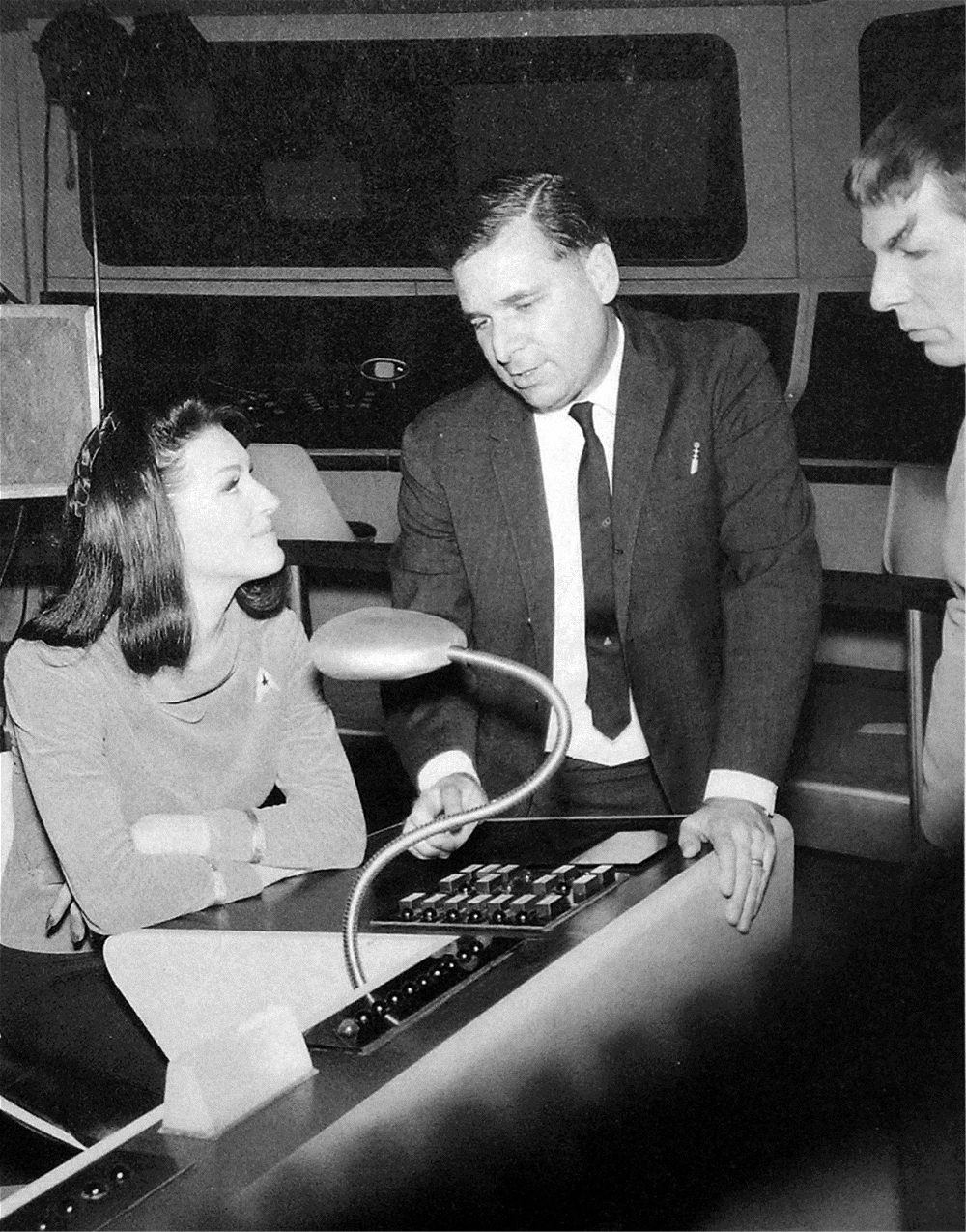
Majel Barrett, Gene Roddenberry and Leonard Nimoy on the set of The Cage.

Eugene Wesley Roddenberry was born in 1921. He had served as a combat pilot during the Second World War and a commercial airline pilot for several years afterwards. He resigned after at traumatic plane crash in the Syrian desert. He later joined the Los Angeles police force as a traffic cop and speechwriter for the Chief of Police. Whilst still working with the police, he began writing scripts for television, also serving as a technical advisor on Mr. District Attorney when it transferred to television from radio in 1951. Over the next decade he sold multiple scripts to shows such as Highway Patrol, The West Point Story and Have Gun - Will Travel. In 1956 he resigned from the police force to focus on his writing and in 1963 created his own show, The Lieutenant, about the US Marine Corps. The series was a popular success, but only aired for one season. Roddenberry was frustrated when his attempts to write more topical material, such as dealing with race relations in the service, were shot down by the studio.

Roddenberry had mostly written in the Western, crime and cop genres, but had become increasingly disenchanted with writing shows about contemporary problems, often looking at the darker side of life. Inspired by the ongoing Space Race between the United States and the Soviet Union, which promoted friendly competition in the field of science rather than direct military conflict, Roddenberry came up with an idea for a series about a starship (initially called the USS Yorktown, later changed to the Enterprise to be less US-centric). exploring new worlds and races in the distant future. The ship would be arranged along military lines and would be armed to defend itself, but its primary mission would be peaceful. Roddenberry sent a series of script ideas and a proposal to CBS, but they passed after an initial meeting which was only to see if the new idea was going to be competition for their in-development Irwin Allen series, Lost in Space. Desilu picked up the project and took it to NBC. Aware the science fiction was seen as a challenging genre (being expensive to produce but often ending up looking cheap), Roddenberry developed a pitch describing the show as "Wagon Train to the stars" (at one point even briefly considering that as the title), more about the people and their challenges than special effects or explosions.


NBC greenlit a pilot episode, selecting a script called The Cage. Roddenberry assembled a cast consisting of Jeffrey Hunter as Captain Christopher Pike, Majel Barrett as Number One, Leonard Nimoy as Mr. Spock (whom Roddenberry had worked with previously) and John Hoyt as Dr. Boyce. Filming began on 27 November 1964 and lasted for a fortnight.

The completed episode was presented to NBC in early 1965 under the title Star Trek. NBC were hesitant after test audiences reacted negatively to the slow-paced, cerebral episode and Roddenberry offered to create a second pilot. Unusually, NBC agreed (possibly due to a lack of promising new pilots for the 1965/66 season). When Jeffrey Hunter decided not to return as Captain Pike, Roddenberry created a new leading character, Captain James T. Kirk, and hired Canadian actor William Shatner to play him. In the event, Leonard Nimoy as Spock was the only character to return from the pilot (despite concerns over his "Satanic" appearance), although Majel Barrett did return in the new, recurring role of Nurse Christine Chapel. The second pilot, Where No Man Has Gone Before, which was a somewhat more action-focused story, went into production on 15 July 1965. NBC was particularly pleased with the low cost of the project, as it reused the sets from The Cage and indicated how the series could be produced on a modest budget despite its futuristic trappings. After a more positive reception to the pilot, they formally greenlit Star Trek for a first season of 16 episodes (later expanded to 29) in early 1966.

Archer: Seasons 1-6

Sterling Archer is a suave, skilled secret agent with excellent combat skills and a knack for meeting beautiful women. He's also an arrogant and spoiled man-child with terrible interpersonal skills and an overbearing, controlling mother, who is also his boss. Along with his co-workers, Archer is put into situations where he has to use his wits to survive...which is often a big problem.


Archer is an animated comedy drama which riffs on spy movies, action thrillers and the Cold War. It's a bit like James Bond, if M was James Bond's mother and everyone was incompetent. Its setting is ambiguous (the Soviet Union and KGB still exist and cars look like they're from the 1970s, but everyone has a mobile phone and internet access) but that's not really important. What is important are the central cast of characters and the increasingly bizarre situations they get into.

Some viewers bounce hard off the show because of Archer himself, a misogynistic and arrogant bully who has no respect for anyone and tends to disparage everyone around him, unless they're a woman he's trying to seduce. He refuses to read full mission dossiers (preferring to skim them for the gist), a fact that nearly gets him and others killed on several occasions. Archer is, of course, supposed to be initially unlikable and in some respects even repugnant. Creator Adam Reed based on the character on the original depiction of James Bond as seen in the novels, where he is far more amoral, cold-hearted and self-centred a character as presented on screen. As the show continues, however, Archer shows both increased depth and character development. He is far more intelligent than he presents himself as and over the course of the series grows friendships with the rest of the character which appear genuine. He is also a massive Lord of the Rings fan (the books, as the films don't seem to exist in this universe yet), dropping frequent Tolkien references, and is also a grammar perfectionist, insisting on the correct use of "literally" and "whom" even in the midst of firefights. Voice actor H. Jon Benjamin plays Archer brilliantly, with excellent comic timing.

The only character in the show who appears to be both sympathetic and relatable is Lana Kane, played by Aisha Tyler. Lana is an expert in hand-to-hand combat and has formidable firearms skills. Initially she has a slightly more abrasive personality but over time she evolves into the conscience of the team. She is also extremely attractive (she and Archer have an on-off relationship through a lot of the series) but is noted as having unusually large hands, which is mentioned frequently. Lana's exasperation when Archer does something monumentally stupid (usually at least twice an episode) can be seen as a stand-in for the audience's reaction. Far less sympathetic is Malory (Jessica Walter), Archer's borderline-alcoholic and controlling mother, and the source of his various neuroses and personality problems. Malory is thoroughly dislikable but later episodes show her background as a secret agent during the height of the Cold War which at least hints at why she is the way she is. In later seasons, when she is no longer in charge of events as much as she was before, she becomes a bit more of an interesting character.

The secondary cast is amusing but a bit more variable in its treatment. Cyril Figgis (Chris Parnell) is initially presented as a sympathetic figure, a geek who has somehow ended up in a relationship with Lana and despises Archer. However, he is quickly revealed to have his own massive personality problems and issues. He gets some good character development in the first three or so seasons, but then becomes less of a prominent figure later on. Pam (Amber Nash) is the relaxed head of HR for the office and evolves over the course of the series into a force of nature, an occasional cocaine addict and drinker who is also a good listener and becomes, improbably, Archer's best friend. She is also a drift racer, a member of a fight club and has a tendency to "Hulk out" and go on the rampage at inopportune moments. She is many viewer's favourite character. Cheryl (Judy Greer) is much more of a random character, Miss Moneypenny if she was a secret millionaire with an incontinent pet ocelot (whom Archer inexplicably dotes on). And yes, that's a Salvador Dali reference (one of Archer's less obscure references). Cheryl provides much of the offbeat and surreal humour of the show, but her random bouts of insanity mean she doesn't have much of a character herself. Ray (creator Adam Reed himself) is a background character, a gay and more flamboyant secondary agent who picks up Archer's slack, who evolves into a more prominent character later on. Rounding out the regular cast is Krieger (Lucky Yates), a mad scientist who provides most of the team's gadgets and weapons but also has his own, dubious experiments going on.

The show does have several over-arcing storylines which span the first four seasons. In these seasons Archer and the team form a private security and spy firm called ISIS (a name which is abandoned in later seasons for obvious reasons). They have an ongoing rivalry with another firm, ODIN, and are also engaged in ongoing battles with the KGB, complicated by Malory's secret affair with the head of that organisation. Archer is also trying to find his father and reignite his relationship with Lana. Episodes in these seasons revolve around fairly obvious James Bond and Cold War spoofs. At the end of Season 4, the agency is shut down by the CIA and the team decide to become criminals and sell a vast quantity of cocaine they've come into possession of. This results in the offbeat fifth season, subtitled Archer Vice, in which all other long-running storylines are (in some cases mercifully) abandoned and the show focuses on a much more tightly serialised narrative. This experiment is successful, but the sixth season reverts to more episodic storytelling with the agents now working for the CIA directly. It ends with arguably the funniest storyline to date, a riff on Fantastic Voyage with the team being miniaturised and injected into a dying scientist. The seventh season, which just started airing in the USA, recasts the team as private investigators based in Los Angeles, with Archer and Lana now parents and in an apparently committed long-term relationship.

At its best, Archer is witty, clever, inventive and funny, mixing slapstick, satire and rapid-fire banter with action. The animation is effective and occasionally - especially in later seasons after a fairly obvious budget hike - spectacular, but many of the best moments of Archer come from when the characters are just standing around talking. The show is much smarter than it first appears, taking on subjects ranging from racism to corporate greed to government irresponsibility in a creative manner.

On the negative side of things, Archer is highly reliant on running gags, catchphrases and recurring villains and situations, which for some viewers will get older and more tiring faster than others. Barry the rival agent was amusing the first few times he appeared, but by the end of Season 4 that storyline had not only outstayed its welcome, but it had been wrung dry and become irritating. Fortunately, later seasons seem to realise this and are less reliant on recurring villains in favour of more original stories.

Archer (****) is a very funny, enjoyable and surprisingly sophisticated comedy series that is well worth watching. The first six seasons are available now on Netflix in the UK and USA, and Season 7 is currently airing on FX in the States.

Friday, 15 April 2016

Second MALAZAN prequel novel title teased

In an interview with The Critical Dragon, Ian Cameron Esslemont has announced the working title for his second Malazan prequel novel.


The first book in the Path to Ascendancy series, Dancer's Lament, came out last month to a positive critical response. The second book, which I suspect we will see next year, has the current working title Deadhouse Landing, although the publishers have yet to approve it.

The title recalls the title of the second novel in Steven Erikson's Malazan Book of the Fallen sequence, Deadhouse Gates (one of the most critically-lauded books in the series). The title hints that the second book in the series will explore Kellanved and Dancer's time in the Deadhouse of Malaz City.

Esslemont also confirms that he is currently contracted for three books in the Path to Ascendancy series, but it could go on for longer if the first three books are successful.

A Design for Life at 20

On 15 April 1996, Welsh rock band Manic Street Preachers released their nineteenth single, the first from their fourth album. They were a low-to-mid ranking British band, having achieved modest success with their first three records but by no means were a household name. Compared to the biggest bands in Britain at the time - Oasis, Blur and Pulp - they were minnows. Their record company had decided to keep them on by just one vote a few months earlier, and big things were not expected of them. Their previous album, The Holy Bible, had been dark, complex, "difficult" but highly rewarding in critical and artistic terms. However, it had sold like a damp squib.


The Manics were recovering from the biggest catastrophe of their careers and maybe their lives. A year earlier their rhythm guitarist, lead writer and "propagandist-in-chief" Richey Edwards had disappeared without a trace. His car had been found abandoned at the Severn Bridge, a notorious suicide spot, after Richey had been suffering from a prolonged period of despair, depression and frustration. Although suicide was suspected, a number of eyewitness reports (including a detailed one of him taking a taxi around Cardiff) suggested that he might still be alive. But he was never seen again. The remaining members of the band - guitarist and singer James Dean Bradfield, drummer Sean Moore and bassist and co-writer Nicky Wire - spent three months waiting for news and then reconvened to discuss their future.

The band had already been preparing their fourth album, with Richey having contributed several lyrics. James had played demos of a few of these for him the day before he disappeared. One, "The Small Black Flowers That Grow in the Sky", based on a Richey lyric about animal cruelty, had reduced him to tears. With work in full flow, the band were reluctant to abandon the promising record but also did not want to disrespect Richey's memory. However, the band were encouraged to proceed by Richey's family, who hoped that hearing his songs on the radio might encourage him to get in contact. Work resumed but the band initially found getting into the swing of things difficult. Nicky Wire, who had to write more lyrics than normal, found himself suffering badly, producing lyrics he could only describe as terrible.

Out of this period he did produce two songs that seemed to hold some promise. "The Pure Motive" and a short, atypically (for the Manics) lyric-light song called "A Design for Life". Wire had come up with the title by taking Joy Division's "An Ideal for Living" and just substituting different words. The song wasn't even really a song, more of a short poem about the Welsh working class. James Dean Breadfield liked the title and some of the lyrics, but felt others were a little too dark and a bit too "Holy Bible-ish" for an album that was already more positive in its outlook. They combined the two songs, moved some lyrics around and then Wire produced the new - and now iconic - opening two lines: "Libraries give us power" (taken from the inscription outside Pillgwennly Library, Newport: "Knowledge is Power") and "Then work came and made us free" (possibly darkly inspired by "Arbeit macht frei", a Nazi slogan most famously found over the gates to Auschwitz). The rest of the song fell into place quickly. Bradfield declared he had to write "the best tune ever" to fit the lyrics. He played the finished demo down the phone to Nicky who was dumbstruck. Drummer Sean Moore, who also plays a major role in the composition and fine-tuning of the songs, then came on board and provided the song's time signature, as well as its drum solo outro.

The song was played for the first time at support gig for the Stone Roses (who were in the middle of self-destructing) in late 1995 and proved popular with the fans. Radio stations began playing it in March 1996 and it picked up an enthusiastic response, rapidly being A-listed by most stations. When it was finally released, it sold 100,000 copies in a week, a figure that dwarfs modern single sales (well, any not by Adele, anyway). The band prepared for their first #1 single but missed the top sport by only about a thousand copies, with the smooth swingbeat track "Return of the Mack" by Mark Morrison pipping them to the post.

The song received enormous sales, acclaim and airplay, paving the way for Everything Must Go, the album, on 20 May. At the Brit Awards in February 1997, the band won two Brit Awards. The band also received two NME Awards and were shortlisted for the Mercury Music Prize. In the summer of 1998 they repeated the award trick with their fifth album, This Is My Truth, Tell Me Yours, but that outsold Everything Must Go by two-to-one and gave them their first #1 single with "If You Tolerate This Your Children Will Be Next". But it was "A Design for Life" that became their signature song, the closer at almost every single set they'd play for the next two decades and their most euphoric and life-affirming moment: a song about the working class being set free by education.

Neil Gaiman to write GOOD OMENS TV series

Neil Gaiman has confirmed that he will be scripting a six-episode mini-series based on his 1990 collaboration with Terry Pratchett, Good Omens.


Gaiman had previously decided not to proceed as a writer on the project, believing it should only be done between him and Pratchett. Pratchett passed away last year, meaning that it was likely that the project would have to be given to another writer. However, Pratchett left behind a letter to be given to Gaiman in the light of Pratchett's death, in which he asked Gaiman to handle the project.

The BBC had previously been interested in the series when it was mooted as a 13-part series, but budget cuts at the BBC seem to have removed their interest. Cutting the story to six parts might be enough to reignite their interest, especially after their bullish recent performance with expensive-looking period and genre dramas such as Wolf Hall, Jonathan Strange & Mr. Norrell, The Last Kingdom and War and Peace. Good Omens also did well for the BBC as a radio drama in 2014, starring Peter Serafinowicz and Mark Heap as angels Crowley and Aziraphale.

In the same article, Narrativia, the production company set up by Pratchett before his death, confirmed that it was continuing to develop an ongoing TV series based on the City Watch storyline in the Discworld novels and it was also working on a film based on the novel Mort, with Hollywood scriptwriter Terry Rossio (Shrek, Aladdin, Pirates of the Caribbean: The Curse of the Black Pearl) developing a script.

It sounds like Good Omens is a bit further along than the other two projects, and hopefully we may be hearing more news about it soon.

Bobbie Draper cast on THE EXPANSE

Daniel Abraham and Ty Franck, who in gestalt form are known as James S.A. Corey, have confirmed that the fan-favourite character of Bobbie Draper has been cast for the second season of The Expanse.


New Zealand actress Frankie Adams has been cast in the role. Adams is a relative newcomer, but impressed Abraham and Franck with her audition and they lobbied for her to be cast. Adams is an actress of Samoan descent and is over six feet tall. She is also an amateur boxer. The mix of acting skill and physical presence was deemed perfect for the role of Draper, a Martian marine who gets mixed up in a crisis on Ganymede in the novel Caliban's War.

The Expanse's second season begins production shortly, to debut on SyFy in January 2017. A UK airdate for the series or the DVD/Blu-Ray (already available in the States) has still not been set.

Producers ask to end GAME OF THRONES after just 13 more episodes after Season 6

In breaking news, David Benioff and D.B. Weiss have asked HBO to end Game of Thrones after just twenty-three more episodes (including the imminent sixth season). Season 6, which starts on 24 April, will consist of 10 episodes as normal but Benioff and Weiss are envisaging two further seasons with a shorter run each.


The likely reaction to this news from some hardcore show fans.

Benioff and Weiss's plan is for Season 7 to consist of seven episodes and Season 8 to consist of just six. The plan is for each season to have the same shooting schedule and budget as now, but this will allow them to focus both time and money in a way that has not been possible up until now. Indeed, the shooting schedule for episodes such as Watchers on the Wall (in Season 4), Hardhome (Season 5) and the penultimate episode of Season 6, featuring the largest battle filmed for the series to date, was so punishing it threatened to derail production altogether, with extra resources having to be drafted in.
“I think we’re down to our final 13 episodes after this season. We’re heading into the final lap,” said Benioff. “That’s the guess, though nothing is yet set in stone, but that’s what we’re looking at.”

If the show retains the $100 million budget it hit with Season 6, that means that theoretically each episode in Season 8 could have a budget of $16.6 million, making Game of Thrones quite easily the most expensive long-running TV show ever made.

It had previously been suggested that the final season could be a shorter run, or HBO could even count Seasons 7 and 8 as one extra-length season broken in half to focus more resources and money on each episode (HBO had previously followed this tactic on The Sopranos and Oz, whilst AMC had on Breaking Bad). This would also help with actor contracts, which might be up for renegotiation. However, HBO conducted significant renegotiations with the entire cast during Season 5 which would have likely rendered this point moot. So this isn't entirely unexpected news. It is unexpected that HBO and the producers would be openly discussing the plan. However, this may also be a form of damage control: if HBO turn round and announce the final two seasons will actually be seven-and-seven episodes, or eight-and-seven, that could be counted as a better outcome than this plan.
To live up to the standard they’ve set for themselves — and fans — Weiss and Benioff said they can’t continue to produce 10 episodes of the show in the show’s usual 12- or 14-month time frame. “It’s crossing out of a television schedule into more of a mid-range movie schedule,” Weiss said.

However, the plan does help explain the show's recent trailer for Season 6, which seemed to indicate that not a lot of story was necessarily left after the sixth season and spinning out the plot for twenty further episodes seemed improbable.

 "Ser Titus of House Pullo! How many episodes of Game of Thrones are left after this season?"
 "Thanks, Titus."

What will be of interest to readers is what this means for the Song of Ice and Fire novel series. Although the TV show has dropped a number of storylines and characters from the novels, the primary, overall story is still following the same beats. The fact that HBO think they can finish the story quite quickly after Season 6 may indicate that George R.R. Martin can actually likewise finish the books with two more novels as he has been promising for some time, to some scepticism.

It should be noted that Benioff and Weiss have not yet received approval from HBO for their plan. Indeed, it might be that HBO have let this discussion out into the public so if they negotiate more episodes - say 7 and 7 or 8 and 7 - it will feel more positive. With a formal confirmation of the renewal of Game of Thrones for its final two seasons expected within hours of the Season 6 premiere, we shouldn't have too long to wait to find out for sure. But certainly it would be impossible for these discussions to be made public if a shorter run of some kind wasn't certain at this time.