Showing posts with label memorials. Show all posts

Thursday, 27 August 2026

RIP Peter Cullen

In what is turning out to be a trying week, it is sad to report the passing of Canadian actor Peter Cullen at the age of 84. Although well-known for numerous roles, he will forever be iconically known as the voice of Optimus Prime in the Transformers franchise.


Born in Montreal in 1941, Cullen graduated from the National Theatre School of Canada in 1963. He worked as an announcer for Montreal radio. He began working in television in Canada and picked up interest from American television. He made a breakthrough by appearing regularly on The Sonny & Cher Show from 1971 to 1974.

In the early 1980s Cullen's agent spotted the emerging genre of animated television with toy tie-in lines, and put Cullen forwards for multiple roles. Cullen impressed the team at Sunbow Television responsible for the animated tie-in to Hasbro's Transformers line (initially an extensive import and rebranding of Takara's Diaclone and Microchange toy lines from Japan) and was cast in the core role of Optimus Prime, leader of the heroic Autobots, as well as his lieutenant, Ironhide, in 1984. When trying to work out a voice for Prime, Cullen was inspired by his older brother Larry, who had volunteered to fight in the US Marine Corps in Vietnam. Larry had advised his younger brother to not "act" like a hero, but instead "be" a hero, with wisdom and compassion instead of just acting tough.

Cullen rapidly became iconic in the role. Famously, young children were left traumatised by Prime's death in Transformers: The Movie (1986), something that left Cullen shocked. Cullen returned to voice the character during his resurrection in the third season of the TV show.


The success of the role saw Cullen become in-demand for other voice roles. He played multiple roles in the US dubs of Voltron and Saber Rider, and multiple roles in the GI Joe animated series. He voiced the villainous computer KAAR, nemesis of KITT, in Knight Rider, and provided the voice-over sounds for the titular enemy in the film Predator (1987). He voiced one of the titular creatures in Gremlins (1984). Arguably his two most iconic voice-over roles after Prime came with playing the evil Venger in the Dungeons & Dragons animated series (1983-85) and Eyore in The New Adventures of Winnie the Pooh (1988-91). Amongst Cullen's numerous achievements was providing the first English-language voice for Mario in 1983.

Cullen reprised his role as Optimus Prime in the 2007 live-action film Transformers, proceeding to play the role in sequels Revenge of the Fallen (2009), Dark of the Moon (2011), Age of Extinction (2014), The Last Knight (2017), Bumblebee (2018) and Rise of the Beasts (2023). He also played Optimus Prime in the animated series Transformers: Prime (2010-13), Rescue Bots (2011-16), Robots in Disguise (2015-17) and Titans Return (2017-18). He also played the role in numerous video games and advertisements, and had a key appearance as himself in The Toys That Made Us (2018), in the episode about the Transformers franchise.

Cullen began appearing at Transformers conventions in the 1990s and was struck by how his performance had inspired young people. He struck up a strong friendship with fellow voice actor Frank Welker, who played Prime's nemesis Megatron in Transformers. In the 2020s both Cullen and Welker were cast in the animated series Invincible, playing on their iconic characters' rivalry. Peter Cullen was given a Lifetime Achievement Award at the Children's Emmy Award in 2023 for his huge contribution to iconic voice roles across forty years.

Peter Cullen was a huge inspiration and reassuring voice for several entire generations of children. He will be extremely missed.

RIP Tim Curry

In sad news, British actor Tim Curry has passed away at the age of 80. One of the best-known and most popular actors of his generation, Curry was known for his charisma, acting skill, singing voice, his ability to make the cheesiest roles his own, and his generosity to fans.

Born in Cheshire in 1946, Curry was raised abroad in Hong Kong as well as different towns around the UK. At school he studied singing and became a soprano. He decided to focus on acting and studied drama at the University of Birmingham, graduating in 1968.

Curry almost immediately demonstrated his flamboyance and love of combining acting with singing and dancing by appearing in the West End musical Hair, which involved interactions with the audience (including dancing with my mother during one performance!). He met Richard O'Brien during the tour and they struck up a key friendship.

When O'Brien was developing The Rocky Horror Show, he reconnected with Curry and cast him in the key role of Frank-N-Furter. Curry relished early reviews of the play in 1973 which called him "ambisextrous" and "Bowiesque." Curry played the role in London and New York, attracting significant acclaim. Curry continued the role in the 1975 film adaptation, The Rocky Horror Picture Show, which made him an immediate star. The film's longevity, with regular viewing parties at cinemas worldwide to this very day and the mega-selling soundtrack album, is almost unmatched among pop culture phenomena.

Curry would go on to enjoy considerable success on stage through the 1970s and 1980s, such as the title role in Peter Shaffer's Amadeus, and continued with TV and film roles in the UK and USA, keeping a toe in both countries. In 1985 Curry enjoyed additional success with his roles as the Lord of Darkness in Ridley Scott's Legend and Wadsworth the Butler in Clue, the latter being arguably his second-biggest film role as the movie became another cult success, frequently referenced to this day.

In the late 1980s he focused on Hollywood work, and famously turned up in movies both excellent and dismal, though he was never less then supremely entertaining in them. His work ethic was formidable. Iconic roles  followed in The Hunt for Red October (1990), Home Alone 2 (1992), Loaded Weapon 1 (1993), The Three Musketeers (1993), The Shadow (1994) and Congo (1995). He also played scores of guest roles on television, but his outstanding performance was playing Pennywise in the 1990 TV mini-series Stephen King's It.

Curry also had a substantial career in animation, providing voices for shows such as The Wild Thornberries, Captain Planet and Gargoyles. He also began providing voice-over work for video games, including Wing Commander III, Toonstruck, Brutal Legend, Dragon Age: Origins and the Gabriel Knight series. In 2008 he played the role of Premier Anatoly Cherdenko in Command & Conquer: Red Alert 3 and gave what is generally regarded as the most hilarious line reading in filmed history.


Curry enjoyed a late career surge starting with his role as King Arthur in Spamalot on the stage. He took over the role of Emperor Palpatine in the animated series Star Wars: The Clone Wars and appeared in the film Burke & Hare.

Curry experienced a stroke in 2012 which left him unable to walk and partially paralysed. He worked hard at rehabilitation and resumed voice-over roles, as he found memorising lines after his stroke very difficult. In 2016 he made his last on-screen appearance, fittingly in the television remake of The Rocky Horror Picture Show. His final role was a voice-over in the horror movies Stream (2024) and Stream 2: Sudden Death (2026). In 2025 he published his autobiography, Vagabond.

An international treasure, noted for his quick wit, humour, warmth and impressive output, Tim Curry will very much be missed.

RIP Dolly Parton

Dolly Parton, pop culture titan of the 20th and early 21st Century, has sadly passed away at the age of 80.


Parton was born in 1946 in Tennessee and became one of the United States's best-known country singers. She was known for her musical giga-hits, including "Nine to Five," "Jolene," and "I Will Always Love You," as well as her acting career and her philanthropy, including an international literary programme for children that positively impacted millions of lives.

I usually cover the passing of people with genre connections, though if anyone was universally beloved enough to overcome that, certainly it would be Dolly Parton. However, she did have several minor and perhaps surprising ties to genre fiction. In 2011, she voiced a role in the animated fantasy film Gnomeo & Juliet, which was her penultimate acting role. However, far more significant was her ownership of Sandollar Productions.

In 1996, the production company played a key role in bringing the television series Buffy the Vampire Slayer to the screen, and was credited as a production partner on the show for all seven seasons (Parton herself declined a producer's credit, not wanting her name to overshadow the cast). Parton watched and enjoyed the show, and arranged parties and gifts for the cast and crew during its early seasons. Sandollar went on to produce spin-off series Angel as well. Star Sarah Michelle Gellar has expressed her admiration and gratitude for Parton's support.

An international legend and icon, Dolly Parton will certainly be greatly missed.

Friday, 5 June 2026

RIP Anthony Stewart Head

The sad news has broken that actor and musician Anthony Stewart Head has passed away at the age of 72, following complications developing from pneumonia. Head was known to multiple generations for numerous roles on stage and screen. However, he will almost certainly be best-remembered for playing the role of Rupert Giles on Buffy the Vampire Slayer (1997-2003).

Head was born in Camden, London in 1954. The son of documentary film-maker Seafield Head and actress Helen Shingler (as well as the younger brother of singer Murray Head), unsurprisingly he chose a career in the spotlight. He studied at LAMDA (the London Academy of Music and the Dramatic Arts) before making his stage debut in the 1970s. He made his TV debut in 1978 in the World War II drama series Enemy at the Door.

As well as acting, Head was noted for his singing voice. He spent some time in the musicals Godspell and The Rocky Horror Show, and provided backing vocals for the bands Red Box and Two Way in the 1980s.

Head made his major breakthrough in an unconventional way. In 1987 he went up for what appeared to be a small role in a TV advertising campaign for coffee company Nescafe. The campaign saw a series of adverts forming a will-they, won't-they romance between Head's character and Sharon Maughan's. Surprisingly, the advertising campaign (which ran until 1993) caught the imagination of the country and turned Head almost overnight into a sex symbol. The advertising campaign transferred to the United States, where the coffee company was known as Taster's Choice, with both Head and Maughan reprising their roles (albeit this time with American accents). The campaign opened doors for Head in the USA and he started to be offered work in American television.

In 1996 Head auditioned for the role of the Eighth Doctor for the Doctor Who TV movie, losing out to Paul McGann. Despite losing the main role, Head soon began contributing to the franchise by voicing webcasts and audio dramas.

In 1996, Head was simultaneously cast in pilots for two shows, one in the UK and one in the USA: Jonathan Creek and Buffy the Vampire Slayer. Both shows went on to be long-running, smash-hit successes but Head could only be in one of them full-time. Despite the complications of filming in Los Angeles whilst his family was based in the UK, he picked Buffy, his second major breakout hit.

In Buffy, Head played Rupert Giles, the "Watcher" who trains and mentors the titular Slayer (played by Sarah Michelle Gellar), succeeding the role played by Donald Sutherland in the original film. He originally played the role as a stiff upper-lift British stereotype but as the show continued, his character's darker backstory was explored in some detail, revealing a rougher, rock-and-roll origin as a more morally dubious magic-user known as "Ripper." Head was able to use his more normal speaking voice for this version of the character, as opposed to his posher voice as the adult Giles.

Head played the role for five full seasons and into the sixth. Missing his family, Head switched from a regular to a recurring role, appearing multiple times through the sixth and seventh seasons before joining Buffy for her final battle in the series finale. Some scenes in the early seventh season were even shot at Head's actual house in the UK to accommodate his schedule. Buffy also allowed him to demonstrate his singing voice, singing The Who's "Behind Blue Eyes" in a Season 4 episode before playing a key role in the Season 6 musical, Once More With Feeling.

Buffy made Head a worldwide star and he got regular job offers for both sides of the Atlantic, though he preferred to remain in the UK. Recurring roles on My Family and Monarch of the Glen followed, along with another highly memorable role playing the British Prime Minister in Little Britain, playing the straight man to David Walliams' deranged assistant. 

In 2005 Head continued his association with Doctor Who by narrating documentaries covering the return of the show to television. In 2006 he played the villain Mr. Finch in the episode School Reunion, opposite David Tennant and Billie Piper. The story was notable for reintroducing Elisabeth Sladen as Classic Who companion Sarah Jane Smith, but Head's villainous turn won praise as well.

In 2007, Head was in advanced talks with the BBC and Fox to reprise his role as Rupert Giles in a UK-set Buffy spin-off show called Ripper. The planned BBC-Fox co-production would have seen Giles investigating smaller-scaled supernatural mysteries in Britain, with the possibility for occasional appearances by his Buffy co-stars. However, the BBC and Fox could not agree on terms, particularly an episode count that would satisfy both parties, as well as debates over the tone of the series.

In 2008, Head was cast as King Uther Pendragon in the first four seasons of the BBC fantasy series Merlin. Uther is the King of Britain who is driven by an utter hatred of magic, forcing the young Merlin to operate undercover in his mission to help the young Prince Arthur achieve his destiny. The character is initially presented as a villain but Head provided him with more depth and explanation for his motivations.

Through the 2010s Head made frequent appearances in guest roles in television. In 2020 he achieved another notable success by playing the villainous role of Rupert Mannion on Ted Lasso.

It is unusual for an actor to embody one high-profile, breakout role in a career, and it is notable that Head managed to achieve so many. His coworkers seem to have been perennially unified in singing his praises as a decent and hard-working actor who welcomed collaboration and enjoyed being part of successful ensembles. He will certainly be missed by multiple generations of TV fans. He is survived by his daughters Emily and Daisy Head, both successful actresses.

Wednesday, 3 June 2026

RIP John Blanche

News has sadly broken that legendary Games Workshop illustrator John Blanche has passed away. Blanche is famed for establishing the look and feel of the Warhammer 40,000 science fantasy universe in the 1980s.


Blanche was somewhat vague on his personal details, allowing that he was born in 1948 on an unspecified British council estate, and gained his love of art whilst studying at college in the 1960s. He was drawn to science fiction and fantasy imagery, especially after reading The Lord of the Rings, but was told his interest would not lead to any kind of commercial success.

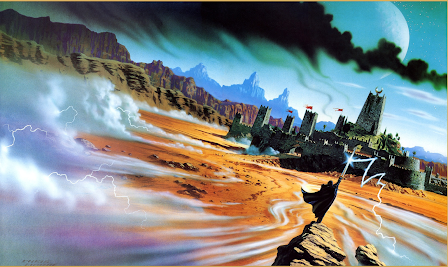
"Epic 40,000" (1997) depicts battles on an even more gigantic scale than standard 40K.

Staying true to his personal brand, he worked as a taxidermist in a Georgian manor house (as you do) before noting the explosion of science fiction and fantasy publishers in the 1970s, inspired by the success of Tolkien and the "New Wave" of authors spearheaded by the likes of Michael Moorcock. He relocated to London and got involved in the publishing industry with the help of artist and publisher Roger Dean, contributing to magazines and book covers, including some pieces for David Day's Tolkien Bestiary (1979).

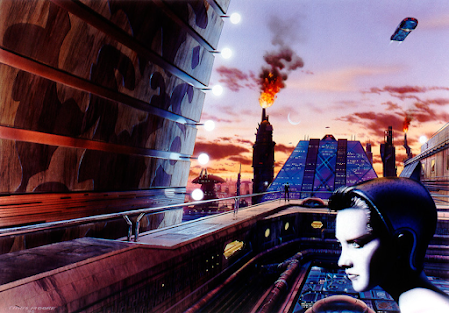
"Amazonia Gothique" (1986) was Blanche's irritated reaction to the dominance of "bikini chainmail" and other illogical armour for female warriors in the SF and fantasy genres. This piece proved inspirational and influential on GW's Warhammer 40,000 line.

Blanche had already gotten into collecting and painting metal miniatures for wargames, so the chance to work for Games Workshop in 1977 seemed too good to pass up. He began illustrating covers for White Dwarf Magazine, and drew the localised British cover for Games Workshop's reprint of the Dungeons & Dragons Basic Set. He continued to juggle book and magazine work with Games Workshop, but the relationship grew closer in the early 1980s. He created the cover art for the first edition of Warhammer Fantasy Battle in 1983 and worked on dozens of sourcebooks and magazine articles for the game.

In 1986 he was made Art Director at Games Workshop in Nottingham and played a key role in establishing the look and aesthetic of the Warhamer 40,000 universe. He personally drew hundreds of pieces of art inspired by the setting and commissioned more as Art Director. His work for Games Workshop is notable for its sheer longevity; he only officially retired from the company in 2023.


"The Emperor of Mankind" (2008) may be Blanche's most famous single painting, a rare depiction of the Emperor of humanity sitting immobile on the Golden Throne on Terra, as he has done for ten thousand years.

His work for GW did not prevent him from working elsewhere, and he provided some iconic cover art for the Fighting Fantasy game book series as well. He also provided art for the local thrash metal band Sabbat.

John Blanche's artwork was powerfully influential on multiple generations of British science fiction and fantasy fans. His style was inimitable and his skill extremely impressive. He will be missed.

It's probably most fitting to leave on a quote from Warhammer 40,000's most notable writer of fiction, Dan Abnett:

"For me, John Blanche will always be the master. His extraordinary, grotesque vision informs everything we do."

Thursday, 21 May 2026

RIP Michael Keating

British actor Michael Keating has sadly passed away at the age of 79. Keating was best-known for playing the fan-favourite character of Vila in classic British science fiction series Blake's 7.

Michael Keating (far right) as Vila Restal in Blake's 7, alongside fellow late castmembers Paul Darrow (far left) as Kerr Avon and Gareth Thomas (centre) as Roj Blake

Born in Edmonton, Middlesex in 1947, Keating started acting as a teenager. After some early stage appearances, his screen debut was in a 1969 episode of Special Branch and he made occasional guest appearances in British dramas through the 1970s. At the end of 1977, he appeared in Doctor Who, playing the role of Goudry in the memorable serial The Sun Makers, alongside Tom Baker.

He was near-simultaneously cast in the role of Vila Restal in Blake's 7. Vila was a shrewdly conniving conman and thief, a petty criminal who is rescued more by default than design and becomes a founding member of Roj Blake's crew of freedom fighters on the starship Liberator. Vila is arguably the most reluctant crewman and initially held in disdain by his fellows (especially the ruthless Kerr Avon) until his supreme skill with computerised lock systems and his handiness in a fight (even if only in ambushes or attacking from behind) becomes apparent. Vila is, despite himself, inspired by Blake's cause and becomes a loyal member of the crew. He ultimately becomes the only character to appear in all fifty-two episodes of the series, airing from 1978 to 1981. Ironically, Vila was nearly killed off several times as the producers pondered which character was for the chop next, but was saved by other actors choosing to leave of their own accord and the growing sense he was one of the more popular characters for his mordant wit. 

Keating went on to make guest appearances in other British shows through the 1980s and 1990s until he was finally cast as Reverend George Stevens in popular British soap opera EastEnders, a recurring role from 2005 to 2017.

Keating returned to the role of Vila for Big Finish's line of Blake's 7 audio dramas, appearing in intermittent releases from 1998 to 2022.

News of Keating's passing elicited a large amount of sympathy from the Blake's 7 fanbase, as well as friends and fans of his work on other projects. The show had recently received a burst of new publicity with well-received HD remasters and Blu-Ray releases of the original show, and news that a possible reboot was in development.

Saturday, 21 March 2026

RIP Nicholas Brendon

News has sadly broken of the passing of Nicholas Brendon, who was best-known for playing the role of Xander Harris on Buffy the Vampire Slayer.

Brendon was born in Los Angeles in 1971 and was an identical twin. As well as his slightly older twin brother Kelly Donovan, he had two younger brothers. He developed a stutter as a child, which badly impacted his self-confidence, and pursued acting as a way of managing the condition, abandoning plans to become a professional baseball player. His initial attempts to break into acting ended in failure, so he considered retraining in medicine.

A second attempt at acting saw Brendon audition for the pilot for Buffy the Vampire Slayer in late 1995. Cast as Xander Harris, the high school nerd who develops a crush on newly-arrived Buffy Summers (Sarah Michelle Gellar) only to discover she is the Slayer, the prophesised destroyer of vampire-kind, Brendon retained the role when it went to series, entering production in 1996 and finally airing (as a mid-season replacement) in 1997.

Nicholas Brendon appeared in all seven seasons of Buffy, until the show ceased airing in 2003. His character was notable for not possessing any special powers or skills, instead presenting the "ordinary guy" perspective on events. He was also somewhat the stand-in for creator Joss Whedon, sharing Whedon's interest in comic books and movies. Xander's nerdish persona was somewhat at odds with Brendon's tall good looks, so the show pivoted with Xander dating the popular Cordelia (Charisma Carpenter) in the second and third seasons before hooking up with immortal ex-demon Anya (Emma Caulfield) in Season 4. Xander also became an effective fighter against the forces of evil. Several episodes focused on his character development, arguably the most notable being in Season 3's The Zeppo when he saves the day whilst his super-powered friends, busy with a world-ending threat, are otherwise occupied. In later seasons he gets an ordinary job (in construction) and develops impressive skills in carpentry and design. One episode also saw Xander split into two identical people, which allowed Nicholas and his twin brother Kelly to work together (some fans, unaware that Brendon was a twin, thought the show had demonstrated amazing vfx skill instead). Xander's crowning moment of glory comes in the Season 6 finale when he saves Sunnydale and possibly the world from Willow (Alyson Hannigan) after she is consumed by darkness. The show ends with Xander recovering from Anya's death and his loss of an eye in the final battles against the forces of evil.

Brendon went on to play the recurring role of Kevin Lynch on Criminal Minds, appearing from the third through tenth seasons from 2007 to 2015 in 21 episodes. He also played the main role of Seth Richman in Kitchen Confidential in 2005-06, and the recurring role of Lee McHenry in four episodes of Private Practice in 2010-11. He chalked up multiple film roles, the most notable being in comedy-horror film Psycho Beach Party (2000) alongside Amy Adams and Lauren Ambrose.

Nicholas Brendon also toured on the Buffy convention circuit, but struggled with depression and alcoholism, attending rehab several times. He married and divorced twice, and was arrested several times. He went on Dr. Phil twice to discuss his issues. He also had other health issues, requiring spinal surgery in 2021 and suffering a heart attack in 2022.

There's no denying that Nicholas Brendon had a troubled life, and had a lot of problems after his brush with fame on Buffy in trying to further his career. However, his family reported that new antidepressant medication seemed to be working in the last few years of his life, he had avoided some of the problems that earlier afflicted him and he had found a new career as an artist. It appears he may have found some peace in his last few years.

Friday, 27 February 2026

RIP Dan Simmons

News has broken that science fiction author Dan Simmons, best known for his Hyperion Cantos series, has passed away at the age of 77.


Born in Illinois in 1948, Simmons did not break into writing fiction until he was already in his thirties, having instead worked as an elementary school teacher. He credits Harlan Ellison's mentorship with getting him into writing workshops and programmes. He published his first short story, "The River Styx Runs Upstream," in 1982, and another, "Remembering Siri," in 1983. This story is notable as being the first set in his Hyperion setting. Another 1983 story, "Carrion Comfort," inspired his horror novel of the same name.

Despite his reputation as a major science fiction author, Simmons actually broke through as a horror author with his first two novels, Song of Kali (1985) and Carrion Comfort (1989). He attracted critical attention and approval from Stephen King, and won the World Fantasy Award for Song of Kali, with Carrion Comfort picking up a Bram Stoker Award, Locus Award and British Fantasy Award.

In 1989 Simmons also published his first major science fiction work and also his best-known single novel, Hyperion. An SF take on The Canterbury Tales, the book forms a series of narratives told by travellers on their way to confront a mysterious alien entity known as the Shrike. The sequel/continuation (Simmons would occasionally suggest the two books had been written as one ultra-long novel, split in half for practical reasons and a major shift in formal), The Fall of Hyperion (1990), won a British Science Fiction Association Award. The two books were retrofitted as a duology called The Hyperion Cantos and published in omnibus under that title in 1990. After detouring into other settings, Simmons would return to the same universe for Endymion (1996) and The Rise of Endymion (1997), which were not quite as well-received, but still solid. Simmons got to experience the joys of Hollywood development hell, with Hyperion optioned for both film and television multiple times (most recently by actor-producer-director Bradley Cooper, a big fan of Simmons) but never quite making it.

Simmons would continue to write in other settings. The five-volume Seasons of Horror series was published intermittently from 1991 to 2002, and was followed by the Joe Kurtz trilogy (2001-03), which saw him move into contemporary detective fiction. Phases of Gravity (1989) and The Hollow Man (1992) were science fiction, whilst The Crook Factory (1999) was a historical thriller. His next major work was the Ilium duology, consisting of Ilium (2003) and Olympos (2005).

Simmons entered a new phase of his career with arguably his second-best-known novel, though perhaps better-known to a more general audience. The Terror (2007) expertly merged elements of historical and speculative fiction into an engrossing account of the infamous Franklin Expedition. It was adapted as a TV series in by AMC in 2018. Drood (2008) tackled the mystery around Charles Dickens's final novel. Black Hills (2010) attracted less interest, and Simmons experienced significant opprobrium for his 2011 novel Flashback, which some commentators regarded as Islamophobic. Simmons noted the novel was an expansion of a earlier short story in which the antagonists are instead Ronald Reagan-influenced capitalists, which attracted no criticism at the time, though commentators also pointed out his long, post-9/11 history of political commentary on the issue over the previous decade. Despite criticisms, the book sold well and was optioned for television. Simmons rallied to deliver the novels The Abominable (2013) and The Fifth Heart (2015). His final completed novel, Omega Canyon, was due for publication last year but was delayed for unspecified reasons.

At his best, Dan Simmons could be an atmospheric writer, skilled in character, setting and story. His novels could trend long, sometimes to tremendous effect (in his Hyperion Cantos duology and The Terror), but sometimes invoking filler. But he was a restless author, always happy to explore new ideas and new genres rather than resting on his laurels and bashing off a dozen, easy Hyperion sequels. Bradley Cooper, Stephen King and Guillermo Del Toro were major fans, Harlan Ellison regarded him as a protege and George R.R. Martin published him in anthologies.

Dan Simmons passed away today from complications resulting from a stroke. He is survived by his wife Karen and daughter Jane, two grandchildren and his brother. With Hyperion and The Terror, he achieved the rare feat of writing two genre novels which crossed over into mainstream awareness and praise, which is no small achievement.

Thursday, 26 February 2026

RIP Rob Grant

In tragically surprising news, as he was in the news just last week, Red Dwarf co-creator Rob Grant has passed away at the age of 70.

Born in Salford in 1955, Grant grew up in the north of England, studying at Liverpool University. He met Doug Naylor in the mid-1970s at university and they collaborated on a series of sketch shows for BBC Radio 4, including Cliche and Son of Cliche. For the latter they created a character called "Dave Hollins, Space Cadet," the last human being alive after being marooned in the distant future. Filing that for future reference, they started working on TV projects for comedian Jasper Carrott and then the satirical puppet show Spitting Image. In 1986, Grant and Naylor wrote "The Chicken Song," a satirical song for Spitting Image which unexpectedly hit #1 on the British music charts.

Both Grant and Naylor were science fiction fans and wanted to do something in that genre. In 1987 they developed the TV science fiction sitcom Red Dwarf for the BBC. After running into numerous problems with casting - original choice for Rimmer, Alan Rickman, bailed out to appear in some obscure American movie set in a skyscraper - and scheduling - the entire first season had to remounted after a studio strike - the show debuted in February 1988 and was immediately successful. Its stars, Craig Charles, Chris Barrie, Danny John-Jules and Norman Lovett (later joined by Hattie Hayridge and Robert Llewellyn), became well-known figures on British television almost overnight.

The show aired six seasons from 1988 to 1993, selling hundreds of thousands of copies on VHS and hundreds of thousands of copies of two novels penned by Grant and Naylor, Infinity Welcomes Careful Drivers and Better Than Life. The TV show also spawned a high-selling magazine and a fervent fan community. Despite being one of the the biggest comedy shows in Britain during its early lifetime, the show attracted relatively little attention from the critical community and was mostly ignored for TV awards. Ironically, the show achieved its highest critical success in the United States by winning an International Emmy Award for the Season 6 episode Gunmen of the Apocalypse. There were two attempts to film a pilot for the US market, both failing to go to series.

Grant and Naylor co-created a more conventional sitcom for ITV about theatrical agents called The 10%ers in 1993, but their creative relationship was cooling. They stopped working together after 1993 and dissolved their writing partnership in 1995, though both retained ownership stakes in the Grant Naylor production company. This dissolution, along with legal troubles for castmembers of the show, prevented a new series of Red Dwarf being made until 1997, with Naylor leading a new writing team. Naylor later wrote the eighth season in 1999 by himself. Rob Grant's last contribution to the Red Dwarf mythos was a novel, Backwards, published in 1996.

Grant created and wrote the period sitcom Dark Ages for ITV in1999 and the SF sitcom The Strangerers for Sky One in 2000. He pivoted to writing novels for Gollancz, namely Colony (2000), Incompetence (2003) and Fat (2006), along with a radio series for BBC Radio 4 called Quanderhorn, a pastiche of Quatermass, written by Andrew Marshall. He also penned a radio series called The Nether Regions, again with Marshall.

In 2022 Grant announced an intention to return to Red Dwarf to produce a spin-off prequel TV show called Red Dwarf: Titan. This created a legal tangle with Naylor that took a year or so to resolve. Since 2023, Grant had been working on this project with Marshall, with multiple streaming companies taking meetings but nobody willing to commit a budget. Just last week, they confirmed they had written a novel version of the project, which Gollancz had picked up for publication this summer. This will now be a posthumous release, and Grant's final project.

Rob Grant suddenly passed away on 25 February. Red Dwarf castmembers, friends and fans have posted tributes online.

On a personal note, I met Rob Grant on several occasions in the late 2000s at various publishing events in London with Gollancz. He was very personable, funny and a seemingly infinite reservoir of anecdotes. He will very much be missed.

Monday, 19 January 2026

RIP Jean Rabe

News has sadly broken that fantasy author and tabletop RPG legend Jean Rabe has passed away at the age of 68. She is best-known for her contributions to the Dragonlance fantasy setting and Dungeons & Dragons roleplaying game.

Born in Ottawa, Illinois, Rabe was a keen gamer as a child, starting with checkers and chess and moving up to wargames as a teenager. In 1974 she was introduced to the newly-launched Dungeons & Dragons roleplaying game. She worked in journalism through the 1980s before leaving the field to join TSR, the publishers of Dungeons & Dragons, in 1987.

At TSR she ran the RPGA Network, wrote articles for Dragon Magazine and penned novels and adventure modules for D&D and Gamma World. She became particularly noted for her contributions to the Dragonlance series. In 1996 she penned the books marking the start of the Dragonlance Fifth Age gaming era.

She also edited a BattleTech magazine, MechForce Quarterly, worked for Imperium Games and wrote fiction in other D&D settings as well as the Star Wars and Shadowrun universes. In 2005 she served as a juror for the Andre Norton Award for YA Fiction; she knew Norton and had co-written multiple works with her. Rabe also was the business manager and editor of the SFWA Bulletin until 2013.

After a hiatus in the early 2010s, Rabe returned to writing and publishing with the successful Piper Blackwell Mysteries urban fantasy series, which extended to six novels published from 2018 to 2023. Her last novel was The Love-Haight Case Files, cowritten with Donald J. Bingle, published in 2024.

Rabe's Dragonlance novels include the Dragons of a New Age trilogy, Maquesta Kar-Thon (with Tina Daniell), the Dhamon Saga and The Stonetellers series. She also wrote the Forgotten Realms novel Red Magic, three Endless Quest novels, the Shadowrun novel Aftershock, and multiple books with Andre Norton, including Return to Quag Keep, a sequel to the very first D&D-based work of fiction.

Rabe was also a prolific editor, editing sixteen anthologies from 2001 to 2013, mostly for DAW.

As well as gaming and journalism, Rabe was a keen animal-lover. She is survived by her husband Bruce Rabe. She will be very much missed.

Tuesday, 1 July 2025

RIP Jim Shooter

Legendary - or perhaps infamous - comics writer and editor Jim Shooter has sadly passed away at the age of 73. Shooter was best-known for his divisive stewardship of Marvel Comic as editor-in-chief from the late 1970s through the mid-1980s, and his involvement in the creation of the Transformers franchise.


Born in Pittsburgh in 1951, Shooter started reading comics at age eight, but fell off quickly, feeling the stories were uninteresting. Whilst recovering from surgery at the age of twelve, he started reading Marvel Comics and became a huge fan. He realised that DC Comics were looking boring in comparison, and resolved to "help." Shooter started writing stories for DC characters and teams and sent them in sight unseen. To his surprise, DC replied positively and hired him as a freelance writer at the mind-boggling age of fourteen. Shooter created a variety of minor characters (including the Superman villain Parasite) and set up the idea of Superman and the Flash having occasional races to see who was faster. Shooter briefly worked for Marvel in 1969 but found the renumeration did not cover the cost of living in New York and returned to Pittsburgh. A brief second stint at DC led to an editorial job at Marvel in 1975, this time on a more reasonable salary.

High turnover in Marvel's top ranks saw Shooter rise rapidly through the ranks, becoming Marvel's new editor-in-chief in 1978. He oversaw such projects as Chris Claremont's run on X-Men (though that was already underway), Frank Miller's take on Daredevil and John Byrne's work on Fantastic Four.

Shooter developed a mixed reputation. On the one hand, he stringently imposed deadlines and made writers and artists work to them, sometimes ruthlessly pruning those unable to do so. Marvel's reputation for missing deadlines and sometimes skipping entire months had become quite acute in the mid-1970s, but this ended under Shooter's reign and predictability returned. Shooter initially won over artists and readers by insisting that artists be treated with more respect, paying for them to travel in better conditions to conventions, and giving them a wide leash of creativity. However, after a few years Shooter developed a more restrictive attitude, insisting that comics be written and draw according to his design. Some of the biggest-selling books were left alone, but middling ones saw greater editorial oversight or intervention.

Many writers and artists at Marvel claimed that Shooter's downfall was caused by the runaway success of his Secret Wars storyline in 1985, which he ascribed to his own writing and planning rather than the massive commercial appeal of seeing almost every Marvel character combined into one mega-saga. Shooter became less tolerant of other writers' ideas after this point. With grumbling about Shooter's policies reaching fever pitch, despite his commercial success (Marvel's market share grew to an estimated 80% under his watch)w, he was fired in 1987. He subsequently founded Valiant Comics in 1989, Defiant Comics in 1993 and Broadway Comics in 1995. He returned to work for DC in 2007, and then Dark Horse Comics in 2009.

Shooter also played a key role in the development of Transformers. Hasbro struck a deal with Takara Toys in mid-1983 to bring their Diaclone and Microchange lines of transforming robots to the international market, but found that the Japanese toy lines had little or no expository fiction about what these robots were or what they doing. Some of the toys appeared to be mecha (complete with little pilots), but others did not. Hasbro themselves came up with the names "Transformers" (after some minor controversy worrying about if kids would confuse the name with real-life electrical transformers and somehow fry themselves), "Autobots" and "Decepticons," but realised they didn't have time or storytelling expertise to develop more ideas. They contacted Marvel, noting their successful toy-comic-cartoon collaboration on GI Joe several years earlier.

Shooter looked for a Marvel writer to work on the project, but an early collaboration with Denny O'Neill resulted in little more than the name of the Autobot leader, "Optimus Prime." Shooter himself then briefly took over, developing a design document that contains the first mention of the name "Cybertron" (Shooter himself is often credited with creating the name). Shooter also developed the basic idea of the Autobots and Decepticons fighting a war over resources, particularly energy, and coming to Earth to find more energy, only to crash into Mount St. Hillary (originally Mount St. Helens, until he realised the real-life recent eruption might make that in poor taste) and lie dormant for four million years. Shooter's treatment also features the first appearances of the name "the Ark" for the Autobot ship, and "Aunty" for its computer (Aunty was originally the name of the ship itself but moved to the computer when Shooter decided it was too whimsical). Shooter himself didn't claim to have created all of these ideas, noting some came from conversations he'd been having with O'Neill, and maybe some early conversations with Bob Budiansky. Budiansky then took over the day-to-day work on the franchise, coming with the names of almost all the other Transformers from Shockwave, Megatron and Mirage, right through the 1989 line of Micromasters and Pretenders. Budiansky also became the main writer on the Transformers Marvel comic, which began publication in May 1984, with Shooter editing.

Shooter was something of a divisive figure, respected for his practical trouble-solving skills, his recognition of talent, and fighting for better recognition of Marvel Comics within the wider industry (noting a screaming match with one of the people involved in the Transformers animated series who was trying to pass off Shooter's original design document as his own, since he thought nobody would care about the comics people) but derided for his top-down and sometimes micro-management approach to editing. Secret Wars was enormously popular - and is serving as the primary inspiration for the upcoming next two Avengers films - and may have firmly cemented the idea of the "big crossover mega-event" which would go on to dominate the comics industry (for good and ill).

Sunday, 13 April 2025

RIP Jean Marsh

News has sadly broken that the British actress and producer Jean Marsh has passed away at the age of 90. She is best-known as the creator and star of the classic British TV series Upstairs, Downstairs (a rare UK show which was a big hit in the USA), and for playing the role of Doctor Who companion Sara Kingdom.

Marsh was born in Stoke Newington, London in 1934. Growing up during World War II, she showed an aptitude for acting, singing and dance, especially ballet. She attended theatre school and trained hard for an acting career, with her parents' blessing. She made her screen debut at 18 in the British TV movie The Infinite Shoeblack (1952). She made numerous appearances on British screens and stages through the 1950s before going to the United States in 1959 to star in a John Gielgud play on Broadway, a fresh take on Much Ado About Nothing. Whilst in the States she appeared in some American TV episodes, including an episode of The Twilight Zone. In 1963 she played Octavia in the Elizabeth Taylor version of Cleopatra.

In 1965 she was cast in the role of Princess Joanna, the sister of King Richard the Lionheart, in the Doctor Who serial The Crusade. She impressed the production team with her performance so much they invited her back later that year to play Sara Kingdom. Although she only appears in one story, The Daleks' Masterplan, that story (made up of twelve episodes) is the single longest Doctor Who story ever made (the 1986 season was made up of a single fourteen-episode serial, but in reality that was four separate stories presented under a single title with a linking device). Her nine-episode run was longer than that of previous companion Katarina. Sara Kingdom was an unusual companion, being a futuristic, 41st Century special forces operative introduced by killing the Doctor's ally Brett Vyon (Nicholas Courtney), having been tricked into thinking he's a traitor. The Doctor convinces Sara of his good intentions and recruits her into helping in his battle against the Daleks. In a shocking move, Sara is brutally killed in the final episode when the Daleks' "Time Destructor" is activated and ages her to death (the Doctor is caught in the blast but survives due to his much greater lifespan, though fanon would later suggest it contributed to his first regeneration the following season).

As one of only three companions in the show's history to be definitively killed off, Sara would occasionally be mentioned in later stories, even in the comeback era, as an example of when the Doctor gets things wrong.

In 1989 she returned to Doctor Who to play the role of the evil "sorceress" Morgaine; she was reunited with Nicholas Courtney, now playing his traditional Doctor Who role of Brigadier Alastair Lethbridge-Stewart of UNIT. Courtney greeted her by saying, "We've both been in Doctor Who before and you killed me!" Marsh later had a cameo on the show's 50th anniversary special An Adventure in Space and Time about the real-life genesis of the show.

In 1970-71 Marsh worked with fellow actress Eileen Atkins on creating a new TV project, with the idea of focusing on the lives of a posh family in a period drama and their lower-class servants. Upstairs, Downstairs launched in 1971 and was an immediate, huge hit. The show ran for five seasons and 68 episodes. It aired in the USA as part of the PBS Masterpiece Theatre slot and became a critical and commercial success, a huge rarity for a UK show. The show won eight Emmy Awards and a Golden Globe, as well as two BAFTAs and a Peabody. Marsh created and produced the show, and also starred as Rose Buck, the head maid of the house.

In 2010 the show was relaunched as a sequel and ran for two seasons and nine episodes, with Marsh reprising her role. However, the show was overshadowed by the launch of Downton Abbey on an opposing channel, which went on to be a much bigger success with a very similar premise. Marsh reflected on the situation: "It might be a coincidence, and I might be the Queen of Belgium!" Marsh had previously worked with Downton Abbey creator Julian Fellows on Julian Fellows Investigates: A Most Mysterious Murder.

In 1991 she co-created the television series The House of Eliott, about fashion designers in the 1920s. It was a big success for the BBC, running for three seasons and 34 episodes, though it is probably more fondly remembered for the long-running French & Saunders comedy skit mocking the show, House of Idiot (in the final instalment, the entire cast turns up and berate the pair for their irreverence). Marsh created the show and contributed ideas, but declined to appear.

Marsh had numerous other roles of interest; her other primary genre contribution was probably playing Queen Bavmorda, the main villain of the 1988 movie Willow. She briefly reprised her role in the 2022 TV sequel series. She also played the role of Mombi in Return to Oz (1985), as well appearing in Jane Eyre (1970) and The Eagle Has Landed (1976). Her TV roles were vastly more numerous, appearing in both British and American shows including Danger Man, The Saint, I Spy, Adam Adamant Lives!, Department S, UFO, The Persuaders!, The Waltons, Hawaii Five-O, The Love Boat, Murder She Wrote, The Tomorrow People, Holby City and Sense & Sensibility.

Jean Marsh had a minor stroke in 2011, which she recovered quickly from but did limit the roles she chose to take on. Towards the end of her life she was diagnosed with dementia. She passed away at her home in London.

Jean Marsh was an extremely-respected British actress and producer. Her performances were always memorable and powerful, and co-creating two hit TV shows is a very impressive achievement, not to mention "blatantly inspiring" one of the biggest TV shows of all time. She will be missed.

Wednesday, 26 February 2025

RIP Michelle Trachtenberg

The surprising news has broken of the passing of Buffy the Vampire Slayer actress Michelle Trachtenberg, at the far-too-young age of 39.


Born in New York City in 1985, Trachtenberg started her acting career at just the age of three, appearing in commercials. She played Nona Mecklenberg on the Nickelodeon series The Adventures of Pete & Pete in 1994-96, and Lily Montgomery on the soap opera All My Children. She made her breakthrough in the successful movies Harriet the Spy (1996) and Inspector Gadget (1999). She picked up additional notable roles in the film EuroTrip (2004) and Mysterious Skin (2004) as well as recurring roles on Six Feet Under and Gossip Girl.

Trachtenberg's most notable genre role was playing Dawn Summers on Buffy the Vampire Slayer. She joined the show in the first episode of its fifth season in 2000 and remained on the show until its conclusion in 2003. Dawn is introduced as the sister of protagonist Buffy Summers, which is interesting because Buffy is repeatedly noted to be an only child in the first four seasons and Dawn is not mentioned, nor appears. The mystery of where Dawn came from, and why Buffy and her friends act as if she's been around all along, becomes a major plot point for the series. Trachtenberg's arrival on the show was controversial with fans, but after the storyline played out, she had a warmer reception from the fanbase. Trachtenberg noted making the show was hard work and she clashed with showrunner Joss Whedon; according to several actors' claims, his bullying behaviour meant he was not allowed to be alone with Trachtenberg on set, something he later disputed. Trachtenberg credited other actors with having her back, especially Sarah Michelle Gellar (Buffy).

Tragically, Trachtenberg's passing comes a few weeks after it was confirmed a new iteration of Buffy was in development with Gellar attached, leading to speculation that Trachtenberg might be able to reprise her role as Dawn.

During her later years, Trachtenberg mostly switched to guest roles on TV shows, as well as appearing in the Gossip Girl revival in 2022-23. Trachtenberg also experienced health complications, undergoing a liver transplant in 2024.

Co-stars including Ed Westwick, Rosie O'Donnell, Kim Cattrall, James Marsters, David Boreanaz, Kenan Thompson, Shawn Ashmore and Melissa Gilbert have paid tribute to her. Likely more tributes will be made in the coming days.

Trachtenberg was a gifted actress at a young age, and made her role on Buffy the Vampire Slayer work under difficult circumstances. She passed away at far too young an age, and will be missed.

Monday, 17 February 2025

RIP Viktor Antonov

News has sadly broken that Viktor Antonov, the artist and visual designer on video games such as Half-Life 2 and Dishonored, has passed away at the far-too-young age of 52.


Born in Sofia, Bulgaria in 1972, Antonov got his start in the video game business as an artist. He worked on Redneck Rampage (1997) and its various mission packs, followed by a Quake II expansion and Kingpin: Life of Crime (1999), with its gritty, crumbling tenement locations. He started working with Valve whilst Half-Life 2 (2004) was in development and quickly became the game's art director. He spent a lot of time looking at locations in his native Bulgaria, as well as other Eastern European countries, to serve as reference points for the game's sprawling City 17, the neighbouring settlement of Ravenholm and more. Half-Life 2's recent 20th anniversary saw Antonov interviewed about his work on the game.

Antonov was feted for the incredible world design of Half-Life 2 and was hired by Arkane Studios to work on the city of Dunwall for Dishonored (2012). Antonov again knocked it out of the park, creating a realistic, immersive steampunk city of crumbling buildings and diesel-punk-ish brutalism. Antonov then moved into consultancy work, advising on the visual design of Fallout 4 (2015), Dishonored 2 (2016), DOOM (2016) and Prey (2017). He returned to full-time art direction with "Project DG," a game for Eschatology Entertainment, a company he himself had co-founded in 2022.

Visual and graphic design is a key component of video games, but most games are made by art teams and committees. Antonov was unusual in putting his unique touch on a game's environments that was immediately recognisable as his own. Anyone playing Half-Life 2 or its expansions, or Dishonored or its sequel, knows immediately they are in an "Antonovian" landscape. Hopefully he did enough work on "Project DG" that we'll be able to spend at least some more time with one of his worlds.

A great artist who specialised in creating worlds that fused the fantastical and the realistic, he will be missed.

Monday, 10 February 2025

RIP Chris Moore

Esteemed British science fiction artist Chris Moore has sadly passed away at the age of 77. Moore is best-known for his memorable covers for Gollancz books, including for their SF Masterworks line, and his frequent art for the likes of Alastair Reynolds and William Gibson.

Picking a single representative piece of art for Chris Moore is impossible, but his cover for Steven Erikson's debut novel Gardens of the Moon was very striking.

Moore was born in Rotherham, South Yorkshire in 1947. He was educated at Mexborough Grammar School and Doncaster Art School. In 1972 he joined forces with Michael Morris to form Moore Morris Ltd., and worked on graphic design and cover art for book, magazine and record covers, operating out of Covent Garden in London. The partnership dissolved in 1980, when Moore moved out of the capital. During his time there he'd created cover art for artists including Rod Stewart, Journey, Fleetwood Mac, Status Quo, Pentangle and Rick Wakeman.

In 1974, art director Peter Bennet suggested that Moore start creating covers for science fiction novels, a genre Moore had little interest in or knowledge of (outside of seeing 2001: A Space Odyssey). But Moore agreed and was soon producing art for new books and reprints alike of Isaac Asimov, Larry Niven, Anne McCaffrey, Clifford D. Simak and Arthur C. Clarke. Heading into the 1980s, he also become a preferred cover artist for mainstream authors including Jeffrey Archer, Jackie Collins and Wilbur Smith.

Moore's minimalist cover for Alastair Reynolds' debut novel Revelation Space helped make the novel a huge success.

In 1989 Moore was sought out to produce concept art for Stanley Kubrick's A.I., but Kubrick took against Moore's agent and tried to go around him to employ Moore directly, which Moore felt was unethical so passed on the opportunity.


A full list of Moore's iconic artwork is impossible to write with any kind of conciseness, but his 1980s and 1990s artwork for Philip K. Dick reprints and Arthur C. Clarke were particularly memorable, along with his work on the SF Masterworks series in the 2000s. He was particularly closely linked with Alastair Reynolds, with his moody, minimalist designs of spaceships and asteroids backdropped against planets giving the Reynolds books an immediately recognisable design.

Chris Moore passed away at home on 7 February. A very fine artist with a great eye for SF visions, he will be missed.

Thursday, 16 January 2025

RIP David Lynch

News has sadly broken of the passing of legendary director, producer and occasional actor David Lynch, four days before what would have been his 79th birthday. A connoisseur of the strange and inexplicable, Lynch is best-known in genre circles for directing the first feature film version of Dune in 1984, and creating the deliciously strange television series Twin Peaks (1990-91, 2017).


Born in Missoula, Montana in 1946, Lynch moved around a lot as a child, living in five different states in his formative years (including an inspirational stretch in Washington State). As a Boy Scout he was present at the inauguration of President John F. Kennedy in January 1961, on Lynch's 15th birthday. Early plans to be a painter fell through after a dispiriting trip to Europe, so he pivoted to film to support his young family.

His first short film was Six Men Getting Sick (Six Times) (1967), an "arty" but somewhat baffling short piece, setting the tone for his career. Several promising short films followed, and then his first full release, Eraserhead (1977). Lynch spent five years making the movie, remounting it every time he raised enough money to shoot a bit more material. The film proved polarising on the festival circuit, but it picked up a cult following after a wider release in 1977. Stanley Kubrick and Mel Brooks both highly rated it.

Such plaudits saw Lynch taken more seriously and producer Stuart Cornfeld agreed to help him fund his next project. After considering several scripts doing the rounds, Lynch chose The Elephant Man purely based on the title. The film, starring John Hurt as the deformed Joseph Merrick, was rapturously received and earned Lynch his first Academy Award nomination. George Lucas was a huge fan and offered Lynch the chance to direct the third Star Wars film, an idea Lynch found baffling and declined.

Perhaps appropriately, Lynch instead decided to join forces with novelist Frank Herbert on an adaptation of his 1965 novel Dune. Herbert had been furious when viewing Star Wars in 1977, finding many points of similarity between his novel and Lucas' film. Herbert considered legal action, but was advised to instead leverage the resulting sci-fi craze to get Dune on the screen instead. Despite production difficulties, Lynch enjoyed making the film and working with Herbert, and also considered the cast most impressive: a young actor he discovered, Kyle MacLachlan, became a frequent collaborator. However, Lynch fell out with the producers over the film's final cut (which bombed at the box office in 1984), and a later attempt to re-edit the film into a TV mini-series without his permission angered him.

Lynch returned to more of his traditional output with the intense, surreal and disturbing Blue Velvet (1986), also starring MacLachlan. The film was praised by Woody Allen and saw Lynch regain some of the kudos he'd lost with Dune.

Lynch then surprised many by deciding to move into television, helped by ex-Hill Street Blues producer Mark Frost. After developing a Marilyn Monroe biopic series, they hit on the idea of a murder mystery in the American north-west under the working title "Northwest Passage." ABC bought the project and it hit the screens in 1990 as Twin Peaks. Again starring MacLachlan, the show saw the FBI brought into investigate a puzzling murder in Twin Peaks, Washington. The mystery gripped not just the USA, but every country it was broadcast in, and "Who killed Laura Palmer?" because the single-most-asked question of 1990. The first, eight-episode season was acclaimed, as was its haunting soundtrack, but ABC wanted a full 22-episode second season, which stretched viewer interest past the breaking point. Aware they were losing the audience, ABC insisted on the killer being revealed early, to Lynch's immense frustration. Aware the show would not be returning, he ended the second season on a brutal cliffhanger that raised a whole load of new questions. Lynch returned to the series with a bizarre prequel film Twin Peaks: Fire Walk With Me (1992), that answered few questions and alienated many fans of the show.

Lynch returned to film, directing Wild at Heart (1990), Lost Highway (1997) and The Straight Story (1999); the latter shocked audiences for being a relatively straightforward story with no sex or violence, though it did retain some of Lynch's surreal imagery.

Lynch again decided to work in television, developing a new project for ABC about a young woman who arrives in Los Angeles and gets mixed up with some strange local characters and another woman with amnesia. The pilot was half-finished when ABC decided to shelve it, but Lynch worked out a deal to turn it into a feature film. Mulholland Drive (2001) was a surprise hit when it launched, attracting wild critical praise and moderate commercial success. The film was praised for launching the career of Naomi Watts and enhancing the career of up-and-comer Justin Theroux. The film has several times topped polls to find the best film of the 21st Century (so far).

Lynch continued to work in film, releasing Inland Empire (2006), but admitted he had become pickier about projects. He collaborated with Werner Herzog on the latter's My Son, My Son, What Have Ye Done? (2009) and with the band Nine Inch Nails on a 2013 music video ("Came Back Haunted"). To the surprise of some, he decided his next project would be a reprise of Twin Peaks, by producing, co-writing and directing 18 new episodes for Showtime. The third season of Twin Peaks aired in 2017 and received significant critical praise.

In 2022 Lynch did finally return to film, but in an acting role. He portrayed director John Ford in Steven Spielberg's autobiographical film The Fabelmans. New projects were definitively ruled out by his diagnosis with emphysema in 2024, which he blamed on his lifelong smoking habit.

David Lynch was very much one of a kind. An intense artist, he had a bemusing sense of humour and little interest in playing by other people's rules. His films are mostly unified by their strangeness, a mirror to the weirdness of life (both the everyday and the extraordinary). Although Dune is his only overtly science-fictional work, and Twin Peaks dabbles in fantasy, a lot of Lynch's other work taps into his fascination with quantum mechanics. Mulholland Drive, perhaps his most popular and well-regarded film, spins on a dime between two different versions of Los Angeles, with the same actors playing suddenly very different characters. Lost Highway and Inland Empire both employ similar devices.

Lynch could direct more conventionally, with The Elephant Man, Dune, The Straight Story and elements of Twin Peaks hinting at a more commercially-aware side, and many a Hollywood producer probably regretted Lynch not adopting a more conventional approach. But that was never in Lynch's style. He is survived by four children, and will very much be missed.

Saturday, 9 November 2024

RIP Tony Todd

The news has sadly broken of the death of American actor Tony Todd, at the age of 69. Todd was best-known for his intense performances that led to a starring role in the Candyman horror franchise and multiple roles on Star Trek.

Todd was born in 1954 in Washington, DC and grew up in Hartford, Connecticut. He studied theatre at the University of Connecticut and the Eugene O'Neill Nation Actors Theatre Institute, whilst joining the Artists Collective, Inc. and the Trinity Repertory Company in Providence, Rhode Island.

He made his screen debut in 1986, playing Sergeant Warren in the classic war movie Platoon. He made a career of memorable supporting terms on film and also on TV, where he played guest roles on 21 Jump Street, MacGyver, Night Court and Matlock.

In 1990 he was cast in his first memorable role in the Star Trek franchise. He appeared as Klingon Commander Kurn in the Season 3 Next Generation episode Sins of the Father, but in a major plot twist it was revealed that Kurn was actually Worf's brother, and sought his brother's help in restoring their family honour, triggering a multi-season story arc. He returned in the two-part episode Redemption before transferring to Deep Space Nine, in the Season 4 episode Sons of Mogh. He also played the role of Kurn in the video games Klingon Honour Guard and Star Trek Online.

Also for Deep Space Nine, he played the role of the adult Jake Sisko in the Season 4 episode The Visitor. Often cited as the single best episode of Deep Space Nine, Todd gained immense plaudits for his performance as a man haunted by the disappearance of his father and who dedicates his whole life to search for him. The episode was nominated for a Hugo Award in 1996.

In 1998 he completed the trifecta by playing the Alpha Hirogen in the Star Trek: Voyager episode Prey.

In 1992 he was cast in what came to be regarded as his signature role, as Daniel Robitaille aka The Candyman in the horror franchise of the same name, created by Clive Barker. Todd attracted critical praise for his performance in The Candyman (1992). He reprised the role in Candyman: Farewell to the Flesh (1995) and Candyman 3: Day of the Dead (1999), though neither sequel was as well-regarded as the original.

In 2021 Jordan Peele co-wrote and produced a new film in the franchise, just called Candyman, directed by Nia DaCosta. The film saw Todd reprise his role, despite early consideration of recasting the role due to Todd's age. Todd had kept in good shape in the intervening years and it was deemed his physical presence and distinct voice were integral to the character. The film received critical acclaim.

Todd also became a noted voice actor in video games, playing the Vortigaunts in Half-Life 2: Episode 2 and Half-Life: Alyx, as well as providing voices for Dota 2 and Call of Duty: Black Ops II. He also played Venom in Spider-Man 2 and Locus in Indiana Jones and the Great Circle, which will now be a posthumous release.

Todd is survived by 2 children and his younger sister, actress Monique Dupree. A memorable performer with great screen presence, he will be missed.

Friday, 25 October 2024

RIP Jeri Taylor

News has sadly broken that television producer and writer Jeri Taylor has passed away at the age of 86. She is best-known for her contributions to the Star Trek franchise, including co-creating Star Trek: Voyager.

Jeri Taylor on the set of Star Trek: The Next Generation. She was a writer and producer on the show from its fourth season, and executive producer during the final season.

Born in Bloomington, Indiana in 1938, Taylor received her BA degree in English from Indiana University in 1959. She later gained a master's degree in English from California State University in Northridge.

Taylor began working in television in 1976, producing and writing for shows including Quincy, M.E., Magnum, P.I., In the Heat of the NightJake and the Fatman and Blue Thunder. On Jake and the Fatman she met J. Michael Straczynski, giving him one of his first writing credits on a live-action show.

She joined Star Trek: The Next Generation in 1990 as a supervising producer, starting with the episode Brothers in Season 4. Her first writing credit was the episode Suddenly Human. She would go on to write or co-write episodes including The Wounded, Night Terrors, The Drumhead, Unification, Aquiel and Descent.

For Season 6 of TNG she was promoted to Co-executive Producer and for Season 7 became Executive Producer and effective showrunner (though the term was not used at the time) whilst Rick Berman and Michael Piller were focusing on Deep Space Nine. During Season 6 and 7 she was also involved in the development of Star Trek: Voyager, contributing enough that she was named co-creator of the show alongside Berman and Piller. She was made Executive Producer and effective showrunner of Voyager for its first four seasons. Taylor was closely identified with the writing and character development of Captain Janeway.

She also found time to work on Deep Space Nine, contributing story material for three episodes in its second season.

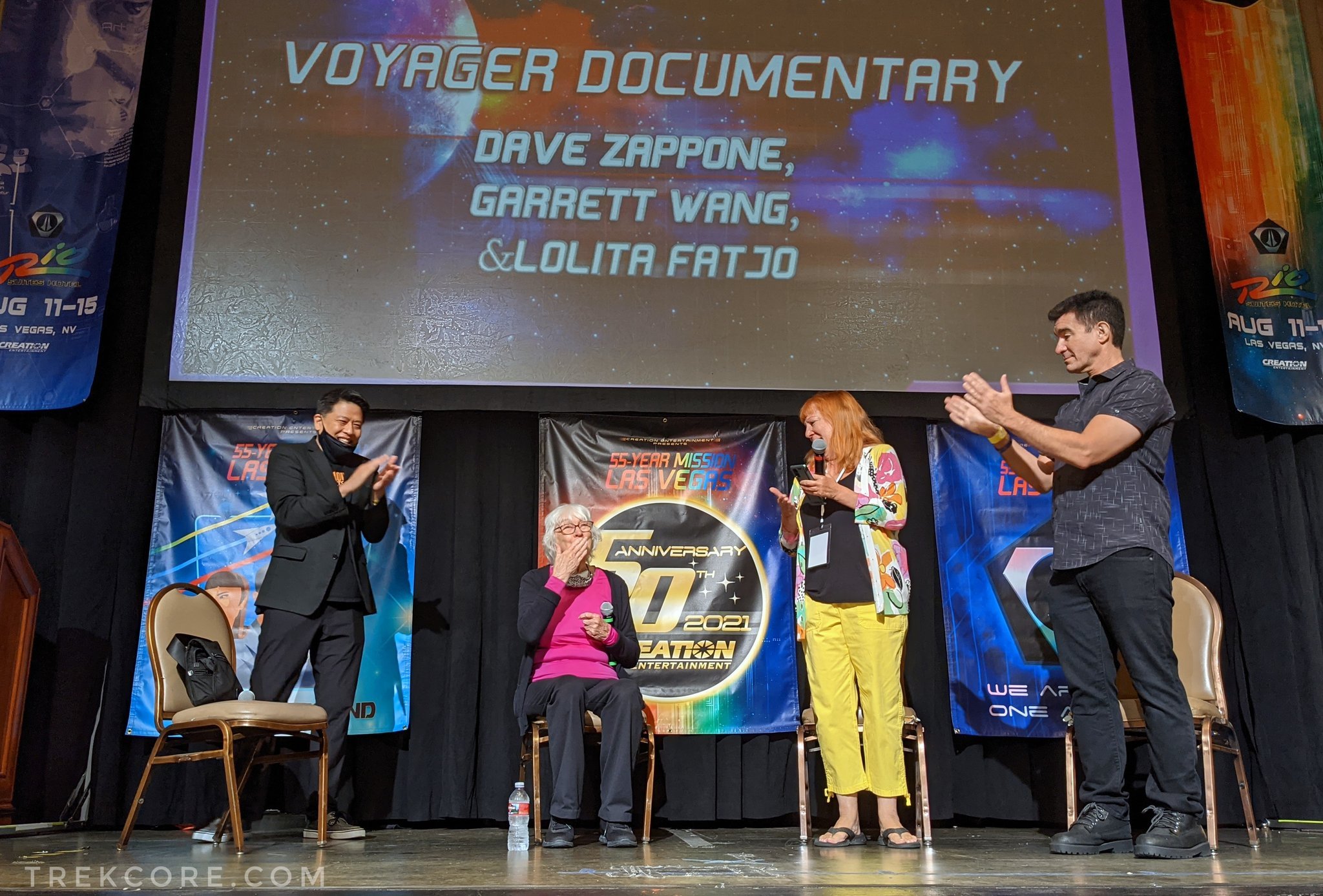
Taylor's appearance at STLV in Las Vegas, 2021, alongside Voyager actor Garrett Wang, TNG/DS9/VOY script supervisor Lolita Fatjo (for whom Leeta is named) and Voyager documentary director Dave Zappone. Source: TrekCore

Taylor was a rare TV writer who made the transition to novels, penning the novelisation of Unification before writing the novel Mosaic, which explores the backstory of Janeway in considerable detail, and its later sequel Pathways. Unlike most Star Trek novels, Taylor's books were considered of a higher level of canonicity and reliability.

Taylor chose to leave the Star Trek franchise after the fourth season of Voyager, but accepted the position of creative consultant for the remainder of Voyager's run, offering feedback on scripts.

After Voyager wrapped Taylor decided to retire from television altogether, and mostly shunned the limelight. However, in 2021 she attended her first Star Trek convention in Las Vegas and was warmly greeted by fans and fellow castmembers.

One of the more significant figures in the writing and development of Star Trek, Jeri Taylor was a skilled writer and producer. She will very much be missed.

Tuesday, 3 September 2024

RIP James Darren

News has sadly broken that actor and musician James Darren has passed away at the age of 88. He is best-known for his roles on SF shows The Time Tunnel and Star Trek: Deep Space Nine, as well as a long singing career and Hollywood movie roles in the 1950s and 1960s.


Darren was born in Philadelphia in 1936 as James William Ercolani. He grew up in South Philadelphia and studied acting in New York City. He was discovered by a talent agent and signed to a long-term contract with Columbia Pictures in 1956. His first film was Rumble on the Docks (1956), which resulted in significant attention and fan mail. He continued to star in films such as Operation Mad Ball (1957), The Brothers Rico (1957), The Tijuana Story (1957) and Gunman's Walk (1958).

In 1959 he played third on the bill on Gidget, though his role was effectively the lead. The film had a title song that someone else was going to sing but Darren, who had sang on nights out for years, volunteered to give the song a go himself. His vocal performance impressed the producers and he ended up singing multiple songs for the film. Darren's singing ability attracted the attention of Colpix Records, who had him release a string of pop songs through the 1960s.

Darren continued to play supporting roles in various films and returned to the role of Gidget in Gidget Goes Hawaiian (1961) and Gidget Goes to Rome (1963). However, Darren felt he was not fulfilling his leading man potential, with his success in the Gidget Trilogy and his supporting turn in mega-hit The Guns of Navarone (1961) failing to lead to further leading roles. Darren later suggested his agents had failed to capitalise on his profile at the time. Darren diversified his career by voicing characters on Hanna-Barbera animated film and TV shows at a time when most Hollywood stars ignored the medium.

Darren also met and befriended Frank Sinatra and Sammy Davis Jr., becoming a junior member of the "Rat Pack" in the 1960s.

In 1966 Darren starred as an android in an episode of Voyage of the Bottom of the Sea. He met the show's creator Irwin Allen and struck up a friendship. Allen then offered him the leading role of Dr. Anthony Newman on his next TV series, The Time Tunnel. The show only ran for a single season of 30 episodes, but attracted a cult following and constant repeats in both the USA and Europe made Darren a familiar television face.

Slightly disillusioned with film, Darren spent the 1970s focused on television and furthering his singing career in nightclubs. He appeared on S.W.A.T., Charlie's Angels, Police Story, Hawaii Five-O, The Love Boat and Fantasy Island, among others. He furthered his profile by presenting the documentary show Portrait of a Legend, interviewing famous musicians about their career.

In 1983 Darren gained renewed fame by playing Officer James Corrigan on the police drama T.J. Hooker, alongside Star Trek star William Shatner. Darren used the opportunity to move into directing, helming several episodes of Hooker before handling episodes of Hunter, The A-Team and Renegade.

In 1998 Darren was cast in Star Trek: Deep Space Nine in the role of Vic Fontaine, a holosuite lounge singer from 1960s Las Vegas who dispenses advice to the crew. Darren was cast for his real-life singing experience and being a member of the Rat Pack, although the producers also found his association with Shatner amusing. Darren credited the show with a late-stage career revival, leading to him recording two new albums and making further acting appearances. Darren also portrayed a "real" character in the Mirror Universe in one episode, where he was immediately killed off. Darren only appeared in eight episodes in the sixth and seventh seasons, despite fan perceptions he appeared in far more, with his biggest role coming in the episode It's Only a Paper Moon, where he helps Nog (Aron Eisenberg) deal with PTSD triggered by losing his leg in combat.

James Darren passed away on 2 September 2024. He had been suffering from heart issues for several weeks before his passing. He is survived by his second wife and three sons. He will be missed.