Showing posts with label the sandman. Show all posts

Saturday, 1 February 2025

Netflix's THE SANDMAN to end with Season 2

Netflix has confirmed what has been strongly rumoured for a good two years now, that the upcoming second season of The Sandman will the final one.


Despite early reports that Netflix were eyeing three to four seasons for the show, the first season's just-good-enough performance (which saw an unusually long delay before the second season was commissioned) and the impending problem that main character Dream plays a smaller role in many of the storylines in the middle and latter part of the graphic novel series, barely appearing in some issues, saw Netflix move to make the second season the final one. The series will continue to adapt the primary story arc of the comics, but in an abridged format, with some of the middle-series storylines and episodes likely to fall by the wayside.

Extremely fortuitously for Netflix, they made this decision before filming and a long time before accusations of sexual misconduct were made against Sandman creator/author Neil Gaiman by eight women. These accusations, which Gaiman has strenuously denied, has seen both publishers and another production company, Amazon Studios, cutting ties with the author.

Netflix has not yet confirmed a broadcast date for Season 2 of The Sandman beyond "2025."

Thursday, 3 November 2022

SANDMAN renewed for a second season at Netflix

It's been a wait, but Netflix have renewed The Sandman for a second season.


Netflix released the first season of the show on 5 August, immediately garnering very strong reviews and solid streaming numbers. The streamer took the unusual step of releasing a bonus extra episode two weeks later.

Despite the rare mix of both critical and commercial success, Netflix have taken an unusually long time to renew the show, something attributed to the first season's budget of upwards of $15 million per episode. Although Netflix is no stranger to spending big on a show, they normally prefer to start lower and gradually increase the budget over time, such as Stranger Things' gradually building budget from $7 million per episode in its debut season to over $20 million per episode in the fourth, with some episodes reportedly hitting $30 million. Sandman was a bigger up-front investment and the streaming numbers were very healthy, but perhaps not a slam-dunk on cost. However, Netflix were in danger of acquiring a reputation as the company that always cancels even good shows prematurely, and word-of-mouth on Sandman was so strong that the streamer likely feels a second season should boost the whole show's numbers positively.

The first season adapted the first two graphic novels in the Sandman series (of ten in total, at least in the main series), Preludes and Nocturnes and The Doll's House, as well as two of the stories in the third graphic novel, Dream Country. The second season will, presumably, complete Dream Country and adapt the fourth and fifth graphic novels, Season of Mists and A Game of You, bringing the story to its halfway point and allowing them to adapt the entire series in four seasons (a more enticing proposition than the 5-7 season plans being mooted by other streamers for their big fantasy projects).

The Sandman Season 2 will likely shoot in 2023 for release in 2024.

Wednesday, 31 August 2022

Where to Start with...The Sandman?

The Sandman has been a massive hit for Netflix and sales of the graphic novels have gone through the roof. However, if you're an eager new fan waiting to get in on the phenomenon, where do you start? The graphic novels have so many instalments, spin-offs, prequels and editions that boarding this train is perhaps a tad more complicated than it should be.


The Original Series

The Sandman was originally published as 76 monthly comic book issues (75 monthly issues and a special) between 1989 and 1996. These comics were collected into 10 graphic novels. This is the original or "core" Sandman series. The easiest way to start reading The Sandman is to simply read the original graphic novel series in order. This consists of:
  1. Preludes & Nocturnes (issues #1-8)
  2. The Doll's House (#9-16)
  3. Dream Country (#17-20)
  4. Season of Mists (#21-28)
  5. A Game of You (#32-37)
  6. Fables & Reflections (#29-31, 38-40, 50, The Sandman Special)
  7. Brief Lives (#41-49)
  8. Worlds' End (#51-56)
  9. The Kindly Ones (#57-69)
  10. The Wake (#70-75)
Obviously ten graphic novels are a fairly expensive investment when bought independently (or in a slipcase edition), so there are other options.


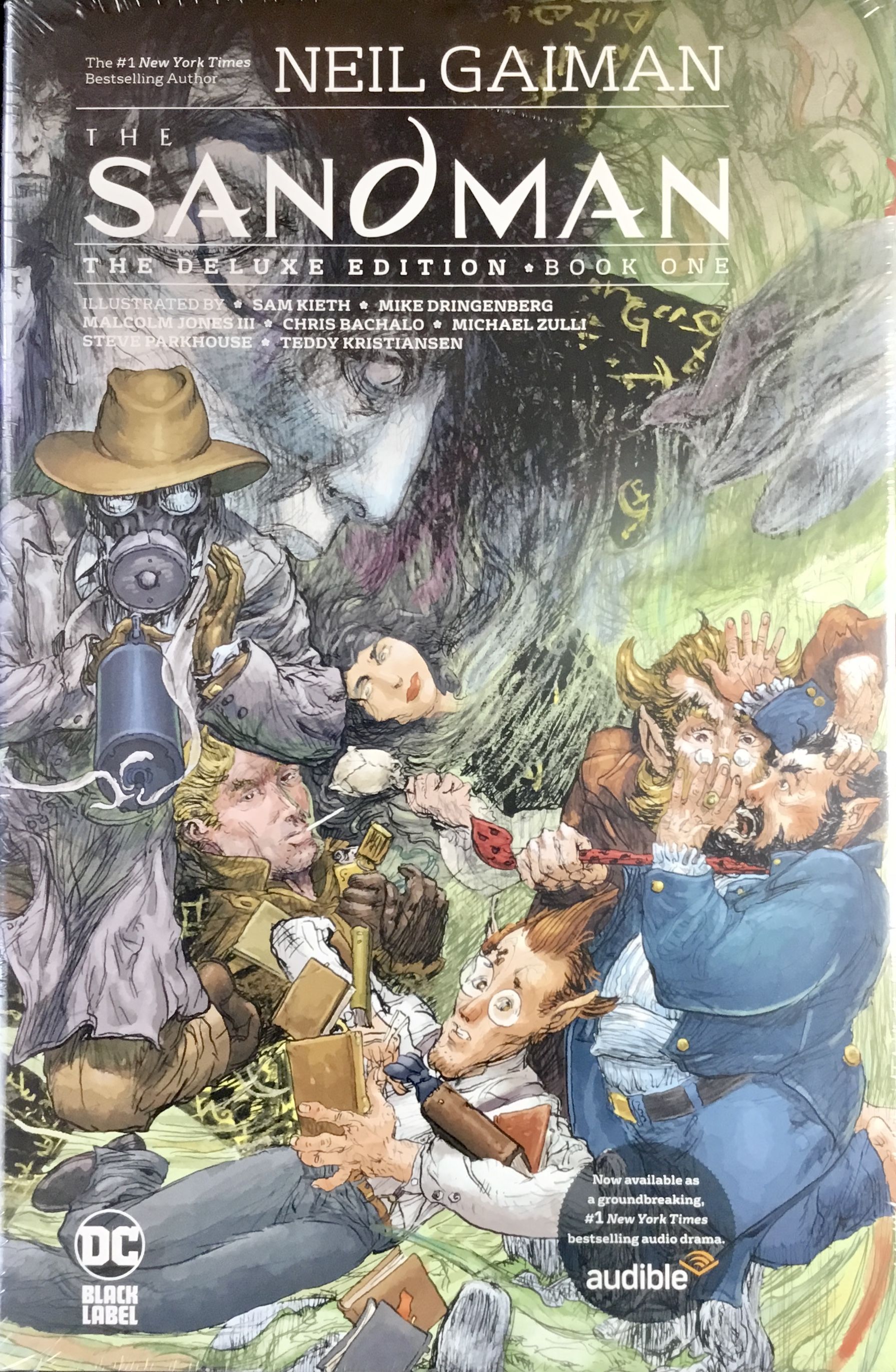
DC recently reprinted the series as four large-format collected editions. These editions are not the prettiest (they are similar to Image's recent one-part binding of the entire first half of Saga: cheap but effective) but they are probably the best way of getting the whole story as cheaply as possible (you also have to be happy with the Netflix advert on the front cover):
  1. The Sandman: Book One (#1-20) (UK, USA)
  2. The Sandman: Book Two (#21-37, The Sandman Special) (UK, USA)
  3. The Sandman: Book Three (#38-56) (UK, USA)
  4. The Sandman: Book Four (#57-75) (UK, USA)
The Absolute Sandman hardcover collection uses the same numbering as above but is very expensive, although likely to sustain many more readings. The Annotated Sandman also uses this system but is published in black-and-white and features extensive notes and annotations from Neil Gaiman. 


The Deluxe Sandman hardcover collection attempts to split the difference with nice hardcover editions but keeping the price down by collecting fewer issues, so there are more of them. These are effectively omnibuses with each book containing two of the original graphic novels. This collection has a bonus in that it also incorporates two of Gaiman's other Sandman series (see below) into the main series:
  1. The Deluxe Sandman: Book One (#1-16), (UK, USA)
  2. The Deluxe Sandman: Book Two (#17-31, The Sandman Special), (UK, USA
  3. The Deluxe Sandman: Book Three (#32-50) (UK, USA)
  4. The Deluxe Sandman: Book Four (#51-69), (UK, USA)
  5. The Deluxe Sandman: Book Five (#70-75, The Dream Hunters, Endless Nights) (UK, USA)
One flaw with this series is that the advert for the Audible version of the books on the cover is actually part of the cover, not a sticker, so cannot be removed.


The Sandman Omnibus is astronomically expensive and also partially out-of-print but is also the most concise version of the series, breaking the whole thing, including the spin-offs, down into just three volumes:
  1. The Sandman Omnibus: Volume I (#1-37, The Sandman Special)
  2. The Sandman Omnibus: Volume II (#38-75)
  3. The Sandman Omnibus: Volume III (Death: The High Cost of Living, Death: The Time of Your Life, Sandman Midnight Theatre, Endless Nights, The Dream Hunters, Overture)
This edition was available in a two-volume silver slipcase, a three-volume set and individually, but at the moment you can only afford to get most of these by selling at least three internal organs and your firstborn on the black market.


Gaiman's Sequels, Prequels & Expansions

The Sandman universe soon expanded into a wider universe of stories, books and collections. These are divided into works by Neil Gaiman and works by other hands. These are the works written by Gaiman expanding his original series. Below are the most common graphic novel collections:
  • Death: The High Cost of Living
  • Death: The Time of Your Life
  • Endless Nights
  • The Dream Hunters
  • Overture
The first two graphic novels spin off the character of Death from the main series into her own stories, whilst Endless Nights is an anthology telling seven stories, one about each of the Endless. The Dream Hunters is a self-contained, spin-off story about Dream and Overture is a prequel taking place immediately before the events of the main series. Endless Nights is sometimes counted as #11 of the main graphic novel series and Overture as #0, although they can be read fully independently of the main series.

These graphic novels are available independently apart from the two starring Death, which are now more usually found in one collection simply called Death (UK, USA), and Endless Nights and The Dream Hunters can also be found as part of The Essential Sandman: Book Five (as noted above) and all five as part of The Sandman Omnibus: Volume III (also see above).


Series by Other Hands

Neil Gaiman has given his blessing for other writers to carry on with stories set in his world, both as mini-series and ongoing series. Some of these series are only loosely or nominally connected to the Sandman universe, whilst others have more definitive connections.

These are as follows:
  • Sandman Mystery Theatre (70 issues, 1993-1999, Matt Wagner, Steven T. Seagle)
  • The Dreaming (60 issues, June 1996 - May 2001, Peter Hogan, Caitlin R. Kiernan)
  • The Girl Who Would Be Death (4 issues, 1998-1999, Caitlin R. Kiernan)
  • Sandman Presents (31 issues, March 1999-July 2004, various)
  • Lucifer (75 issues, June 2000 - June 2006, Mike Carey)
  • Destiny: A Chronicle of Deaths Foretold (3 issues, 2000, Alisa Kwitney)
  • Dead Boy Detectives (2001: 4 issues, Ed Brubaker, Bryan Talbot; 2012: 12 issues, Toby Litt, Mark Buckingham, Gary Erskine)
  • House of Mystery (42 issues, 2008-11, Lilah Sturges, Bill Willingham, Luca Rossi)
Since 2018, DC has produced a family of titles under the banner heading The Sandman Universe, with writers specially chosen by Neil Gaiman:
  • The Sandman Universe (2018, 1 issue, various)
  • The Dreaming (2018-20, 20 issues, Simon Spurrier, Bilquis Evely)
  • House of Whispers (2018-20, 22 issues, Nalo Hopikinson, Dan Watters, Dominike Stanton)
  • Lucifer (2018-20, 24 issues, Dan Watters, Max Fiumara, Sebastian Fiumara)
  • Books of Magic (2018-20, 23 issues, Kat Howard, David Barnett, Tom Fowler)
  • John Constantine, Hellblazer (2019-20, 13 issues, Simon Spurrier, Marcio Takara, Aaron Campbell)
  • The Dreaming: Waking Hours (12 issues, 2020-21, G. Willow Wilson, Nick Robles)
  • Locke & Key: Hell & Gone (3 issues, 202-21, Joe Hill, Gabriel Rodriguez)
  • Nightmare Country (ongoing, 2022-tbc, James Tynion IV, Lisandro Estherren)
There have also been additional graphic novels not published as individual comics:
  • The Little Endless Storybook (2001, Jill Thompson)
  • Death: At Death's Door (2004, Jill Thompson)
  • Dead Boy Detectives (2005, Jill Thompson)
  • God Save the Queen (2007, Mike Carey, John Bolton)
  • Delirium's Party: A Little Endless Storybook (2011, Jill Thompson)
There have also been two prose works set in the world of the Dreaming. The first, Sandman: Book of Dreams (1996) features short fiction by authors like Caitlin Kiernan, Tad Williams, Gene Wolfe, Susanna Clarke, Colin Greenland and an introduction by musician Tori Amos. The second, Dream Hunters (1999) by Gaiman himself, is a short, self-contained novel. Most of the graphic novel versions of Dream Hunters include the prose version.


Recommendation

Probably the best overall place to start with is The Deluxe Sandman collection of five hardcovers which covers the entire original comic series plus the most significant spin-offs, followed up by the Death one-volume collection and Overture.

If that's not possible (Deluxe seems to going in and out of availability fairly quickly, despite only being released a year ago), the 2022 four-volume edition is perfectly fine, followed up by DeathEndless NightsThe Dream Hunters and Overture.

Thank you for reading The Wertzone. To help me provide better content, please consider contributing to my Patreon page and other funding methods.

Friday, 19 August 2022

SANDMAN surprise-drops a bonus episode

Netflix have surprise-dropped a further episode of The Sandman. The episode, the eleventh of the first season, adapts two of the more acclaimed issues of the comic.

"A Dream of a Thousand Cats" is one of the most popular Sandman stories and tells the story of a cat who, distraught where her kittens are disposed of by her owners, seeks out Dream and learns more of the true history of the relationship between humans and cats. The fairy-tale nature of the story, and of course the popularity of cats, has made it one of the more enduring Sandman tales. The story is notable for confirming what was earlier only alluded to, that Morpheus deals with the dreams of every living creature in the universe, not just humans.

The TV version of the episode is animated and has an all-star cast, including Sandra Oh, Rosie Day, David Gyasi, Joe Lycett, Neil Gaiman himself (as the Skull Crow), James McAvoy, Nonso Anozie, Diane Morgan and Tom Wu, as well as the dual husband-and-wife teams of Michael Sheen and Anna Lundberg, and David and Georgia Tennant.

"Calliope" is presented in traditional live-action and follows the comic pretty closely, as writer Richard Madoc struggles with inspiration for his next novel and eventually takes possession of the imprisoned Calliope, one of the Greek muses. Madoc enjoys success, but is unaware that Calliope is the ex-wife of Morpheus and the mother of his child, attracting the ire of the King of Dreams. The TV version of this story also enjoys an impressive cast, featuring Melissanthi Mahut as Calliope, Arthur Darvill as Richard Madoc and Derek Jacobi as Erasmus Fry, with a supporting appearance by Amita Suman.

This release means that the Sandman TV series has now adapted the first 18 issues of the Sandman comic (which ran for 76 issues in total), covering the first two graphic novel collections, Preludes and Nocturnes and The Doll's House, as well as half of the third, Dream Country.

It'll be interesting to see if the two other stories from Dream Country are likewise dropped in a surprising manner. A Midsummer Night's Dream, in which Dream commissions William Shakespeare to create the first of two magical, original plays, is often cited as the best individual Sandman story and plays something of a role in the ongoing story arc of the series. The final story, Facade, is less likely to be adapted because the comic story uses another DC Universe character they don't necessarily have the rights to, so they would have to replace the character altogether.

This would free up Season 2 to adapt the fourth and fifth graphic novels, Season of Mists and A Game of You and potentially allow the show to wrap up in four seasons rather than five.

Netflix have yet to confirm a second season of The Sandman, but with the first season attracting blanket critical acclaim and being the #1 show on the service in over 80 countries, it feels pretty likely at this point.

Sunday, 7 August 2022

The Sandman: Season 1

1916. English sorcerer Roderick Burgess, distraught over the death of his son at Gallipoli, seeks to bind and imprison Death itself. His plan misfires and instead he captures Dream. Dream is unable to give Burgess what he wants, and eventually Burgess leaves him to rot in a glass prison in his cellar. During Dream's absence, his realm, the Dreaming, falls into disrepair and many dreams and nightmares escape into the world of the living. Some people also fall into a permanent sleep, a sleeping sickness that lasts decades and claims thousands. Eventually Dream escapes, and finds he must return his realm to order and reclaim the dreams and nightmares...even those who are prepared to do anything to retain their liberty.
Adapting The Sandman for the screen is a Herculean task. Neil Gaiman's 76-issue comic series ran from 1988 to 1996 and was collected as ten dense graphic novels, telling stories spanning thousands of years and involving a cast running into the hundreds. At the centre of it all is Dream or Morpheus, a non-human anthropomorphic personification of the concept of dreams. In many issues Dream doesn't even show up, or only has a brief cameo. The series alternates between epic story arcs and self-contained fables, and the tone can spin on a dime from comedy to tragedy to outright horror to fantasy to historical drama. Very minor moments in earlier issues can have massive ramifications fifty issues later.

There is also the legacy that Sandman has accrued. The series occupies a space in comics similar to what The Lord of the Rings does in fantasy novels, a dominant force whose sheer name value and beloved following makes tackling an adaptation a humbling and challenging task. Fortunately, at least in this case the original creator was on hand to help tackle the adaptation and guide it to the screen.

Netflix's The Sandman is an unabashed triumph, something that is a relief to say after so many recent streaming adaptations of beloved fantasy works were underwhelming, if not outright terrible. The one-two punch in recent weeks of Sandman and Amazon's splendid tackling of Brian K. Vaughan's Paper Girls may make one wonder if streaming services are turning a corner and are now producing better adaptations, but I suspect we will continue to see variable results moving forwards.

The Sandman works because it combines a talented cast of actors, directors, vfx personnel and behind the scenes crew with excellent judgement over how to develop the source material. Some episodes are lifted from issues of the comic almost verbatim, with Gaiman's almost-thirty-five-year-old material still feeling as fresh and engrossing as when it was originally committed to paper. Other episodes see the source material reimagined or tackled in a different way due to practical concerns, or cost, or not having the rights to certain characters or ideas, and in every case the judgement is sound.

The first season of the TV series adapts the first two graphic novels in the series, Preludes and Nocturnes and The Doll's House, constituting the first sixteen issues of the comic. In the former story arc, Dream is imprisoned, escapes and sets about repairing the Dreaming and recovering three of the symbols of office (a ruby, a bag of sand and a helmet), which involves confronting a murderous killer, tracking down a demon-hunter in contemporary London and descending into Hell itself for a tense audience with Lucifer. In the latter, Dream sets out to recover three missing inhabitants of the Dreaming who escaped during his imprisonment, as well as investigating the appearance of a "dream vortex" which threatens the fabric of reality.

The adaptation collapses these two stories into ten episodes (some of them surprisingly short by modern standards) and overlaps them a little bit more than in the comics, positing the Corinthian (a brilliant Boyd Holbrook) as more of an antagonist for the entire season. The result is a compelling pace, with excellently-crafted cliffhangers demanding you watch just one more episode. This is enhanced by brilliant casting: Tom Sturridge has a hard job playing the taciturn, oft-emotionless Dream, but he manages the impossible by nailing Dream's implacability but also giving him brief bursts of humour and charisma. Vivienne Acheampong is outstanding as the fussy librarian Lucienne, who keeps the Dreaming ticking over in Dream's absence, and Kyo Ra is superb as Rose Walker, the closest thing we have a to a "regular human" lead in the story.

Other actors appear just for one episode or so, but are fantastic: David Thewliss is chilling as John Dee, Jenna Coleman is suitably bedrazzled as walking human dumpster fire Johanna Constantine (a rights-enforced gender flip of John "Hellblazer" Constantine) and Gwendoline Christie is fire and ice personified as Lucifer Morningstar. Ferdinand Kingsley is also outstanding as Hob Gadling, an ordinary human whom is gifted immortality by the Endless on a whim to see how he handles it, and Kirby Howell-Baptiste imbues Death with the whimsy, humour, wisdom and depth of her comics counterpart.

Contained within the first season was the tricky mandate to adapt three of the greatest individual issues of comics ever published into live-action: "Twenty-Four Hours" (here realised as episode five, 24/7), "The Sound of Her Wings" and "Men of Good Fortune" (here combined into episode six, The Sound of Her Wings). "Twenty-Four Hours" had to be changed a fair bit, due to the absence of a narrating figure and limits on the amount of horror even Netflix can put on screen, but the end result is still fascinating (and horrific). But The Sound of Her Wings is flawless, taking the two vaguely related stories from the comic (the first in which Dream spends a day watching his sister, Death, at work, and the second in which Dream spends one day every 100 years meeting Hob Gadling, who may or may not be a friend) and combining them into a beautiful hour of drama.

Flaws are almost non-existent: Mervyn Pumpkinead's CGI feels a bit stiff compared to the flawless vfx elsewhere, and the utterly brilliant end credits (which vary from episode to episode) barely have a chance to start before Netflix forces them off the screen for the next episode. And that's really about it.

The first season (*****) builds to a suitably epic conclusion, with quiet moments that readers of the comics know will have a seismic impact further down the road, but ultimately leaves the viewer shocked that the team have managed the impossible: they have taken The Sandman and made a superb television series out of it. The hope now is that they can continue.

The first season of The Sandman is available to watch on Netflix worldwide right now and I recommend you avail yourself of the opportunity to catch up on it as soon as possible.

Thank you for reading The Wertzone. To help me provide better content, please consider contributing to my Patreon page and other funding methods.

Saturday, 23 July 2022

Netflix releases trailer for THE SANDMAN

Netflix has dropped another trailer for it's imminent adaptation of Neil Gaiman's Sandman comic series.

Sandman ran for 75 issues (collected as 10 graphic novels) from 1989 to 1996, ending its run as one of the most acclaimed comic and graphic novel series in history. It won a World Fantasy Award, two Bram Stoker Awards and multiple Eisner Awards, and was nominated for a Hugo Award. It also elevated Neil Gaiman into becoming an international superstar, one of science fiction and fantasy's most respected authors.

The comic tells the story of Morpheus, the Lord of Dreams, one of the seven Endless. The Endless are godlike personifications of certain ideals, such as Death, Despair and Delight. Morpheus is imprisoned by a human sorcerer at the start of the series, leading to decades of chaos as his realm falls into disrepair in his absence. Escaping, Morpheus has to set his realm to rights and then deal with various adversaries, including serial killers, a living weapon and Lucifer themselves.

The Sandman launches on Netflix on 5 August.

Monday, 6 June 2022

SANDMAN gets full trailer and release date

Netflix's adaptation of Neil Gaiman's The Sandman will hit screens on 5 August this year.

The trailer opens with Sandman/Morpheus/Dream (Tom Sturridge) intoning, "I am the King of Dreams, ruler of the Nightmare Realm." We then meet Johanna Constantine (Jenna Coleman), occult detective, as meets Mad Hettie and is told that the Sandman is coming. Johanna says he's a fairy story, but Hettie disagrees. Two police officers are then shown shooting open the Sandman's prison releasing him back into the world after more than a century of imprisonment.

Morpheus then returns to his realm, the Dreaming, where he meets his librarian Lucienne (Vivienne Acheampong), who warns him that the realm has gone to rot in his absence. We then briefly see a brace of characters: Death (Kirby  Howell-Baptiste), Desire (Mason Alexander Park), John Dee (David Thewlis) and The Corinthian (Boy Holbrook), who notes that "he's free, he's out of his cage." The trailer ends with Morpheus greeting a raven, who may or may not be Matthew (voiced by Patton Oswalt).

The show also stars Gwendoline Christie as Lucifer, Charles Dance as Roderick Burgess, Asim Chaudhry as Abel, Sanjeev Bhaskar as Cain, Donna Preston as Despair, Joely Richardson as Ethel Cripps, Kyo Ra as Rose Walker, Stephen Fry as Gilbert, Razane Jammal as Lyta Hall and Sandra James-Young as Unity Kincaid, with Mark Hamill as the voice of Merv Pumpkinhead.

Gaiman is co-writing the new adaptation and has also served as showrunner.

Saturday, 25 September 2021

Netflix releases first teaser for THE SANDMAN

Netflix has released its first teaser trailer for its adaptation of Neil Gaiman's seminal comic book series, The Sandman.


The teaser comes from the very start of the story, and sees Roderick Burgess (Charles Dance) attempting to capture and contain Death (Kirby Howell-Baptiste), but failing and instead imprisoning her brother, Dream (Tom Sturridge), whom is none too pleased about this turn of events.

Netflix has not yet set a release date for The Sandman, although it is believed they are eyeing an early 2022 release.

Wednesday, 26 May 2021

Netflix announces additional castmembers for SANDMAN

Netflix began filming a TV adaptation of Neil Gaiman's Sandman graphic novel series last October, and by now are probably not far off from finishing. They announced the main cast back in January and have now announced a number of additional castmembers.


The new castmembers are:
  • Kirby Howell-Baptiste as Death
  • Mason Alexander Park as Desire
  • Donna Preston as Despair
  • Razane Jammal as Lyta Hall
  • Joely Richardson as Ethel Cripps
  • Niamh Walsh as Young Ethel Cripps
  • David Thewlis as John Dee
  • Kyro Ra as Rose Walker
  • Patton Oswalt as the voice of Matthew the Raven
  • Stephen Fry as Gilbert
  • Jenna Coleman as Johanna Constantine
  • Sandra James Young as Unity Kincaid
They join Tom Sturridge as Dream, Boyd Holbrook as the Corinthian, Gwendoline Christie as Lucifer, Charles Dance as Roderick Burgess, Asim Chaudhry as Abel, Sanjeev Bhaskar as Cain and Vivienne Acheampong as Lucienne.

The Sandman is expected to debut on Netflix either in late 2021 or early 2022. The first season adapts the first two graphic novels in the series, Preludes & Nocturnes and The Doll's House.

Thursday, 28 January 2021

Netflix's SANDMAN TV series announces cast

Netflix's adaptation of Neil Gaiman's Sandman graphic novels has announced its primary cast. Remarkably, they kept the casting (mostly) secret for almost two months after filming had begun.


British actor Tom Sturridge is playing Morpheus, aka Dream, the Lord of the Dreaming and one of the Endless, seven beings given power over different facets of human existence. Sturridge is best-known for his stage work and for playing Henry VI in The Hollow Crown.

American actor Boyd Holbrook is playing the Corinthian, a nightmare in human form with teeth for eyes. He is best-known for playing DEA agent Steve Murphy in the first two seasons of Narcos. He also played the villain Donald Pierce in Logan.

Gwendoline Christie is playing Lucifer, the genderless fallen angel and ruler of hell. Christie is best-known for playing Brienne of Tarth on six seasons of HBO's Game of Thrones and Captain Phasma in two Star Wars movies.

Charles Dance is a British actor of long-renown, with roles in films such as The Jewel in the Crown, The Golden Child, Alien 3 and Last Action Hero, and TV series including The Crown and Going Postal. He is best-known to modern audiences for playing Lord Tywin Lannister on four seasons of Game of Thrones. He is playing Roderick Burgess, a man who tries to cheat his fate by imprisoning Death, but instead ensnares her brother, Dream, leading to chaos.

Asim Chaudhry is a British comedian best-known for appearing in the mockumentary series People Just Do Nothing and Hoff the Record (alongside David Hasselhoff). He is playing Abel, the first murder victim and brother of Cain. The two of them are doomed to repeat their cycle of murderer and victim forever in the Dreaming.

Sanjeev Bhaskar is a British comedian and actor of long standing, having risen to fame as one of the stars of Goodness Gracious Me and The Kumars at No. 42. He has played more serious roles, such as in the TV series The Indian Doctor and Unforgotten. He is playing Cain, the first murderer.

Vivienne Acheampong is best-known for her roles in The Witches, Famalam and Death in Paradise, as well as doing voice work for World of WarCraft. She is playing Lucienne, a genderflipped version of the comic book character of Lucien, the chief librarian of the Dreaming and one of Dream's key allies.

Many other roles are yet to be announced, with fans particularly keen on seeing who will be playing the iconic role of Death from the comic books.

The Sandman is currently shooting, with Neil Gaiman attached as writer and executive producer. The first season of the TV series is directly based on the first two graphic novels in the series, Preludes and Nocturnes and The Doll's House. It is expected to debut in late 2021 or early 2022.

Audible has also renewed their audio version of The Sandman, with a different cast, for two more seasons.

Tuesday, 20 October 2020

Shooting starts on the SANDMAN TV series

Neil Gaiman has reported that shooting has begun on Netflix's adaptation of his graphic novel series, Sandman.

Shooting began on Thursday 13 October, with the first scene being shot being a sequence set in 1918 where Dr. John Hathaway procures a book from the museum where he works and gives it to Roderick Burgess, the antagonist of the early part of the story.

Gaiman notes that with shooting underway, they should probably get around to announcing the cast (presumably because the longer shooting continues, the more likely it is that casting and set pictures will leak) and hopes to be able to do that shortly.

Sandman is expected to debut on Netflix in late 2021 or early 2022.

Monday, 20 July 2020

Casting begins for Netflix's SANDMAN TV series

Neil Gaiman has provided an update on pre-production for the TV version of his seminal graphic novel series, Sandman.


Casting is underway for the project with a view to start production as soon as possible given the ongoing pandemic.

Gaiman poured cold water on some popular fan casts, particularly hope that Michael Sheen (who starred in the adaptation of Gaiman and Terry Pratchett's Good Omens) will reprise his role as Lucifer from the recent Audible version of the comic book. Gaiman did note that was the possibility that some other cast members from the Audible version could appear in the TV series.

Gaiman confirmed that the series will be set in the present day rather than the late 1980s, meaning that Dream is imprisoned for 104 years at the start of the series rather than 73 years. The first season will last for 10 episodes and will cover the first two graphic novels (of ten in total), Preludes and Nocturnes and The Doll's House.

Sandman will likely be shooting for a late 2021 or early 2022 debut.

Sunday, 30 June 2019

Netflix and Warner Brothers developing a SANDMAN TV series

In surprising but welcome news, it has been revealed that Netflix, Warner Brothers and Neil Gaiman are in advanced discussions about developing a Sandman TV series.


The news comes after the success of Gaiman's American Gods TV series, for Starz and Amazon Prime, and Good Omens on Amazon. Netflix clearly want in on a piece of the Gaiman action as well.

Sandman is Gaiman's magnum opus, a massive story spanning 76 comic issues released by DC between 1988 and 1996, collected in ten graphic novels which have sold well over 30 million copies. The comics tell the story of Morpheus, the Lord of Dreams, after he is imprisoned by an English sorcerer in 1916. He escapes seventy years later, but finds the realm he rules over - the Dreaming - in ruins, and has to set about restoring it. Along the way he reconnects with his family, friends and allies, and realises some mistakes that he made centuries in the past finally have to be made right.

Actor-producer Joseph Gordon-Levitt was previously developing Sandman as a movie project as Warner Brothers, but left after "creative differences" with the studio. It is believed that Gordon-Levitt wanted a straight adaptation of the graphic novels, whilst the studio wanted something more effects-driven to compete the superhero marketplace.

The project has not yet been formally greenlit, but reportedly Netflix and Warner Brothers are close to agreeing terms.

UPDATE: The story has now been confirmed by Entertainment Weekly, with Allan Heinberg set to write, with Neil Gaiman and David Goyer to serve as executive producers. Netflix has apparently stumped up a massive budget and amount of money for the rights to the show. It is also the most expensive television project ever undertaken by DC Comics. Surprisingly, DC and Warner's sister studio HBO turned down the project due to the price tag attached.

Sunday, 6 March 2016

Joseph Gordon-Levitt departs SANDMAN movie

Actor/director Joseph Gordon-Levitt has departed the upcoming Sandman movie, based on the classic series of graphic novels by Neil Gaiman.


Gordon-Levitt has been at the forefront of this latest attempt to get the character on-screen, citing problems with the tone of the books - thoughtful, character-based and contemplative - and what studios seem to want from comic book movies. Apparently those issues had been overcome and Warner Brothers were happy with the progress Gordon-Levitt and producer David Goyer had been making on the film with screenwriter Jack Thorne. However, Warner Brothers have since shifted responsibility for all films based on the Vertigo Comics brand (of which Sandman was the founding title) over to their subsidiary New Line. According to Gordon-Levitt, his vision for the film and New Line's were incompatible, so he has chosen to leave the project. This comes a day after the news that Jack Thorne had also departed, with screenwriting being handled by Eric Heisserer instead.

To say that this is a cause for deep concern would be an understatement. In the early 2000s a Sandman movie was in development to be produced by the infamous Jon Peters (he of the "giant spider" obsession on the aborted Superman Lives project, as brilliantly retold by Kevin Smith) and, to Gaiman's immense relief, it never got off the ground. The draft scripts featured Morpheus, the Lord of Dreams, as an ass-kicking superhero with explosions going off and lots of standard action beats (fortunately Peters had gotten the giant spider obsession out of his system with Wild Wild West, otherwise that would have no doubt showed up).

Whilst some took issue with Gordon-Levitt producing, directing and maybe starring as Morpheus, there was no doubt that he had deep respect and appreciation for the source material and its tone. Bringing in Jack Thorne, the writer of British TV dramas such as This is England and particularly his supernatural series The Fades was a stroke of genius. Thorne is one of the most interesting and respected scriptwriters of his generation.

Heisserer has written the remakes of A Nightmare on Elm Street and The Thing, along with Final Destination 5. That's a pretty big step down in writer quality.

The fear now is that we are going to get a much more conventional movie that eschews much of what was interesting from the graphic novels in favour of a more standard superhero/action film. The presence of David Goyer, who hasn't written a good script since Batman Begins (although he did work on the story treatments for The Dark Knight and The Dark Knight Rises), also isn't tremendously encouraging on that front.

Hopefully this still all works out, but it certainly looks like a step in the wrong direction right now.

Tuesday, 17 December 2013

Joseph Gordon-Levitt and David Goyer to make a SANDMAN movie

It's been announced that actor/director Joseph Gordon-Levitt and screenwriter David Goyer are to collaborate on a movie adaptation of Neil Gaiman's Sandman graphic novels.


Gaiman's comic series has been optioned several times before, but never made it out of development hell. According to Gaiman, whilst some of the scripts have been pretty good several have been absolutely horrendous, treating Morpheus like a superhero more than like the mythological force he is. This new project seems more promising, especially since Gordon-Levitt tweeted the hashtag #preludes, hinting that the first film will be a straight-up adaptation of Preludes and Nocturnes, the first Sandman graphic novel. This has always been the most logical place to start the project, but most previous scripts have been original stories featuring the characters or only loosely based on the actual texts.

Gordon-Levitt has starred in films such as Looper, Inception and The Dark Knight Rises and also gained critical acclaim for his directorial debut, Don Jon. Goyer has had a more mixed career: he has been praised for writing or co-writing the first two Blade movies, the three Christopher Nolan Batman movies and Dark City, but he also wrote Man of Steel, Ghost Rider: Spirit of Vengeance and Blade: Trinity. According to some reports, Goyer is only outlining the Sandman movie as he may be too busy working on the Man of Steel sequel and other projects. He will have a producer's credit on the final movie as well.

Gordon-Levitt is currently only attached to produce, though some reports have him negotiating a deal to star and possibly direct.

Thursday, 16 May 2013

The Sandman: The Wake by Neil Gaiman

One of the Endless has fallen, so there must be a wake. As the millions whose lives they touched gather to remember the fallen, a new Endless must arise to take their place.

Note: normally I try to stay spoiler-free in reviews (even if the book has been out for seventeen years). However, it's simply impossible to discuss this collection without spoiling the biggest plot twist in the entire Sandman series, so be forewarned before continuing.


The Wake is the tenth and concluding graphic novel in the Sandman sequence. It is an extended coda to the main narrative of the series, which climaxed in the preceding book, The Kindly Ones. As such the story is about wrapping up (or at least addressing) loose ends, revisiting some old characters and paying off some old debts. There's no real threat or tension in the narrative, just a loosening of the pace that allows Gaiman to quietly (but still effectively) develop and round off character arcs and leave the series with grace.

The first three parts of The Wake form a single narrative. A wake is held for Morpheus (who died at the end of The Kindly Ones) and beings from across the universe arrive to take part. There are numerous cameos from familiar characters (including brief ones from Superman and Batman, since Sandman is part of the DC Universe) and Daniel, the 'new' Dream, frets about his new role as he rebuilds the Dreaming. There is some tension to be mined from Daniel's meeting with Lyta Hall (who was arguably responsible for Dream's death) and from Matthew's decision to remain in the Dreaming or not, but mainly the emphasis here is on the loss and how it effects the other characters in the series. Wisely, after setting it up as a big event, Gaiman chooses not to show us the first meeting between Daniel and the rest of the Endless (in some parallel universe where Gaiman cashed in and sold out, we can imagine that scene as the opening of The Sandman II).

The latter three parts are more diverse. In the first, Hob Gadling attends a terrible American Renaissance Faire. Gadling is six hundred years old, the result of a bargain between Dream and Death, and is horrified at the romanticising of the England of his youth, a place of plague and death where life was cheap. Gadling, who is now dating an African American woman, is also wracked by guilt over the spell of his life he spent dealing in slaves. Ultimately Gadling is offered the chance by Death to end the bargain and die, since the other partner in the bargain is also dead.

Gadling has always been one of the more interesting characters in the Sandman series, appearing intermittently since the early issues and providing Dream with arguably the only true friend he has. This story sees Gadling severing his ties with the dead Dream and moving on with his life in a touching and human way.

In the penultimate part of the series, Gaiman cheekily takes a big risk ("What are they going to do? Stop buying it with one more issue to go?") by having a story told mostly in text, in which a Chinese government minister from a thousand years ago is exiled into the desert and inadvertently passes through a 'soft place' into the edge of the Dreaming, where he meets both Morpheus and Daniel at different parts of their existence. It's a bizarre and existential story which is intriguing and amusing (especially with the cameo from a cat).

In the final part, we suddenly reverse back to the early 17th Century. William Shakespeare has decided to end his writing career, but has to fulfil a promise: the second of two plays commissioned by Dream. As he labours on the work - a play called The Tempest - Shakespeare reviews his life, considers his legacy and muses on the choices he did not make. He wonders if a person can every truly change, and of course this what the entire series was about: Dream coming back from his captivity a changed being, but in the end not able to change enough, resulting in his destruction.

The Wake (****½) is not a blood-and-thunder grand finale, but instead it's an effective analysis and wrapping-up of what has come before. There are perhaps minor signs of the author overdoing it (dedicating three issues to a funeral and wake might be seen as over-indulgence), but for the most part Gaiman restrains the sentimentality in favour of an attempt to finding meaning in life and death and the choices that are made. The collection is available now in the UK and USA, and as part of The Absolute Sandman, Volume IV (UK, USA).

Tuesday, 15 January 2013

The Sandman: The Kindly Ones by Neil Gaiman

The Kindly Ones, three powerful beings also known as the Furies. They have the power to even harm the Endless, if they should be summoned to do so by a mortal with a just grievance...and if that member of the Endless has spilled the blood of one of their own family. When Lyta Hall's young son Daniel goes missing, she blames Dream and calls upon the Kindly Ones for aid. When they agree - for Dream has the blood of his own son on his hands - a sequence of events is set in motion which will profoundly change everything.


The Kindly Ones is the ninth of the Sandman graphic novels and is also the largest. It is a sustained storyline, originally published across thirteen issues of the title's original comics run. It was also deliberately written by Neil Gaiman to be read as a single graphic novel, a decision that provoked the ire of some readers of the comic who felt that many of the individual issues failed to satisfy when taken on their own merits. However, read as a single story it becomes clear that The Kindly Ones may be the strongest of The Sandman's long storylines.

The Kindly Ones takes no prisoners. Previously, Gaiman was careful to reintroduce older characters in a way that newer readers would still be able to follow and enjoy what was going on. He has no truck with that here, instead pulling together dozens of characters and narrative strands from earlier issues and collections. These storylines include: the aftermath of Dream's slaying of his son Orpheus, Delirium's acquisition of a talking dog named Barnabas; the saga of Lyta Hall and her infant son Daniel; the relationship between Dream and the witch Thessaly; the retirement of Lucifer as Lord of Hell and his vow to destroy Dream; Desire's long-standing ire with his/her brother; the adventures of the faerie lord Cluracan and his sister Nuala; the resurrection of the Corinthian; the misadventures of Rose Walker; and numerous subplots involving the inhabitants of the Dreaming, including Cain and Abel, the raven Matthew, the librarian Lucien and handyman Mervyn. It's a challenging juggling act which Gaiman pulls off with skill, by drawing the various narratives together in often surprising ways. The story also revisits the very beginnings of The Sandman, with the manor house where Dream spent seventy years imprisoned figuring prominently.


As well being a feast for continuity lovers, the collection also delivers its own thematic arc: this is a Greek tragedy, pure and simple. Events build slowly and with growing intensity towards an ending that is not actually that inevitable, but only becomes so when the Sandman refuses to allow himself to deviate from what he sees as his own responsibilities and obligations. A key theme referred to throughout the comics, but much more prevalent here, is that the Sandman used to be far too rigid for his own good, but has changed since his imprisonment by humans. The Kindly Ones shows how far he has changed...and how far he has to go. As a result, The Kindly Ones offers the most insight into the character of Dream himself, even when he is not actually on the page. Other characters are also well-served, with even minor players from earlier issues getting moments to shine.

The art style in the collection has attracted a lot comment. It's an interesting choice, giving the largest and most coherent Sandman storyline the most stylised and perhaps 'weird' art style in the history of the series. The juxtaposition of the heavy drama and odd art style actually works well, with the art tying in well with the more oddball moments of the story (such as Cluracan giving birth to his own nemesis).

The Kindly Ones (*****) is Neil Gaiman at the top of his game, delivering the rich and powerful climax (though not the conclusion) that The Sandman deserves. The collection is available now in the UK and USA, and as part of The Absolute Sandman, Volume IV (UK, USA).

Sunday, 2 December 2012

The Sandman: Worlds' End by Neil Gaiman

Two travellers are driving across the United States, headed for Chicago. An unseasonable storm strands them at an inn, known as Worlds' End. Within waits a collection of fellow travellers from many worlds, all waiting for the storm to end. To pass the time they tell stories, stories from many worlds and many times.


Worlds' End is the eighth Sandman collection. It's a collection of self-contained short stories, but the stories feature recurring motifs. They are being told against the backdrop of a 'reality storm' that has been triggered by a cataclysmic event somewhere else in the multiverse (and, although a strong clue is given, we will not find out the nature of that event until the end of the following volume). It's Neil Gaiman's last chance to really exercise his imagination at short lengths before the beginning of the subsequent story arc, Sandman's largest and most epic, The Kindly Ones.

Worlds' End features a succession of stories, told by and featuring characters both new and familiar from the Sandman mythos. 'A Tale of Two Cities' is told in a minimalist art style, mostly through prose accompaniment, and features a traveller who loves his city so much that he becomes trapped in its dreams. It's weird and offbeat, and will probably appeal a lot to fans of China Mieville.

'Cluracan's Tale' features the return of the elf Cluracan, whose story is a bonkers collection of trickery, deception and a swordfight that may or may not have happened. It's lightweight (and Gaiman's not a huge fan of it, feeling it was too big for his page count and was consequently diminished in its impact) but fun. 'Hob's Leviathan' features a traditional narrative device, of a youngster running away to sea, and the return of one of the more popular Sandman characters, Hob Gadling, who was gifted with immortality by Dream and who meets him once a century to catch up. In this story, Hob is a passenger on a ship where the journey takes a turn for the very strange. It's a smart and tight story, with a couple of twists that are perhaps predictable but pulled off so well it doesn't really matter.

In 'The Golden Boy' Gaiman resurrects the fairly obscure DC character Prez Rickard, the first teenage President of the United States of America (running on an independent ticket). Set in an alternate United States, Prez becomes the embodiment of the hopes that Americans apparently place in their leaders: a virtuous man who helps the poor and needy without impoverishing the country, and manages to lower its debts. He resists corruption and survives tragedy (an attempted assassination that takes the life of his fiancee). A story about such a paragon sounds boring, but Gaiman infuses it with wit and some amusing lines and cultural references, not mention several nods to his friend Alan Moore's Watchmen. He also solves a minor puzzle about Dream that had been left dangling for almost five years by that point.

The next story, 'Cerements', is the most complex. Given there are nods in it to the work of Gene Wolfe - the inhumers share some similarities with the guild of torturers in The Book of the New Sun - this is to be expected. It is a tale told by Petrefrax, a prentice inhumer from the Necropolis Litharge. But within his tale, three others tell their tales (one of which contains a short story in itself). The result is a complex Russian's doll of narratives nestled within one another, seemingly disconnected but featuring some key insights into the Endless and (another recurring element in these stories) the nature of how they die. Compared to Cluracan's story (which is lightweight but baggy), 'Cerements' is fiendishly complex but told with impressive economy.

At the end of the collection - after a meta-aside in which a woman at the inn complains about the sexism of the story-tellers - the storm ends with a haunting vision of vast figures in the sky, a clue as to what caused the storm and the event that will drive the remainder of the series.

Worlds' End uses a familiar device (influenced by The Canterbury Tales) but does so with wit and intelligence. The stories are decent, with Cluracan's perhaps being the least memorable, and feature some wonderful fantastical imagery. 'The Golden Boy' also flirts with politics, not the nitty-gritty of ideologies, but what people want from their leaders, no matter how unrealistic. There is also a feeling of doom overhanging the collection, of events, no matter how seemingly disconnected, being linked to a tragedy whose own story is yet to be told.

Worlds' End (****½) is one of the stronger Sandman collections and is available now in the UK and USA, and as part of Volume III of The Absolute Sandman (UK, USA)

Monday, 19 November 2012

The Sandman: Brief Lives by Neil Gaiman

Delirium of the Endless has resolved to find her missing brother, Destruction. She asks for the help of her family, but the only one to respond positively is Dream. Recently dumped by a mortal woman, Dream needs something to take his mind off moping and decides this quest is the answer. He and Delirium set out on what promises to be an adventure...until people start dying and Dream is asked the impossible by his son.


Brief Lives is the seventh volume in the Sandman series, picking up after the events of the Fables and Reflections collection. In particular, it expands on the story Orpheus in which Dream's son awoke the rage of the Furies and was left in a dire predicament. Dream, who has been changed more than he will care to admit by a century's imprisonment at the hands of a mortal, finds himself in a situation where he requires Orpheus's help but the price that is asked in return is dire. This in turn has grave consequences that will extend across the remainder of the series's run. This dark undercurrent gives Brief Lives a lot of weight for something that starts off as a light-hearted adventure (or at least as close as Sandman ever gets).

The collection has a number of memorable characters, such as Destruction's laconic talking dog Barnabas, but it's Delirium who receives the most attention and development. Delirium talks in non-sequiturs and apparently has the attention span of a five-year-old, but during the course of the story we learn more about her and how she sees the world. We also get interesting glimpses of her former life as Delight, before she changed (for reasons even the other Endless do not understand). The collection also delves deeply into the purpose and nature of the Endless, explaining who they are and what they do. Destruction's conclusions about the Endless are somewhat disheartening and led to his self-imposed exile, but Dream does not accept those arguments (although Delirium does...but still maintains her duties). Brief Lives is thus about lives and even how those measured in millennia still feel brief when the end comes. There's also the ongoing themes of redemption, responsibility and consequence that have formed the spine of the series since its beginnings.

As usual Gaiman's writing is accomplished and the graphic format forces him to conciseness (avoiding the problem of indulgence that has occasionally blighted his prose work, most notably in American Gods). Characterisation is deft, with Delirium getting the most attention but even briefly-appearing characters like Despair get moments of humanity that may force the reader to reappraise them. There's also some great comic moments, such as Dream's raven-who-was-once-a-man Matthew having to teach Delirium to drive (with chaotic results) and Dream, in full moping mode, conjuring a rainstorm just so he can go out and stand in it and look forlorn, to the amusement of his minions. The artwork is appropriately dreamlike, with artists Jill Thompson and Vince Locke nailing the surrealness of such locations as Delirium's realm. However, the artwork arguably works less well in depicting the real-world locations and Destruction, in particular, feels a little underwhelming after his larger-than-life first appearance (based on Brian Blessed in Blackadder) in the previous volume.

The only other issue of note is that the storyline featuring the tracking down of Ishtar feels a bit pointless. Gaiman raises the issues of femininity, empowerment and the suggestion that prostitution and religion (which were linked in ancient times in several cultures) were separated to prevent the rise of matriarchal power groups, all of which is fascinating, but also underdeveloped in the context of the story. Still, Ishtar's final dance is a powerful scene and one that has some resonance through the rest of the story.


Brief Lives (****) is a very solid instalment of The Sandman and is the one that proves the turning point of the entire saga (though this may not be immediately obvious). It is available now in the UK and USA. The stories in this collection are also included in The Absolute Sandman, Volume III (UK, USA).

Thursday, 2 September 2010

SANDMAN TV series under discussion

Discussions over a visual adaptation of Neil Gaiman's Sandman comic book series have been going on for a long time now, usually stalling over issues of budget and script quality, particularly for the movie option. However, with HBO's aborted attempt to bring Preacher to the screen several years ago and AMC tackling The Waking Dead, it did appear inevitable that a TV company would take a crack at the material.


HBO was apparently interested in the property, but Warner Brothers have now snatched the rights and are developing a potential series with several collaborators looking to come on board. Frontrunner at the moment is Eric Kripke, the creator of the popular series Supernatural who recently quit that show when it was renewed for a sixth season despite Kripke having concluded his planned five-year arc for the show. Kripke is reportedly nervous about the prospect of tackling such a huge project, but is also up for the challenge.

Arguments about who can play Death and Dream can begin now (Brian Blessed for Destruction we'll take as read).