Monday, 12 March 2012

GAME OF THRONES Season 2 episode title update

An update on what we know about the second season episodes for Game of Thrones.


201: The North Remembers. Written by David Benioff & D.B. Weiss, directed by Alan Taylor. 1 April.
202: The Night Lands. Written by David Benioff & D.B. Weiss, directed by Alan Taylor. 8 April.
203: What is Dead May Never Die. Written by Bryan Cogman, directed by Alik Sakharov. 15 April.
204: Garden of Bones. Written by Vanessa Taylor, directed by David Petrarca. 22 April.
205: The Ghost of Harrenhal. Written by David Benioff & D.B. Weiss, directed by David Petrarca. 29 April.
206: The Old Gods and the New. Written by David Benioff & D.B. Weiss, directed by David Nutter. 6 May.
207: Written by David Benioff & D.B. Weiss, directed by David Nutter. 13 May.
208: Written by David Benioff & D.B. Weiss, directed by Alan Taylor. 20 May.
209: Blackwater. Written by George R.R. Martin, directed by Neil Marshall. 27 May.
210: Written by David Benioff & D.B. Weiss, directed by Alan Taylor. 3 June.

EDIT: Apparently David Benioff and D.B. Weiss got another writer in for at least one of the episodes. This person has not yet been identified (although it's not Jane Espenson, who also worked on Season 1, as she was too busy with Torchwood: Miracle Day when Season 2 was being written).

EDIT2: HBO have confirmed that Vanessa Taylor (a former writer on Alias and Everwood), a co-executive producer on the series, has written two episodes of Season 2. Which episodes is so far unconfirmed.

Sunday, 11 March 2012

The Star Trek: Deep Space Nine Companion by Terry J. Erdmann

Deep Space Nine, the second spin-off from the original Star Trek series, ran for seven seasons from 1993 to 1999. At the time it was originally on the air it was considered the 'awkward child' of the Star Trek franchise, being overshadowed at the start of its run by the end of Star Trek: The Next Generation and then for the rest of its run by the start of Star Trek: Voyager. Time has been kind to the series, however, and it is now widely regarded as the best - or at least the most consistently excellent - of the Star Trek television series.


It's therefore appropriate that the best Star Trek series got the best companion book out of all of the series, and in fact probably the best non-fiction book ever written about Star Trek. To write it, Terry J. Erdmann took the unusual step of developing it alongside the series. He literally started writing it in 1993 when the show launched and completed it in 1999 after it concluded, publishing it in 2000. This - slightly mental - way of writing the book allowed him to interview the writers, actors and production staff at regular intervals when their memories of each episode were fresh, and in some cases be on-set for the filming of scenes. This wasn't a cash-in hack job to ride on the show's popularity, but an eight-year project that is impressive in showing its creators' commitment to doing as good a job as possible.

The format of the book is fairly standard. The book is divided into seven sections, one for each season of the show. There's an overview of the season as a whole and then a summary of each episode, as well as cast lists, transmission dates and all the usual gubbins you get in books like this. However, the meat of the book is the elaborate 'behind the scenes' section for each and every one of the 173 episodes that was made. These sections usually feature interviews with the episode writers about how the idea for the episode came about, comments from the actors who were heavily featured (regular, recurring and guest stars alike) in the episode in question, and discussions with the director and production crew who had to turn each script into a reality.

These behind-the-scenes sections are impressive. Every episode, no matter how minor or unsuccessful, has one, and they're usually between 2 and 4 A4 pages of reasonably small print in length. This is why the book is over 700 pages long, which is bordering on the 'insane' side of things for an episode guide. The reason for the length is that almost everyone involved in the making of the series offers insightful thoughts on the production process. The writers (including future Battlestar Galactica showrunner Ronald D. Moore) are honest and forthright in debating their writing choices, including what went wrong as well as what went right. Showrunner Ira Steven Behr's brutally honest appraisals of how dire episodes like Let He Who Is Without Sin and Proft and Lace made it to the screen are interesting and also extremely funny.

The actors also have their say, talking about how they developed their characters from episode to episode and why they made the acting choices that they did. Production crew are also interviewed, from the director of each episode down to the stuntmen, visual effects personnel and occasionally even the extras. The book makes it clear that vast amounts of work went into making each episode of the show. That the series turned out as well as it did under the chaos of a production schedule almost unthinkable today is clearly a tribute to the professionalism of everyone involved.

What is most interesting is the way the guide tackles the sometimes challenging relationship between DS9 and the rest of the Star Trek franchise. The writers are unapologetic about the problems they had on The Next Generation, where interpersonal conflict between the human characters was not allowed, and applaud the freedom that Deep Space Nine gave them to write more interesting psychological stories. They also reveal that Deep Space Nine had cast-iron rules about limiting the amount of technobabble in the series and a total ban on 'holodeck malfunction' episodes. However whilst the contributors are surprisingly honest, this is still an official tie-in book, so the severity of the disagreements between the DS9 staff and overall Star Trek franchise-runner Rick Berman are downplayed (more recent interviews indicate some of these disagreements were a lot more serious than this book indicates, with Berman eventually giving up and preferring to work on Voyager). The absence of any mention of the rivalry between the DS9 and Babylon 5 fanbases is also interesting given some of the things happening at the time, probably another casualty of the book trying to take a positive view of everything.

Still, whilst there's a few areas the book doesn't touch on, pretty much everything else about the series is explored in ridiculous detail. From the transition of motion-controlled model work to full CGI (the revelation that a considerably more elaborate version of the Battle of Wolf 359 from the pilot episode was shot but has never been shown is tantalising; maybe something for a future Blu-Ray release?) to the ongoing evolution of the prosthetics work, there's few side-areas of the production that are not touched upon.

The Star Trek: Deep Space Nine Companion (*****) is hands-down the best tie-in book of its nature I've ever read, and in this age of instant and free-to-access wikis and production videos and webcasts, maybe the best there ever will be. It's an impressive guide to how this series was conceived and filmed, packed with fascinating revelations and trivia. Even if you have no interest in DS9, it's still a fascinating read for anyone interested in the process of producing a weekly science fiction TV show. The book is - sadly - long out of print, but copies (for somewhat excessive prices) can still be found on Amazon UK and Amazon USA.

Kings of Morning by Paul Kearney

Years ago, ten thousand Macht mercenaries marched into the heart of the Asurian Empire and were betrayed. Only a handful of survivors, led by the famous warrior Rictus, escaped to see home. In the years since then, Rictus has lived through times of peace and war, standing alongside the legendary Corvus as he forged the fractious Macht cities into a single nation. The Macht have now re-invaded the Empire, this time deploying new weapons and strategies that baffle their enemies. But their greatest ally is the division and turmoil that seethes in the heart of the Empire, as the imperial household is divided at the very moment it needs to unify against the invaders.


Kings of Morning is the third and concluding book in Paul Kearney's Macht sequence, which began with 2008's excellent The Ten Thousand and continued with 2010's even better Corvus. As with those books, Kings of Morning mixes fantasy with historical fiction and even a hint of SF: Kuf, the planet on which the books take place, is apparently an alien world and the Macht seem to be the descendants of human settlers/invaders, with the natives a notably different humanoid race. The influence of Alexander the Great on Corvus's story is clear, meaning the general trajectory of the plot can be a little predictable. However, Kearney mixes things up enough to ensure the story never gets stale.

Structurally, the novel is a little different to its two predecessors, which focused almost completely on Rictus's point of view. The opening quarter or so of the novel shows a political crisis within the heart of the Empire, as the brutish heir to the imperial throne, Kouros, and his younger brother engage in a bitter feud, with their father apparently unwilling to intervene. A hapless slave boy is unwittingly caught in the middle of this dispute, to his ruin (a strong stomach is required for the scenes where he is tortured by Kouros). This is an interesting way of starting the book and demonstrates Kearney's impressive power of concise storytelling without sacrificing depth. In this story the Macht are a vague and distant threat, easily dismissed, until it's almost too late.

We then switch back to Corvus, Rictus and the Macht army on the march and are soon back into a world of strategy meetings, comradeship and desperate battles against superior numbers. Yet Kearney, for all his reputation as one of the finest writers of battles working today (in either fantasy or historical fiction), keeps the martial action at a distance for most of the book, instead focusing on Rictus's character development as he sees the culmination of Corvus's plans and starts thinking about his own future. The conflict in Rictus between the lifelong soldier who tires of peace but hates the waste of war is developed well throughout the book and contrasted against the world-weariness of the Asurian Great King, Ashurnan.

Kearney's skills of characterisation are impressive, particularly the attention he gives to Kouros. Though an unthinking, thin-skinned brute, Kouros is given a backstory and motivation that explain why he is the way he is without ever risking him becoming sympathetic, and developing him as a villain (if he's even competent enough to be called that) much more than beyond the initial impression the reader gets of him. Kearney also undercuts the storyline of the two royal twins and their mutilated servant trying to flee into the wilds, with it moving in some very unexpected directions (even if the ultimate destination is unsurprising).

Kearney restrains the military activity to a few brief descriptions of sieges and negotiated truces before giving us one large battle. Inspired by several of Alexander's engagements, the Battle of Gaugamesh is an impressive display of depicting a complex engagement spread over a large battlefield in a straightforward manner. Kearney's skills at writing warfare remain undimmed, but it's his depiction of the aftermath, of the mix of disgust at the waste of life of war and admiration of the heroism of those who endure such hellish circumstances, which impresses the most.

The novel climaxes in a surprising fashion. Whether the parallels between Corvus and Alexander will continue or not is something that is not answered, as this trilogy is the story of Rictus, and that story ends impressively with Kings of Morning. We bow out of the story at this point with the full impression that life will go on regardless.

Criticisms are hard to find. The novel is very concise and at times the reader will want more information, more character scenes, more battle sequences, but these are not necessary for the story Kearney is telling. In epic fantasy it is rare to find an author who leaves the reader wanting more rather than feeling over-stuffed on thousands of pages of needless filler, and the former is definitely preferable. Some may feel the novel lacks a full resolution to Corvus's story, which is fair, but then this trilogy is not about Corvus and it certainly finishes Rictus's story in fine form. Finally, some may feel we don't get any revelations of note about the (possibly techno-organic) black armour of the Macht that makes them so difficult to kill, but again Kearney gives us some clues to be going on with and there are few possible explanations for it that would not veer towards either the obvious or the cheesy.

Overall then, Kings of Morning (*****) is a superb military fantasy novel and a fine conclusion to one of the best epic fantasy/historical fiction crossovers of recent years. The novel is available now in the UK and USA.

Yet another GAME OF THRONES trailer

This one is interesting as it gives us a good look at Margaery and Ygritte for the first time, as well as featuring some nice shots of King's Landing (the Croatian city of Dubrovnik with some CGI enhancements). Also, Joffrey getting slapped again, which never gets old. There are also fleeting glimpses of Jeyne Westerling and some dialogue which suggests they are bringing more of Book 3 forwards into the second season than first thought (especially with the Daenerys storyline).


The second season starts on HBO on 1 April and in the UK on Sky Atlantic the following day.

Saturday, 10 March 2012

New cover art: Justin Cronin & Tad Williams

Some new American cover art for forthcoming releases. First up is The Twelve, the sequel to Cronin's 2010 mega-seller, The Passage, due on 16 October:


Next is The Dirty Streets of Heaven, the first in the urban fantasy Bobby Dollar trilogy from Tad Williams, due on 4 September:


The other two books in the trilogy have the working titles Happy Hour in Hell and Sleeping Late on Judgement Day. DAW are making much of the fact that the books in this trilogy will be shorter than Williams's usual work.

Info on Guy Gavriel Kay's new novel

Guy Gavriel Kay has released some info on his next novel, following up on 2010's well-received Under Heaven. His new novel will retain the Chinese-style setting of his previous book, but will this time be based around the Song Dynasty. It sounds like the book will be set in the same world as Under Heaven, but four centuries later.

From Kay's website, Brightweavings.com:
Guy Gavriel Kay's new novel is once more inspired by Chinese history, this time during the Song Dynasty, almost four centuries after the story told in his bestselling Under Heaven. The dazzling elements of the Song - cultural brilliance, vicious political rivalries, warfare against nomadic peoples, court mandarins versus the military - are rich ground for Kay's unique blending of fantasy and themes of history. Vivid among a large cast, a young man with a dream of regaining the empire's lost 'rivers and mountains' and a brilliant woman trying to shape a space for herself outside the 'inner quarters', where women are expected to live out their lives, confront the challenges and dangers of a world in turmoil. The Song Dynasty's legacy is prominent in the way Westerners imagine Chinese history to this day and Kay weaves a story that captivates on both an epic scale and within the intimate lives of his characters.

The new novel will be published in 2013 by Roc in the United States.

Friday, 9 March 2012

Interview with R. Scott Bakker

I recently interviewed R. Scott Bakker for the Orbit Blog. We talked about his epic fantasy sequence, the influence of George R.R. Martin and the prospects of a Prince of Nothing film or TV series appearing, as well as some info about his next book, The Unholy Consult (due for 2013 publication, it looks like).

Thursday, 8 March 2012

Centurion

AD 117. The Roman Empire is attempting to complete the conquest of Britain, but is facing fierce resistance from the northern tribes, the Picts. During a Pictish raid on a Roman border garrison, Centurion Quintus Dias is taken prisoner. Determined to end the Pictish threat, Roman governor Agricola dispatches the Ninth Legion under the charismatic General Titus Flavius Virilus to resolve the situation. The Ninth Legion, aided by a treacherous Pictish scout and the escaped Dias, is ambushed and Dias and a small number of survivors must escape back to the Roman lines.


Centurion is the fourth movie from British director Neil Marshall, following on from the well-received Dog Soldiers and The Descent (and the not-so-well-received Doomsday), and can be seen as part of a mini-trend of low-budget Roman and medieval films (also including Black Death, Ironclad and The Eagle) made in the last few years.

The film has an impressive cast, with the current-hot-property Michael Fassbender starring as Quintus Dias. Fassbender carries the film with aplomb, and makes for a worthy leading man. Dias's restrained, thoughtful but effective style of leadership is contrasted against Dominic West's formidably heroic Virilus, which West handles excellently. After seeing West playing a succession of highly flawed characters, it's a refreshing change to see him playing a stalwart soldier who always does the best thing for his troops. The other actors are also pretty good, most notably Liam Cunningham as the unfortunately-named Ubriculius and David Morrissey as Bothos. Cunnginham, Morrissey and Fassbender have a great on-screen rapport and the scenes where Bothos, 'Brick' and Dias take on the world are great fun.

Noel Clarke (Kidulthood and a recurring character on Doctor Who) and Riz Ahmed (whose performance in Four Lions is fantastic) also bring some quality to the smaller roles of Macros and Tarak. Unfortunately, most of the remaining Roman characters lack characterisation to really stand out from the others. The movie also has a rather passive enemy in Gorlacon (Ulrich Thomsen) who fails to convince as a master warlord and tactician. More impressive is Olga Kurylenko as Etain, the mute warrior who leads the hunt for Dias and his men. Etain is mute, so Kurylenko has to get across her character without the aid of dialogue, which is a formidable challenge but one she rises to. The only other female character of note is Arianne (an interesting but ultimately too-brief appearance by Imogen Poots), a 'witch' the Romans encounter in the woods who turns out to be nothing of the sort.

The film starts out as a war movie, with its biggest setpiece being a chaotic battle in the woods clearly inspired by Gladiator's opening battle but with only a small amount of the budget available to film it. Marshall spends his resources wisely here to get maximum bang for his buck, resulting in a reasonably good battle sequence that gets across the incoherent chaos of this type of warfare very well. The rest of the move is a thriller in which one group of characters chases another across the Scottish Highlands. These sequences, filmed on location in Scotland, are stunning, showcasing some of the impressive vistas and landscapes in the north of Britain and adding authenticity to the action.

Structurally, the film struggles with the fact that it's basically a countdown to a final confrontation between the hunters and the hunted, and Marshall elects to get this out of the way sooner rather than later, contributing to the film's lean run-time of just 93 minutes. Impressively, he adds a subplot about how the Roman soldiers' years of struggle and sacrifice to bring the Picts to heel is sold short by the Emperor Hadrian's decision to withdraw from the lands they have managed to secure so he can build a new defensive wall. This then factors into the film's ending, giving us a different finale to what viewers may have been expecting given the film's genre and set-up.

On the negative side, the movie could have done with engaging with the morality of the situation a bit more decisively. The Romans are invaders in a country not their own and have conducted crimes of unspeakable brutality against the natives. As a result Etain and her people's military campaign against the Romans can be seen as fully justified. However, the film's structure and point-of-view seem to rely on us siding with the Romans. If Marshall was going for a more complex viewpoint - of sympathising with the Roman soldiers on the sharp end of the campaign whilst disapproving of the overall reasons for the invasion and occupation - this is not really given enough screentime to be effective. A sequence nodding in this direction in which Rachael Stirling plays the cunning and ruthless daughter of a Roman senator falls flat, as she only appears in one scene with no preamble. As a result, the movie's moral throughline feels confused and incoherent.

Centurion (***½) sports some excellent performances, some good pacing and some strong scenes of both characterisation and action. It certainly looks like much more money was spent on it than was the case (it certainly looks more epic and impressive than Ironclad, which had twice the budget of Centurion). Unfortunately, the film misses an opportunity to talk about the rights and wrongs of the situation and the potential for a more nuanced movie about war and occupation is lost. What we are left with is certainly an entertaining, well-made action movie but not much more than that. The film is available now in the UK (DVD, Blu-Ray) and USA (DVD, Blu-Ray).

Tuesday, 6 March 2012

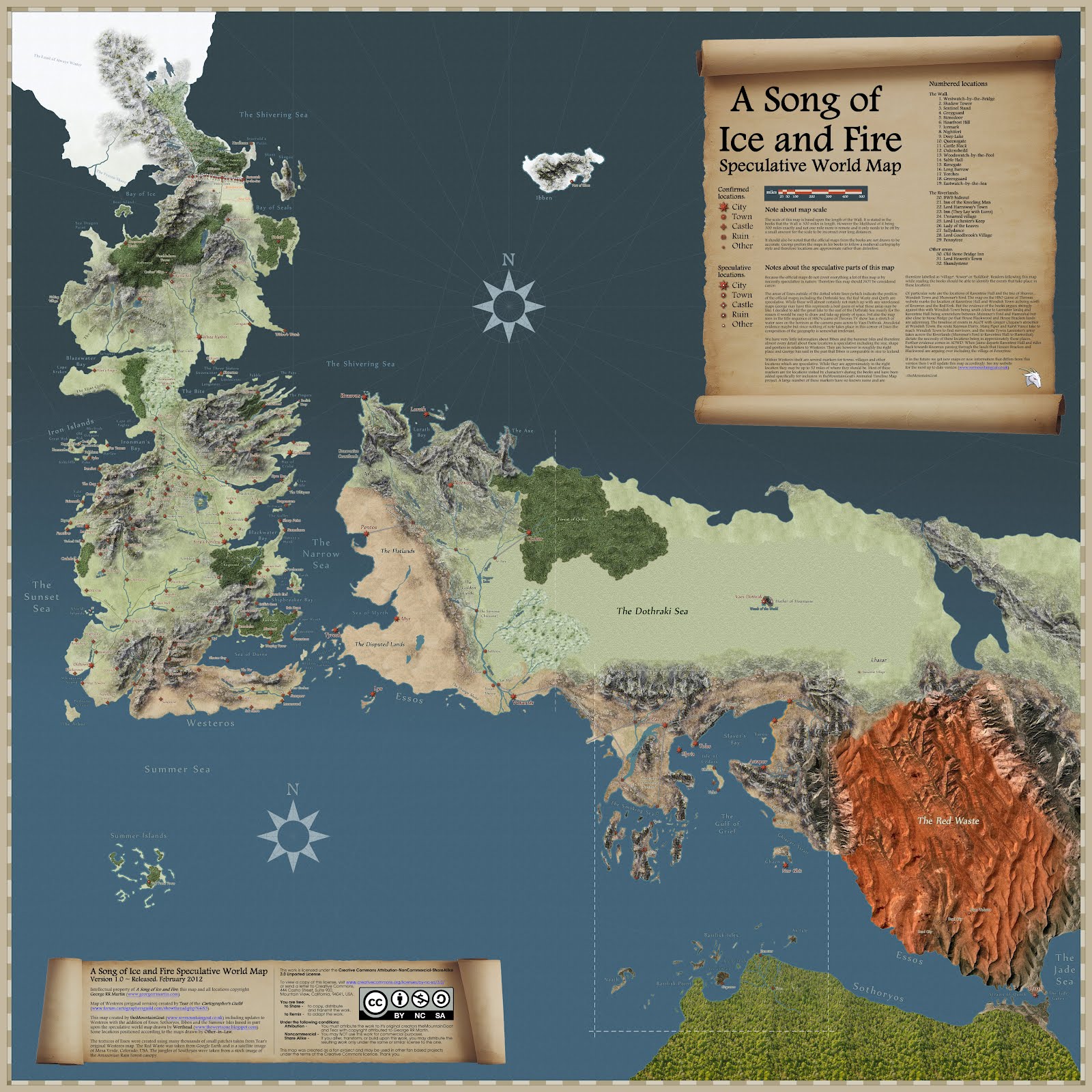
The most complete ASoIaF World Map yet

Westeros.org contributor (and TitanCon co-organiser) SerMountainGoat has created a new world map for A Song of Ice and Fire. The map was inspired by the superb map of Westeros created by poster Tear at the Cartographer's Guild a couple of years ago (a map so good the HBO crew used it for referencing whilst planning the TV series), but adds Essos, Sothoryos, Ibben and the Summer Islands to the mix (some of the placements of which I worked on for my own stop-gap map from last year).


After completing the map, SMG contacted George R.R. Martin. Martin commented on the map's accuracy and also revealed some fresh information about the forthcoming Maps of Ice and Fire book, due on October this year.

"This is a very handsome map. And based on the information you have, it's quite good.

But of course there's lots of information you don't have, so it's not accurate. There are certain things -- the geography and location of the Summer Islands, the placement of Qarth and the Jade Gates, everything east of Slaver's Bay and the Dothraki Sea... that you would have no way of knowing.

(...) I've been working on maps for the Bantam map book for most of the last week. Including lots of maps of places we have never seen before, and a "known world" map that goes as far east as Asshai. (Not a true world map, of course. If my world contains analogues of the Americas, Australia, Antarctica, and the like, the people of the Seven Kingdoms are unaware of them, so it did not seem right for the readers to know more than the characters."
SMG's website (linked above) has multiple versions of the map, including label-less and pure 'geographic' maps for gamers, as well as using the map as the basis for an annotated, interactive timeline of the books. This is very much still a work in progress, but the concept so far seems impressive.

Kudos to SMG for the most definitive world map of the setting so far, and possibly the last major one before we get the official maps later this year.

ETA: Another Westeros poster, Maester Zoidberg, has posted his take on a world map here. It is also excellent.

Sunday, 4 March 2012

RIP Ralph McQuarrie

Ralph McQuarrie, the concept artist who designed much of the look of the original Star Wars movies, has passed away at the age of 82.


McQuarrie played a key role on the original Star Wars film, designing R2-D2, C3-PO and Darth Vader. He also created the final look of Chewbacca (drawing inspiration from a John Shoenherr painting for, of all things, a George R.R. Martin short story). He had a cameo appearance in The Empire Strikes Back. Many years later, he was asked to work on the prequel trilogy but declined.

McQuarrie also worked on Raiders of the Lost Ark, Stark Trek IV: The Voyage Home, *batteries not included, E.T., Jurassic Park, Close Encounters of the Third Kind and Cocoon, winning an Oscar for the latter. He also played a key role as a concept artist on the original 1978 TV series of Battlestar Galactica and did some work for the aborted Star Trek: Phase II TV project before it was abandoned.

George Lucas had this to say about his colleague:

"I am deeply saddened by the passing of such a visionary artist and such a humble man. Ralph McQuarrie was the first person I hired to help me envision Star Wars. His genial contribution, in the form of unequaled production paintings, propelled and inspired all of the cast and crew of the original Star Wars trilogy. When words could not convey my ideas, I could always point to one of Ralph's fabulous illustrations and say, 'Do it like this.'

"Beyond the movies, his artwork has inspired at least two generations of younger artists—all of whom learned through Ralph that movies are designed. Like me, they were thrilled by his keen eye and creative imagination, which always brought concepts to their most ideal plateau. In many ways, he was a generous father to a conceptual art revolution that was born of his artwork, and which seized the imaginations of thousands and propelled them into the film industry. In that way, we will all be benefiting from his oeuvre for generations to come. Beyond that, I will always remember him as a kind and patient, and wonderfully talented, friend and collaborator."