Sunday, 27 November 2011

George R.R. Martin's first-ever published piece of writing

A good find by HaraktheHirsute on the Westeros.org board. This is the letter George R.R. Martin wrote to Marvel Comics in 1963, published in Fantastic Four #20 when he was 15:


There you go. From such small seeds etc.

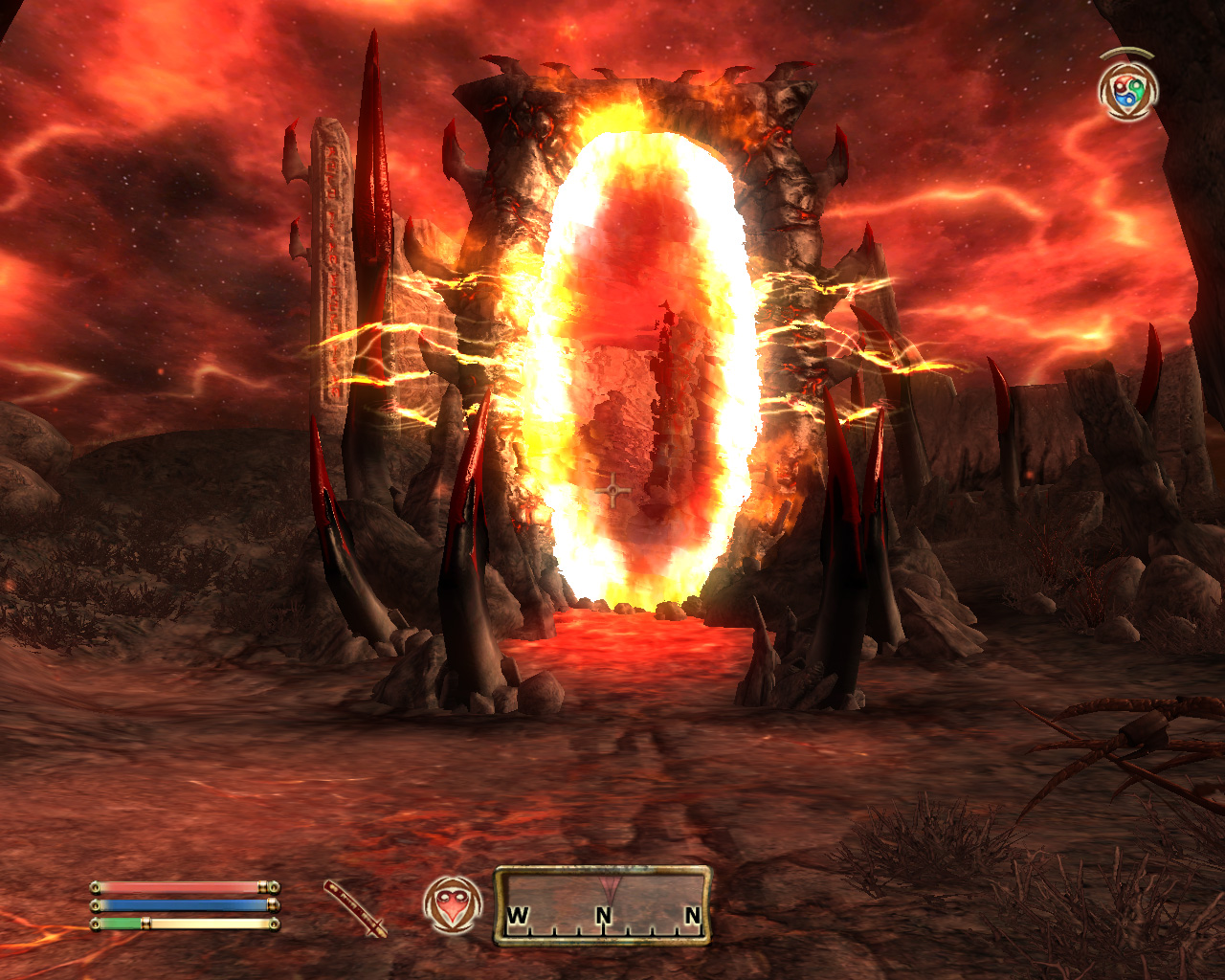
The Elder Scrolls IV: Oblivion

The Empire of Tamriel is under a dark threat. The Emperor has been assassinated, leaving behind no heir. Portals to the dimension of Oblivion are opening all over the Empire, unleashing demons and monsters upon a defenceless population. The Blades, guardians of the Empire, seem unable to resolve the crisis. It falls upon a single hero to bring peace back to the Empire...if he can be bothered, that is.


Oblivion is the fourth game in the Elder Scrolls series of roleplaying games (the fifth, Skyrim, came out a few weeks ago). Originally released in 2006, Oblivion was the first game in the series to be developed with the latest generation of video game consoles in mind as well as the series' traditional home on PC, and was an early showcase for the graphical capabilities of those consoles. Five and a half years on, it remains an impressive game, even if time has not been kind to many of its niggling faults.

Like the first three games in the series - Arena, Daggerfall and Morrowind - Oblivion is an open-world RPG which gives the player a huge playing area to travel around in straight away. Whilst there is a core narrative relating to the search for a new Emperor and shutting down the portals to Oblivion, the player is free to completely ignore this in favour of pursuing side-quests, secondary narratives (such as joining the Thieves' Guild or Dark Brotherhood, both of which have extensive questlines of their own) or simply raiding dungeons for loot for personal gain. This freedom is both exhilarating and also daunting, as some players might feel overwhelmed by the amount of choice on offer. For this reason, the game pushes it core storyline much more strongly than previous games in the series to give players something more tangible to hold onto and pursue.

You know the dragons in Skyrim? These are Oblivion's equivalent, only they're crap.

Unfortunately, the central storyline ends up not being particularly interesting, which is annoying as it also seeks to subversively overthrow some of the cliches and conventions of fantasy RPGs. Initially the game leads you to believe that your character is the 'chosen one' who must save the world, but amusingly you quickly discover that you're not. Your job (if you choose to pursue the central storyline) is to find the true heir and clear the way for him to save the world. Essentially, you're a fixer who has to rush around solving problems and leaving the way clear for the real hero to do his stuff. This is a bold narrative decision, but also one that can be potentially frustrating, making you feel like you're playing second fiddle to an NPC. For this reason, the main storyline is rather short (if you concentrate on it and don't get distracted by other quests, you can finish it in less than ten hours) and also teams you up with the 'real hero' only for the final mission of that storyline. However, be advised that starting the main quest (by following directions to the city of Kvatch after speaking to the old dude at the monastery at the start of the game) will result in portals to Oblivion opening all over the countryside and result in constant, extremely annoying, battles with imps and lesser demons when you're simply trying to get around. Completing the main quest closes the Oblivion portals, thankfully.

The game engine is rather old (it was first used in 2002's Morrowind) but was hugely upgraded for Oblivion. On release the visuals were absolutely, jaw-droppingly beautiful and still look impressive today (and can be made truly awesome with high-texture mods). Vast forests, grassy plains, towering mountains, medieval towns and ancient ruins are a constant feast for the eyes, and rendered with tremendous atmosphere. Even more impressive is the freedom you have to travel everywhere: if you can see it, you can walk there. In Oblivion it's often appealing to simply go for a walk or ride through the countryside in a random direction and see what you bump into.

Unfortunately, the game is less accomplished in its depiction of people and creatures. Human characters are stiff, with somewhat oddly-rendered faces and clunky animation. Monsters fare better, with a variety of interesting creature designs. Interacting with other living creatures is also hit or miss. The game suffers massively from a very limited voice cast. Aside from Patrick Stewart (who has about five lines in the whole game) and Sean Bean (voicing the 'proper' hero), everyone else, even major NPCs, is voiced by the same small pool of actors. When Brother Jauffre, a major character in the game, is talking to you in the exact same voice that the innkeeper round the corner was using to talk to a customer who was also voiced by the same actor, any sense of immersion in the game is seriously dented. Dialogue and the writing in general are also, for the most part, cliched and predictable.

"One does not simply walk into Oblivion. Apart from you, obviously, just by walking up to gates and clicking on them and then going through that tedious tower raid thing again and again. What's up with that?"

Combat and magic use are pretty solid mechanics, with a nice physicality to the combat making it feel like you are in a serious melee. The game allows members of all classes to develop skills outside of those classes, so a sword-wielding mage or a magic-casting warrior are viable possibilities. Unfortunately, the game's levelling mechanic is a little bizarre, since you only level up when your core class skills are practised to a high enough level. Since the entire game world levels up with you (i.e. visiting a wilderness area at Level 1 might result in combat with a bandit in leather armour equipped with a short sword, whilst visiting the same area at Level 20 will reveal a plethora of bandits in magical armour armed with sorcerous blades), there is no real imperative to level up, so it's actually better to pick a class opposite to what you want to play and then develop the non-class skills to high levels. In fact, the level-scaling mechanic is a seriously annoying feature, and one that is a dealbreaker for many players. PC gamers can simply mod the feature out, but console players are stuck with it.

It's a tribute to Oblivion's team of developers that the game can survive an indifferent plot, some bad writing and a series of immersion-shattering, poor design problems. This is mainly down to the inventive and better-written side-quests. Joining the Dark Brotherhood (the assassins' guild) results in a tense, dark-tinged and morally challenging questline that puts the main story to shame. Individual quests are also very strong. Going to sleep on a boat-turned-tavern in the capital's port results in the inn being stolen and sailed out to sea! This leaves you having to take on the hijackers and return the boat to port. Another quest finds you having to venture inside a magical painting to rescue its creator, with a completely different art style to the rest of the game. A visit to a village in night results in you being attacked by invisible fiends, which turn out to be cursed villagers forced into invisibility by a dubious mage (which is a bit harsh if you've already killed several of them without realising what they were). Also, simply not following any quests at all and going dungeon-diving at random can result in memorable encounters and some sweet loot.

Umbra, noted mass-slaughterer of innocent people if you let her out of her dungeon. Which is a horrendous tragedy but also hilarious.

The central draw of the Elder Scrolls games, and indeed Bethesda's Fallout games which are in a similar vein, is the chance to experience your own narrative at your own pace. No two players will ever play the game in quite the same way or experience the same quests in the same order, and it's this involvement of the player's decision in determining the narrative which can be extremely compelling and result in unique stories. For example, in my first play-through I wandered into a dungeon holding a powerful warrior named Umbra, one of the few non-level-scaled characters in the game. Since I was only Level 3, I died near-instantly. After trying a few different tactics to overcome her and steal her sword (one of the most powerful magical weapons in the game), I gave up and fled the dungeon. As I looked back I saw the maniacal super-warrior chasing me along the lakeside. Fleeing at a full run past a guard patrol, I watched as they engaged Umbra and promptly expired. Still, their sacrifice allowed me time to escape. Thinking no more of the incident, I played on for about another 30 hours, bringing the main quest to completion (amongst many other things). On a whim I decided to travel on foot back to the Imperial City alongside Martin (Sean Bean's character) rather than fast-travel there. As we approached the lakeside, we noted numerous corpses of guardsmen, bandits, monsters and merchants along the road. There were dozens and dozens of them. Hearing a familiar cry, I saw Umbra emerge from nearby rocks and attack. It turned out that Umbra had spent the intervening in-game time (weeks, at least) wandering back and forth slaughtering everything in sight. Now considerably more hardcore and with Lord Boromir Stark at my side, I engaged the nutcase in battle and defeated her, getting her mighty sword just in time for the main quest's climactic, huge battle. Awesome.

It's moments like this that allow Oblivion (****) to overcome its many issues and emerge as a highly enjoyable computer roleplaying game. PC gamers also have access to a truly vast number of mods and expansions which do everything from upgrading the graphics, making the characters more realistic and fixing the level-scaling issues to completely overhauling the game and providing new storylines and entire new maps to play on. The game is available now (in a special edition including the expansions) on PC (UK, USA), X-Box 360 (UK, USA) and PlayStation 3 (UK, USA).

Friday, 25 November 2011

GAME OF THRONES Season 1 DVD release details

Via Westeros, we have some info on the DVD and Blu-Ray releases for Game of Thrones, Season 1.


The first season will be released in the UK and USA (and some other territories as well, from the sound of it) on 20 March 2012, about three to four weeks before Season 2 debuts on DVD. As well as all ten episodes, the set will include a plethora of special features.

The Blu-Ray will have the following exclusive items:

  • The Complete Guide to Westeros: an interactive guide to Westeros and Essos, their key locations and noble houses etc. There are also 24 exclusive histories of the Seven Kingdoms told by the characters.
  • Anatomy of an Episode: a guide to the creation of an episode from start to finish, in this case the sixth episode, A Golden Crown.
  • In-Episode Guides: in-feature infoboxes that provide information about characters, locations and histories whilst each episode plays.
  • Hidden Dragon Easter Eggs: find the hidden dragon eggs to unlock more exclusive content.

The following features will appear on both DVD and Blu-Ray:

  • Making Game of Thrones: a 30-minute documentary about the series.
  • Creating the Show Open: a featurette about how the opening title sequence was crafted.
  • From the Book to the Screen: George R.R. Martin, David Benioff and D.B. Weiss discuss the issues involved in bringing the novel to the screen.
  • Character Profiles: profiles of fifteen major characters, provided by the actors playing them.
  • The Night's Watch: an in-depth look at the men of the Night's Watch.
  • Creating the Dothraki Language: a feature on how the Dothraki language was created for the show.
  • Audio Commentaries: Seven audio commentaries with cast and crew including David Benioff, D.B. Weiss, George R.R. Martin, Emilia Clarke, Peter Dinklage, Kit Harington and more.
Sounds like a pretty good package, considering the amount of time they made us wait for it, and should tide people over until the second season starts airing a few weeks later.

Tuesday, 22 November 2011

A first look at GAME OF THRONES Season 2

Here are some interesting images from the recent Game of Thrones trailer released by HBO:


Rory McCann returns as Sandor Clegane, the Hound, now a member of King Joffrey's Kingsguard. Apparently Sandor's role, which was somewhat under-emphasised in Season 1, will be beefed up for Season 2 to something more like that of the books. It may also just be the lighting, but his make-up for this season looks markedly better as well.


The Painted Table of Dragonstone. It's good to see it's in the series, but it does appear to be a smaller and less grandiose version of what is described in the novels.


Stephen Dillane as King Stannis Baratheon. The production team have opted not to have Stannis bald, as in the novels, but otherwise have gone for a stern look more in keeping with his depiction in the books.


Theon Greyjoy meets a drowned priest of the Iron Islands. In a change from the books, this is a miscellaneous priest rather than his uncle, Aeron 'Damphair' Greyjoy. This is probably to keep their options open when it comes to casting Aeron for a later season.


Melisandre of Asshai, played by Carice Van Houten. With her red hair and neck choker, this is Melisandre pretty much straight out of the books.


Natalie Dormer as Margaery Tyrell. This is a big change from the novels, as Dormer's casting means that Margaery is older and more seasoned than the young noblewoman of the novels. Some fans are speculating that Margaery's character responsibilities may be combined with those of the Queen of Thorns to produce a stronger, more interesting character.


Liam Cunningham as Ser Davos Seaworth, Stannis's most loyal retainer. An excellent piece of casting and Davos looks the part perfectly here. Since Davos spends more of his time on a ship than on a horse, it's interesting to speculate that he might be present at a certain parley here.


Michelle Fairley as Catelyn Stark and Finn Jones as Ser Loras Tyrell, both returning characters from Season 1. It's interesting to note the combination of the Baratheon stag and the Tyrell colours on the banner behind them, suggesting that for the TV show Renly might have adopted his own, subtly different sigil.


Gethin Anthony as King Renly Baratheon, here shown cultivating a beard, possibly to look more 'kingly'. Combined with the stag-like crown, this makes Renly look a lot more like Robert's little brother. Behind him is a mostly-obscured Brienne of Tarth, played by Gwendoline Christie.

Overall, it looks like HBO is hitting the right marks in getting A Clash of Kings onto the screen. The season will start airing in the USA and (presumably) the UK in April 2012.

Monday, 21 November 2011

New Mark Charan Newton series announced

Tor UK have signed up Mark Charan Newton for a new fantasy series, starting with a two-book contract. Provisionally entitled Drakenfield, the new series will be a first-person narrative featuring a private investigator solving crimes in a fantasy world. Newton claims this series will dial down the 'weirdness' from his Legends of the Red Sun sequence and be more like historical fiction, citing C.J. Sansom as a possible reference point. The first volume is very tentatively set for publication in mid-2013.

GAME OF THRONES Season 2 behind-the-scenes vid

HBO have aired an interesting behind-the-scenes video for Season 2 of Game of Thrones, showing us our first glimpses of new characters. Keen-eyed viewers can spot Stannis, Melisandre, Davos and Margaery Tyrell.


Season 2 of Game of Thrones is currently scheduled to start airing in April 2012.

Sunday, 20 November 2011

Wertzone Classics: The Left Hand of Darkness by Ursula K. Le Guin

Thousands of years from now, the myriad colony worlds of Hain (including Earth) are being reunited under a new interstellar government, the Ekumen. Genly Ai is the First Envoy, who sets foot alone onto the surface of the frigid planet of Winter (Gethen to its inhabitants) to bring offers of trade, peace and alliance to the people of the planet. However, the genderless inhabitants (who only have sexual urges and genders for a brief period once a month) are sceptical of Ai's claims, and he soon finds himself a pawn of political factions in two neighbouring countries eager to use or discard him as they see fit.


The Left Hand of Darkness was originally published in 1969. It is set in a shared future history which Le Guin has used for several other novels and short stories, though foreknowledge of these other works is completely unnecessary to read this book. The novel also has a formidable reputation as one of the most critically-acclaimed science fiction novels in the history of the genre, noted for its complex themes and its use of metaphors to tackle a wide variety of literary ideas.

The novel spends a fair amount of time talking about the genderless inhabitants of Gethen, who have no sexual urges at all apart from a brief period called kemmer, when they are able to mate and reproduce. Le Guin has put a lot of thought into how not only this works biologically but also the impact it has on society and on the world. Her notions that a lack of sex drive for most of the month reduces the aggressiveness of humans (Gethen has never had a major war) seem obvious, but these ideas are constantly examined and re-examined during the course of the book and she steers away from trite answers.

Whilst the gender theme is notable and the most oft-discussed aspect of the novel, much is also made of the planet's cold climate and the challenges the people face in living in a world mostly covered by glaciers and icecaps where the warm seasons are perishingly short. The politics and divisions between the neighbouring countries of Karhide and Orgoreyn are also described in some detail. As a result Gethen, also called Winter, is as vivid and memorable as any of the human characters in the novel.


Amongst the individual characters, the dominant ones are Ai himself and Estraven, the Prime Minister of Karhide whose interest in Ai sees him suffer a fall from grace and having to travel a long road to try to redeem himself. The book is told from the first-person POV of both characters, moving between them with interludes taking in myths and legends from Gethen's past and also on matters such as the Gethenese calendar and sexual biology (there's also an appendix which handily collates this information into an easy-to-find collection). The two characters are compelling protagonists, with Ai's bafflement at his status as a man from another planet being considered incidental at best to the trivial politics of two nations leading him into difficulties, whilst Estraven's characterisation is subtle and compelling, with the reader constantly having to review his or her opinion of him based on new information as it comes to light.

The themes that the novel tackles extend far beyond the obvious ones of gender and climate. Duality (expressed in Ai's discussion of Taoism with Estraven), faith, the difficulties of communication even when language is shared and politics are also discussed and examined. But where The Left Hand of Darkness impresses is that these thematic discussions are woven into the narrative in a manner that is seamless and stands alongside a compelling plot. The book's climax, where the two main characters have to traverse a 700-mile-wide icecap with limited supplies, is a fantastic adventure narrative in its own right.

Complaints are few. Written in the 1960s, Le Guin presents a few outdated ideas on gender roles and sexuality that were common at the time, but these are minor issues at best.

Overall, The Left Hand of Darkness (*****) is a smart and intelligent read that has a lot to say and does so in a manner that is page-turning, compelling, relentlessly entertaining and refreshingly concise (the novel clocks in at a slim 250 pages in paperback). One of the all-time classics of the genre and a book that more than deserves its reputation. The novel is available now in the UK and USA.

Theft of Swords by Michael J. Sullivan

Hadrian and Royce are partners in crime, a mercenary and thief who make a living working for the various nobles who rule over the lands of Avryn but spend most of their time feuding with one another. One particular job ends with Hadrian and Royce being arrested and charged with regicide. Determined to prove their innocence and take revenge on those who framed them, they set out on a quest that could change the fate of Avryn and the whole world.


Michael J. Sullivan's Riyria Revelations series is already a proven success, with both small press and self-published editions of the books selling well. Orbit have picked up the series and recast the original six books as three omnibuses, bringing them to a wider audience. Whilst this laudably rewards the author's success, it also raises the stakes: standing out from the crowd in self-publishing is one thing, but how does Sullivan's work stack up compared to the current fantasy heavyweights?

The answer is...okay, actually. Sullivan's ambition with this series was to create a series that in a way beat against the current trend for adult, edgy, violent and explicit fantasy novels in favour of something more straightforward or 'classic'. Something that evoked the spirit of say Eddings or Brooks without being as dire. Sullivan lists Harry Potter as an inspiration, particularly the way it welded together accessibility and a classic structure with darker elements (such as major character deaths), and that's certainly a reasonable ambition.


Theft of Swords (which combines the first two novels in the series, The Crown Conspiracy and Avempartha) is a fast-paced, straightforward read with a fast-moving plot and easy-to-read writing. Sullivan's risk in aping the simpler form of fantasy fiction is that he might skirt towards blandness, and this is certainly a problem in the book. He has a fairly blank prose style which is effortless to read, but also somewhat forgettable. His skills with characterisation are somewhat stronger, but still not as great as might be wished. Particularly odd is that his central characters of Hadrian and Royce are not very well-developed at all, and many of the secondary characters are more interesting and better-drawn. The central duo do get a bit more fleshed out towards the end of the second half of the book and we also get a possible reason for why Sullivan had to hold back on certain revelations about them, but it is a bit of a challenge to read a book where the two heroes are so (apparently) shallow.

Other issues can be found in the worldbuilding, particularly the existence of apparently substantial kingdoms with walled cities in them that are only about 20 miles wide. Sullivan aims for some consistency here - a couple of hundred soldiers forms a large army in this world, presumably because populations are correspondingly tiny - but it's still a bit odd. On the racial front, things are fairly traditional: dwarves are geniuses for stonecarving whilst elves are long-lived, pointy-eared types. The only dwarf we meet is a grubby villain, whilst the elves are (in this first book anyway) kept firmly off-screen and are the enemies of humanity, but these are minor (and not particularly unprecedented) twists to the established formula. Naturally, the main storyline also revolves around prophecies, chosen ones whose arrival will signify the end of the world and so on, and it won't take a genius to guess who the chosen one is going to be.


The principle problem with the book is its very predictability. At first, reading an epic fantasy without blood spraying over people's faces every five seconds or two mandatory graphic (and usually badly-written) sex scenes per book is a refreshing change of pace, and feels like a valid direction to take at this time. However, the book's embracing of classic tropes without doing much (or, at times, anything) to subvert or challenge them eventually gets dull. Brandon Sanderson, for example, is also writing classic epic fantasy but remembers to put in plenty of interesting twists: a post-magic-apocalypse setting, a Wild West angle and, of course, lots of original magic systems. These flourishes are absent from Sullivan's debut work.

Theft of Swords (***) is an easy, relaxing read but also one that lacks depth or originality. It's fun enough to warrant reading on (and the series rep has it improving massively as it continues), but I do wonder if publishing these stories as 650-page omnibuses rather than their original 320-page, bite-sized chunks was a mistake. A fun popcorn read, but ultimately not much more. The omnibus is available now in the UK and USA.

Tuesday, 15 November 2011

Cover art for China Mieville's RAILSEA

The American cover art for China Mieville's next novel, Railsea, has been revealed:


Hard info on the book - due out in May 2012 - is scant at the moment, but from advance pagination (though we should remember this is highly unreliable) and some other hints, it sounds like this might be Mieville's second YA novel, though that is far from confirmed. More news as I hear it.

Monday, 14 November 2011

Trailer for THE HUNGER GAMES

The film version of Suzanne Collins' novel is due for release on 23 March, 2012 and stars Jennifer Lawrence (most recently seen in X-Men: First Class) as Katniss Everdeen. Donald Sutherland, Woody Harrelson, Stanley Tucci, Elizabeth Banks, Lenny Kravitz and Toby Jones also have supporting roles.


The film has a good cast and Lawrence is a rising talent who should be great in the lead role. Director Gary Ross also has some interesting form, with his most notable previous movies being Pleasantville and Seabiscuit.