Showing posts with label a game of thrones. Show all posts

Wednesday, 4 February 2026

Sales of A SONG OF ICE AND FIRE surpass 100 million

It's been a long time coming, but sales of George R.R. Martin's A Song of Ice and Fire sequence, perhaps better known by the name of its TV adaptation, HBO's Game of Thrones, have finally and officially passed the 100 million mark.

The Juniper Books rejacketing of the Song of Ice and Fire series.

The news was buried in The Hollywood Reporter's recent article on Martin, although the main focus was elsewhere (yes, The Winds of Winter still isn't out yet, and yes, the fall-out from Martin's public dissatisfaction with House of the Dragon continues to reverberate).

The series started off a little sluggishly, with A Game of Thrones only doing okay on its first publication in August 1996 (the series turns thirty this year) and it taking until the paperback was released before sales picked up, something Martin attributed to the cover quote from fellow fantasy author Robert Jordan, of Wheel of Time fame. Sales and critical acclaim grew with the release of A Clash of Kings in 1998 and A Storm of Swords in 2000. By the time of the release of A Feast for Crows in 2005, sales of the series had approached or exceeded five million. At least twelve million copies had been sold by the time A Dance with Dragons was published and the Game of Thrones TV series launched, both in 2011.

The immense success of Game of Thrones propelled sales of the novels to insane heights. The books reportedly sold a further nine million copies in the first year of the TV show alone (from 2011 to 2012). Sales hit 70 million in 2016 and are believed to have reached 90 million around the time of the pandemic, coinciding with the - contentious in some parts - conclusion of the TV series. With the franchise off the air and no new novel in the mainline series appearing, sales appear to have slowed, although spin-off books The World of Ice and Fire (2014), A Knight of the Seven Kingdoms (2015, collecting three earlier-published novellas) and Fire & Blood (2018) all sold extremely well.

Sales of the series appeared to uptick again after House of the Dragon launched to initial success in 2022, and no doubt there has been another sales boost from the successful launch of A Knight of the Seven Kingdoms a few weeks ago.

Crossing the 100 million mark puts Martin in rarefied company. In the secondary world/epic fantasy field, he is just behind Sir Terry Pratchett and Robert Jordan, who have both also crossed the 100 million mark in the last few years, though of course J.R.R. Tolkien continues to rule the roost with at least 300 million sales of his various Middle-earth books (and this figure is highly conservative). Stephen King has over 400 million sales, but only around a tenth of those comes from his epic fantasy or at least epic fantasy-adjacent work, the Dark Tower series and Eyes of the Dragon, meaning that Martin may comfortably be the biggest-selling living epic fantasy author (unless you count Harry Potter as epic fantasy, which most don't seem to).

How long he holds onto that crown will be interesting to see. Brandon Sanderson recently passed 50 million books sold, but Sarah J. Maas recently hit 75 million copies sold and is selling books at a staggering rate.

It should also be noted that book sales are famously sluggish in their reporting, with the reporting sometimes trailing the real figures by many years. Martin's actual sales could be a fair bit higher than this number.

If the books continue to generate hit TV shows, we'll likely see a steady increase in sales. Obviously one thing would blast sales through the stratosphere again, but when those winds will blow remains to be seen.

Wednesday, 17 July 2019

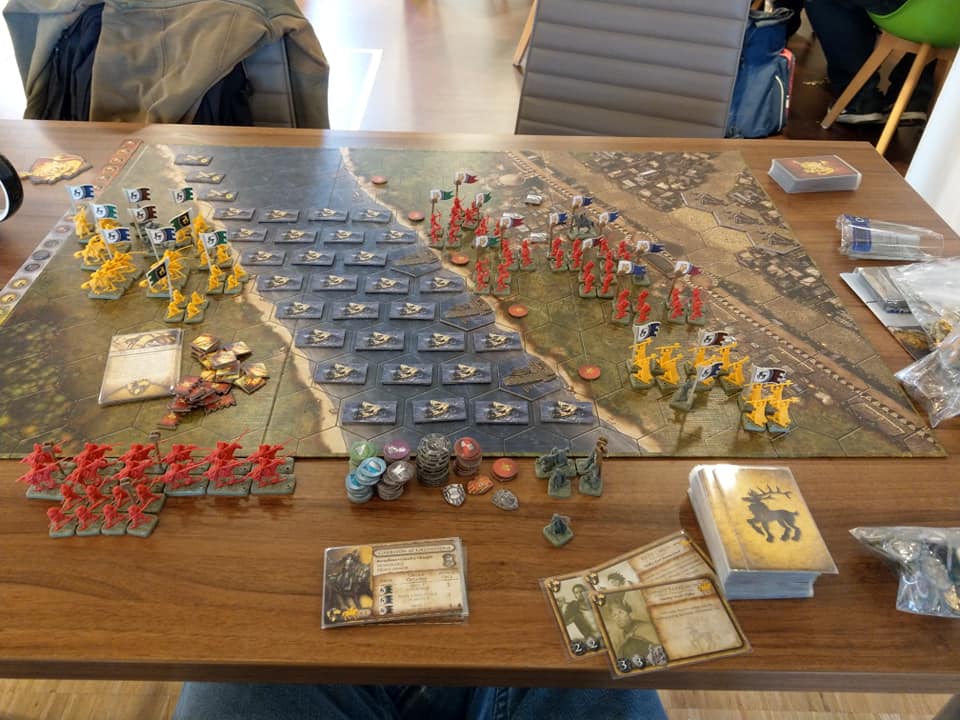
Battles of Westeros

Way back in 2003, Fantasy Flight Games released the A Game of Thrones board game, which essentially fused elements of the classic board game Diplomacy into the A Song of Ice and Fire setting. A huge success, the game has remained continuously in print up until today, getting a second edition and multiple expansions, the latest of which was released only last year, along the way. 


Back in 2010 Fantasy Flight released their second ASoIaF-based board game, Battles of Westeros, a miniatures wargame which, as the box proclaims, spins off of the popular BattleLore rules system. The game received several expansions, but the line was abruptly cancelled in 2012. Despite that, the base game remains available at reasonable prices thanks to eBay, although the expansions are a lot more hit and miss.

Having recently gotten a copy of the game and several expansions (Lords of the RiverTribes of the Vale and the big House Baratheon expansion), I was surprised to see that the game had done poorly, as it is excellent. 


On a basic level, Battles of Westeros is a spin-off of the popular Command & Colors line of wargame/board game hybrids created by designer Richard Borg in 2000. This system has spawned a whole range of different iterations, the best-known and biggest-selling of which is the WWII version, Memoir ’44. The most recent is the excellent space opera version, Red Alert: Space Fleet Warfare, with other versions ranging from Command & Colors: Napoleonics to Tricorne (based on the American Revolutionary War) to The Great War, based on WWI. Most relevant here is BattleLore, a fantasy version featuring knights, griffins, trolls and elves. Battles of Westeros proudly proclaims itself “a BattleLore game,” which is being somewhat elastic with the truth as the game pretty much rewrites the rules of both BattleLore and Command & Colors so much that only the basic elements remain in common.

For gameplay purposes, you play scenarios which pit two armies against one another. The base game allows you to play Stark vs. Lannister, but the expansions add the Baratheon and Tully forces, as well as the irregular forces of the Brotherhood Without Banners and the tribes of the Vale of Arryn. The scenario details tell you how to set up the map, which is a plain green field covered in hexes. You place hexagonal tokens on the map to depict scenery, such as hills, villages, mountains, rivers and forests (the House Baratheon expansion also features a second map, depicting the Blackwater Rush and the walls of King’s Landing), and set up your armies as directed. Each army consists of archers, infantry, cavalry and – most critically – “leaders.” These leaders are special units depicting the commanders of the armies in question, such as Robb Stark, Jaime Lannister, Brienne of Tarth, Shagga, Stannis Baratheon, Brynden the Blackfish and so on. These units are usually quite powerful in combat, but they also play an important role in giving orders to your troops (and getting them captured or killed can be a devastating blow).


The game’s biggest deviation away from the Command & Colors system is that the board is not divided into sectors. Those games have a central sector and two flanks, and you draw cards telling you how many units in each sector you can use on that turn. Battles of Westeros replaces this with you playing cards as orders given by your leaders to troops within yelling distance. So, you play a card on a leader and he or she can direct units within 2 hexes of their figure. This is immediately more logical and also causes each player to carefully consider each turn how to manoeuvre their armies (and keep their leaders within order-giving range of their key troops without endangering them). Each turn you also get a number of general-purpose order tokens you can use to order any unit on the map, regardless of if they are in range of a leader or not, which is handy if you have a bunch of archers on a hill off to one side of the battlefield you want to take potshots at enemy forces without getting a general to ride over and keep telling them to do so.

Each leader also has special abilities, some they can use continuously and extremely powerful once-per-game abilities (such as allowing your troops to attack twice in one turn) that can prove decisive if used wisely.


There are additional rules for flanking enemy troops and veterancy: not all your troops are equal, with their experience denoted by the colour of their flag (green for fresh recruits, blue for experienced soldiers and red for veterans). That also determines how many dice they roll in attack and how far they move, with more experienced troops generally being slower but able to hit much harder. There is also a morale tracker, which swings back and forth determining on how the battle is going: lose too many units to the enemy without inflicting comparable damage and your army can rout altogether.

Despite this level of detail, Battles of Westeros is not a particularly complex game, especially if you have some previous experience of the Command & Colors system. Most turns have you playing a card on a leader, moving the figures of the troops they are commanding and rolling dice to determine if they are successful, and that’s pretty much it, unless you want to use a special ability. You then draw some new cards, roll some dice to determine how many other units you can move and away you go. Each scenario has specific victory conditions or complications to add variety to the game, and each leader has their own set of cards which you can add to your command deck, which adds quite a bit of longevity and replay value to the game, which is increased even further by the expansions.


The game’s presentation is solid (Fantasy Flight has built up a beautiful library of ASoIaF-related artwork over the last fifteen years), the rules are reasonably comprehensible and well-laid out, and the production value of the components is excellent. Most copies of the game you’ll find now are getting on for a decade, and every one I’ve seen has been in good nick. The cards are also good quality and the miniatures are impressive, although a little on the small side.

The rules are great, and if you’ve played a lot of Command & Colors the changes will likely be welcome. In particular, tying the order cards to the leader figures rather than random sectors simply makes a hell of a lot more sense, and it’d be cool to see this idea moved over to some of the other games in the same line. Complete newcomers may find a slightly steeper hill to climb, but in overall terms and compared to many contemporary board games (especially those on the wargame side of things), the game is not particularly hard to learn.


The negatives are relatively minor, but there are a few niggles. The figures don’t fit into their bases very well, so it’s recommended you glue them in, which can be fiddly and time-consuming. The only reason they’re not pre-fitted to the bases is to make painting them easier, but the figures are small enough that I don’t really see the value of painting them. As a Fantasy Flight game there are also an absolute ton of fiddly tokens, symbols and paraphernalia, a lot of which are really unnecessary to the game. Another negative with the rules is that the game is extremely limited in counterattacking options, to the point where it very rarely happens. It feels like the idea of using order tokens to allow counterattacking (recently employed in Red Alert) should be implemented here.

Another issue is the length of gameplay. Command & Colors is best-known for being relatively fast to play, especially versus traditional wargames, with it being possible to blast through say a few Memoir ’44 scenarios in 30-45 minutes apiece. Battles of Westeros has no truck with this, and you’ll be lucky to get a scenario done in much under two hours. However, the much greater detail of the combat means you’ll be making much more interesting decisions than in a standard C&C games, so the greater length can be seen as a reflection of the greater depth of gameplay. If you want a fast-playing wargame, break out Memoir ’44, if you want something a bit more detailed if slower then unleash BattleLore or Red Alert, but if you want something longer, meatier and more engrossing, Battles of Westeros works fine for that.


The biggest weakness is, of course, the lack of ongoing support. Despite the success of the TV show, Fantasy Flight have shown little interest in resurrecting the game and the recent release of CMON Games’ A Song of Ice and Fire: The Tabletop Miniatures Game (which has far more beautiful miniatures and considerably less-compelling rules) suggests they may no longer have the miniatures rights to do so. There are some online resources to extend the game and there are enough scenarios in the base game and expansions to ensure you will get a lot of value out of the game.

Battles of Westeros (****½) is a fine addition to any library of ASoIaF-based games, if you can track down a copy at a good price.

Friday, 12 April 2019

Some recent media collaborations

I've recently collaborated with a few media outlets for some new projects.


First up, Entertainment Weekly used some of my photos from the Game of Thrones pilot shoot in 2009 for their coverage of the final season of the show. You can find that article here and in the print magazine from a couple of weeks ago.


Bloomberg also consulted with me for an article on the economy of Westeros (TV edition). You can find my original article on the economy of Westeros from the books here.

There's also a couple more outlets where my work will be showing up shortly, which should be quite interesting.

Saturday, 6 August 2016

Sales of A SONG OF ICE AND FIRE pass 70 million on its 20th birthday

Worldwide sales of A Song of Ice and Fire, the book series on which the Game of Thrones TV series is based, have passed 70 million.


Sales of A Song of Ice and Fire hit 58 million in April 2015, indicating that the series has sold an additional 12 million copies in just the last year. With no new novel released in that time, that is a remarkable achievement and a reflection of the success of both the books and the TV show helping drive sales.

This month marks the 20th anniversary of the publication of A Game of Thrones. It is also approximately 25 years since George R.R. Martin started writing the series and the sixteenth anniversary of the publication of A Storm of Swords (which I read on release, something I will forever be grateful for). I will be writing a more in-depth article on the anniversary shortly.

How do Martin's sales compare to other SF and fantasy authors? Quite favourably*:

JK Rowling: 450 million
Stephen King: 300 million
JRR Tolkien: 300 million
Stephanie Meyer: 250 million
Anne Rice: 136 million
CS Lewis: 120 million
Edgar Rice Burroughs: 100 million
Sir Arthur C. Clarke: 100 million
Suzanne Collins: 100 million
Andre Norton: 90 million
Sir Terry Pratchett: 85 million
Robert Jordan: 80 million
George R.R. Martin: 70 million


* Yes, this list is out of date. An update is in the planning.

Saturday, 2 July 2016

When Theories are Confirmed: Twenty Years of Speculation

One of the major appeals of any long-running series, whether on TV, in films or in books, is the fun that fans can have from getting together and piecing together clues to long-running mysteries, and then seeing if those theories are confirmed or not later on. This took off in the 1990s, when viewers of Twin Peaks and Babylon 5 would eagerly compare notes on what the latest episode contributed to the mythology and what it meant for future episodes.

Spoilers from Season 6 of Game of Thrones, potentially impacting on events in the unpublished Song of Ice and Fire novels, ahead.

Wednesday, 18 May 2016

Happy 20th Anniversary to A SONG OF ICE AND FIRE (more or less)

This year marks two important milestones for George R.R. Martin fans: the 20th anniversary of A Song of Ice and Fire appearing in print and the 25th anniversay of George starting to write the first book.


George started writing A Game of Thrones in the summer of 1991. The novel was published on 6 August 1996. However, that wasn't the first time any Song of Ice and Fire material appeared in print. That honour came three months earlier when his publishers started rolling out various excerpts and outtakes from the novel.

The first thing to appear was a sample booklet from HarperCollins Voyager, George's UK publishers. This booklet contained the first 124 pages from the novel (running up roughly to the end of the chapter where Robert tells Eddard about Daenerys's wedding) and was published separately in the UK for 99p (but now retails online for £150!). It was sold at bookstores across the country as a way of whetting the appetite for the book. My three local bookshops cunningly positioned the booklets next to the hardcover displays for the seventh Wheel of Time novel, which was released on 15 May 1996, to get some cross-series fantasy promotion going on.

In the United States, Bantam ran an excerpt in Asimov's Science Fiction in July 1996 (published in June). This excerpt was huge. Dubbed Blood of the Dragon, it contained all of the Daenerys chapters from A Game of Thrones assembled into one self-contained novella. Blood of the Dragon went on to win the Best Novella prize at the 1997 Hugo Awards, making this the only literary Hugo the series has received so far (Game of Thrones has won three for Best Dramatic Presentation, however). A Storm of Swords got the same treatment in 2000 when the Daenerys chapters were pulled out to form a novella called Path of the Dragon, although this didn't win a Hugo.

So there you go. Although the anniversary of A Game of Thrones itself isn't until August, when we'll see some fancy new editions hit the shelves and likely some more celebration of the fact, A Song of Ice and Fire has now been in print for more than twenty years.

So, are the Targaryens immune to fire?

This is a question that has come up regularly in the twenty years since A Game of Thrones was first published but even moreso since the advent of the TV series five years ago. The events of this week's episode, Book of the Stranger, have raised the question yet again, so it bears some revisiting.


As usual, we have to remember that there is a distinct and separate book canon and a distinct and separate TV canon. The two stories take place in distinct fictional universes and, although the TV show draws on the book storyline, it is not the same story and can differ from it, sometimes subtly and sometimes quite wildly. What is canon in the books may have no bearing on the TV show and vice versa.


In the book canon

In the Song of Ice and Fire novels, the Targaryens are not immune to fire as a matter of course. Long exposure to living in a land dominated by volcanic activity, with the city of Valyria itself built around rivers of lava, may have given the Valyrians - including the Targaryens - a very moderate, increased resistance to heat. But that's all. The difference is not massive. As George R.R. Martin says:
"It gives me a chance to clear up a common misconception. TARGARYENS ARE NOT IMMUNE TO FIRE! The birth of Dany's dragons was unique, magical, wondrous, a miracle. She is called The Unburnt because she walked into the flames and lived. But her brother sure as hell wasn't immune to that molten gold."
"So she won't be able to do it again?"
"Probably not."

In addition:
"Lastly, some fans are reading too much into the scene in GAME OF THRONES where the dragons are born -- which is to say, it was never the case that all Targaryens are immune to all fire at all times."

We see ourselves that Viserys was not immune to the molten heat of the pot of gold dumped over his head by Khal Drogo in Vaes Dothrak, and during the Dance of Dragons several Targaryens burned to death in dragonback battles.

So the question arises, how did Daenerys survive the funeral pyre in Lhazar at the end of A Game of Thrones? The simple answer is magic. Mirri Maz Duur had already used magic to save Khal Drogo's life (if only as a vegetable), drawing from the life of Daenerys's unborn child. When Daenerys burned Mirri Maz Duur alive on the funeral pyre, along with Drogo's body and the three dragon eggs, it created a magical catalyst that allowed the dragon eggs to hatch (the lack of blood sacrifice may be why the previous Targaryen eggs had not hatched, although this doesn't explain the failure at Summerhall where many lives were lost trying to hatch eggs). It might be that just killing Duur with the eggs and fire present was enough, or that Daenerys's act of faith (stepping into the flames) furthered things along, or the magical influence of the comet may have helped. An additional theory is that Mirri Maz Duur herself was in the middle of trying to work some black magic to try to escape and this backfired and allowed the eggs to hatch and Daenerys to emerge unharmed.

George's commentary on the matter is clear: this was a one-off, magical event that will probably never happen again, unless similar circumstances arise.

Some readers dispute this, pointing out that Daenerys survives the conflagration in Daznak's Pit at the end of A Dance with Dragons. This is true, but Daenerys is wounded during the incident, suffering blisters and pain from the heat. Daenerys got lucky (or Drogon was careful not to hurt her), avoiding the flames directly but still suffering after-effects.

So the answer to this question is clear: in the books Daenerys is not immune to fire at all times and can still be harmed by it.


In the TV canon

The TV series Game of Thrones leaves considerably less room to argue. In the first episode of the series, Winter is Coming, Daenerys gets into a scalding-hot bath and doesn't bat an eyelid. In A Golden Crown she picks up one of her dragon eggs after placing it in a brazier for several minutes and is unharmed. When her handmaid Irri touches the same egg, she burns her hands. In Valar Morghulis Daenerys is chained up whilst her dragons breath fire around her to kill the warlock Pyat Pree. The warlock is incinerated but Daenerys is completely unfazed by it.

Finally, in this week's episode Daenerys overturns four braziers in the Temple of the Dhosh Khaleen in Vaes Dothrak and burns the temple to the ground whilst she is standing in the middle of it. Afterwards she walks out completely unharmed, having apparently made the conscious decision to use her flame-immunity to cow the Dothraki into following her.

The Inside the Episode video that HBO posts for each episode is also fairly clear on the matter: this is an ability that Daenerys has at all times. So again the answer is clear: in the TV series Daenerys is immune to fire at all times and cannot be harmed by it.

The question of "Why?" is an interesting one. Viserys clearly was not immune to fire when he was killed in A Golden Crown. It may be something in the consistency of the molten gold that allowed it to kill him, but more likely the immunity to fire is something unique to Daenerys. If you believe that she is the Prince Who Was Promised rather than Jon Snow (or if they both are, somehow), it may have something more to do with that. It will be interesting to see if the show expands on this or leaves it more open to interpretation.

The next question is "How will this go down in the books?" We'll have to wait for The Winds of Winter to find out, but the situation in the books is already different: Daenerys had Drogon by her side when the Dothraki arrived, so the situation will play out in a different manner.

Wednesday, 21 October 2015

A History of Epic Fantasy - Part 21

The Wheel of Time may have sold more copies (because it's three times the length), but A Song of Ice and Fire, by every available metric, has more actual readers than any epic fantasy series since The Lord of the Rings. Whilst the massive success of the HBO television adaptation, Game of Thrones, has driven this success, the critical acclaim given to the series has also been unusually laudatory over a very long period of time. So, as we have asked before, what factors have given the series its immense appeal?

George R.R. Martin (and his wife Parris, the True Power Behind the Throne) with his Alfie Awards, presented at the 2015 Worldcon.

Fantasy From a Fan

As George R.R. Martin will tell you every time he gets the chance, he was a fan of science fiction, fantasy and historical novels a long time before he wrote his first story. He grew up reading Clarke, Heinlein, Howard and Vance, delved into Tolkien as a teenager and spent the 1970s and 1980s reading almost everyone of note in the field. A regular attendee of the World Science Fiction Convention (Worldcon), he regularly read every novel on the shortlist for the Hugo Awards. At different times he also took part on panels, organised events and edited anthologies. Other fantasy authors may have been fans of the genre, or aspects of the genre, but almost none were as deeply immersed in it and in fandom as Martin was.

The result is that A Song of Ice and Fire wears a lot of influences on its sleeve, from Dune, The Lord of the Rings, The Dying Earth and The Chronicles of Amber through to Memory, Sorrow and Thorn, the first two volumes of which Martin had read before starting work on A Game of Thrones. But as well as being an avid reader of SFF, Martin also enjoyed historical fiction. He was a fan of Dorothy Dunnett and Bernard Cornwell, as well as French writer Maurice Druon. Druon's Accursed Kings sequence, about murderous intrigue in the French court in the 14th Century, was particularly influential. The result is a fantasy series that is a mishmash of sources and influences, streamlined into one cohesive whole by an experienced and seasoned writer. If Martin had attempted to write this series at the start of his career in the 1970s, it certainly would not have worked as well.

George R.R. Martin's fantasy is noted for his high level of realism, grit and incredibly restrained use of magic or fantastical creatures. Apart from this bit, obviously.

Rare Magic

A Song of Ice and Fire is notable for its (relatively) restrained attitude to magic. There is very little in the first book, a little more in the second and it's only with the introduction of continent-spanning candle-based communication systems, magic trees and R'hllor's on-demand (but highly unreliable) way of answering questions in the latest volumes that the level of magic in the series has even started to approach that of other series. This "stealth fantasy" approach, allowing people who'd normally run away from a book featuring wizards chucking fireballs at one another to read the books under the (increasingly tenuous) excuse it was really "historical fantasy". Some of these readers have even stuck around to enjoy other works, some of them with much higher levels of magic in them.

Similarly, if there is one bane of fantasy it's The Prophecy. Many fantasy series have employed The Prophecy as a narrative device, some reasonably well and originally (The Wheel of Time), some whimsically (The Belgariad) and some pretty straight and boringly (much of the rest of the genre). A Game of Thrones takes great delight in setting up and then smashing the prophecy of the "Stallion That Mounts the World" before the novel is even over. Later volumes see other prophecies assert themselves with varying degrees of success, in some cases with multiple candidates seeming to fulfil the same prophecy through completely different sets of circumstances, fuelling discussion and debate.


One of those fantasy worlds where "Here Be Dragons" is written on the explored bits.

An Uncertain World

Since Tolkien, worldbuilding has formed a major cornerstone of the genre, and indeed A Song of Ice and Fire is replete with chronologies, maps and family trees. However, Martin has also been restrained in giving out such information. Hard info on history much before the Doom of Valyria is entirely missing, with the characters forced to rely on (highly uncertain) myths and legends instead. And while detailed maps of Westeros and (now) Essos exist, the majority of the world remains unexplored. We've learned a huge amount about Martin's fictional world, but the edges of the maps remain greyed out and much of the backstory remains uncertain.

Arguably still more effective than Congress and Parliament combined.

Humanising Politics

Political intrigue is hard to do in a fantasy novel where no-one really cares about the fictional families and countries involved. Martin's masterstroke here is to encapsulate each region of Westeros into a single family and each family into a handful of representatives, whom we can get to know and, through them, their families and their factions. Even more intriguing is his decision to then show variations within those families, and to shade every character with moments of redemption, villainy or tragedy. The result is, as one review put it, a series that captures "the intoxicating complexity" of the Wars of the Roses or the Roman Empire whilst still telling a manageable and comprehensible story.

Of course, Martin's biggest success was his cast of characters, which may be ultimately unmatched in the genre. From the scheming Cersei to the witty Tyrion (whose wit masks a darker side) to the overly noble Eddard to the inexperienced Daenerys, each comes across as a fully-drawn character with foibles, moments of wisdom and humanity.

Remember that bit where Tyrion turned out to be a rapist? No, the TV writers didn't either, apparently. Awkward.

Grit and Humour

Certain fantasy authors, such as Stephen Donaldson and Glen Cook, didn't shy away from the darker side of things before Martin, but Martin was certainly the one who brought these elements to the fore and made them successful. Sudden character deaths and not backpedalling from the baser side of humanity gave the books a threatening tone rarely seen before in the genre, not to mention numerous scenes which the squeamish will not enjoy. Unfortunately, some authors who have followed in Martin's train have dwelt on the darker side of humanity to the point of nihilism and wallowing in misery for misery's sake. Martin also depicts the lighter side of humanity, through humour (anything Tyrion says), heroism (Jaime Lannister jumping into a pit to fight a bear with only one hand) and redemption (Jaime again, but also arguably Stannis - in the books anyway - and maybe Theon). The depiction of the Seven Kingdoms at peace, at the start of the books and in the prequel novellas, also shows that despite the grimness of war, this is ultimately a land and a people worth saving.

Joe Abercrombie wearing his influences on his sleeve.


A Feast for Fantasy

A Song of Ice and Fire has gone on to be hugely influential in the fantasy field. A number of writers have followed in Martin's wake who, even if they've never read him, have found the genre much more welcoming and open to harder-edged works in his wake. These range from Steven Erikson and Scott Bakker's dark 'n' gritty fantasy epics to the more adventurous books by Scott Lynch and Joe Abercrombie's grimfunny First Law works. Even literary darling Michael Chabon has come out as a GRRM fan (even if only from his earlier work, in a marvellously hipsterish author-fanboying moment). The immense success of the Game of Thrones TV series has also led to renewed interest in film or TV versions of other fantasy properties, with The Kingkiller Chronicle, the Shannara series and the Discworld City Watch books all under option or in production.

"I am aware of the theoretical existence of something called 'deadlines'." 

Making Long Publishing Delays Acceptable  

...okay, this wasn't so great. Thanks, George.


The impact of A Song of Ice and Fire was seismic, on the genre of epic fantasy both in books and in the visual medium, an area where the genre had previously struggled. Despite the obvious visual qualities of the genre, almost every previous attempt to make an epic fantasy film or TV series had crashed and burned, and over the years there'd been more than a few attempts.

Sunday, 18 October 2015

A History of Epic Fantasy - Part 20

The majority of works that caused seismic shifts in the fantasy field did so almost overnight: Terry Pratchett became a massive bestseller within just a couple of years of his first Discworld novel being published. Robert Jordan's books hit the bestseller lists almost instantly, as did Terry Brooks's. Tolkien took a decade or so, but only due to limited publicity and no paperback editions being available for The Lord of the Rings until the mid-1960s. But other works took a bit longer to really make their mark felt.

The HarperCollins Voyager preview booklet of A Game of Thrones, the first-officially available chunk of A Song of Ice and Fire. Released circa May/June 1996.


A Trilogy in [some] Parts

George Raymond Richard Martin (born in 1948 in Bayonne, New Jersey) was a very well-known writer in science fiction and horror in the early 1990s. He published his first short story in 1971, won his first (of five, to date) Hugo Award in 1975 and released his first novel in 1977. His 1980 short story Sandkings and his 1982 vampire novel, Fevre Dream, were both hugely critically acclaimed and successful. However, his 1983 novel The Armageddon Rag crashed and burned spectacularly in terms of sales. He put his writing career on hold, but a meeting with a producer interested in making a film of The Armageddon Rag led to a new career in Los Angeles. He worked on the first two seasons of the relaunched Twilight Zone before switching to becoming a writer, script editor and producer on Beauty and the Beast. In 1987 his short story Nightflyers was also adapted for film.

Beauty and the Beast ended, slightly controversially, in 1990 after the writers had killed off lead character Catherine, played by Linda Hamilton. This led to the conclusion that while even the Terminator couldn't kill Linda Hamilton, George R.R. Martin could (slightly erroneously, as the show's producer actually had to make the final call on how to writer her out). Ratings dropped, the fans got angry and the show had to be shut down. Back home in Santa Fe, Martin began writing a science fiction novel called Avalon. His prose writer career had been revived by the release of several successful short fiction collections and a new "fixup" novel (several short stories combined into a cohesive narrative) called Tuf Voyaging. Starting in 1987, Martin had also begun editing the Wild Cards series of collaborative superhero anthologies, which soon proved extremely successful.

After several months of working on Avalon, in the summer of 1991, Martin suddenly got the idea for a scene in which a young boy goes with his father to watch a deserter being beheaded, after which he finds some direwolf pups in the snow. This scene led to others, and soon the SF novel was forgotten. Martin produced over 100 pages and a map into the fantasy story before he was called back to Hollywood to work on a TV project called Doorways, which never made it to the screen. Returning to the fantasy story after almost two years away, Martin realised he was still full of ideas and enthusiasm for it. He had a title in mind: A Song of Ice and Fire, a trilogy consisting of the novels A Game of Thrones, A Dance with Dragons and The Winds of Winter.

That plan didn't long survive contact with the word processor.

A first edition of A Game of Thrones on sale at the 2014 Worldcon.


A Storm of Sales

Martin sold his fantasy "trilogy" to American and British publishers in 1994, for quite impressive sums of money. Martin ending his long exile from writing novels was in itself exciting, but publishers were almost giddy at the prospect of a respected, long-standing writer trying his hand at fantasy, not to mention that the sample chapters and outline were compelling. Both sides of the Atlantic deployed similar strategies to get fantasy fans and the book-buyers for the stores excited. In the United States all of the chapters from the POV of Daenerys Targaryen were pulled out and assembled into a stand-alone novella called Blood of the Dragon. This novella won the first Hugo Award for the series in 1997. In the UK HarperCollins simply pulled out the first 100 pages or so of the novel and published them as a stand-alone novella.

A Game of Thrones was published in August 1996, but the early marketing work didn't seem to have paid off. The book sold okay, but not as much as either publisher had hoped. There had been plenty of positive reviews, but also a few that had been more mixed or negative. In the UK, the biggest genre magazine SFX published a notoriously negative review which, at a time when the Internet and its formidable powers of book recommendations were still in their infancy, seemed to drive off at least some prospective buyers. In America the problem was more down to an oversaturated market and the underwhelming (if flashy) cover design.

Fortunately, the publishers had faith in the book. In the States they relaunched it with a new cover design and pulled in some heavy-weight blurbs. Anne McCaffrey, Janny Wurts, Katharine Kerr and Raymond E. Feist (among others) gave really strong soundbites but it was the ringing endorsement of Robert Jordan which had the biggest impact. Sales rose sharply, accompanied by rapidly-spreading word of mouth and the help of the nascent Internet.

Sales improved again after Robert Silverberg published Legends, an anthology featuring new short stories set in the signature worlds of major fantasy writers. Martin contributed a story called The Hedge Knight. Readers picked up the anthology for the Terry Pratchett, Robert Jordan or Stephen King contribution, read Martin's, and then picked up the main novels as a result. Combined with growing word of mouth and stronger reviews (SFX this time gave a much most positive review), these factors helped push A Clash of Kings onto the lower rungs of the bestseller lists. In 2000 A Storm of Swords debuted at #11, before A Feast for Crows and A Dance with Dragons nailed the top spot.

And introducing Ser Not-Appearing-In-The-Book

A Dance of Delays

The writing of the first three books of A Song of Ice and Fire proceeded relatively smoothly. The publication dates (August 1996, October 1998 and July 2000) were quite reasonable, sales rose steadily and the critical acclaim only got bigger with each new novel. However, Martin was struggling with structural issues behind the scenes. He'd started the series with multiple characters in the age range of 3 to 14, planning for each novel to span months or years so they would grow up relatively quickly. But by the end of the third novel less than two years had passed and the characters were still a long way from adulthood.

Whilst writing the third volume in the series, he hit upon an alternate plan: he would bench the story for five years and pick up in Book 4 with all of the "training montages" and awkward growing up material having happened completely off-screen, allowing him to rejoin the narrative and get things moving towards a grand conclusion. In the event this proved unworkable, leading to a massive over reliance on flashbacks and exposition that bogged the novel down. Instead, he jettisoned that material and rewrote the book so it started immediately after A Storm of Swords. Pursuing this blind alley, backing up and starting again cost him over a year's work on the novel. The decision to push stories in the Iron Islands and Dorne to prominence also complicated events. In the end, the fourth book grew to such a huge size and went so far over deadline that drastic action was required.

At the suggestion of his friend (and later formidable fantasy talent in his own right) Daniel Abraham, Martin chopped the story in half by location. The characters in the south of Westeros had their stories told in A Feast for Crows, published in October 2005, and the remaining characters would appear in A Dance with Dragons, to follow, hopefully, a year later.

In event, Dragons was not published until July 2011 after additional structural nightmares, constant rewrites and a whole lot of complaining about it online.

"Let's get out of here."
"Where are we going?"
"Book Six."

A Feast for Viewers

By the time A Feast for Crows was published, worldwide sales of the series are guesstimated to have reached about 5 million. The series was big and the critical acclaim was strong, enough for Martin's Hollywood agent to make attempts to attract the interest of television and film producers. David Benioff, the toast of Hollywood for his fast and skilled scriptwork, was sent the novels and was hooked early on. So was his friend Dan Weiss, then working on the aborted Halo movie. They joined forces and suggested to Martin that they take the project to Martin's favourite TV network, HBO, the creators of The Sopranos, The Wire, Deadwood and Rome.

The project was huge and ambitious, and HBO hesitated over the project, not sure if it was "them". They tentatively took it on, but then grew in confidence when another adaptation of books outside of their usual comfort zone, with the vampire drama True Blood, paid off handsomely. Even though it was almost sunk several times (by the 2007-08 Hollywood Writer's Strike and then a confusing and problematic pilot), the TV adaptation, under the title Game of Thrones finally hit the screens in April 2011 to almost-instant acclaim.

The success of the TV show boosted the sales of the novels by a staggering degree. Over nine million copies of the books were sold in 2011-12 alone. By the end of 2015, sales of the series had passed 60 million. Although still somewhat less than The Wheel of Time, the much smaller number of novels in the series meant that A Song of Ice and Fire has now beaten every other fantasy series by a living writer (bar only J.K. Rowling) in terms of actual readers. Whilst gratifying to Martin, this also meant that the number of readers excitedly waiting for the sixth and (planned) penultimate novel in the series, The Winds of Winter, had grown massively and exponentially. However, the rapid production schedule for the TV series also meant that planned plot points for later novels had to appear on TV as early as the fifth season, leading some to fear that the show would comprehensively spoil the books before the books could ever be finished.

A Song of Ice and Fire is the most popular epic fantasy series of the modern age, despite its incomplete status and lengthy between-volume gaps. But how the story affected people and the impact it had on the direction of the genre is a slightly different story.

Saturday, 27 June 2015

A Song of Facts and Figures: A Game of Thrones

After seeing some recent online discussions about A Song of Ice and Fire - the book series upon which the hit HBO series Game of Thrones is based - I thought it would be useful to provide some statistics and information about each book in the series.


An American first edition of A Game of Thrones spotted by myself at Worldcon in London, August 2014. This edition was retailing for £540 (approx. $850). I passed.

A Game of Thrones
Writing Period: Summer 1991-Late 1995 or early 1996 (very approx.)
Originally Published: 6 August 1996 (UK/US)

Word Count: 298,000
Manuscript Page Count: 1,088*
Hardcover Page Count: 672
Paperback Page Count: 836

Chapters: 73
POV Characters: 8 + Prologue

George R.R. Martin started writing the first volume in the series, A Game of Thrones, in the summer of 1991. He conceived of the chapter where Bran watches Gared being executed and then finding the direwolf pups in the snow whilst working on a separate SF novel, Avalon. Martin was originally unsure if this was a novel, novella or a series. He wrote several additional chapters, initially deciding that this would be a "realistic" fantasy novel featuring no magic or supernatural elements, just set in a fictional world. However, his friend and fellow writer Phyllis Eisenstein convinced him this was the wrong path to take and, as he later put it, talked him into "putting the dragons in" (A Storm of Swords is dedicated to her).

Martin had completed approximately 100 manuscript pages before he received word from Hollywood that a TV pilot script he had written, called Doorways, had been picked up by ABC. Martin returned to Hollywood for much for 1992 and 1993 to work on the project. In the event, a pilot was produced but never aired and ABC passed on the series. During this time Martin continued to develop ideas for the novel and its characters. By the time he had returned to Santa Fe and resumed work on the novel in 1993, he had expanded the series to a trilogy, provisionally consisting of the novels A Game of Thrones (focusing on Eddard Stark and the War of the Five Kings), A Dance with Dragons (focusing on Daenerys) and The Winds of Winter (focusing on events at the Wall).

By October 1993, A Game of Thrones consisted of 173 manuscript pages and thirteen completed chapters. Martin also, unusually for him, prepared a brief outline of how he envisaged the story developing. This outline, made public early this year, is extremely different to the story that we ended up with (not to mention being much shorter), but some of the bare bones remain.

The outline, prepared to help sell the trilogy to potential publishers, proved highly and rapidly successful: HarperCollins in the UK picked up the trilogy for £450,000 ($662,000 in 1994 money) in February 1994. Bantam Spectra picked up the American rights around the same time.

It is unclear when A Game of Thrones was completed, because Martin originally did not envisage the novel finishing where it did. Originally, it appears that Martin planned for a rather shorter and more concise version of the War of the Five Kings to take place, with the first novel expected to end around the time of the Red Wedding. However, this proved impractical during the writing. When he passed 1,300 manuscript pages, Martin realised that the first novel would have to be split into two. He found suitable endpoints for the first novel, which ended up at 1,088 manuscript pages, and submitted this as the first novel in the series, A Game of Thrones. The remaining 300-400 pages were held back for the second novel, now provisionally entitled A Clash of Kings. This split seems to have taken place in late 1995 or early 1996.

Blood of the Dragon, a self-contained novella consisting of all of the Daenerys chapters from A Game of Thrones. Published in Asimov's in July 1996, it won the series a Hugo Award in 1997. Note in the blurb that A Dance with Dragons is still envisaged as the second (!) book in the series.

For A Game of Thrones, both the US and UK publishers chose similar release strategies. Epic fantasy was big business at the time and an established, respected SF author of many years standing dipping his toe into the genre was seen by both publishers as a good marketing opportunity. In the American market, the chapters featuring Daenerys Targaryen were extracted from A Game of Thrones and turned into a stand-alone novella called Blood of the Dragon. This was published in Asimov's Science Fiction in July 1996. It later won the Best Novella Award at the 1997 Hugo Awards, the only Hugo the series has won for fiction (although its TV spin-off, Game of Thrones, has now won three), and helped drum up American interest in the novel.

The pre-release preview novella released by HarperCollins Voyager, circa May/June 1996 and sold in bookstores for 99p.

In the UK, HarperCollins Voyager published the first few chapters of the book as a stand-alone novella, retailing at 99p. Voyager seemed to cunningly position this so readers picking up the then-latest Wheel of Time hardcover, A Crown of Swords (released in May 1996), might be tempted by this sneak peek. I certainly remember it being available at the same time, although I chose not to pick it up at the time (otherwise I may have ended up getting involved in the ASoIaF fandom years earlier than I did, which would have been interesting).

Cover Art
The first edition of A Game of Thrones was published with a silver, reflective foil cover prepared by Tom Hallman and a debatable blue-purple typeface. It was not a huge success, and initial American sales were disappointing. The British edition, with more striking cover art by Jim Burns, was more successful. Sales of the book did not really start taking off until the US paperback, with new cover art by Stephen Youll, was released in 1997.

Sales of the book were also helped by a number of prominent fantasy and science fiction authors providing cover blurbs. Katherine Kerr (known for her Deverry novels), Julian May (of the Galactic Milieu sequence), Raymond E. Feist (of Riftwar fame), Janny Wurts (known for The Wars of Light and Shadow) and Anne McCaffrey (author of the Dragonriders of Pern series) all provided quotes but the most influential (according to both Martin and his publishers) was that given by Robert Jordan, author of The Wheel of Time. The Wheel of Time was the then-dominant epic fantasy series on the market and Jordan's blessing seemed to provide a noticeable boost to sales.

In 1998, Martin and Jordan both contributed short stories to Robert Silverberg's Legends anthology. Martin provided The Hedge Knight, the first of his Dunk & Egg novellas set ninety years before the events of A Game of Thrones, whilst Jordan contributed New Spring, a short story set twenty years before his Wheel of Time sequence. Martin pointed out that many readers picked up Legends primarily for the Jordan story and then read his tale, which inspired them to pick up A Game of Thrones.


Avalon?
George R.R. Martin has not revealed much about Avalon, the novel he abandoned to work on A Song of Ice and Fire. It was part of his Thousand Worlds setting, where his early novels Dying of the Light (1977), Windhaven (1981) and Tuf Voyaging (1987) were all set, along with a large amount of his short fiction (most of it collected in Dreamsongs). Avalon is the name of a planet in this setting, mentioned several times in the other books as being one of the more powerful and civilised planets in the Thousand Worlds, but nothing about the plot or characters of the book are known.

Over the years Martin has even hinted that he may finish Avalon once A Song of Ice and Fire is completed. If true, this would almost certainly make A Song of Ice and Fire the biggest mid-novel writing tangent in history.

The completed manuscript of A Dance with Dragons.

* A Note on Manuscript Pages
As regular readers of Martin's blog will know, he often speaks about "manuscript pages" when talking about the length of his novels. This occasionally causes confusion, especially when he talks about The Winds of Winter being 1,500 pages long, as this leads people to expect a novel half again even the massive lengths of A Storm of Swords and A Dance with Dragons.

"Manuscript pages" refers to the number of pages the book takes up on Martin's word processor, an ancient (late 1980s vintage) piece of software called WordStar 4.0 running on an old DOS machine. All five books to date have been written on this machine, as (presumably) is The Winds of Winter. The published versions of the books vary in length immensely depending on font and margin size, and are inconsistent with one another. Martin prefers to refer to the manuscript page size as this remains uniform across all five published books to date.

Under this count, the novels are the following lengths:

A Game of Thrones: 1,088 manuscript pages (approx. 298,000 words)
A Clash of Kings: 1,184 manuscript pages (approx. 326,000 words)
A Storm of Swords: 1,521 manuscript pages (approx. 424,000 words)
A Feast for Crows: 1,063 manuscript pages (approx. 300,000 words)
A Dance with Dragons: 1,510 manuscript pages (approx. 422,000 words)

Note that A Feast for Crows is 2,000 words longer than A Game of Thrones but occupies 25 fewer MS pages, likely the result the former having 27 fewer chapters and thus fewer page breaks than Thrones.

Next up (natch): A Clash of Kings

Thursday, 5 February 2015

This early outline for A SONG OF ICE AND FIRE is very different

Waterstones have tweeted something rather interesting and special: a letter written by George R.R. Martin to his agent, the late Ralph Vinccinanza, in October 1993 which contains an outline of A Song of Ice and Fire as then-envisioned.

Spoiler Warning: Although this outline deviates massively from the novels-as-published, it is possible there may be glimpses of future story elements here. There is certainly one confirmation which could be construed as major. Please do not read any further if you are really paranoid about spoilers.


A note on chronology here. Martin started writing A Game of Thrones in the summer of 1991, when the scene with Bran attending Gared's execution and then finding the direwolves in the snow popped into the authors' head while he was working on an SF novel, Avalon. That chapter led into the second, with Catelyn greeting Eddard ino the godswood, and things snowballed from there until Martin had written over 100 manuscript pages. Progress was halted when the ABC network commissioned a pilot script Martin had written, entitled Doorways. Much of 1992 was spent rewriting the script and prepping, casting and filming the pilot. ABC decided to drop the project in 1993 and Martin returned home to Santa Fe. Normally, long interruptions in writing a novel meant that the idea would go cold, but Martin had instead spent a lot of his time working on the pilot also rolling over ideas for the fantasy story in his head.

By late 1993, as the letter indicates, two things had happened. The first was that his initial idea for a purely 'historical' series, merely set in a fictional world, had been abandoned. Martin's original idea had focused on the civil war storyline alone with no magic, Others or other supernatural elements (reminiscent of some of K.J. Parker's novels). Martin's friend Phyllis Eisenstein talked him out of this and convinced him to "put the dragons in". The letter firmly has the dragons and Others in place. The second was that the story had expanded from a single novel into a trilogy, consisting of A Game of Thrones (focusing on the war between the Starks and Lannisters), A Dance with Dragons (focusing on Daenerys Targaryen's invasion of Westeros) and The Winds of Winter (focusing on the Others and their assault on the realm).


It's clear why Waterstones felt able to release the outline: it bears very little resemblance to the story we've ended up with. No R'hllor, no Stannis, no Renly, no Melisandre, no ironborn (the Lannisters instead sack Winterfell themselves) or Dornish, no Golden Company or Young Griff and no Slaver's Bay. The focus is overwhelmingly on the major characters from the first novel and remains on them throughout. The outline also seems to posit either the characters all being older at the start, or that the five-year gap is still in play: more likely the former, as GRRM later said that he came up with the five-year gap some way into writing the first three books, and of course abandoned it during the torturous writing of the fourth novel. Of course this is a brief outline, so many details are expected to be missing. It would be interesting to see if those original versions of those chapters are still around, and if characters like Theon are in them.

More interesting is that the Red Wedding is not present at all: Robb Stark dies on the battlefield, whilst Catelyn is killed by the Others beyond the Wall, having escorted Bran beyond. During the period when ASoIaF was a trilogy, Martin had said that he envisioned A Game of Thrones ending with the Red Wedding, but this outline seems to suggest that if was so, it was a passing notion during the brief period between the outline being written and the decision to split Thrones into two books (and later three). It's also clear that Martin massively complicated Daenerys's storyline by having her go to Qarth and Slaver's Bay. The outline shows Daenerys finding the dragon eggs in the wastelands beyond the Dothraki Sea and using them to rapidly conquer the Dothraki so she could lead them in an invasion of Westeros in the second novel. Speculatively, Martin introduced the Qarth and Slaver's Bay episodes to give Daenerys something to do when it became clear that the action in Westeros was vastly more involved, complicated and space-consuming than he'd originally planned. The complications between Jon, the wildlings, the Watch and Stannis would also appear to have served a similar function by giving Jon more story material to deal with during the civil war to the south.


The outline is fascinating and also something of a relief: it's not very good, or at least, not as good as what we've ended up with. Some fans have suggested that writers should create an outline and stick to it without deviation, but in most cases this would be an appalling idea. The ASoIaF outline shows that, along with Robert Jordan's Wheel of Time outline (a very early version of which posited the Dark One as a human warlord from another planet and the Forsaken as half-demons) and J. Michael Strazynski's bonkers original arc for Babylon 5 (which lasted for ten seasons across two different series), refining and deviating from the arc when better ideas present themselves is often essential.

Can the outline be used to guage what happens in the next (final?) two novels? Maybe. Daenerys would seem to be about to meet/conquer the Dothraki with Drogon, so she's gotten back on track through a very circular route. But that was clear from the ending of A Dance with Dragons anyway. The Tyrion, Jaime, Sansa and Arya storylines have all gone in completely different directions as well.

Likely, there isn't much (if anything) left of this arc in the future books. But it's a fascinating look into the creative process and how ideas change over time.

Tuesday, 18 February 2014

New SONG OF ICE AND FIRE covers for the UK

HarperCollins Voyager have unveiled new cover art for the Song of Ice and Fire novels by George R.R. Martin.

Click to embiggen.


The new books emphasise landforms and geography, unlike the previous covers which featured military and medieval iconography.

They're striking, but to my mind don't quite capture the feel of the series. In particular, A Clash of Kings featuring (presumably) the Red Waste on the cover is a little odd given that only one chapter takes place there. It's also mildly disappointing that Voyager still haven't recombined A Storm of Swords and A Dance with Dragons into a single paperback volume each, given how many larger or comparable novels out there are available in one paperback volume (The Wise Man's Fear, The Naked God, Atlas Shrugged, The Lord of the Rings, Diana Gabaldon's novels etc). I'm also hoping that the Game of Thrones tie-in note are stickers and not part of the cover, as they are rather incongruous. The current paperback set rather subtly and elegantly notes the GoT reference in a small section on the back cover, which is a better idea.

The new covers will be available alongside the previous ones and will not replace them outright.

Tuesday, 9 July 2013

Robert Jordan bigging up A GAME OF THRONES in 1997

This is a cool find, courtesy of Terez. It's a letter from the late Robert Jordan to George R.R. Martin's editor, Anne Groell, requesting a signed copy of A Game of Thrones. The letter is dated 6 March 1997, after Thrones came out in hardcover (August 1996) but before its paperback publication.

Click to embiggen.


It also features an interesting statement from Jordan regarding series length:
"I see in Locus that George says he no longer thinks he can finish the story in a trilogy. Good. Not that his story will be any longer, but that he isn't going to try shoe-horning his story into the form everybody seems to say such stories must follow. Writing what you want to write, in the way you want to write it, isn't easy when people are telling you that you can't do it that way because it it isn't done that way. He apparently is as lucky as I am in having a publisher and editor who are willing to go against the flow."

GRRM has said many times that he credits the early success of A Game of Thrones in paperback to Jordan's cover quote and, a bit later, people picking up Legends to read Jordan's short story New Spring, also reading The Hedge Knight and then picking up the novels. An interesting insight into Jordan's opinion of Martin (and for the reverse, Martin penned a memorial for Jordan when he died in 2007).

Saturday, 26 May 2012

ASoIaF/GoT mod for CRUSADER KINGS II released

A modding team have released their Song of Ice and Fire-based mod for Crusader Kings II, Paradox Interactive's acclaimed medieval dynasty simulator. Crusader Kings II: A Game of Thrones is available right now for free, but you need a copy of Crusader Kings II to play it.


The mod not only alters the existing game setting and factions, it also introduces new features not present in the base game and allows for some amusing changes to the way things fell out in the books, as this report on a campaign indicates:
"An interesting development in my campaign if anyone's interested. Managed to squash Robert's Rebellion after ol' King Aerys met an "unfortunate" end and Rhaegar ascended to the throne. Spared Robert's life which eventually led to him choosing trial by combat. He killed Rhaegar so now I'm playing as Aegon with Varys as my regent. Gotta say, this mod is leaps and bounds ahead of vanilla CK2 and the official ASOIAF games as well."


Thursday, 19 April 2012

Mapping Daenerys's journey in A SONG OF ICE AND FIRE

With the arrival of the semi-canon world map produced by HBO for the Game of Thrones TV series, it is now possible to - at least roughly - chart the journey undertaken by Daenerys Targaryen in the Song of Ice and Fire novels. This has long been a subject of much discussion amongst book fans due to the absence of maps of the eastern continent in the books.

Note that if you are only familiar with the TV series, this article contains significant spoilers for later events from the books.


Note that the scale on the above map is approximate, and all distances given are approximate as well. It's also worth noting that the HBO map (on which the above is based and which in turn was based on George R.R. Martin's rough draft map) is canon only up to (roughly) Vaes Tolorro. The precise location of Qarth and the shape of the landmass around it will be clarified in The Lands of Ice and Fire (due in October), though I doubt the distance will be radically different.

A Game of Thrones
Pentos - Norvos: 550 miles (approx.)
Norvos - Qohor: 500 miles (approx.)
Qohor - Vaes Dothrak: 2,255 miles (approx.)
Vaes Dothrak - Lhazar: 1,000 miles (approx.)

A Game of Thrones opens with Daenerys and her brother Viserys living in the Free City of Pentos as guests of Magister Illyrio Mopatis. Mopatis and Viserys arrange the marriage of Daenerys to Khal Drogo of the Dothraki. They then leave Pentos for the Dothraki city of Vaes Dothrak, which lies approximately 3,000 miles to the east, on the far side of the Dothraki sea. The khalasar travels via the Valyrian straight roads for maximum speed, passing through the Free Cities of Norvos and Qohor along the way. They then leave the Valyrian roads and strike out through the vast Forest of Qohor (taking two weeks to cross it) before arriving on the far western edge of the Dothraki sea. The route they take across the sea is unclear, as the HBO map reveals the presence of a large river and an area of lakes in the midst of the Dothraki sea. The Dothraki may have had to have gone around or simply crossed straight through the middle.

Drogo and Daenerys then spend a period of time - several weeks at the very least but possibly months - in Vaes Dothrak (where Viserys meets his gold crown-assisted end). Drogo's khalasar then strikes south for the lands of the Lhazareen, where he plans to take many slaves and herd them downriver to Meereen to sell them to fund an invasion of Westeros. As we know, this doesn't exactly work out as, thanks to Mirri Maz Duur, Drogo is reduced to the state of a vegetable, forcing Daenerys to put him out of his misery. The book ends with the hatching of Dany's dragons somewhere south of the Lhazareen lands, on the edge of the Red Waste.

A Clash of Kings
Lhazar - Vaes Tolorro: 850 miles (approx.)
Vaes Tolorro - Qarth: 450 miles (approx.)

Compared to her long trip in the first book, A Clash of Kings sees Daenerys facing a much shorter - but far harder - journey. She and her much-reduced khalasar have to cross the Red Waste, a forbidding landscape of arid plains and deserts which stretches southwards for over a thousand miles. Fortunately, her khalasar finds refuge in the abandoned city of Vaes Tolorro (and fans can debate the plausibility of Dany's followers surviving a journey of over 800 miles through harsh terrain with limited supplies) and is able to regroup before completing the journey to Qarth, the great city which guards the straits linking the Summer Sea to the Jade Sea.

At the end of the novel, Daenerys and her followers board Illyrio's ship, planning to return to Pentos by sea.

A Storm of Swords
Qarth - Astapor: 2,500 miles (approx. by sea)
Astapor - Yunkai: 225 miles (approx.)
Yunkai - Meereen: 163 miles (definite)

Obviously, the plan to return home by sea doesn't exactly work out. Thanks to Ser Jorah Mormont's "It sounded like a good idea at the time," plan to stop off at Slaver's Bay to hire an army of Unsullied, Daenerys ends up fighting a war she never really planned, liberating tens of thousands of slaves but also bringing massive amounts of death and destruction to the lands of Slaver's Bay. This culminates in her plan to remain in Meereen and learn the art of rulership.

A Dance with Dragons
Meereen - 'Dragonstone': Unknown, probably a few hundred miles.

Daenerys spends most of the novel in Meereen trying to work out how to extricate herself and her followers from the quagmire she has inadvertently stumbled into, and ends up being paralysed by indecision. However, towards the end of the novel she does make a final journey of several hundred miles on the back of her largest dragon, Drogon, into the southern edge of the Dothraki sea. There she finds refuge on an isolated hill she dubs 'Dragonstone' in memory of the island of her birth. Some time after that, she encounters a Dothraki khalasar with her dragon at her side. And that's where she'll stay until The Winds of Winter reveals what happens next.

Total: 8,466 miles (with a fairly large error margin of a few hundred miles either way by this point)


The map also raises some interesting questions about what will happen next. We know there will be a huge battle at Meereen between its besiegers and defenders, with the ironborn (and their magic horn of dragon summoning) and the mercenaries Tyrion is trying to woo as unpredictable elements. Whether Daenerys returns home by land or sea (or air!), she may find her job has already been done for her, as ten thousand warriors of the Golden Company have already begun their own invasion of Westeros following her (alleged) nephew, Aegon VI. How exactly that unfolds will be fascinating to watch (though I doubt we'll see it soon).