Showing posts with label mass effect 3. Show all posts

Friday, 24 June 2022

Mass Effect: Legendary Edition

2183. Twenty-five years have passed since humanity discovered it was not alone in the universe. The Milky Way is dominated by the Citadel Council, a multi-species authority that seeks to limit conflict and war and promote peace and trade. One soldier now stands ready to become the first human Spectre, an elite agent with the authority to destroy threats to galactic peace. But their first mission uncovers evidence of a rogue element in the Spectre ranks, and evidence that a powerful, ancient threat is returning to the galaxy after fifty thousand years. With the Council not ready to face this truth, it falls to Commander Shepard to recruit a crew of like-minded allies and expose this new threat.
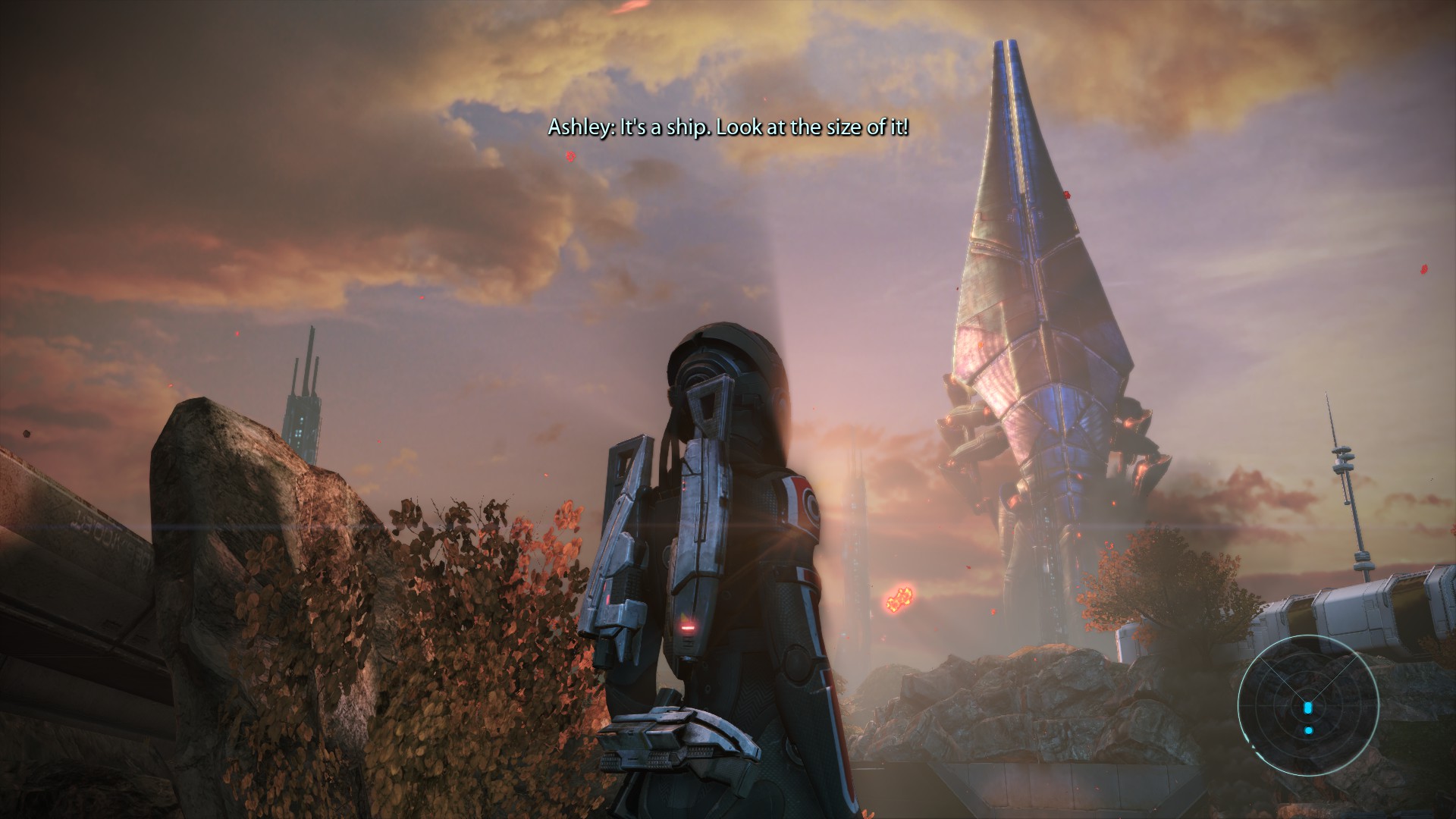
Yeah, get used to seeing these, Shepard.

If video games are about fulfilling fantasies, BioWare's Mass Effect trilogy offers one of the most compelling in the history of the medium: you are Commander Shepard, Space Adventurer. Your surname is set in stone but otherwise you can determine your Shepard's gender, appearance, abilities, sexuality and personality. You then guide your Shepard through a lengthy quest to save the galaxy, but it's up to you how you do it. You can be the ultimate hero, a paragon of honour and justice, or you can be a brutal, sarcastic antihero. Or maybe you just wing it as the fancy takes you. Depending on your deeds and words, entire civilisations will be destroyed, trusted friends may be betrayed or left for dead, and the fate of trillions of lives hang in the balance.

Most RPGs released since the trilogy have been open-world games, offering freedom in allowing you to travel across a vast landscape and mix and match quests and activities, but none have offered narrative freedom and control in this manner. You can see why, as well. It's very hard to pull off, and even BioWare themselves have shied away from trying to do it again. Their Dragon Age series has offered some of the same ideas of narrative control, but constantly changing protagonists and drastically changing locations between games has minimised the same kind of impact.

Where you command your ship from, and spend a lot of time searching for new worlds to visit in your bouncy tank.

The Mass Effect trilogy is really one immense game split into three for length and pacing reasons, and the Legendary Edition of the trilogy combines them for the first time into one cohesive package. Every bit of DLC is also included (one optional expansion for the first game excepted, which almost everyone ignored first time around anyway) and all three games have been given graphical spruce-ups and had their load times drastically improved. The first game has also had its combat revamped to better match the latter two games in the series. The result is now the best way to experience the trilogy, certainly for newcomers, and seasoned hands will find a more streamlined experience as well.

Martin Sheen plays the main human antagonist and has a blast in the process.

The trilogy's most vital feature is that you get to create your character and take them through all three games, carrying all their decisions with them to make for one epic story. The trilogy is ostensibly made up of roleplaying games, although it ends up being more of an RPG-shooter hybrid. All three games are separated into non-combat areas, where you can pick up missions, engage in dialogue and diplomacy and usually some shopping, and mission levels, which are linear maps where you usually make your way to an objective and shoot very large numbers of people along the way. The most important stuff usually happens in the non-combat zones, where you can guide Shepard through conversations using a radial dial and picking your responses. You can also gain "Paragon" and "Renegade" responses by picking kind or aggressive replies respectively. Increase your Paragon and/or Renegade scores and you can unlock special replies, which can sometimes allow you to avoid combat by defusing situations or intimidating an opponent into backing down. This is usually where you'll decide what kind of Shepard you can be, either a hero or an antihero (you can't really be a villain) or some kind of middle ground, although those trying to have their cake and eat it may find they're locked out of the special replies on both ends of the spectrum.

"Earth!?! Where are we?"

Combat sees you deploy Shepard and two companions and fight in third-person. Combat is inspired by the Gears of War series, with lots of conveniently-placed, chest-high walls to hide behind and fire off shots at the enemy. Combat in the first game is fairly forgettable, improves sharply in the second game and reaches its best in the final title. You can focus on your own fight and let AI handle your companions, or you can pause and give them orders mid-combat. The three games do handle difficulty differently, so I found that Mass Effect 2 could sometimes be challenging on Normal whilst Mass Effect 3 could occasionally feel a bit too easy even on Nightmare, so tweaking difficulty levels to find the right balance is key. However, given the important stuff happens in the dialogue scenes, combat can occasionally feel like a chore. Dropping the difficulty all the way to the easiest level makes combat trivial and allows you to get on with the story.

And it's the worldbuilding, story and characters where Mass Effect shines. Mass Effect is nothing too original - imagine 1990s SF TV classic Babylon 5 mashed up with the 2003 Battlestar Galactica and you're about 90% of the way there - but it almost gleefully mixes and matches its inspirations to create something very enjoyable, if occasionally familiar. The alien races are all memorable and have their interesting foibles and cultural tics, like the third-person-referring Hanar or grumpy space dwarf Voluses, or the Elcor, whose lack of facial expressions and monotonous voices means they have to patiently explain their current emotional state at the start of every sentence. The backstory, painting humanity as newcomers on the galactic stage who are still a bit paranoid about aliens but who are also rising fast in power and influence, angering older galactic civilisations, is also rich and interesting.

Tali, kickass space engineer and one of your best friends in the series.

The in-game story is also excellent, with you initially chasing down a rogue Spectre who has allied to a renegade race of mechanoids. The stakes get bigger and busier, and you eventually have to sacrifice a trusted friend and pull a gun on another when your relationship goes south. Eventually you discover the real threat, a Cthulhu-esque nightmare of techno-horrors from beyond the dawn of time, and have to fend off their first incursion into the galaxy with a massive space battle and a desperate battle up a burning skyscraper...and that's all in just the first game!

The story ranges far and wide across the galaxy, although players are often baffled by the turn it takes in Mass Effect 2. Trying to avoid spoilers, but suffice to say that there is a two-year gap between the events of the first two games and Shepard's warnings of the return of the Reapers have been disregarded by the Council, forcing them to join forces with a human separatist organisation with a dubious moral past but who have the massive resources needed to take the fight to a new enemy, the Collectors. The game feels like a huge side-quest from the main story arc, but it's also immaculately structured, with Shepard having to assemble a (more or less literal) Dirty Dozen of specialists in various fields, win their trust and then mount an all-out assault on the Collector home base. The brilliance of Mass Effect 2 is how closely it focuses on your relationship with the various characters: mess up your recruitment jobs and you may find some candidates will not help you, or may stab you in the back, or are so disillusioned with you that they will be killed in the final battle. Mass Effect 2 is distinctly odd when looked at in the grand context of the trilogy but it's a brilliant game in its own right.

One of the problems with facing cosmic techno-horrors from the beyond the dawn of time is that every other side-villain in the trilogy comes across as a time-wasting prat. This guy takes that to another level.

Mass Effect 3 then becomes an all-out war story, with you right in the middle of a desperate battle for survival with entire planets falling and burning, and a desperate resistance being organised against ridiculous odds. This may sound familiar, but really, Mass Effect 3 does an almost unmatched job of putting you in a ludicrously overwhelming situation and forcing you to make very tough decisions on which the fate of the galaxy will depend. It's enough to almost make you forgive the infamously divisive ending, which tries to bring the preceding ~95 hours of great storytelling to a satisfying close and can't quite manage it. It works and more or less fits the themes of the trilogy, but it also does feel like some of the unknowable mystery set up by the first game has been dissipated by lengthy exposition scenes in the third.

The Mass Effect's trilogy's ace card is its cast of characters. BioWare had superb casts of fun characters in earlier games, all the way back to Minsc and Boo in the venerable Baldur's Gate, but it was in Mass Effect where they really nailed it. Almost every character is excellently-written, superbly-acted (Mass Effect may have cumulatively the greatest voice cast and vocal performances of any video game series, ever) and given motivations and backstory that allow you to understand where they're coming from. A few characters are a bit on the bland side - Ashley, Kaidan, Vega, Jacob - and a couple don't feel like they really fit into a Paragon-based crew (Zaeed) or a Renegade-based one (about half the rest), but overall they're a great bunch. And of course Tali, Garrus, Wrex, Liara and Javik are among the best, most entertaining AI companions you could wish for in any game. There's also a few who might annoy at first or don't appear to do much, but gradually reveals themselves to be great picks (Jack, Samara, EDI, Grunt). Forging friendships or even romances with these characters, or encouraging hook-ups between their ranks, is amusing.

It's never revealed how much Shepard is paid for their troubles, but it's clearly not enough as this side-hustling advertising gig indicates.

So far, so good. But there are some issues. The first is that having all three games and their DLC in the same package creates some weird pacing problems, particularly in how you access the expansion missions. Arrival should really only be done after the final mission in Mass Effect 2 (it acts as a bridge to Mass Effect 3), but it's possible to trigger the mission a lot earlier and it fits very awkwardly into the timeline if you do that. Similarly, the Citadel expansion to Mass Effect 3 should be done as late in the game as possible to ensure you get to recruit the largest possible cast of characters from all three games for a reunion, but the lighthearted, comedic tone of the expansion fits awkwardly alongside the increasingly grimdark-AF atmosphere as the trilogy moves towards it conclusion.

There's also a lot of stuff that the games don't tell you that a newcomer should really know, like how regularly touring the ship between missions can unlock new conversations with your companion characters and open up opportunities to gain Renegade or Paragon points, or unlock new missions or "war assets" for use later on in Mass Effect 3 (Legendary Edition carries forwards more decisions from the first two games to help you in the third).

If you immediately got this Baldur's Gate reference, you are automatically a person of taste and refinement. Well done.

There's also the fact that although BioWare tinkered with how the OG Mass Effect works, they don't bring it fully in line with the other two games. Mass Effect is an RPG with a shooter combat mode, whilst Mass Effect 2 and 3 are much more shooters with RPG conversations. The difference is that Mass Effect has non-combat skills and more areas where combat and conversations mix, whilst the other two games only have very modest skill trees and much more clearly delineate their non-combat and combat areas. Mass Effect feels a bit out of keeping with the other two games and not fully integrated into how most of the series works, so the unified experience of playing all three games remains uneven (although less on this time around).

There's also the issue with minigames. Mass Effect 1 and 2 have laborious minigames for lockpicking and hacking, which are both tedious and should be dumped. Mass Effect 3 swaps them out for it simply taking a while and having to make sure nobody's shooting at you at the time. All three games also have an exploration mechanic which they handle differently. Mass Effect 1 has you driving around planets in the Mako, an inexplicably bouncy tank, looking for minerals and (very rarely) shooting bad guys. There's also identikit buildings - seriously, it's worse than Dragon Age II - you can sometimes clear out of enemies and loot. Exploring all these optional planets takes forever (literally 50% or more of Mass Effect 1's total playtime if you're going for an exhaustive run) and isn't much fun.

You will be doing this a lot.

Mass Effect 2 ups the ante with mineral scanning, which means you sit in orbit around planets and move the mouse around looking for minerals. It sounds and plays very dull, but is important to build up minerals for the final battle in the last game. Again, if you go for an exhaustive, 100% playthrough you will probably spend at least five hours accruing far more resources then you will ever need.

Mass Effect 3 has a much faster and more modest scanning game where you go looking for war assets to use against the Reapers. It's a bit more hit and miss, but it's fun to track down missing fighter squadrons or a damaged cruiser which can they rejoin the fleet for the final battle.

By the third game, even villains are stopping to tell Shepard how awesome they are before trying to kill them.

Another issue is that some storylines have not aged gracefully. Various cliches like genius autistic characters (who are then subjected to abuse and torture), wish-fulfilment hot alien space babes (some of the costume choices in the game were corny when the games came out, let alone now) and villains who are villains because villains rear their head from time to time and will make you roll your eyes as often. The games do improve immensely over this, sometimes fast enough for the third game to mock some of the decisions from the first.

Frozen Prothean soldier Javik is a very late addition to the crew (only appearing in the third game) but a superb one, with his bewildered disbelief at the state of the galaxy thanks to "primitive races" of his time being a constant source of comedy.

The biggest weakness of the trilogy is probably how it is divided into distinct "roleplaying" and "shooting" modes. The meat of the game is in the roleplaying sections and the shooting can sometimes feel rote and phoned in, a simple way of adding "more gameplay" to the series. The more hardcore RPG fan, especially those familiar with BioWare's earlier Knights of the Old Republic SF RPG, will bemoan the way tactical, squad-based combat has transformed into real-time twitch shooting. The games sometimes awkwardly move between the two modes and it can be odd seeing a Paragon Shepard extolling the value of all life and then five seconds later is gunning down forty enemies in rapid succession, gaining achievements for the number of people they massacre and set on fire. At its weakest, the trilogy can feel like a very-well written and characterised adventure game that is broken up by an shooting gallery minigame. Combat does improve across the three games, although the ability to split "run," "cover" and "use" into three different commands would make things even better.

It takes a while, but eventually Mass Effect delivers some outstanding CGI space battles.

If you've never played the Mass Effect trilogy before, then Mass Effect: Legendary Edition (****½) is an easy sell. One of the greatest video game stories ever told with one of the single finest casts of characters in video game history, with some genuine weight and consequence to your decisions. The workmanlike combat and tedious minigames can be borne for the sake of just spending time in this excellent world, and the negatives do generally clear up as the trilogy continues. If you're already a hardened Mass Effect fan, than Legendary Edition clears up some inconsistencies, puts all three games in a handy launcher, smooths out the process of carrying your character and decisions through all three titles and adds graphical and control improvements that make the experience just more enjoyable. Mass Effect: Legendary Edition is available now on PC, PlayStation and Xbox.

Thank you for reading The Wertzone. To help me provide better content, please consider contributing to my Patreon page and other funding methods.

Saturday, 7 November 2020

EA and BioWare confirm MASS EFFECT remaster for 2021 and a new game for later release

Electronic Arts have confirmed that the Mass Effect video game trilogy is getting a remaster for release in Spring 2021 and a further game in the series for later release.

Mass Effect: Legendary Edition includes all three games in the original trilogy (released in 2007, 2010 and 2012) plus all their accompanying expansions and DLC in one package. The primary change to the games will be graphically: textures, shaders, models and effects will be updated to modern standards but apparently there will not be a full "remake" of the three games. This seems to reduce the chance of the three games being brought fully into line with one another so they can be played as one seamless experience (the first Mass Effect, in particular, feels a bit clunky compared to the latter two games, which are much more streamlined).

BioWare have also confirmed that they are in early development on the "next chapter" of the Mass Effect series. It's unclear if this is a full Mass Effect 5, to follow up on the underwhelming Mass Effect: Andromeda (2017), or will be more of a spinoff. BioWare are currently working on updated content for Star Wars: The Old Republic and Anthem, as well as developing a fourth game in the Dragon Age franchise.

Mass Effect: Legendary Edition will be released in the Spring of 2021 for X-Box One and PlayStation 4, with an "enhanced" version available of PC, X-Box X and PlayStation 5. 

Tuesday, 21 November 2017

Happy 10th Anniversary to MASS EFFECT

On 20 November 2007 the video game company BioWare took one of the biggest risks in their history by releasing what was only their third original game, not one set in a pre-existing universe. The first, Jade Empire (2005), had been extremely good but had not set the world on fire. Given that BioWare had bet the farm on them moving into original, creator-owned IPs, they needed their new game to be a success. It was called Mass Effect and, rather fortunately, it was.


BioWare had been founded in Canada in 1995 by newly-graduated medical doctors Ray Muzyka, Greg Zeschuk and Augustine Yip. Using programming knowledge gained from other courses taken alongside their medical studies, they created a video game called Shattered Steel. It was published by Interplay and was a very modest success. Yip decided to return to practising medicine whilst Muzyka and Zeschuk moved into full-time development. Their second game came about during discussions with Interplay, who wanted to use the Dungeons and Dragons licence they'd just acquired (at a steal) from TSR, Inc. BioWare created a new video game engine, which they dubbed "Infinity", which blew away the team at Interplay and led to them getting the commission to make a massive fantasy roleplaying game. For a brand new studio it was a big achievement...and a huge responsibility.

Fortunately the two doctors and their rapidly expanding team were up to the job. They released Baldur's Gate in 1998 and it was an enormous success. They branched into console development with MDK2 (2000) but their hearts had been stolen by character and story-focused roleplaying games, games which emphasised character developments and even romances over magical explosions and loot. Baldur's Gate II: Shadows of Amn (2000) was an even bigger success than its forebear, whilst Interplay's in-house Black Isle Studios used the Infinity Engine to craft the excellent games Planescape: Torment (1999), Icewind Dale (2000) and Icewind Dale II (2002).

BioWare then created a new engine, the Aurora Engine, to power a new D&D roleplaying game. Neverwinter Nights (2002) was also a big success, although more for its incredibly powerful campaign-creation system allowing players to recreate the D&D experience online than the game's own, pedestrian story (the game's expansions were rather better-received). By this time BioWare had become arguably the most feted RPG design studio on the planet, so were the perfect collaborators for LucasArts, who wanted to make the first-ever Star Wars roleplaying game. The result, Knights of the Old Republic, was released in 2003 and was a huge success, one of the best RPGs of all time and possibly the finest single Star Wars video game ever made (a distinction it comfortably holds today, despite a serious challenge from Jedi Outcast and TIE Fighter).

At the very height of their success and critical acclaim, BioWare chose to give it up and begin working on their own, original titles. They encouraged their partner companies to dish the sequels out to the old Black Isle team, now rising out of the ashes of the collapsed Interplay as Obsidian Entertainment. Obsidian made the well-regarded (if buggy) Knights of the Old Republic II (2004) and Neverwinter Nights II (2007) whilst BioWare began their assault on the original IP space.

BioWare began developing three original games. The first was a martial arts roleplaying game called Jade Empire, using the Knights of the Old Republic engine. The game came out in 2005 and was an original X-Box title. It was a modest success, but not the mega-selling hit BioWare had been hoping for. They also began working on a new fantasy IP, a vast and expansive RPG using a whole new engine which would be a "spiritual successor" to Baldur's Gate. The game eventually went way over time and budget, but was ultimately released in 2009 under the name Dragon Age. Fortunately it was a big hit and went to spawn two sequels (and a third, under the working title Dragon Age IV, is currently in development).

Alongside these titles, BioWare began working on a science fiction RPG. They wanted to do something different for this game and that was to make an epic space opera in every sense of the word: a game with a deep, detailed backstory, lots of alien races and a growing menace which would eventually, over the course of three games, build into an apocalyptic threat. BioWare also really wanted to nail the things they'd always been applauded for - deep, interesting characters complete with friendships, interrelationships and even romances - but using modern 3D technology to make the characters more relateable and convincing than ever before.


Released in November 2007, Mass Effect fulfilled those goals. The player takes on the role of Commander Shepard, a resourceful military officer in the Systems Alliance (a future human government) and the first human "Spectre", a special forces agent tasked with dealing with massive threats to the Citadel, a multi-racial alliance based in a huge, ancient, alien space station. Saren Arterius, a rogue Turian Spectre, begins undertaking strange attacks against Citadel forces and Shepard is assigned to stop him, using a starship called the Normandy and a multi-ethnic crew of humans and aliens. The game ranges across a large chunk of the Milky War galaxy and, as the story developers, Shepard is forced to make a number of huge decisions with extremely far-reaching consequences. Literally, the fate of entire species is in Shepard's hands.

The game was widely praised for the customisability of the character. Shepard could be male (voiced by Marc Meer) or female (voiced by Jennifer Hale) and their physical appearance could be tweaked considerably. They could also be "good" (Paragon) or "evil" (Renegade) based on moral decisions they made throughout the game. Companion characters could be permanently killed off, along with allies and enemies (who would then go on to appear - or not - in the sequels). This led to a game with a set storyline but where the details of that story could completely change from player to player.

At the end of the game it is confirmed that Saren is working for a powerful alien race called the Reapers, a biomechanical nightmare that emerges every few millennia to wipe out advanced spacefaring races for unknown reasons. The overwhelming threat of the Reapers became the driving force behind the sequels.

Mass Effect sold well on release and was critically acclaimed, appeasing BioWare's new owners Electronic Arts (who were rather less happy with the long gestation period and enormous budget of Dragon Age, eventually mandating a low-budget, quickie sequel to help justify the cost of the first game). It was followed by Mass Effect 2 in 2010 and Mass Effect 3 in 2012. These games increased the emphasis on characterisation and story whilst refining combat (both games saw a reduction in traditional RPG gameplay elements, such as inventory management, to the ire of some fans). Mass Effect 3's release in March 2012 was highly controversial, with a badly-written ending that many fans felt was unsatisfying. BioWare released patches and DLC which reworked the ending and improved it, but it remained a dubious decision.

Despite the poorly-received ending of the third game, the Mass Effect series remains generally well-regarded. It's a big-budget, combat-focused space opera game which nevertheless emphasises relationships, dialogue and story over mass slaughter. There's a lot of good writing, moments of great humour and some canny characterisation in the trilogy, and the degree to which you can change things so entire races can be absent from later games in the series is remarkable. Mass Effect was also highly notable in that it was almost the only new space opera universe to appear on screen in the first decade of the 21st Century (The Expanse and SyFy label-mates Killjoys and Dark Matter eventually helped end that drought). The game trilogy eventually went on to sell about 20 million copies, which although not setting the world on fire (Fallout 4, for example, sold over half that in its first 24 hours on sale) is very impressive for a single-player-focused, narratively-driven game series.

Unfortunately, Mass Effect's legacy has not been enduring. The fourth Mass Effect game, Mass Effect: Andromeda was released in 2017 and faced a seriously mixed reception, with technical issues and a bland storyline. The game sold 2 million copies in its first six months on sale, which was far below EA and BioWare's expectations and led to the series being put on hiatus (despite two sequels to Andromeda being in the planning stages). BioWare are now focusing on Dragon Age IV and a whole-new IP, an action game called Anthem. Not only is the future of Mass Effect itself in doubt, EA seems to be down on the whole idea of single-player-focused games with strong stories altogether, preferring big "open world" games or multiplayer.

Although flawed, the original Mass Effect trilogy remains a compelling gaming experience and well worth a look if you haven't yet given it a try. The complete trilogy is available now for the PlayStation 3, X-Box 360, X-Box One and PC.

Thank you for reading The Wertzone. To help me provide better content, please consider contributing to my Patreon page and other funding methods, which will also get you exclusive content weeks before it goes live on my blogs. The Cities of Fantasy series is debuting on my Patreon feed and you can read it there one month before being published on the Wertzone.

Sunday, 22 March 2015

Gratuitous Lists: Best Space Battles

There are two key ingredients to the perfect space opera. The first is successfully evoking a  sensawunda: the scale of the cosmos, the ingenuity of the technological developments required to space interstellar distances and the majesty of the universe. The second is to have really, really big spaceships which, at a dramatically appropriate moment, explode.

Here is a list of what I think are the best space battles of SFF TV and film are over the years, listed in no particular order but with my favourite one at the end.


Babylon 5: The Battle of Gorash VII
Season 2, Episode 20: The Long, Twilight Struggle
Airdate: 1 August 1995


Babylon 5 was the first SF show to feature 100% CGI spaceship shots and space battles. Scepticism from more established shows (who preferred to use models, although they were more complicated, limited and expensive) was replaced by them rushing to embrace computer models after Babylon 5 pioneered the concept.

The first two seasons had many, many great space battles but the most emotionally draining one came at the climax of the Narn-Centauri War. The Centauri Republic learned that the Narn Regime was going to attack their supply depot on Gorash VII and cut their supply lines leading into Narn space, forcing a temporary stalemate. The Centauri chose to instead launch a full-scale assault on the Narn homeworld using mass drivers to propel asteroids into the planet's surface and lay it waste. The defence of Gorash VII was handled by the Centauri's redoubtable allies instead, the powerful Shadows. What made this battle more interesting was a greater use of tactics: the Narn use long-range energy mines to try to disrupt the Shadow attack and later concentrate their fire on one of the Shadow ships to cripple it (the first hint in the series that the Shadows aren't completely invulnerable). In addition to Foundation Imaging's brilliant visuals, Christopher Franke (ex-Tangerine Dream) also delivered a killer score fit for the occasion.


Babylon 5: The Battle of Babylon 5
Season 3, Episode 10: Severed Dreams
Airdate: 1 April 1996


Babylon 5 was also the first show to feature a pre-planned (if not in quite as much detail as claimed at the time) five-year story arc which had several major paradigm shifts for the concept and format built into it. The biggest of these came at almost exactly halfway through the show. Having spent a season and a half covertly investigating the murder of the Earth Alliance President, the crew of the Babylon 5 station inadvertently force his tyrannical successor to declare martial law across the Alliance. In the resulting chaos, the colonies on Mars and Proxima III break away and are subjected to retaliatory bombings and air strikes. As full-scale civil war erupts, two rebel Omega-class destroyers take refuge at Babylon 5 and are cornered by pursuing forces. The crew of B5 are finally forced to make a stand.

This was a hugely important moment for the show and it delivered in spades. Unfortunately, the above video is the only decent one I can find online and omits the ending of the battle, when newly-arrived reinforcements almost force the station to surrender but Minbari cruisers led by Ambassador Delenn force them to retreat or be destroyed (and risk plunging Earth into an interplanetary war with a race who wiped the floor with them last time).

Later seasons would also feature large-scale space battles, but they lost a little something when Foundation Imaging was controversially fired from the show at the end of the third season. Netter Digital, who replaced them, showed considerably less care and attention to details (such as the proper Newtonian movement of the ships in 3D space). As computing power increased Netter also adopted a bit of a George Lucas approach to everything, chucking in tons of ships and beams in lieu of keeping things clear and well-directed. But for the first three seasons, the space battles were very cool indeed.


Firefly: Reavers vs. the Alliance
Serenity
Release date: 22 August 2005


Firefly wasn't really a show about space battles, mainly because the series is set in the aftermath of a civil war and failed rebellion and was more about surviving when your cause is taken from you. However, Joss Whedon wisely decided to cut loose in the big-budget movie spin-off. The battle is well-directed and excellently scored, but works because the tiny Serenity (which probably couldn't survive more than a couple of direct hits from any of the Reavers or Alliance's weapons) is just try to get through the blockade to reach the broadcasting centre. This makes the battle more of a chaotic backdrop to the real tension of the scene and this works pretty well. The above video omits the horrifying climax to the battle, the scene which is definitive proof that Joss Whedon is evil.


Mass Effect: The Battle of Earth
Mass Effect 3
Release date: 6 March 2012


Most video games featuring space battles have you actually taking part in them, which is a different type of list altogether. The Mass Effect trilogy is different in that the spaceships are merely a way of getting around from place to place, with the in-game battles being set on planetary surfaces or on space stations. For the conclusion of the trilogy, however, BioWare went all-out to produce a CGI firestorm for the moment when the alliances Commander Shepherd (i.e. you) had spent three games and 60-odd hours assembling finally engages the Reapers over the surface of occupied Earth. It's nicely done, especially considering that the course of the battle varies depending on your in-game actions. Spend a lot of time carefully honing your forces and getting every upgrade possible and your fleet does a lot better. Skimp out on upgrades and maybe fail to get every faction on board, and your fleet suffers much heavier losses with different CGI shots to show this.

Great stuff. Just a shame that the actual ending to the story was less impressive and less well-thought-out. [/understatement]


Battlestar Galactica: The Battle of the Resurrection Ship
Season 2, Episode 12: Resurrection Ship, Part 2
Airdate: 13 January 2006


Battlestar Galactica used many of the tricks, skills and even same artists who worked on the CGI for Babylon 5, Star Trek and Firefly, so by the time they started work on that show they were already old hands. The result was a show that used its CG brazenly and with confidence from day one, with (more or less) Newtonian physics and the use of "more realistic" bullets and missiles rather than lasers. They also inherited Firefly's "documentary in space" feel, with crash-zooms and occasionally going out of focus.

There were some great dogfights in the first two seasons, but the quality of the battles took an upswing in this episode, when the battlestars Galactica and Pegasus team up to take down the mysterious Cylon "resurrection ship". The battle, one of the first to truly look glorious in high definition, is a backdrop to the drama as Lee Adama faces a moment of nihilistic contemplation and Admiral Cain and Commander Adama have to consider whether to proceed with their plans to kill one another or not. It's an interesting, non-triumphant way of approaching the battle with its cold cut from the preceding scene to the battle already being underway and the camera cutting away from the moment where the battlestars destroy a Cylon basestar outright (the first time they do so in a fair fight in the series).


Battlestar Galactica: The Battle of New Caprica
Season 3, Episode 4: Exodus, Part 2
Airdate: 20 October 2006


For the conclusion of its four-part "New Caprica" arc, BSG faced a problem. It had created the ultimate hostage scenario, with over 40,000 civilians trapped under Cylon occupation on the colony of New Caprica. The Galactica and Pegasus have escaped with skeleton crews and only a few of their fighter squadrons (most of the pilots still being on the ground). Our protagonists have to orchestrate a rebellion against the Cylon ground forces and engage and draw off at least two basestars in orbit whilst 40,000 civilians escape. A tall order and Admiral Adama has to come up with a badass, unexpected way of doing so. Cue the most memorable moment in the series (in any series): "All hands, brace for turbulence."


Star Trek: The Battle of the Mutara Nebula
Star Trek II: The Wrath of Khan
Release date: 4 June 1982


A strong contender for the #1 spot. Admiral Kirk on the Enterprise and Khan Noonian Singh on the captured Reliant face off for the last time. Several things make this battle work so well. There's a lumbering sense of scale with these huge ships taking time to make turns, pass, reverse course and so on. They also need to strategically manoeuvre and place themselves to get the best firing angles (Kirk gains the upper hand after Khan, more used to fighting land battles on Earth, fails to properly appreciate the 3D nature of space). It feels more strategic. Other SF shows (including later Star Trek ones) tend to make the ships feel more like nimble fighters, which isn't always appropriate. More key is the fact that the two ships are actually pretty evenly matched. In fact, the larger Enterprise is probably slightly more powerful. It requires Khan to get the drop on Kirk and put him on the back foot. This is the key point the later attempts to match this battle (most notably in Nemesis and Into Darkness) ignore, as they prefer to have the Enterprise crew go up against someone in some gonzoid massive ship of mega-death, which is simply excruciatingly dull.


Star Trek: The Next Generation: Defending the Enterprise-C
Season 3, Episode 15: Yesterday's Enterprise
Airdate: 19 February 1990

 
Given its 178-episode, seven-season run it's surprising that Star Trek: The Next Generation didn't have more space battles. There were a few battles in the Klingon Civil War and the Enterprise would occasionally have to fire on alien ships which were either ridiculously inferior or, more frequently, would have no impact, but not much more than that. The highlights were the battles against the Borg, although they tended to end with the Borg victorious which wasn't so much fun. More annoying was that the most famous battle in Star Trek's history, the Battle of Wolf 359, where forty Federation starships took on a Borg cube and were obliterated, took place off-screen. A small slice of the battle is seen in the Deep Space Nine pilot episode, Emissary, but a larger and more elaborate depiction of the battle was cut for time.

That leaves TNG's sole contribution to memorable space battles being one that happened in a parallel timeline. In this timeline, created when the Enterprise-C was flung twenty-two years forwards in time, the Federation is slowly being crushed by the Klingon Empire. Realising that the Enterprise-C can restore history to its proper place if it returns to the past, Captain Picard and the crew of the Enterprise-D have to buy time for their escape...easier said than done when three Klingon K'Vort-class battlecruisers are bearing down on them. The stage is set for a pretty impressive (for 1990) space battle, and one that gleefully takes advantage of its alternate universe setting to kill off regular characters. Sadly, the scene where Wesley Cruser is decapitated by debris (no, really) was cut at the scripting stage.
 

Star Trek: Deep Space Nine: The Defence of DS9
Season 4, Episode 1: The Way of the Warrior
Airdate: 2 October 1995


Deep Space Nine was The Next Generation's grittier and more conflict-driven spin-off, where negotiations were less assured of success and desperate phaser exchanges more commonplace. There was less potential for space battles at first, with the DS9 station being too large and powerful for single ships to attack and the crew's runabout shuttles being too small and weedy to take on larger ships, but in the second and third seasons the threat of the Dominion emerges and the station prepares for war. Ironically, it isn't the Dominion who are the first force to stage a full-scale attack on the station (that will come almost two seasons later) but the Federation's own erstwhile allies, the Klingons. Manipulated by the Dominion into attacking the Cardassians and then enraged when Sisko's crew rescues the Cardassian government and proves they aren't Dominion shapeshifters, the Klingons stage a massive assault on DS9 that doesn't entirely go to plan.


Star Trek: Deep Space Nine: Operation Return
Season 6, Episode 6: The Sacrifice of Angels
Airdate: 3 November 1997


By its sixth season DS9 was struggling to produce the effects needed to match the script needs. With full-scale war raging between the Federation/Klingon alliance and the Dominion, more episodes required effects shots featuring entire fleets of ships. Motion control was poor at producing such shots in a timely fashion (earlier episodes used toys and even drawings in the far background of such shots), so the producers finally threw their hands up and embraced CGI, even calling on the ex-Babylon 5 CGI team at Foundation Imaging to assist. Sacrifice of Angels, which depicts the Federation attempting to retake Deep Space Nine from the Dominion (who had captured it at the end of the fifth season), features the biggest space battle in Star Trek's entire history: 600 Starfleet vessels, later joined by (at least) 200 Klingon warships, mount a frontal assault on 1,200 Dominion and Cardassian ships.

Its not just the sheer size or impressive (for the time) CGI which sells the battle, it's the use of tactics. If earlier Trek battles drew on naval inspiration, this one is based on Napoleonic field engagements, with fighters used as skirmishers to break up enemy formations and allow cavalry (the heavier starships) to slip in and destroy the enemy. There's also the use of the unwieldy size of the enemy fleet, and the Federation bringing more of its heavier guns to bear against the enemy's weak spots, allowing them to gain overwhelming local superiority and threaten to trigger a rout of the entire line. It doesn't work entirely as well in three-dimensional space, but it's another battle where some thought has gone into how it works.


Star Wars: The Battle of Yavin
Episode IV: A New Hope
Release date: 25 May 1977


There's not much to say about this one, is there? In 1977 audiences were blown away by this lengthy battle sequence, inspired by WWII movies like The Battle of Britain and The Dambusters, where the X-wing and Y-wing fighters mount a desperate attack on the Death Star. It still looks good now, although the fighters are a little stiff compared to how they move around in later films and TV. But given this was all pre-CGI, it's very impressive with a great use of tension and music.

Of course, George Lucas tinkered with the battle in the 1997 special edition of the film by introducing new CGI shots. These shots stick out like a sore thumb and the ships now move around too chaotically. It also feels fairly arbitrary on when a new shot is shoved in or an old one is left out. A better argument could be made for completely redoing the whole sequence in CGI or simply leaving it alone rather than this weird, distracting hybrid version which doesn't really satisfy anyone.


And my pick for the top spot:

Star Wars: The Battle of Endor
Episode VI: Return of the Jedi
Release date: 25 May 1983


The best space battle evaaah? Quite possibly. This battle shows how much Lucasfilm learned in six years since Episode IV, with some hugely impressive shots, a lot more movement in the ships and a great variety in design. The battle features designs from the two previous films (X-wings, TIE fighters, Star Destroyers) and also new ships, such as the ever-popular A-wings, TIE interceptors and Mon Calamari Star Cruisers. The designers took a leaf out of real history here, where large-scale battles feature many different designs at work (fifteen different fighter and bomber classes took part in the Battle of Midway, for example). A shame they couldn't find a satisfying way of filming the B-wings though, who disappear after the opening shots.

There's also some good tactics here. Once the Death Star becomes operational the Rebels charge the Imperial fleet, where the Death Star can't fire without hitting their own ships. Whilst expecting to get chewed up, the Rebels actually do a great job here of blowing up Star Destroyers and taking down the Imperial flagship fairly comfortably (a lucky A-wing kamikaze notwithstanding).

The battle is also completely filmed with motion-controlled models with no CGI whatsoever, which is jaw-dropping. And it's also insanely quotable thanks to the presence of Admiral Ackbar, the most grizzled alien fish-man space admiral in history.


Thursday, 7 February 2013

RIP Robin Sachs

Sadly, the news has broken that veteran actor Robin Sachs passed away last week at the age of 61.

 As Ethan Rayne on Buffy the Vampire Slayer.


Sachs is known for bringing his distinctive gravelley voice to numerous science fiction and fantasy roles on TV and film. He is best-known for his portrayal of Ethan Rayne, arch-enemy of Rupert Giles, in four episodes of Buffy the Vampire Slayer. He also had multiple appearances on Babylon 5, in which he played two roles, although, confusingly, each role had two names. He played the role of Hedronn, a member of the Minbari Grey Council, in two episodes and the TV movie In the Beginning. In the latter his character was inexplicably renamed Caplann. He also appeared as the Narn captain (and later general) Na'Kal in four episodes of the show, with the character now being called Na'Tok in his latter two appearances. Sachs is the latest in a surprisingly large number of actors who worked on Babylon 5 to pass away before his time.

Playing both a Minbari and a Narn on Babylon 5.


Also under heavy prosthetics, he played General Sarris in the 1999 SF spoof movie Galaxy Quest and General Valen in Star Trek: Voyager (in the episode The Void). In more recent years he has become known for voicing roles in computer games, playing multiple roles in Dragon Age 2 and voicing the popular character Zaeed Massani in Mass Effect 2 and 3. His last role was voicing the character of Ataman in the recent Resident Evil CG movie, Damnation.

Saturday, 2 February 2013

Mass Effect 3: Leviathan and Omega

When Mass Effect 3 was released a year ago, it was known that the game would be expanded by the arrival of extra missions via DLC (downloadable content). Because the game's (highly controversial) ending made any more missions set after the game nonsensical, these DLC episodes take place earlier during the game's timeframe, and can be accessed via the save the game automatically generates when you finish it (to just before the assault on the Cerberus base).


The first of the two story-driven DLCs to appear so far is Leviathan. This episode picks up on a dangling plot thread from Mass Effect 2, where it was revealed that a Reaper named the Leviathan of Dis had been destroyed by an unknown force of tremendous power. In the DLC Commander Shepard is contacted by a scientist who has discovered what killed Leviathan, but is killed himself before he can impart that knowledge. Shepard has to follow the scientist's trail of research to discover the location of Leviathan's killer, and whether it can be employed to help in the war against the Reapers.

Gameplay-wise, Leviathan is split into two distinct sections. The first section is set in the scientist's lab and sees Shepard investigating artifacts and computer logs to piece together a fuller picture of what happened. Several excursions via the Normandy to alien planets follow, with traditional combat missions (and one creepy mission dealing with a base full of indoctrinated scientists) leading to the discovery of more clues. The DLC concludes with an underwater showdown between Shepard and Leviathan's enemy, which is a bit cheesy and mainly seems to serve as a bit of retconned foreshadowing for the end of Mass Effect 3 proper (and as such may be enjoyed more by people playing through the game for the first time with all the DLC pre-installed).

Leviathan is, from a gameplay perspective, lightweight but from a lore and story POV, a bit more interesting than expected. There's some major backstory revelations about the Reapers and some very good character-building for EDI, who gets to play a big role in the investigation sections.


The more eagerly-awaited of the two DLCs was Omega, which picks up on another plot thread left dangling from Mass Effect 3 proper. In that game it was revealed that Cerberus had taken control of Omega, the 'hive of scum and villainy' that you spent some time on in Mass Effect 2. Omega's crimelord boss, Aria T'Loak, was unimpressed by this move and spent most of Mass Effect 3 trying to build up a coalition of forces to retake Omega. In the DLC she succeeds, and employs Shepard (and just Shepard; none of the rest of the Normandy crew can take part) to help out.

Omega is a long series of combat missions, undertaken with Aria T'Loak and a new character called Nyreen Kandros, the first female turian encountered in the series. The absence of most of the regular Mass Effect cast and the inability to choose your own squad for the combat missions is grating, but the game is able to turn this to its advantage by focusing on the characters of Aria and Nyreen and developing a complex backstory between them. The DLC is interesting in that it's one of the few chunks of the Mass Effect universe where Shepard is more of an observer of events rather than the crucible around which they revolve, and is more interesting for that. The DLC also features a better-than-average villain in the form of General Petrovsky, a Cerberus officer who is unusually sensible and logical for a bad guy. Arguably the DLC's real triumph is in allowing Aria (one of the most unrepentantly amoral characters in the whole series) to soften a little under Shepard's influence without destroying the character, and doing so through some via good characterisation related to the new character of Nyreen. It's a subtle element that's rather under-developed given the combat-oriented nature of the DLC, but one that gives the episode more depth that it first appears.

Both DLCs (***½ each) are playable, fun and feature some lore and background revelations that enhance the enjoyment of the Mass Effect universe. However, they are also rather short (2-3 hours each) and the degree to which players smarting from the mishandling of the ending of Mass Effect 3 proper will want to play them is debatable. They are available now on the X-Box 360, PlayStation 3 and PC.

Monday, 31 December 2012

The Wertzone Awards 2012

Once more unto the breach!


Best Novels


1. Existence by David Brin
David Brin returns after a long absence with a sweeping, state-of-the-nation take on what our lives may be like in the mid-21st Century. Strong characters and a thorough exploration of scientific and technological ideas combine for my strongest book of the year.

2. Dark Eden by Chris Beckett
Beckett's second novel is difficult to describe, being a piece built more around mood and atmosphere than plot. It's the story of the descendants of an ancient starship crash who discover more about the world around them and their true history, and thus about themselves.

3. Kings of Morning by Paul Kearney
Kearney conclude his exploration of Greek and Persian history through the lens of fantasy with aplomb, with flawed characters finding their destinies against the backdrop of war.

4. Railsea by China Mieville
A vast world consisting of oceans of rails, with immense trains ploughing across them. A crazed and whimsical echo of Moby Dick, but with awesome monsters and concepts straight from Mieville's weird imagination. Also incidental winner of the Biggest Mole Monster in SFF Award 2012.

5. Forge of Darkness by Steven Erikson
Erikson steps back from the immense complexity of his Malazan sequence to deliver a (relatively) straightforward prequel. Freed from the weight of backstory, Forge of Darkness is Erikson's finest fantasy novel in a decade.

6. 2312 by Kim Stanley Robinson
Like Brin, Robinson also undertakes a thorough exploration of what humanity may be like in the future, this time 300 years hence. His effort is larger-scaled, taking in the entire Solar system, but fails compared to Brin due to an undercooked political thriller subplot. Still, a visionary work.

7. Red Country by Joe Abercrombie
A bonkers mashup of Al Swearengen, Rockstar Games and Clint Eastwood, this is a fantasy war western on an epic scale. With Abercrombie's trademark black humour and cynical characters, the story is traditionally bloody, brutal and conspicuously lacking in banjos.

8. Sharps by K.J. Parker
Parker's latest novel veers away from her(?) recent novels in being based around an ensemble cast rather than a single individual. It's also hilarious, with the characters being in the middle of a traditional epic fantasy backdrop but without a clue what's going on.

9. The King's Blood by Daniel Abraham
After the good-but-underwhelming Dragon's Path, Abraham's Dagger and the Coin series explodes more readily into life with this second volume. It's a more coherent and focused work than the first novel, consolidating Abraham's position as one of our most promising (relatively) new fantasy writers.

10. The Killing Moon by N.K. Jemisin
Jemisin's epic fantasy by way of Egyptian history and mythology is a bit of a slow-burner, but a smart and intriguing book.

Bubbling under: Blood and Bone by Ian Cameron Esslemont, Great North Road by Peter F. Hamilton, The Dirty Streets of Heaven by Tad Williams, The Twelve by Justin Cronin, Blue Remembered Earth by Alastair Reynolds, Orb Sceptre Throne by Ian Cameron Esslemont, The Iron Wyrm Affair by Lilith Saintcrow, Caliban's War by James S.A. Corey, The Middle Kingdom by David Wingrove, Ice and Fire by David Wingrove, Crown of Embers by Rae Carson.


The Wertzone SFF Comeback Award 2012


After a decade being mildly snarky about the Star Wars prequels (among a few other things), Brin returns with his most epic and impressive novel to date. Nicely done.


The Wertzone Award for Best Book Read in 2012 Regardless of Release Date


A book that manages to pack more story, character and thematic exploration into its low page count than some authors manage in entire trilogies. Intelligent and thought-provoking. Next year for the hat-trick?


Best Games


1. XCOM
Firaxis's resurrection of a twenty-year-old classic is a resounding success. Eminently replayable with a fiendish, "Just one more go!" feel, XCOM is a fitting tribute to the original game and a thoroughly compelling game in its own right.

2. Dishonored
Darkly atmospheric with an unusual setting and a laudable focus on stealth and intelligence over mindless slaughter, playing Dishonored is a rich (but often stressful) experience with a strong element of replayability to it as you attempt to get that perfect 'undetected' pass of a level.

3. Far Cry 3
As bonkers freeform shooters go, they don't get much more bonkers or more successfully freeform than Far Cry 3. A fantastic sense of setting and place with sublime combat overcomes some early makework problems in the early game. Plus the only game on this list where you can blow up a crocodile with a landmine, and is that not what humanity has striven for since first we looked at the stars?

4. The Walking Dead
A zombie game where the zombies are incidental, serving only as the vehicle which fleshes out character and plot. And with this game (based on being halfway through), Telltale have delivered their best characters and most compelling plot so far, not to mention the finest take on The Walking Dead franchise in any medium to date. Full review forthcoming.

5. Alan Wake (PC Edition)
An older, under-appreciated game on console is brought back to life on PC with jaw-dropping graphics and a sense of atmosphere that is staggering, not to mention some hilarious observations on the life of a 'struggling writer'. The PC version includes the two expansions and is an absorbing game.

6. Black Mesa
A bunch of unpaid fans spend eight years updating the greatest first-person shooter of all time (Half-Life) with modern graphics and production values. Frankly better than almost all of the actual original first-person shooters professionally released this year. Worth it just for the Chuckle Brothers reference.

7. Mass Effect 3
It's been a surprisingly thin year for roleplaying games, but Mass Effect 3 nearly makes up for it by itself. With a thorough exploration of consequence and hopelessness, set against a backdrop of smart characterisation and a soundtrack to die for, this could have been a contender for game of the year...at least before a series of titanic logic failures leads to the single most controversial ending of any popular franchise in the last ten years. The Leviathan and 'Extended Cut' DLCs help repair the damage somewhat, but it's not quite enough to overcome the disbelief. Still, the other 95% of the game is awesome.

8. Max Payne 3
Rockstar were always going to have to work hard to convince fans of one of the finest action games of all time that they were suited to take over the franchise, and in isolated, brilliant moments Max Payne 3 succeeds. In others it disappoints, particularly the game's reluctance to actually let you play it (with frequent, unskippable and tedious five-minute cut scenes). The breathless action sequences and stunning soundtrack go some way to repairing the damage, however.

9. Game of Thrones: The RPG
Awful graphics and dubious combat do not for a good RPG make. However, the awesome characters and a series of plot twists that even GRRM may have considered too shocking elevate this game above its problems to become something really interesting. And, based on the dozen hours I've pumped into it so far, frankly better than Dragon Age: Origins.

10. Alan Wake's American Nightmare
Remedy's quasi-sequel to the excellent Alan Wake has some terrific ideas floating below the surface, but ultimately proves too repetitive to withstand comparison with its older, more impressive sibling.


Best TV Series


1. Game of Thrones
The second season may have been more disappointing than the first, but it was still the television highlight of the year. Peter Dinklage's performance is even stronger this year than in the first, and more screen time for Charles Dance is always a good thing (though skirting the edges of being too much of a good thing). Some of the more tedious aspects ("Ships! Dragons! Ships! Dragons!") are more than outweighed by the outstanding episode Blackwater.

2. The Walking Dead
The second season of this show was probably best first-experienced on Blu-Ray, with the endless wanderings through the forest looking for missing characters getting a bit old by mid-season. But a renewed focus on character relationships and the deteriorating mental state of the redoubtable Shane (along with the occasional zombie massacre scene) do prove ultimately worthwhile.

3. Merlin
The final season of what started as a light-hearted kid's show proves to be unexpectedly dark, with multiple character deaths and a surprising adherence to the original legend's brutal conclusion. Well-acted and thoroughly enjoyable. If only the whole series had been like this.

4. Doctor Who
A switch to more stand-alone episodes after last year's over-convoluted arc proves to be a success, allowing the show to return to its roots as an enjoyable slice of SF hokum. The arrival of mysterious new companion Clara 'Kenny' Oswald, played with infectious enthusiasm by Jenna-Louise Coleman, has also helped revive the show following the exhaustion of Rory and Amy's storylines.

5. Red Dwarf
Given the damage wreaked on the Red Dwarf name by its seventh and eighth seasons (and the horrendous Back to Earth special of a few years ago, now retconned as the ninth season), expectations were accordingly low for this new season. The cast overcome the issues of age to continue to deliver fine performances with some of the best scripts the show has had in twenty years. Whilst there's still lots of misfires, this latest return for the show is worthwhile.


6. Battlestar Galactica: Blood and Chrome
This pilot for an aborted Battlestar Galactica spin-off tries to make up for the problems of Caprica - being too talky and lacking action - but goes way too far in the opposite direction. Dubious characters and workmanlike performances are held up by some remarkable CGI, but ultimately it's for the best the show wasn't picked up.


Best Film


1. Ted
The touching and beautiful story of a young boy and his magical bear who comes to life. Later they take drugs together and meet Sam Jones from the 1980s Flash Gordon movie whilst Patrick Stewart berates Brandon Routh for making Superman Returns in narrative voiceover. Frankly, no other film this year was as much fun.

2. The Dark Knight Rises
Better than The Dark Knight (note: I am well aware that I am the only person on Earth who thinks this), this third movie in the series is a satisfying conclusion to Christopher Nolan's grimdark interpretation of the Dark Knight. As usual, Michael Caine is the best thing in it but is given a run for his money by Anne Hathaway's unexpectedly excellent Catwoman and Tom Hardy's evil Bane (despite sounding like he's sucking in helium whilst at the bottom of well).

3. The Hobbit: An Unexpected Journey
Whilst the overall wisdom of extending a very short novel into a nine-hour trilogy remains to be seen, this first installment works thanks to excellent performances by Martin Freeman, Ian McKellan, Andy Serkis and Richard Armitage and the decision to flesh out the dwarves and their backstory much more than Tolkien did. Also the winner of the Best Hedgehog Scene of 2012 Award.

4. Cabin in the Woods
Joss Whedon and Drew Goddard's metatextual examination of the horror movie genre risks tremendous smugness in its own cleverness but just about gets away with it with a darkly effective premise. Jet-black humour and a ruthlessness in dispatching major characters combine with inventive methods of murder and misdirection to create something very interesting.

5. The Avengers
Joss Whedon almost loses control of this vast behemoth of a movie several times, but just about reigns it in. The movie risks overwhelming the audience with explosions and action, but an undercurrent of humour and some great character moments (mostly involving Mark Ruffalo and Scarlett Johansson) save the film from total Baydom and instead render it nosily enjoyable.

7. The Hunger Games
Suzanne Collins's slightly underwhelming novel is transformed into an enjoyable film, even if it adheres too much to the books in not giving the characters real moral issues to address. Still, great performances from Jennifer Lawrence and Donald Sutherland bode well for the sequels.
7. The Woman in Black
Daniel Radcliffe shakes off the Ghost of Potter to deliver a fine performance in this adaptation of Suzanne Hill's novel. Some standard horror techniques are over-used, but the film delivers an atmospheric experience.

8. Prometheus
Ridley Scott's Alien quasi-prequel features some superb acting, stunning set design and phenomenal set-pieces, but sacrifices too much logic and intelligence to achieve it. A visually impressive cinematic experience, but ultimately a hollow one. However, it does confirm the long-held belief that Everything is Better With Idris Elba.


The Wertzone Missing in Action 2012 Award


At the start of the year it seemed very possibly - even likely - that Valve was on the cusp of officially announcing Half-Life 3. That didn't happen, though head of Valve Gabe Newell did confirm that they are at least working on it, and we can expect it to appear some time between now and the heat death of the universe.


The Wertzone Award for Special Achievements in Seriously, Dude, What the Hell?


Tie.